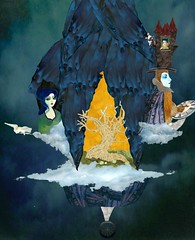
As I began painting this creature, caught in the midst of transformation, first in her shamanic dress with her guiding creatures-- in the process of developing their own feathers--I came upon the book The Spell of the Sensuous and began exploring the idea that the tale of the Loss of Eden may be one of the human desire to transcend the environment, in the process losing the ability to listen to and respond to--communicate with--the environment. That painting was a gift, and so I made maquettes of the creatures to keep me company as I thought about those ideas, and in the process of putting them together, she gained some deer-like aspects and full-blown wings. In this painting, I wanted to emphasize that the environment is not separate from her, that the whole painting is one being, there is a whole, and this is just the view I have of it right now.
As I worked on it, I discovered the book Deep: Freediving, Renegade Science, and What the Ocean Tells Us about Ourselves, by James Nestor, and learned of a whole realm of language humans know nothing about and are only now trying to study, the language of cetaceans:
“Sperm whales produce four distinct vocalization patterns: normal clicks, for tracking down prey at distances of more than a mile; creaks, which sound, despite their name, like machine-gun fire, for homing in on close-range prey; codas, the patterns used during social interactions; and slow clicks, which no one quite understands. One theory is that bulls use slow clicks to attract females and scare off other males. The clicks are very similar to dolphin clicks but more complex.
Coda clicks, the focus of Schnöller’s work, are used only during socializing and are significantly different from clicks used to aid perception and navigation. They sound unremarkable to the human ear—something like the tack-tack-tack of marbles dropped on a wood table. But when the clicks are slowed down and viewed as a sound wave on a spectrogram, each reveals an incredibly complex collection of shorter clicks inside it.
Inside those shorter clicks are even shorter clicks, and so on. The more closely Schnöller focused in on a click, the more detailed it became, unfolding on his computer screen like a Russian nesting doll.
An average click lasts anywhere from twenty-four milliseconds (thousandths of a second) to seventy-two milliseconds. Inside these clicks are a series of microclicks, which themselves are separated by microseconds, and so on. All these tiny clicks inside the coda are transmitted at very specific and distinct frequencies. There could be even shorter, organized click patterns within these microclicks, but Schnöller’s machines—which record at 96,000 Hz, the highest speed available on most modern audio equipment—aren’t fast enough to process them.
Schnöller tells me that sperm whales can replicate these clicks down to the exact millisecond and frequency, over and over again. They can also control the millisecond-long intervals inside the clicks and reorganize them into different structures, in the same way a composer might revise a scale of notes in a piano concerto. But sperm whales can make elaborate revisions to their click patterns, then play them back in the space of a few thousandths of a second.
‘When you think about it, human language is very inefficient, it is very prone to errors,’ Schnöller says. Humans use phonemes—basic units of sound, like kah, puh, ah, tee—to create words, sentences, and, ultimately, meaning. (English has about forty-two phonemes, which speakers shuffle around to create tens of thousands of words.) While we can usually convey phonemes clearly enough for others to understand them, we can never fully replicate them the same way each time we speak. The frequency, volume, and clarity of the voice shifts constantly, so that the same word uttered twice in a row by the same person will usually sound discernibly different, and will always show clear differences on a spectrogram. Comprehension in human language is based on proximity: If you enunciate clearly enough, another speaker of the same language will understand you; if you bungle too many vowels and consonants, or even pronunciation (think of French or a tonal Asian language), then communication is lost. Schnöller’s research suggests that sperm whales don’t have this problem.”
Sperm whales are apparently the loudest animals on Earth--as far as we know--and if they want to yell, their clicks will out-perform 2,000 pounds of TNT exploding about 60 meters away. That maximum sound, 236 decibels, is just 4 decibels away from boiling the water around them into vapor, and is already too loud for air, where it can’t be heard. These whales have huge brains, with very developed auditory processors and a neocortex (that higher-level functioning section humans are so proud of) about six times larger than ours. And, “in 2006, researchers at New York City’s Mount Sinai School of Medicine discovered that sperm whales had spindle cells, the long and highly developed brain structures that neurologists associate with speech and feelings of compassion, love, suffering, and intuition—those things that make humans human. Sperm whales not only have spindle cells, but have them in far greater concentration than humans do.”
So it would seem that they might be able to tell us something, if we were able to go down into the water with them, where it’s possible to hear them, and then focus our hearing processes a lot more so we could catch all those microclicks. Then, of course, would come the process of translation.
Dolphins also use this clicking form of communication, and it was in reading about them that I was really knocked over, that I was really reminded of how Abrams had so carefully tied magic together with the ability to shift one’s perspective “sideways,” into another life-form. Like sperm whales, dolphins also use the clicking sounds as a sonar, via a melon beneath their lower jaw, which is covered in data points--thousands compared to our two ears. With the information gained, a dolphin can ‘see’ a shape up to six miles away, or a foot underneath the sand. And not just through sand, but through skin--this sonar process would allow a dolphin swimming next to you to look into your brains and heart. Some researchers, like Fabrice Schnöller, are starting to think that it’s not just that the dolphins can construct sonographic images via sound, but that they can actually share those images with each other, via holographic communication: “This nonverbal form of communication allows cetaceans to share fully rendered three-dimensional images with other cetaceans, the same way you might snap a photograph on your smartphone and send it to a friend. Schnöller believes cetaceans can share what they’re thinking and seeing with one another without ever opening their ears, or their eyes.”
So, in this method of communication, in this form of language, we have several “magical”, “superhero” abilities: X-ray vision, incredible distance vision, and telepathy. Not to mention any questions about whether those holographic images are creations of group belief--that is, worlds-- that the dolphins swim into together, meaning, maybe they are creating their “Dreamtime” as they click.
You might be thinking, well, but humans don’t have a melon with a thousand points of data-retrieval, so, you know, too bad.
But you know better, right?
In the book, Nestor interviews Brian Bushway, a former student of and current colleague of Daniel Kish, who founded World Access for the Blind. Brian, who has been blind since he was fourteen, can be seen here as an adult, riding his mountain bike and teaching other blind people move around using echolocation:
I first read about Daniel Kish in an article for Men’s Journal by Michael Finkel, which I also recommend reading in its entirety, where Finkel describes Kish’s abilities and his clicks, and shares part of his own brief lessons in echolocation:
“He is so accomplished at echolocation that he's able to pedal his mountain bike through streets heavy with traffic and on precipitous dirt trails. He climbs trees. He camps out, by himself, deep in the wilderness. He's lived for weeks at a time in a tiny cabin a two-mile hike from the nearest road. He travels around the globe. He's a skilled cook, an avid swimmer, a fluid dance partner. Essentially, though in a way that is unfamiliar to nearly any other human being, Kish can see.
[...]
“I listen as Kish opens a cabinet and rummages amid his pots. He returns and stands behind me. "Make a click," he says.
It's a terrible click, a sloppy click; what Kish calls a "clucky click." Kish's click is a thing of beauty – he snaps the tip of his tongue briefly and firmly against the roof of his mouth, creating a momentary vacuum that pops upon release, a sound very much like pushing the igniter on a gas stove. A team of Spanish scientists recently studied Kish's click and deemed it acoustically ideal for capturing echoes. A machine, they wrote, could do no better.
My click will work for now. Kish tells me that he's holding a large glass lid, the top to a Crock-Pot, a few inches in front of me. "Click again," he says. There's a distinct echo, a smearing of sound as if I'm standing in my shower. "Now click," he says. The echo's gone. "I've lifted it up. Can you tell?"
I can, quite clearly. "Click again," he instructs. "Where is it?" I click; there's no echo.
"It's still lifted," I say.
"Try again," says Kish. "But move your head, listen to your environment."
I turn my head to the right and click. Nothing. Then I click to the left. Bingo. "It's over here," I say, tilting my head in the direction of the lid.
"Exactly," says Kish. "Now let's try it with a pillow."
If you look at the chart below, created by Abstruse Goose, you’ll see that both our sight and our hearing make us aware of a woefully small amount of the information available in our environment. But Finkel points out that if we translated the amount of light variety we can pick up into sound terminology, we would say we can see “less than one octave of frequency.” We hear much ‘better’ than we see, much more.

“Kish does not go around clicking like a madman. He uses his click sparingly and, depending on his location, varies the volume. When he's outside, he'll throw a loud click. In good conditions, he can hear a building 1,000 feet away, a tree from 30 feet, a person from six feet. Up close, he can echolocate a one-inch diameter pole. He can tell the difference between a pickup truck, a passenger car, and an SUV. He can locate trail signs in the forest, then run his finger across the engraved letters and determine which path to take. Every house, he explains, has its own acoustic signature.
He can hear the variation between a wall and a bush and a chain-link fence. Bounce a tennis ball off a wall, Kish says, then off a bush. Different response. So too with sound. Given a bit of time, he can echolocate something as small as a golf ball. Sometimes, in a parking garage, he can echolocate the exit faster than a sighted person can find it.
[...]
Kish hears the sonic reflections from his click even in a place teeming with ambient noise. ‘It's like recognizing a familiar voice in a crowd,’ he says. The load upon his mind is undoubtedly immense. Yet he casually processes everything, constructing and memorizing a mental map of his route, all while maintaining an intricate conversation with me. It's so extraordinary that it seems to border on the magical.”
There we are again, with that word.




 Posts
Posts