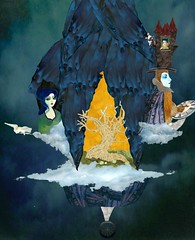
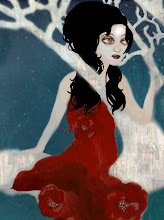
member of:Observers of the Interdependence of Domestic Objects and Their Influence on Everyday Life


This group has been active for a long time and has already made some remarkable assertions which render life simpler from the practical point of view. For example, I move a pot of green color five centimeters to the right, I push in the thumbtack beside the comb and if Mr. A (another adherent like me) at this moment puts his volume about bee-keeping beside a pattern for cutting out vests, I am sure to meet on the sidewalk of the avenida Madero a woman who intrigues me and whose origin and address I never could have known...
--Remedios Varo


(Slideshow is of Artwork by Remedios Varo)
By believing passionately in something that still does not exist, we create it. The nonexistent is whatever we have not sufficiently desired.
--Franz Kafka

Showing posts with label perception and reality. Show all posts

Friday, May 30, 2014

Theodora and the Birds Part II

Maquettes created in the style taught by Clive Hicks-Jenkins for compositional study.
may my heart always be open to little
birds who are the secrets of living
whatever they sing is better than to know
and if men should not hear them men are old

may my mind stroll about hungry
and fearless and thirsty and supple
and even if it’s sunday may i be wrong
for whenever men are right they are not young

and may myself do nothing usefully
and love yourself so more than truly
there’s never been quite such a fool who could fail
pulling all the sky over him with one smile

–E.E. Cummings


In my previous post on fungi, I quoted David Abrams’ suggestion that shamans go about trying to expand their knowledge past what their specifically human senses can teach them by binding their perception, and then their nervous systems, to those of another animal--by learning to experience the world as that other animal, and thus obtain information otherwise hidden from them. In Becoming Animal, Abrams suggests that a big part of what we could learn from any animal would be to listen to the whole of our bodies, to even allow the information coming in through our skin and ears and noses and eyes to overwhelm and silence the voice in our heads with whom we usually spend our days.

“Never having separated their sentience from their sensate bodies—having little reason to sequester their intelligence in a separate region of their skull where it might dialogue steadily with itself—many undomesticated animals, when awake, move in a fairly constant dialogue not with themselves but with their surroundings. Here it is not an isolated mind but rather the sensate, muscled body itself that is doing the thinking, its diverse senses and its flexing limbs playing off one another as it feels out fresh solutions to problems posed, adjusting old habits (and ancestral patterns) to present circumstances.
This kind of distributed sentience, this intelligence in the limbs, is especially keen in birds of flight. Unlike most creatures of the ground, who must traverse an opaque surface of only two-plus dimensions as we make our way through the world, a soaring bird continually adjusts minute muscles in its wings to navigate an omnidimensional plenum of currents and interference patterns that alter from moment to moment—an unseeable flux compounded of gusting winds and whirling eddies, of blasts and updrafts and sudden calms, of storm fronts, temperature gradients, and countless other temperamental vectors and flows that may invisibly and at any moment impinge upon your feathered trajectory—whether from in front or above or below, shoving you from one side or the other or from several directions all at once. Flying is an uninterrupted improvisation with an unseen and wildly metamorphic partner.”

Many animals in the world’s forest will keep a keen attention to the songs and silences of the birds, using them to locate any change--dangerous or not-- in the forest’s activities, such as the arrival of a human, or a fox, or the approach of a storm, all information that can be gathered from the bird’s unique access to the sounds and scents on the breeze, to changes in its eddies and flows, and also to their brilliant perspective allowed by quick access to great heights.

So it was that Abrams’ studies with a particular Shaman in Nepal, Sonam, focused on developing a relationship with a bird: the raven. His studies, however, began slowly, and the methods recall the idea explored in my first St. Theodora post, of the story of our loss of Eden perhaps actually being one about our new focus on transcending the landscape around us and being above it; our loss, therefore, of the ability to feel the garden or paradise, and to understand the language of its parts--a loss which left us bereft, and very much alone. So Sonam first had Abrams focus his eyes on a rock, for hours at a time. Then he had him focus on a point just inside the rock, then on a point in the air somewhere between himself and the rock. Then he asked him to focus his eyes and his ears on that point in the air between himself and the rock. Each request provoked some new difficulty, as you can imagine, and took focus, and time, to accomplish.
During all this time, Abrams’ understanding of his senses and how they communicate with each other and deepen each other was developing, as was his sense of the rock, and also the air. He says:

“The strangest thing about my time with Sonam and his wife, Jangmu, was how deeply I came home to myself during those days and nights. Rather than sampling alien practices and exploring beliefs entirely new to me, it was the quality of my own felt experience that became ever more fascinating, the carnal thickness underlying even my most ephemeral daydreams. From that first evening in their house, I found myself noticing ordinary, physical sensations much more vividly than I had realized was possible. As though something in my hosts’ way of moving somehow untied and dispersed all my abstract reflections. The churning of words within my head simply fell silent when I was anywhere around Sonam, freeing my awareness to witness the unique intensities of particular textures, smells, and sounds as these registered along my skin or in the depths of my viscera. Their home, with its stone walls, had a palpable density that hunkered close as I slept on the mud-caked floor across from Sonam and Jangmu, and when I awoke in the mornings I seemed to emerge from my private dreams into the wider dreaming of this breathing house nested within the broad imagination of the bouldered hillside.
[...]
And herein was the strangeness: the more my consciousness sank into the muscled thickness of my animal flesh, the more I could feel the tangible earth around me swell and breathe and move within itself—trees, riverbanks, and boulders quietly responding to all the happenings in their vicinity.[...] As though by dissolving my detached cogitations into the sensory curiosity of my body, I had slipped into alignment with the sentience of the land itself. Awakening as this upright, wide-eyed, smooth-skinned thing, I noticed that all the other things around me were also awake.
[...]Hence I began to feel far more palpably present, and real, to the rocks and the shadowed cliffs than I’d felt before. I felt that I was known to these mountains now. This experience—this awareness of my elemental, thingly presence to the tangible things that surround me—has remained, for me, the purest hallmark of magic, the very signature of its uttermost reality. Magic doesn’t sweep you away; it gathers you up into the body of the present moment so thoroughly that all your explanations fall away: the ordinary, in all its plain and simple outrageousness, begins to shine—to become luminously, impossibly so. Every facet of the world is awake, and you within it. The deeper I slid into the material density of the real, the more I found that there was nothing determinate or predictable about existence. Actuality, this inexhaustible mystery, cannot be domesticated. It is wildness incarnate. Reality shapeshifts.”

Maquettes made by Zoe Blue

Maquettes made by Zoe Blue

This segment of his book struck me as so completely in tune with the process Katharine Butler Hathaway described, in her memoirs, as a method of releasing herself from the monstrous grip of terrors and self-destructive beliefs both as she lay strapped tight to her board, day in and day out, for those ten years of her childhood, and as she tried to develop as an adult afterwards, with the physical and emotional difficulties caused by her disfigurement. She would focus on some ordinary thing around her-- a chair, a door, a table-- focus on it, not as a superior being but in appreciation, until she began to see what an amazing object it really was, until she began to feel the object’s uniqueness, it’s aliveness. And from that feeling, she was able to realize a certain magic to all parts of the universe, and it became apparent to her--it became overwhelmingly clear--that all kinds of things were possible, that all kinds of amazing possibilities lay in front of her. And she went about them. It is true, what Abrams says. Reality shapeshifts. Nothing is determinate or predictable about existence--it’s only when your awareness barely skips over what’s around it that things seem so solid, unchangeable, and pre-ordained.

Nothing is even determinate about your own body. As his studies progressed from rock to air to raven, as he began to learn the dancing motions of the bird, and the feeling between its shoulder blades brought to him by his prolonged exercises of attention, he became able to experience things very differently. He developed his focus on the bird to the extent that Sonam finally came to him with a new request: to bring his tactile sense--his full bodily sense--into the exercise. He wanted him to focus his entire body to the place where his two eyes converged onto the body of the raven.

He explained this by talking about the fire in the hearth and the water in a small nearby brook. He wanted Abrams to look not only with his eyes, and he wasn’t asking him to reach out his hand touch the fire or the water; he wanted him to feel himself as the fire, to feel the heat building in his chest, radiating outward, to feel the easing of his muscles and the cooling of his organs with the fluid motion of the water. What he wanted Abrams to do was to approach that shamanic magic of entering the bird’s body.

“After several days of exasperated effort spent on the baffling task set for me, the fruition arrived unexpectedly, when I’d given up for the afternoon and was making my way back toward the hut. A couple hundred yards along the trail I came upon a raven crossing the dirt to peck at the corpse of a small rodent. As the bird leaned forward, I felt something inside me tip forward as well, and lost my balance for a moment. I regained my equilibrium as the bird kept pecking at the carcass, but now couldn’t help noticing a sensation in my neck every time the raven reached its beak toward the ground. After a few tries, the bird succeeded in loosening a large morsel from the remains, and swooped up onto a shelf of rock with the gore in its beak; as it did so I felt a sudden weightlessness in my chest which abated as the raven settled onto the ledge. Had I really felt that? Yes!!! I knew immediately that this was what Sonam had been nudging me toward. The sensations were subtle, but unmistakable. As if the bird outside me had somehow awakened an analogue of itself inside my own muscles. Or, rather, as if the raven were not only pulling apart that bit of blood and meat out there on the rock ledge, but was also doing so in here, within my own organism.”

After some practice, he became more able to feel most of the things he saw with his eyes, so that he was able to experience the gentle motions of a field of flowers in the breeze or the weight of a heavy load carried by a child, or even sensations related to particular types of clouds. 

Since the theories of evolution suggest that we have done much of this before--transforming from fish to lizard to bird, or stretching out deep inside the soil as seemingly endless mycelial mats--perhaps what is really happening with this kind of intensely focused perception is an entry into non-linear time: into the same Dreamtime he talked about in The Spell of the Sensuous. He explains there that the Dreamtime is not a time properly understood to be in the past, a time which is over, even though it is the time which tells the story that explains the shape of the land and the relations of the people and other animals and the plants that make it up. It is like that latent image--a story you tell yourself about yourself which then controls what you see, what you miss, what ‘happens’ around you. It is a dream, and as in a dream, all the animate and inanimate beings around you quiver with a certain magic, which physics calls potential, and which can be seen, even, at some incredibly microscopic level where the vibration of your atoms becomes apparent. That is a time which is also a place, and you can move around within it and, if you focus, feel it from a different part of your consciousness--say, that of a bird. And if you can experience the story you are a part of from a different angle, then you have loosened the chains of your own character-arc, and reality shape-shifts around you (and inside you).

Maquettes by Zoe Blue


And this brings me back to St. Theodora, to her desire for her hair to become the trees, her blood the water to feed them, and her body a church. Reading Abrams’ Becoming Animal, I begin to see that church as the temple, the space in which the different aspects of the earth meet, change one another, and disperse again:

“Was this, then, the truth of perception—the body subtly blending itself with every phenomenon that it perceives? During those days, it began to seem as though my body was not, properly speaking, mine, but rather a piece of the sensuous world—and seeing was a steady trading of myself here with the things seen there, so that this sensitive flesh became a kind of distributed thing, and the visible terrain a field of feeling. And yet, as I noted—scribbling—in my journal, there was still distance and depth. The commingling of myself with things did not dissolve the distance between us, and so the sentience at large was hardly a homogeneous unity or bland “oneness,” but was articulated in various nodes and knots and flows that shifted as I moved within the broad landscape: that round rock overhanging the cliff’s edge feels like the right knee of the valley, as that jostling bunch of trees across the river far below seems an agitation within the groin of the world, and the ribbon of water way down there is now, yes, a thread of icy clarity winding up my spine. Perception alters, and with it the earth. The magician’s body is a kind of cauldron brewing potions that alter their powers according to the precise blend of senses involved; he offers these in turn to his apprentice, whose creaturely body slowly awakens, loosening itself from societal, fear-induced constraints.”

So Theodora moves, with deer-like grace and care, through the forest. She dons her cape of feathers for a shamanic dance, and meets with her familiar, at his moment of transition between lizard and bird, and experiences the world as a flux, as a moment, briefly lucid and amazed at the precise creativity of her own dreaming mind.


Maquettes of St. Theodora and her Bird-Lizard Companion
by Zoe Blue

Tuesday, May 13, 2014

Samantha Keely Smith


Mutiny, 2012, by Samantha Keely Smith

Please press the images to see larger versions.


Vestige, 1998, by Samantha Keely Smith


Alley, 1998, by Samantha Keely Smith


Samantha Keely Smith first began painting her dreams, pulling strange, overlapping worlds with gleaming or ghostly figures in natural settings. She had recurring dreams, from childhood, that she feels may have come from a past life. As she painted them, their reason for existence began to clarify itself to her, and she was less haunted by them. She then moved into a deeper place, where words and particular shapes and beings no longer seemed “whole” enough to express what she was now struggling to express. After that came layer upon sometimes destroyed layer of motion and intense color, as if she were re-forming the chaos of the psychological underpinnings (memory, fear, dream, will-to-act, fantasy, all swirling around each other, conflicting with each other, making shifting alliances) of what we perceive as the solid, physical world into a more open-ended image we could stand before and perhaps even try to understand. 

Shift, by Samantha Keely Smith--You can see "another" world underneath...
Maybe, then, from that chaos, without the authoritarian, pre-defined, concrete, unchangeable image we call “reality” super-imposed on top of it, we could re-define the outlines of the world created by those psychological underpinnings, changing the universe as we stand there, and then leave the room to discover some miraculous occurrence. The world we see is not the only world there to experience...


Kindred by Samantha Keely Smith(The sea and the sky consider a trade, the sun jumps in to join...)

“What I'm trying to talk about or discover is really this whole notion of another existence coexisting with the one we see in reality, and the possibility of past lives, the spirit world and all that--the idea of being constrained by the here-and-now and the hold that earthly things have on us, our spirit, our soul."

Cantos, by Samantha Keely Smith


She says: "... I see the images the way you see things with your peripheral vision because they're so fleeting that I can never be totally sure of what I've seen...I only know a painting is finished when I can see there is nothing 'off' about it, and that it feels like what I saw in that first fleeting glimpse."

Vessel, by Samantha Keely Smith (look closely!)

"There are two worlds that exist together, and there is one that pushes against the other, that claims the other doesn’t, or need not, exist. " --To me, those two worlds are the one we easily see and the one that is harder for us to see: the one we want to believe in, want to believe into existence. That is the one that takes work, focus, concentration, because it contradicts the version handed to us on a plate.

Surfacing, by Samantha Keely Smith

VIA.


Wednesday, April 23, 2014

Earth Day Saint: The Spell of the Sensuous

St. Theodora by Zoe Blue

Happy (late) Birthday, Vesna!
“The most sophisticated definition of “magic” that now circulates through the American counterculture is “the ability or power to alter one’s consciousness at will.” No mention is made of any reason for altering one’s consciousness. Yet in tribal cultures that which we call “magic” takes its meaning from the fact that humans, in an indigenous and oral context, experience their own consciousness as simply one form of awareness among many others. The traditional magician cultivates an ability to shift out of his or her common state of consciousness precisely in order to make contact with the other organic forms of sensitivity and awareness with which human existence is entwined. Only by temporarily shedding the accepted perceptual logic of his culture can the sorcerer hope to enter into relation with other species on their own terms; only by altering the common organization of his senses will he be able to enter into a rapport with the multiple nonhuman sensibilities that animate the local landscape. It is this, we might say, that defines a shaman: the ability to readily slip out of the perceptual boundaries that demarcate his or her particular culture—boundaries reinforced by social customs, taboos, and most importantly, the common speech or language—in order to make contact with, and learn from, the other powers in the land. His magic is precisely this heightened receptivity to the meaningful solicitations—songs, cries, gestures—of the larger, more-than-human field.
Magic, then, in its perhaps most primordial sense, is the experience of existing in a world made up of multiple intelligences, the intuition that every form one perceives—from the swallow swooping overhead to the fly on a blade of grass, and indeed the blade of grass itself—is an experiencing form, an entity with its own predilections and sensations, albeit sensations that are very different from our own.”
(Abram, David (2012-10-17). The Spell of the Sensuous: Perception and Language in a More-Than-Human World)

What if the ancient story of the Garden of Eden is the loss, in monotheistic culture, of this magic? What if our expulsion, our great sin is that we stopped listening to, stopped attuning ourselves with, all the other consciousnesses around us, and began to see only human intelligence as any intelligence at all? The word, Paradise, comes from the Persian term for an enclosed garden. Our loss of Paradise may have been our loss of the ability to immerse ourselves in that garden...to feel the pulse of its life, to share perception with its creatures and plants, to comprehend their communications.


St. Theodora by Zoe Blue: horns are mother-of-pearl


The author of The Spell of the Sensuous, David Abram, paid his way through school by working as a magician, and later studied the plays on perception that magic used and how they might aid a psychologist, using sleight-of-hand techniques to help people who were difficult to treat via regular psychotherapy. He then went to study with Shamans in various regions of the world, to better understand the malleability of perception. What he learned there re-focused his attentions on the rest of the world--that is, the non-human parts of it--in a fascinating manner that he describes and explores in this book.

“In Koyukon belief, the other animals and the plants once shared a common language with human beings. This was in the Distant Time (Kk’adonts’idnee), a time during which all living beings 'shared one society and went through dreamlike transmutations from animals or plants to humans, and sometimes back again.' We will postpone until the next chapter the question of whether the stories told of the Distant Time by the Koyukon people depict an originary time 'long ago' in the past—as they are often interpreted according to the linear-historical view of time first imported into the Koyukon territory by Catholic missionaries—or whether the Distant Time is more coherently understood as a unique dimension or modality of time, one that is more integral to the living present than it is to the historical past. In any case, and despite the apparent differentiation of animal and human languages since, or outside of, the Distant Time, the various discourses of humans and animals still overlap and interpenetrate in the everyday experience of Koyukon persons.”

He gives wonderful examples of that overlap of languages:

“The interpenetration of human and nonhuman utterances is particularly vivid in the case of numerous bird songs that seem to enunciate whole phrases or statements in Koyukon. Many bird calls are interpreted as Koyukon words.… What is striking about these words is how perfectly they mirror the call’s pattern, so that someone [outside the tribe] who knows birdsongs can readily identify the species when the words are spoken in Koyukon. Not only the rhythm comes through, but also some of the tone, the “feel” that goes with it.
[...]
Hence the whirring, flutelike phrases of the hermit thrush, which sound in the forest thickets at twilight, speak the Koyukon words sook’eeyis deeyo—“it is a fine evening.” The thrushes also sometimes speak the phrase nahutl-eeyh—literally, “a sign of the spirit is perceived.” The thrush first uttered these words in the Distant Time, when it sensed a ghost nearby, and even today the call may be heard as a warning.”

If our loss of Eden was much like the story of Babel--an inability to comprehend the communications of other creatures, life-forms, or even other humans via a loss of ability or perhaps just willingness to take the time and effort necessary to immerse ourselves in the perceptual experience of those other forms or beings, then a return to Eden would be the opposite: Paradise would be the ability to shift our entire being to feel the world’s communications to us, thus being able to respond appropriately. Everything would fall into place: Magic.

St. Theodora's Companion, Zoe Blue


One of the suggestions the author makes towards this end comes from his study of the storytelling techniques of different tribes such as the Aborigines in Australia and their song cycles, and where a person is “conceived.”

“What, then, is the Dreamtime—the Jukurrpa, or Alcheringa—that plays such a prominent part in the mythology of Aboriginal Australia? It is a kind of time out of time, a time hidden beyond or even within the evident, manifest presence of the land, a magical temporality wherein the powers of the surrounding world first took up their current orientation with regard to one another, and hence acquired the evident shapes and forms by which we now know them. It is that time before the world itself was entirely awake...”

The above reminds me of the idea of a latent image, of the belief landscape that lies underneath every occurrence and interaction in your life. Abram then goes on to talk about how the world “got” (or gets, continuously) its form, which is a tale told by song, a song which travels the whole landscape of the country via the path of the Ancestor which first walked, creating the landscape as he did so:

"The distance between two significant sites along the Ancestor’s track can be measured, or spoken of, as a stretch of song, for the song unfolds in an unbroken chain of couplets across the land, one couplet 'for each pair of the Ancestor’s footfalls.' The song is thus a kind of auditory route map through the country; in order to make her way through the land, an Aboriginal person has only to chant the local stanzas of the appropriate Dreaming, the appropriate Ancestor’s song.”

Then comes the immersion, the sort of hypnosis, that the song provides:

“Knowledge of distant parts of one’s song cycle—albeit in one’s own language—apparently enables a person to vividly experience certain stretches of the land even before he or she has actually visited those places. Rehearsing a long part of a song cycle together while sitting around a campfire at night, Aboriginal persons apparently feel themselves journeying across the land in their collective imagination...”

In this culture, as in the others he studied, a sense of place is fundamental to being. A person feels his environment as a part of himself. Abrams gives fascinating examples from the Apache culture and the Aboriginal culture which describe a great power in storytelling, singing, and words themselves which all describe an immersion in the landscape that is very different from what most modern life experiences. But back to Eden:

“The Dreamtime is not, like the Western, biblical notion of Genesis, a finished event; it is not, like the common scientific interpretation of the “Big Bang,” an event that happened once and for all in the distant past. Rather, it is an ongoing process—the perpetual emerging of the world from an incipient, indeterminate state into full, waking reality, from invisibility to visibility, from the secret depths of silence into articulate song and speech. That Native Australians chose the English term “Dreaming” to translate this cosmological notion indicated their sense that the ordinary act of dreaming participates directly in the time of the clan Ancestors, and hence that that time is not entirely elsewhere, not entirely sealed off from the perceivable present.”

Shiny horns (and companion)
Zoe Blue


Here, Dreamtime is the “time” of the creation of the world--not the distant past, but an underlying, symbolic, living layer--something to interact with, to pay attention to, something to know. If we look for a way to see that time in space, Abrams suggests thinking of the “future” as the horizon, or the other side of the trees in front of you; the “past,” then, is the detail in the rings of those trees, the archeological finds in the soil underneath, including the type of sediment or rock that gives a precise accounting of the conditions in the area for the previous thousands of years; the present is the very air you are breathing, all the scents and textures and thoughts and songs and tiny bits of the insides of every other being breathing that same air right now. All those things are “invisible” to you, yet they are right here, right now--present, past, future, making up one landscape that you are a part of--and that you can alter.

Learning to pay such an immersed attention to all aspects of our entire environment right now is a step towards rediscovering Eden. And, just like modern psychology suggests that we would be well-served to step back, especially in tense situations, and re-view our surroundings from the perspective of a fly on the wall, “propelling [our] awareness laterally” is also a tool of the shaman:

“The traditional or tribal shaman, I came to discern, acts as an intermediary between the human community and the larger ecological field, ensuring that there is an appropriate flow of nourishment, not just from the landscape to the human inhabitants, but from the human community back to the local earth. By his constant rituals, trances, ecstasies, and “journeys,” he ensures that the relation between human society and the larger society of beings is balanced and reciprocal, and that the village never takes more from the living land than it returns to it—not just materially but with prayers, propitiations, and praise.
[...]
Any healer who was not simultaneously attending to the intertwined relation between the human community and the larger, more-than-human field, would likely dispel an illness from one person only to have the same problem arise (perhaps in a new guise) somewhere else in the community. Hence, the traditional magician or medicine person functions primarily as an intermediary between human and nonhuman worlds, and only secondarily as a healer. Without a continually adjusted awareness of the relative balance or imbalance between the human group and its nonhuman environ, along with the skills necessary to modulate that primary relation, any “healer” is worthless—indeed, not a healer at all. The medicine person’s primary allegiance, then, is not to the human community, but to the earthly web of relations in which that community is embedded—it is from this that his or her power to alleviate human illness derives—and this sets the local magician apart from other persons.”

So, again, that immersion in the landscape, that attention to the placement of objects and the interactions of the living beings around you, and the practiced ability to tune into those other perspectives--to be those other beings, at different times--, brings one to paradise: balance, and health, and magic. It is the garden, the Earth itself that is Paradise.


Throughout the book, Abrams explores the way that developing and using a phonetic alphabet has changed the human relationship with the landscape and turned our attention inward, detaching us from our environment and our surroundings in a way that has had rather extreme consequences, both for human health and for environmental health. But he is careful to point out that his point is not to blame our current situation on writing; rather it is to encourage us to pay attention to our way of thinking, and to work on it, to make “an attempt to think in accordance with our senses, to ponder and reflect without severing our sensorial bond with the owls and the wind [...] a style of thinking, then that associates truth not with static fact, but with a quality of relationship.”

In The Little Locksmith, Katharine Butler Hathaway describes the night terrors that she suffered, the times of overwhelming panic, while she lay strapped to her board, immobile and of uncertain future, for ten long years as a child. Later, when she was able to get up and move around, she still suffered these crippling panics, as she faced her extreme difference and the things that she believed it would keep her from experiencing in this world--things like social inclusion and romantic love (she was, however, incorrect about both). She talks through her memoir of the process of writing being her savior, but also says that often when she needs it most desperately, when she feels those terrors, she is unable to function as a writer, she can’t find that place. But then she discovers this method-- a method of immersion much like what Abrams suggests, though she is not particular about the type of environment:

“After I had discovered my eyes I taught myself to remember them whenever the horrors struck me. No matter what might be happening to me, no matter how crazy and frightened I might feel, there was always the great visible world before me, and I could look at it. When a moment of terror came I could look at a chair, or at a table or at a door, and by deliberately and faithfully looking at it and really seeing it with my whole attention, with the intense and humble selfless concentration of an artist, of a child, of a van Gogh, I could realize and see the chair, or the table, or whatever the object happened to be that was in front of me [thus drawing her out of herself], as I had never realized and seen it before; and it became for me in that moment an object of love, full of mystery and meaning, because the entire visible world became, when I really looked at it, lovable, mysterious, and significant. An ecstasy filled my hand and I began to work. And so I found out where I was to go. For by setting myself to work with the aim of translating my wonderful delight and realization of things into words and sentences I could deliberately cultivate the delight and prolong its visitations until it became the element within which I lived, safe at last, happy and invulnerable.”

She uses writing to extend those moments of immersion in the real world, to further their relations to her life, to imagine them outwards. Writing, then, becomes her savior, enables her to detach herself from her own perspective and immerse herself in another:

“Even in the midst of my sickness, when I had believed I never would write again, the healthy instinct began to work when one day I had reached over from my bed to get a pencil and paper out of the drawer of the night table beside me and I wrote down on a little block of pink paper an idea for a novel that had fallen like a seed into my mind from listening to my nurse tell the story of her life.[...] It filled me with excitement and anticipation. It happened that for me and my purpose it was a living seed. Out of it a story grew and kept on growing year after year, curving like a vine first in one direction and then in another, yet creating and maintaining by means of its own mysterious will its own equilibrium and design. It grew as knowingly as a beautiful and intricate shell forms itself, or is formed by its soft, amorphous, yet accurately guided inhabitant. It was mysterious and beautiful to me, not necessarily to anybody else. But that was enough. I was in love with it, spellbound. It was a story about two sisters who lived in an old yellow farmhouse on the edge of Danvers. I watched every fly that crawled over the kitchen table in that imagined farmhouse, and I smelled every cake and loaf of bread the sisters made, and I heard the stamping footsteps of their father coming in from the snow. [...] I was able to build up for myself what appeared to be an invulnerable calmness and joy, and a complete indifference to my own personal life except that it should remain empty and leave me free to live wholly in this new element which was not the real world but a kind of mirror element in which the essence and movement of the real world was reflected, as in a fortune-teller’s crystal.”

A living seed, which curves like a vine, which grows into new relations between new people, each of whom offer her other perspectives, unique from her own. And she spends time with them, develops them, heals with them--and part of her process is going out, alone (which was a startling concept in itself at the time, for any woman), and purchasing and renovating a home in Castine. That purchase was chosen because of the place itself--a certain magic she felt it had. It was a place with legends of its own which were attached to the very land, and even behaviors that were associated with weather patterns. From her time there, she went out into the world, traveling --again alone-- to Europe to become part of the Surrealist circle, an artist in her own right, and falling in love, falling out of love, recovering, and then falling in love again, this time to marry.

It is an intriguing suggestion, that immersion in place and “propelling [our] awareness laterally,” might be just the technique to practicing true, transformational magic. That, like the shaman, we might ourselves become, for the moment, a bird or a monkey or a horned beast, and then “come back” to ourselves with new, impossible information. One step closer to Paradise.

As I studied fire and firing neurons and their rhythms and the heat of dance, I also delved into the tales of St. Caterina of Bologna; as I explored the realm on the other side of the mirror or at the bottom of the lake, and the idea of having a fish-tail, I discovered the tales of St. Fevronia. I often like to have a Saint or figure that has a religious or mythological (intensely emotional and heavily symbolic) significance; the figures help to solidify ‘theory’ and emblemize ideas...they also thus serve as meditation aids. For the garden/earth ideas I am exploring, I’ve had no such figure to draw upon, not until the day I finished this painting, when I stumbled upon the story of Saint Theodora of Vasta. She was a woman in 11th-Century Greece who disguised herself as a man in order to join the militaristic defense of her city against raiding bandits. In an event that seems to me to precisely reflect the ideas above, she was, while disguised as a man and fighting with weapons, killed, and as she died, she made a request to God to turn her body into a Church, her hair into trees, and her blood into the water for those trees. A church was indeed built upon her grave, and as you can see from the below photos, trees did in fact begin to grow out of its roof. According to legend, a river re-directed itself to flow under the church; it wasn’t until 2003 that geologists were able to use high-frequency georadar to see that the trees were actually growing up through the walls--until then, there appeared to be no root system at all for the trees. It is not easily explainable how the church has survived for hundreds of years with the weight of 17 holly and maple trees growing on its roof (some of them over 98 feet high). The existence of the building at this point really begs for such a transformational mythology to explain it.

Photo of St. Theodora's Chapel from ListofWonders.com

Photo from Xristianos.gr

Interior of chapel, to show that you cannot see the trees from the inside..
Photo from Panoramio.com


The Passionflower the monkey holds is based upon the one drawn by Maria Sybilla Merian, which was used for the cover of Amazing Rare Things. The lizard-to-bird transition comes from here. The pomegranates were at the request of the birthday recipient of this painting, Vesna.

Thursday, March 6, 2014

The Unwritten


by Yuko Shimizu...how does he see?
There is a spiritual discipline in Tibetan Buddhism of a certain type of meditation in which one focuses on a being of some sort: a representative being, symbolic, who serves as a companion and as a reminder of certain concepts. This might be a fox, a fox-human hybrid, a monk, a fish-tailed, horse-hooved woman whose purity of heart is stronger than any human weapon. One focuses on this being with such concentration and such intent, that eventually the thought materializes into a physical form. He or she can begin to materialize even when not called upon, and can be seen by others, but it still will not survive long without the focused practice of the meditator.  This materialized thoughtform is called a Tulpa.


“The term entered Western literature in 1929, through the explorer Alexandra David-Néel’s “Magic and Mystery in Tibet.” She wrote that Tibetan monks created Tulpas as a spiritual discipline during intense meditation.[...]
Jack, a young man I interviewed, decided to make a Tulpa when he was in college. He set aside an hour and a half each day for this. He’d spend the first 40 minutes or so relaxing and clearing his mind. Then he visualized a fox (he liked foxes). After four weeks, he started to feel the fox’s presence, and to have feelings he thought were the fox’s.
Finally, after a chemistry exam, he felt that she spoke to him. “I heard, clear as day, ‘Well, how did you do?’ ” he recalled. For a while he was intensely involved with her, and said it felt more wonderful than falling in love with a girl.
Then he stopped spending all that time meditating — and the fox went away. It turned out she was fragile. He says she comes back, sometimes unexpectedly, when he practices. She calms him down.
The mere fact that people like Jack find it intuitively possible to have invisible companions who talk back to them supports the claim that the idea of an invisible agent is basic to our psyche. But Jack’s story also makes it clear that experiencing an invisible companion as truly present — especially as an adult — takes work: constant concentration, a state that resembles prayer.”--T.M. Luhrmann

Some say that this is the way to keep God “alive”: through regular meditative practice on the principles of that God, until He or She is accompanying you in your daily life. On a societal level--if, for example, everyone in your neighborhood is doing the same thing, and they all pretty much agree on the principles of the God-- the being could have quite a strong physical existence. In fact, if we were to go back to the story of St. Fevronia, we might say that those who can see the religious processions taking place inside the lake, those who can hear the bells tolling--the ones who are called pure of heart--those are the ones who focus on her story, her spirit, her representation with sufficient intent.  When we read the studies--like the gorilla studies-- in neuroscience which describe humans as beings who will only see what their brain thinks is important or relevant to its worldview and understanding of needs, desires and dangers, and we wonder why those perceptive blinders were put on so early in life (around 5 years of age), we could understand it to be a matter of concentration, meditation, intent. A small child has to pay close attention to make out the shapes and colors and humans around him or her, and to understand their intentions and their words. After that small child has ‘figured it out,’ the sense of urgency and focus tends to decrease, beliefs are in place, and when you meet a new person, you make your judgement of who they are and what they represent and what kind of things they’re going to say and what those things will really mean pretty much instantaneously--and what that person actually does or says will be something close to irrelevant as far as changing your mind goes. The same type of neuroscience studies are telling us that we consciously make decisions about 5% of the time--the rest of the time, we’re on autopilot, marching our way through life to a tune we can barely hear. 

How many of the religious really pray? How many people will take five minutes out of their day to blank their minds of lists and concerns and plans, and focus on an ideal, however important they may claim that ideal to be?


by Yuko Shimizu

Here’s a thought: artists do it. Readers do it. Writers do it. Brand-new lovers do it. Not all of them, of course, but when you are stopped, in your rush to get somewhere or do something, by an image, that is a moment of opportunity. What stopped you about the image? What didn’t fit in your perceptual bias, making you suddenly consciously aware of your surroundings? Don’t discard it and move on! Pay Attention. Maybe it was the colors, maybe a sense of motion, or a sense of suspension; maybe an interaction between the depicted characters struck an emotional chord or a curiosity. What is the story behind the image, and how is it different from the one you usually believe to underly the world’s events and the interactions of the people around you? When you read a book, and you don’t want to put it down to sleep, or use the bathroom, or eat, or go to work, you have sunk into another way of being and seeing. Your brain is experiencing events as if they were occurring in the physical space around you, you are taking in the feelings and behaviors and traumas and excitements as your own (so be careful). This experience offers an opportunity to alter your own perception, to see the world in a slightly different light, and if you were to, for example, when you finish the book, call up a character in your mind and converse with him or her, if you were to really visualize the character--skin-tone, scent, hair-texture, style of dress, voice-print, style of speech--and then spend time with him or her, speak with her, listen to what she has to say, could those interactions change who you are and the world around you? Could you even bring that character into physical being?

The Unwritten, Cover of Volume One by Yuko Shimizu

Cover of The Unwritten, by Yuko Shimizu
In The Unwritten, Tom Taylor is presented to us as the son of the author of a wildly famous series of books (think Harry Potter) who disappeared under mysterious circumstances. The protagonist of the series, Tommy Taylor, is named after him, and Tom himself goes around to conventions to tell adoring fans about his dad and answer questions and sign things--an existence he detests. He is always trying to point out the distinction between himself and the character, but the idea itself falls on deaf ears. At one of these conventions, a young student stands up and questions his identity as the author’s son. Public opinion swings rapidly and violently, the way it is wont to do, and Tom finds himself hiding from a variety of hateful ex-fans. Soon, his identity is re-established, but not in a way he finds pleasing at all, and not the identity he’d been living before--he goes from reviled to worshiped, from demon to messiah, and all of it through no acts of his own. It’s truly as if he is simply a pawn of a storyline his father put him in before he had a chance to have any say about it--in fact, it’s always been that way, for him, but now events are such that he is forced to do something about it. 
What the comic--which is fascinating--begins to explore is the way in which stories shape our society, our ways of thinking, and the very behaviors which we thought were most private and individualistic. The first book introduces a set of characters who shape what stories will be presented to the public by a sinister influence upon the authors. In a way very well-matched to that theme, the comic is wound with stories inside stories, and at one point, Tom’s tale is suspended for a brief foray into history (which soon ties back into his present) via the author and poet Rudyard Kipling. 

Cover of The Unwritten by Yuko Shimizu

Cover of The Unwritten by Yuko Shimizu
His very patriotic poetry, exhorting citizens to give up their youth and lives for empire and the British Way, becomes part of the tale of an author who lost his way and found himself trapped in a terrifying, soul-destroying situation. Crushed, he turns to writing again to find his way out:

Pages from The Unwritten, Volume One
The artwork on these pages is by Mark Carey and Peter Gross, who are also the authors. 

Pages from The Unwritten, Volume One
The artwork on these pages is by Mark Carey and Peter Gross, who are also the authors. 

Pages from The Unwritten, Volume One
The artwork on these pages is by Mark Carey and Peter Gross, who are also the authors. 
The whale in this story is the submerged being that tries to amalgamate all stories so that they support one ideal, but it’s impossible, which is why there will always be ways around and through the most hulking and oppressive walls. I find the idea that music and dancing would be the method, here, to find a rhythm not-in-step with the overpowering pulse of contemporary society, very attractive.

The comic is full of fantastically illustrated and developed ideas of the walls of reality and the possible doorways through them...I recommend it whole-heartedly, and am myself waiting impatiently for the arrival of the second book on my doorstep. The good news (or bad, depending on the state of one’s wallet) is that there are at least 8 books of issues already out.

And one more teaser:

Pages from The Unwritten, Volume One
The artwork on these pages is by Mark Carey and Peter Gross, who are also the authors. 


Sunday, February 9, 2014

Montaigne, Your Life and The End of the World

Gormenghast Castle, by Su Blackwell


All Images in this post by Su Blackwell.

As a younger man, in his twenties and thirties, Montaigne was gripped by a terror of death and a semi-constant absorption with its lurking shadows, threats and assaults. All of his favorite philosophers seemed to suggest that the more one imagined one’s own death, the better prepared one would be to have a “good” death, which meant a brave countenance and several manly, well-timed speeches; but the more he thought about death, the more he brooded, the less lively and alive he was. On top of this philosophical difficulty was the disastrous events of his early thirties, in which his best friend was killed by the plague, his father passed, his perfectly healthy younger brother was killed by a minor blow to the head in a sporting match, and his first child died at two months of age. Death was everywhere, and thinking about it philosophically brought him no peace.

What did finally bring him peace was his own brush with death, when one of his own men accidentally knocked him off of his horse. Sarah Bakewell describes the incident in her book, How to Live: Or a Life of Montaigne in One Question and Twenty Attempts at an Answer:

“During what followed, as witnesses later told him, Montaigne thrashed about. He ripped at his doublet with his nails, as if to rid himself of a weight. ‘My stomach was oppressed with the clotted blood; my hands flew to it of their own accord, as they often do where we itch, against the intention of our will.’ It looked as if he were trying to rip his own body apart, or perhaps to pull it away from him so his spirit could depart. All this time, however, his inward feelings were tranquil.
[...]
The servants continued to carry him towards the house, in this state of inward languor and outward agitation. His family noticed the commotion and ran out to him—’with the outcries customary in such cases,’ as he later put it. They asked what had happened. Montaigne was able to give answers, but not coherent ones. He saw his wife picking her way awkwardly over the uneven path and considered telling his men to give her a horse to ride. You would think that all this must have come from ‘a wide-awake soul,’ he wrote. Yet, ‘the fact is that I was not there at all.’ He had traveled far away. ‘These were idle thoughts, in the clouds, set in motion by the sensations of the eyes and ears; they did not come from within me’—chez moi, a term usually meaning ‘at home.’ All his actions and words were somehow produced by the body alone. ‘What the soul contributed was in a dream, touched very lightly, and merely licked and sprinkled, as it were, by the soft impression of the senses.’ Montaigne and life, it seemed, were about to part company with neither regret nor formal farewells, like two drunken guests leaving a feast too dazed to say goodbye.”

Gormenghast Castle Detail


“His return to life was as violent as the accident: all jostlings, impacts, flashes, and thunderclaps. Life thrust itself deeply into him, whereas death had been a light and superficial thing. From now on, he tried to import some of death’s delicacy and buoyancy into life. ‘Bad spots’ were everywhere, he wrote in a late essay. We do better to ‘slide over this world a bit lightly and on the surface.’ Through this discovery of gliding and drifting, he lost much of his fear, and at the same time acquired a new sense that life, as it passed through his body—his particular life, Michel de Montaigne’s—was a very interesting subject for investigation. He would go on to attend to sensations and experiences, not for what they were supposed to be, or for what philosophical lessons they might impart, but for the way they actually felt. He would go with the flow.”

The Raven, by Su Blackwell


It’s an important detail, that comment about making yourself a subject for investigation. If all possibilities are happening at once, by living your life you are choosing one to investigate, to experience, to immerse yourself in, the same way that some part of you chooses a dream to immerse yourself in, whether that dream is a path through an impossibly lush landscape full of intensely magical fauna or a horrifying race through twisting, dark forests with monsters on your trail. Some part of you has chosen, and I believe that that part of you is Habit. There you are: head down, pencil clenched in your hand, berating yourself silently for having managed to somehow miss the majority of the semester’s classes and then forgetting to study, while your whole future depends on this exam you’re about to fail. You can’t even keep the options straight on the paper. What is this nightmare about? It’s a habitual way of thinking, of responding to the world, of translating the events in front of you: you’re never prepared, you can’t keep things straight, you don’t understand your options, etc. To look up from that test and think: this is a dream, I don’t have to feel like this--that would be a simple thing. But you don’t. Why? Because you believe. You readily accept that you do have to. And here’s the suggestion I’m making: at any time, when something is happening that’s unpleasant, or even just mildly annoying, look down at your hands. Mess with some talisman that you’ve chosen to carry, feel its weight, recall where you got it and why. This will take your focus off of the unpleasant thing, the annoying circumstances, the fight that all the boiling blood in your body is furiously prepared and eager to be a part of (but which I can bet you will regret later), and put it on something else. This permits you a moment of distance, which can result in several things, two of which I’ll mention here: one, if you’re dreaming, taking your focus off of the event often allows for a total change of venue. You look away, and the set changes, that’s how these things work. Two, if you’re not dreaming (but are you *sure*?), it gives you the opportunity, as I mentioned, for a moment of distance, which can allow for a change in perspective. Recall, in Mastermind, the fly-on-the-wall trick, which suggests that you relive an argument or regretted moment as if you were not one of the people involved but rather a fly on the wall:

“It’s a process of picturing something vividly but from a distance, and so, from a perspective that is inherently different from the actual one you have stored in your memory. From scenario one to scenario two, you have gone from a concrete to an abstract mindset; you’ve likely become calmer emotionally, seen things that you missed the first time around, and you may have even come away with a slightly modified memory of what happened. In fact, you may have even become wiser and better at solving problems overall, unrelated to the scenario in question. (And you will have also been practicing a form of meditation. Sneaky, isn’t it?)” Konnikova, Maria (2013-01-03). Mastermind: How to Think Like Sherlock Holmes (p. 148).

This is something like what happened with Montaigne. He had a very close brush with death, and experienced that distance via the time it took his body to decide whether it was staying or going. In that distance, he both lost his overwhelming fear of death and came to appreciate the fact that he could, from such a distanced vantage point, study all his own emotions and internal experiences. Thus the essay was born: Montaigne was the first person to study human thought and feeling in this way, and he was exceptional at it. He began a life-long study of what it was to live as a human, and how to do so well. Sarah Bakewell’s book pulls together some of his ideas, along with information about his time period and other biographical details, as a sort of guidebook through his massive tomes of essays. The first two chapters stood out to me as being astonishingly well-matched companions to the first two installments of the Last Policeman Trilogy by Ben H. Winters (the third is to come out this summer), which I’ll come to in a moment.

What Montaigne expresses, in his description of his brush with death, is much like what one experiences in a moment of lucid dreaming: you relinquish your grip on whatever habit is holding you to the action, and are filled with such a sense of relief, it’s much like floating.
It's a un-focusing of attention on certain things, and that is sometimes most easily-managed by the next title in the Montaigne book-- by paying attention to something else, to its every detail.

Detail: Wildflowers of the British Isles, by Su Blackwell

His mode of focus was writing:

“The trick is to maintain a kind of naive amazement at each instant of experience—but, as Montaigne learned, one of the best techniques for doing this is to write about everything. Simply describing an object on your table, or the view from your window, opens your eyes to how marvelous such ordinary things are. To look inside yourself is to open up an even more fantastical realm. The philosopher Maurice Merleau-Ponty called Montaigne a writer who put ‘a consciousness astonished at itself at the core of human existence.’ More recently, the critic Colin Burrow has remarked that astonishment, together with Montaigne’s other key quality, fluidity, are what philosophy should be, but rarely has been, in the Western tradition.”

The Baron in the Trees, by Su Blackwell


In The Last Policeman, Henry Palace, along with everyone else on the planet, has just been given the date of his death. In a matter of months, a 6.5-kilometer-wide comet, known generally as Maia, has a 100% chance of colliding with Earth, thus destroying a large portion on impact and setting in motion the slow death of everything that survives that first bit. Because so many people decide to kill themselves (in Concord, where he lives, the method of choice is hanging) or “go Bucket-list,” there are a lot of openings among the detectives’ ranks, and Henry gets a promotion to his dream-job surprisingly early in his career. In the background, the selfish aspects of society go about responding the way you’d expect, dismissing promises, abandoning loved ones, walking away from their jobs and heading for the beach or trying out heroin or just doing whatever catches their (shallow) interest of the moment. Policing itself is not done with much finesse--there’s no concern with lengthy trials, and not much concern with investigation, but if you’re caught doing something against the law, they toss you in the can, where you’ll stay till the end. There still is a small detective squad, though, and one of the tasks before those detectives is to determine whether a death is clearly suicide, or if there might have been foul-play. As the story opens, Henry Palace sits before his cadaver, a hanger in a McDonald’s bathroom, and he says to himself, Holy Moly--this is it. My first murder.
No one else thinks so, but that doesn’t bother him. Henry Palace always wanted to be a detective, and Henry Palace wants to be a good detective. The world is falling to pieces around him, but that’s a lot of information, and there don’t seem to be many things he can do with all that information. This information in front of him, however, he figures he can do something with. He figures he can find out who killed Peter Zell, and let his family and the world know that this particular guy didn’t give up. He wasn’t a hanger.
And he does it a lot like Montaigne does it: he writes down all the details and then tests out the image, the experience of that information in his head:

“I write quietly for a minute, faster and faster, the pen scratching in the silence of the lobby, the old man looking abstractedly at me, head tilted, eyes distant, like I’m something in a museum case. Then I thank him and put away my blue book and my pen and step out onto the sidewalk, the snow falling on the red brick and sandstone of downtown, and I’m standing there for a second watching it all in my head, like a movie: the shy, awkward man in the rumpled brown suit, climbing up into the shotgun seat of a shiny red pickup running a converted engine, driving off into the last hours of his life. {...] Now, driving slowly in the direction of the Somerset Diner, I’m trying to capture the memory of someone else’s feelings, trying to decide exactly what Peter Zell was experiencing in that moment.”

Detail: The Baron in the Trees, by Su Blackwell

Detail: The Baron in the Trees, by Su Blackwell

Henry Palace does a lot of that, of trying to see events that already happened unfolding before him, trying to feel the emotions of someone no longer present, and where those emotions might have pushed them. And when someone is talking to him, maybe in a threatening manner, he often sits deep inside himself and lets his consciousness float up like a fly on the wall, and his response is therefore generally much more useful than the standard use-of-force. For example, in the second book, Countdown City, in which there is no longer a detective squad, but there is still Henry Palace, who will do the right thing and do it well for a friend in need, he comes up against a woman who holds huge power in the “Free Society” in which he’s found himself, a place where he spends his entire visit inside sweating the realization that he could be executed at any moment. She has just called him out in the midst of a meeting in which a man’s life hangs in the balance, and she’s removed him from the room for a private chat about why he’s inside their walls under false pretext. The man on trial was accused of stealing, and Henry, waiting in the background, trying to figure out a way to speak to the ‘witness’ for his own case, had found himself asking what he was accused of stealing. He was told that it didn’t matter, and the attention he drew to himself with his arguments to the contrary led to this private chat. As he faces the woman, Julia, he is very aware of his tenuous grasp on life as long as he’s within these walls, and especially while in her presence.

She tells him:
“I’m answering your question from downstairs. How can we pass sentence on someone who might be innocent?” She glares at me through the thickness of her glasses. “Wasn’t that your question?”
“Sort of.”
“No, it was, that’s what you asked. Don’t backtrack. He didn’t do it, by the way.”
She thrusts out her chin, waiting for astonishment, anger, argument. And in fact I am a little astonished; I can see him clearly, the shivering nervous defendant, barely out of his teens, hands bound, waiting for the punishment of the mob.
But I hold my peace, I just raise my eyebrows, go, “Oh, really?”
“Yeah. Really. I set him up.” She’s pushing, she’s feeling me out, and I know exactly why. She thinks that she hates me and she wants to make sure. I come to her tainted by my association with Martha, with “the wife,” and Julia Stone would therefore prefer to tell me to fuck off back to copland or wherever I came from. I therefore need to play it slow, hang back, save my questions until I think there’s a chance she’ll answer them.”

He does, and she does. And they part on good terms, which is the only spoiler I’ll give you. This is why he’s such a good detective: he hangs back where we would expect him to lunge forward, he treads lightly, tilts his perspective this way and that, and always notes things down in his little notebook, for the focus, the detail. He tells us:

“There is an aspect of my character that tends to latch on to one difficult but potentially solvable problem, rather than grapple with the vast and unsolvable problem that would be all I could see, if I were to look up, figuratively speaking, from my small blue notebooks. There are a million things I might be doing other than putting in overtime to make right one Bucket List abandonment, to heal Martha Milano’s broken heart. But this is what I do. It’s what makes sense to me, what has long made sense. And surely some large proportion of the world’s current danger and decline is not inevitable but rather the result of people scrambling fearfully away from the things that have long made sense.”

Detail: The Baron in the Trees, by Su Blackwell


Detail: The Baron in the Trees, by Su Blackwell

At another moment, as he struggles to remain upright and conscious, bleeding heavily from an arterial wound in his arm, he explains a central reality to human life--even for those of us who are, right now, unaware of the comet hurtling towards us:

“Because a promise is a promise, Officer Cavatone, and civilization is just a bunch of promises, that’s all it is. A mortgage, a wedding vow, a promise to obey the law, a pledge to enforce it. And now the world is falling apart, the whole rickety world, and every broken promise is a small rock tossed at the wooden side of its tumbling form.”

The Book of the Lost, by Su Blackwell

These two apocalyptic detective novels are surprisingly uplifting; the single man’s willingness to do the right thing, the example of his focus and the unexpected way that it changes eddies and then flows (and one day, maybe currents?) in the universe makes you believe. And it’s not that we have to put on the grim suit of the detective and step forward into danger to be a part of what he’s doing. In the astonishing way of these things, I was given as a gift a book called The Little Locksmith, a memoir written by Katharine Butler Hathaway, who also focused on these two ideas in order to make her life into something of genuine magic.
The Beginning of Something Beautiful by Su Blackwell

When she was five, Katharine came down with a variant of tuberculosis that settles in the spine, and in an effort to keep her from becoming a “hunchback,” her doctors and parents had her strapped flat to a board, which is how she lived the next ten years of her life. When she got up, at age fifteen, she still had the dreaded curve to her spine, and she never grew out of the body of her ten-year-old self.  She went on to do much, however, and in this memoir, which is a jewel--a treasure on par with Unexpected Journeys--she describes her life as if it were a miracle she had been given. But she does not downplay the terrors that came with all that time tied to the bed, often--as at night--alone, and acutely aware of terrible possibilities lying ahead of her:

Creature from the Sea by Su Blackwell

“I had two hideous familiars, two fiendish jailers, who with the sudden onrush of darkness and solitude leapt on me every night and seized me on on each side and would not let me go. These two were two Awful Thoughts which my mind had hit upon in its childish explorings and had been poisoned by and made sick and swollen by, as if one of them had been a snake that had bitten me and the other an evil plant that had stung me. One of the two Awful Thoughts was the endlessness of Space, and the other was the endlessness of Time. Every night, held in the grip of these two horrors, my little brain rolled over backward in humble, piteous convulsions of fear, and my body trembled and shook with the hideous disaster of having been born into this awful universe, of being forced to exist in the very arms of these two unthinkable things.[...] Each night the whole terrible realization would spread slowly and surely to the very edges of my body and mind, soaking me, cooking me, in the pure poison of horror. [...]Every night, as if I were compelled as a sort of punishment, I went over and over the same hopeless path, climbing up to the brink of unthinkableness and then tumbling back again, up and back, up and back--until I could actually feel the aching groove the repetition made inside my head...”

During the day, she was able, by turning an intimate focus upon objects brought to her, or plant-life outside her window, or her own collection of talismans, to construct a sense of wonder at the universe in all its details, and this focus came together with the discovery of writing and art to save her:
Book illustration by Su Blackwell


“Although my back was imprisoned, my hands and arms and mind were free. I held my pencil and pad of paper up in the air above my face, and I wrote microscopic letters and poems, and made little books of stories, and very tiny pictures. I sewed the smallest doll clothes anybody had ever seen, with the narrowest of hems and most delicious little ruffles. I painted with water colors and made paper dolls and dollhouse furniture out of paper. I loved paper, colored paper, fancy tissue, and crepe paper and ordinary white or brown paper too. The commonest substance in the world, it had for me an uncommon charm because of all the things it suggested to my mind that could be made out of it. I used to hold a piece of paper in my hands up above my face and let my eyes dwell on it in a sort of trance until, like the Japanese flowers, it would begin to bloom. Appearing on it, in my mind’s eye, some little object would take shape which to me seemed the most adorable little object in the world--a house, a box, a fan, or a screen. Then, having seen the image of it, I would put my scissors and paints and paste and fingers to work in order to bring that darling little object into being. It was surely the magic of transformation in this performance that made it so delightful, and almost awe-inspiring. Paper was the nearest thing to nothing in the way of material, and yet it was possible to make it into something that people would exclaim over and fall in love with--something that had a shape, something that opened and shut or stood up. It was something precious made out of nothing.”

Book Illustration by Su Blackwell

Later, when she was up and out of the bed, she began to explore the evenings with her brother Warren, discovering a new sense of night which would be followed by a curious buzzing and odd sensation that, as she waited with pencil and paper, would turn into poems or stories, writings that would form the focus of her adult life, which led her, among other things, to Paris, where she became a part of the Surrealist circle, and also to love--something she never thought possible for someone “like her”--and a happy marriage.

And for those who find it unlikely that the fictional Henry Palace’s method of dealing with aggression should be effective in real life, Katharine had yet another surprise. She described her time as a young teenager, first out of bed and unaccustomed to the attentions of anyone other than the loving family members who surrounded her, discovering just how horrible and frightening people can be. As she walked along the street, people would stop and stare, children would jeer and assault her, and laugh hatefully:

“One day I suddenly realized that I had become so self-conscious and afraid of all strange children that, like animals, they knew I was afraid, so that even the mildest and most amiable of them were automatically prompted to derision by my own shrinking and dread. As soon as this dawned upon me I began to try to charm them like a lion trainer.
By main force I began to lift the focus of my own attention, and consequently theirs too, off of myself and place it gently but firmly upon them instead. When they glanced up as I approached along the sidewalk they found me looking with interest into their own faces, as if I had noticed something quite astonishing and amusing in them. If they stared back without smiling I still managed to compel myself to look into their faces invitingly while I still pretended to be unperturbed and lightly amused.
This method worked on them, and it worked on me. For I discovered that it was ridiculously easy to bend their soft and pliable attention back upon themselves, and then to make them unconsciously begin to feel a pleasant warmth being shed upon them, something even desirable and fascinating. At first it was only by a most desperate effort of imagination that I managed to summon up this ray of love and deep interest and direct it upon my enemies; but as soon as I saw that it worked my technique improved, and the charm worked better all the time until it suddenly merged into naturalness and was no longer a charm but the expression of real feeling. After that there was no fear or distrust left in me, and no child ever shouted at me again or, if any did, I didn’t hear it or know it.”

Each of these books thoroughly investigate and develop the ideas of a little distance, a lot of attention, and a wonder at the details of the universe, and they all face down terrors in  a way that gives a unique sense of hope, wonder and strength to the reader. Enjoy them!