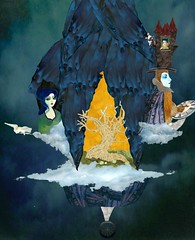
member of:Observers of the Interdependence of Domestic Objects and Their Influence on Everyday Life


This group has been active for a long time and has already made some remarkable assertions which render life simpler from the practical point of view. For example, I move a pot of green color five centimeters to the right, I push in the thumbtack beside the comb and if Mr. A (another adherent like me) at this moment puts his volume about bee-keeping beside a pattern for cutting out vests, I am sure to meet on the sidewalk of the avenida Madero a woman who intrigues me and whose origin and address I never could have known...
--Remedios Varo


(Slideshow is of Artwork by Remedios Varo)
By believing passionately in something that still does not exist, we create it. The nonexistent is whatever we have not sufficiently desired.
--Franz Kafka

Showing posts with label Original art. Show all posts

Wednesday, April 23, 2014

Earth Day Saint: The Spell of the Sensuous

St. Theodora by Zoe Blue

Happy (late) Birthday, Vesna!
“The most sophisticated definition of “magic” that now circulates through the American counterculture is “the ability or power to alter one’s consciousness at will.” No mention is made of any reason for altering one’s consciousness. Yet in tribal cultures that which we call “magic” takes its meaning from the fact that humans, in an indigenous and oral context, experience their own consciousness as simply one form of awareness among many others. The traditional magician cultivates an ability to shift out of his or her common state of consciousness precisely in order to make contact with the other organic forms of sensitivity and awareness with which human existence is entwined. Only by temporarily shedding the accepted perceptual logic of his culture can the sorcerer hope to enter into relation with other species on their own terms; only by altering the common organization of his senses will he be able to enter into a rapport with the multiple nonhuman sensibilities that animate the local landscape. It is this, we might say, that defines a shaman: the ability to readily slip out of the perceptual boundaries that demarcate his or her particular culture—boundaries reinforced by social customs, taboos, and most importantly, the common speech or language—in order to make contact with, and learn from, the other powers in the land. His magic is precisely this heightened receptivity to the meaningful solicitations—songs, cries, gestures—of the larger, more-than-human field.
Magic, then, in its perhaps most primordial sense, is the experience of existing in a world made up of multiple intelligences, the intuition that every form one perceives—from the swallow swooping overhead to the fly on a blade of grass, and indeed the blade of grass itself—is an experiencing form, an entity with its own predilections and sensations, albeit sensations that are very different from our own.”
(Abram, David (2012-10-17). The Spell of the Sensuous: Perception and Language in a More-Than-Human World)

What if the ancient story of the Garden of Eden is the loss, in monotheistic culture, of this magic? What if our expulsion, our great sin is that we stopped listening to, stopped attuning ourselves with, all the other consciousnesses around us, and began to see only human intelligence as any intelligence at all? The word, Paradise, comes from the Persian term for an enclosed garden. Our loss of Paradise may have been our loss of the ability to immerse ourselves in that garden...to feel the pulse of its life, to share perception with its creatures and plants, to comprehend their communications.


St. Theodora by Zoe Blue: horns are mother-of-pearl


The author of The Spell of the Sensuous, David Abram, paid his way through school by working as a magician, and later studied the plays on perception that magic used and how they might aid a psychologist, using sleight-of-hand techniques to help people who were difficult to treat via regular psychotherapy. He then went to study with Shamans in various regions of the world, to better understand the malleability of perception. What he learned there re-focused his attentions on the rest of the world--that is, the non-human parts of it--in a fascinating manner that he describes and explores in this book.

“In Koyukon belief, the other animals and the plants once shared a common language with human beings. This was in the Distant Time (Kk’adonts’idnee), a time during which all living beings 'shared one society and went through dreamlike transmutations from animals or plants to humans, and sometimes back again.' We will postpone until the next chapter the question of whether the stories told of the Distant Time by the Koyukon people depict an originary time 'long ago' in the past—as they are often interpreted according to the linear-historical view of time first imported into the Koyukon territory by Catholic missionaries—or whether the Distant Time is more coherently understood as a unique dimension or modality of time, one that is more integral to the living present than it is to the historical past. In any case, and despite the apparent differentiation of animal and human languages since, or outside of, the Distant Time, the various discourses of humans and animals still overlap and interpenetrate in the everyday experience of Koyukon persons.”

He gives wonderful examples of that overlap of languages:

“The interpenetration of human and nonhuman utterances is particularly vivid in the case of numerous bird songs that seem to enunciate whole phrases or statements in Koyukon. Many bird calls are interpreted as Koyukon words.… What is striking about these words is how perfectly they mirror the call’s pattern, so that someone [outside the tribe] who knows birdsongs can readily identify the species when the words are spoken in Koyukon. Not only the rhythm comes through, but also some of the tone, the “feel” that goes with it.
[...]
Hence the whirring, flutelike phrases of the hermit thrush, which sound in the forest thickets at twilight, speak the Koyukon words sook’eeyis deeyo—“it is a fine evening.” The thrushes also sometimes speak the phrase nahutl-eeyh—literally, “a sign of the spirit is perceived.” The thrush first uttered these words in the Distant Time, when it sensed a ghost nearby, and even today the call may be heard as a warning.”

If our loss of Eden was much like the story of Babel--an inability to comprehend the communications of other creatures, life-forms, or even other humans via a loss of ability or perhaps just willingness to take the time and effort necessary to immerse ourselves in the perceptual experience of those other forms or beings, then a return to Eden would be the opposite: Paradise would be the ability to shift our entire being to feel the world’s communications to us, thus being able to respond appropriately. Everything would fall into place: Magic.

St. Theodora's Companion, Zoe Blue


One of the suggestions the author makes towards this end comes from his study of the storytelling techniques of different tribes such as the Aborigines in Australia and their song cycles, and where a person is “conceived.”

“What, then, is the Dreamtime—the Jukurrpa, or Alcheringa—that plays such a prominent part in the mythology of Aboriginal Australia? It is a kind of time out of time, a time hidden beyond or even within the evident, manifest presence of the land, a magical temporality wherein the powers of the surrounding world first took up their current orientation with regard to one another, and hence acquired the evident shapes and forms by which we now know them. It is that time before the world itself was entirely awake...”

The above reminds me of the idea of a latent image, of the belief landscape that lies underneath every occurrence and interaction in your life. Abram then goes on to talk about how the world “got” (or gets, continuously) its form, which is a tale told by song, a song which travels the whole landscape of the country via the path of the Ancestor which first walked, creating the landscape as he did so:

"The distance between two significant sites along the Ancestor’s track can be measured, or spoken of, as a stretch of song, for the song unfolds in an unbroken chain of couplets across the land, one couplet 'for each pair of the Ancestor’s footfalls.' The song is thus a kind of auditory route map through the country; in order to make her way through the land, an Aboriginal person has only to chant the local stanzas of the appropriate Dreaming, the appropriate Ancestor’s song.”

Then comes the immersion, the sort of hypnosis, that the song provides:

“Knowledge of distant parts of one’s song cycle—albeit in one’s own language—apparently enables a person to vividly experience certain stretches of the land even before he or she has actually visited those places. Rehearsing a long part of a song cycle together while sitting around a campfire at night, Aboriginal persons apparently feel themselves journeying across the land in their collective imagination...”

In this culture, as in the others he studied, a sense of place is fundamental to being. A person feels his environment as a part of himself. Abrams gives fascinating examples from the Apache culture and the Aboriginal culture which describe a great power in storytelling, singing, and words themselves which all describe an immersion in the landscape that is very different from what most modern life experiences. But back to Eden:

“The Dreamtime is not, like the Western, biblical notion of Genesis, a finished event; it is not, like the common scientific interpretation of the “Big Bang,” an event that happened once and for all in the distant past. Rather, it is an ongoing process—the perpetual emerging of the world from an incipient, indeterminate state into full, waking reality, from invisibility to visibility, from the secret depths of silence into articulate song and speech. That Native Australians chose the English term “Dreaming” to translate this cosmological notion indicated their sense that the ordinary act of dreaming participates directly in the time of the clan Ancestors, and hence that that time is not entirely elsewhere, not entirely sealed off from the perceivable present.”

Shiny horns (and companion)
Zoe Blue


Here, Dreamtime is the “time” of the creation of the world--not the distant past, but an underlying, symbolic, living layer--something to interact with, to pay attention to, something to know. If we look for a way to see that time in space, Abrams suggests thinking of the “future” as the horizon, or the other side of the trees in front of you; the “past,” then, is the detail in the rings of those trees, the archeological finds in the soil underneath, including the type of sediment or rock that gives a precise accounting of the conditions in the area for the previous thousands of years; the present is the very air you are breathing, all the scents and textures and thoughts and songs and tiny bits of the insides of every other being breathing that same air right now. All those things are “invisible” to you, yet they are right here, right now--present, past, future, making up one landscape that you are a part of--and that you can alter.

Learning to pay such an immersed attention to all aspects of our entire environment right now is a step towards rediscovering Eden. And, just like modern psychology suggests that we would be well-served to step back, especially in tense situations, and re-view our surroundings from the perspective of a fly on the wall, “propelling [our] awareness laterally” is also a tool of the shaman:

“The traditional or tribal shaman, I came to discern, acts as an intermediary between the human community and the larger ecological field, ensuring that there is an appropriate flow of nourishment, not just from the landscape to the human inhabitants, but from the human community back to the local earth. By his constant rituals, trances, ecstasies, and “journeys,” he ensures that the relation between human society and the larger society of beings is balanced and reciprocal, and that the village never takes more from the living land than it returns to it—not just materially but with prayers, propitiations, and praise.
[...]
Any healer who was not simultaneously attending to the intertwined relation between the human community and the larger, more-than-human field, would likely dispel an illness from one person only to have the same problem arise (perhaps in a new guise) somewhere else in the community. Hence, the traditional magician or medicine person functions primarily as an intermediary between human and nonhuman worlds, and only secondarily as a healer. Without a continually adjusted awareness of the relative balance or imbalance between the human group and its nonhuman environ, along with the skills necessary to modulate that primary relation, any “healer” is worthless—indeed, not a healer at all. The medicine person’s primary allegiance, then, is not to the human community, but to the earthly web of relations in which that community is embedded—it is from this that his or her power to alleviate human illness derives—and this sets the local magician apart from other persons.”

So, again, that immersion in the landscape, that attention to the placement of objects and the interactions of the living beings around you, and the practiced ability to tune into those other perspectives--to be those other beings, at different times--, brings one to paradise: balance, and health, and magic. It is the garden, the Earth itself that is Paradise.


Throughout the book, Abrams explores the way that developing and using a phonetic alphabet has changed the human relationship with the landscape and turned our attention inward, detaching us from our environment and our surroundings in a way that has had rather extreme consequences, both for human health and for environmental health. But he is careful to point out that his point is not to blame our current situation on writing; rather it is to encourage us to pay attention to our way of thinking, and to work on it, to make “an attempt to think in accordance with our senses, to ponder and reflect without severing our sensorial bond with the owls and the wind [...] a style of thinking, then that associates truth not with static fact, but with a quality of relationship.”

In The Little Locksmith, Katharine Butler Hathaway describes the night terrors that she suffered, the times of overwhelming panic, while she lay strapped to her board, immobile and of uncertain future, for ten long years as a child. Later, when she was able to get up and move around, she still suffered these crippling panics, as she faced her extreme difference and the things that she believed it would keep her from experiencing in this world--things like social inclusion and romantic love (she was, however, incorrect about both). She talks through her memoir of the process of writing being her savior, but also says that often when she needs it most desperately, when she feels those terrors, she is unable to function as a writer, she can’t find that place. But then she discovers this method-- a method of immersion much like what Abrams suggests, though she is not particular about the type of environment:

“After I had discovered my eyes I taught myself to remember them whenever the horrors struck me. No matter what might be happening to me, no matter how crazy and frightened I might feel, there was always the great visible world before me, and I could look at it. When a moment of terror came I could look at a chair, or at a table or at a door, and by deliberately and faithfully looking at it and really seeing it with my whole attention, with the intense and humble selfless concentration of an artist, of a child, of a van Gogh, I could realize and see the chair, or the table, or whatever the object happened to be that was in front of me [thus drawing her out of herself], as I had never realized and seen it before; and it became for me in that moment an object of love, full of mystery and meaning, because the entire visible world became, when I really looked at it, lovable, mysterious, and significant. An ecstasy filled my hand and I began to work. And so I found out where I was to go. For by setting myself to work with the aim of translating my wonderful delight and realization of things into words and sentences I could deliberately cultivate the delight and prolong its visitations until it became the element within which I lived, safe at last, happy and invulnerable.”

She uses writing to extend those moments of immersion in the real world, to further their relations to her life, to imagine them outwards. Writing, then, becomes her savior, enables her to detach herself from her own perspective and immerse herself in another:

“Even in the midst of my sickness, when I had believed I never would write again, the healthy instinct began to work when one day I had reached over from my bed to get a pencil and paper out of the drawer of the night table beside me and I wrote down on a little block of pink paper an idea for a novel that had fallen like a seed into my mind from listening to my nurse tell the story of her life.[...] It filled me with excitement and anticipation. It happened that for me and my purpose it was a living seed. Out of it a story grew and kept on growing year after year, curving like a vine first in one direction and then in another, yet creating and maintaining by means of its own mysterious will its own equilibrium and design. It grew as knowingly as a beautiful and intricate shell forms itself, or is formed by its soft, amorphous, yet accurately guided inhabitant. It was mysterious and beautiful to me, not necessarily to anybody else. But that was enough. I was in love with it, spellbound. It was a story about two sisters who lived in an old yellow farmhouse on the edge of Danvers. I watched every fly that crawled over the kitchen table in that imagined farmhouse, and I smelled every cake and loaf of bread the sisters made, and I heard the stamping footsteps of their father coming in from the snow. [...] I was able to build up for myself what appeared to be an invulnerable calmness and joy, and a complete indifference to my own personal life except that it should remain empty and leave me free to live wholly in this new element which was not the real world but a kind of mirror element in which the essence and movement of the real world was reflected, as in a fortune-teller’s crystal.”

A living seed, which curves like a vine, which grows into new relations between new people, each of whom offer her other perspectives, unique from her own. And she spends time with them, develops them, heals with them--and part of her process is going out, alone (which was a startling concept in itself at the time, for any woman), and purchasing and renovating a home in Castine. That purchase was chosen because of the place itself--a certain magic she felt it had. It was a place with legends of its own which were attached to the very land, and even behaviors that were associated with weather patterns. From her time there, she went out into the world, traveling --again alone-- to Europe to become part of the Surrealist circle, an artist in her own right, and falling in love, falling out of love, recovering, and then falling in love again, this time to marry.

It is an intriguing suggestion, that immersion in place and “propelling [our] awareness laterally,” might be just the technique to practicing true, transformational magic. That, like the shaman, we might ourselves become, for the moment, a bird or a monkey or a horned beast, and then “come back” to ourselves with new, impossible information. One step closer to Paradise.

As I studied fire and firing neurons and their rhythms and the heat of dance, I also delved into the tales of St. Caterina of Bologna; as I explored the realm on the other side of the mirror or at the bottom of the lake, and the idea of having a fish-tail, I discovered the tales of St. Fevronia. I often like to have a Saint or figure that has a religious or mythological (intensely emotional and heavily symbolic) significance; the figures help to solidify ‘theory’ and emblemize ideas...they also thus serve as meditation aids. For the garden/earth ideas I am exploring, I’ve had no such figure to draw upon, not until the day I finished this painting, when I stumbled upon the story of Saint Theodora of Vasta. She was a woman in 11th-Century Greece who disguised herself as a man in order to join the militaristic defense of her city against raiding bandits. In an event that seems to me to precisely reflect the ideas above, she was, while disguised as a man and fighting with weapons, killed, and as she died, she made a request to God to turn her body into a Church, her hair into trees, and her blood into the water for those trees. A church was indeed built upon her grave, and as you can see from the below photos, trees did in fact begin to grow out of its roof. According to legend, a river re-directed itself to flow under the church; it wasn’t until 2003 that geologists were able to use high-frequency georadar to see that the trees were actually growing up through the walls--until then, there appeared to be no root system at all for the trees. It is not easily explainable how the church has survived for hundreds of years with the weight of 17 holly and maple trees growing on its roof (some of them over 98 feet high). The existence of the building at this point really begs for such a transformational mythology to explain it.

Photo of St. Theodora's Chapel from ListofWonders.com

Photo from Xristianos.gr

Interior of chapel, to show that you cannot see the trees from the inside..
Photo from Panoramio.com


The Passionflower the monkey holds is based upon the one drawn by Maria Sybilla Merian, which was used for the cover of Amazing Rare Things. The lizard-to-bird transition comes from here. The pomegranates were at the request of the birthday recipient of this painting, Vesna.

Tuesday, February 4, 2014

Toy Theater


Toy Theater by Zoe Blue


 I've been working on a drawing for a painting in which the world of puppetry has begun to slowly creep its way in, a sure sign of my little brain's gnawing on the problem of 3D puppet-creation for the puppet challenge over at Clive's blog.

Toy Theater by Zoe Blue


The theater is a small detail of the painting, but, in the spirit of the maquettes, also once a challenge, and also brought to life to serve as models, I decided to flesh it out, making my first foray into the world of three-dimensions.

Toy Theater by Zoe Blue

The base and frame of the stage are wooden, which Gabriel helped me with, kindly protecting my little sloppy fingers from their assured destruction.

Toy Theater by Zoe Blue

Somewhere out there is a certain beautiful blonde who will recognize a pomegranate and fancy boots.

Friday, November 1, 2013

Ewa Erzulie

Ewa and the Green Lion by zoe blue
18x24 acrylic on panel


One of the most striking aspects of the traditions surrounding the devotions to Erzulie is that they always end with her weeping. Erzulie is lovely, beautiful, and she has the adoration of all men, yet she does not strike hateful jealousy in the women, because of her child-like innocence. She induces wonder and care, she is like a child. And, though she begins all celebrations in her honor filled with giddiness and pleasure at the excess of beautiful and expensive things that are always lavished on her parties, she slowly grows sad, accusing the people of not honoring her enough, not giving her enough, not loving her enough. In Maya Deren's book The Divine Horsemen, she suggests that this is just another aspect of her child-like behavior (along with an "impatience with economies, with calculation, even with careful evaluation" 139), that you cannot give a child enough attention to satiate its need, and that those present at the devotions understand this and soothe her. I feel, however, that perhaps Erzulie is right. We do not devote enough of our attentions to child-like wonder, to endless and all-enveloping love--if we did, the world would be a much different place.
In Candomblé Ketu, Ewá represents the water element, and is the goddess of enchantment, beauty, and harmony. Like Erzulie, in the related Voodoo pantheon, she is universally loved and loving and "represents all that is fragile and sensitive." According to Morwyn, in Magic from Brazil, "Euá was so beautiful that men would fight to the death to possess her. In order to stop the carnage she changed herself into a puddle of water that evaporated to the sky, condensed into a cloud, and fell as rain. Thus she is known as the deity of transformation."
Here, I am fusing the two water divinities, hoping for a major transformation such as the one Erzulie begs for, one in which I no longer need to mess with stupidities like balancing my checkbook, for example...
The story of Erzulie, the story of Ewá, also reminds me of the Chinese bodhisattva Guan Yin, who also caused a massive transformation, defeating violence: during an unjust and forced visit to the Underworld, she was so overwhelmed with compassion for the souls which suffered untold tortures there, her very love transformed that hell into a paradise. She changed, simply by being full of compassion, the very order of things (something to think about the next time someone calls you a naive utopian). She is, like Ewá and Erzulie, the patroness of mothers and of sailors, and she can be called upon to bring rain.


detail of ewa and the green lion by zoe blue
detail of Ewa and the Green Lion

Alchemists, the precursors to our modern chemists, also strove for major transformation. The endless writings on the steps necessary to transmute base metals into gold are thought by some to have been mere code for a higher transmutation, an internal transmutation, in which the base form of the self becomes light, reaches higher consciousness. Alchemists sought to create an elixir of healing and eternal life, and one of the code names for that ultimate elixir was "the remedy of the green lion."

Here, Erzulie-Ewa is caught in mid-transformation at the base of Legba's tree, her hair feathering out into bird's wings and her torso spilling to the ground. The green lion frolics in the water.

Saturday, September 21, 2013

Papa Legba

Papa Legba Maquette by zoe blue
Papa Legba is sometimes an old man, sometimes a young man, almost always with a top hat and cane. He has one foot in your habitual ways (the "real world"), and one foot in fresh possibility; the border he crosses is the liminal space in which you are offered or forced to accept an alteration in your perspective in order to survive--a wormhole. No voodoo ceremony can begin without him: he is the one who allows the worlds of loa and humans to meet.  This connection between worlds is frequently represented by a special tree, its roots reaching deep into the underworld, its trunk and branches thrusting into our reality and through to the heavens. He is syncretized with St. Peter, who holds the keys to the gates of heaven, waiting for our arrival. Papa Legba's key plants into the ground via his cane, to connect with those spirits underneath: for example, those we have lost, ancestors. The key grows into a support for him, and also a snake (dweller of the worlds below). His scarf, a bird, covers any calls to the over-world spirits, those in the heavens, that we aspire to, that we desire to live through us. The bird-soul transcends the old. Papa Legba changes from old to new, from human to not, from alive to dead and back again. And he’s looking at you.

Papa Legba Maquette by zoe blue
Maquettes in the style taught by Clive Hicks-Jenkins
What is this key? Papa Legba is the language loa, he translates your cry of pain into a question, your inability to express your needs and desires into a new universe, where those needs and desires are so natural, they are easily communicated.  Languages and stories (and symbols) are used in society to tie everyone together into a community, to a consensual reality, to the same (overall) patterns of understanding.  As long as we’re using the shared image-meanings, then we follow the same story of humanity. If we want a different story, what then? What can Legba do? He can give us a key--that is, access to other symbols, or other ways to see your own. He can give new meaning to what is already there before you, unlocking its other possible meanings, translating it, thereby changing the world.


Everyone has personal symbols. Even if we aren’t aware of them, they rear up in our dreams and they modify our behavior (sometimes in ways that directly clash with societal mores); they are there, underneath, as a part of who we are. We all begin as synaesthetes, in fact, combining our understanding of the world across pairings from various senses. Alexandra Horowitz talks about this in her book On Looking, Eleven Walks with Expert Eyes:

“What the infant sees, for instance, is something quite fuzzier and more dazzling than what the normal adult sees: babies are very nearsighted and they lack the clouded filters that take bright light down a notch. Even more critically, the world is not yet organized into discrete objects for these new eyes: It is all light and dark, shadow and brightness. To the newborn infant, there is no ‘crib,’ no ‘mama’ and ‘daddy,’ no floor no wall no window no sky. Much of this can be seen, but none can yet be made sense of. 

Information taken in by the eyes might be processed in any part of the brain--it could be the visual cortex, leading to an inchoate ‘seeing’; but it could also be the motor cortex, leading to a leg kicking; or the auditory cortex, in which case a nearby teddy bear may be experienced as a bang, or a ringing, or a whisper. There is good reason to believe that this kind of synesthesia is the normal experience for infants. Synesthesia--literally ‘joining of sensations’-- is a somewhat rare and highly improbable form of perception in adults[....]

While tasting sounds or smelling letters is viewed as aberrant (if conducive to creativity) among adults, those eminently creative infants may sense the world with crossed wires all the time. Heinz Werner, a German psychologist of the early twentieth century, called this the ‘sensorium commune’: a primordial way of experiencing the world, pre-knowledge and pre-categorization. Researchers have found remnants of this perceptual organization in adults: on being shown drawings of curly lines, adults tend to characterize the lines as ‘happy’; descending lines, ‘sad’; sharp lines, ‘angry.’ To feel a tone, as though one were inside a vibrating bell, is to see glimpses of your vestigial sensorium commune.

But mostly, we ignore that feeling; we do not label lines as being happy or vexed or gloomy. One theory of synesthesia holds that the synapses connecting neurons identifying shapes and those leading to the experience of taste get snipped sometime in the first few years of life. This may be the simple result of our lack of attention to the connection.”

Lack of attention. That’s precisely it. The important objects, experiences, and details--that is, the ones clearly marked by our parents, extended family, teachers, priests, politicians, etc as important--are granted our attention and they develop. But the other connections, the other details, are still there in your brain. They still exist as a part of you. And in some other universe, you are living according to those connections. If you can find them, from here, you can go there

If synesthesia is conducive, as Horowitz suggests, to creativity, why not seek out such connections? In fact, isn’t that exactly the Art of Memory, the Ars Memoria? Recall that the process is to break an idea down into images, sounds, smells--some kind of symbols--which help you to hold together the disparate parts of the idea. A woodchuck holding a crumbling, tart apple tart, enters the cafe and tries to find a friend. His crumbling tart, the couch where Freud sits, the woman in the red dress all come together in a way particular to you, meaningful to you, and this process of knitting together the symbols not only helps your recall of the information, but guides you to realize, accidentally, other previously unseen connections between things, which leads directly to creativity and invention. This is, I believe, the magic that the practitioners of Ars Memoria were suspected of: by shifting around seemingly symbolic objects in their minds--Varo’s pot of green paint, her stencil for cutting out vests--, they affected the outside world. 


In his book, Wizard: The Life and Times of Nikola Tesla, Mark Seifer describes a moment of such odd connections in which Tesla went from nearly killing himself (through physical and mental exhaustion) in an effort to solve a problem to its sudden, clearly laid-out solution, via a gorgeous sunset and a Goethe poem. He was struggling to design a way to harness AC power without any ‘cumbersome’ intermediaries, and the struggle took every minute of his time, and he drove himself so hard that he suffered a nervous collapse, which took on the aspect of a severe attention to detail:

“I could hear the ticking of a watch…three rooms [away]. A fly alighting on a table…would cause a dull thud in my ear. A carriage passing at a distance…fairly shook my whole body…I had to support my bed on rubber cushions to get any rest at all…The sun’s rays, when periodically intercepted, would cause blows of such force on my brain that they would stun me…In the dark I had the sense of a bat and could detect the presence of an object…by a peculiar creepy sensation on the forehead.” A respected doctor “pronounced [his] malady unique and incurable.” Desperately clinging to life, Tesla was not expected to recover.”


His friend Szigeti took him out to the park to try to get him moving around. They went at sunset, and suddenly, the beauty of the scenery caused Tesla to burst into spontaneous recitation: 

‘See how the setting sun, with ruddy glow, 
The green-embosomed hamlet fires.
He sinks and fades, the day is lived and gone. 
He hastens forth new scenes of life to waken. 
O for a wing to lift and bear me on, 
And on to where his last rays beckon.’
(From Goethe’s Faust

“As I uttered these inspiring words,” Tesla declared, “the truth was (suddenly) revealed. I drew with a stick on the sand the diagrams shown six years later in my address before the American Institute of Electrical Engineers…Pygmalion seeing his statue come to life could not have been more deeply moved.”


The association between sunset, Faust, and successfully harnessing AC power is still lost on me, but the world has been changed as a result of his connection of those things: power floods our homes, lights our nights, keeps the stereo on and the clothes clean and me instantly connected to friends across the world. All of these things were once unimaginable. Impossible. 


Yet, here we are.

**Update: please follow the link in Niklas' comment, the essay is fantastic!!

Sunday, July 21, 2013

St. Fevronia IV: Perfect Abandon

St. Fevronia IV: Perfect Abandon
Acrylic on Panel 18 x 24 by zoe blue


In his article Dream Theory in Malaya,* the anthropologist Kilton Stewart described his study of the utilization of dreams in Senoi society. The Senoi were an isolated tribe of the Malay Peninsula at the time of his writing and research, in 1935; his interest in them was piqued by the fact that they seemed able to keep other tribes at bay without the use of violence, simply through a reputation for witchcraft: he thus set about to study the way that they used lucid dreaming and dream interpretation as a major part of that perceived power to manipulate the world around them. 

Their response to dreams of falling struck him particularly, as it did me:

“The simplest anxiety or terror dream I found among the Senoi was the falling dream. When the Senoi child reports a falling dream, the adult answers with enthusiasm, ‘That is a wonderful dream, one of the best dreams a man can have. Where did you fall to, and what did you discover?’ ...The child at first answers, as he would in our society, that it did not seem so wonderful, and that he was so frightened that he awoke before he had fallen anywhere.

‘That was a mistake,’ answers the adult-authority. ‘Everything you do in a dream has a purpose, beyond your understanding while you are asleep. You must relax and enjoy yourself when you fall in a dream. Falling is the quickest way to get in contact with the powers of the spirit world, the powers laid open to you through your dreams. Soon, when you have a falling dream, you will remember what I am saying, and as you do, you will feel that you are traveling to the source of the power which has caused you to fall.

‘The falling spirits love you. They are attracting you to their land, and you have but to relax and remain asleep in order to come to grips with them. When you meet them, you may be frightened of their terrific power, but go on. When you think you are dying in a dream, you are only receiving the powers of the other world, your own spiritual power which has been turned against you, and which now wishes to become one with you if you will accept it."

The astonishing thing is that over a period of time, with this type of social interaction, praise, or criticism, imperatives, and advice, the dream which starts out with fear of falling changes into the joy of flying.”

This struck me as the perfect description for passing through Borges’ mirror to the other, less automatic, more alive (terrifying, unknown) universe; a passing which I have also depicted as the plunge into an underwater universe as taken by the people following St. Fevronia under threat of annihilation by the soldiers of Batu Khan. Falling comes somewhere between floating and flying, and in this lucid-dreaming version is a perfect abandon. 

In that post-painting haze, as I was trying to organize my thoughts about this plunge-float-fall, I stumbled upon a book with an intriguing title: Time Distortion in Hypnosis


 by Linn Cooper and Milton Erickson. The sensation of floating, like the sensation of falling, carries with it a suspension of time, and it is somewhere in that suspension that we can find the ‘source of the power’ Stewart was referring to in his study. In their book, Cooper and Erickson detailed the studies they had managed in which they taught their subjects to greatly distort time, a difficult concept to grasp mentally, for which they gave the examples of dream-time and those expanded moments of fear for one’s life:

“Thus, a young man who very nearly ran his car over a cliff while taking his fiancee for a drive, reported that the time interval during which they were in danger seemed to be very long. In analyzing certain other aspects of his experience, he told of doing an amount of thinking and reflecting that was appropriate to a long interval. In other words, the seeming duration was long. However, on considering the number of feet which the car had slid with locked wheels and its probable speed when the emergency occurred, he was able to calculate that the clock reading during the emergency was but a few seconds.”

You have a lot of things going on internally at all times, most of which you are unaware of--including not only things like breathing but also things like the decision about what to see --but in moments of intense focus, like the above car accident, you can more actively take in all those details that some part of your brain is always filing away somewhere: for example, the minute movements of facial muscles, subtle clues in body language, calculating your opponent’s next swing, the precise amount you should turn the wheel to avoid oncoming traffic, remembering to relax your body before impact and focusing on the breaths you are taking, how loud they might be if a predator is present, and how they are affecting your body’s ability to move and process information. A person who has this focus at all times would have immense communicative abilities, as well as a fantastic control over the ability to pull opportunities towards him and dangers away from him. As noted, we usually only experience that focus during those moments of intense terror or danger, but aren’t meditation, hypnosis, and lucid dreaming exactly this sort of pausing and stretching of time?

What all that suggests is this: what’s important is not how long a second takes, but rather how much you can consciously extract from that second.
The second itself is apparently very, very relative. A good example of this relativity is given early on in the book with the task of picking cotton given to the subjects in two different ways. In the first test, the subject was hypnotized, placed in a mental cotton field, and asked to pick four rows of cotton, signaling the experimenter when the task was complete. It took her 217 seconds to complete the task, and she told the experimenter that she had picked 719 cotton bolls:

“She picked with her right hand part of the time, and with her left hand part of the time, shifting the bag accordingly. She picked only ripe bolls, leaving the green ones alone. Sometimes she stopped and brushed the leaves aside to make sure that she hadn’t missed any. She didn’t hurry, but she worked steadily. It was late afternoon, and the woods along the west edge of the field cast a shadow. She stated that she seemed to have been working about an hour and twenty minutes.”

Then the same task was given, but this time instead of the limit being four rows, the limit was one hour and twenty minutes. The subject was hypnotized, placed in the mental cotton field, and given three seconds--this fact was unknown to her. After three seconds, the experimenter had her blank her mind, stopping everything, then asked her to report. This time, she had picked 862 bolls, again without hurry. The felt time was an hour and twenty minutes. Asked to describe the experience, she remember detail, and she felt the time pass. The result suggests that the last second was actually decisive: at that point, the subject’s mind felt that the entire experience should be over, and it filled in the story, detail by detail.

Doesn’t that make you wonder where all your memories come from?

To further investigate, the doctors tried introducing sound to the test. Given a ten-second experiment, they would chime a knife against a glass 4 seconds in, without any warning given to the subject. The subject may have been preparing a meal as his or her task, and would then report a phone ringing or dropping a pitcher to the floor--his hallucinated experience would include a confabulation to make sense of the sound that his ears had picked up. The most interesting thing about that is how he managed to drop the pitcher before he heard the sound, so that the timing of it hitting the floor would match the sound of its contact. How did that happen?

What if everything, your entire life story, is happening all at once? What if all you think you have ever experienced is a pattern, which you are focusing on during this second, a pattern which explains world politics, the music your neighbor is playing, the proliferation of weapons at your local school, your food allergies, your preferences in a significant other, the quality of the education you have gotten, what you’re wearing right now? What if you’re really starting from that last second--the second right now--and explaining it all to yourself in high speed that feels like the normal unfolding of an entire life? What counts, what matters, if that’s the case, is the pattern, yes? Like a fractal, unfolding in each snowflake, each furl of a leaf, the placement of the planets. Like each bit of information contained in a hologram.

Cooper and Erickson worked with several musicians, and got some rather interesting results, exemplified in the reports of a professional violinist, who used her “special time” (what they called those gloriously long seconds) to review and practice violin pieces, describing them in a manner reminiscent of the eye-flickering it takes Neo to learn Jujutsu in the Matrix. She would play not just the entire piece, but also difficult passages over and over, strengthening her actual finger memory, her general technique, and her performance ability in the process.

The authors suggest that the reason musical subjects are able to both hear long pieces of music and practice them in such short periods of time is because “a piece of music is a pattern, extended in experiential time...” and another subject described her experience with this “special time” similarly:

“I can see the beginning and the end of everything I do in a trance. Like a dream, it’s a round thing--it’s not a progression. In music you have to begin at the beginning and play it through to the end, but in a painting you can see it all at once.”

I stayed up late reading all this, and the next morning in an incredible moment of synchronicity, I woke up with this poem waiting for me from Vesna, who had not seen or heard anything about this painting or the book I was reading, though everything in the poem, from its ‘all-at-once’ nature to the gradation of colors seems related, to me:


Where do I begin
If not from the end?
The breadcrumbs of memories will take me
Where I need to be


The Black will fade
Into Indigo
Purple
and Blue


Absorbed in soliloquy
Embracing the mystery


Where do I begin
If not from the end?


In the above painting, St. Fevronia has taken the plunge: she is relaxed, floating or falling towards another pattern, another universe entirely, in a moment of intense focus and need that somehow feels like joy. The blue (moonlit) hellebores are here again because it is all a matter of perception.


*Stewart later wrote Pygmies and Dream Giants , a book which wielded a great influence on the development of dream theory. Note that UCSC research professor G. William Domhoff (who was not there for the study) began around 1985 to argue that Stewart inflated and embellished his findings, and he claims that there is no evidence that this analysis of falling dreams belongs to the Senoi. Since my interest is in the idea the analysis itself provides, not who created it, I will leave that argument to others.

Sunday, June 30, 2013

Santa Caterina IV: Tango to a Parallel Universe


Santa Caterina at the Crossing
Acrylic on Panel, 18 x 24, by Zoe Blue


“A 24-year-old woman was first seen in 1950, because of seizures. From early childhood she had been unusually fond of music and had always felt a strong desire to express her emotions in dancing. At the age of 16 she was a tall, gaunt girl who felt both inferior and aloof. At this time she would often dance in the living room and her father would tease her about her ‘jitterbug antics.’ Offended, she would withdraw to her room and in solitude play records by the hour. She felt transported by loud ‘swing’ music and discovered that by concentrating intensely she could ‘see visions.’ These usually were of a blond woman and a dark man. They were dressed in various fashions but usually wore evening clothes, as if they were about to attend a formal dance. The couple seemed to be dancing together. The patient mentioned this phenomenon casually to her parents and friends, none of whom believed her. She rather enjoyed the vision and the accompanying trancelike state which she entered after prolonged listening. She continued to induce these episodes for the next 2 years.
In 1945, the patient struck her head in an automobile accident; however, there was no alteration of consciousness or signs of external injury. She was in bed for the next 5 days because of ‘shock.’ Six months later she had a nocturnal generalized convulsion. Shortly thereafter the visual hallucinations began to appear whenever she heard certain music, even though she had not consciously willed them. This inexorable recurrence reduced her to panic at the sound of jazz music...” {Source: Musicogenic Epilepsy: Report of 3 Cases; David D. Daly, MD and Maurice J Barry, Jr., MD; Psychosomatic Medicine, September 1957, 19: 399-408}.


Did her desire, her focus, her need--and the music--bring her in contact with some other reality, in which a woman danced with a partner, instead of alone and subject to ridicule? It is important to notice the difference between a fantasy or daydream and a hallucination, the latter affecting all the senses and being something that our entire being sinks into. 

And what happened after the accident? All of a sudden the existence of that other pair no longer depended upon her call...as if they really did exist on their own...

If there really are unlimited streams of reality, where could they all be hiding, other than inside the mind? As we trace the electricity of our brains and bodies and the music of that electricity, can we discover wormholes to other universes, other iterations of our selves?

One Tango dancer grasps the bow and the other the viola, all four characters involved in the same rhythmic event though from different planes of reality; out of darkness, out of light, the electricity brings them together and to life. Who is calling whom? Who is real and who is not? 


Tuesday, May 14, 2013

Santa Caterina II

Santa Caterina II, black ink 19x24, by zoe blue


“Leap, and the net will appear.” --variously attributed to American naturalist John Burroughs, Gaelyn Foley, Julia Cameron, and also an “unknown” Zen source.

Fly

come on
uncling
unwrap
your wing
confuse
the gravity
with your
lovely personality
don’t feed
the fear
not even
with a bite
just fly baby
enjoy the flig
ht

--Vesna


In the Church of Corpus Domini, Bologna, Santa Caterina de Vigri sits upright on view, her flesh ranging from a brick-red to black and still cleaving to her bones, though she died in 1463. She is the only such saint to sit upright, and her shrine miraculously survived the bombing raids of 1943 which destroyed the building in which she sits. Next to her sits her violetta, created by Andrea Amati (1413-63), which is the oldest known surviving stringed instrument. So, the saint, uncorrupted, remains with her instrument, a fellow-survivor. She sits across the nave from the tomb of Luigi Galvani, famous for his attempts to show electricity as the ‘spark’ of life with his seizing frogs, experiments which led later to tales like Frankenstein and the reality of electroshock therapy and cardiac paddles. His life gave meaning to the word galvanize, which means not only to give life to the moribund but also to protect from corrosion. The elements of this nave scene led me to consider the connections between electricity, music, and incorruptibility.

The mysterious creative power of music has been expressed visually in several of my favorite Remedios Varo paintings: for example the mother-of-pearl-faced musician creating a structure from the sounds of his clarinet, or the musician freeing birds from crystal cages by playing her bow across beams of sunlight. Might music itself be the life-spark that Galvani was looking for? The source of the rhythm and melody that synchronize us into being, harmonize into personality and memory, the whole cloth of our existence?

In This is Your Brain on Music, Daniel Levitin explains:


"Contrary to the old, simplistic notion that art and music are processed in the right hemisphere of our brains, with language and mathematics in the left, recent findings from my laboratory and those of my colleagues are showing us that music is distributed throughout the brain. Through studies of people with brain damage, we’ve seen patients who have lost the ability to read a newspaper but can still read music, or individuals who can play the piano but lack the motor coordination to button their own sweater. Music listening, performance, and composition engage nearly every area of the brain that we have so far identified, and involve nearly every neural subsystem. Could this fact account for claims that music listening exercises other parts of our minds; that listening to Mozart twenty minutes a day will make us smarter?"

Could it even be that the music itself is the method by which the pieces of our brain communicate with each other? If each neuron gives off a spark, like electricity, wouldn’t that electricity have its own beat and lyricism, just like all the other currents of electricity that surround us invisibly in our world, which Kubisch gave voice to with her headphones? And if so, then it would be important to keep those elements in sync with each other, in rhythm. To have concordance between the left brain and the right, between the amygdala and the cerebellum, between the serotonin and the dopamine. Perhaps this is why pharmaceuticals have had such a large failure rate with emotional and mental illnesses--it’s not a matter of a certain number of neurons or interactions; it’s a matter of harmony. Even with just an octave’s worth of notes, Levitin tells us, there are endless possibilities for a melodic line and its harmonizations, and when you add in tempo, rhythm and timbre, the possible variances multiply exponentially. It makes sense that each of us would have a unique balance; it makes sense that each of us would be our own song. Now, studies show that Alzheimer’s patients and parkinsonian patients as well as patients with the inability to form new memories can miraculously function under particular musical circumstances. In his Musicophilia, Oliver Sacks describes the 
“extraordinary powers of music with our post-encephalitic patients--its power to ‘awaken them at every level: to alertness when they were lethargic, to normal movements when they were frozen, and, most uncannily, to vivid emotions and memories, fantasies, whole identities which were, for the most part, unavailable to them....[And] It is music that the parkinsonian needs, for only music, which is rigorous yet spacious, sinuous and alive, can evoke responses that are equally so. And he needs not only the metrical structure of rhythm and the free movement of melody--its contours and trajectories, its ups and downs, its tensions and relaxations--but the ‘will’ and intentionality of music, to allow him to regain the freedom of his own kinetic melody.”

Stepping off the edge of the universe, Caterina II by zoe blue


And what about the expansion of perception? Levitin tells us:

“[Miles] Davis famously described his improvisational technique as parallel to the way that Picasso described his use of a canvas: The most critical aspect of the work, both artists said, was not the objects themselves, but the space between objects. In Miles’s case, he described the most important part of his solos as the empty space between notes, the “air” that he placed between one note and the next. Knowing precisely when to hit the next note, and allowing the listener time to anticipate it, is a hallmark of Davis’s genius. This is particularly apparent in his album Kind of Blue.”

It’s as if that’s the way they create a new path in the world, because the spaces between the notes or the objects is where your expectations are formed. Those spaces, instead of just handing you something, are rather training your mind to expect that thing, and then reinforcing that expectation. They change your perceptual reality by changing your expectations--then you look away from the paintings or step away from the speakers, and all of your brain, which was involved in that experience of listening, as stated above, has been nudged in a new direction, which has repercussions: symbolic, perhaps, but you are now operating with a new broadness of rhythmic or tonic possibility. The electricity of your mind, your being’s music, now opens to more than it did before. 

For the drawing, I was focusing on the idea of music being the animating electricity that Galvani was talking about, because it’s what gives us the ‘spark.’ If electricity is how a person’s billions of neurons communicate, and the rhythmic coherence of all their firings is what holds a body together; if Christina Kubisch has shown that electricity always has sound, its own music even though outside our limited range of hearing; then couldn’t you see music as the juice giving life to the body--or even see the body, or the less tangible ‘person,’ as an expression of a particular music? And that music is how we communicate with the entire universe (even a black hole is a low B flat), being in sync or out, discordant or concordant, and how well our lives “go” probably has a lot to do with that.   The idea of the ink is the connectedness, in both negative and positive space, of all of it: the birds singing, the man conducting even as he leaps into the void, the girl sailing out of the void--perhaps because of the motion of his arms or the sound of the violin, or the rhythm of the swirling birds, or some mixture of all of that together with whatever the tree’s input happens to be --but she's not just falling in a terrifying swoop. That electricity slowly rises, through granite, through roots, through the biped, through the birds, and into the universe as pure song.

If we do understand music to be our essence, how can we consent to live without harmony, to bludgeon our own internal rhythm and spark with the mechanized drumbeat of unchosen routine? An awareness of our lives as a symphony with the universe must surely persuade us to take the chance, to expand the harmonies and concordant possibilities in our own contribution to its music.
from Caterina II by zoe blue


The idea is to stop. Listen to the birds, to your heartbeat, to your own breath. Listen to the pull your whole being has towards something. Ignore the part of you that’s focused on what you want to escape, and pay attention to the part of you that has a magnetic pull, a pulse, a compulsion, however senseless, towards. Play that tune. Dance. Leap.

James Rhodes, who is performing at the Soho Theater this summer was the first classical pianist to be signed to Warner Bros records--the world’s largest rock label, and under their label put out ‘Bullets and Lullabies’, a number one iTunes album, in 2010. He wrote an editorial for the April 26, 2013 issue of the Guardian which he titled with the great words of Charles Bukowski: ‘Find what you love and let it kill you,’ where he exhorts us to : 

“Do the maths. We can function - sometimes quite brilliantly - on six hours' sleep a night. Eight hours of work was more than good enough for centuries (oh the desperate irony that we actually work longer hours since the invention of the internet and smartphones). Four hours will amply cover picking the kids up, cleaning the flat, eating, washing and the various etceteras. We are left with six hours. 360 minutes to do whatever we want. Is what we want simply to numb out and give Simon Cowell even more money? To scroll through Twitter and Facebook looking for romance, bromance, cats, weather reports, obituaries and gossip? To get nostalgically, painfully drunk in a pub where you can't even smoke?”“What if you could know everything there is to know about playing the piano in under an hour (something the late, great Glenn Gould claimed, correctly I believe, was true)? The basics of how to practise and how to read music, the physical mechanics of finger movement and posture, all the tools necessary to actually play a piece - these can be written down and imparted like a flat-pack furniture how-to-build-it manual; it then is down to you to scream and howl and hammer nails through fingers in the hope of deciphering something unutterably alien until, if you're very lucky, you end up with something halfway resembling the end product.”“What if, rather than paying £70 a month for a gym membership that delights in making you feel fat, guilty and a world away from the man your wife married you bought a few blank canvases and some paints and spent time each day painting your version of "I love you" until you realised that any woman worth keeping would jump you then and there just for that, despite your lack of a six-pack? I didn't play the piano for 10 years. A decade of slow death by greed working in the City, chasing something that never existed in the first place (security, self-worth, Don Draper albeit a few inches shorter and a few women fewer). And only when the pain of not doing it got greater than the imagined pain of doing it did I somehow find the balls to pursue what I really wanted and had been obsessed by since the age of seven – to be a concert pianist. Admittedly I went a little extreme – no income for five years, six hours a day of intense practice, monthly four-day long lessons with a brilliant and psychopathic teacher in Verona, a hunger for something that was so necessary it cost me my marriage, nine months in a mental hospital, most of my dignity and about 35lbs in weight. And the pot of gold at the end of the rainbow is not perhaps the Disney ending I'd envisaged as I lay in bed aged 10 listening to Horowitz devouring Rachmaninov at Carnegie Hall.”

And yet, it gives him more than the years of greed in the city; it gives him so much, he would never turn back. It gives him so much, he’s hollering for the rest of us to come join him--not on his path, but on our own. It’s worth it, he says.   

Do not miss his video here--either the introduction or the playing.


Leap, and the net will appear.

Again, from Vesna:

The awareness of your existence
draws
a smile after smile on my face
Feeling filthy rich
like an arabian princess
Smile is a new currency
It is all mixed up
The economy and the fantasy
I am almost sure
we are not crazy

Vesna ©
16-05-2011


*PS
The elm flowers are also there for a reason, but I will stop now. If you use this image for any sort of meditation of your own, please let me know your results!!