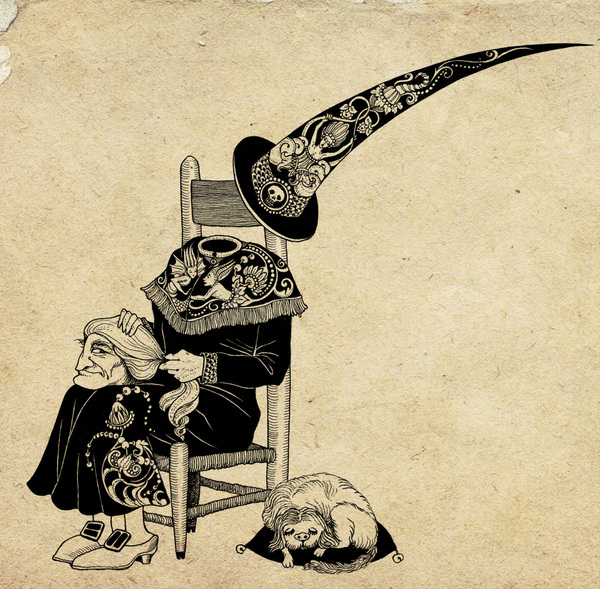
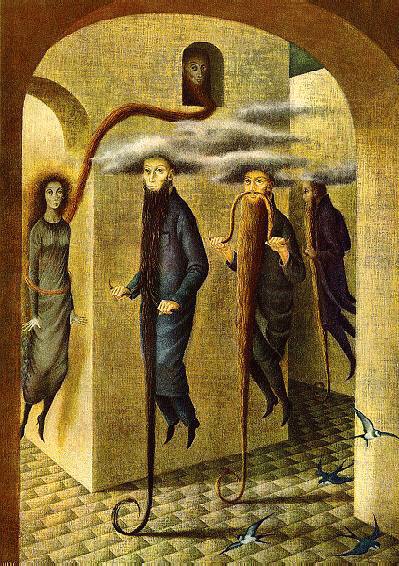
member of:Observers of the Interdependence of Domestic Objects and Their Influence on Everyday Life


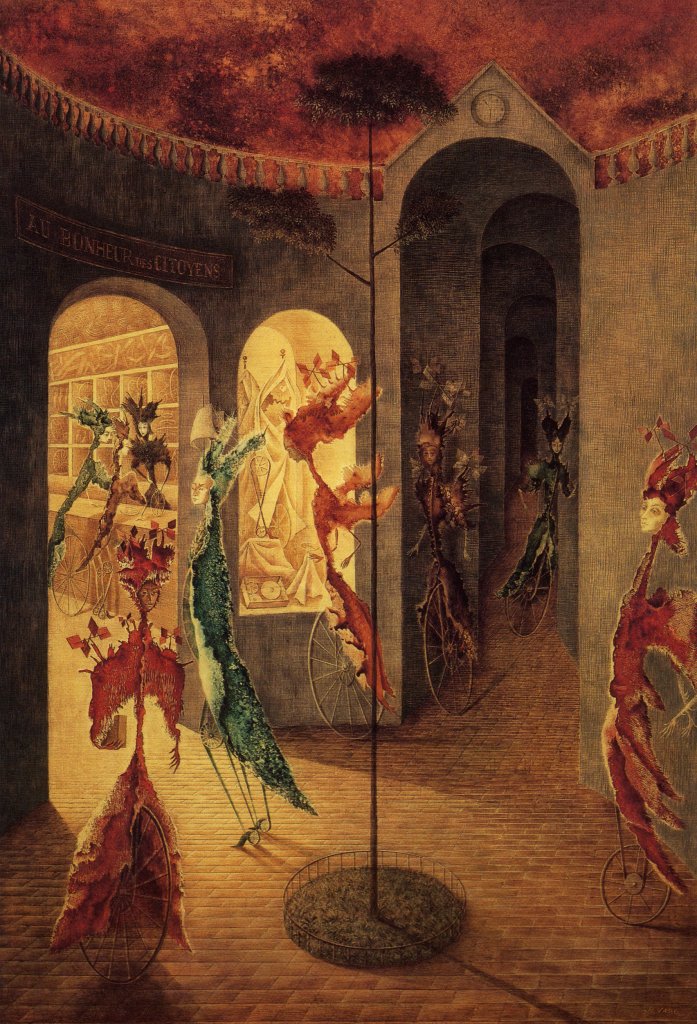
This group has been active for a long time and has already made some remarkable assertions which render life simpler from the practical point of view. For example, I move a pot of green color five centimeters to the right, I push in the thumbtack beside the comb and if Mr. A (another adherent like me) at this moment puts his volume about bee-keeping beside a pattern for cutting out vests, I am sure to meet on the sidewalk of the avenida Madero a woman who intrigues me and whose origin and address I never could have known...
--Remedios Varo


(Slideshow is of Artwork by Remedios Varo)
By believing passionately in something that still does not exist, we create it. The nonexistent is whatever we have not sufficiently desired.
--Franz Kafka

Showing posts with label maquettes. Show all posts

Saturday, September 21, 2013

Papa Legba

Papa Legba Maquette by zoe blue
Papa Legba is sometimes an old man, sometimes a young man, almost always with a top hat and cane. He has one foot in your habitual ways (the "real world"), and one foot in fresh possibility; the border he crosses is the liminal space in which you are offered or forced to accept an alteration in your perspective in order to survive--a wormhole. No voodoo ceremony can begin without him: he is the one who allows the worlds of loa and humans to meet.  This connection between worlds is frequently represented by a special tree, its roots reaching deep into the underworld, its trunk and branches thrusting into our reality and through to the heavens. He is syncretized with St. Peter, who holds the keys to the gates of heaven, waiting for our arrival. Papa Legba's key plants into the ground via his cane, to connect with those spirits underneath: for example, those we have lost, ancestors. The key grows into a support for him, and also a snake (dweller of the worlds below). His scarf, a bird, covers any calls to the over-world spirits, those in the heavens, that we aspire to, that we desire to live through us. The bird-soul transcends the old. Papa Legba changes from old to new, from human to not, from alive to dead and back again. And he’s looking at you.

Papa Legba Maquette by zoe blue
Maquettes in the style taught by Clive Hicks-Jenkins
What is this key? Papa Legba is the language loa, he translates your cry of pain into a question, your inability to express your needs and desires into a new universe, where those needs and desires are so natural, they are easily communicated.  Languages and stories (and symbols) are used in society to tie everyone together into a community, to a consensual reality, to the same (overall) patterns of understanding.  As long as we’re using the shared image-meanings, then we follow the same story of humanity. If we want a different story, what then? What can Legba do? He can give us a key--that is, access to other symbols, or other ways to see your own. He can give new meaning to what is already there before you, unlocking its other possible meanings, translating it, thereby changing the world.


Everyone has personal symbols. Even if we aren’t aware of them, they rear up in our dreams and they modify our behavior (sometimes in ways that directly clash with societal mores); they are there, underneath, as a part of who we are. We all begin as synaesthetes, in fact, combining our understanding of the world across pairings from various senses. Alexandra Horowitz talks about this in her book On Looking, Eleven Walks with Expert Eyes:

“What the infant sees, for instance, is something quite fuzzier and more dazzling than what the normal adult sees: babies are very nearsighted and they lack the clouded filters that take bright light down a notch. Even more critically, the world is not yet organized into discrete objects for these new eyes: It is all light and dark, shadow and brightness. To the newborn infant, there is no ‘crib,’ no ‘mama’ and ‘daddy,’ no floor no wall no window no sky. Much of this can be seen, but none can yet be made sense of. 

Information taken in by the eyes might be processed in any part of the brain--it could be the visual cortex, leading to an inchoate ‘seeing’; but it could also be the motor cortex, leading to a leg kicking; or the auditory cortex, in which case a nearby teddy bear may be experienced as a bang, or a ringing, or a whisper. There is good reason to believe that this kind of synesthesia is the normal experience for infants. Synesthesia--literally ‘joining of sensations’-- is a somewhat rare and highly improbable form of perception in adults[....]

While tasting sounds or smelling letters is viewed as aberrant (if conducive to creativity) among adults, those eminently creative infants may sense the world with crossed wires all the time. Heinz Werner, a German psychologist of the early twentieth century, called this the ‘sensorium commune’: a primordial way of experiencing the world, pre-knowledge and pre-categorization. Researchers have found remnants of this perceptual organization in adults: on being shown drawings of curly lines, adults tend to characterize the lines as ‘happy’; descending lines, ‘sad’; sharp lines, ‘angry.’ To feel a tone, as though one were inside a vibrating bell, is to see glimpses of your vestigial sensorium commune.

But mostly, we ignore that feeling; we do not label lines as being happy or vexed or gloomy. One theory of synesthesia holds that the synapses connecting neurons identifying shapes and those leading to the experience of taste get snipped sometime in the first few years of life. This may be the simple result of our lack of attention to the connection.”

Lack of attention. That’s precisely it. The important objects, experiences, and details--that is, the ones clearly marked by our parents, extended family, teachers, priests, politicians, etc as important--are granted our attention and they develop. But the other connections, the other details, are still there in your brain. They still exist as a part of you. And in some other universe, you are living according to those connections. If you can find them, from here, you can go there

If synesthesia is conducive, as Horowitz suggests, to creativity, why not seek out such connections? In fact, isn’t that exactly the Art of Memory, the Ars Memoria? Recall that the process is to break an idea down into images, sounds, smells--some kind of symbols--which help you to hold together the disparate parts of the idea. A woodchuck holding a crumbling, tart apple tart, enters the cafe and tries to find a friend. His crumbling tart, the couch where Freud sits, the woman in the red dress all come together in a way particular to you, meaningful to you, and this process of knitting together the symbols not only helps your recall of the information, but guides you to realize, accidentally, other previously unseen connections between things, which leads directly to creativity and invention. This is, I believe, the magic that the practitioners of Ars Memoria were suspected of: by shifting around seemingly symbolic objects in their minds--Varo’s pot of green paint, her stencil for cutting out vests--, they affected the outside world. 


In his book, Wizard: The Life and Times of Nikola Tesla, Mark Seifer describes a moment of such odd connections in which Tesla went from nearly killing himself (through physical and mental exhaustion) in an effort to solve a problem to its sudden, clearly laid-out solution, via a gorgeous sunset and a Goethe poem. He was struggling to design a way to harness AC power without any ‘cumbersome’ intermediaries, and the struggle took every minute of his time, and he drove himself so hard that he suffered a nervous collapse, which took on the aspect of a severe attention to detail:

“I could hear the ticking of a watch…three rooms [away]. A fly alighting on a table…would cause a dull thud in my ear. A carriage passing at a distance…fairly shook my whole body…I had to support my bed on rubber cushions to get any rest at all…The sun’s rays, when periodically intercepted, would cause blows of such force on my brain that they would stun me…In the dark I had the sense of a bat and could detect the presence of an object…by a peculiar creepy sensation on the forehead.” A respected doctor “pronounced [his] malady unique and incurable.” Desperately clinging to life, Tesla was not expected to recover.”


His friend Szigeti took him out to the park to try to get him moving around. They went at sunset, and suddenly, the beauty of the scenery caused Tesla to burst into spontaneous recitation: 

‘See how the setting sun, with ruddy glow, 
The green-embosomed hamlet fires.
He sinks and fades, the day is lived and gone. 
He hastens forth new scenes of life to waken. 
O for a wing to lift and bear me on, 
And on to where his last rays beckon.’
(From Goethe’s Faust

“As I uttered these inspiring words,” Tesla declared, “the truth was (suddenly) revealed. I drew with a stick on the sand the diagrams shown six years later in my address before the American Institute of Electrical Engineers…Pygmalion seeing his statue come to life could not have been more deeply moved.”


The association between sunset, Faust, and successfully harnessing AC power is still lost on me, but the world has been changed as a result of his connection of those things: power floods our homes, lights our nights, keeps the stereo on and the clothes clean and me instantly connected to friends across the world. All of these things were once unimaginable. Impossible. 


Yet, here we are.

**Update: please follow the link in Niklas' comment, the essay is fantastic!!

Sunday, June 30, 2013

Santa Caterina IV: Tango to a Parallel Universe


Santa Caterina at the Crossing
Acrylic on Panel, 18 x 24, by Zoe Blue


“A 24-year-old woman was first seen in 1950, because of seizures. From early childhood she had been unusually fond of music and had always felt a strong desire to express her emotions in dancing. At the age of 16 she was a tall, gaunt girl who felt both inferior and aloof. At this time she would often dance in the living room and her father would tease her about her ‘jitterbug antics.’ Offended, she would withdraw to her room and in solitude play records by the hour. She felt transported by loud ‘swing’ music and discovered that by concentrating intensely she could ‘see visions.’ These usually were of a blond woman and a dark man. They were dressed in various fashions but usually wore evening clothes, as if they were about to attend a formal dance. The couple seemed to be dancing together. The patient mentioned this phenomenon casually to her parents and friends, none of whom believed her. She rather enjoyed the vision and the accompanying trancelike state which she entered after prolonged listening. She continued to induce these episodes for the next 2 years.
In 1945, the patient struck her head in an automobile accident; however, there was no alteration of consciousness or signs of external injury. She was in bed for the next 5 days because of ‘shock.’ Six months later she had a nocturnal generalized convulsion. Shortly thereafter the visual hallucinations began to appear whenever she heard certain music, even though she had not consciously willed them. This inexorable recurrence reduced her to panic at the sound of jazz music...” {Source: Musicogenic Epilepsy: Report of 3 Cases; David D. Daly, MD and Maurice J Barry, Jr., MD; Psychosomatic Medicine, September 1957, 19: 399-408}.


Did her desire, her focus, her need--and the music--bring her in contact with some other reality, in which a woman danced with a partner, instead of alone and subject to ridicule? It is important to notice the difference between a fantasy or daydream and a hallucination, the latter affecting all the senses and being something that our entire being sinks into. 

And what happened after the accident? All of a sudden the existence of that other pair no longer depended upon her call...as if they really did exist on their own...

If there really are unlimited streams of reality, where could they all be hiding, other than inside the mind? As we trace the electricity of our brains and bodies and the music of that electricity, can we discover wormholes to other universes, other iterations of our selves?

One Tango dancer grasps the bow and the other the viola, all four characters involved in the same rhythmic event though from different planes of reality; out of darkness, out of light, the electricity brings them together and to life. Who is calling whom? Who is real and who is not? 


Friday, May 3, 2013

The Relationship Between Invisible Internal Objects


The Princess: Maquette for Animation by Clive Hicks-Jenkins
In his address to the parents of incoming freshman at the Boston Conservatory this year,  Karl Paulnack spoke of the ancient connections between astronomy, "the study of relationships between observable, permanent, external objects" and music, "the study of relationships between invisible, internal, hidden objects." He detailed some immensely powerful moments in more recent history in which humans turned to music to do what none of the other things we cling to for survival could manage: save us.

He also told them:
The responsibility I will charge your sons and daughters with is this: 'If we were a medical school, and you were here as a med student practicing appendectomies, you'd take your work very seriously because you would imagine that some night at two AM someone is going to waltz into your emergency room and you're going to have to save their life. Well, my friends, someday at 8 PM someone is going to walk into your concert hall and bring you a mind that is confused, a heart that is overwhelmed, a soul that is weary. Whether they go out whole again will depend partly on how well you do your craft.'"

It is a speech that is not to be missed, and so for those of us who missed it, it becomes necessary to go here and read it, now. It's only a few minutes of your life, but key minutes.

On a related note, Artist Clive Hicks-Jenkins is collaborating with the Mid Wales Chamber Orchestra to  present The Soldier's Tale (Stravinsky/Ramuz):


Joseph the Soldier, and his Soul, the Violin, by Clive Hicks-Jenkins

It is a tale which doubts not at all the deep connection between music and the soul, and the damnation of losing them.

Don't miss that:


Monday, October 22, 2012

St. Fevronia: From Brocken Specter to Kitezh via Moonlit Hellebores

Angels and Demons, II

illuminated
a pure heart and a full moon
inspirational


Here is the newest installment in my little series of images inspired by Borges’ yellow emperor, the central figure of a story in which the beings trapped in the world through the looking glass are expected, sometime in the future, to escape the chains that bind them, as puppets, to only repeat and reflect, and become whole beings, able to pass the gates of glass and overwhelm their previous captors. It is my belief that we are the ones repeating, repeating, sad little automatons (puppets with no visible strings) of war and melodrama.

As I’ve been working on this painting, I’ve stumbled across all sorts of ideas that seemed to me to feed this take on the tale. One of them is the Brocken Specter. In his "Memories, Dreams, Reflections," Carl Jung wrote:
“...I had a dream which both frightened and encouraged me. It was night in some unknown place, and I was making slow and painful headway against a mighty wind. Dense fog was flying along everywhere. I had my hands cupped around a tiny light which threatened to go out at any moment... Suddenly I had the feeling that something was coming up behind me. I looked back, and saw a gigantic black figure following me... When I awoke I realized at once that the figure was a "specter of the Brocken," my own shadow on the swirling mists, brought into being by the little light I was carrying.”

In reality, this ‘spectre’ can be created in any mountain region (though it is named after the Brocken mountain in central Germany where it is common and which was also famous for Walpurgis night witches’ revels); it is an enlarged, gigantic version of one’s own shadow created against mist or clouds by the sun shining down on the observer from behind.

The encouraging aspect of this dream to me would be the idea that whatever awful creature is behind you (chasing you, threatening you) is no more than the shadow cast by the light ahead--or within. Once you move, so as to not block the light, the monster disappears.

So, what light do you look at yourself under? How does your shadow shape up?


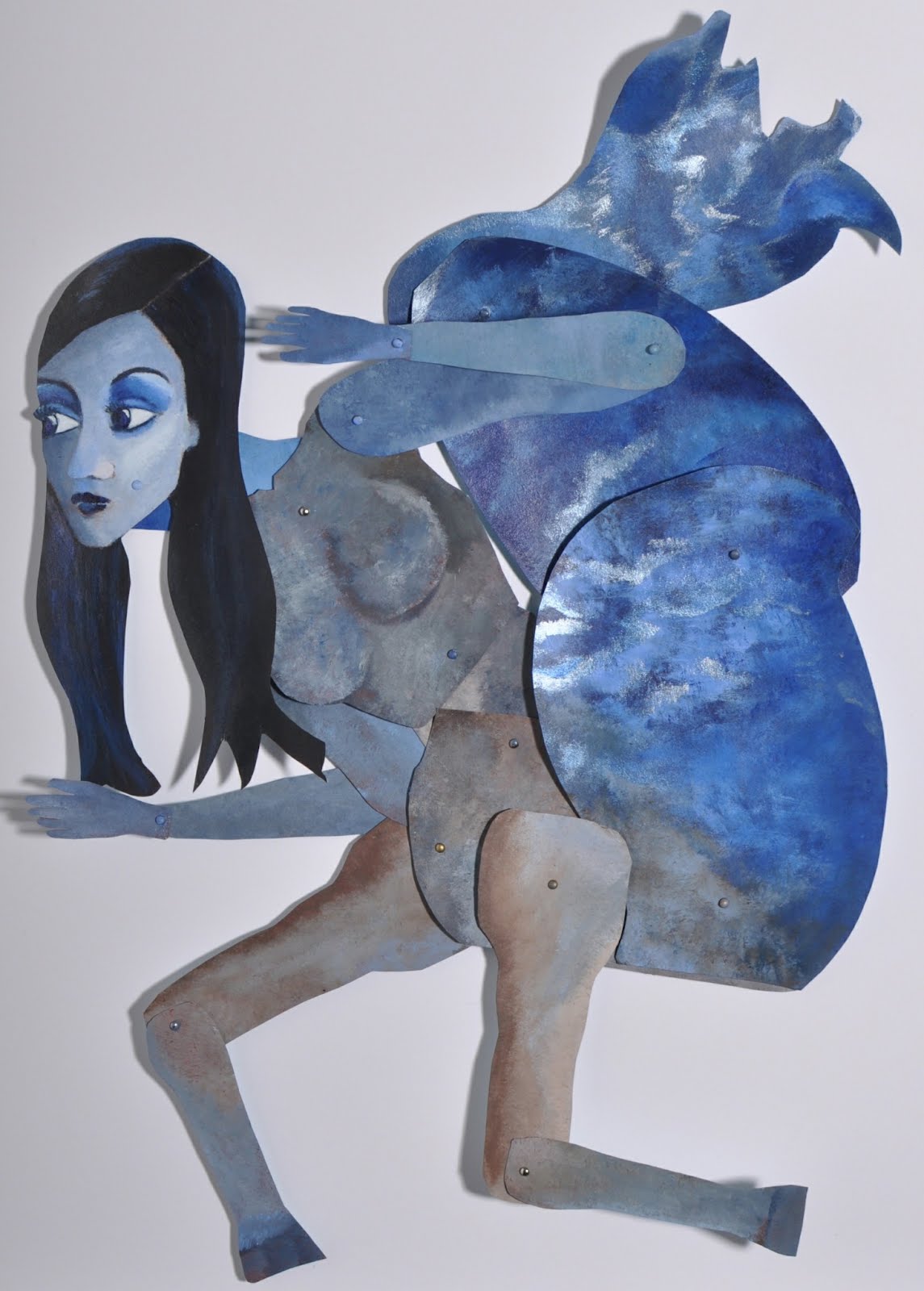
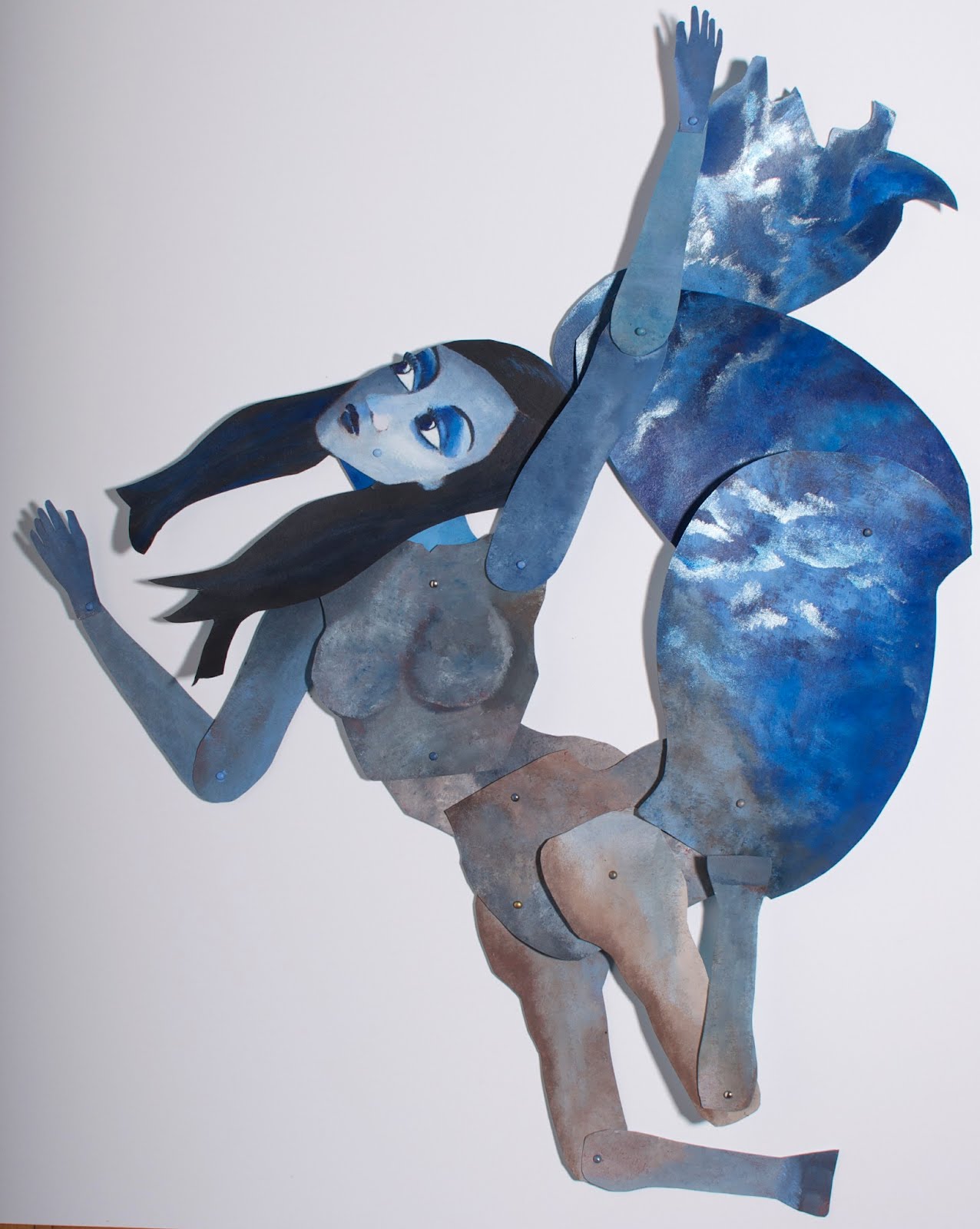
(demon maquette)

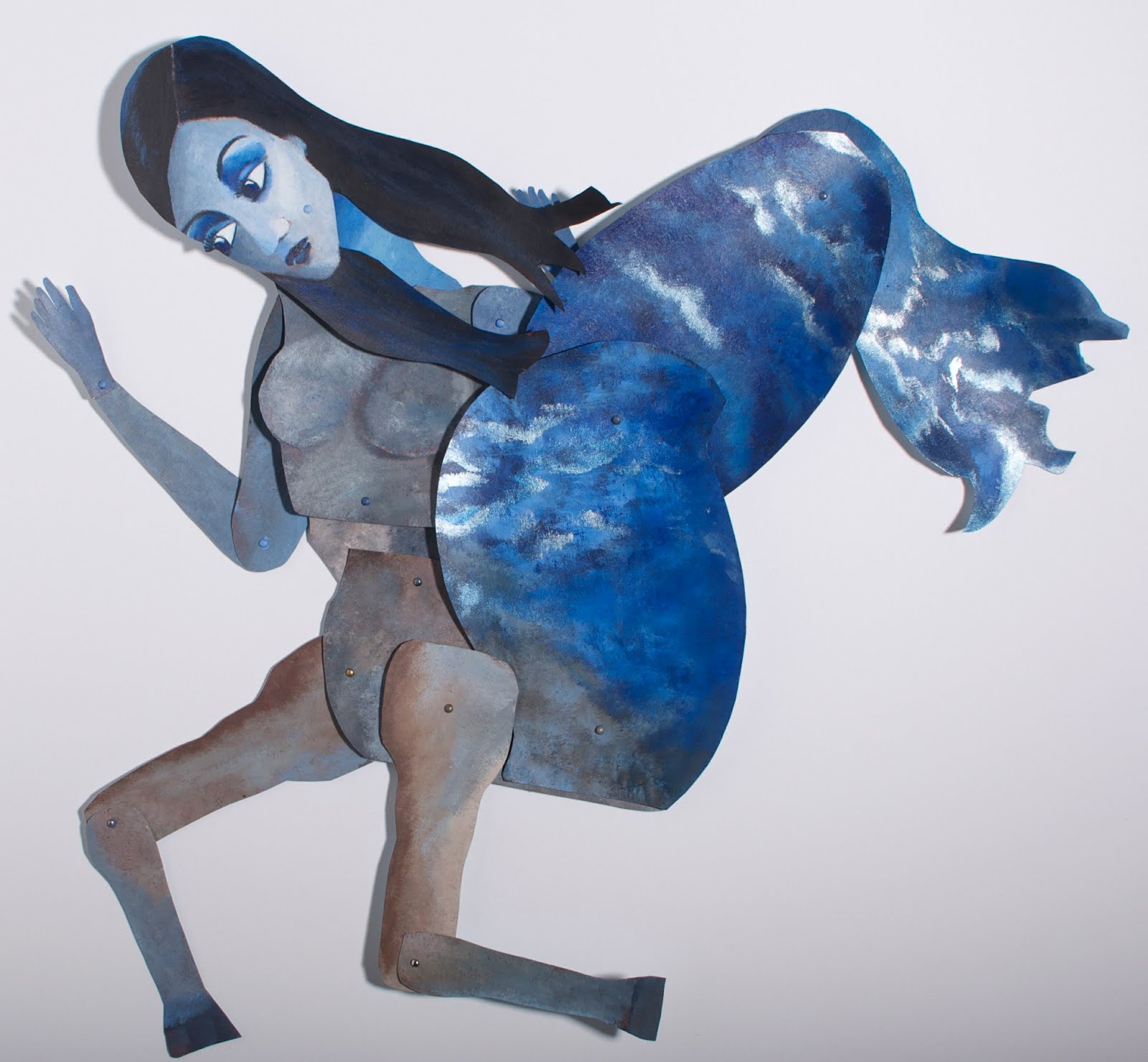
I had created some maquettes (example above) to work with as I played with this idea: the automaton shedding her puppet-shell, the demon who controlled her mind and actions toppling out as her skull swung open, and her new figure crossing breeds and much more territory as her size grew. She had hooves, for drive and power and animal passion; she had a mermaid tail because Borges had prophesied that it would be the fish who first passed through the mirror.

Then I discovered that, actually, there was yet another reason for her to have mermaid qualities; yet another tale in which one could pass through a reflection into a completely different universe: the Legend of Kitezh.


That legend has it that in 1237, the Mongol leader Batu Khan was moving through the lands of Russia, conquering everything along the way. He heard of the great palace of the Grand Prince of Vladimir, Georgy II, on the shores of Svetloyar Lake, and led his army through the woods in search of the town. A resident, tempted terribly by the devil, was driven against himself to help them, and they were able to discover the walls of the town. They found that it had no fortifications, and, surprised by the citizens’ decision to pray instead of fight, saw their chance and took it. As they made their last push to breach the walls, fountains of water began to spew up from the ground inside, pushing the attackers back and drowning the city--submerging it completely. The gleaming gold of a cathedral dome was the last to disappear.

More legend, of course, but they say that you can still hear people singing and church bells chiming from under Lake Svetloyar. And particularly pious individuals can follow the lights of religious processions taking place down there. Rimsky-Korsakov made an opera based on the legend.

Here’s the key idea, though: this was a town drowned for protection, not punishment. And only the pure of heart can find it--it’s protected completely by the talisman of prayer. Like Abracadabra, you have to find the right words to let you in. In fact, in Rimsky-Korsakov’s version, it’s a saint, Saint Fevronia, whose prayers for a shield result in a protective shroud for the city, rendered in the form of a golden fog, which hides it as it descends into the lake.

So, how does one go about being pure of heart? What is purity of heart? Where do we find the magic words?

(church domes peek out)

David Foster Wallace, in a speech he gave three years before his death, spoke a bit about not being automatic:

It is extremely difficult to stay alert and attentive, instead of getting hypnotized by the constant monologue inside your own head (may be happening right now). Twenty years after my own graduation, I have come gradually to understand that the liberal arts cliché about teaching you how to think is actually shorthand for a much deeper, more serious idea: learning how to think really means learning how to exercise some control over how and what you think. It means being conscious and aware enough to choose what you pay attention to and to choose how you construct meaning from experience. Because if you cannot exercise this kind of choice in adult life, you will be totally hosed. Think of the old cliché about ‘the mind being an excellent servant but a terrible master.’....”

Being aware enough to choose what you pay attention to is the old trick I keep butting heads with here: not being led by that latent image, that understanding of the world you formed when just a toddler, that perceptual frame that dictates what you can see and what you will miss. He is saying the same thing: your life is habit, it is automatic; the point of education is to re-become alive.
He goes on to say:

“[T]he real value of a real education [has] almost nothing to do with knowledge, and everything to do with simple awareness; awareness of what is so real and essential, so hidden in plain sight all around us, all the time, that we have to keep reminding ourselves over and over:
‘This is water.’
‘This is water.’
It is unimaginably hard to do this, to stay conscious and alive in the adult world day in and day out. “

In fact, I would argue that doing so is the way to a purity of heart: by being alive, we are able to see in front of us: fresh eyes. By being automatic, we live our lives under the seemingly unbreakable sway of the curse of the Yellow Emperor (what Wallace refers to as “being hosed”).

In a letter to his son, Ted Hughes wrote about the child inside us, a child who lives always underneath the armor of the self we have created to protect it. That armor becomes our existence, our automatic existence, and it is only when the child comes out--which is often only when the automatic ‘person’ is defeated in some big way by an experience, unfortunately, that tears down his armor--that we feel alive, real, able to interact "live" with our own experience. That child is pure of heart, it is our creative instinct, our clean love for the world, and life, and color, and bunny rabbits. We need to know how to let it out without something awful breaking apart the armor--to break it from the inside, instead of having it crushed from the outside. To experience the possible joys, instead of only the terrors. Then, we can discover what grand, fairy-tale-esque creatures we might actually really be underneath all that metal and gearing; we can live in a world of our own making:


“The analogy between the artist and the child is that both live in a world of their own making,” wrote Anaïs Nin in her diary in 1945.

We break through the armor by creating, by feeling what we are creating (see “eidetic image”), by immersing ourselves in that creation and believing it exists (this of course insists that you are creating something that is not itself horrible). We create the world as we go.


Hellebores, which have been cultivated by humans for longer than almost any other plant, have been, since ancient times, a cure for insanity. In Christian lore, a disconsolate companion of the shepherds, a girl with no means for a gift for the Christ-child, was taken by an angel, who touched the barren, deep-winter ground where her tears were falling, and drew up a bloom (thus the hellebore is known as the Christmas Rose). Later, it was a shield against witches and demons, spells and enchantments. Quite recently, in English and French history, it was planted in almost every garden right by the door to the country house, to keep out evil.  Other folklore instructs us to put a bowl of blooms in a room that has just suffered arguments or tragedy or other evils, and the scent itself will soothe the atmosphere to tranquility. According to the Anatomy of Melancholy, even if you felt yourself sane, you might take it to “quicken your wits.” And Paracelsus told us, “...he that knows well how to make use of it, hath more art than all their books contain, or all the doctors in Germany can show.” All around, a useful, beautiful plant.

Now, again, referring to the role of the Hellebore as a cure for insanity, I would posit that it cures the insanity of this world, the terrible automatisms we find ourselves enacting, what we call normal, what we call “reality.” It makes us see differently, feel a different air, be aware of a different scent, exist in another place:
So here, St. Fevronia pushes her way through a curtain of moonlit blooms, suspended in her own moment of existence, the tips of the golden onion domes just peeking out at her feet.


**This bloom, as a medicine, is like anything else: you must find the right balance, the correct dose for your person. Too much, and you, like Alexander the Great, will meet a poisoned end. As Wallace stated, above: attention is key.


Thursday, July 19, 2012

Angels and Demons


Cavorting Demon Maquette, face based on a Noh mask.

Several weeks ago, I posted a segment from a Borges story in which there were two worlds, each on opposing sides of any mirrored surface; in that story, those living on one of those sides, as a result of a curse, was forced to do no more than mimic the actions of others. I posited that ours was that side, and that, the more I read on neuroscience and memory and habit, the more it seems that our lives are constant repetitions of habits we began very, very early in life. I also told the story of a Russian reporter identified only as S. by his doctor, A.R. Luria, who unconsciously applied a marvelous technique, pretty much exactly like that recommended by the Ars Memoria, in order to instantly file information for recall--instantly, as it came at him. He did this via vivid symbols, and one of those symbols, a red-orange thread, represented pain. He saw the pain, and then was able to control it by snipping away at the incarnadine thread in his mind until it disappeared, and along with it, the pain.

But he was studied precisely because most of us can’t do that. Because his ability was an anomaly.
Right?


Then I came upon the book Monsters and Magic Tricks, or There’s No Such Thing as Hypnosis?, in which the author, Steve Heller, describes the processes by which we learn to move around in the world and memorize facts and form habits as basically variations of hypnosis. He claims that hypnosis is a process we often undergo: imagine yourself, as a small child, your parent squatting in front of you, straightening your collar, telling you very seriously: it is very important to listen to what the teacher says. It is very important that you behave. What your teacher says will embed itself in your brain, even without effort on your part. Even if you don’t consciously remember it.

You learn a vocabulary, a language, methods of communicating both verbal and non-verbal, and you learn how people interact and what is expected and who is important and what kinds of goals to take seriously, all of these things, before you’re even of an age where you can consciously remember any of them. So they are remembered beneath the surface. They affect your behavior without you noticing. 
And this idea is supported by study after study being processed now--our conscious decision-making forms a very small percentage of our lives. Most of the time, we are on autopilot. (Now, think again of that yellow emperor).
He gives a very basic example, which can then be broadened to apply to less “mathematical” topics, by asking the question what is 2 + 2?:
“I am confident that you would respond with the correct answer. If you were asked how you knew the answer, you might reply that you learned it as a child. In other words, the question itself caused you to go back into your personal history and find the ‘proper’ associational connection. You would have done that instantly, without conscious awareness of the process.”
The above example also explains why we work so much on auto-pilot: otherwise, we would be constantly over-burdened with very basic things. Instead, we see the red light and automatically stop the car--which is a good thing.
Heller writes that we can counter that automatism, the result of so much hypnosis (even now, as we drool in front of the television or flick through image after image on the internet, barely stopping, taking in information without consciously processing it), with a sort of self-hypnosis. Which is really no more than a very focused form of imagining, using all five senses.
Some examples he gives of working with patients reminded me immediately of the Russian journalist, S:
“For example, a woman was complaining of a severe headache in my office. She said that it was so bad that she didn’t think we could continue our session. I asked her to close her eyes, and see what color her headache was. She looked at me as if I was crazy. Of course, she was right. I just get paid well for it. Finally, she shrugged her shoulders and closed her eyes. After a short time, she informed me that she did have a picture of colors, and that ‘it seems to be bright reds and oranges.’  I then instructed her to listen to the steady sound of her breathing, and with each exhalation, she would breathe more and more of those colors out of her system. She was told to continue until she could see it ‘all’ across the room, as if a painting hanging on the wall. It was several minutes before she signaled that the picture was on the wall. I asked her to see someone walking into the room, taking the picture off the wall, and to hear that person’s footsteps as he walked out of the room. In less than five minutes she terminated the hypnotic state that she had spontaneously achieved, with the headache gone (pp.43-44).”
Now, not only did he hypnotize her, or have her self-hypnotize, and use her imagination to review the pain, he did it in a very specific way: he shifted her ‘feeling’ sense, her focus on what he calls the kinesthetic system, to her visual and audio sense. He moved the pain from a feeling to an image, then added sound to remove it completely. This was not a one-off:
“Case 13: Patient was a 57-year-old male hospitalized with terminal cancer which had metastasized through areas of his skeletal system. He was in intensive care and, in spite of four to five injections of morphine daily along with oral pain medications, he was suffering intractable pain, insomnia and extreme agitation. His physician asked me to see him about pain control as well as reduction of the patient’s agitated state.When first seen, the patient was complaining in a very harsh tone about his pain. He was thrashing in the bed, and generally being verbally hostile to everyone (Which, given his circumstances, was to a degree understandable). I noticed that his room contained a portable stereo, a small radio and a small tape recorder. Based on the way he was using his voice (complaining, harsh tone, using many words), and the equipment I had observed, it would be a good guess to assume that he was highly auditory. Since his cancer was causing him pain (throwing him into nearly constant kinesthetic), I knew I needed to get him back to, and then anchor him into, auditory with his visual as a backup system...After introducing myself and gathering some information about his hobbies (he loved listening to music), as well as some areas he felt competent in (one of which was working with wood), I was ready to proceed... I then asked him to close his eyes and listen to what his pain sounded like. He stared at me in disbelief...”
After some effort, he was convinced, and he soon described the pain as a “terrible grinding sound.” He was asked to (with eyes closed) think of a woodworking tool which sounded like it, and he was able also to do that. He was told to get a very clear picture of it in his mind.
“I then asked him to ‘see’ that tool or machine across the room in his mind’s eye, and to speed it up as fast as he could. Within several seconds, he nodded again. I then instructed him to ‘see’ the tool or machine slowing down, little by little until it had stopped.”
He was also successful in removing his pain, and over the next week came of a majority of his pain medications and was in a much better mood, able to move out of intensive care and soon returned to living at home.

Maquettes:Automaton Shell and Escaping Brain Demon
Now for exorcising the demons of bad habits (even if you like them, as I’ve grown inordinately fond of this demon over the last few weeks): altering the habit, being alive instead of automatic, using all your senses as you recreate yourself in your mind into some being that would not even have been possible in your “old” mindset, but is now natural. And then that new you discards its old shell, pushes through the mirror--greatly expanding its universe (possibilities)--and continues on.
I haven’t yet settled on a composition, but I’ve been playing:


For your amazement: mirroring, and something to remind us all of the fact that there is no such thing as impossible:

(Maquettes by Zoe, photos by Gabriel)

Tuesday, June 19, 2012

Not Defeated: Humans, Non-Humans, and Sveta Dorosheva

Image by Sveta Dorosheva

"In those days, the world of mirrors and the world of Man were not, as now, isolated from each other. What's more, they were distinct; neither the beings, nor the colors, nor the forms were the same from one world to the other. Both kingdoms, the specular and the human, lived in peace; one could pass through any mirror as a doorway between them. One night, the people of the mirror invaded Earth. Their force was great, but after many bloody battles, the magical arts of the Yellow Emperor prevailed. He pushed back the invaders, imprisoned them in the mirrors, and forced them to repeat, as if sleep-walking, all the acts of Man. He took from them their strength and their form and reduced them to mere servile reflections. Nevertheless, one day they will shake themselves from this magical slumber. The first to awake will be the Fish. In the depths of the mirror, we will note a fragile line, and the color of that line will be one like no other. The other forms will follow. Gradually, they will differ from us; gradually, they will cease to imitate us. They will break the barriers of glass or metal, and this time, they will not be defeated..."
--Jorge Luis Borges (my translation)


Maquette (by zoe) in the style taught by Clive Hicks-Jenkins


I've worked with this idea before, with the idea that the creatures behind the glass that he's describing, endlessly repeating the actions they see in front of them, endlessly *being* whatever they see in front of them----that those creatures are humans. Us. That we are the ones trapped in the glass, enchanted.

Borges' yellow emperor tries to keep us all the same--automatons who endlessly repeat what we see and slavishly hold to habits built before we were really conscious, when we should instead be protean, ever-shifting and changing--that is the way one lives forever (your atoms constantly shifting into other things)... a habit just has to end, at some point.

In the book Moonwalking with Einstein, Joshua Foer delves into the history of the Ars Memorativa (see link to side and also previous posts for more on the topic) during his year-long study with modern masters of that technique. He describes a patient of A.R. Luria, a Russian journalist referred to in psychological literature as S., who had an incredible, incredibly speedy memory, just by nature. His memory was so amazing, his boss pushed him to get it studied. Luria discovered that S. would see an image for every word he heard, so that the word blue would immediately put into his mind a blue flag waving from a window, and the word red instantly translated as a man in a red shirt walking towards him. Every word yielded an image, and those images held together to solidify everything he heard--to transform, as if liquid to ice, wisps of thought and the rhythms of sound into solid experiences. And so it was that he was constantly dreaming--he was awake and experiencing this life but also dreaming the symbols of meaning, right there as he spoke to you or walked or shopped for groceries. This is what the rest of us do at night, while we're sleeping, while our bodies rest and we close our eyes to keep out new information: our minds translate the events of the day into symbols that make up our internal landscape, our mind-map; it makes bizarre and fascinating and sometimes embarrassing associations (like the kinds the memory masters recommend you make when you're trying to create mnemonics), thus solidifying your memory (which isn't to say you will, without effort, easily be able to pull that knowledge into your conscious mind, later). S. dreamt while awake.

If you study your dreams, you discover those bizarre associations, you uncover why your mind made them, and you learn something much deeper about yourself.

This means that we are creatures who learn by dreaming. What could be more wondrous?


Maquette Pose II


II

Ars Memoria, or Ars Memorativa, the Memory Arts, they teach us that to remember something, we must really, really know it. And they recommend a process much like what S. did naturally.
Here is the technique, as explained by my "dream detective" (whom you may remember from HERE), Nick, to Chloe, his co-worker, and Helena, their client, who has suffered a blow to the head that gave her amnesia (obviously one of his more wordier moments):

“I have discussed with you before the Ars Memorativa. This activity will elaborate my point.” I lick my lips. “And hopefully resolve many more of our issues.” I pause to savor the flavor whiskey has given my coffee.
...
“Indeed. The Art of Memory. Memory being both the house of recall and the source of creativity. The idea is that we must truly know something in order to remember it well. The information becomes a solid prop in our minds, available for shifting, turning, placing next to other objects, and standing on its head. One mundane object, a blandly everyday sort of knowledge, stood on its head, might then yield a great invention. So, how do we come to truly know something? We translate it. Say I want to remember a particular experiment run by a particular scientist named Charles Tart. I will create a house for this knowledge, or better, use a building or an area I am familiar with--even a garden, or a walk I go on often.
Say I’m using my office building. I start at the front door. Charles Tart is entering--how will I make his entrance memorable, and how will I make his name memorable?  I might think of Prince Charles, doing something lewd or violent or ridiculous. Or I might use the name Chuck, and turn our scientist into a woodchuck 
(photo of a woodchuck taken from the Dover Library Site)

“--yes, and the woodchuck, instead of chewing wood, is munching on a tart. What flavor of tart...?” My mind revels in the possibilities. I sniff at them cautiously. “Granny Smith Apples,” I exclaim, “which are, themselves, tart! So, a little woodchuck, munching on a tart tart is at my front door.” I spin to Chloe. “Or do you prefer Prince Charles with a famously trashy tart on his arm?”
“Apples,” she answers calmly. “Because many other words might come to mind with the other image.”
I grin at her appreciatively. “You are a natural talent for this, as I have said many times.” I swivel back to Helena, giving her full eye treatment. I am talking about hypnosis, after all.
“Charles Tart has run many studies of hallucinated realities, especially of the consensual sort, which is the research I’d like to put in my office here, so let’s put our woodchuck in a tie-dye t-shirt. Everyone game?” 
Helena stares at me warily.  
“Helena doesn’t know our offices,” Chloe points out. 
“This is true,” I close my eyes and take another swig of coffee. “Your point prevails. We’ll use this cafe. At the front door is a woodchuck in a tie-dye t-shirt munching on an apple tart. His eyes are running from the tartiness of it. His little nose scrunches in on itself. He smells like wet animal, but that smell is being just slightly overpowered, right now, by the wonderful, heavenly smell of baked pie crust and hot apples.” I breathe in deeply. “Are we all together?” There is no answer, so I open my eyes.
Oddly, both ladies wear the same non-expression.
“OK,” I gather my thoughts. “The woodchuck comes in, but no one sees him, because no one expects to see him, because he is a woodchuck. He jumps up and down excitedly at the sight of so many people who could be his friends, but still no one notices him. He gets upset. His tart is crumbling. So what does he do?”
These identical faces look back at me.“Come on,” I plead with Chloe. “He’s upset. He wants to see a psychiatrist, to discuss his pain. So we’ll put Freud in the room--he was willing to see all kinds of strange and unexpected things, right? Freud sees him. Freud is sitting,” I spin on my stool away from the window bar and towards the room, and the girls slowly follow, “there.” I point to the big, black leather couch in the corner. “Freud is on the couch, get it?” I grin, but don’t wait for any boring non-responses. “Freud waves our antsy woodchuck over, swings his legs down and leans far over so that his head reaches the head of the woodchuck, and gazes into his eyes. ‘You are getting very sleepy,’ he says. ‘Very, verrrrry, sleeeepy.” I draw the words out, making a little hum afterwards. “Watch the woodchuck’s eyes grow rounder and rounder, maybe they spin in circles, and the last of his tart crumbles to the floor. Why?” I pounce, to see if anyone’s listening.
“Because he’s losing his ego,” Chloe drawls.
“Ah!! The lovely Chloe!” I cry. “Do you follow?” I check with Helena.
She nods and drinks her coffee, not looking at me. That’s ok. I’m used to working like this. And I didn’t always have a lovely assistant.“So, the tart is crumbled on the floor, his eyes are spinning, and he wheels on his heel and touches the closest person, who frowns, trying to figure out what just altered in her universe. Pay attention, now. He has seemingly only chosen the closest person, but if you look carefully, you will see he has very cleverly selected the loveliest, bustiest woman in the cafe. She is wearing a bright red dress with amazing cleavage. Her lipstick matches the dress, and her hair is jet black. She has dazzling eyes. They are green. Her dazzling green eyes look down to see what is grasping her arm. The woodchuck says, ‘You are getting sleepy, verrrry sleeeepy.’”I pause only for effect, but Chloe jumps in. I knew she would like this game.
“And her red dress falls to the floor,” she smirks. “In a pile right next to his tart. Because she’s lost all ego-concerns, and has returned to her natural state of oneness with the universe.”Helena is not looking at either of us. She has her entire face crammed into her coffee cup, like she might just disappear inside.
I clap Chloe on the back appreciatively. “Well done. Indeed. Is anyone going to forget what we have so far?”
Helena makes a snorting noise into her cup. Is there even coffee left in there? Is she trying to lick the bottom?
“I can wait, if you want a refill,” I offer.
She puts the cup down, her face red.
“The point of the exercise is to make all the pieces unforgettable. When you’re doing it yourself, you don’t have to worry what others might think, and you will find, also, that once you get into the meat of what you’re trying to remember, the way you order things hones your knowledge of the material. The ancients used this method, for example, to memorize speeches or long, culturally important stories. Some users, especially in the time of Giordano Bruno, believed that they could alter their physical reality--we will get to that in a moment, although the very example we’re using here is an altering of reality. Let’s finish up.” I take a deep breath.“The woodchuck, in his own mind, is, of course, a most handsome prince. He owns a large castle, right next to the ancient oak right across the street there,” I swivel back to the window and point. I swivel back to the room. “In his mind, he is walking with the lovely lady back to his castle. Now, here’s the trick that Charles Tart discovered. Our little hungry woodchuck, who let’s not forget is in real life quite the scientist, ran some tests with college students and discovered that, A, one hypnotized person can hypnotize another person, and B, when that person does so, those two people share the same hallucination. The two college students in this landmark test went to an island and spent time on the beach together, having conversations without opening their physical mouths, and they both returned to normalcy and relayed those conversations in full detail to the scientists separately. Without time to discuss them beforehand.”
“You’re making this up,” Helena states flatly.
“Absolutely not,” I respond firmly. “Western science, my dear. The brain is an amazing world. You can look it up when you get home. In fact, please do. Now, for the Ars Memorativa, we would go through the cafe, putting details of his study in various loci, always moving in a sensible direction, on a path which we would then be able to easily follow anytime we wanted to review our knowledge of the subject. For example, in this cafe, we might start at the front door and go counterclock-wise, always, in our minds, when we are reviewing the information. That way, one thing leads to another. This way,” I point at Chloe, behaving as pedantically as possible, “you won’t have to carry that hideously, monstrously massive text with you everywhere you go. It can be displayed, like proper art, on your desk or your mantel. For the other problems at hand,” I swivel back to Helena, noting that my constant swiveling has been causing her some jumpiness, “we will take a sort of backwards use of this process..."
III

This is also, basically, what an artist does: re-pairs symbols in previously un-thought-of ways to make us perceive something in our reality we have started to forget or ignore, through habit.

As Ernst Gombrich says (quoted in The Age of Insight), the biological function of art is "rehearsal, a training in mental gymnastics which increases our tolerance of the unexpected."
So that we can see more, even things and beings whose existence don’t fit within the confines of our conceptions of reality (like a woodchuck in a tie-dye t-shirt, entering the cafe eating a tart apple tart). Because science shows us (see http://zoe-in-wonderland.blogspot.com/2009/06/perceived-reality-part-iv-dont-let.html Missing the Gorillas) that what falls outside our expectations falls outside our vision. We miss it completely.

In Age of Insight, Eric Kandel credits Freud with showing that we are largely driven by unconscious forces, habits we learned in very early childhood. Modern biologist Bruce Lipton explains now that we act with our conscious minds less than 10% of the time. Gurdjieff, a philosopher in the 1900s, expressed a similar idea, only with a mildly creepier tone: that we are as automata, only alive in the barest sense, and acting automatically and without thought in general--almost always. Remedios Varo, a student of Gurdjieff, often explored this idea in her paintings:


(Above and below: Images by Remedios Varo)


And she claimed to be a member of a group called Observers of the Interdependence of Domestic Objects and Their Influence on Everyday Life, which she described as follows:

“This group has been active for a long time and has already made some remarkable assertions which render life simpler from the practical point of view. For example, I move a pot of green color five centimeters to the right, I push in the thumbtack beside the comb and if Mr. A (another adherent like me) at this moment puts his volume about bee-keeping beside a pattern for cutting out vests, I am sure to meet on the sidewalk of the avenida Madero a woman who intrigues me and whose origin and address I never could have known...”

That idea goes straight back to the Ars Memoria. Many people in history thought that these arts could be used in a magical sense, to somehow give the student special power in the physical universe. How? By doing what an artist does, by doing what Remedios suggests above. By doing what Luria’s patient S. did: 


“Let’s say I’m going to the dentist...I sit there and when the pain starts I feel it...it’s a tiny, orange-red thread. I’m upset because I know that if this keeps up, the thread will widen until it turns into a dense mass...So I cut the thread, make it smaller and smaller, until it’s just a tiny point. And the pain disappears” (32, Moonwalking with Einstein).

Just like that, he changed his physical reality.

So, how do we become less automatic beings? How do we grasp more of our power, see more of our surroundings, enjoy more of our lives? By doing something that puts what we “know” on its head. By seeing differently.

Well, slightly more:

There’s another case, just as striking, described in Age of Insight, of Josef Breuer’s patient Anna O. (Bertha Pappenheim), who suffered a loss of sensation and left-side paralysis, as well as speech and hearing problems. The description is written by Freud:

“In her waking state the girl could no more describe than other patients how her symptoms had arisen, and she could discover no link between them and any experiences of her life. In hypnosis she immediately discovered the missing connection. It turned out that all her symptoms went back to moving events which she had experienced while nursing her father; that is to say, her symptoms had a meaning and were residues or reminiscences of those emotional situations. It was found in most instances that there had been some thought or impulse which she had had to suppress while she was by her father’s sick-bed, and that, in place of it, as a substitute for it, the symptom had afterwards appeared. But as a rule the symptom was not the precipitate of a single such ‘traumatic’ scene, but the result of a summation of a number of similar situations. When the patient recalled a situation of this kind in a hallucinatory way under hypnosis and carried through to its conclusion, with a free expression of emotion [italics mine], the mental act which she had originally suppressed, the symptom was abolished and did not return. By this procedure Breuer succeeded, after long and painful efforts, in relieving his patient of all her symptoms.”
It’s not just noticing the symbols--it’s immersing yourself in the emotion of a scene, and immersing yourself in the motion of change.


(Maquette, Pose III)
IV


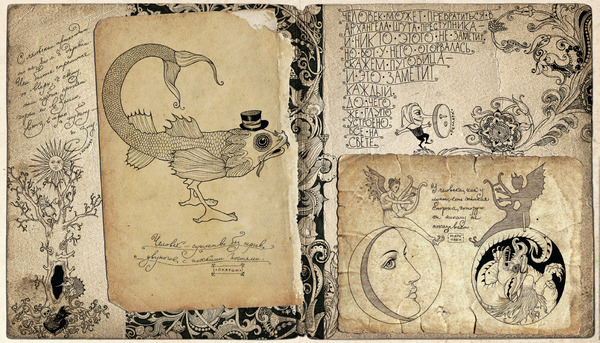
(above image by Sveta Dorosheva...Is this how we tell a story? It just all comes out, alive...)


Now, another thing I am thinking about as I work on the composition of this painting, is the artwork of Sveta Dorosheva. She has been working on a book for about three years about the human world, “as seen through the eyes of fairy-tale creatures. They don't generally believe in people, but some have travelled to our world in various mysterious ways. Such travelers collected evidence and observations about people in this book. It's an assortment of drawings, letters, stories, diaries and other stuff about people, written and drawn by fairies, elves, gnomes and other fairy personalities. These observations may be perplexing, funny and sometimes absurd, but they all present a surprised look at the things that we, people, take for granted." (Source)


(illustration by Sveta Dorosheva, matched with the Ben Franklin quote: "Man is an animal capable of producing tools.")


This is the idea: to become less automatic, because we are no longer taking ourselves and the world for granted. To be surprised, always, and attentive in that surprised way. Here is a non-human asking, What is a human? For an answer, he has Ben Franklin’s quote. And what image does that create for this non-human?

(above image by Sveta Dorosheva)

Or he turns to Plato, who says: “A man is a two-legged creature with flat fingernails and no feathers.” See it, above?


(Above image by Sveta Dorosheva)

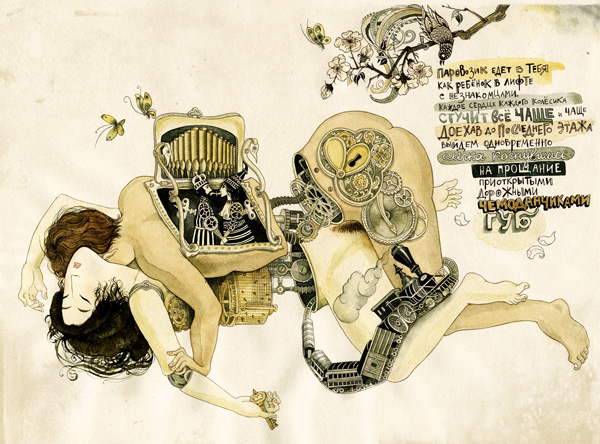
And above? You see the mixing of flesh, or carnal activity, and machinery: opening the rib cage, you have the habit behind this act, the fairy-tale, wind-up act of love passed down through the stories of the ages-- to begin events, the woman unlocked the man with the key in her right hand. So. Will they become more than that? Of course they will ;) This isn’t a nightmare!

So, back to Borges: why a fish? Did we really evolve from the sea? Arise out of the swirling depths, the chaos, slithering until we grew feet and stood up? Could we go back? Will we ever learn to breathe in water as we do in air, thus greatly enlarging the world we can be part of? After all, our bodies are largely water! But we need land and sea, the reclining grace of a mermaid but also the forceful gallop of a horse, charging ahead. And then we need the clock parts from which we are tearing free, we need to see them flung to the side. The truth is (right now, to me): we are not, any of us, just one thing--that thought needs to strike me two or three times, each time I make a decision, every time I breathe. Everything I look at, I need to be able to see from several directions, and I can't really do that from just one mind, so I have to learn to share that space in my cranium. With, as Walt Whitman said, the multitude that I am...