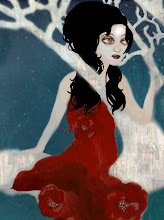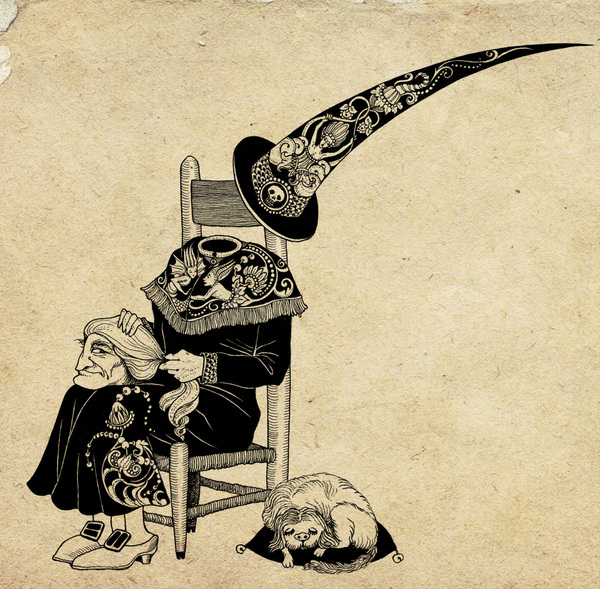
Image by Sveta Dorosheva
"In those days, the world of mirrors and the world of Man were not, as now, isolated from each other. What's more, they were distinct; neither the beings, nor the colors, nor the forms were the same from one world to the other. Both kingdoms, the specular and the human, lived in peace; one could pass through any mirror as a doorway between them. One night, the people of the mirror invaded Earth. Their force was great, but after many bloody battles, the magical arts of the Yellow Emperor prevailed. He pushed back the invaders, imprisoned them in the mirrors, and forced them to repeat, as if sleep-walking, all the acts of Man. He took from them their strength and their form and reduced them to mere servile reflections. Nevertheless, one day they will shake themselves from this magical slumber. The first to awake will be the Fish. In the depths of the mirror, we will note a fragile line, and the color of that line will be one like no other. The other forms will follow. Gradually, they will differ from us; gradually, they will cease to imitate us. They will break the barriers of glass or metal, and this time, they will not be defeated..."
--Jorge Luis Borges (my translation)
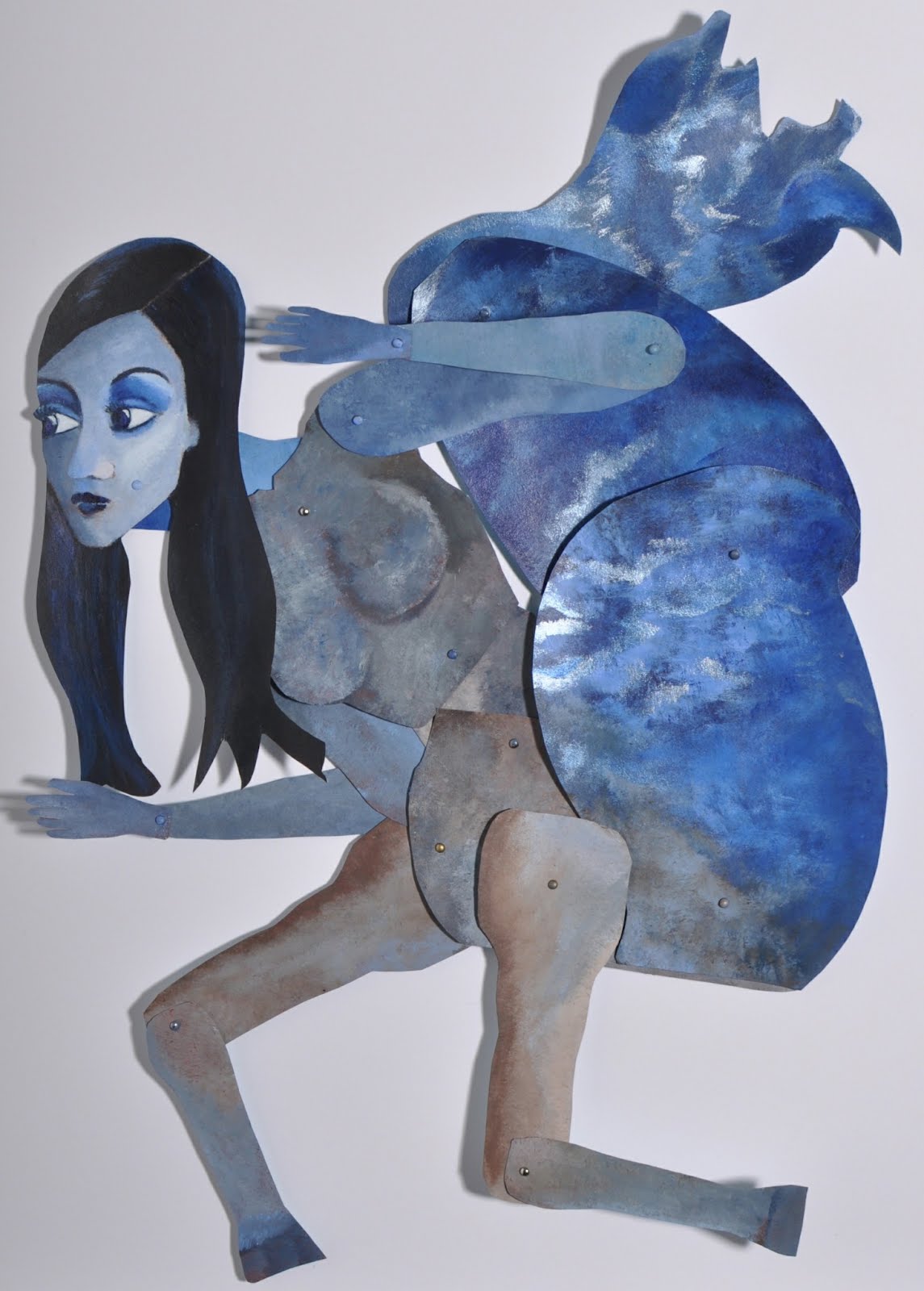
Maquette (by zoe) in the style taught by Clive Hicks-Jenkins
I've worked with this idea before, with the idea that the creatures behind the glass that he's describing, endlessly repeating the actions they see in front of them, endlessly *being* whatever they see in front of them----that those creatures are humans. Us. That we are the ones trapped in the glass, enchanted.
Borges' yellow emperor tries to keep us all the same--automatons who endlessly repeat what we see and slavishly hold to habits built before we were really conscious, when we should instead be protean, ever-shifting and changing--that is the way one lives forever (your atoms constantly shifting into other things)... a habit just has to end, at some point.
In the book Moonwalking with Einstein, Joshua Foer delves into the history of the Ars Memorativa (see link to side and also previous posts for more on the topic) during his year-long study with modern masters of that technique. He describes a patient of A.R. Luria, a Russian journalist referred to in psychological literature as S., who had an incredible, incredibly speedy memory, just by nature. His memory was so amazing, his boss pushed him to get it studied. Luria discovered that S. would see an image for every word he heard, so that the word blue would immediately put into his mind a blue flag waving from a window, and the word red instantly translated as a man in a red shirt walking towards him. Every word yielded an image, and those images held together to solidify everything he heard--to transform, as if liquid to ice, wisps of thought and the rhythms of sound into solid experiences. And so it was that he was constantly dreaming--he was awake and experiencing this life but also dreaming the symbols of meaning, right there as he spoke to you or walked or shopped for groceries. This is what the rest of us do at night, while we're sleeping, while our bodies rest and we close our eyes to keep out new information: our minds translate the events of the day into symbols that make up our internal landscape, our mind-map; it makes bizarre and fascinating and sometimes embarrassing associations (like the kinds the memory masters recommend you make when you're trying to create mnemonics), thus solidifying your memory (which isn't to say you will, without effort, easily be able to pull that knowledge into your conscious mind, later). S. dreamt while awake.
If you study your dreams, you discover those bizarre associations, you uncover why your mind made them, and you learn something much deeper about yourself.
This means that we are creatures who learn by dreaming. What could be more wondrous?
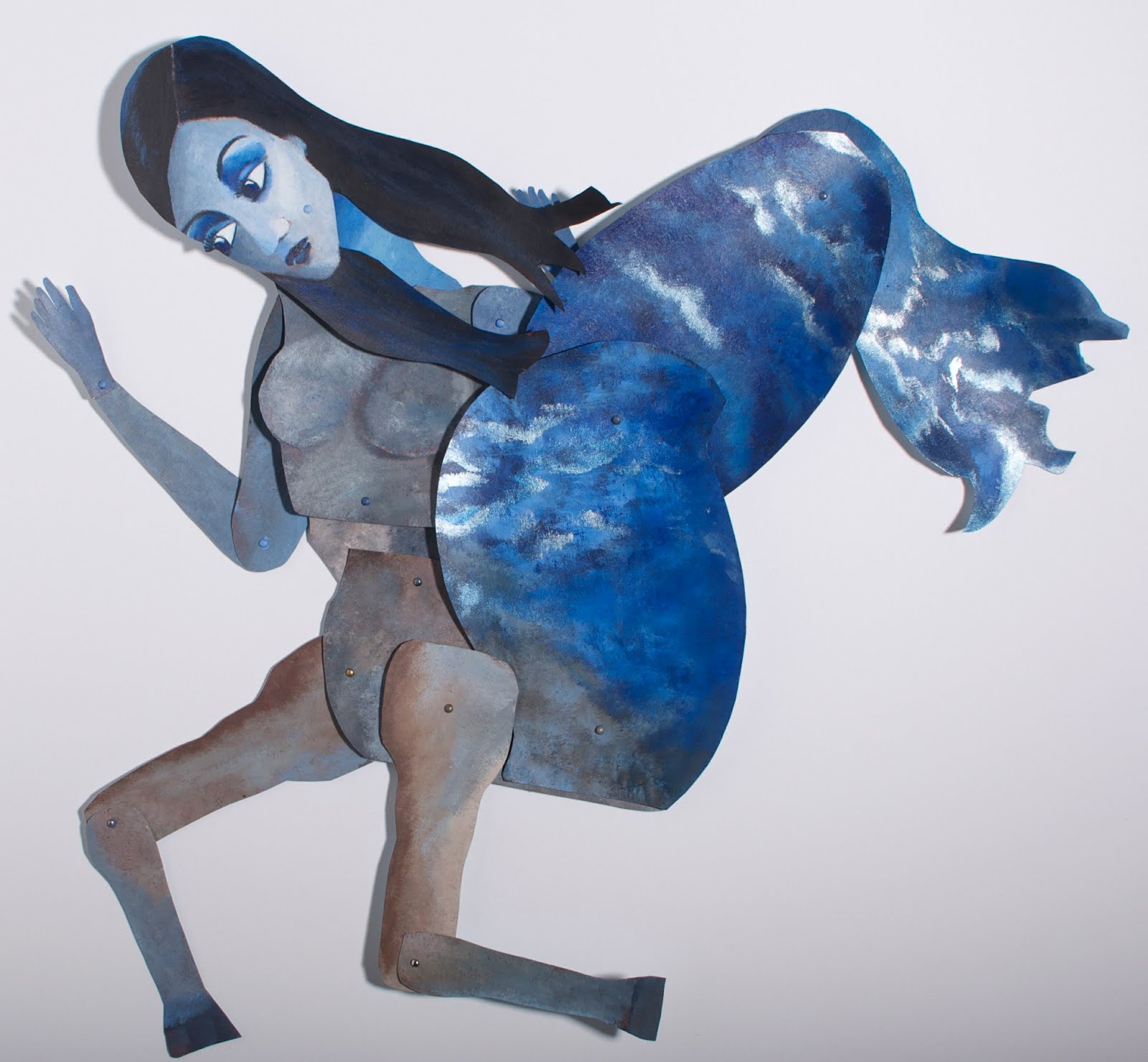
Maquette Pose II
II
Ars Memoria, or Ars Memorativa, the Memory Arts, they teach us that to remember something, we must really, really know it. And they recommend a process much like what S. did naturally.
Here is the technique, as explained by my "dream detective" (whom you may remember from HERE), Nick, to Chloe, his co-worker, and Helena, their client, who has suffered a blow to the head that gave her amnesia (obviously one of his more wordier moments):
“I have discussed with you before the Ars Memorativa. This activity will elaborate my point.” I lick my lips. “And hopefully resolve many more of our issues.” I pause to savor the flavor whiskey has given my coffee.
...
“Indeed. The Art of Memory. Memory being both the house of recall and the source of creativity. The idea is that we must truly know something in order to remember it well. The information becomes a solid prop in our minds, available for shifting, turning, placing next to other objects, and standing on its head. One mundane object, a blandly everyday sort of knowledge, stood on its head, might then yield a great invention. So, how do we come to truly know something? We translate it. Say I want to remember a particular experiment run by a particular scientist named Charles Tart. I will create a house for this knowledge, or better, use a building or an area I am familiar with--even a garden, or a walk I go on often.
Say I’m using my office building. I start at the front door. Charles Tart is entering--how will I make his entrance memorable, and how will I make his name memorable? I might think of Prince Charles, doing something lewd or violent or ridiculous. Or I might use the name Chuck, and turn our scientist into a woodchuck

(photo of a woodchuck taken from the Dover Library Site)
“--yes, and the woodchuck, instead of chewing wood, is munching on a tart. What flavor of tart...?” My mind revels in the possibilities. I sniff at them cautiously. “Granny Smith Apples,” I exclaim, “which are, themselves, tart! So, a little woodchuck, munching on a tart tart is at my front door.” I spin to Chloe. “Or do you prefer Prince Charles with a famously trashy tart on his arm?”
“Apples,” she answers calmly. “Because many other words might come to mind with the other image.”
I grin at her appreciatively. “You are a natural talent for this, as I have said many times.” I swivel back to Helena, giving her full eye treatment. I am talking about hypnosis, after all.
“Charles Tart has run many studies of hallucinated realities, especially of the consensual sort, which is the research I’d like to put in my office here, so let’s put our woodchuck in a tie-dye t-shirt. Everyone game?”
Helena stares at me warily.
“Helena doesn’t know our offices,” Chloe points out.
“This is true,” I close my eyes and take another swig of coffee. “Your point prevails. We’ll use this cafe. At the front door is a woodchuck in a tie-dye t-shirt munching on an apple tart. His eyes are running from the tartiness of it. His little nose scrunches in on itself. He smells like wet animal, but that smell is being just slightly overpowered, right now, by the wonderful, heavenly smell of baked pie crust and hot apples.” I breathe in deeply. “Are we all together?” There is no answer, so I open my eyes.
Oddly, both ladies wear the same non-expression.
“OK,” I gather my thoughts. “The woodchuck comes in, but no one sees him, because no one expects to see him, because he is a woodchuck. He jumps up and down excitedly at the sight of so many people who could be his friends, but still no one notices him. He gets upset. His tart is crumbling. So what does he do?”
These identical faces look back at me.“Come on,” I plead with Chloe. “He’s upset. He wants to see a psychiatrist, to discuss his pain. So we’ll put Freud in the room--he was willing to see all kinds of strange and unexpected things, right? Freud sees him. Freud is sitting,” I spin on my stool away from the window bar and towards the room, and the girls slowly follow, “there.” I point to the big, black leather couch in the corner. “Freud is on the couch, get it?” I grin, but don’t wait for any boring non-responses. “Freud waves our antsy woodchuck over, swings his legs down and leans far over so that his head reaches the head of the woodchuck, and gazes into his eyes. ‘You are getting very sleepy,’ he says. ‘Very, verrrrry, sleeeepy.” I draw the words out, making a little hum afterwards. “Watch the woodchuck’s eyes grow rounder and rounder, maybe they spin in circles, and the last of his tart crumbles to the floor. Why?” I pounce, to see if anyone’s listening.
“Because he’s losing his ego,” Chloe drawls.
“Ah!! The lovely Chloe!” I cry. “Do you follow?” I check with Helena.
She nods and drinks her coffee, not looking at me. That’s ok. I’m used to working like this. And I didn’t always have a lovely assistant.“So, the tart is crumbled on the floor, his eyes are spinning, and he wheels on his heel and touches the closest person, who frowns, trying to figure out what just altered in her universe. Pay attention, now. He has seemingly only chosen the closest person, but if you look carefully, you will see he has very cleverly selected the loveliest, bustiest woman in the cafe. She is wearing a bright red dress with amazing cleavage. Her lipstick matches the dress, and her hair is jet black. She has dazzling eyes. They are green. Her dazzling green eyes look down to see what is grasping her arm. The woodchuck says, ‘You are getting sleepy, verrrry sleeeepy.’”I pause only for effect, but Chloe jumps in. I knew she would like this game.
“And her red dress falls to the floor,” she smirks. “In a pile right next to his tart. Because she’s lost all ego-concerns, and has returned to her natural state of oneness with the universe.”Helena is not looking at either of us. She has her entire face crammed into her coffee cup, like she might just disappear inside.
I clap Chloe on the back appreciatively. “Well done. Indeed. Is anyone going to forget what we have so far?”
Helena makes a snorting noise into her cup. Is there even coffee left in there? Is she trying to lick the bottom?
“I can wait, if you want a refill,” I offer.
She puts the cup down, her face red.
“The point of the exercise is to make all the pieces unforgettable. When you’re doing it yourself, you don’t have to worry what others might think, and you will find, also, that once you get into the meat of what you’re trying to remember, the way you order things hones your knowledge of the material. The ancients used this method, for example, to memorize speeches or long, culturally important stories. Some users, especially in the time of Giordano Bruno, believed that they could alter their physical reality--we will get to that in a moment, although the very example we’re using here is an altering of reality. Let’s finish up.” I take a deep breath.“The woodchuck, in his own mind, is, of course, a most handsome prince. He owns a large castle, right next to the ancient oak right across the street there,” I swivel back to the window and point. I swivel back to the room. “In his mind, he is walking with the lovely lady back to his castle. Now, here’s the trick that Charles Tart discovered. Our little hungry woodchuck, who let’s not forget is in real life quite the scientist, ran some tests with college students and discovered that, A, one hypnotized person can hypnotize another person, and B, when that person does so, those two people share the same hallucination. The two college students in this landmark test went to an island and spent time on the beach together, having conversations without opening their physical mouths, and they both returned to normalcy and relayed those conversations in full detail to the scientists separately. Without time to discuss them beforehand.”
“You’re making this up,” Helena states flatly.
“Absolutely not,” I respond firmly. “Western science, my dear. The brain is an amazing world. You can look it up when you get home. In fact, please do. Now, for the Ars Memorativa, we would go through the cafe, putting details of his study in various loci, always moving in a sensible direction, on a path which we would then be able to easily follow anytime we wanted to review our knowledge of the subject. For example, in this cafe, we might start at the front door and go counterclock-wise, always, in our minds, when we are reviewing the information. That way, one thing leads to another. This way,” I point at Chloe, behaving as pedantically as possible, “you won’t have to carry that hideously, monstrously massive text with you everywhere you go. It can be displayed, like proper art, on your desk or your mantel. For the other problems at hand,” I swivel back to Helena, noting that my constant swiveling has been causing her some jumpiness, “we will take a sort of backwards use of this process..."III
This is also, basically, what an artist does: re-pairs symbols in previously un-thought-of ways to make us perceive something in our reality we have started to forget or ignore, through habit.
As Ernst Gombrich says (quoted in The Age of Insight), the biological function of art is "rehearsal, a training in mental gymnastics which increases our tolerance of the unexpected."
So that we can see more, even things and beings whose existence don’t fit within the confines of our conceptions of reality (like a woodchuck in a tie-dye t-shirt, entering the cafe eating a tart apple tart). Because science shows us (see http://zoe-in-wonderland.blogspot.com/2009/06/perceived-reality-part-iv-dont-let.html Missing the Gorillas) that what falls outside our expectations falls outside our vision. We miss it completely.
In Age of Insight, Eric Kandel credits Freud with showing that we are largely driven by unconscious forces, habits we learned in very early childhood. Modern biologist Bruce Lipton explains now that we act with our conscious minds less than 10% of the time. Gurdjieff, a philosopher in the 1900s, expressed a similar idea, only with a mildly creepier tone: that we are as automata, only alive in the barest sense, and acting automatically and without thought in general--almost always. Remedios Varo, a student of Gurdjieff, often explored this idea in her paintings:
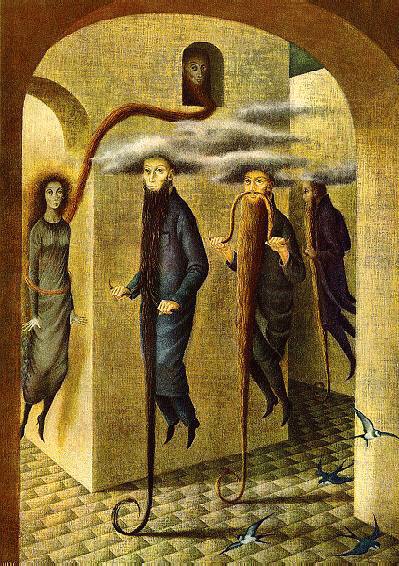
(Above and below: Images by Remedios Varo)
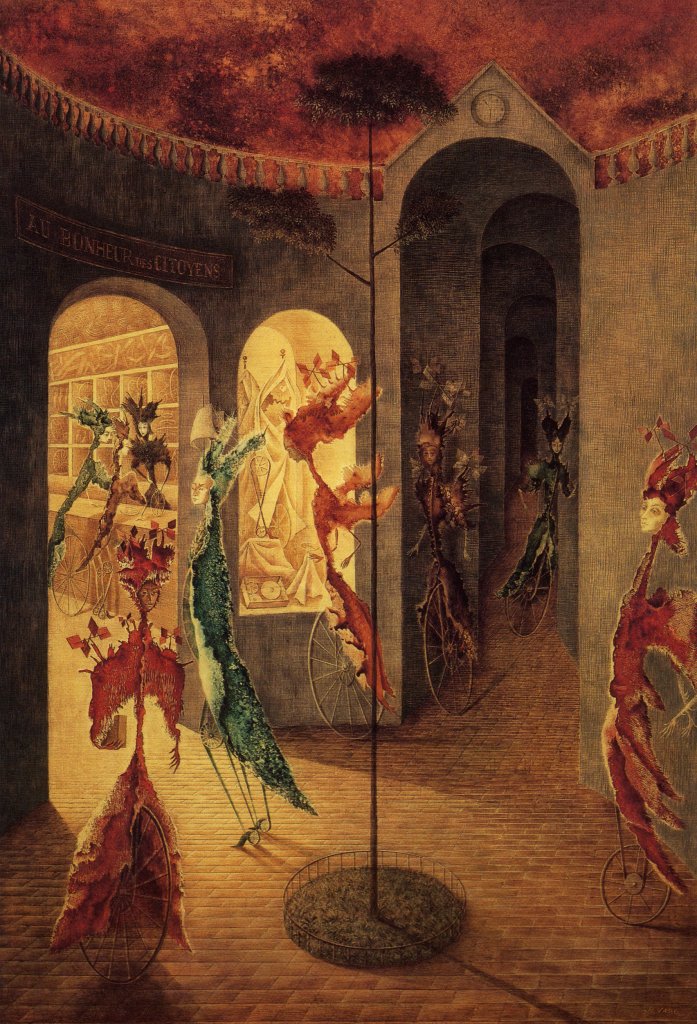
And she claimed to be a member of a group called Observers of the Interdependence of Domestic Objects and Their Influence on Everyday Life, which she described as follows:
“This group has been active for a long time and has already made some remarkable assertions which render life simpler from the practical point of view. For example, I move a pot of green color five centimeters to the right, I push in the thumbtack beside the comb and if Mr. A (another adherent like me) at this moment puts his volume about bee-keeping beside a pattern for cutting out vests, I am sure to meet on the sidewalk of the avenida Madero a woman who intrigues me and whose origin and address I never could have known...”
That idea goes straight back to the Ars Memoria. Many people in history thought that these arts could be used in a magical sense, to somehow give the student special power in the physical universe. How? By doing what an artist does, by doing what Remedios suggests above. By doing what Luria’s patient S. did:
“Let’s say I’m going to the dentist...I sit there and when the pain starts I feel it...it’s a tiny, orange-red thread. I’m upset because I know that if this keeps up, the thread will widen until it turns into a dense mass...So I cut the thread, make it smaller and smaller, until it’s just a tiny point. And the pain disappears” (32, Moonwalking with Einstein).
Just like that, he changed his physical reality.
So, how do we become less automatic beings? How do we grasp more of our power, see more of our surroundings, enjoy more of our lives? By doing something that puts what we “know” on its head. By seeing differently.
Well, slightly more:
There’s another case, just as striking, described in Age of Insight, of Josef Breuer’s patient Anna O. (Bertha Pappenheim), who suffered a loss of sensation and left-side paralysis, as well as speech and hearing problems. The description is written by Freud:
“In her waking state the girl could no more describe than other patients how her symptoms had arisen, and she could discover no link between them and any experiences of her life. In hypnosis she immediately discovered the missing connection. It turned out that all her symptoms went back to moving events which she had experienced while nursing her father; that is to say, her symptoms had a meaning and were residues or reminiscences of those emotional situations. It was found in most instances that there had been some thought or impulse which she had had to suppress while she was by her father’s sick-bed, and that, in place of it, as a substitute for it, the symptom had afterwards appeared. But as a rule the symptom was not the precipitate of a single such ‘traumatic’ scene, but the result of a summation of a number of similar situations. When the patient recalled a situation of this kind in a hallucinatory way under hypnosis and carried through to its conclusion, with a free expression of emotion [italics mine], the mental act which she had originally suppressed, the symptom was abolished and did not return. By this procedure Breuer succeeded, after long and painful efforts, in relieving his patient of all her symptoms.”It’s not just noticing the symbols--it’s immersing yourself in the emotion of a scene, and immersing yourself in the motion of change.
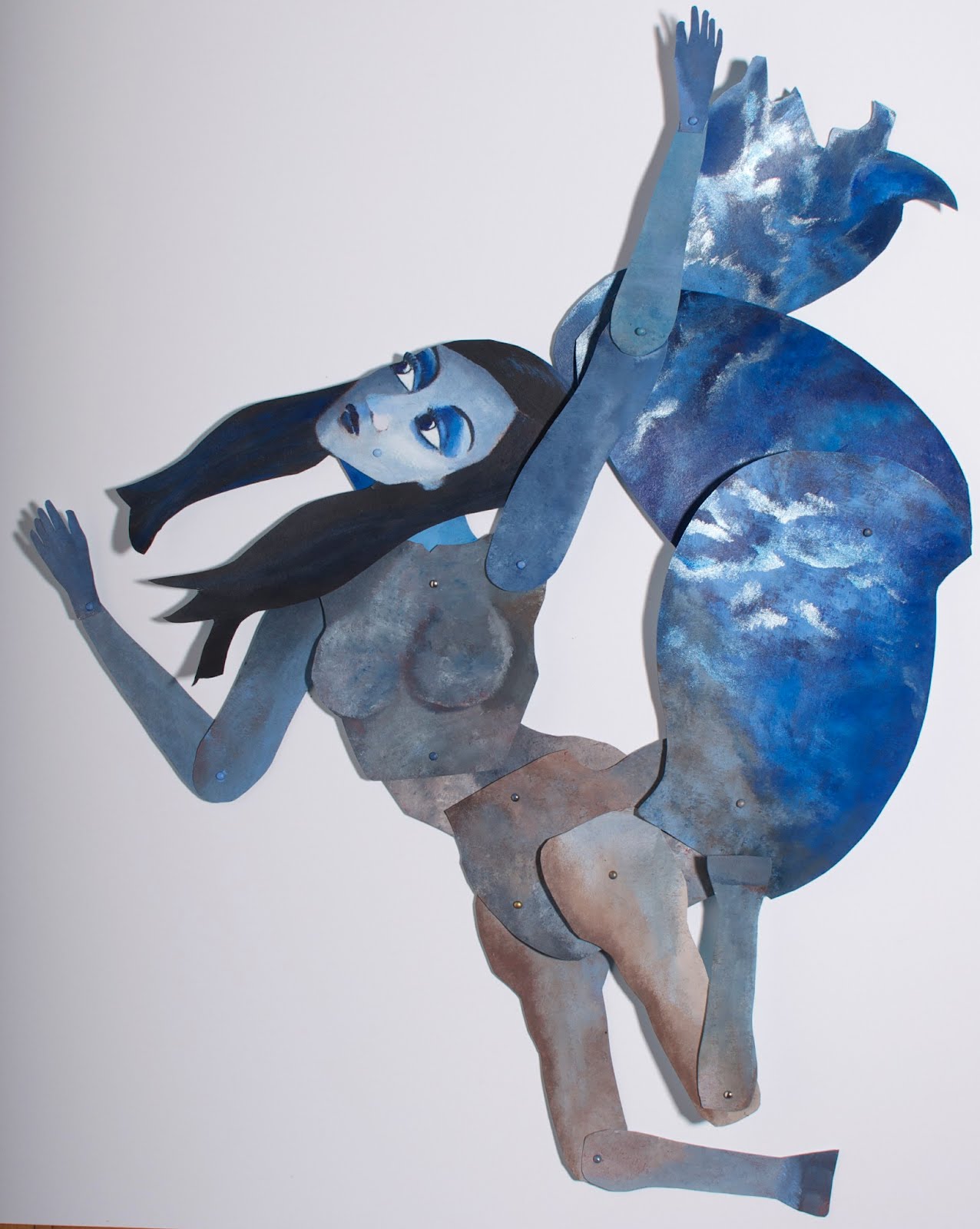
(Maquette, Pose III)
IV
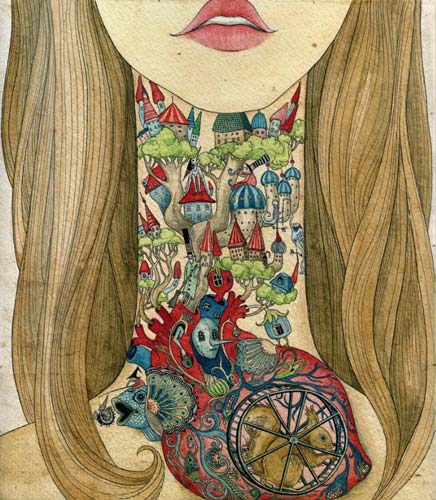
(above image by Sveta Dorosheva...Is this how we tell a story? It just all comes out, alive...)
Now, another thing I am thinking about as I work on the composition of this painting, is the artwork of Sveta Dorosheva. She has been working on a book for about three years about the human world, “as seen through the eyes of fairy-tale creatures. They don't generally believe in people, but some have travelled to our world in various mysterious ways. Such travelers collected evidence and observations about people in this book. It's an assortment of drawings, letters, stories, diaries and other stuff about people, written and drawn by fairies, elves, gnomes and other fairy personalities. These observations may be perplexing, funny and sometimes absurd, but they all present a surprised look at the things that we, people, take for granted." (Source)

(illustration by Sveta Dorosheva, matched with the Ben Franklin quote: "Man is an animal capable of producing tools.")
This is the idea: to become less automatic, because we are no longer taking ourselves and the world for granted. To be surprised, always, and attentive in that surprised way. Here is a non-human asking, What is a human? For an answer, he has Ben Franklin’s quote. And what image does that create for this non-human?
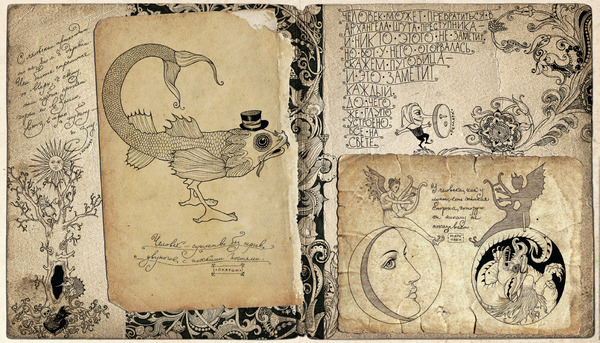
(above image by Sveta Dorosheva)
Or he turns to Plato, who says: “A man is a two-legged creature with flat fingernails and no feathers.” See it, above?
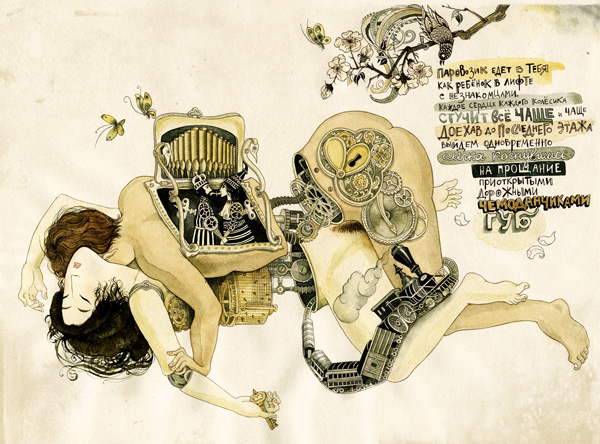
(Above image by Sveta Dorosheva)
And above? You see the mixing of flesh, or carnal activity, and machinery: opening the rib cage, you have the habit behind this act, the fairy-tale, wind-up act of love passed down through the stories of the ages-- to begin events, the woman unlocked the man with the key in her right hand. So. Will they become more than that? Of course they will ;) This isn’t a nightmare!
So, back to Borges: why a fish? Did we really evolve from the sea? Arise out of the swirling depths, the chaos, slithering until we grew feet and stood up? Could we go back? Will we ever learn to breathe in water as we do in air, thus greatly enlarging the world we can be part of? After all, our bodies are largely water! But we need land and sea, the reclining grace of a mermaid but also the forceful gallop of a horse, charging ahead. And then we need the clock parts from which we are tearing free, we need to see them flung to the side. The truth is (right now, to me): we are not, any of us, just one thing--that thought needs to strike me two or three times, each time I make a decision, every time I breathe. Everything I look at, I need to be able to see from several directions, and I can't really do that from just one mind, so I have to learn to share that space in my cranium. With, as Walt Whitman said, the multitude that I am...




 Posts
Posts