Some of you have already seen this on my Flickr page from a few days ago, but I forgot to post it here, so:

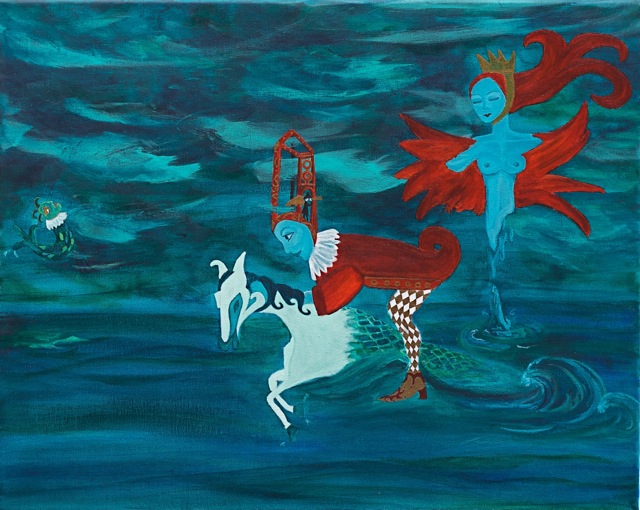
St. Ulrich and St. Afra; Agwe and Erzulie
(St. Afra's feast day is today, Aug. 5)
St. Afra (died 304) was a Cypriot woman, who was converted in Augsberg, Germany as she hid Bishop Narcissus of Girona from the Roman authorities. She was caught, of course, sheltering the bishop, and as a result burned to death (thus the wings of flame). There are conflicting stories about her, one stating that she was a prostitute in the Temple of Venus (thus she is partly formed of water, here), and the other that she died a virgin. The discrepancy in stories is one reason I chose her to represent Erzulie instead of the Virgin Mary (whom she is syncretized with in Voodoo); Erzulie is presented as innocent and virginal, but also as married to three other Loa, (one being Agwe) and having numerous lovers. For some reason, this is not a contradiction in her case. She is universally adored, all her husbands know about each other, they know of all her lovers, and they are not bitter, because they know that she has that much love. It is possible that Christianity also at one point mirrored this contradiction in Mary--why else a virgin mother, with the same name as the most beloved prostitute and the very first Christian evangelist?--but I felt that it was more succinct in the case of Afra. Also, she shares Church and crypt with St. Ulrich, who happens to be the saint syncretized with Agwe, who, as I mentioned, is one of the husbands of Erzulie.
"Voudoun has given woman, in the figure of Erzulie, exclusive title to that which distinguishes humans from all other forms: their capacity to conceive beyond reality, to desire beyond adequacy, to create beyond need. In Erzulie, Voudoun salutes woman as the divinity of the dream, the Goddess of Love, the muse of beauty." 138The Divine Horsemen
One of the most striking aspects of the traditions surrounding the devotions to Erzulie is that they always end with her weeping. Erzulie is lovely, beautiful, and she has the adoration of all men, yet she does not strike hateful jealousy in the women, because of her child-like innocence. She induces wonder and care, she is like a child. And, though she begins all celebrations in her honor filled with giddiness and pleasure at the excess of beautiful and expensive things that are always lavished on her parties, she slowly grows sad, accusing the people of not honoring her enough, not giving her enough, not loving her enough. In Maya Deren's book "The Divine Horsemen," she suggests that this is just another aspect of her child-like behavior (along with an "impatience with economies, with calculation, even with careful evaluation" 139), that you cannot give a child enough attention to satiate its need, and that those present at the devotions understand this and soothe her. I feel, however, that perhaps Erzulie is right. We do not devote enough of our attentions to child-like wonder, to endless and all-enveloping love--if we did, the world would be a much different place.
"As any water deity does, Agwe symbolizes the intuitive knowledge held within, the deep connection to eternal movements and powerful forces."
Source: Sosyete du Marche
St. Ulrich (born 890; the first saint that the Vatican officially canonized) rebuilt St. Afra's church in Augsburg, Germany, which they are both now the patron saints of, and his sarcophagus is there along with hers in the crypt. He is often, thus, shown in icons alongside her. Because of his ability to change any meat given to him or that he is giving away into fish on Fridays, he is often depicted holding fish, which is why his icons became symbolic of Agwe, the Loa of the deep waters, of the emotional depths, of the chaos before creation. He was also a good choice because many of his icons show him riding his horse across waters so deep that his companions are all drowning behind him. As I didn't want to draw drowning men, I decided to make his horse's special abilities apparent in some other way.



 Posts
Posts