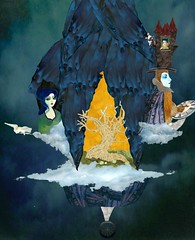
member of:Observers of the Interdependence of Domestic Objects and Their Influence on Everyday Life


This group has been active for a long time and has already made some remarkable assertions which render life simpler from the practical point of view. For example, I move a pot of green color five centimeters to the right, I push in the thumbtack beside the comb and if Mr. A (another adherent like me) at this moment puts his volume about bee-keeping beside a pattern for cutting out vests, I am sure to meet on the sidewalk of the avenida Madero a woman who intrigues me and whose origin and address I never could have known...
--Remedios Varo


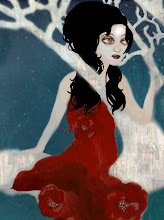
(Slideshow is of Artwork by Remedios Varo)
By believing passionately in something that still does not exist, we create it. The nonexistent is whatever we have not sufficiently desired.
--Franz Kafka

Showing posts with label black and white photography. Show all posts

Thursday, May 13, 2010

What Will Survive of Us

“To see the light we must first acknowledge that we are in the dark."
--Dominic Rouse


“What will survive of us is Love”

In an audio file on his website, Rouse explains some of the thought process behind this image.


“‘What will survive of us is love’ is the final line of a Philip Larkin poem entitled an aranbole tomb (?), a poem inspired by a medieval tomb found by Larkin in an English church, on which was a life-sized carving of a knight and his lady lying side by side and hand in hand. And the final verse reads thus:
‘Time has transfigured them into untruth/ The stone fidelity they hardly meant has come to be their final blazon. And to prove our almost instinct, almost true: What will survive of us is love.’
“It is true, is it not, that for which we will be best remembered are our acts of passion, of love? And yet, there is no earthly reason why we should love at all. Because to love is to be vulnerable. And the only place outside of Heaven where we can be safe from the dangers of love is Hell. Without love, this planet would indeed be Hell. And I would rather live in a one-roomed hovel on the outskirts of Paradise than in a luxury penthouse apartment in downtown hell....
Love is no preparation for life at all. Love is the culmination of it.”


Here, the (innocent?) girl faces the task of crossing what could simply be a parlor, but what might be, in fact, a dangerous moat, a patch of quicksand guarded at one end by a hungry, heartless alligator--jaws open and waiting. She does not know, as she is blindfolded. Perhaps this is her house, and should seem familiar. Perhaps the alligator is simply a her father having a bad day. But are you aware that alligators eat their own children? One of the aspects of surrealism is the placement of familiar things in unfamiliar settings, or the juxtaposition of familiar things in an unfamiliar way. And what that juxtaposition or placement tells us, in the end, is said to be some truth we did not previously realize or were not previously conscious of--a surprise that was always there. Here, the small child, dressed to be precious and cared-for, stands on the brink of nothing more frightening than the next room in a very large house. The placement of the alligator and the blindfold, however, bring out something else. The familiarity of one’s own home is not actually a guarantee of safety, for, as Helen Keller told us, “there is no such thing as safety.” And, there are things that are completely natural to this world which act with unbelievable viciousness and speed (an alligator, as Jaba-the-Hut-like as it might seem, can move up to 30 miles per hour over a short, straight distance such as this one), intent on ending us. But the title of this piece keeps us on track: “What will survive of us is Love.”

The blindfold is a fascinating symbol which can remind us of so many things. There is the childhood freedom of a game: spinning round and round blindly, then swinging the bat to get the candy or pin the tail of the donkey. There is no fear in that blindness, only the giddiness of guessing. Keeping that sensation seems key to all the most amazing discoveries in history--that wild, fearless, excited stabbing motion, that sense that what I want will be there, because I’m grasping for it. The lack of seriousness. I’ve written here before about how blind we are to most of reality, as we have been trained all our lives to see only certain aspects of it--how many gorillas wander by us each day, unnoticed because our focus was elsewhere?


“Angeline”

“To be a surrealist means barring from your mind all remembrance of what you have seen,and being always on the look-out for what has never been. Rene Magritte (1898-1967)

The blindfold here reminds me of a story I stumbled onto when reading about the life of St. Lucy, who gouged out her own eyes because they attracted the unwanted interest of a man. In the tales of her life, she is able to see even without her eyes, because of the very faith exhibited in that act. More recent science has uncovered cases just as miraculous, for example that of an autistic girl, blind from birth, who walks around unaided, making a little chirping noise as she goes, which she somehow uses as a sonar, as in the case of bats. The phrase “blind faith” seems apt, here. You move forward not because you know it’s safe (note the meaning-ladened snake and the vulture), not because you know what’s ahead, but because you want to move forward. The act itself ends up being somehow larger than the result.


“Tree of Knowledge”


Lenswork Magazine, an unbelievably high-quality photography magazine, has made available a folio of 15 of Rouse’s works, which you can purchase here. On the site, you can see the photos at a much better size (recommended).


“Dance for No One”

Monday, May 11, 2009

Jerry N. Uelsmann

Jerry Uelsmann works in a darkroom, creating multiple exposure images, meaning he uses many negatives to produce a single print, and sometimes as many as seven enlargers to work with one print. He started using this process in the 1950s and 60s. "He originally believed that using a camera could allow him to exist outside of himself, to live in a world captured through the lens." (Wikipedia)

According to his website, he "received a Guggenheim Fellowship in 1967 and a National Endowment for the Arts Fellowship in 1972. He is a Fellow of the Royal Photographic Society of Great Britain, a founding member of The Society of Photographic Education and a former trustee of the Friends of Photography."

Photobucket

He says:
"When I studied photography at RIT each darkroom had one enlarger. Then when I started teaching we had a group darkroom. I was still using one enlarger, which was labor intensive for multiple printing. One day while I was waiting for some prints to wash, I looked across at the enlargers and thought to myself that if I had the negatives in different enlargers and simply moved the paper, the speed with which I could explore things or line them up would increase a hundred times. That was the moment that changed the way I worked with multiple images."

jerry n uelsmann

"During the early 1960s I was the only photographer in an art department at the University of Florida at Gainesville. I worked with painters and sculptors who were interacting with their art as it was being created. That’s when the post-visualization idea occurred; that the darkroom could serve as a visual research lab. I spend much time in my darkroom building images from separate negatives, hopefully into something cohesive. My main technique involves combination printing. I did not invent this method; it was widely used by Oscar Rejlander and Henry Peach Robinson in the 1850s. When I began re-investigating darkroom options I was reminded of the saying that “nothing is new except what has been forgotten.”

"My creative process begins when I get out with the camera and interact with the world. A camera is truly a license to explore. There are no uninteresting things. There are just uninterested people. For me to walk around the block where I live could take five minutes. But when I have a camera, it could take five hours. You just engage in the world differently. If you can get to a point where you respond emotionally, not intellectually, with your camera there’s a whole world to encounter. There’s a lot of source material once you have the freedom of not having to complete an image at the camera.
Of course as I developed a way of building images in the darkroom, this also fed back into the way in which I saw the world. So if I find an interesting tree or rock I think, “Gee, that could be a wonderful background for something.” I begin to build a vocabulary based on things that I encounter and then I start photographing things specifically for use in my darkroom. I may photograph objects on a light box so they have a white background or shoot things on black velvet so I can sandwich those negatives later in the darkroom."

jerry n uelsmann

But my initial approach is very non-intellectual. I just can’t emphasize that enough. Today there is a lot of conceptually based art that begins with a particular theory and then the individual makes the images to fit. It’s like an assignment, all planned and then they just follow through and do the work. My approach is a lot less premeditated."

jerry n uelsmann


"Of course, in order to make art, the frustration of not working has to be greater than the frustration of working. I try to push images as far as I can. Sometimes I go too far, then as time passes, I think, “That was stupid or overkill” or whatever. But you have to go to those places. You can’t just say, “We have an hour to talk on the phone, let’s only be profound.” You start wherever you can and then you work at it.

For me, every year I produce at least 100 different images and at the end of the year, I try to sit back and look at them and find ten that I like. Many years, it’s hard to find those ten. "

jerry n uelsmann

“I often get called a surrealist because people like labels, and I like being part of that tradition though I don't really consider myself a surrealist. I like art that is inner-directed. I like to explore my own innermost realities.”


"Although photographers must contend with implied veracity they are always inventing other realities. The “straight” photograph does not literally replicate a scene. An Ansel Adams picture of Yosemite is not what you experience when you go there. There is always a transition that breaks from reality. Photographic veracity is an effective tool because it implies a real situation and allows the viewer to respond to it accordingly."


His wife is Maggie Taylor, whose work I have blogged about before here. She also works with a collage process of photography. Her work is in color, and though she started out using traditional negatives, she has since switched to digital processing, using a lot of 19th century images.
“I'm more interested in quirky characters, so a lot of the people I use tend to look Victorian. I see them as actors on a stage, and there is usually a story to go along with the image. But I like for it to be open-ended, so people can use their imaginations. I think we both like surrealism, but it's not a conscious thing. We both like narrative and symbolism.”
They live in Gainsville, Florida.


A Playlist of Uelsmann's photos is here

"The camera is a license to explore. It grants you societal permission to go out and interact with the world. It gives value to my life. Even if I did not have the finished images that I made, I still would be content with all the experiences that the photographing has given me."--Jerry N. Uelsmann

Sunday, April 19, 2009

Robert and Shana ParkeHarrison: Another silent post


A bizarre and surreal past/ future world. A husband and wife team using theater, collage, photography, and whatever else comes in handy to create their images. They say on their site that they are exploring the future world, an environment decimated by man's abuse, but the thing that stands out to me is the heroic magic of the man contending with that environment.
Enjoy,
Thanks to Pequenos Nadas on Imeem for the playlist.

Wednesday, April 1, 2009

The Magic of Black and White

The photography of Beth Moon:


"Beth Moon was born in Neenah, Wisconsin. Although she was a fine art major at the University of Wisconsin, she is a self-taught photographer. Her interest in photography was discovered somewhat indirectly over the course of time. Beth was designing women's clothing under her own label and needed photographs of her line. Each season, she would hire photographers to photograph her new designs until she decided to do it herself. "I never looked back," she recalls. Beth later sold the company and continued to purse her photographic interests, experimenting with various printing methods. The majority of her work today employs the Mike Ware platinum printing method that she learned while living in England." (VERVE gallery)

"Beth makes large digital negatives to contact print in platinum using Mike Ware's method - a process I find challenging even to read about!
If you're unaware of the nature of many of these historic processes, they are often only UV light sensitive, The fun side effect is you can work with ordinary incandescent bulbs on and see exactly what you're doing and who is doing what." (Brian Pawlawski)


"The Strangler Fig"

Beth Moon describes her process:
Process

I shoot medium format film and do all of my own printing. I sometimes use double exposures and multiple negatives.
There are many steps involved with creating the final print and these are as important to me as the capturing of the image.
All photographs are platinum/palladium prints. These metals are hand coated on 100% rag cotton water color paper. Since platinum, like gold, is so stable and permanent, the platinum print is the most archival of any image on paper. A platinum print can last for centuries.


High Hopes


From Beth Moon's webpage, www.bethmoon.com:
"It is hard to find a subject more challenging to photograph than ancient trees. How do I express their power and beauty to those who have never seen them? How do I convey this power and beauty to those who have?I want to speak the language of the trees. I want to photograph the spirit that dwells within them. I want to record the passion that I see come alive before me and keep a clear picture so that even if a tree is destroyed by tempest wind, disease, greed or lack of concern, I will have a record of beauty and passion for those who were not able to make the journey.

Portraits of Change.
Portraits of Survival.
Portraits of Time.

For those who have felt a heightened sense of spirit as they wandered through groves of giant sequoias in the cool morning mist, or walked among the Joshua trees in the hot desert sun, who thought they found God in the heart of an ancient yew - this is not hard to understand. You cannot help but be overpowered by the sheer simplicity, standing before the stillness of the trees, you stand still, equally bare. Trees intricate and elegant in their simplicity of form; for beauty is not found in the excessive, but in what is venerable, old and wise.

As our earth becomes increasingly crowded these symbolic trees will take on a greater significance reminding us through their grandeur and age as they stand as the earth’s largest, living monuments how essential they are to our psychology and how precious they are to the soul of the world. Some of the oldest trees have been around for thousands of years and could possibly live a thousand more. But they will not remain ecologically intact without our attention and our willingness to protect what is wild.

I photograph these trees because I know written words will not be enough. I photograph these trees because they may not be here tomorrow. I photograph out of love, and take a risk like love, to expose the source, to be exposed, and to show how vulnerable, like the trees, we all are."--Beth Moon


"Avenue of the Baobabs"

The Baobab tree is native to Madagscar, Africa, and Australia. It is also called the Monkeybread Tree, and can be thousands of years old.

According to Wikipedia,
"Having a distinctive foul smell, tree parts may have been used by primitive tribes to ward off evil spirits, making the tree known in African folklore as "God's Thumb.""

"Indigenous Australians used baobabs as a source of water and food, and used leaves medicinally. They also painted and carved the outside of the fruits and wore them as ornaments. A very large, hollow baobab south of Derby, Western Australia was used in the 1890s as a prison for Aboriginal convicts on their way to Derby for sentencing. The Baobab Prison Tree still stands and is now a tourist attraction."

"Known colloquially as "upside-down tree", it is cited in African lore: after creation, each of the animals was given a tree to plant and the hyena planted the baobab upside-down."

"Tabaldi is the name of the Baobab tree in Sudan and its fruit is Gongalis. Baobab's trunk is used as a tank to store water. People in west Sudan use the hollow in the trunk to save water in the rain season. Gongalis is used to make juice or use to cure stomach and other diseases."

"The fruit is nutritious possibly having more vitamin C than oranges and exceeding the calcium content of cow's milk."


"Kapok"

The Kapok, also known as the Ceiba, is native from Mexico down through northern South America. The bark has been used in treatments for headaches and diabetes II. Its flowers are white and pink, and their foul smell attracts bats, which it uses for pollination. Its seed pods can be used for the fiber found inside, which can provide a substitute for down. Sacred in Mayan mythology, where it is considered the Tree of Life. Its spines are mimicked on incense burners, cache vessels, and the "Crocodile Tree" of the ancient Mayans.
According to A Happy Planet,
"The ancient Mayan word for the Kapok tree means "raised up sky". The Maya believed that a great Kapok tree stood at the center of the earth. Its magnificent canopy symbolized the heavens and its flowers symbolized the stars. Today, the Kapok tree remains a true tree of life, supporting vital rainforest plant and animal life."


"Bristle Cone Pine Relic"


"The Crowhurst Yew"


"The Morton Bay Fig"

Again from Beth Moon's site:
"In dreams, the magic that weaves man and animal together glows with vibrancy; there the mysteries of the natural world are plain, the connectedness of life overpowers in a true state of being in balance with the earth. The traceries of energy that link us with the animals of forest, lake and sky are alive if we are quiet enough to see them." --Beth Moon


"The Surrogate"


"The Great Clock of Gormenghast"

Monday, March 30, 2009

Ashes and Snow: Gregory Colbert

"This collection of images and artefacts from around the world expresses a timeless realm in which animals interact and coexist with humankind."


Please go and visit the page, which is a wondrous visual experience, a dream of such a world of coexistence made true. The project includes not only photos, but letters, films which are narrated with fragments from those letters, and art installations as well. The collection originally traveled the world in a Nomadic Museum, which was built specifically for these works and evolved as the show moved from city to city. Wikipedia declares it the most attended exhibit by a living artist yet.
Most importantly, these images are not tampered with! These relationships between humans and animals are occurring!


From Gregory Colbert's page:
"Codex refers to one of the greatest contributions that Roman culture made to the world in the first century: manuscripts in the form of books as we now know them. In medieval times, bestiaries collected stories providing physical and allegorical descriptions of real or imaginary animals along with an interpretation of the moral significance each animal was thought to embody.
Codex Ashes and Snow evokes these traditions in what amounts to a poem, a field study, an illustrated collection of nature's masterpieces and a compilation of ancient artefacts and letters.
This bestiary of species [you can "flip through" 24 such marvelous books on the site], both actual [photos] and mythical [a fictional account of a year of a man's travels, told through daily letters to his wife], is made from meticulously restored 17th-century vellum bindings and handmade pages of photographic artworks by Gregory Colbert, original manuscripts, ancient maps and letters."


He prints his images on Japanese washi paper.


Ashes and Snow - Lisa Gerrard - Patrick Cassidy and Lawrence Fishbourne