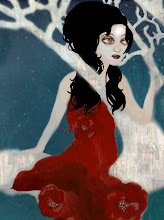
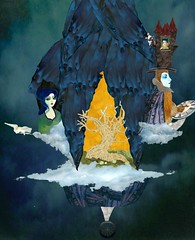
 Above: Self-Portrait, by Madeline von Foerster
If we see what we see and miss what we don’t see because of a perceptual bias, and that perceptual bias is based on cultural lessons and experiential lessons in the first five years of life, then it would seem we are forever trapped in a spiral created by things that occurred long before we realized we had any agency in our own lives. That’s the subconscious, generally perceived to be much more powerful than your conscious, and the entity responsible for subverting all those little chants (I can do this, I can do this) and plans you make in your life. You think you want to do something, but your subconscious thinks differently, and it always wins. Or you think you saw something, but really, your subconscious didn’t agree with what was there, and so it overdubbed the situation (see psych studies of the fallibility of eyewitness accounts).
The coding that your subconscious uses is symbolic. I’ve studied it often through this blog as a latent image, a sort of symbolic painting encapsulating a feeling and a series of relationships that defines how you will interpret your experiences and the world around you. To get an idea of where you are right now, you might capture a dream and pick apart all of the symbols in it--the atmosphere, location (indoors? outdoors?), the colors, the people and their attitudes, the relationships between people, people and objects, objects and objects. As was explored in the last post, architecture, geography, weather--all these things are alive, somehow, they are talking to you and you are talking to them, even though you’re not aware of those conversations. You can explore that notion through your dreams, with the intensified emotions and moods often found there, and then you can change your latent image, your map of your life, by altering pieces of the dream, sinking back into the feeling of the dream, and changing it, consciously. Then it helps to bring that image into the physical world. A painting or a collage with all the representational pieces, plus your alterations...and when you look at it, pause a moment, and feel the change that you made again. Then keep track of the seemingly unrelated changes that begin to take place in your life.
Madeline said about her above self-portrait, “During a previous period of depression in my life, I often experienced a severe sensation of pressure in my cranium. It sometimes felt so unbearable I wished I had a hole in my head! A friend told me, “Maybe you just need to be trepannated!” It was a revelation to discover that this surgery existed and was used therapeutically for centuries.”
In fact, it is a still-used process in cases of traumatic brain injuries, and there are also those who self-trepanate in an effort to reach higher consciousness. In 1965, a Dutchman named Bart Hughes performed this surgery on his own, believing that this act would relieve his brain of cerebrospinal fluid, thus allowing for more blood in the brain, which he theorized would make him some cross between high and enlightened.
In a response to a post on this painting at neurophilosophy.wordpress.com (link to the right in the blogroll), a reader named Morgaine commented: “I’m thinking that to the extent she believed trepanation might relieve pressure, painting it (imaging in such detail) could have tricked her body into thinking she was actually doing a procedure that would lessen pressure on her skull, with her belief/hope (placebo) bolstering her immune system – countering whatever functions may have gone awry contributing to her headache. But also her use of image and attention could have directly changed other facets of physiology such as blood pressure and heart rate…which in turn could have affected her headache.”
Given the choice between Hughes’ method and von Foerster’s...well. Easy choice.
Madeline came back to this post to respond to this idea, and gave another example (more difficult) of the same type of mind-body experience: “The most powerful example of this was when a musician friend asked me to paint the cover art for an album he was making, his own kind of healing catharsis ten years after his wife’s suicide. Even though the image I created was largely peaceful, there was definitely some tension and sorrow in it. During the time I spent on the painting, I experienced horrible sadness, loss, and desolation. If I had had any kind of belief in the supernatural, I would have sworn that I was being inhabited by the woman’s ghost, because I had no great problems in my own life, and the emotions did not feel like my own. But of course it was the manifestation of this imagery/symbolic neurofeedback you describe. By the end of the work I felt a sense of release and peace.”
The idea of being inhabited by the woman’s ghost is such an apt description: we take things into ourselves, much like a haunting. When we focus on a certain feeling, we bring it to life and give it a body to move around in. When we focus on pain, we give pain a body so that it may haunt the world.
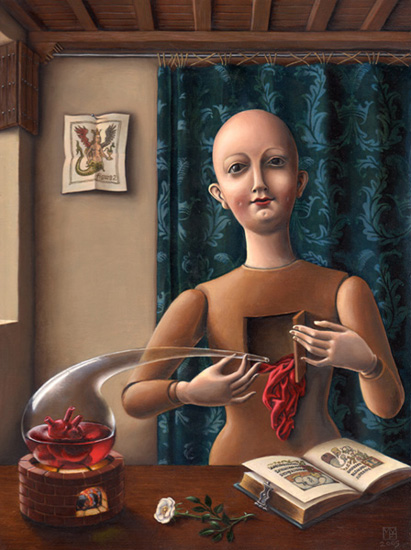
(by Madeline von Foerster)
Two major themes of Madeline con Foerster’s work are extinction and preservation. She has series of paintings based on the old Cabinets of Curiosities that were the precursors to the modern museum and on Reliquaries, those icons or statues with openings or drawers for the bones or other personal mementos of saints one finds in cathedrals.
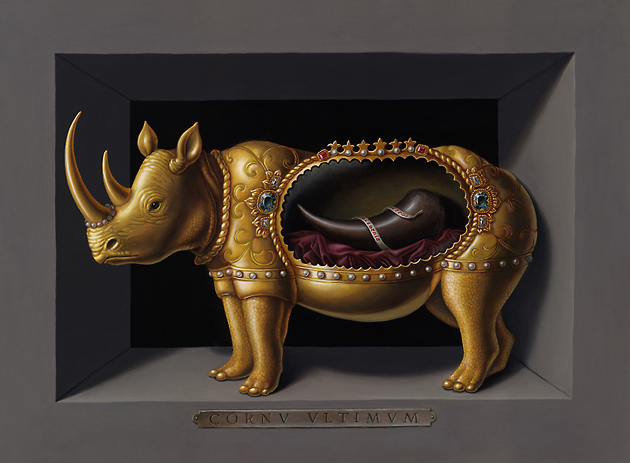
She notes an odd disconnect between those things that are so beautiful, that we love, but that we will drive to extinction in order to ‘own’ them. In a video made about her painting “The Red Thread” (below), she gives an example of that:
“...the bird called the Great Auk that was made extinct a while back and I think when there were something like 40 of the birds left...38 of the were killed for museum specimens.”
I was immediately reminded of the passage in Out of Africa, by Isaak Denisen, in which she kills an iguana to capture the color and flash of its skin, perhaps to make something out of it, and makes an important discovery:
“In the reserve I have sometimes come upon the iguanas, the big lizards, as they were sunning themselves upon a flat stone in a river-bed. They are not pretty in shape, but nothing can be imagined more beautiful than their colouring. They shine like a heap of precious stones or like a pane cut out of an old church window. When, as you approach, they swish away, there is a flash of azure, green, and purple over the stones, the colour seems to be standing behind them in the air, like a comet's luminous tail.
Once I shot an iguana. I thought that I should be able to make some pretty things from his skin. A strange thing happened then, that I have never afterwards forgotten. As I went up to him, where he was lying dead upon his stone, and actually while I was walking the few steps, he faded and grew pale; all colour died out of him as in one long sigh, and by the time that I touched him he was grey and dull like a lump of concrete. It was the live impetuous blood pulsating within the animal which had radiated out all that glow and splendour. Now that the flame was put out, and the soul had flown, the iguana was as dead as a sandbag.
Often since I have, in some sort, shot an iguana, and I have remembered the one in the Reserve. Up at Meru I saw a young Native girl with a bracelet on, a leather strap two inches wide, and embroidered all over with very small turquoise-coloured beads which varied a little in colour and played in green, light blue, and ultramarine. It was an extraordinarily live thing; it seemed to draw breath on her arm, so that I wanted it for myself, and made Farah buy it from her. No sooner had it come upon my own arm than it gave up the ghost. It was nothing now, a small, cheap, purchased article of finery. It had been the play of colours, the duet between the turquoise and the 'nègre' -- that quick, sweet, brownish black, like peat and black pottery, of the Native's skin that had created the life of the bracelet.
In the Zoological Museum of Pietermaritzburg, I have seen, in a stuffed deep-water fish in a showcase, the same combination of colouring, which there had survived death; it made me wonder what life can well be like, on the bottom of the sea, to send up something so live and airy. I stood in Meru and looked at my pale hand and at the dead bracelet. It was as if an injustice had been done to a noble thing, as if truth had been suppressed. So sad did it seem that I remembered the saying of the hero in a book that I had read as a child: "I have conquered them all, but I am standing among graves."
In a foreign country and with foreign species of life one should take measures to find out whether things will be keeping their value when dead. To the settlers of East Africa I give the advice: 'For the sake of your own eyes and heart, shoot not the Iguana.'”
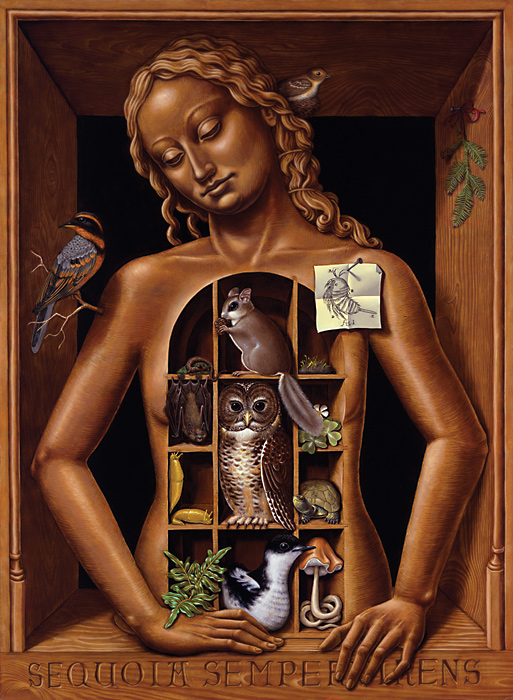
Redwood Cabinet, by Madeline von Foerster
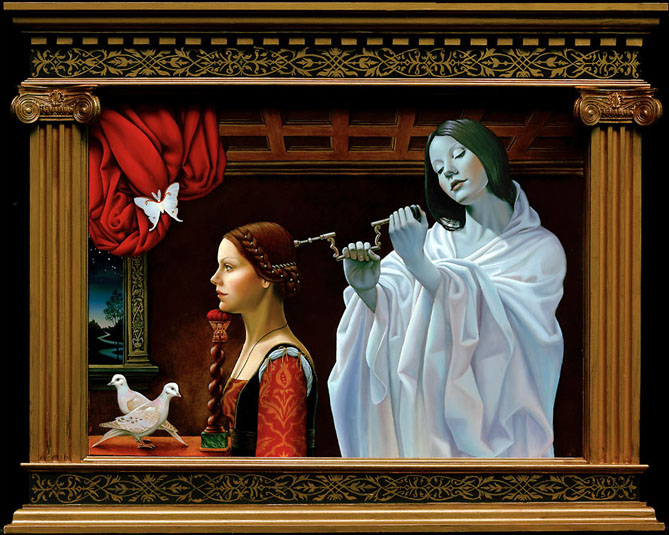
Madeline says: “The wooden ‘cabinets’ in my paintings typically represent a single tree species and are filled or surrounded with other species that rely on the tree (or the ecosystem where it grows) for their survival” (Source: Orion, June 2011). Through the glow of her spectacular technique mixing egg tempera and oil paints, and by pulling together as many of the ‘collection’ of interacting entities as she can, she returns color and life, at some level, to these endangered or missing species. This act can have larger consequences than you might think.
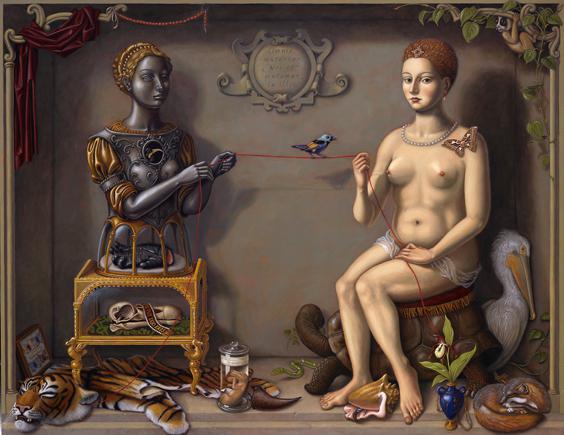
Above: The Red Thread, by Madeline von Foerster
The process, to me, ties back in with the whole idea of a latent image: she is re-imagining the world with these beings in it, in full color and vibrancy, and she is reminding us, by showing us their beauty through her wonderful technique, that we love them. In the above painting, The Red Thread, your eye can move left to right, from loss to life, the thread/vein of those now extinct is re-infused with life (perhaps by the bird?) and goes through the arms of the female, and into her lap, from which it trails to living, breathing creatures. I almost like to see the turtle melding with the pelican to create some other, not-yet-know creature, a cryptid, perhaps. There are those who face the world’s ridicule and bravely strike out to seek such cryptids, and to seek out those creatures we believe to be extinct. And sometimes they find them:
“Recently, researchers in Tanzania spotted a Lowe's servaline genet, a graceful, mongoose-like carnivore last seen in 1932, and widely considered to be extinct. Not long before that, the golden-crowned manakin, a South American bird, resurfaced for the first time since its discovery in 1957.” --(Source: When "Ghost" Species Return From Extinction; Scott Wiedensaul;Special for National Geographic News; July 9, 2002)
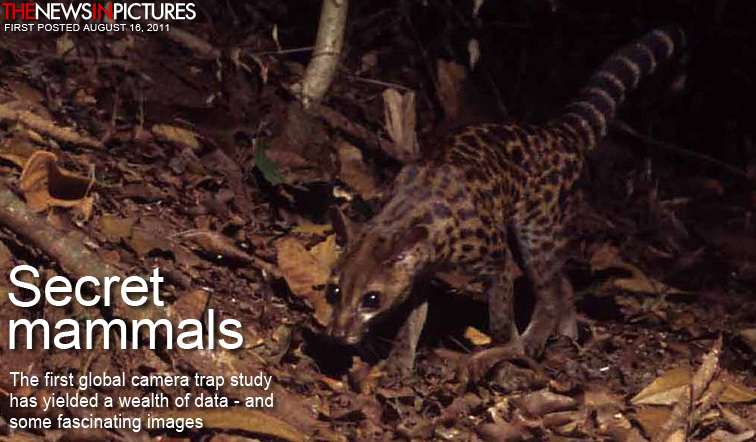
Above: the genet: Photo: Museo delle Scienze (Trento Museum of Science) as part of the TEAM Network Partnership/ www.teamnetwork.org
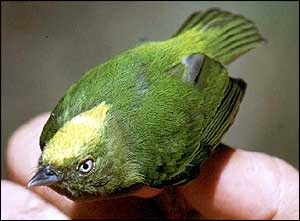
Above: the golden-crowned manakin, photo by Fabio Olmos
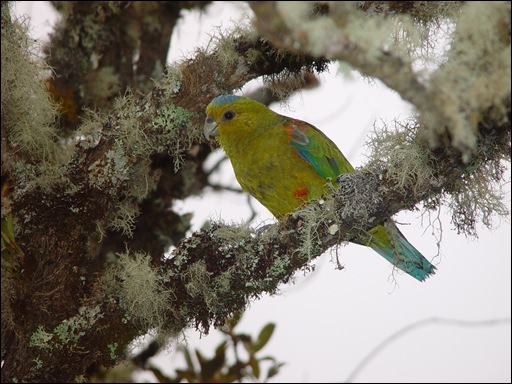
Above: the rediscovered Fuerte’s Parrot in Colombia. Photo by ProAves Colombia
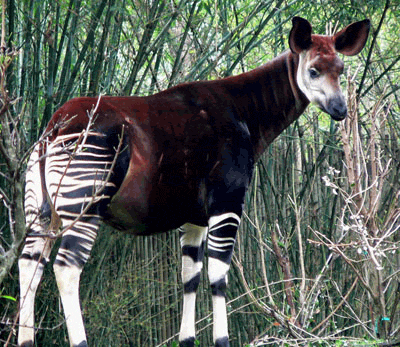
The Okapi, also believed for a long time to be extinct. Source: http://www.learnanimals.com/okapi/pictures.php
Look at the amazing patterns and color! How could you miss this animal?
...
“On occasion, the ghosts return after an absence that covers not decades, but centuries. The plump seabird known as the cahow, or Bermuda petrel, was considered extinct as early as 1620, eaten out of existence by hungry Europeans who plucked the tame bird from its nest burrows. Yet in 1951, a tiny colony was found on a rocky islet off Bermuda, where they had managed to avoid notice for more than 300 years. Nor is that the most extreme example. In the Canary Islands, a large species of lizard was rediscovered in 1999, a full five centuries after its supposed extinction.” (Wiedensaul)
This is magic: look again. I’ve argued many times here that by seeing a harmful and vicious world, we make it so; by focusing on stories of doom and hatred and the endless cycle of killing, we make those stories stronger and more real. They reverberate in the universe and come back to us, the echo hollow and pained. Magic is where we focus on the story of something else, thereby making it more real. Imagine being the intrepid explorer that insists she will find a new cahow. She wants a world with a cahow in it, and she goes off on the most ridiculous, scientifically unfounded search one can imagine, calling upon herself the ridicule of her entire professional community and anyone else who might happen to pass the television when her expedition is mentioned. She (or he) changed the world.
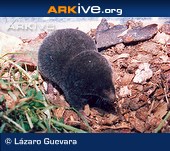
Nelson’s small-eared shrew; photo by Lazaro Guevara
For 109 years, the shrew was believed to be extinct, until Fernando Cervantes and Lazaro Guevara went searching for it in the forest slopes of the San Martin Tuxtla volcano. To imagine the difficulty of this ridiculously impossible search, take out your ruler. The shrew is less than 10 centimeters long from nose to tail. They live on this volcano, which erupted in 1793, destroying every living piece of vegetation around its crater--vegetation which regrows to be a cloud forest, one characterized by having a persistent canopy-level cloud cover.
Yet they found them. Nelson’s small-eared shrew lives.
One more: for the past 60 years, the Ascension Island parsley fern was believed to be extinct. In 2010, Olivia Renshaw and Stedson Shroud were repelling down the island’s Green Mountain, a steep volcano, when they saw--by chance-- 4 tiny, sickly parsley ferns. What is spectacular about this story is that they were not only able to see this plant, know that they were seeing it, believe it--and see from the image below how tiny it is--
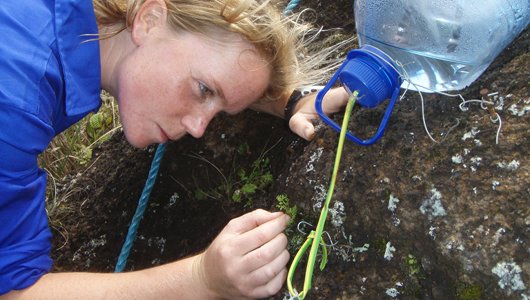
Image by ZUMA press.
but they also were willing to slide down the volcano side, surrounded by safety ropes and the imminent threat of death, twice a week to nurse the plant back to health. Then they collected a few small sample spores to take to London’s Royal Botanic Gardens at Kew, where 60 are now growing in cultures.
Wiedensaul ends his article by saying: “This is still a wide and infinitely surprising world we live in, and...conservationists have learned never to say never when it comes to lost species.”
Madeline says something very similar: “It is my hope that art-makers worldwide succeed in our mammoth task -- that of changing the current omnicidal tide of culture -- before everything worth saving on this planet has been razed, or eaten. I believe there is still time to make a new myth. There is still a chance for imagination to rise to power.”
And she is leading in that rise with her work, is she not? Thank you, Madeline.




 Posts
Posts