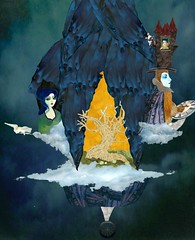
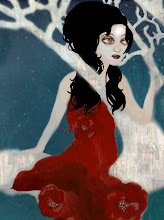
member of:Observers of the Interdependence of Domestic Objects and Their Influence on Everyday Life


This group has been active for a long time and has already made some remarkable assertions which render life simpler from the practical point of view. For example, I move a pot of green color five centimeters to the right, I push in the thumbtack beside the comb and if Mr. A (another adherent like me) at this moment puts his volume about bee-keeping beside a pattern for cutting out vests, I am sure to meet on the sidewalk of the avenida Madero a woman who intrigues me and whose origin and address I never could have known...
--Remedios Varo


(Slideshow is of Artwork by Remedios Varo)
By believing passionately in something that still does not exist, we create it. The nonexistent is whatever we have not sufficiently desired.
--Franz Kafka

Showing posts with label contemporary painter. Show all posts

Saturday, January 18, 2014

Maki Horanai: Creating the Universe


by Maki Horanai

Ocean whispers.
I am hopping on that sound.

Feeling the tickle of the roots from my toes,
I am departing from the ground.

My bird soul is gently lifting off,
Simply defying gravity.

Brushing the Moon and the deep Sky,
Into the Gold background I fly.

                   --Vesna

by Maki Horanai


Maki Horanai's paintings are moments in which quietly-focused beings create the details of the world we find most startling or inspiring.
Above, the figure pulls the sky over the burning gold fire of the firmament, perhaps to 'ease' the burn of the sun and stars, protect our fragile flesh, allow us life. The sky crosses outside of the canvas, reminding us that this is not a painting, it's an act, a moment of magic which directly affects us. Birds cross from the sky, across the gold and into the red (pulse of life) of the dress, their flight covering layers of being... It is an act of love, a defiance of gravity.

Maki Horanai: Creation of the Forest Song
In Creation of the Forest Song, the mother and child have created a nest, with an egg or a piece of land/rock and a small sapling, to give the bird a place to safely create its song. At the table are other little bits of creation. The child (with a 'child-like' eye, curiosity, and faith) is the one with angelic wings, the one who has produced the safe place for the little bird.


"Carried Away," by Maki Horanai

A figure reads a book, the ideas working through his mind and body via the pedals and wings and pumping upwards, again into a billowing cloud of golden flame (the fires of creation), to make a small community, a place of human life, trees, mountains, a lake. The ideas grow wings, become alive, real...

by Maki Horanai
And another such beings rides a horse, carrying a small rock or egg with life creeping out of it in the form of a small, glowing seedling. Civilization seems to grow only as a development from this creative impulse and focus and care; the horse itself is stone and yet the figure rides, and spanning out from the pair are cities, and three significant stars, like some cross between the 'Guiding Light' and the three wise men.


by Maki Horanai
by Maki Horanai
She creates the window frame and a square of blue sky for the bird out of endless space; on her back is a hand-wound gramophone to teach the music.

by Maki Horanai

by Maki Horanai
"My work has been strongly influenced by the nature of my childhood. I grew up in snowy villages along the sea coast in northern Japan. The severe power of the ocean, together with the pure, clean, quiet atmosphere are deeply embedded in my memory. When I was sleeping, the sound of waves was always in my ears. Away from city lights and tall buildings, the stars and moon were always present overhead at night.
I adore the gold background of old paintings of both the east and west, and, as I started to paint, elements of this style surfaced in my work. The works of Giotto (14th century), Fra Angelico (15th century) and Kano Eitoku (16th century) have particularly impressed me.
I’m not consciously aware of the meaning of my paintings as I work. If I know it, then probably I can’t paint. Towards the end of each painting, stories make themselves known to me."--Maki Horanai

by Maki Horanai

by Maki Horanai
The text: "Some years ago I was standing on the shore, watching the crescent moon in the sky. It was very close to the ocean, almost touching it...I was wondering what kind of sound the moon makes as it descends into the sea." The painting on the left is "The mind in the heart of the moon," the center painting is "on the path down to the sea", and the third is "spinning slowly."

by Maki Horanai
"Nurturing Music" by Maki Horanai

"Unfinished Constellation" by Maki Horanai
She now lives in Queensland, where she holds yearly exhibitions at Marks and Gardner Gallery on Tamborine Mountain.
"Moments of Connection with the Universe," by Maki Horanai
by Maki Horanai
Discovered Via Birdy, who also is offering for the second year the Snail Circle--this was really wonderful the first year and I encourage *everyone* to join: you are paired with one other snail-mailer per month, to whom you send a hand-written letter which includes (along with whatever else you write) a passage from a book by which you are currently being blown away. From this, you are certain to be exposed to many new books you otherwise would have missed, and many new friends all over the world. Join us by dropping her an email.

Wednesday, November 23, 2011

Now Showing: Clive Hicks-Jenkins and the Miraculous


“The Rapture,” by Clive Hicks-Jenkins
The story of the Archangel Raphael includes many adventures and extends to the sounding of the trumpet at the end of times and the beginnings of the day of Final Judgment. He is the Angel of Healing Waters, blowing along their surface to remove whatever suffering is within them. He is also the companion of Tobias, a young man betrothed to a woman so cursed her seven previous engagements ended in the death of the fiancé on the night of the wedding. He instructs Tobias to catch a fish from those waters over which he holds such sway, and he burns the heart and liver to drive away the demon that defeats her so, then uses the gallbladder to heal his father’s blindness.
This is an angel that sees all; you can see that much from the expression on his face. He sees the beginnings of our world in the chaos of the waters and the ends of them are carried in his breath, part of which is always held in waiting for God’s command to blow the final trumpet. In Clive’s above portrayal of Raphael, you can see the foliage embroidered on his jacket; the wings hold the waters of the earth and the waters of chaos, the feathers of birds, and the constellations of the night sky. He carries the universe and all its stories and maps—imagined, fantasized, and followed--on his back.
And from all that, he can give to us the gift of a second sight of sorts, and here he does. We are presented with a dizzying aerial view, a very full view of the earth. To Tobias, who is turned away from us, he gives some other, secret knowledge not imparted to us. And yet another view is present: the dog’s. Clive’s Jack, carried along in the fray, sees *us*.

The above painting was the result of a collaboration with the poet Damien Walford Davis.
The Rapture 

Earlier that day,
sensing something archangelic in the air, they cordoned off .

the cool piazza, locked the domed
basilica, closed the crossing .

to the island charnel house and church.
When the quattrocento stage was set, .

they sent the scapegoat out, the lure –
fishing-rod in hand, patched terrier .

to heel – and drew the blackout curtains
close. When he walked in later, .

brilliant as the fish he held, they gathered
round to touch his suit and sun-bleached .

hair: So did it speak? they asked, afraid;
What colour were its wings? And did it .

burn? No words, he said, or fire;
but from that height I saw beyond .

the valley to an exit road where drones
then jetplanes strafed a speeding column .

black, and men crept into holes, their
pounded flesh the many colours of his wings. .

Damian Walford Davis 2011

“Nest” by Clive Hicks-Jenkins I have written about Clive’s portrayals of St. Kevin and the Blackbird and St. Herve and the wolf before [here] http://zoe-in-wonderland.blogspot.com/2009/10/creatures-of-earth-art-of-clive-hicks.html, but for his new show at the Martin Tinney Gallery in Wales beginning November 24, 2011, the evolution of his portrayal of these saints has been amazing, unfolding their stories in new directions and reigniting the potency of their meaning in our lives. This new collection of works seems to emphasize the idea of the entire world being present in the form of a Guardian, in this case a saint. In the story of St. Kevin, a bird comes to rest in his outstretched hand and stays to build its nest and lay its eggs and raise its young to first flight. The saint carries the life and safety of the forest in himself for the bird, and that incarnates as foliage on his flesh. After studying these works, you could enter the forest and see the larger shape of St. Kevin embracing you; as you peer up at the night sky, you could see, outside the smaller forms of the tales of Gemini, Cygnus, and Ursa Major, outside the patterns we use to map out our histories and our futures, the overarching story of Raphael and his healing waters. His wings alone carry all our stories of suffering and its defeat; they are larger than any of those stories—larger than all of them, even. He is himself giant and Romanesque, and the weight of all he carries and all he sees is present on his face. And it is therefore not ours to carry. That’s important. And it is the purpose, isn’t it, of those stories?
“Held,” by Clive Hicks-Jenkins This all-encompassing form is even more interesting when we think of the boxed-in sensation of the story of St. Kevin: he is trapped, in one spot, for the entire building of the nest, the gestation of the egg, and the birth and total dependence of the chick until it is able to leave on its own. The shape of Clive’s drawings underlines that sensation: St. Kevin barely fits the frame, his muscular torso contorts painfully. Yet he becomes the tree, the foliage sprouting across his chest, an impossible patience taking root within him—he creates the world the bird needs; he becomes it. Of tattoos, Clive notes: “…the irreversible is always alarming. But then life is irreversible, and that’s what makes it poignant, exciting, tragic…indeed just about anything you care to call it.” And in fact, the bird has already flown off in these new images, underlining the permanent, irreversible aspect of his decision: he is still rooted to the spot, growing into the landscape that chose him.

“Tobias and the Angel,” by Clive Hicks-Jenkins Clive writes: “The large chiaroscuro study of Tobias and the Angel (the detail above repays clicking on to see a magnified version) is progressing in rather unexpected ways. I’ve been exploring tone and texture to conjure angelic wings and garments that are a step onward from what I’ve attempted in the past. Something happened with the mark-making, transforming what I’d intended to be a tweed-textured jacket into a weave far stranger, almost suggesting a matador’s glittering ‘suit of lights’ oddly combined with the spotted markings of a big cat. This wasn’t at all the direction I’d planned, but now I’m hooked.” These marks then developed further, through a hearty back-and-forth with the readers of his artlog (a lively and energetically collaborative space in itself), to show constellations, smoke, plumage, and water. All this would later have to be translated to the color “version:” “Just the base colours of phthalocyanine blue and cobalt turquoise being worked in at the moment, after which I’ll start laying in the patterning. It’s a long job as the markings suggest turbulent waves, flow patterns, constellations and overlapping pinions, so there’s nothing for it but to keep my concentration fixed and to work work work…” [then] “Back to wings again today, and the task of suggesting colour, iridescence and texture. Water-flow, pinions, ruffles, scales and constellations of stars are a few of the ideas worked into these. Paint has been brushed, smeared, sanded back and scratched through with engraving needles. It’s a slow process but I’m getting there.” Though many of the works for this show are done in black conte over white Arches paper, the acrylic works that he has created show an amazing development of color. A palette already phenomenal—truly, the first thing to draw me into his works in the beginning—has become miraculous. The glowing honey color of Raphael’s jacket, the astonishing shimmer he has created in the wings, and the blues of St. Herve’s face are the openings to a new world in themselves. See the peace in Herve’s face tucked up trustingly against the wild snarl of the wolf. See again, that eye: the central eye of the piece, the wild wolf that sees you watching him, and is not moved.
“Hold,” by Clive Hicks-Jenkins

Friday, February 12, 2010

This One's for the Ladies...Part II

There's More than Two Sides to Every Story


Like previously blogged artist David Hochbaum, Jon Todd is an artist who likes messy-hands work. He outlines his painting, begins working on details, then takes a sander to those details, roughs them up, paints over them and etches back through the top layer to the paint below. He'll screen print over parts, wallpaper others, and pull out a sharpie to make a point somewhere. So the history of the piece is like the history of your life, the history told on your skin in a long, intertwined ink-tale of tattoos, the history of your surroundings told in the clothes you're wearing, the accent and rhythm of your speech, the tilt of your head and the fluttering gestures of your fingers when you keep your mouth shut: the details of your life, carefully worked upon and then smothered by events, re-worked, and then reworked, and then abused and reworked some more. These ladies are not ladies who grew up in elegant homes with lots of help getting dressed--they are tough, thick-skinned, and their eyes draw you into another world, a world they have control over.


“Diamondback Debbie”


“The Snake Handler”

Notice that in the “Snake Handler,” the snakes she’s handling are firmly embedded in the rather large biceps of the rather large man behind her. She looks pretty calm, all things considered.

About his process of creating a work of art, Jon Todd says:

I start with a naïve sketch so I can change things constantly. I love making “happy mistakes.” I am not afraid to kick the crap out of a painting, if it makes the end result unique and pleasing to the viewer. For example, I've spent hours painting detailed tattoos – realizing it was too clean – and then ran it through the belt sander, which made an awesome smearing effect. I've also poured rubbing alcohol, scraped, gouged, and even lit my painting on fire with a blowtorch.


“Two Wrestlers”
You’ll notice many of his characters, like the ones above, and the guy whose snakes are being handled above that, wearing masks like those of the Mexican Wrestlers. In the Mexican “Lucha libre,” these masks are worn as archetypes, symbolic of the character the wrestler is invoking, the spirit under which he is fighting. Taking off an opponent’s mask is akin to sacrilege, and can result in the banning of the the wrestler who performed the act. Here, the masks are permanently embedded in the skin in a brightly colored tattoo--not the basic colors of the usual masks, but a vivid, variegated display of paint or little mosaic tile more reminiscent of the ancient, glimmering aztec monuments. A fusion of sorts between a modern cultural mask and an ancient one.

Difficult histories:
Jon Todd’s work is full of stories that spill across the background and onto the skin of his characters in intricate tattoos. His tattoos are a wild cross of Russian prison tattoos, the Japanese irezumi, and Mexican symbolism. In the Russian prison symbolism (see the example below), each point on a star represents a year in a Russian prison. Skulls are worn by murderers. An epaulet refers to time in solitary confinement. The cat tells us his wearer spent his past life as a thief, with several cats together marking him as member of a ring of thieves. A cross protests slavery, bondage. Barbed wire across the forehead means what you might think: the head wearing it will never be free.


“Crowned Cats”

But it’s not only the symbols of the criminal element he includes in his stories. Here we have the mosaic-tiling and halo style of ancient Byzantine artwork, the grinning colored skulls celebrating the dark joys of the one day of the year Mexicans can reconnect and commune with their dead, a beautiful, Edo-style Japanese woman in a kimono, even a Bodhisattva.


“Open Palms”


‘Kimono”


“Capo”

And although Irezumi is something very tightly associated with the Japanese mafia, or Yakuza, and though for many, many years, body-tattooing was used in Japan as a form of punishment, there is also, as always, another side to the story. According to artelino,
In 1827 the ukiyo-e artist Kuniyoshi Utagawa published the first 6 designs of the 108 Heroes of the Suikoden. The Suikoden were something like ancient Robin Hoods - honorable bandits. The story is based on a classic Chinese novel - Shui-Hi-Chuan, that dates from the 13th and 14th century. The novel was first translated into Japanese in 1757 by Okajima Kanzanion. At the turn of the 18th to the 19th century the story was published with illustrations by Katsushika Hokusai. The novel of the 108 honorable bandits was very popular in Japan and caused a kind of Suikoden craze among Japanese townspeople.

Kuniyoshi's Suikoden ukiyo-e designs show the heroes in colorful, full body tattoos. Japanese tattoo prints and tattoo art in general then became stylish. ...It produced a kind of craze like the Beatlemania in the sixties. Everything connected with the Suikoden was suddenly iki--cool, trendy...

The story of the Suikoden and the subsequent print series by Kuniyoshi was also the ignition powder for the fashion of Japanese body tattoos. Tattoos became popular among people of the lower classes like construction workers, prostitutes and the infamous fire wardens. The latter were admired by the public for their courage. But they had also a reputation of wild, drunken ruffians who could become more dangerous than the fires.


Just as in life, there is a rough and ever-changing balance between what is seen as brave, and what is criminal; what is trash and what is art. A tattoo, in general a permanent mark on one’s body, tells a particular detail of one’s life story through all those phases, meaning the wearer has to be prepared to own that story regardless of the changes in social mores and opinions. And it is perhaps from that pride, from that refusal to hide scars, scary tales, demons, crimes and misdemeanors--from that insistence on one’s own story of oneself above all other stories--comes the challenge in the eyes of these ladies.


“Enter the Dragon”


“Serpent Bella”


“Two Samurai Women”

In the image below, for example, the same woman wears a military uniform, typically representing law and order, yet pinned to her breast is the same prisoner star we saw amongst her tattoos in the less-dressed version of her above. Still, she wears the Byzantine halo, signifying a holy person or saint. And then there’s her hair, a rich shimmering of snakeskin, which itself could stand for any number of things, depending on the cultural perspective of the viewer--or even just the cultures represented in the rich symbolism of this particular painting: there is, in the Byzantine Christian mythology, the master of deception who ended our residence in the Garden of Eden; in Mexican history, the Mayan Gucumatz, the plumed serpent god that created humanity; in Japanese history, it is often conflated with the dragon, a protector of jewels, pearls, and wisdom? According to Wikipedia, “The serpent was a very important social and religious symbol, revered by the Maya. Maya mythology describes serpents as being the vehicles by which celestial bodies, such as the sun and stars, cross the heavens. The shedding of their skin made them a symbol of rebirth and renewal.” In medicine, the snake’s venom is a thing to contend with, however, a certain amount of it could bring expanded consciousness or even healing, and the intertwined snakes that now form the symbol of the medical community come from the rod of Asclepius, an ancient healer whose symbol was itself linked back to the staff of Hermes--who was not only the god of magic, including smooth speech and ingenious invention, but also of thieves, again showing us the many layers present in a single story. So here, her hair is wrapped in snakeskin, or is made up of her own shedding skin, which could mean that she’s duplicitous, a speaker with a forked tongue, or that she’s shedding one layer of her life to enter the next, or that she’s shedding this life, life itself, in order to be reborn into the next. Maybe the shedding of her skin is the step where she peels this story of her life off completely, and enters that ethereal realm (heaven?) where she is chained to no identity, no story, and can begin again.

Tuesday, December 1, 2009

The Wisdom of Dreamers


“Playing with your Heart”


“Fixing your Heart”


Detail

Skount (Raúl Garcia Pereira) is an artist in the fullest sense of the word--he’s studied culinary arts, makes music, and draws or paints all over whatever material he can get his hands on. He started in his pre-teens, with the discovery of a piece of graffiti in his hometown. He realized that art was everywhere, and that he, too, could make it, and he embarked on an exploration of that realization, becoming one of the most well-known graffiti artists in Spain, later traveling all over the world to create commissioned works.


graffiti by Skount


“Open to Fix Me”

Graffiti is an interesting sector of the art world, as it democratizes the field in that materials are very cheap: the canvas is free, and the spray paint needs no brushes or other tools. The art form itself sounds more than a little Buddhist, as well, when you hear Skount describe it: “A graffiti on a wall can last an hour, a week, or months. You never know. It’s just a part of the deal. You either accept that or you don’t paint.” That’s not always because of cleaning crews, either. Sometimes, in spots that will receive a lot of attention, new artists will come along and cover someone else’s work with their own. So the act of creation is often the entire experience, as the “proof” of much of a graffiti-artist’s work will disappear quickly, like the sand-paintings created by Tibetan monks, which are softly blown into the wind once completed. And as you can see from the above images, Skount is big on the detail of textures; his works seem like they would take a good long while to create.

The politics of ownership being what they are, however, graffiti, which in Barcelona (where he was based) was a respected, popular art form in the early 1990s, hit a patch of nasty legal trouble. The government passed a law banning all graffiti, as well as skateboarding and other cheap public activities, and the murals began disappearing faster than ever. Some photographers got together and made an attempt to record the art before it was destroyed, and put together a book called Barcelona 1000 Graffitis, in which professor Josep Maria Catala, of the Autonomous University of Barcelona, reminds us that painting started out on walls, long before there was canvas. The 2002 discovery of an intact Mayan mural from AD. 100 speaks to that claim, as do ancient cave paintings discovered near Tarn-et-Garonne, France. According to Wikipedia,

“The ancient Romans carved graffiti on walls and monuments, examples of which also survive in Egypt...Ancient graffiti displayed phrases of love declarations, political rhetoric, and simple words of thought ...The eruption of Vesuvius preserved graffiti in Pompeii, including Latin curses, magic spells, declarations of love, alphabets, political slogans and famous literary quotes, providing insight into ancient Roman street life.”
“....It was not only the Greeks and Romans that produced graffiti: the Mayan site of Tikal in Guatemala also contains ancient examples. Viking graffiti survive in Rome and at Newgrange Mound in Ireland, and a Varangian scratched his name (Halvdan) in runes on a banister in the Hagia Sophia at Constantinople.These early forms of graffiti have contributed to the understanding of lifestyles and languages of past cultures.”


Perhaps in response to the suddenly aggressive government censorship (he was himself arrested), Skount created the Caonima Dragon:


“Caonima Dragon”

In the Chinese language, a word can have many connotations, with the distinctions being made via intonation. Cao Ni Ma is a combination of Chinese characters which spell “Grass-Mud Horse,” but its pronunciation sounds very much like a nasty obscenity. The Grass-Mud Horse is a type of mythical Alpaca, created by Chinese net-users as a protest against government censorship. Because the word is spelled innocently, the censors did not pick it up. Thus a YouTube recording of a song telling the tale of the Cao Ni Ma and its “river-crab” (a homonym of “harmony,” net-speak for censorship) predator was able to spread like a virus on the web, making it into a New York Times article, and humiliating Chinese officials in a very public arraignment of their censorship policies (which covered everything, even cell-phone text messages). The image above grafts the Caonima with a dragon, which may be representative of the success of that campaign--how simple words (like the collage of newsprint making up its body) grew into such a powerful beast, and also how useless is the attempt to squash language, such an endlessly creative tool. In Asian cultures, the dragon, a benevolent force, is “associated with wisdom—often said to be wiser than humans—and longevity (Wikipedia),” thus underscoring the presence of those two attributes in the opposition groups.

On the other hand, he also reminds us that not all words found on the internet spring from wisdom:


“E-Pollution”


Here’s a video of Skount with fellow street artist Btoy, constructing and spray-painting a large cube on a city square in Barcelona. For those of you who don’t speak Spanish, insane painting occurs about 2 minutes in.


Skount’s appreciation of nature:

“Invoking Nature”


“Princess of Spring”


“Prince of Summer”

It was not his graffiti which caught my eye, however, as I am nowhere near the cultural centers where this kind of activity might take place (he’s absolutely welcome to come paint on the side of my house, though, please). It was his works on paper (also shown above) and his collages that I fell in love with. Skount divides people into four categories: those who need everyone to look at them, those who need someone to look at them, those who need only the one they love to look at them, and those who live for the imaginary gaze of imaginary others. He calls those in the last group the soñadores, the dreamers. And he is one.

He says,
“Dreams are not just a message (a coded message, at that), but also an aesthetic activity, a game of the imagination that has its own value. Dreams are proof that fantasies--emotional immersion in the visualization of events that have never and may never occur-- are one of the profoundest necessities for human life...The characters that come from my imagination are my own possibilities, those that never came to bear, or those still on my horizon...” (translation mine)


And he has found a way to give those fleeting, intangible characters--those missed, impossible, or yet-to-be-born characters--life.


“Adorando mi Corazon Hilado”

Wednesday, October 7, 2009

Creatures of the Earth: The Art of Clive Hicks-Jenkins, Part II

I have blogged about the glorious palette and fascinating symbolism of the paintings of Clive Hicks-Jenkins before here, but new works for an upcoming show, as well as the recent publication of a book he illustrated (using a fascinating and complex method he describes below) have made it seem necessary to address his talent here again.
His new paintings are inspired by the Seamus Heaney poem, St. Kevin and the Blackbird, and they exhibit stunning shades of blue and very real sensations of tenderness, patience, and love. In them, Kevin seems to embrace the world.


The poem:

And then there was St. Kevin and the blackbird.
The saint is kneeling, arms stretched out, inside
His cell, but the cell is narrow, so

One turned-up palm is out the window, stiff
As a crossbeam, when a blackbird lands
And lays in it and settles down to nest.

Kevin feels the warm eggs, the small breast, the tucked
Neat head and claws and, finding himself linked
Into the network of eternal life,

Is moved to pity:now he must hold his hand
Like a branch out in the sun and rain for weeks
Until the young are hatched and fledged and flown.

*

And since the whole thing's imagined anyhow,
Imagine being Kevin. Which is he?
Self-forgetful or in agony all the time

From the neck on out down through his hurting forearms?
Are his fingers sleeping? Does he still feel his knees?
Or has the shut-eyed blank of underearth

Crept up through him? Is there distance in his head?
Alone and mirrored clear in love's deep river,
'To labour and not to seek reward,' he prays,

A prayer his body makes entirely
For he has forgotten self, forgotten bird
And on the riverbank forgotten the river's name.


St. Kevin was a Celtic saint who died in 618, at the ripe old age of 120. His name, meaning "of gentle birth," was given to him because his mother experienced no pain at childbirth. Throughout his life, he would continue this gentle and loving relationship with the mothers of many species.


His particular practice of contemplative life involved extreme solitude and painful physical exercises meant to increase the concentration of the mind. According to Phyllis Jestice in Holy People of the World, "that this contemplation was meant to conform to nature rather than oppose it can be seen in two stories from the life of Kevin." The one is the legend of St. Kevin and the blackbird, illustrated here in these paintings and in the poem by Seamus Heaney, a story that according to Jestice "affirms that spiritual and natural rhythms can and should conform to each other"--for it is said that he prayed continually in perfect stillness until the birds had hatched and left the nest. In the other story,

"Kevin was in his hermitage when he was approached by an angel, who indicated that a pleased God had promised Kevin a vast monastery and great city in the valley below. Furthermore, no one buried in the monastic cemetery would know the pains of hell. The four mountains surrounding the valley would be leveled to accommodate all these wonders. But Kevin refused, calling the animals of the mountains his housemates, and not wanting to move them on his account."


For many years, Saint Kevin slept on a raised stone slab "perched on a perilous precipice that an angel had led him to--" hopefully not the formula for such a long life. Today you can visit the 2 meter-deep cave called St. Kevin's bed, which stands 10 meters above the Upper Lake in Glendalough. Monks later did come and build a monastery in his honor (though not the mountain-destroying small country the angel had suggested), but he visited them seldom, still choosing to live as a hermit. When you visit the sight of its ruins, you can see the "Deer Stone," where another legend regarding his special relationship to nature and mothers has it a doe would wait for the saint in order to give him the milk he needed for two orphaned babies. According to Fionn Davenport in his city guide to Dublin, "The stone is actually a bullaun, used as a grinding stone for medicines or food. Many are thought to be prehistoric and they were widely regarded as having supernatural properties; women who bathed their faces with water from the hollow were supposed to keep their looks forever. The early churchmen brought them into their monasteries, perhaps hoping to inherit some of the stones' powers." (223)


"Tender Blackbird"

Clive says:
"I've borrowed the Renaissance convention of simultaneously viewing an exterior and an interior... in this case the saint's cramped hermitage... by rendering the wall of the building transparent. We've been discussing planting some pencil cypresses in our garden here, and in the painting I've wish fulfilled the intention into a mature avenue! The rowan (Mountain Ash) and the soft fronds of fennel are already in the garden, as is the box-hedge and archway. Alas, we have no hermit, though the blackbirds are legion."

These paintings of St. Kevin will be shown at the one-man exhibition entitled "Touch," at the Martin Tinney Gallery in March 2010.

*****


"Study for St. Hervé and the Wolf"

I had the great luck to be able to discuss with him some of his works concerning the story of the Breton people's Saint, Hervé, and I discovered that he expresses his ideas verbally with just as much poetry and art as he does when he's painting them. He explains:
Clive: "He [St. Hervé] was blind from birth. The story goes that a wolf came down from the woods and ate Hervé's dog, and thereafter the saint was never seen without the wild beast at his side, as though it had decided to do penance for its crime and to replace the dog as the young man's companion."


"St. Hervé and the Wolf"

As seen with the previous paintings of St. Kevin, Clive's paintings often address the extraordinary connections between man and beast that form an important part of the tales of many saints. The vivid red of the above wolf, and the expression on both wolves' faces are very striking; the proximity of that ferocious expression to the calm face of the saint highlights and makes very immediate its wild nature. The painting underscores the ability of the saint to both keep his calm and develop a very close relationship with the wolf without "stealing" from him his wildness. When I noted this aspect to Clive, he responded:

Clive: "I have no interest in expressions of the stories where the nature of the wild is perverted from its true self, as though the intervention is like that of the patriarchal God of the Sistine Chapel, changing things by dint of a flash of lightning from his finger tip. For me the true miracle of relationships that break the usual mould is that the animal moderates its behaviour because it's moved to."


"The Blind Boy and his Beast"

He had an opportunity, while in Nantes (Brittany), to visit the large moated park surrounding Nantes Castle to see the wolves that had been temporarily released there. From a parapet high above them, he was able to study their movements and behaviors.


He said,
"For an hour or more we studied them, fascinated by the way they were so completely un-dog like. Their feral lope was odd, more that of cats, and the pale gold of their eyes was hypnotic and unnerving. They have a very direct stare. Our friends Dave and Philippa were captivated too, though both Peter and Philippa felt that anyone falling into the park would have no mercy from the wolves. The male was particularly large, and much darker. The females fawned on him, and there was evidence of affection between the individuals within the pack. Between them Peter and Philippa concocted gruesome scenarios of what would happen if anyone plummeted into the enclosure, and it was not pretty. But on the last evening of our stay we went back to view the wolves again. To our astonishment we saw a slip of a girl appear through a gate into the enclosure, and the pack swarmed toward her, fluid as a river. But when they reached her instead of the expected carnage, they greeted her with clear pleasure, standing on their hind legs to lick her face and play. It was quite wonderful. Suddenly my Hervé paintings seemed a lot more plausible."


It is immensely pleasurable to see these seemingly contradictory aspects of the wolf captured together in these paintings.


*****


At the end of last month (September 2009), a special edition of Equus, by Peter Shaffer, was published by The Old Stile Press, illustrated with commissioned images by Clive Hicks-Jenkins. He was kind enough to answer a few questions for me about it for this post.


Me:For those of us unfamiliar with the text, could you explain a bit about the main ideas in it which influenced your illustrations?

Clive: Peter Shaffer's play is about a psychiatrist persuaded against his better judgement to take on the case of a disturbed teenage boy accused of having blinded the horses in his care. This horror is known almost from the outset of the play, although the motives behind the terrible act are unpacked slowly so that the drama unfolds as a psychological mystery.

From the first performances Equus caught the imaginations of audiences. The director and designer imaginatively made use of masked and stilted actors to represent the animals, and the action of the play was stylised so that the violence, although disturbing, was represented in a manner that was theatrical rather than unwatchable.

While John Napier's iconic designs for Equus undoubtedly played a significant part in the success of the play, I didn't want to to reproduce them in the book. For the Old Stile Press illustrated edition of Shaffer's text there was an opportunity to create an alternative experience to that of seeing it in performance. My conjuring of Alan Strang's fevered imaginings could be quite different to what had been possible using actors in horse masks. In the book the horses are fluid, transforming from page to page. Sometimes noble and muscular living creatures, sometimes blinded apparitions mutely accusing their young tormentor from the margins. Sexuality underscores play. Alan strips naked and brings himself to orgasm while riding the horse Nugget by night.. He constructs an alternative religion for himself, with Nugget transformed to the Horse-God Equus as the object of his worship. It's a potent brew.


Me: Could you describe the process used for creating these?
Clive: The book illustrations are relief printed from polymer blocks. The images were originated in multiple layers. Pen and ink on paper (sometimes collaged) layered with acrylic on acetate into which were scratched the 'sgraffito' elements. These 'layered' drawings were photographed with a plate camera and the blocks then generated from the negatives via an ultra-violet light-box that 'cured' the exposed areas of polymer through the transparent parts of the negative. (It's an updated version of the the old... and slightly obscure... 'cliché verre' technique once used by printmakers using sunlight through inked glass onto photo-sensitive paper.) The result is as you see. No greys of course. Only the illusion of tonality generated by spacing the marks. The Old Stile Press has made a bit of a speciality of this relief printing from polymer blocks, and I've been the artist who has used it most. It's been a learning curve!


Equus is an edition of 200 copies, with a special edition of 10 copies which includes this edition relief print:


The book can be purchased by making inquiries here. On Clive's website, he has an entire section devoted to "Saints and their Beasts."