member of:Observers of the Interdependence of Domestic Objects and Their Influence on Everyday Life


This group has been active for a long time and has already made some remarkable assertions which render life simpler from the practical point of view. For example, I move a pot of green color five centimeters to the right, I push in the thumbtack beside the comb and if Mr. A (another adherent like me) at this moment puts his volume about bee-keeping beside a pattern for cutting out vests, I am sure to meet on the sidewalk of the avenida Madero a woman who intrigues me and whose origin and address I never could have known...
--Remedios Varo


(Slideshow is of Artwork by Remedios Varo)
By believing passionately in something that still does not exist, we create it. The nonexistent is whatever we have not sufficiently desired.
--Franz Kafka

Showing posts with label illustration. Show all posts

Tuesday, June 22, 2010

Haunted Nonsense

It’s been quite a while since I’ve been inspired to provide a visit on this blog to Carroll’s particular version of Wonderland, but finally I have found the proper artist...


“Mad Hatter”

“Upon being informed of an impending event providing incentive to compose a series of illustrations for the enchanting "Alice’s Adventures in Wonderland" and "Through the Looking-Glass" by the brilliantly snarky Lewis Carroll, I was at once in a state of heightened exultation. In my visual interpretations it is quite apparent I am fond of top hats and mad grins – like a chef who adds pepper to every dish, even dishes who protest, I seem to somehow manifest one or both of these into quite a volume of my work, even a piece dedicated to frowns and people without heads. So it is not surprising how I gravitate towards the deliciously smiley enthusiast of top hats, the Mad Hatter, as well as selecting him the subject of my first illustration. These two books contain a host of the most charmingly bizarre characters ever to have lived in the memory of a work of literature, and the Hatter is quite positively one of the most enchanting citizens of Wonderland. Of course joining him we have the Hatter’s two good friends the March Hare and the Dormouse, not at all of a mind to permit the fellow a soliloquy.” --Jesse E. Larson


“Tweedledum and eedeldeewT”

Tweedledum and Tweedledee
Agreed to have a battle!
For Tweedledum said Tweedledee
Had spoiled his nice new rattle.

Just then flew down a monstrous crow,
As black as a tar-barrel!
Which frightened both the heroes so,
They quite forgot their quarrel.
--Lewis Carroll

I discovered the art work of Jesse E. Larson on RedBubble, where he describes himself thus:
“Jesse E. Larson is host to numerous unrelated titles, some of which include barbering, burying and broomstick-watching – and on occasion, chimney-sweeping, crayoning, and hiding in bell towers – but most notably, illustrating. When not confined to the shadows of an ivy embraced abbey or the attic of a house that does not exist, he attempts to compose to paper visuals of a nonsensical nature with a disposition of mystery, monstrosity, and the macabre. Other times he pretends he is a pirate. An interest in the visual arts was instigated many years ago when he was visiting a rookery while abroad in Romania. It so happened that during this time one of the birds engaged him in conversation, and he having penned a quick sketch of the Parachute Jump – for a visual representation was politely requested – was told by the fowl that the depiction had been very fine. This gracious bit of praise influenced further experimentation and has continued to the present.”


His writing style is such that I will not bore you in this post with my own...


“The Jabberwock’s Waistcoat”

except to say that more of his works can be found at his fantastically-titled blog, Haunted Nonsense, that he sells not just prints but also t-shirts on his RedBubble site, and that it is through his illustrations that I discovered the deliciously Edwardian ghost detective Thomas Carnaki.


“Carnaki”

Larson describes and illustrates the good detective in such a tantalizing way that I immediately procured my own copy of his exploits:
“The English investigator of things that go bump in the night was created by authour William Hope Hodgson in the early years of last century. The "Ghost-Finder’s” initial appearance in the publications The Idler and The New Magazine coincided with the ever intriguing age of Spirituality which was pockmarked with candle-lit rooms and mournfully adorned individuals of heightened sensitivities to the visits of the deceased and otherwise ethereal passers-by. The Edwardian detective shares similar shades of tone with the brooding Sherlock Holmes, and as a Holmes enthusiast I can honestly expound of my own conviction, Carnacki as most deserving of sharing a hansom cab with the enigmatic gentleman of Baker’s Street. Of the ghosts haunting the pages of Carnackian adventures one may be reminded at times of the dreadful manifestations of H.P. Lovecraft, who was so wonderfully capable of provoking a sense of fear and uncertainty of the unknown foliations and age of existence.”--Jesse E. Larson


...and I have also discovered that much of William Hope Hodgson’s writing can be found on-line, here, for free. Go now, and read. Then come back, and visit Mr. Larson’s site, and request that he illustrate more of those stories!

However, he also creates his own kingdoms of nonsense with words, solidifying them with illustrative proof:

"During the afternoon before last I had taken to the foothills of the Loombezzo's for a walk when a rainstorm quickly overtook the vicinity and I was moved to extend the embrace of my umbrella in an effort to keep at least a portion of myself from becoming damp. The breath of the atmosphere became so hurried, I quickly lost grip of the bamboo handle to an impolite gale and my benefactor had been carried into the obscurity of the churning nimbus thundering aloft. Immediately following this occurrence an excited paper fan of an alarming size flip-flapped through the surrounding thicket and proceeded in this manner straight towards my position inducing me to take to my heels at once. I was pursued by this frantic beast for several hours until I escaped its interest and it began chasing an untenanted pram. This unfortunate experience incited the composing of the work below, and further suggested it be one in a series of similar attitudes."


"Le Ventilateur de non-Sequitur" (1 and 2)

And there is a rumor afoot that he has his own illustrated story coming out soon...


Friday, September 4, 2009

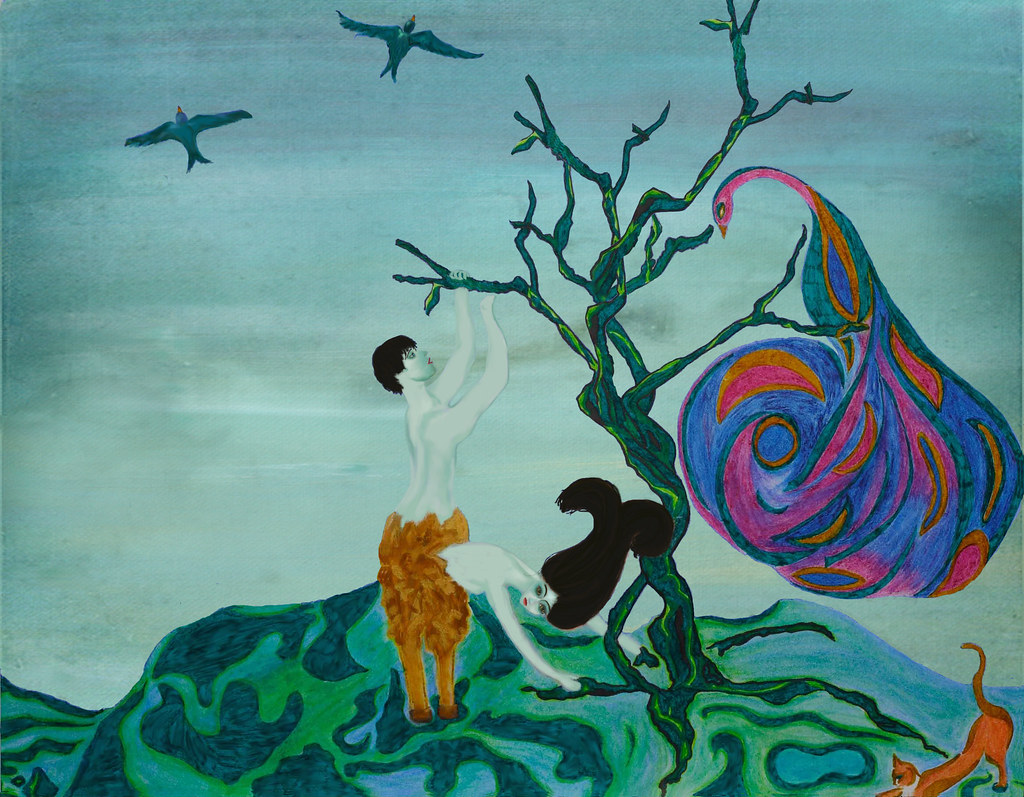
Lost Race Found

Lost Race Found

(to see large, follow the link)

Several times lately, some animal thought to be long-extinct is discovered in some far-off region of the world, doing just fine. This is a moment like that: Plato's Lost Race, the pre-human hermaphrodites, split in half by the gods in punishment for arrogance, each half condemned to wander the Earth in a seemingly endless search for completion.
Here they are, she-he tends the roots and he-she the branches, on swampy, newly forming ground. The proud peacock watching carefully overhead. (Cats are just always necessary.)


Note: This is a new experiment for me.I've been working on this drawing for a while, but I grew furious with the sky and dropped it. Finally, I discovered "free textures" on the flickr page of les brumes, and I borrowed this texture. I photoed my illustration and put it into photoshop, then I made some little changes in the texture I had borrowed and put it over the sky at 57%, and found myself much happier. So, thanks les brumes!

Sunday, August 30, 2009

The Perils of Gardening

The Perils of Gardening


"Beardsley's Garden"


For the Bipolar show at Exhibit A Gallery, the artists were to use a "new" (to them) style or medium. Australian artist Melissa Haslam chose to work with the style of Aubrey Beardsley, who was an illustrator in the late 19th century, famous for his illustrations of, for example, Salome, by Oscar Wilde. The above oil painting, "Beardsley's Garden", is the gorgeous result. She has brought a depth to the shadows in his black and white prints, and to me, the delicate, subtle coloring of the woman's face makes the whole painting "pop."


"Nature"

She says:
"I have been spending time looking into illustrators from what's referred to as the golden age of illustration. Think fairytales and forests with medieval and pre-raphaelite twists. What I like about this era of illustration is that the imagery is so decadent and lush, but it's tempered by subdued colours. The result gives a kind of darkness to the narratives which makes sense because fairytales often are dark and otherworldly. I want to try and use this technique in my own work, so we'll see how that goes."


In an interview with Arrested Motion, she talked some about her subject matter:
"It’s an instinctive thing, but I paint females because I am one and it is what I relate to the most. It’s an entry point for me into the world that is being painted, or the mood that is being portrayed. The plants interest me for many reasons, firstly for their aesthetics. Aesthetics are very important to me and so they are important to my work. It’s so common for humans to find plants and flowers beautiful that there must be something in our biology that makes it so - nature rather than nurture. I have been reading some books on botanical illustration and the stories of botanists risking their lives to discover new, exotic plants to draw or take back to their homeland and the status associated with these finds. It’s a romantic view of the world."


Melissa describes the above painting as being "about a girl who has joined the Garden Gnome Liberation Front (GGLF), and thus, is 'rescuing' oppressed gnomes."


The Garden Gnome Liberation Front actually exists, and has been quite oddly active in France and Italy. According to Wikipedia:


"The first and most predominant gnome liberating force is the Garden Gnome Liberation Front (also known as the Front for the Liberation of Garden Gnomes—le Front pour la Libération des Nains de Jardin (FLNJ)). The Garden Gnome Liberation Front was introduced to the French public in 1997. Over the course of a year, the Front stole over 150 garden gnomes, contending that garden gnomes deserved the same freedoms they were blessed with. The leader of that group was charged in absentia with stealing over 150 garden gnomes over a period of several years.[13][14] The Front's leader was given a suspended prison sentence and fined for the 150 stolen gnomes.

In 1998 there was another strike that has been attributed to the Garden Gnome Liberation Front. This strike was known as the "mass suicide." In Briey, a small city in eastern France, citizens woke up to find 11 garden gnomes hanging from a bridge with nooses around their necks. A nearby note stated: "When you read these few words we will no longer be part of your selfish world, where we serve merely as pretty decorations.""


The botanical details in her paintings are pretty amazing. She spends a bit of time traveling to photograph wildflowers in her native Australia, and she seems to find the most interesting ones. Here are some of the details from the gnome-saver painting:


Besides the Garden Gnome Liberation Front, there are other "perils of gardening" she likes to explore in her paintings. An example is this "Suspicious Stalk":


and here:

"Girls Versus Echidnas"
"The little ones are pretty cute so the girls thought they might take a few of them home, but the fatter, less attractive echidnas are not too happy with the idea." (Melissa)


Some more of her beautiful work:
:
"One Fell from the Apple Tree"


"Flowers and Bugs"


"Beetle Bridge"

She has a blog full of her own work, as well as images of and thoughts on the work of some of her contemporaries, and fantastic botanical images and sources here.