member of:Observers of the Interdependence of Domestic Objects and Their Influence on Everyday Life


This group has been active for a long time and has already made some remarkable assertions which render life simpler from the practical point of view. For example, I move a pot of green color five centimeters to the right, I push in the thumbtack beside the comb and if Mr. A (another adherent like me) at this moment puts his volume about bee-keeping beside a pattern for cutting out vests, I am sure to meet on the sidewalk of the avenida Madero a woman who intrigues me and whose origin and address I never could have known...
--Remedios Varo


(Slideshow is of Artwork by Remedios Varo)
By believing passionately in something that still does not exist, we create it. The nonexistent is whatever we have not sufficiently desired.
--Franz Kafka

Tuesday, May 8, 2012

Eidetic Image II


Image by Tamily Weissman, Jeff Lichtman, and Joshua Sanes: neurons in the neocortex
Or...is it confetti at your high school dance?...

In a fascinating post on his NPR science blog,  Krulwich describes the way a moment of import (and the image of it) will imprint itself on your brain, creating connections that will form a map for your future decision-making and personality development:

"So suppose I'm at a high school dance and I see a beautiful girl across the room, and I ask a friend, "Who is that?" And the friend tells me, "That's Maria."
Remember what happens to Tony in West Side Story? When he first hears her name, his brain starts to pulse "Maria, Maria, Maria, Maria..." It's the most beautiful sound he's ever heard.
A neuroscientist would guess that at this very moment, Tony's brain cells are changing shape, literally growing branches, firing messages that represent bits and pieces of Maria. As they fire, their tentacles are multiplying, getting fatter, their signals getting stronger, and a pattern is forming across tens of thousands of brain cells, all pulsing a message that to Tony feels like all the beautiful sounds of the earth in a single word...say it now, say it loudly...
Mariaaaaaaaaa!
Or, if you're not into Broadway musicals, let's say Tony's brain has created a neuronal pattern. Every time Tony thinks of Maria (which is constantly) cells in his head are linking themselves more tightly together: Maria has re-wired his brain."(Krulwich)


So, now I (Tony) am walking around with a snapshot of the event described above by Krulwich in my brain, which to me is related to: 
Maria, a broadway song I've just composed in my head, the longest note on my favorite instrument, the evening of a certain high-school dance, the guy who told me her name, the last time I went anywhere with that guy and the things that happened then, something seemingly insignificant which stands out to me about redheads, because he's a redhead, money--because his last name is Feurchace, which sounds like purchase--though i've never made that connection consciously--the color burgundy, which is the dress she's wearing, and so red wine, and the things that were said the last time I drank red wine, and the weather on that night, and the weather on this night, and the particular smells in the gym......right? So this never-ending game of free-association (I say tomato, the first word you think of is trench coat) is all subconsciously wired in to that image, the picture of that moment in a high-school gym and everything that came after and everything that led up to it (now seen as cause and effect). Your brain constantly refers to that image whenever presented with any new information, any situation it needs to respond to, etc, because it's an oft-used image and the more we fire together, the more we wire together. Every time we go back to that image, new connections are made, meaning that image grows in meaning, even though it's still just the image of me looking across the room to see Maria as her name is said on a certain sweaty, nervous high-school dance night. (See the whole map of the patterns in which your neurons fire together overlaid with this image.)
Here's where it gets really heady: remember that your main connections and patterns are all pretty muh decided (unless you do serious conscious work later) by your pre-5-yr-old mind. So, the image that's being created here is just an update of the one you already have, with more potent language and color. But it's a great moment for you to make a huge change, for a monster paradigm-shift. If you bust out of your normal behavior and do something really crazy, here, and follow it all the way to its conclusion, you may find yourself remembering your own life history up to this point completely differently. Your life-story no longer leads up to the "pinnacle" it did five minutes ago, at which time you never imagined yourself ditching your straight-As and list of after-school activities and campus presidential duties to grab her hand, catch a plane, and move to the Andes to train to be a curandero. All of a sudden, you remember things you had completely forgotten, things that obviously were leading up to a moment like this, things that make it clear that you were born for the life of an Andean curandero. There was that amazing time in your grandmother's garden, when she was showing you the most beautiful flower you'd ever--in your 4 short years on this planet--seen, and at the same time, a group of children next door were practicing a song in Spanish for a school play. There was that one time your father took you to the mountains to go camping, momentarily breaking from his otherwise completely work-obsessed life, the only time you traded more than three complete sentences. There was the time your mom danced you around the room in her burgundy evening gown the night she won an award for her work in the laboratory, and she was singing "I feel pretty" and you were blushing and happy. All these things had previously been forgotten, but you begin to remember them on the plane, with the love of your life sitting next to you, pointing eagerly at the shape of the clouds out the window to show you a grazing horned goat. When you land, you discover you have an amazing talent for locating mysterious and rare plants, and that she has the equally miraculous ability to make them all taste good. People line up for your cures. Why are you so good at this? Because your whole life was leading up to it, you were born to be this! Somewhere in the back of your mind, you've always been singing that Broadway tune, and you still are, right now as you search through the forest for the herbs. What made you think you were going to be a lawyer? Who knows?
You were fated to be this. But only since the moment you decided to be fated to do it, the moment that one snapshot became your life's map. At that moment (just like when you're dreaming, and whatever you're doing right then makes sense in the story of your life; yes, you're re-taking the third grade even though you already passed your college exit exams, but third grade is important, and it's always been this way), your present changed, your history changed, and your future changed. 
And in the next moment, it can again.


--PART ONE HERE--

Wednesday, May 2, 2012

Maquette Show

by Jodi Le Birge

Clive Hick's-Jenkins is curating an on-line gallery of maquettes created by his ArtLog followers. It's fascinating to see the wildly different ways the process has been affected by each artist's style...


All of the above are the creation of Jodi Le Birge, whose maquette makes me think of the many faces of one person; of our saintly side; of our animal attributes; of our feminine and masculine sides...

Peter Stevenson is planning to use his for a lantern show (!) which I hope to somehow see:


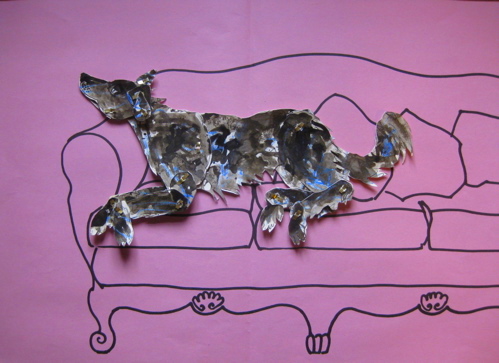
I love how Liz Sangster made her lively, furry dog, with his expressive ears, tail, and tongue, pose on a one-dimensional background--it makes him even more alive! Even the style she used to paint his fur makes his seem charged with energy...


The image below is by Steph Redfern:

These are only a few of the images from his show. There are many, many more, and more artists, and each day, he is unveiling new surprises! Links:


Monday, April 9, 2012

Santa Caterina and her Violetta


"Every disease is a musical problem; every cure is a musical solution."--Novalis


Santa Caterina de Vigri and her Violetta

In the Church of Corpus Domini, Bologna, Santa Caterina de Vigri sits upright on view, her flesh-color ranging from a brick-red to black and still cleaving to her bones though she died in 1463. She is the only such saint to sit upright, and her shrine miraculously survived the same bombing raids of 1943 which destroyed all the surrounding decorations and building. Next to her sits her violetta, created by Andrea Amati (1413-63), which is the oldest known surviving stringed instrument. So, the saint, uncorrupted, and her instrument, also able to out-survive its contemporaries.

According to Marina Warner, in her well-packed and fascinating book Phantasmagoria, "The word 'galvanize' has at least two meanings: applied to metals, it means coating iron or steel with zinc through an electrolytic process in order to protect it from corrosion [italics mine]; figuratively, it means something closer to [Luigi] Galvani's work, the revitalization of a moribund or torpid organism: 'I was galvanized into action.'" These two meanings, both relating quite well to the hope presented by the incorrupt body of a saint that waits its resurrection with its bones still holding it together, and also both relating to her violetta in a manner we will attend to momentarily, are especially interesting here because Mr. Luigi Galvani himself is entombed right across the nave from her.

Luigi Galvani (1737-98) was a physiologist and professor of medicine, the one who first introduced an electric shock into a frog’s corpse and beheld that it caused the animal to kick its legs. This opened up a variety of excited questions about a possibly attainable source of life-force, leading to all sorts of other experiments, and tales like Mary Shelley’s Frankenstein. Luigi’s nephew, Giovanni Aldini, tried this same electrification on human corpses, bringing their limbs to jump and their faces to become quite expressive, and then moved the process to the living via the mentally-ill, thus beginning electroshock therapy in an attempt to bring life back to a frozen (terrified, confused, overwhelmed) mind.

Christopher Turner gives a fantastic description of the famous hypnotist Franz Mesmer’s ‘galvanizing’ use of electricity in the Spring 2006 Issue of Cabinet Magazine:

“In a medical museum in Lyon there is a strange tub-like object constructed of oak and decorated with lengths of ornately woven rope. About six inches in from the rim, eight evenly spaced iron rods sprout up from a highly polished lid. In the eighteenth century, a group of patients would sit or stand around this device in such a way as to press the afflicted areas of their bodies against these moveable metal wishbones and, bound to the instrument by the ropes, would link fingers to complete an "electric" circuit. The atmosphere in which these sessions took place was heavy with incense and séance-like; the music of a glass harmonica (invented by Benjamin Franklin) provided a haunting soundtrack, and thick drapes, mirrors, and astrological symbols decorated the opulent, half-lit room.

Franz Anton Mesmer, the legendary Viennese healer, hypnotist, and showman, would enter this baroque salon of his own invention wearing flamboyant gold slippers and a lilac silk robe. He would prowl around the expectant, highly charged circle, sending clients into trances with his enthralling brown-eyed stare. By slowly passing his hands over patients' bodies, or with a simple flick of his magnetized wand, Mesmer would provoke screams, fits of contagious hysterical laughter, vomiting, and dramatic convulsions. These effects were considered cathartic and curative. When a patient's seizures became so exaggerated as to be dangerous or disruptive, Mesmer's valet, Antoine, would carry him or her to the sanctuary of a mattress-lined "crisis room" where the screams would be muffled.

The baquet, as Mesmer named his vessel, parodied the contemporary craze for medical electricity. Pharmacists and apothecaries frequently prescribed shock treatment, especially in attempts to cure paralysis, and often exposed the sick to a more general "electrical aura" as a healing agent. Benjamin Franklin, then American ambassador to France, was fond of demonstrating the power that could be harnessed in a Leyden jar, the prototype of the modern battery, by using one to send a bolt of electricity through a chain of people. (One medical electrician claimed not only to have shot a charge through 150 guardsmen, but to have made a kilometer-long line of monks simultaneously jump into the air.)”

Mesmer’s baquet was much like Franklin’s battery, a huge reservoir to take in and save Mesmer’s own magnetic-electric inner fire and spread it amongst the members of his rather large groups of patients, all at once.

“In England, such [medical] applications were encouraged by Newton’s suggestions, thrown out in a number of queries at the end of the 1713 edition of his Optics, that the animal spirits or nervous fluid which communicated impulses from the brain to the muscles might be related to a subtle ethereal or electrical fluid that constituted a kind of universal medium in the universe. Hints such as these, combined with the strong inherited tendency to think of electricity as a vapor or effluvium, made it easy to see electricity as a mediator between microcosm and macrocosm, and as the principle of life itself. In America, where electrotherapies formed a strong field of what has been called “electrical humanitarianism,” Dr. T. Gale wrote in his Electricity, Or Etherial Fire, Considered (1802) that electricity was a kind of universal atmosphere, which all living creatures inhabited and respired.” --Steven Connor

Now, it is still true that we use electric paddles to try to revive a (very recently deceased) corpse even today, and very often with success. The question is mainly how to navigate that shadowy, sometimes grisly space between life-saving techniques and Frankenstein, while also somehow sidestepping the messier areas of mass-hysteria and public fainting-spells. But inside that space is a fascinating realm involving the electric impulses that communicate information between synapses in your brain and, again, music. Oliver Sacks thoroughly explores this realm in his book Musicophilia.  

He describes, for example, a man who discovered his first interest and immense talent in his late forties, directly after being struck by lightning.  But there are less far-flung examples of the intense connection between electricity, life, and music in the stories of some epileptic patients:

-"Jon S., a robust man of forty-five, had been in perfect health until January of 2006. His working week had just started; he was in the office on a Monday morning, and went to get something from the closet. Once he entered the closet, he suddenly heard music--'classical, melodic, quite nice, soothing...vaguely familiar...It was a string instrument, a solo violin.'
He immediately thought, 'Where the hell is that music coming from?' There was an old, discarded electronic device in the closet, but this, though it had knobs, had no speakers. Confusedly, in a state of what he later called 'suspended animation,' he groped for the controls of the device to turn the music off. 'Then,' he says, 'I went out.' A colleague in the office who saw all this described Mr. S. as 'slumped over, unresponsive,' in the closet, though not convulsing.
Mr.S's next memory was of an emergency medical technician leaning over him, questioning him."
Sacks asked him about this music, but he could not sing it himself and didn't know what it was, though he felt it familiar.
"I told him that if he ever did hear this music--on the radio, perhaps--he should note what it was and let me know. Mr. S. Said that he would keep his ears open, but as we talked about it, he could not help wondering whether there was just a feeling, perhaps an illusion, of familiarity attached to the music, rather than an actual recollection of something he had once heard. There was something evocative about it, but elusive, like the music heard in dreams."

And then, as I was saving the information I’m working on about the saint, I came across the quote from Hugh Jackson via Oliver Sacks about a ‘doubling of consciousness’ that occurs during the seizures such as the one her violin is creating. What was once her and some paper dolls is now her and dancers--real, alive--, her as part of the show, the musician for the dancers, the one giving them their rhythm, storyline, electricity. She is part of something, something that matters. That’s the other consciousness, the one outside of the four sides of her box.

So, electricity is everywhere. Trees make a little bit, running it through their bark. Your heart works via electricity it generates from potassium, sodium and calcium. Communication is run between the synapses in your brain via electricity. There’s of course lightning. And humans are making more and more electricity even outside of their bodies using a variety of tools. And all of this has a music to it.

Christina Kubisch is an artist who explores this connection between electricity and music from a completely different direction than Galvani, Sacks, Shelley, or even Santa Caterina. She has had a certain type of headphones created which a user takes along with a map of an area (meant only as an inspiration and a guide, but in no way a limiting force) in order to hear the music created by all the electric fields surrounding us every day. She explained how she taps into these ‘Invisible Cities’ of sound in an interview with Cabinet Magazine:

“--How do the headphones actually work?
--Every current in an electrical conductor—for example a wire or a cable—generates an electromagnetic field. These currents can be “musical,” like the signals running through loudspeaker cables; or they can come from electrical activity in the infrastructures of buildings or cities. The magnetic component of these fields is picked up by the sensor coils in the headphones. And, after amplification, these signals are made audible by the little speaker systems in the headphones. So if there’s an electromagnetic field (say, an underground cable) and another one nearby (say, the headphones), the fields pick up each other. The sound jumps through the air from one to the other.”

“--I’m struck by the similarity between some of these sounds and minimalist techno: PanSonic or Alva Noto, for example.
--Yes. There are some sounds that, when I listen to them for half an hour, sound to me like LaMonte Young. The tram in Bratislava, for example, is almost like a choir: a chord, three sounds together that are changing, but each at a different level... Subways, buses, and trains are especially musical, maybe because they depend upon a constant flow of electricity. There’s a wonderful subway in China that sounds to me like electronic music of the 70s... Airplanes, though, sound really ugly: very high, thin, and noisy.”
...
This summer I put on my headphones during a very strong thunderstorm. There was no electricity, because all the power had gone out. But, when I recorded, I got the sounds of natural electricity, which was wonderful. The recording is so strange: very low, but very clear... At two points, you hear voices. You can’t understand the words, but you can tell that they are voices. I knew that electricity could transport voices, but I had never heard it before. It’s quite breathtaking when you hear things like that. This is nature, too—electrical nature!”


Somehow, electricity is there in the force of life, and somehow, music is involved. Think about shamanic, hypnotic drumming, about the heights of ecstasy some reach at jam sessions of their favorite bands--such heights that they are willing to drop everything and follow the band around. Think about the chanters in ancient masses, about techno-music, about binaural beats. And that makes the quote at the top of the post make more sense: problems occur when the rhythm of your life gets out of whack--somehow, the vibrations are off, the energy isn’t there, the organs falter and the synapses sleep late because the alarm never went off.

In an interview with Steve Silberman of Wired Magazine about the studies that went into Musicophilia, Oliver Sacks stated : "The therapeutic power of music hit me dramatically in 1966, when I started working with the Awakenings patients at Beth Abraham in the Bronx. I saw post-encephalitics who seemed frozen, transfixed, unable to take a step. But with music to give them a flow, they could sing, dance, and be active again. For Parkinsonian patients, the ability to perform actions in sequence is impaired. They need temporal structure and organization, and the rhythm of music can be crucial. For people with Alzheimer's, music incites recall, bringing the past back like nothing else."

There it is again, that image of re-infusing a corpse with life, and this time the electricity is created with music--its flow (like electricity) and its rhythmic pulse. It is the first step those post-encephalitics were unable to take; once the music gave them that first step and a current to follow, they were able to ride it.

There was another thought I was chewing on here, with the saint and her violin:
There is a difference between skill and possession. And what you want (even, I would argue, as a doctor) is possession, because if a person is ill, it is from not following the logic (rites, rituals, rules, rhythms) of the reigning forces or melodies (‘gods’) of existence. Only that force understands its own logic, or those in choreography with it. And everything you see is a symbolic aspect of that logic (recall the post on Eidetic Images), including illness. Music historically has much to do with trance, both as a result of possession or not. That trance is the opportunity for something higher and more general than your ego to take over your body. That is the electricity created. In the painting above, St. Catherine is possessed. She is an electric force, radiating. And she is bringing that electricity into the forms, making them alive through her music, infusing the air and their limbs with the tango of their love, that “fire that consumes without leaving ashes” (Vannoccio Biringuccio, 1540).

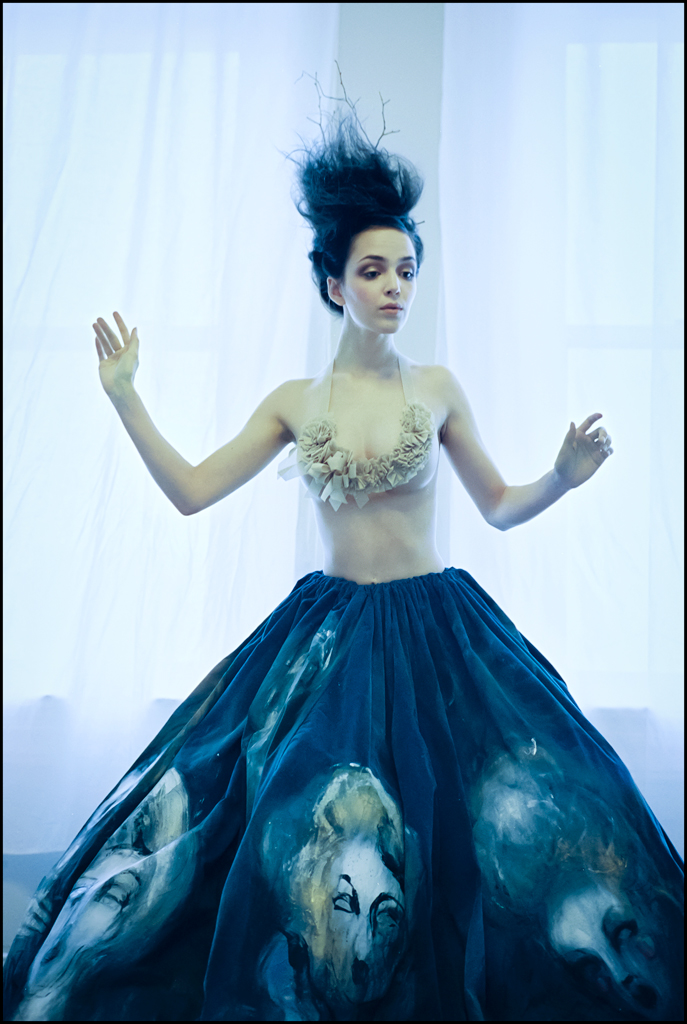
[Please note: the skirt was inspired by the one worn by the model in this Ryan Muirhead photo. The idea of a chaotic waters filled with spirits that she brought to the surface and to life appealed to me.]