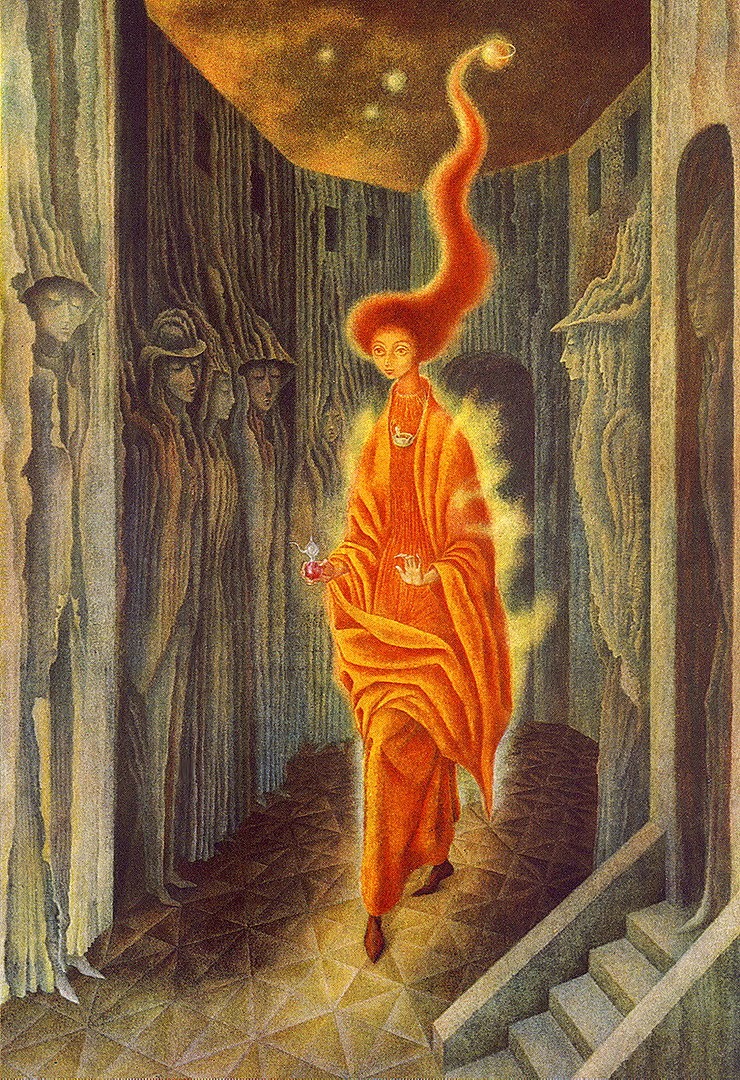
member of:Observers of the Interdependence of Domestic Objects and Their Influence on Everyday Life


This group has been active for a long time and has already made some remarkable assertions which render life simpler from the practical point of view. For example, I move a pot of green color five centimeters to the right, I push in the thumbtack beside the comb and if Mr. A (another adherent like me) at this moment puts his volume about bee-keeping beside a pattern for cutting out vests, I am sure to meet on the sidewalk of the avenida Madero a woman who intrigues me and whose origin and address I never could have known...
--Remedios Varo


(Slideshow is of Artwork by Remedios Varo)
By believing passionately in something that still does not exist, we create it. The nonexistent is whatever we have not sufficiently desired.
--Franz Kafka

Saturday, March 1, 2014

The Crack in Everything, Pried Open by Alien Hands

 “There is a crack, a crack in everything. That’s where the light gets in.”--Leonard Cohen
Harmony by Remedios Varo

In Alan J. Friedman’s 2000 essay on Varo’s work, The Serene Science of Remedios Varo, he notes that what looks like magical thinking and mysticism often really reflects hard, leading-edge science, and that many of her paintings in fact seem to represent the moment in which a scientist discovers a new model for the universe, “the defining moment, when the new idea becomes a concrete model, invested with all the precision its creator can muster, yet still filled with mystery and unknown promise.” In the above painting, Harmony, he sees the scientist trying to include all of nature in that model: “Among the objects in this model are natural history specimens and mathematics (one of the slips of paper has the first 5 digits of pi, 3.1415). Science, in the form of a prepared mind, is helped by chance (the figure emerging from the wall).” 

Detail of Harmony  by Remedios Varo

Each of us already has a theory of existence, which all five senses base their decisions (notice? don’t notice?) on; that theory exists as the limits to each person’s perspective. In this painting, the figure looks at the symbols and their relations, trying to discover the form of the subconscious cage the world is--to him--limited by, the cage outlining his current life, trying to recognize it and trying to find a crack--like the one the blue figure comes out of here--through which he can slip to a new model, in a moment much like this:

The Phenomenon of Weightlessness by Remedios Varo

Friedman says: “In Phenomenon of Weightlessness (1963), a scientist is astonished as his model of the earth and moon breaks away from the stand on which it rested (seen on the floor), and floats in space on its own. Physicists immediately recognize this painting as depicting Einstein’s physics, which modified the concepts of absolute space and absolute time that Newton had built into his model of how objects behave in space and time under the influence of gravity.”

Friedman notes that of course we are always seeking out new models, because no model is ever complete. In every scientific model, in every life, there are things that do not fit. That’s the crack Leonard Cohen sings about. Pick at it, play with it. Change the universe.
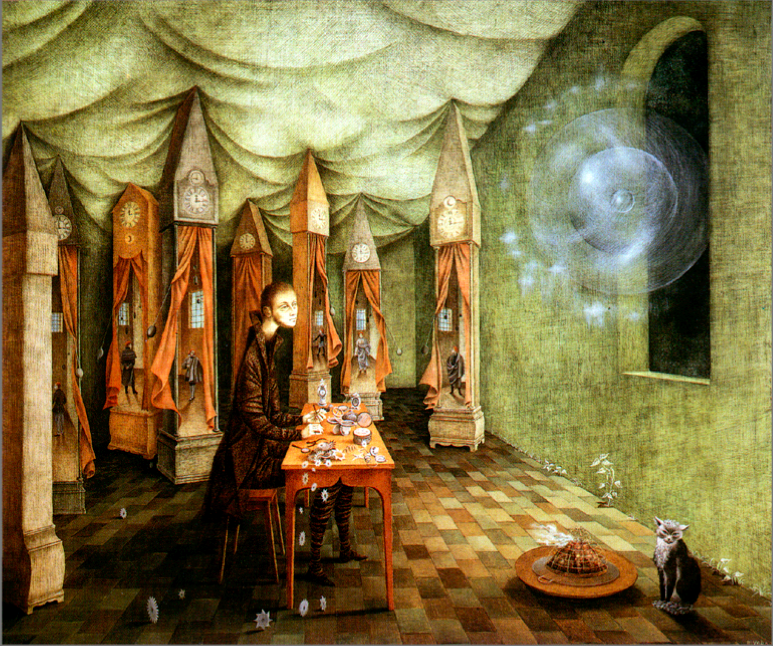
Revelation of the Clockmaker, by Remedios Varo

In Incognito, David Eagleman explains how little the conscious mind is involved in decision-making and lifestyle by exploring the myriad “zombie systems” that compete for position in your subconscious without your awareness. To illustrate, he talks about having a secret, noting that if you have no desire to tell anyone, the story’s just boring, and if you have no problem telling everyone, it’s just juicy, but if you’re conflicted, that’s because you are of (in this case) two minds, much like the two minds that argue about whether to have the cheesecake or stay on the diet, or how much fun it will really be to do those push-ups or read that horrific slog of a textbook which appears to have a lot of important knowledge but is awfully poorly-written. In the example he gives of a trauma, like rape, studies show that not talking about the event has significant long-term health effects both physical and psychological; there is something in you that very much needs to talk about it. There is also something in you which does not want to suffer the possible social (or other) consequences:

“Brains are like representative democracies. They are built of multiple, overlapping experts who weigh in and compete over different choices. As Walt Whitman correctly surmised, we are large and we harbor multitudes within us. And those multitudes are locked in chronic battle.” (107)

There’s the you that focuses on emotional reasoning, there’s the logical side, there’s the lazy side, there’s the side that only looks to the future and the one aching for the past, and at various times one or the other wins out. One of the best and most fascinating examples he gives to show how much conflict is going on “beneath the hood” that you have no idea even exists is that of alien hand syndrome:

“As preposterous as this plotline may seem, there is, in fact, a disorder called alien hand syndrome. While it’s not as dramatic as the Evil Dead version, the idea is roughly the same. In alien hand syndrome, which can result from the split-brain surgeries we discussed a few pages ago, the two hands express conflicting desires. A patient’s “alien” hand might pick up a cookie to put it in his mouth, while the normally behaving hand will grab it at the wrist to stop it. A struggle ensues. Or one hand will pick up a newspaper, and the other will slap it back down. Or one hand will zip up a jacket, and the other will unzip it. Some patients with alien hand syndrome have found that yelling “Stop!” will cause the other hemisphere (and the alien hand) to back down. But besides that little modicum of control, the hand is running on its own inaccessible programs, and that is why it’s branded as alien—because the conscious part of the patient seems to have no predictive power over it...
[...]
What does alien hand syndrome tell us? It unmasks the fact that we harbor mechanical, “alien” subroutines to which we have no access and of which we have no acquaintance. Almost all of our actions—from producing speech to picking up a mug of coffee—are run by alien subroutines, also known as zombie systems. (I use these terms interchangeably: zombie emphasizes the lack of conscious access, while alien emphasizes the foreignness of the programs.) Some alien subroutines are instinctual, while some are learned; all of the highly automated algorithms that we saw in Chapter 3 (serving the tennis ball, sexing the chicks) become inaccessible zombie programs when they are burned down into the circuitry. When a professional baseball player connects his bat with a pitch that is traveling too fast for his conscious mind to track, he is leveraging a well-honed alien subroutine. Alien hand syndrome also tells us that under normal circumstances, all the automated programs are tightly controlled such that only one behavioral output can happen at a time. The alien hand highlights the normally seamless way in which the brain keeps a lid on its internal conflicts. It requires only a little structural damage to uncover what is happening beneath.” (132)

Once he has solidly illustrated just how complicated and multiple our person is, he turns to robots and Artificial Intelligence, and this is where I come back to the paintings of Remedios Varo and those cracks in the universe that allow the light of another, wholly-formed and wildly different universe to get in.

Au Bonheur des Dames, by Remedios Varo... little automated creatures heading to the store for more parts....

Eagleman tells us that robots have been stuck at a certain stage for a long time in terms of how human-like their thinking can become, and he posits (convincingly) that the reason for this lies in that seething community of disagreeing and developing personalities that aren’t even noticed by your conscious self, and their lack of existence within the robot’s “mind.” He notes that when programmers set up a robot, they look for and try to implement the best process to the best solution for whatever problems or situations face the robot. And that’s the one process and solution they put in (as a subagent) for the robot to “turn on” when the situation arises. But:

“If a space alien landed on Earth and discovered an animal that could climb a tree (say, a monkey), it would be rash for the alien to conclude that the monkey is the only animal with these skills. If the alien keeps looking, it will quickly discover that ants, squirrels, and jaguars also climb trees. And this is how it goes with clever mechanisms in biology: when we keep looking, we find more. Biology never checks off a problem and calls it quits. It reinvents solutions continually. The end product of that approach is a highly overlapping system of solutions...” (127)
And, later:

“If we hope to invent robots that think, our challenge is not simply to devise a subagent to cleverly solve each problem but instead to ceaselessly reinvent subagents, each with overlapping solutions, and then to pit them against one another.
[...]
Probably the best way to cultivate a team is with an evolutionary approach, randomly generating little programs and allowing them to reproduce with small mutations. This strategy allows us to continuously discover solutions rather than trying to think up a single perfect solution from scratch. As the biologist Leslie Orgel’s second law states: 'Evolution is smarter than you are.' If I had a law of biology, it would be: 'Evolve solutions; when you find a good one, don’t stop.' (p. 148). 

That is, whatever your model of the universe is, keeping picking at the cracks in it.


This is also what an artist does, with play. Backing away from what one already knows and trying something new to address the same situation (eg how to translate an idea into an image) brings more of these differing subconscious opinions to the conscious surface for assessment. 

Pretend I have drawn a pattern down on paper, and I say to you, "this is the universe.” That’s basically what a person does: we expect politicians to act that way, we expect our doctor to say one thing and not the other, we wait for that response from the in-laws, etc.  But say I see something only slightly odd or out of place as I’m walking down the street and instead of ignoring it, I focus all of my attention on it. That focus on something outside my usual experience creates a new pathway in my brain which sprouts bazillions of other tangential connections, effectively changing me and also the universe that I live in because connections beget connections and eventually that odd thing is part of the structure--fundamental, even, to the pattern I am calling the universe. Yes it was already “there,” in that I was able to glimpse it (barely) but every thing and every time is already there; the issue is bringing it to the level of perception which makes it part of the consensual universe, making it structural. 

“Perhaps, contrary to Plato’s allegory of the cave, we sometimes only see the real once we have seen its shadow in art.” Henderson, Caspar; The Book of Barely Imagined Beings: A 21st Century Bestiary. 

Remedios Varo had fled the Fascist government of Spain to France after the assassination of the poet Federico Garcia Lorca, but as the Nazis began their move into France, deportation became a strong possibility, meaning a forced return to Franco’s regime, where she was already a target. By February 1940, her lover, Péret, had been arrested, having refused to enlist; soon after that she discovered that her first husband was also interred in a camp, and she moved heaven and earth and called on every friend and favor she could to get him out, finally successfully. Both Lizarraga (her first husband) and Péret called upon images of her to help them through their imprisonment and recalled how even the sense of her spirit strengthened them. Soon, however, she found herself arrested by the Nazis in France, an experience she refused to talk about after the several weeks it took her to recuperate in a friend’s apartment.  All this is to say that she experienced first-hand the life-altering terror of a violent state which insists that its voice is the only true voice, that its plans are the only correct plans, that its future is the only possible future, and she survived not to rail against it but to create its alternative, to strengthen many other possible voices, plans and futures through her particular magic.

It took immense effort to get the financing and the false passports and safe passage for her escape from France, endeavors that were undertaken by heroic groups of underground operators, in this case, a group working with Varian Fry whose efforts on her behalf took six months of work; there are a few descriptions from that time period that I think are significant in tying her experience and the ideas of continual evolution explored in Incognito together with this “crack in everything.” The French government made an agreement (Article 19 of the Franco-German armistice) to “surrender on demand” any person with religious views, anti-fascist views, or any other view the Third Reich disapproved of to the Nazis. As the Nazis raised the swastika atop the Eiffel Tower, Varo gave up on her attempts to find and save Péret and joined millions in a mass-flight from Paris to the south:

“It was a June remembered as among the loveliest in years, bright, sunny, cloudless, and not too warm, as Varo became one of the horde of more than eight million refugees: ‘men, women and children [who] took off in utter panic toward the unoccupied zone in the south, packing a few belongings on the roofs of their small cars or on the racks of motorcycles or bicycles or in baby carts, peddlers’ carts, wheelbarrows, or in any wheeled contrivance they could lay a hasty hand on, for many were on foot.” (72, Kaplan)

Twisted Roads, by Remedios Varo

Hairy Locomotion, by Remedios Varo

Her friend Oscar Dominguez managed to find her a spot in a car, sparing her the walk, and the experience of that ride offers the first of the significant things I believe she took with her, planting it deep inside her later paintings:

“Friends remember hearing that Varo traveled ‘in the car of some eccentric Americans who loaded their little car with fossils instead of provisions; in spite of the bombers and black smoke that weighed over the city and its outskirts, they stopped in front of each cathedral to admire it and were touched at encountering, almost unreal, an almond tree in flower.’” (72)

She had barely escaped from her own imprisonment; her lover’s fate was uncertain, though certainly dark; bombs were raining down occasionally upon the easy target of this mass exodus, yet these people, who were sparing Varo a painfully difficult foot-journey, took the time to stop and wonder at a flowering almond tree. In the midst of the traumas and struggles of her life and the lives of those around her, Varo sat down at her easel and created moments of flowering magic: little almond trees growing out of the hard rock of fear and suffering.

Varo made it to Marseille, which became an underground port for intellectuals and artists attempting to flee the country, and where Varian Fry had set up his committee, working wherever he could--even, for a period, from a hotel bathroom--to gather information, proper documents, false documents, financing, knowledge of as-yet undiscovered pathways--whatever was necessary to get as many people as possible away from the Nazis’ targeted wrath. There was a great attempt like this, focused specifically on artists and intellectuals, because those were the people who offered dreams and visions of ‘other ways,’ doorways through the thick stone walls of Fascist mind-fortresses, playfulness in the midst of their very serious endeavors. The Nazis understood this without question, and they made an equally vigorous effort to kill the very people Fry and others were struggling to save.

At one point in the months leading up to Varo’s escape, a collection of Surrealists were staying in secret at an abandoned villa, Villa Air-Bel; Péret had also managed to make it to Marseille, and the two of them stayed close-by the Villa, joining its inhabitants by day. They focused on surrealist games in every break from their struggle to raise food-money, and at one point, Varo discovered that a Republican refugee friend of theirs had a toreador outfit with him, and she and Jacque Hérold and Péret each took turns trying it on and posing in a photo shop along the dock. That is the second moment that I believe she carried with her to her easel each time.

Remedios Varo kept this photo with her all her life

“It was such games, played with a vengeance during the many months in Marseilles, that kept them going. As Breton remarked, ‘So great is this power of defiance, of scorn and also of hope...that the actors in this scene had perhaps never found themselves so childlike, never sang, played or laughed so whole-heartedly.’” (Kaplan, 79)

As they were waiting to give their money (an eventual gift from Peggy Guggenheim) to an intermediary who would pass it on to a black-market operator who would then take them by fishing boat to Casablanca, where they had already secured passage on a Portuguese liner, Varo and Péret stumbled into a young man who offered them a seemingly more secure journey. They gave him their money, and he disappeared. But this story Varo would talk about, for its bizarre twist of luck:

“Although he left them stranded, running off with their precious cash, the thief may have saved their lives. For, as the newspapers soon would report, the black-market operator to whom the money was to have been delivered turned out to be a psychopathic killer who had murdered the previous refugees he had offered to help-- a charge verified by the mute testimony of twelve bodies found buried in his backyard.” (Kaplan, 72)

Varo never spoke of her interment, as far as I have been able to find. She did not seem to focus on the fear and bizarre violence that we do see reflected in other surrealist works of this time. She did not go on to march and protest against fascists and publish articles expressing her--justified--rage. Instead, she went on, with that contrasting flowering almond and the sense of play in the face of terror, and she picked at the cracks, there in the seemingly solid foundations of our often terrifying world, and widened them into a series of mysterious and beautiful jewels of paintings, in which she catches characters suddenly waking from their zombie-subroutine-led existence and making the choice to look in a different direction, at something (somewhere) else:

Note the girl whose eyes are not following those of the others.... (Painting by Remedios Varo)

Rupture, by Remedios Varo

The Call, by Remedios Varo

She created life in those cracks, and even now, here, where Hitler’s terror can’t reach me, Varo’s magic does. I study her art and it changes my life, all these years after her death.

Embroidering the Earth’s Mantel, by Remedios Varo: Note that the woman closest to us on the left is pushing a secret through that little crack where her embroidery comes out....
Detail from Embroidering the Earth's Mantel, by Remedios Varo: The lovers escaping through the crack

Detail of Embroidering the Earth's Mantel 


Sunday, February 9, 2014

Montaigne, Your Life and The End of the World

Gormenghast Castle, by Su Blackwell


All Images in this post by Su Blackwell.

As a younger man, in his twenties and thirties, Montaigne was gripped by a terror of death and a semi-constant absorption with its lurking shadows, threats and assaults. All of his favorite philosophers seemed to suggest that the more one imagined one’s own death, the better prepared one would be to have a “good” death, which meant a brave countenance and several manly, well-timed speeches; but the more he thought about death, the more he brooded, the less lively and alive he was. On top of this philosophical difficulty was the disastrous events of his early thirties, in which his best friend was killed by the plague, his father passed, his perfectly healthy younger brother was killed by a minor blow to the head in a sporting match, and his first child died at two months of age. Death was everywhere, and thinking about it philosophically brought him no peace.

What did finally bring him peace was his own brush with death, when one of his own men accidentally knocked him off of his horse. Sarah Bakewell describes the incident in her book, How to Live: Or a Life of Montaigne in One Question and Twenty Attempts at an Answer:

“During what followed, as witnesses later told him, Montaigne thrashed about. He ripped at his doublet with his nails, as if to rid himself of a weight. ‘My stomach was oppressed with the clotted blood; my hands flew to it of their own accord, as they often do where we itch, against the intention of our will.’ It looked as if he were trying to rip his own body apart, or perhaps to pull it away from him so his spirit could depart. All this time, however, his inward feelings were tranquil.
[...]
The servants continued to carry him towards the house, in this state of inward languor and outward agitation. His family noticed the commotion and ran out to him—’with the outcries customary in such cases,’ as he later put it. They asked what had happened. Montaigne was able to give answers, but not coherent ones. He saw his wife picking her way awkwardly over the uneven path and considered telling his men to give her a horse to ride. You would think that all this must have come from ‘a wide-awake soul,’ he wrote. Yet, ‘the fact is that I was not there at all.’ He had traveled far away. ‘These were idle thoughts, in the clouds, set in motion by the sensations of the eyes and ears; they did not come from within me’—chez moi, a term usually meaning ‘at home.’ All his actions and words were somehow produced by the body alone. ‘What the soul contributed was in a dream, touched very lightly, and merely licked and sprinkled, as it were, by the soft impression of the senses.’ Montaigne and life, it seemed, were about to part company with neither regret nor formal farewells, like two drunken guests leaving a feast too dazed to say goodbye.”

Gormenghast Castle Detail


“His return to life was as violent as the accident: all jostlings, impacts, flashes, and thunderclaps. Life thrust itself deeply into him, whereas death had been a light and superficial thing. From now on, he tried to import some of death’s delicacy and buoyancy into life. ‘Bad spots’ were everywhere, he wrote in a late essay. We do better to ‘slide over this world a bit lightly and on the surface.’ Through this discovery of gliding and drifting, he lost much of his fear, and at the same time acquired a new sense that life, as it passed through his body—his particular life, Michel de Montaigne’s—was a very interesting subject for investigation. He would go on to attend to sensations and experiences, not for what they were supposed to be, or for what philosophical lessons they might impart, but for the way they actually felt. He would go with the flow.”

The Raven, by Su Blackwell


It’s an important detail, that comment about making yourself a subject for investigation. If all possibilities are happening at once, by living your life you are choosing one to investigate, to experience, to immerse yourself in, the same way that some part of you chooses a dream to immerse yourself in, whether that dream is a path through an impossibly lush landscape full of intensely magical fauna or a horrifying race through twisting, dark forests with monsters on your trail. Some part of you has chosen, and I believe that that part of you is Habit. There you are: head down, pencil clenched in your hand, berating yourself silently for having managed to somehow miss the majority of the semester’s classes and then forgetting to study, while your whole future depends on this exam you’re about to fail. You can’t even keep the options straight on the paper. What is this nightmare about? It’s a habitual way of thinking, of responding to the world, of translating the events in front of you: you’re never prepared, you can’t keep things straight, you don’t understand your options, etc. To look up from that test and think: this is a dream, I don’t have to feel like this--that would be a simple thing. But you don’t. Why? Because you believe. You readily accept that you do have to. And here’s the suggestion I’m making: at any time, when something is happening that’s unpleasant, or even just mildly annoying, look down at your hands. Mess with some talisman that you’ve chosen to carry, feel its weight, recall where you got it and why. This will take your focus off of the unpleasant thing, the annoying circumstances, the fight that all the boiling blood in your body is furiously prepared and eager to be a part of (but which I can bet you will regret later), and put it on something else. This permits you a moment of distance, which can result in several things, two of which I’ll mention here: one, if you’re dreaming, taking your focus off of the event often allows for a total change of venue. You look away, and the set changes, that’s how these things work. Two, if you’re not dreaming (but are you *sure*?), it gives you the opportunity, as I mentioned, for a moment of distance, which can allow for a change in perspective. Recall, in Mastermind, the fly-on-the-wall trick, which suggests that you relive an argument or regretted moment as if you were not one of the people involved but rather a fly on the wall:

“It’s a process of picturing something vividly but from a distance, and so, from a perspective that is inherently different from the actual one you have stored in your memory. From scenario one to scenario two, you have gone from a concrete to an abstract mindset; you’ve likely become calmer emotionally, seen things that you missed the first time around, and you may have even come away with a slightly modified memory of what happened. In fact, you may have even become wiser and better at solving problems overall, unrelated to the scenario in question. (And you will have also been practicing a form of meditation. Sneaky, isn’t it?)” Konnikova, Maria (2013-01-03). Mastermind: How to Think Like Sherlock Holmes (p. 148).

This is something like what happened with Montaigne. He had a very close brush with death, and experienced that distance via the time it took his body to decide whether it was staying or going. In that distance, he both lost his overwhelming fear of death and came to appreciate the fact that he could, from such a distanced vantage point, study all his own emotions and internal experiences. Thus the essay was born: Montaigne was the first person to study human thought and feeling in this way, and he was exceptional at it. He began a life-long study of what it was to live as a human, and how to do so well. Sarah Bakewell’s book pulls together some of his ideas, along with information about his time period and other biographical details, as a sort of guidebook through his massive tomes of essays. The first two chapters stood out to me as being astonishingly well-matched companions to the first two installments of the Last Policeman Trilogy by Ben H. Winters (the third is to come out this summer), which I’ll come to in a moment.

What Montaigne expresses, in his description of his brush with death, is much like what one experiences in a moment of lucid dreaming: you relinquish your grip on whatever habit is holding you to the action, and are filled with such a sense of relief, it’s much like floating.
It's a un-focusing of attention on certain things, and that is sometimes most easily-managed by the next title in the Montaigne book-- by paying attention to something else, to its every detail.

Detail: Wildflowers of the British Isles, by Su Blackwell

His mode of focus was writing:

“The trick is to maintain a kind of naive amazement at each instant of experience—but, as Montaigne learned, one of the best techniques for doing this is to write about everything. Simply describing an object on your table, or the view from your window, opens your eyes to how marvelous such ordinary things are. To look inside yourself is to open up an even more fantastical realm. The philosopher Maurice Merleau-Ponty called Montaigne a writer who put ‘a consciousness astonished at itself at the core of human existence.’ More recently, the critic Colin Burrow has remarked that astonishment, together with Montaigne’s other key quality, fluidity, are what philosophy should be, but rarely has been, in the Western tradition.”

The Baron in the Trees, by Su Blackwell


In The Last Policeman, Henry Palace, along with everyone else on the planet, has just been given the date of his death. In a matter of months, a 6.5-kilometer-wide comet, known generally as Maia, has a 100% chance of colliding with Earth, thus destroying a large portion on impact and setting in motion the slow death of everything that survives that first bit. Because so many people decide to kill themselves (in Concord, where he lives, the method of choice is hanging) or “go Bucket-list,” there are a lot of openings among the detectives’ ranks, and Henry gets a promotion to his dream-job surprisingly early in his career. In the background, the selfish aspects of society go about responding the way you’d expect, dismissing promises, abandoning loved ones, walking away from their jobs and heading for the beach or trying out heroin or just doing whatever catches their (shallow) interest of the moment. Policing itself is not done with much finesse--there’s no concern with lengthy trials, and not much concern with investigation, but if you’re caught doing something against the law, they toss you in the can, where you’ll stay till the end. There still is a small detective squad, though, and one of the tasks before those detectives is to determine whether a death is clearly suicide, or if there might have been foul-play. As the story opens, Henry Palace sits before his cadaver, a hanger in a McDonald’s bathroom, and he says to himself, Holy Moly--this is it. My first murder.
No one else thinks so, but that doesn’t bother him. Henry Palace always wanted to be a detective, and Henry Palace wants to be a good detective. The world is falling to pieces around him, but that’s a lot of information, and there don’t seem to be many things he can do with all that information. This information in front of him, however, he figures he can do something with. He figures he can find out who killed Peter Zell, and let his family and the world know that this particular guy didn’t give up. He wasn’t a hanger.
And he does it a lot like Montaigne does it: he writes down all the details and then tests out the image, the experience of that information in his head:

“I write quietly for a minute, faster and faster, the pen scratching in the silence of the lobby, the old man looking abstractedly at me, head tilted, eyes distant, like I’m something in a museum case. Then I thank him and put away my blue book and my pen and step out onto the sidewalk, the snow falling on the red brick and sandstone of downtown, and I’m standing there for a second watching it all in my head, like a movie: the shy, awkward man in the rumpled brown suit, climbing up into the shotgun seat of a shiny red pickup running a converted engine, driving off into the last hours of his life. {...] Now, driving slowly in the direction of the Somerset Diner, I’m trying to capture the memory of someone else’s feelings, trying to decide exactly what Peter Zell was experiencing in that moment.”

Detail: The Baron in the Trees, by Su Blackwell

Detail: The Baron in the Trees, by Su Blackwell

Henry Palace does a lot of that, of trying to see events that already happened unfolding before him, trying to feel the emotions of someone no longer present, and where those emotions might have pushed them. And when someone is talking to him, maybe in a threatening manner, he often sits deep inside himself and lets his consciousness float up like a fly on the wall, and his response is therefore generally much more useful than the standard use-of-force. For example, in the second book, Countdown City, in which there is no longer a detective squad, but there is still Henry Palace, who will do the right thing and do it well for a friend in need, he comes up against a woman who holds huge power in the “Free Society” in which he’s found himself, a place where he spends his entire visit inside sweating the realization that he could be executed at any moment. She has just called him out in the midst of a meeting in which a man’s life hangs in the balance, and she’s removed him from the room for a private chat about why he’s inside their walls under false pretext. The man on trial was accused of stealing, and Henry, waiting in the background, trying to figure out a way to speak to the ‘witness’ for his own case, had found himself asking what he was accused of stealing. He was told that it didn’t matter, and the attention he drew to himself with his arguments to the contrary led to this private chat. As he faces the woman, Julia, he is very aware of his tenuous grasp on life as long as he’s within these walls, and especially while in her presence.

She tells him:
“I’m answering your question from downstairs. How can we pass sentence on someone who might be innocent?” She glares at me through the thickness of her glasses. “Wasn’t that your question?”
“Sort of.”
“No, it was, that’s what you asked. Don’t backtrack. He didn’t do it, by the way.”
She thrusts out her chin, waiting for astonishment, anger, argument. And in fact I am a little astonished; I can see him clearly, the shivering nervous defendant, barely out of his teens, hands bound, waiting for the punishment of the mob.
But I hold my peace, I just raise my eyebrows, go, “Oh, really?”
“Yeah. Really. I set him up.” She’s pushing, she’s feeling me out, and I know exactly why. She thinks that she hates me and she wants to make sure. I come to her tainted by my association with Martha, with “the wife,” and Julia Stone would therefore prefer to tell me to fuck off back to copland or wherever I came from. I therefore need to play it slow, hang back, save my questions until I think there’s a chance she’ll answer them.”

He does, and she does. And they part on good terms, which is the only spoiler I’ll give you. This is why he’s such a good detective: he hangs back where we would expect him to lunge forward, he treads lightly, tilts his perspective this way and that, and always notes things down in his little notebook, for the focus, the detail. He tells us:

“There is an aspect of my character that tends to latch on to one difficult but potentially solvable problem, rather than grapple with the vast and unsolvable problem that would be all I could see, if I were to look up, figuratively speaking, from my small blue notebooks. There are a million things I might be doing other than putting in overtime to make right one Bucket List abandonment, to heal Martha Milano’s broken heart. But this is what I do. It’s what makes sense to me, what has long made sense. And surely some large proportion of the world’s current danger and decline is not inevitable but rather the result of people scrambling fearfully away from the things that have long made sense.”

Detail: The Baron in the Trees, by Su Blackwell


Detail: The Baron in the Trees, by Su Blackwell

At another moment, as he struggles to remain upright and conscious, bleeding heavily from an arterial wound in his arm, he explains a central reality to human life--even for those of us who are, right now, unaware of the comet hurtling towards us:

“Because a promise is a promise, Officer Cavatone, and civilization is just a bunch of promises, that’s all it is. A mortgage, a wedding vow, a promise to obey the law, a pledge to enforce it. And now the world is falling apart, the whole rickety world, and every broken promise is a small rock tossed at the wooden side of its tumbling form.”

The Book of the Lost, by Su Blackwell

These two apocalyptic detective novels are surprisingly uplifting; the single man’s willingness to do the right thing, the example of his focus and the unexpected way that it changes eddies and then flows (and one day, maybe currents?) in the universe makes you believe. And it’s not that we have to put on the grim suit of the detective and step forward into danger to be a part of what he’s doing. In the astonishing way of these things, I was given as a gift a book called The Little Locksmith, a memoir written by Katharine Butler Hathaway, who also focused on these two ideas in order to make her life into something of genuine magic.
The Beginning of Something Beautiful by Su Blackwell

When she was five, Katharine came down with a variant of tuberculosis that settles in the spine, and in an effort to keep her from becoming a “hunchback,” her doctors and parents had her strapped flat to a board, which is how she lived the next ten years of her life. When she got up, at age fifteen, she still had the dreaded curve to her spine, and she never grew out of the body of her ten-year-old self.  She went on to do much, however, and in this memoir, which is a jewel--a treasure on par with Unexpected Journeys--she describes her life as if it were a miracle she had been given. But she does not downplay the terrors that came with all that time tied to the bed, often--as at night--alone, and acutely aware of terrible possibilities lying ahead of her:

Creature from the Sea by Su Blackwell

“I had two hideous familiars, two fiendish jailers, who with the sudden onrush of darkness and solitude leapt on me every night and seized me on on each side and would not let me go. These two were two Awful Thoughts which my mind had hit upon in its childish explorings and had been poisoned by and made sick and swollen by, as if one of them had been a snake that had bitten me and the other an evil plant that had stung me. One of the two Awful Thoughts was the endlessness of Space, and the other was the endlessness of Time. Every night, held in the grip of these two horrors, my little brain rolled over backward in humble, piteous convulsions of fear, and my body trembled and shook with the hideous disaster of having been born into this awful universe, of being forced to exist in the very arms of these two unthinkable things.[...] Each night the whole terrible realization would spread slowly and surely to the very edges of my body and mind, soaking me, cooking me, in the pure poison of horror. [...]Every night, as if I were compelled as a sort of punishment, I went over and over the same hopeless path, climbing up to the brink of unthinkableness and then tumbling back again, up and back, up and back--until I could actually feel the aching groove the repetition made inside my head...”

During the day, she was able, by turning an intimate focus upon objects brought to her, or plant-life outside her window, or her own collection of talismans, to construct a sense of wonder at the universe in all its details, and this focus came together with the discovery of writing and art to save her:
Book illustration by Su Blackwell


“Although my back was imprisoned, my hands and arms and mind were free. I held my pencil and pad of paper up in the air above my face, and I wrote microscopic letters and poems, and made little books of stories, and very tiny pictures. I sewed the smallest doll clothes anybody had ever seen, with the narrowest of hems and most delicious little ruffles. I painted with water colors and made paper dolls and dollhouse furniture out of paper. I loved paper, colored paper, fancy tissue, and crepe paper and ordinary white or brown paper too. The commonest substance in the world, it had for me an uncommon charm because of all the things it suggested to my mind that could be made out of it. I used to hold a piece of paper in my hands up above my face and let my eyes dwell on it in a sort of trance until, like the Japanese flowers, it would begin to bloom. Appearing on it, in my mind’s eye, some little object would take shape which to me seemed the most adorable little object in the world--a house, a box, a fan, or a screen. Then, having seen the image of it, I would put my scissors and paints and paste and fingers to work in order to bring that darling little object into being. It was surely the magic of transformation in this performance that made it so delightful, and almost awe-inspiring. Paper was the nearest thing to nothing in the way of material, and yet it was possible to make it into something that people would exclaim over and fall in love with--something that had a shape, something that opened and shut or stood up. It was something precious made out of nothing.”

Book Illustration by Su Blackwell

Later, when she was up and out of the bed, she began to explore the evenings with her brother Warren, discovering a new sense of night which would be followed by a curious buzzing and odd sensation that, as she waited with pencil and paper, would turn into poems or stories, writings that would form the focus of her adult life, which led her, among other things, to Paris, where she became a part of the Surrealist circle, and also to love--something she never thought possible for someone “like her”--and a happy marriage.

And for those who find it unlikely that the fictional Henry Palace’s method of dealing with aggression should be effective in real life, Katharine had yet another surprise. She described her time as a young teenager, first out of bed and unaccustomed to the attentions of anyone other than the loving family members who surrounded her, discovering just how horrible and frightening people can be. As she walked along the street, people would stop and stare, children would jeer and assault her, and laugh hatefully:

“One day I suddenly realized that I had become so self-conscious and afraid of all strange children that, like animals, they knew I was afraid, so that even the mildest and most amiable of them were automatically prompted to derision by my own shrinking and dread. As soon as this dawned upon me I began to try to charm them like a lion trainer.
By main force I began to lift the focus of my own attention, and consequently theirs too, off of myself and place it gently but firmly upon them instead. When they glanced up as I approached along the sidewalk they found me looking with interest into their own faces, as if I had noticed something quite astonishing and amusing in them. If they stared back without smiling I still managed to compel myself to look into their faces invitingly while I still pretended to be unperturbed and lightly amused.
This method worked on them, and it worked on me. For I discovered that it was ridiculously easy to bend their soft and pliable attention back upon themselves, and then to make them unconsciously begin to feel a pleasant warmth being shed upon them, something even desirable and fascinating. At first it was only by a most desperate effort of imagination that I managed to summon up this ray of love and deep interest and direct it upon my enemies; but as soon as I saw that it worked my technique improved, and the charm worked better all the time until it suddenly merged into naturalness and was no longer a charm but the expression of real feeling. After that there was no fear or distrust left in me, and no child ever shouted at me again or, if any did, I didn’t hear it or know it.”

Each of these books thoroughly investigate and develop the ideas of a little distance, a lot of attention, and a wonder at the details of the universe, and they all face down terrors in  a way that gives a unique sense of hope, wonder and strength to the reader. Enjoy them!


Tuesday, February 4, 2014

Toy Theater


Toy Theater by Zoe Blue


 I've been working on a drawing for a painting in which the world of puppetry has begun to slowly creep its way in, a sure sign of my little brain's gnawing on the problem of 3D puppet-creation for the puppet challenge over at Clive's blog.

Toy Theater by Zoe Blue


The theater is a small detail of the painting, but, in the spirit of the maquettes, also once a challenge, and also brought to life to serve as models, I decided to flesh it out, making my first foray into the world of three-dimensions.

Toy Theater by Zoe Blue

The base and frame of the stage are wooden, which Gabriel helped me with, kindly protecting my little sloppy fingers from their assured destruction.

Toy Theater by Zoe Blue

Somewhere out there is a certain beautiful blonde who will recognize a pomegranate and fancy boots.