member of:Observers of the Interdependence of Domestic Objects and Their Influence on Everyday Life
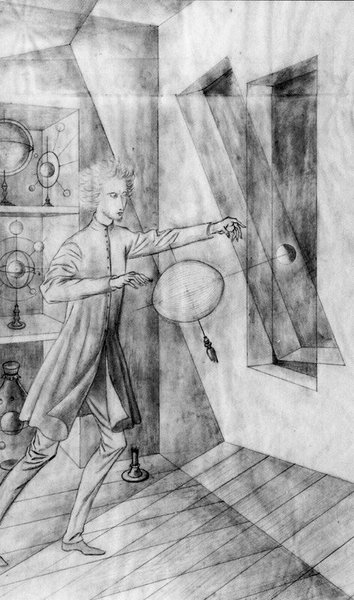
This group has been active for a long time and has already made some remarkable assertions which render life simpler from the practical point of view. For example, I move a pot of green color five centimeters to the right, I push in the thumbtack beside the comb and if Mr. A (another adherent like me) at this moment puts his volume about bee-keeping beside a pattern for cutting out vests, I am sure to meet on the sidewalk of the avenida Madero a woman who intrigues me and whose origin and address I never could have known... --Remedios Varo
(Slideshow is of Artwork by Remedios Varo)
By believing passionately in something that still does not exist, we create it. The nonexistent is whatever we have not sufficiently desired. --Franz Kafka
Ailuromancy is one of many, many 'mancies' (see a seemingly endless list HERE), methods of divination which rely on careful attention to some aspect of one's surroundings to explain present, past, and future. Ailuromancy is divination based on the study of the actions of a cat.
There
are various listings of what a white cat or a black cat have to be
doing to bring good luck or what is a warning, or what signals rain,
etc. Many of the actions seem rather mundane and regularly practiced
during a cat’s routine day--cleaning her left paw, for example. What cat
would leave the left paw dirty until she thought it was about to rain?
So I decided to step in with some observations of my own. Always
remembering (as I will mention again later, with Schrodinger’s cat) that
the observer is the one making connections between cause and
effect...And my observations have been made, in this particular case,
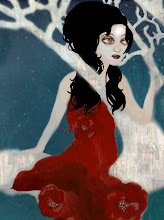
via a study of the behavior of the above three blue cats.
If a Blue Cat Interrupts your Step...
If a Blue Cat is Intent on Flying...
If a Blue Cat Kisses You
Similarly, there is a method of divination called Ambulomancy, divination by walking around. If you're looking at the sky, there is Aeromancy, where atmospheric conditions are read for meaning; Apantomancy "is a form ofdivination using articles at hand or things that present themselves by chance. The diviner works him/herself into astate of trance until an object or event is perceived and a divination worked out. A branch of Apantomancy places special significance on chance meetings of animals." (Wiki/ The Element Encyclopedia of the Psychic World).
That particular mancy is just like
dream interpretation but while awake. According to Buckland, in his Encyclopedia of Divination and Soothsaying: "A chance
meeting with a chimney sweep, for example, could be taken as indicative
of some future event, as could opening a drawer and unexpectedly seeing a
magnifying glass. (The augurs of ancient Rome would include such things
as the fall of a stick in a temple, the squeak of a mouse, stumbling,
or sneezing.) The way in which these objects and people are interpreted
would depend entirely on the diviner"--going back to the idea that you
are creating the objects and occurrences around you as you observe them.
Recently, I became lucid in the middle of a dream while standing in a
very tall-ceilinged bathroom. It struck me as incredible that my mind
had bothered to create such an amount of colorful detail in the patterns
of the tiles on the floor and walls. When you look at your desk and see
crumbs, are they meaningful to you? No. But why would your dreaming
mind bother to put them there? And if it does, don’t they necessarily
have meaning? I was unable to follow this thought further into the
dream, however, because at that moment, my cat pounced on me, waking me
up.
If a Blue Cat Stops You in the Street...
According to the Encyclopedia of Divination, there is also Alveromancy,
which studies sounds for their meaning. They list ocean waves, wind
blowing, echoes or bird calls, but the idea brings to mind the
paradigm-shifting sounds of shamanic drumming and that amazing song "I
Put a Spell on You", specifically as sung by Nina Simone...
Occultopedia
states: "The ancient Egyptians believed sound was a direct channel
between humanity and the gods. They also thought that the practice and
use of sound in the words and names of scripts revealed the real mystery
of magic and prophecy." The power of the real name of god, spoken
aloud; chanting, the particular order of words in a spell: "Proper
pronunciation and recital of magical script was one of the most
important principles in ancient working magic and divination...According
to Herodotus, the Peleiades--sacred women priestesses of Zeus and the
Mother Goddess, Dione, at the Oracle in Dodona--received prophetic signs
and omens from the sounds and noise caused by the movement of the
foliage of the sacred oak outside the temple. At this same Oracle
another form of Alveromancy was also performed, as diviners listened and
interpreted the murmur made by a miraculous fountain.” Our detective is listening to the voices of his cats, of course.
Across
the world, there are a variety of "Devil's Bridges," amazing or
particularly difficult constructions rumored to only have succeeded by a
deal with the devil--the exchange being the soul of the first one to
cross the bridge (a new crossing over previously uncrossable space, and
the dangers of being the first to step off of what was previously the
edge of the earth--it’s easy to see how this idea developed). In many of
these stories, the people tried to circumvent the devil by sending an
animal across first, and in one particular case, that animal was a cat.
The devil, furious, nonetheless went to claim his soul, but the cat
shredded him and fled, thus both protecting the townsfolk and saving his
own soul. The cat can see in the dark, cannot be deceived, is good at
sneaking up on you (unless she is a hungry siamese, which you can hear
for miles:)), and excels at catching rats, so she makes an excellent
detective herself.
I thought it might be fun if everyone posted in the comments what a certain action by a Blue Cat might 'mean'. Go on, be diviners! There are some suggestions here, but you know cats can get twisted up in any position, can suddenly and inexplicably go berserk or, conversely, they can be the calmest one in the room (also inexplicably). So, go wide.
If a Blue Cat Offers to be a Scarf...
**Update:
Apparently, these aren't even the first cat detectives. You can read about a real one, Fred the Undercover Kitty, who even won medals for his service, here.
:D
The idea here is again about Yin/Yang and the balance of light and dark (see Wade Davis post), and the forest and night being where we can go to get past the conscious territory and its rules, taboos, and glaring spotlight of social structure and performance and the related heritage and traditions, which generally not only keep us from exploring new ideas but, more than that, keep us from even realizing there’s anything beyond that blinding spotlight. We can’t even conceive of it. The woods at night take us far beyond our remembered history and our great books filled with warnings and listings of our failings and battles and weakness. And deep in the darkness of the woods is Erzulie, the Black Madonna, who is so far outside the spotlight she can’t even conceive of our failings and weaknesses. This is Erzulie, who expects lavish attention, love, and childlike, free behavior beyond what responsible adults think is logical or even acceptable.
Back again to the subject of Yin and Yang, only this time to the liminal space, that edge between them, the fuzzy part where you squint, realizing something is just past your field of vision, and what is that? You step into that space, leaning forward--there’s still floor underneath you, but it feels precarious. How do you know there isn’t a great yawning pit just out of sight? Suddenly, there is the possibility of asymmetry--maybe it will be like the astronaut discovering life without gravity. The floor doesn’t do what it’s supposed to, and suddenly, you’re on your head.
Sketch for Phenomenon of Weightlessness, by Remedios Varo. A North American astronaut contacted Varo after seeing the painting to tell her how precisely it expressed what the experience had been like.
In The Hare with Amber Eyes, Edmund de Waal describes his favorite Netsuke, the tiny, beautiful carvings from wood or ivory that used to be used to balance your coin purse over your belt: “They are always asymmetric, I think with pleasure. As with my favorite Japanese tea- bowls, you cannot understand the whole from a part....This was a netsuke of a very ripe medlar fruit, made out of chestnut wood in the late eighteenth century in Edo, the old Tokyo. In autumn in Japan you sometimes see medlars; a branch hanging over a wall of a temple or from a private garden into a street of vending machines is impossibly pleasing. My medlar is just about to go from ripeness to deliquescence. The three leaves at the top feel as if they would fall if you rubbed them between your fingers. The fruit is slightly unbalanced: it is riper on one side than the other.”
This idea, that you can’t know the whole from a part--that the whole is more than its parts--is difficult to hold on to. Art has generally seemed to me to be about balance, about placing things so that no one part outweighs the others, so that each part fits together, like a puzzle. But that little bit of imbalance, that little bit of asymmetry, that is the liminal space that we are really always seeking. That is the unsteady ground, between what you already knew and what you might yet find. That is the part that tells you you are still alive, that more is coming, that the world is bigger than you thought. And so it becomes clear that the art itself is the imbalance; as you paint or write, you are creating something just outside the realm of the known, just off the tip of the balance of things. Thus you make a doorway, or a liminal space, where one can get lost in contemplation and come out of the woods in a different place.
An object carries with it its own history, “the sensuous, sinuous intertwining of things with memories.” But what if you don’t know the stories? You could seek them out, as he does, adding weight to the tiny thing, making it more alive and more active in your life. Or, or--you could make them up. The object has weight, and the story you will create around it is thus given a weight that makes it real, and a trajectory that brings it into your possession. You give the object, and therefore yourself, that history, and then you are moving forward, into the future, from a different place. Your “here” has shifted. The ground has shifted. You passed through a liminal zone, a wormhole if you like. The object becomes memory, talisman, amulet. You carry it, and it reminds you of who you are and where you have come from, and you forget, or it ceases to matter, that you created all of that back-story from a wild grasping at air as you tumbled down the rabbit hole in the dark. The story is real because it landed you on your feet, and here you are...
Kitty and clockworks
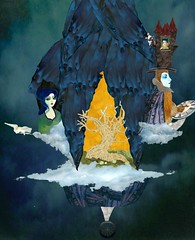
There are a few shared stories in this drawing: Castor and Pollux, Neptune, St. Ulrich and Agwe; the Green Man as he is linked to the Black Madonna also known as Erzulie; the famous hanging gardens of Babylon (with its forest of thick, tall trees planted, unbelievably, atop columns under which visitors could stroll and the entire thing green and lush in the midst of the desert); the Tower of Babel and the looming, layered crowding babel of metropolis and Metropolis. The night and the forest and the dark cellars of the unknown. The cuckoo bird that escapes the confines of time. The cat that sees all. They are all thrown together, a jumble of stories and pathways and perspectives, and somewhere in there is your perfect path, that somehow, somehow, you are landing on, even though there are so many other places to land.
Green Man and Erzulie
In a previous drawing of Agwe and Erzulie, I had shown the story of the saint syncretized with Agwe, Ulrich, and his horse that could walk on water by giving the horse a fish tail. Later, I discovered that Castor and Pollux (explored HERE) were also said to ride hippocampi and protect sailors, and then Neptune and Poseidon (who created horses out of the froth and foam of breaking waves), with the same tasks. I had paired Ulrich with St. Afra, who had been said to be both a virgin and a temple prostitute for one of the pagan goddesses; Agwe is paired with Erzulie, who is both a virgin and a wife to three husbands and a lover to many more; Neptune’s two paredrae are Salacia and Venilia, one who represents the overpowering, gushing forces of water, and the other the still, tranquil, quiet waters. All of these powerful beings push up forcefully from the deep, dark waters of chaos, from the collective unconscious, from the place where dark and light are perfectly balanced and unified; all of them are able to travel across the line separating the living and the dead. In this drawing, I was thinking also of the Green Man, the ancient being forming out of the darkness of the woods, still partially hidden behind the foliage, and his link to the 12th-century Sufi saint Khidr, who is “the principle mediating between the imaginary realm and the physical world.” (Tom Cheetham, Wiki). “There are legends of him [Khidr] in which, like Osiris, he is dismembered and reborn; and prophecies connecting him, like the Green Man, with the end of time. His name means the Green One or Verdant one, he is the voice of inspiration to the aspirant and committed artist. He can come as a white light or the gleam on a blade of grass, but more often as an inner mood. The sign of his presence is the ability to work or experience with tireless enthusiasm beyond one’s normal capacities” (William Anderson, Green Man: The Archetype of Our Oneness with the Earth). That--the tireless enthusiasm, the push beyond one’s normal capacities--is what Erzulie expects of all of us. One of her most striking aspects is her demand for luxury, finery, attention, love and play beyond the logic of economy, the heat of her festival days, and life’s other commitments. She is never satisfied. And she insists on imagining beyond possibility. And the Green Man he’s talking about here, Khidr, is represented in iconography with a fish, or as a fish; he meets Moses in Chapter 18 of the Quran ‘at the junction of the two seas’ to teach him the two sides of many events which may seem at first to be ‘good’ or ‘evil’ but could be the opposite, bringing us back to yin and yang. The junction of the two seas. He is also like Erzulie in a bizarre ambiguity--he is a very young man with a long white beard (the Green Man has historically been associated with something very ancient, but is also quite virile, right?).
The vines stretch from her to him or from him to her. Her body is a framework for pulsing life and the thumping and fluttering and bursting free of spirit; a face rests atop this as a symbol of all that lies beneath. Here, the vines wrapping around the Green Man are disgorged from her mouth and eyes instead of his. They are inextricably linked. Erzulie is deeply syncretized with the Black Madonna of Czestochowa, whose icons are reproduced complete with the scarring given the original by two thieves who unsuccessfully tried to steal her from her home. It is a common behavior of Black Madonnas (statues, more often than not) to refuse to be told where to go: “Many have mysterious provenance: they appeared miraculously in wells, ghost ships, trees or caves...These statues demonstrate supernatural power, making themselves light or heavy or refusing to stay where they are placed. The identify where they are hidden via apparitions and dreams [which connects them directly to the Artnap story that Vesna is writing, in which the two larger characters above were born, which has to do with the painting of a certain saint that would be sold if the painter had not somnolently buried it somewhere unknown. She has hired the detective to find her steadily disappearing paintings and locate the source of the problem.] They choose the sites of their own shrines” (Encyclopedia of Spirits, by Judika Illes). The Czestochowa icon is one of the more famous. It was said to be painted one a tabletop built by Jesus, and to have travelled and passed in ownership across the centuries until it came to rest in a Pauline monastery in Poland. “In 1439, Hussites (Protestants) attacked the monastery and attempted to remove the icon. One man struck the Madonna with his saber. He instantly fell to the floor writhing in pain and died. The icon was stolen, but arriving at the city limits, the thieves' horses refused to budge. The thieves found they could not leave town until they abandoned the Black Madonna, now covered in blood and dirt. The horses immediately moved and a miraculous healing spring emerged at the spot. Saber scars on her cheek and the arrow wound in her throat remain visible. Polish soldiers brought copies of her image to Haiti. The wounds on her cheek resemble African tribal marks, and the Black Madonna of Czestochowa is now intensely identified with the Vodou lwa Ezili [Erzulie] Dantor” (Illes). The Black Madonnas are known for their intense miracles, including the resurrection of the dead and buried. For C. G. Jung, she was the archetype of the dark feminine, “that which is unconscious, unpredictable and mysterious in humans and in the Godhead. She represents the existential terror one has to face in the ‘dark night of the soul’”. Now, moving from these two to the Okapi and Phaeton’s sisters in their transition into weeping Poplars. Phaeton was young and inexperienced and lost control of the sun's chariot, plunging it to the Earth and scorching all of Africa. An enraged Zeus hurled him into the river Eridanos. There, his sisters gathered and wept, turning into "amber-teared" poplar trees. They represent many things, including eternal life and everlasting love, and the white poplar was planted and lives forever in the Eleusian Fields in honor of Persephone, who lived both below the earth and above it; amongst death for part of the year and bringing rebirth to those above for the other part. The Poplar tree has leaves of two colors (back to our theme of yin and yang, dark and light), which are also mythologically explained as representative of Herakles' ability to go back and forth from the underworld--all of this symbolizing, to me, one's ability to (repeatedly!) go into the unknown and come back out with some saving grace. For this also, I have presented the Okapi amongst them, once thought extinct, but very much alive. The poplars are rooted in the earth, inexorably connected to the deep waters from which one of our many-named hero rises, and they reach up to the sky and out of their own realm into the 'outer' world, along with the birds. One last thing about the 'underworld': When Herakles went down there, though it wasn't one of his tasks, one of the things he did was rescue Theseus. Theseus had gone down to rescue/kidnap Persephone, but having been tricked by Hades to sit down and eat first, he sat in the chair of forgetfulness. It is forgetfulness we must guard against when digging into the unknown and spending time underneath things; imbalance on the side of darkness (ie too much time spent there) is what leads us to the atrocities mentioned in this post. So, that’s the scene for those who brave the basement stairs (here made of a combination of the stairs from Asphalt, shown in a photo in Lotte Eisner’s The Haunted Screen and Clive Hicks-Jenkins set for the theater production Little Shop of Horrors. ). The whole scene unfolds behind the bark of the Baobab.
“This book first arose out of a passage in [Jorge Luis] Borges, out of the laughter that shattered, as I read the passage, all the familiar landmarks of my thought—our thought that bears the stamp of our age and our geography—breaking up all the ordered surfaces and all the planes with which we are accustomed to tame the wild profusion of existing things, and continuing long afterwards to disturb and threaten with collapse our age-old distinction between the Same and the Other. This passage quotes a ‘certain Chinese encyclopaedia’ in which it is written that ‘animals are divided into: (a) belonging to the Emperor, (b) embalmed, (c) tame, (d) suckling pigs, (e) sirens, (f) fabulous, (g) stray dogs, (h) included in the present classification, (i) frenzied, (j) innumerable, (k) drawn with a very fine camelhair brush, (l) et cetera, (m) having just broken the water pitcher, (n) that from a long way off look like flies’. In the wonderment of this taxonomy, the thing we apprehend in one great leap, the thing that, by means of the fable, is demonstrated as the exotic charm of another system of thought, is the limitation of our own, the stark impossibility of thinking that.”
Michel Foucault, The Order of Things (New York: Pantheon, 1970) xv.
"Everything leads me to think that, in the near future, reality will be considered exclusively as a mere state of depression and inactivity of the mind" --Salvador Dali






 Posts
Posts