member of:Observers of the Interdependence of Domestic Objects and Their Influence on Everyday Life


This group has been active for a long time and has already made some remarkable assertions which render life simpler from the practical point of view. For example, I move a pot of green color five centimeters to the right, I push in the thumbtack beside the comb and if Mr. A (another adherent like me) at this moment puts his volume about bee-keeping beside a pattern for cutting out vests, I am sure to meet on the sidewalk of the avenida Madero a woman who intrigues me and whose origin and address I never could have known...
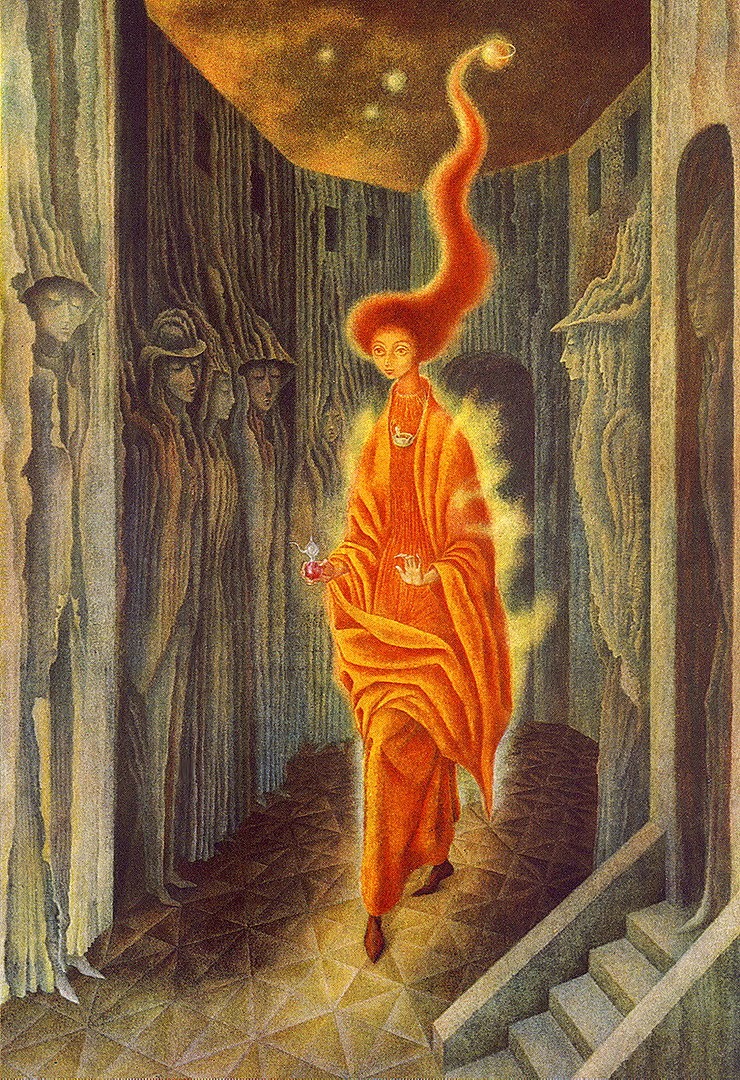
--Remedios Varo


(Slideshow is of Artwork by Remedios Varo)
By believing passionately in something that still does not exist, we create it. The nonexistent is whatever we have not sufficiently desired.
--Franz Kafka

Wednesday, April 23, 2014

Earth Day Saint: The Spell of the Sensuous

St. Theodora by Zoe Blue

Happy (late) Birthday, Vesna!
“The most sophisticated definition of “magic” that now circulates through the American counterculture is “the ability or power to alter one’s consciousness at will.” No mention is made of any reason for altering one’s consciousness. Yet in tribal cultures that which we call “magic” takes its meaning from the fact that humans, in an indigenous and oral context, experience their own consciousness as simply one form of awareness among many others. The traditional magician cultivates an ability to shift out of his or her common state of consciousness precisely in order to make contact with the other organic forms of sensitivity and awareness with which human existence is entwined. Only by temporarily shedding the accepted perceptual logic of his culture can the sorcerer hope to enter into relation with other species on their own terms; only by altering the common organization of his senses will he be able to enter into a rapport with the multiple nonhuman sensibilities that animate the local landscape. It is this, we might say, that defines a shaman: the ability to readily slip out of the perceptual boundaries that demarcate his or her particular culture—boundaries reinforced by social customs, taboos, and most importantly, the common speech or language—in order to make contact with, and learn from, the other powers in the land. His magic is precisely this heightened receptivity to the meaningful solicitations—songs, cries, gestures—of the larger, more-than-human field.
Magic, then, in its perhaps most primordial sense, is the experience of existing in a world made up of multiple intelligences, the intuition that every form one perceives—from the swallow swooping overhead to the fly on a blade of grass, and indeed the blade of grass itself—is an experiencing form, an entity with its own predilections and sensations, albeit sensations that are very different from our own.”
(Abram, David (2012-10-17). The Spell of the Sensuous: Perception and Language in a More-Than-Human World)

What if the ancient story of the Garden of Eden is the loss, in monotheistic culture, of this magic? What if our expulsion, our great sin is that we stopped listening to, stopped attuning ourselves with, all the other consciousnesses around us, and began to see only human intelligence as any intelligence at all? The word, Paradise, comes from the Persian term for an enclosed garden. Our loss of Paradise may have been our loss of the ability to immerse ourselves in that garden...to feel the pulse of its life, to share perception with its creatures and plants, to comprehend their communications.


St. Theodora by Zoe Blue: horns are mother-of-pearl


The author of The Spell of the Sensuous, David Abram, paid his way through school by working as a magician, and later studied the plays on perception that magic used and how they might aid a psychologist, using sleight-of-hand techniques to help people who were difficult to treat via regular psychotherapy. He then went to study with Shamans in various regions of the world, to better understand the malleability of perception. What he learned there re-focused his attentions on the rest of the world--that is, the non-human parts of it--in a fascinating manner that he describes and explores in this book.

“In Koyukon belief, the other animals and the plants once shared a common language with human beings. This was in the Distant Time (Kk’adonts’idnee), a time during which all living beings 'shared one society and went through dreamlike transmutations from animals or plants to humans, and sometimes back again.' We will postpone until the next chapter the question of whether the stories told of the Distant Time by the Koyukon people depict an originary time 'long ago' in the past—as they are often interpreted according to the linear-historical view of time first imported into the Koyukon territory by Catholic missionaries—or whether the Distant Time is more coherently understood as a unique dimension or modality of time, one that is more integral to the living present than it is to the historical past. In any case, and despite the apparent differentiation of animal and human languages since, or outside of, the Distant Time, the various discourses of humans and animals still overlap and interpenetrate in the everyday experience of Koyukon persons.”

He gives wonderful examples of that overlap of languages:

“The interpenetration of human and nonhuman utterances is particularly vivid in the case of numerous bird songs that seem to enunciate whole phrases or statements in Koyukon. Many bird calls are interpreted as Koyukon words.… What is striking about these words is how perfectly they mirror the call’s pattern, so that someone [outside the tribe] who knows birdsongs can readily identify the species when the words are spoken in Koyukon. Not only the rhythm comes through, but also some of the tone, the “feel” that goes with it.
[...]
Hence the whirring, flutelike phrases of the hermit thrush, which sound in the forest thickets at twilight, speak the Koyukon words sook’eeyis deeyo—“it is a fine evening.” The thrushes also sometimes speak the phrase nahutl-eeyh—literally, “a sign of the spirit is perceived.” The thrush first uttered these words in the Distant Time, when it sensed a ghost nearby, and even today the call may be heard as a warning.”

If our loss of Eden was much like the story of Babel--an inability to comprehend the communications of other creatures, life-forms, or even other humans via a loss of ability or perhaps just willingness to take the time and effort necessary to immerse ourselves in the perceptual experience of those other forms or beings, then a return to Eden would be the opposite: Paradise would be the ability to shift our entire being to feel the world’s communications to us, thus being able to respond appropriately. Everything would fall into place: Magic.

St. Theodora's Companion, Zoe Blue


One of the suggestions the author makes towards this end comes from his study of the storytelling techniques of different tribes such as the Aborigines in Australia and their song cycles, and where a person is “conceived.”

“What, then, is the Dreamtime—the Jukurrpa, or Alcheringa—that plays such a prominent part in the mythology of Aboriginal Australia? It is a kind of time out of time, a time hidden beyond or even within the evident, manifest presence of the land, a magical temporality wherein the powers of the surrounding world first took up their current orientation with regard to one another, and hence acquired the evident shapes and forms by which we now know them. It is that time before the world itself was entirely awake...”

The above reminds me of the idea of a latent image, of the belief landscape that lies underneath every occurrence and interaction in your life. Abram then goes on to talk about how the world “got” (or gets, continuously) its form, which is a tale told by song, a song which travels the whole landscape of the country via the path of the Ancestor which first walked, creating the landscape as he did so:

"The distance between two significant sites along the Ancestor’s track can be measured, or spoken of, as a stretch of song, for the song unfolds in an unbroken chain of couplets across the land, one couplet 'for each pair of the Ancestor’s footfalls.' The song is thus a kind of auditory route map through the country; in order to make her way through the land, an Aboriginal person has only to chant the local stanzas of the appropriate Dreaming, the appropriate Ancestor’s song.”

Then comes the immersion, the sort of hypnosis, that the song provides:

“Knowledge of distant parts of one’s song cycle—albeit in one’s own language—apparently enables a person to vividly experience certain stretches of the land even before he or she has actually visited those places. Rehearsing a long part of a song cycle together while sitting around a campfire at night, Aboriginal persons apparently feel themselves journeying across the land in their collective imagination...”

In this culture, as in the others he studied, a sense of place is fundamental to being. A person feels his environment as a part of himself. Abrams gives fascinating examples from the Apache culture and the Aboriginal culture which describe a great power in storytelling, singing, and words themselves which all describe an immersion in the landscape that is very different from what most modern life experiences. But back to Eden:

“The Dreamtime is not, like the Western, biblical notion of Genesis, a finished event; it is not, like the common scientific interpretation of the “Big Bang,” an event that happened once and for all in the distant past. Rather, it is an ongoing process—the perpetual emerging of the world from an incipient, indeterminate state into full, waking reality, from invisibility to visibility, from the secret depths of silence into articulate song and speech. That Native Australians chose the English term “Dreaming” to translate this cosmological notion indicated their sense that the ordinary act of dreaming participates directly in the time of the clan Ancestors, and hence that that time is not entirely elsewhere, not entirely sealed off from the perceivable present.”

Shiny horns (and companion)
Zoe Blue


Here, Dreamtime is the “time” of the creation of the world--not the distant past, but an underlying, symbolic, living layer--something to interact with, to pay attention to, something to know. If we look for a way to see that time in space, Abrams suggests thinking of the “future” as the horizon, or the other side of the trees in front of you; the “past,” then, is the detail in the rings of those trees, the archeological finds in the soil underneath, including the type of sediment or rock that gives a precise accounting of the conditions in the area for the previous thousands of years; the present is the very air you are breathing, all the scents and textures and thoughts and songs and tiny bits of the insides of every other being breathing that same air right now. All those things are “invisible” to you, yet they are right here, right now--present, past, future, making up one landscape that you are a part of--and that you can alter.

Learning to pay such an immersed attention to all aspects of our entire environment right now is a step towards rediscovering Eden. And, just like modern psychology suggests that we would be well-served to step back, especially in tense situations, and re-view our surroundings from the perspective of a fly on the wall, “propelling [our] awareness laterally” is also a tool of the shaman:

“The traditional or tribal shaman, I came to discern, acts as an intermediary between the human community and the larger ecological field, ensuring that there is an appropriate flow of nourishment, not just from the landscape to the human inhabitants, but from the human community back to the local earth. By his constant rituals, trances, ecstasies, and “journeys,” he ensures that the relation between human society and the larger society of beings is balanced and reciprocal, and that the village never takes more from the living land than it returns to it—not just materially but with prayers, propitiations, and praise.
[...]
Any healer who was not simultaneously attending to the intertwined relation between the human community and the larger, more-than-human field, would likely dispel an illness from one person only to have the same problem arise (perhaps in a new guise) somewhere else in the community. Hence, the traditional magician or medicine person functions primarily as an intermediary between human and nonhuman worlds, and only secondarily as a healer. Without a continually adjusted awareness of the relative balance or imbalance between the human group and its nonhuman environ, along with the skills necessary to modulate that primary relation, any “healer” is worthless—indeed, not a healer at all. The medicine person’s primary allegiance, then, is not to the human community, but to the earthly web of relations in which that community is embedded—it is from this that his or her power to alleviate human illness derives—and this sets the local magician apart from other persons.”

So, again, that immersion in the landscape, that attention to the placement of objects and the interactions of the living beings around you, and the practiced ability to tune into those other perspectives--to be those other beings, at different times--, brings one to paradise: balance, and health, and magic. It is the garden, the Earth itself that is Paradise.


Throughout the book, Abrams explores the way that developing and using a phonetic alphabet has changed the human relationship with the landscape and turned our attention inward, detaching us from our environment and our surroundings in a way that has had rather extreme consequences, both for human health and for environmental health. But he is careful to point out that his point is not to blame our current situation on writing; rather it is to encourage us to pay attention to our way of thinking, and to work on it, to make “an attempt to think in accordance with our senses, to ponder and reflect without severing our sensorial bond with the owls and the wind [...] a style of thinking, then that associates truth not with static fact, but with a quality of relationship.”

In The Little Locksmith, Katharine Butler Hathaway describes the night terrors that she suffered, the times of overwhelming panic, while she lay strapped to her board, immobile and of uncertain future, for ten long years as a child. Later, when she was able to get up and move around, she still suffered these crippling panics, as she faced her extreme difference and the things that she believed it would keep her from experiencing in this world--things like social inclusion and romantic love (she was, however, incorrect about both). She talks through her memoir of the process of writing being her savior, but also says that often when she needs it most desperately, when she feels those terrors, she is unable to function as a writer, she can’t find that place. But then she discovers this method-- a method of immersion much like what Abrams suggests, though she is not particular about the type of environment:

“After I had discovered my eyes I taught myself to remember them whenever the horrors struck me. No matter what might be happening to me, no matter how crazy and frightened I might feel, there was always the great visible world before me, and I could look at it. When a moment of terror came I could look at a chair, or at a table or at a door, and by deliberately and faithfully looking at it and really seeing it with my whole attention, with the intense and humble selfless concentration of an artist, of a child, of a van Gogh, I could realize and see the chair, or the table, or whatever the object happened to be that was in front of me [thus drawing her out of herself], as I had never realized and seen it before; and it became for me in that moment an object of love, full of mystery and meaning, because the entire visible world became, when I really looked at it, lovable, mysterious, and significant. An ecstasy filled my hand and I began to work. And so I found out where I was to go. For by setting myself to work with the aim of translating my wonderful delight and realization of things into words and sentences I could deliberately cultivate the delight and prolong its visitations until it became the element within which I lived, safe at last, happy and invulnerable.”

She uses writing to extend those moments of immersion in the real world, to further their relations to her life, to imagine them outwards. Writing, then, becomes her savior, enables her to detach herself from her own perspective and immerse herself in another:

“Even in the midst of my sickness, when I had believed I never would write again, the healthy instinct began to work when one day I had reached over from my bed to get a pencil and paper out of the drawer of the night table beside me and I wrote down on a little block of pink paper an idea for a novel that had fallen like a seed into my mind from listening to my nurse tell the story of her life.[...] It filled me with excitement and anticipation. It happened that for me and my purpose it was a living seed. Out of it a story grew and kept on growing year after year, curving like a vine first in one direction and then in another, yet creating and maintaining by means of its own mysterious will its own equilibrium and design. It grew as knowingly as a beautiful and intricate shell forms itself, or is formed by its soft, amorphous, yet accurately guided inhabitant. It was mysterious and beautiful to me, not necessarily to anybody else. But that was enough. I was in love with it, spellbound. It was a story about two sisters who lived in an old yellow farmhouse on the edge of Danvers. I watched every fly that crawled over the kitchen table in that imagined farmhouse, and I smelled every cake and loaf of bread the sisters made, and I heard the stamping footsteps of their father coming in from the snow. [...] I was able to build up for myself what appeared to be an invulnerable calmness and joy, and a complete indifference to my own personal life except that it should remain empty and leave me free to live wholly in this new element which was not the real world but a kind of mirror element in which the essence and movement of the real world was reflected, as in a fortune-teller’s crystal.”

A living seed, which curves like a vine, which grows into new relations between new people, each of whom offer her other perspectives, unique from her own. And she spends time with them, develops them, heals with them--and part of her process is going out, alone (which was a startling concept in itself at the time, for any woman), and purchasing and renovating a home in Castine. That purchase was chosen because of the place itself--a certain magic she felt it had. It was a place with legends of its own which were attached to the very land, and even behaviors that were associated with weather patterns. From her time there, she went out into the world, traveling --again alone-- to Europe to become part of the Surrealist circle, an artist in her own right, and falling in love, falling out of love, recovering, and then falling in love again, this time to marry.

It is an intriguing suggestion, that immersion in place and “propelling [our] awareness laterally,” might be just the technique to practicing true, transformational magic. That, like the shaman, we might ourselves become, for the moment, a bird or a monkey or a horned beast, and then “come back” to ourselves with new, impossible information. One step closer to Paradise.

As I studied fire and firing neurons and their rhythms and the heat of dance, I also delved into the tales of St. Caterina of Bologna; as I explored the realm on the other side of the mirror or at the bottom of the lake, and the idea of having a fish-tail, I discovered the tales of St. Fevronia. I often like to have a Saint or figure that has a religious or mythological (intensely emotional and heavily symbolic) significance; the figures help to solidify ‘theory’ and emblemize ideas...they also thus serve as meditation aids. For the garden/earth ideas I am exploring, I’ve had no such figure to draw upon, not until the day I finished this painting, when I stumbled upon the story of Saint Theodora of Vasta. She was a woman in 11th-Century Greece who disguised herself as a man in order to join the militaristic defense of her city against raiding bandits. In an event that seems to me to precisely reflect the ideas above, she was, while disguised as a man and fighting with weapons, killed, and as she died, she made a request to God to turn her body into a Church, her hair into trees, and her blood into the water for those trees. A church was indeed built upon her grave, and as you can see from the below photos, trees did in fact begin to grow out of its roof. According to legend, a river re-directed itself to flow under the church; it wasn’t until 2003 that geologists were able to use high-frequency georadar to see that the trees were actually growing up through the walls--until then, there appeared to be no root system at all for the trees. It is not easily explainable how the church has survived for hundreds of years with the weight of 17 holly and maple trees growing on its roof (some of them over 98 feet high). The existence of the building at this point really begs for such a transformational mythology to explain it.

Photo of St. Theodora's Chapel from ListofWonders.com

Photo from Xristianos.gr

Interior of chapel, to show that you cannot see the trees from the inside..
Photo from Panoramio.com


The Passionflower the monkey holds is based upon the one drawn by Maria Sybilla Merian, which was used for the cover of Amazing Rare Things. The lizard-to-bird transition comes from here. The pomegranates were at the request of the birthday recipient of this painting, Vesna.

Thursday, March 6, 2014

The Unwritten


by Yuko Shimizu...how does he see?
There is a spiritual discipline in Tibetan Buddhism of a certain type of meditation in which one focuses on a being of some sort: a representative being, symbolic, who serves as a companion and as a reminder of certain concepts. This might be a fox, a fox-human hybrid, a monk, a fish-tailed, horse-hooved woman whose purity of heart is stronger than any human weapon. One focuses on this being with such concentration and such intent, that eventually the thought materializes into a physical form. He or she can begin to materialize even when not called upon, and can be seen by others, but it still will not survive long without the focused practice of the meditator.  This materialized thoughtform is called a Tulpa.


“The term entered Western literature in 1929, through the explorer Alexandra David-Néel’s “Magic and Mystery in Tibet.” She wrote that Tibetan monks created Tulpas as a spiritual discipline during intense meditation.[...]
Jack, a young man I interviewed, decided to make a Tulpa when he was in college. He set aside an hour and a half each day for this. He’d spend the first 40 minutes or so relaxing and clearing his mind. Then he visualized a fox (he liked foxes). After four weeks, he started to feel the fox’s presence, and to have feelings he thought were the fox’s.
Finally, after a chemistry exam, he felt that she spoke to him. “I heard, clear as day, ‘Well, how did you do?’ ” he recalled. For a while he was intensely involved with her, and said it felt more wonderful than falling in love with a girl.
Then he stopped spending all that time meditating — and the fox went away. It turned out she was fragile. He says she comes back, sometimes unexpectedly, when he practices. She calms him down.
The mere fact that people like Jack find it intuitively possible to have invisible companions who talk back to them supports the claim that the idea of an invisible agent is basic to our psyche. But Jack’s story also makes it clear that experiencing an invisible companion as truly present — especially as an adult — takes work: constant concentration, a state that resembles prayer.”--T.M. Luhrmann

Some say that this is the way to keep God “alive”: through regular meditative practice on the principles of that God, until He or She is accompanying you in your daily life. On a societal level--if, for example, everyone in your neighborhood is doing the same thing, and they all pretty much agree on the principles of the God-- the being could have quite a strong physical existence. In fact, if we were to go back to the story of St. Fevronia, we might say that those who can see the religious processions taking place inside the lake, those who can hear the bells tolling--the ones who are called pure of heart--those are the ones who focus on her story, her spirit, her representation with sufficient intent.  When we read the studies--like the gorilla studies-- in neuroscience which describe humans as beings who will only see what their brain thinks is important or relevant to its worldview and understanding of needs, desires and dangers, and we wonder why those perceptive blinders were put on so early in life (around 5 years of age), we could understand it to be a matter of concentration, meditation, intent. A small child has to pay close attention to make out the shapes and colors and humans around him or her, and to understand their intentions and their words. After that small child has ‘figured it out,’ the sense of urgency and focus tends to decrease, beliefs are in place, and when you meet a new person, you make your judgement of who they are and what they represent and what kind of things they’re going to say and what those things will really mean pretty much instantaneously--and what that person actually does or says will be something close to irrelevant as far as changing your mind goes. The same type of neuroscience studies are telling us that we consciously make decisions about 5% of the time--the rest of the time, we’re on autopilot, marching our way through life to a tune we can barely hear. 

How many of the religious really pray? How many people will take five minutes out of their day to blank their minds of lists and concerns and plans, and focus on an ideal, however important they may claim that ideal to be?


by Yuko Shimizu

Here’s a thought: artists do it. Readers do it. Writers do it. Brand-new lovers do it. Not all of them, of course, but when you are stopped, in your rush to get somewhere or do something, by an image, that is a moment of opportunity. What stopped you about the image? What didn’t fit in your perceptual bias, making you suddenly consciously aware of your surroundings? Don’t discard it and move on! Pay Attention. Maybe it was the colors, maybe a sense of motion, or a sense of suspension; maybe an interaction between the depicted characters struck an emotional chord or a curiosity. What is the story behind the image, and how is it different from the one you usually believe to underly the world’s events and the interactions of the people around you? When you read a book, and you don’t want to put it down to sleep, or use the bathroom, or eat, or go to work, you have sunk into another way of being and seeing. Your brain is experiencing events as if they were occurring in the physical space around you, you are taking in the feelings and behaviors and traumas and excitements as your own (so be careful). This experience offers an opportunity to alter your own perception, to see the world in a slightly different light, and if you were to, for example, when you finish the book, call up a character in your mind and converse with him or her, if you were to really visualize the character--skin-tone, scent, hair-texture, style of dress, voice-print, style of speech--and then spend time with him or her, speak with her, listen to what she has to say, could those interactions change who you are and the world around you? Could you even bring that character into physical being?

The Unwritten, Cover of Volume One by Yuko Shimizu

Cover of The Unwritten, by Yuko Shimizu
In The Unwritten, Tom Taylor is presented to us as the son of the author of a wildly famous series of books (think Harry Potter) who disappeared under mysterious circumstances. The protagonist of the series, Tommy Taylor, is named after him, and Tom himself goes around to conventions to tell adoring fans about his dad and answer questions and sign things--an existence he detests. He is always trying to point out the distinction between himself and the character, but the idea itself falls on deaf ears. At one of these conventions, a young student stands up and questions his identity as the author’s son. Public opinion swings rapidly and violently, the way it is wont to do, and Tom finds himself hiding from a variety of hateful ex-fans. Soon, his identity is re-established, but not in a way he finds pleasing at all, and not the identity he’d been living before--he goes from reviled to worshiped, from demon to messiah, and all of it through no acts of his own. It’s truly as if he is simply a pawn of a storyline his father put him in before he had a chance to have any say about it--in fact, it’s always been that way, for him, but now events are such that he is forced to do something about it. 
What the comic--which is fascinating--begins to explore is the way in which stories shape our society, our ways of thinking, and the very behaviors which we thought were most private and individualistic. The first book introduces a set of characters who shape what stories will be presented to the public by a sinister influence upon the authors. In a way very well-matched to that theme, the comic is wound with stories inside stories, and at one point, Tom’s tale is suspended for a brief foray into history (which soon ties back into his present) via the author and poet Rudyard Kipling. 

Cover of The Unwritten by Yuko Shimizu

Cover of The Unwritten by Yuko Shimizu
His very patriotic poetry, exhorting citizens to give up their youth and lives for empire and the British Way, becomes part of the tale of an author who lost his way and found himself trapped in a terrifying, soul-destroying situation. Crushed, he turns to writing again to find his way out:

Pages from The Unwritten, Volume One
The artwork on these pages is by Mark Carey and Peter Gross, who are also the authors. 

Pages from The Unwritten, Volume One
The artwork on these pages is by Mark Carey and Peter Gross, who are also the authors. 

Pages from The Unwritten, Volume One
The artwork on these pages is by Mark Carey and Peter Gross, who are also the authors. 
The whale in this story is the submerged being that tries to amalgamate all stories so that they support one ideal, but it’s impossible, which is why there will always be ways around and through the most hulking and oppressive walls. I find the idea that music and dancing would be the method, here, to find a rhythm not-in-step with the overpowering pulse of contemporary society, very attractive.

The comic is full of fantastically illustrated and developed ideas of the walls of reality and the possible doorways through them...I recommend it whole-heartedly, and am myself waiting impatiently for the arrival of the second book on my doorstep. The good news (or bad, depending on the state of one’s wallet) is that there are at least 8 books of issues already out.

And one more teaser:

Pages from The Unwritten, Volume One
The artwork on these pages is by Mark Carey and Peter Gross, who are also the authors. 


Saturday, March 1, 2014

The Crack in Everything, Pried Open by Alien Hands

 “There is a crack, a crack in everything. That’s where the light gets in.”--Leonard Cohen
Harmony by Remedios Varo

In Alan J. Friedman’s 2000 essay on Varo’s work, The Serene Science of Remedios Varo, he notes that what looks like magical thinking and mysticism often really reflects hard, leading-edge science, and that many of her paintings in fact seem to represent the moment in which a scientist discovers a new model for the universe, “the defining moment, when the new idea becomes a concrete model, invested with all the precision its creator can muster, yet still filled with mystery and unknown promise.” In the above painting, Harmony, he sees the scientist trying to include all of nature in that model: “Among the objects in this model are natural history specimens and mathematics (one of the slips of paper has the first 5 digits of pi, 3.1415). Science, in the form of a prepared mind, is helped by chance (the figure emerging from the wall).” 

Detail of Harmony  by Remedios Varo

Each of us already has a theory of existence, which all five senses base their decisions (notice? don’t notice?) on; that theory exists as the limits to each person’s perspective. In this painting, the figure looks at the symbols and their relations, trying to discover the form of the subconscious cage the world is--to him--limited by, the cage outlining his current life, trying to recognize it and trying to find a crack--like the one the blue figure comes out of here--through which he can slip to a new model, in a moment much like this:

The Phenomenon of Weightlessness by Remedios Varo

Friedman says: “In Phenomenon of Weightlessness (1963), a scientist is astonished as his model of the earth and moon breaks away from the stand on which it rested (seen on the floor), and floats in space on its own. Physicists immediately recognize this painting as depicting Einstein’s physics, which modified the concepts of absolute space and absolute time that Newton had built into his model of how objects behave in space and time under the influence of gravity.”

Friedman notes that of course we are always seeking out new models, because no model is ever complete. In every scientific model, in every life, there are things that do not fit. That’s the crack Leonard Cohen sings about. Pick at it, play with it. Change the universe.

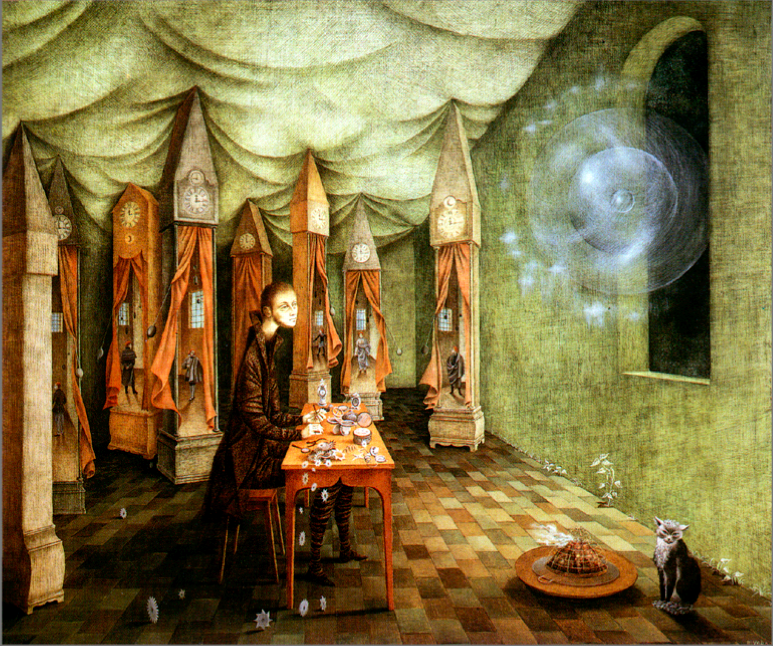
Revelation of the Clockmaker, by Remedios Varo

In Incognito, David Eagleman explains how little the conscious mind is involved in decision-making and lifestyle by exploring the myriad “zombie systems” that compete for position in your subconscious without your awareness. To illustrate, he talks about having a secret, noting that if you have no desire to tell anyone, the story’s just boring, and if you have no problem telling everyone, it’s just juicy, but if you’re conflicted, that’s because you are of (in this case) two minds, much like the two minds that argue about whether to have the cheesecake or stay on the diet, or how much fun it will really be to do those push-ups or read that horrific slog of a textbook which appears to have a lot of important knowledge but is awfully poorly-written. In the example he gives of a trauma, like rape, studies show that not talking about the event has significant long-term health effects both physical and psychological; there is something in you that very much needs to talk about it. There is also something in you which does not want to suffer the possible social (or other) consequences:

“Brains are like representative democracies. They are built of multiple, overlapping experts who weigh in and compete over different choices. As Walt Whitman correctly surmised, we are large and we harbor multitudes within us. And those multitudes are locked in chronic battle.” (107)

There’s the you that focuses on emotional reasoning, there’s the logical side, there’s the lazy side, there’s the side that only looks to the future and the one aching for the past, and at various times one or the other wins out. One of the best and most fascinating examples he gives to show how much conflict is going on “beneath the hood” that you have no idea even exists is that of alien hand syndrome:

“As preposterous as this plotline may seem, there is, in fact, a disorder called alien hand syndrome. While it’s not as dramatic as the Evil Dead version, the idea is roughly the same. In alien hand syndrome, which can result from the split-brain surgeries we discussed a few pages ago, the two hands express conflicting desires. A patient’s “alien” hand might pick up a cookie to put it in his mouth, while the normally behaving hand will grab it at the wrist to stop it. A struggle ensues. Or one hand will pick up a newspaper, and the other will slap it back down. Or one hand will zip up a jacket, and the other will unzip it. Some patients with alien hand syndrome have found that yelling “Stop!” will cause the other hemisphere (and the alien hand) to back down. But besides that little modicum of control, the hand is running on its own inaccessible programs, and that is why it’s branded as alien—because the conscious part of the patient seems to have no predictive power over it...
[...]
What does alien hand syndrome tell us? It unmasks the fact that we harbor mechanical, “alien” subroutines to which we have no access and of which we have no acquaintance. Almost all of our actions—from producing speech to picking up a mug of coffee—are run by alien subroutines, also known as zombie systems. (I use these terms interchangeably: zombie emphasizes the lack of conscious access, while alien emphasizes the foreignness of the programs.) Some alien subroutines are instinctual, while some are learned; all of the highly automated algorithms that we saw in Chapter 3 (serving the tennis ball, sexing the chicks) become inaccessible zombie programs when they are burned down into the circuitry. When a professional baseball player connects his bat with a pitch that is traveling too fast for his conscious mind to track, he is leveraging a well-honed alien subroutine. Alien hand syndrome also tells us that under normal circumstances, all the automated programs are tightly controlled such that only one behavioral output can happen at a time. The alien hand highlights the normally seamless way in which the brain keeps a lid on its internal conflicts. It requires only a little structural damage to uncover what is happening beneath.” (132)

Once he has solidly illustrated just how complicated and multiple our person is, he turns to robots and Artificial Intelligence, and this is where I come back to the paintings of Remedios Varo and those cracks in the universe that allow the light of another, wholly-formed and wildly different universe to get in.

Au Bonheur des Dames, by Remedios Varo... little automated creatures heading to the store for more parts....

Eagleman tells us that robots have been stuck at a certain stage for a long time in terms of how human-like their thinking can become, and he posits (convincingly) that the reason for this lies in that seething community of disagreeing and developing personalities that aren’t even noticed by your conscious self, and their lack of existence within the robot’s “mind.” He notes that when programmers set up a robot, they look for and try to implement the best process to the best solution for whatever problems or situations face the robot. And that’s the one process and solution they put in (as a subagent) for the robot to “turn on” when the situation arises. But:

“If a space alien landed on Earth and discovered an animal that could climb a tree (say, a monkey), it would be rash for the alien to conclude that the monkey is the only animal with these skills. If the alien keeps looking, it will quickly discover that ants, squirrels, and jaguars also climb trees. And this is how it goes with clever mechanisms in biology: when we keep looking, we find more. Biology never checks off a problem and calls it quits. It reinvents solutions continually. The end product of that approach is a highly overlapping system of solutions...” (127)
And, later:

“If we hope to invent robots that think, our challenge is not simply to devise a subagent to cleverly solve each problem but instead to ceaselessly reinvent subagents, each with overlapping solutions, and then to pit them against one another.
[...]
Probably the best way to cultivate a team is with an evolutionary approach, randomly generating little programs and allowing them to reproduce with small mutations. This strategy allows us to continuously discover solutions rather than trying to think up a single perfect solution from scratch. As the biologist Leslie Orgel’s second law states: 'Evolution is smarter than you are.' If I had a law of biology, it would be: 'Evolve solutions; when you find a good one, don’t stop.' (p. 148). 

That is, whatever your model of the universe is, keeping picking at the cracks in it.


This is also what an artist does, with play. Backing away from what one already knows and trying something new to address the same situation (eg how to translate an idea into an image) brings more of these differing subconscious opinions to the conscious surface for assessment. 

Pretend I have drawn a pattern down on paper, and I say to you, "this is the universe.” That’s basically what a person does: we expect politicians to act that way, we expect our doctor to say one thing and not the other, we wait for that response from the in-laws, etc.  But say I see something only slightly odd or out of place as I’m walking down the street and instead of ignoring it, I focus all of my attention on it. That focus on something outside my usual experience creates a new pathway in my brain which sprouts bazillions of other tangential connections, effectively changing me and also the universe that I live in because connections beget connections and eventually that odd thing is part of the structure--fundamental, even, to the pattern I am calling the universe. Yes it was already “there,” in that I was able to glimpse it (barely) but every thing and every time is already there; the issue is bringing it to the level of perception which makes it part of the consensual universe, making it structural. 

“Perhaps, contrary to Plato’s allegory of the cave, we sometimes only see the real once we have seen its shadow in art.” Henderson, Caspar; The Book of Barely Imagined Beings: A 21st Century Bestiary. 

Remedios Varo had fled the Fascist government of Spain to France after the assassination of the poet Federico Garcia Lorca, but as the Nazis began their move into France, deportation became a strong possibility, meaning a forced return to Franco’s regime, where she was already a target. By February 1940, her lover, Péret, had been arrested, having refused to enlist; soon after that she discovered that her first husband was also interred in a camp, and she moved heaven and earth and called on every friend and favor she could to get him out, finally successfully. Both Lizarraga (her first husband) and Péret called upon images of her to help them through their imprisonment and recalled how even the sense of her spirit strengthened them. Soon, however, she found herself arrested by the Nazis in France, an experience she refused to talk about after the several weeks it took her to recuperate in a friend’s apartment.  All this is to say that she experienced first-hand the life-altering terror of a violent state which insists that its voice is the only true voice, that its plans are the only correct plans, that its future is the only possible future, and she survived not to rail against it but to create its alternative, to strengthen many other possible voices, plans and futures through her particular magic.

It took immense effort to get the financing and the false passports and safe passage for her escape from France, endeavors that were undertaken by heroic groups of underground operators, in this case, a group working with Varian Fry whose efforts on her behalf took six months of work; there are a few descriptions from that time period that I think are significant in tying her experience and the ideas of continual evolution explored in Incognito together with this “crack in everything.” The French government made an agreement (Article 19 of the Franco-German armistice) to “surrender on demand” any person with religious views, anti-fascist views, or any other view the Third Reich disapproved of to the Nazis. As the Nazis raised the swastika atop the Eiffel Tower, Varo gave up on her attempts to find and save Péret and joined millions in a mass-flight from Paris to the south:

“It was a June remembered as among the loveliest in years, bright, sunny, cloudless, and not too warm, as Varo became one of the horde of more than eight million refugees: ‘men, women and children [who] took off in utter panic toward the unoccupied zone in the south, packing a few belongings on the roofs of their small cars or on the racks of motorcycles or bicycles or in baby carts, peddlers’ carts, wheelbarrows, or in any wheeled contrivance they could lay a hasty hand on, for many were on foot.” (72, Kaplan)

Twisted Roads, by Remedios Varo

Hairy Locomotion, by Remedios Varo

Her friend Oscar Dominguez managed to find her a spot in a car, sparing her the walk, and the experience of that ride offers the first of the significant things I believe she took with her, planting it deep inside her later paintings:

“Friends remember hearing that Varo traveled ‘in the car of some eccentric Americans who loaded their little car with fossils instead of provisions; in spite of the bombers and black smoke that weighed over the city and its outskirts, they stopped in front of each cathedral to admire it and were touched at encountering, almost unreal, an almond tree in flower.’” (72)

She had barely escaped from her own imprisonment; her lover’s fate was uncertain, though certainly dark; bombs were raining down occasionally upon the easy target of this mass exodus, yet these people, who were sparing Varo a painfully difficult foot-journey, took the time to stop and wonder at a flowering almond tree. In the midst of the traumas and struggles of her life and the lives of those around her, Varo sat down at her easel and created moments of flowering magic: little almond trees growing out of the hard rock of fear and suffering.

Varo made it to Marseille, which became an underground port for intellectuals and artists attempting to flee the country, and where Varian Fry had set up his committee, working wherever he could--even, for a period, from a hotel bathroom--to gather information, proper documents, false documents, financing, knowledge of as-yet undiscovered pathways--whatever was necessary to get as many people as possible away from the Nazis’ targeted wrath. There was a great attempt like this, focused specifically on artists and intellectuals, because those were the people who offered dreams and visions of ‘other ways,’ doorways through the thick stone walls of Fascist mind-fortresses, playfulness in the midst of their very serious endeavors. The Nazis understood this without question, and they made an equally vigorous effort to kill the very people Fry and others were struggling to save.

At one point in the months leading up to Varo’s escape, a collection of Surrealists were staying in secret at an abandoned villa, Villa Air-Bel; Péret had also managed to make it to Marseille, and the two of them stayed close-by the Villa, joining its inhabitants by day. They focused on surrealist games in every break from their struggle to raise food-money, and at one point, Varo discovered that a Republican refugee friend of theirs had a toreador outfit with him, and she and Jacque Hérold and Péret each took turns trying it on and posing in a photo shop along the dock. That is the second moment that I believe she carried with her to her easel each time.

Remedios Varo kept this photo with her all her life

“It was such games, played with a vengeance during the many months in Marseilles, that kept them going. As Breton remarked, ‘So great is this power of defiance, of scorn and also of hope...that the actors in this scene had perhaps never found themselves so childlike, never sang, played or laughed so whole-heartedly.’” (Kaplan, 79)

As they were waiting to give their money (an eventual gift from Peggy Guggenheim) to an intermediary who would pass it on to a black-market operator who would then take them by fishing boat to Casablanca, where they had already secured passage on a Portuguese liner, Varo and Péret stumbled into a young man who offered them a seemingly more secure journey. They gave him their money, and he disappeared. But this story Varo would talk about, for its bizarre twist of luck:

“Although he left them stranded, running off with their precious cash, the thief may have saved their lives. For, as the newspapers soon would report, the black-market operator to whom the money was to have been delivered turned out to be a psychopathic killer who had murdered the previous refugees he had offered to help-- a charge verified by the mute testimony of twelve bodies found buried in his backyard.” (Kaplan, 72)

Varo never spoke of her interment, as far as I have been able to find. She did not seem to focus on the fear and bizarre violence that we do see reflected in other surrealist works of this time. She did not go on to march and protest against fascists and publish articles expressing her--justified--rage. Instead, she went on, with that contrasting flowering almond and the sense of play in the face of terror, and she picked at the cracks, there in the seemingly solid foundations of our often terrifying world, and widened them into a series of mysterious and beautiful jewels of paintings, in which she catches characters suddenly waking from their zombie-subroutine-led existence and making the choice to look in a different direction, at something (somewhere) else:

Note the girl whose eyes are not following those of the others.... (Painting by Remedios Varo)

Rupture, by Remedios Varo

The Call, by Remedios Varo

She created life in those cracks, and even now, here, where Hitler’s terror can’t reach me, Varo’s magic does. I study her art and it changes my life, all these years after her death.

Embroidering the Earth’s Mantel, by Remedios Varo: Note that the woman closest to us on the left is pushing a secret through that little crack where her embroidery comes out....
Detail from Embroidering the Earth's Mantel, by Remedios Varo: The lovers escaping through the crack

Detail of Embroidering the Earth's Mantel