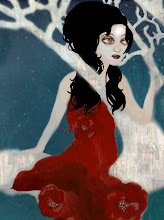
"Now, there is a law written in the darkest of the Books of Life, and it is this: If you look at a thing nine hundred and ninety-nine times, you are perfectly safe; if you look at it the thousandth time, you are in frightful danger of seeing it for the first time." (Napoleon of Notting Hill)

Cathedral of Commerce, by Rob Gonsalves
(Note: All artwork in this post by Rob Gonsalves or M.C. Escher.)
“The noun is formed by an accumulation of adjectives. They do not say "moon," but rather "round airy-light on dark" or "pale-orange-of-the-sky" or any other such combination. In the example selected the mass of adjectives refers to a real object, but this is purely fortuitous. The literature of this hemisphere (like Meinong's subsistent world) abounds in ideal objects, which are convoked and dissolved in a moment, according to poetic needs. At times they are determined by mere simultaneity. There are objects composed of two terms, one of visual and another of auditory character: the color of the rising sun and the faraway cry of a bird. There are objects of many terms: the sun and the water on a swimmer's chest, the vague tremulous rose color we see with our eyes closed, the sensation of being carried along by a river and also by sleep. These second-degree objects can be combined with others; through the use of certain abbreviations, the process is practically infinite. There are famous poems made up of one enormous word. This word forms a poetic object created by the author. The fact that no one believes in the reality of nouns paradoxically causes their number to be unending. The languages of Tlön's northern hemisphere contain all the nouns of the Indo-European languages - and many others as well.” (Translation from the linked Title).
The idea here is this: Re-formulate your metaphors. Rethink your language-object associations. Re-see what is in front of you, by naming it, describing it differently. Out of this new way of seeing and describing comes a whole culture, with its own architecture--the molding of shapes and ways of living in that new space--, which then of course can lead to an archeology--an inspired history of how the architecture developed over time. New sciences emerge which make sense from that point of view. These new sciences and maths and cultural histories and literatures then gradually overtake the ones that were previously taught, the ones which had been called Earth cultures and sciences and maths, etc.
In Napoleon of Notting Hill, G.K. Chesterton, one of Borges’ literary inspirations, travels along a similar path, albeit one with large amounts of blood-spilling swashbuckling (although this is somehow rendered with the distance of mythic history even as it is happening in the novel). The opening quote (above) occurs as three clerks make their routine morning walk to work together, one of them--for no clear reason--choosing to walk behind them today, instead of abreast. This is not his only change in habit for the day, by the end of which a whole new world will begin its emergence, with much fanfare and bluster:
“So the short Government official looked at the coat-tails of the tall Government officials, and through street after street, and round corner after corner, saw only coat-tails, coat-tails, and again coat-tails--when, he did not in the least know why, something happened to his eyes.Two black dragons were walking backwards in front of him. Two black dragons were looking at him with evil eyes. The dragons were walking backwards it was true, but they kept their eyes fixed on him none the less. The eyes which he saw were, in truth, only the two buttons at the back of a frock-coat: perhaps some traditional memory of their meaningless character gave this half-witted prominence to their gaze. The slit between the tails was the nos-line of the monster: whenever the tails flapped in the winter wind the dragons licked their lips...” (8)
Chesterton goes on to develop the effects of this bizarre flipping of the rear-clerk’s vision in a truly fabulous language in style, the whole of which reminds me of the characters passing through Borges' Yellow Emperor's mirror, an act which will allow them to stop moving mechanically and start living--another sort of revolution, which in that case is prophesied to be heralded with the glinting, curving line of a fish in the glass-- no longer an automaton limited to the breathing of dry air, but rather a creature who can take on any atmosphere:
“But when first the two black dragons sprang out of the fog upon the small clerk, they had merely the effect of all miracles--they changed the universe. He discovered the fact that all romantics know--that adventures happen on dull days, and not on sunny ones. When the chord of monotony is stretched most tight, then it breaks with a sound like a song. He had scarcely noticed the weather before, but with the four dead eyes glaring at him he looked round and realised the strange dead day.
The morning was wintry and dim, not misty, but darkened with that shadow of cloud or snow which steeps everything in a green or copper twilight. The light there is on such a day seems not so much to come from the clear heavens as to be a phosphorescence clinging to the shapes themselves. The load of heaven and the clouds is like a load of waters, and the men move like fishes, feeling that they are on the floor of a sea. Everything in a London street completes the fantasy; the carriages and cabs themselves resemble deep-sea creatures with eyes of flame. He had been startled at first to meet two dragons. Now he found he was among deep-sea dragons possessing the deep sea.”

by Rob Gonsalves: Note the appearance of the line of ships as well as the posts changing to women or vice versa.
"They crawled on past the lamp-posts; their mien was so immovable that a fanciful description might almost say, that the lamp-posts crawled past the men, as in a dream." --Napoleon of Notting Hill
In his guide to hyper-lucid dreaming, Frederick Dodson suggests that a person pay particular attention to his/her attention as often as possible. Am I dreaming now? (Yes). He also points out that one of the reasons people so desire to dream lucidly, besides the sense of agency it allows them, is because, in a lucid dream, things seem more real than real. There is a vividness, in every sense, which does not regularly exist when we are awake--unless, of course, we are mystics. Dodgson suggests that “f you can think of or visualize places of beauty and strangeness while falling asleep you change your own energy frequency to a state that is more attuned to lucid dreaming. Also try putting your attention to places you have never been before. To the waking-life-mind lucidity appears beautiful and strange. The idea of this exercise is to "lucid dream" before you lucid dream, that is, to create the state yourself rather than waiting for a lucid dream to deliver results. And as you create the desired state from your own power and initiative, it will be many times magnified in the actual lucid dream. "

By Rob Gonsalves
But the point is to have the feeling that the world you are facing is amazing, and that--and even more amazing--you do have agency in it.
Chesterton suggests an amazingly fantastic example of this in another novel of his, The Man who Was Thursday, a Nightmare. In this scene, Mr. Lucian Gregory, an “anarchic poet” living in the fabulously described Saffron Park is faced with Mr. Gabriel Syme, who we quickly find is an undercover police agent, out looking for anarchists (though, to be specific, he is looking for dangerous anarchists, and he does not seem too concerned with our poet). They have a little language duel, in which Lucian declares that all poets are anarchists, that it is their duty to abolish things, if only for the singularly “poetic” moment of the blaze, the delight of chaos. Otherwise, he says, the Underground Railway would be the height of poetry, with its dull and plodding regularity, its guarantee of sticking to plan. Gabriel says: it is.
“The rare, strange thing is to hit the mark; the gross, obvious thing is to miss it... Chaos is dull; because in chaos the train might indeed go anywhere, to Baker Street or to Baghdad. But man is a magician, and his whole magic is in this, that he does say Victoria, and lo! it is Victoria. No, take your books of mere poetry and prose; let me read a time table, with tears of pride. Take your Byron, who commemorates the defeats of man; give me Bradshaw, who commemorates his victories. Give me Bradshaw, I say!’…‘I tell you,’ went on Syme with passion, ‘that every time a train comes in I feel that it has broken past batteries of besiegers, and that man has won a battle against chaos. You say contemptuously that when one has left Sloane Square one must come to Victoria. I say that one might do a thousand things instead, and that whenever I really come there I have the sense of hairbreadth escape.’” (4)
So, to note that you have done something immense and magical by defeating all odds to actually arrive in Victoria at the allotted time--and what's more, by way of some strange vehicle which whips around under and over ground at great speeds and with strange noises--well, suddenly, you realize, what power I have! And how much better is this realization than the one we more typically put our energies into: my god, I woke up this morning 15 minutes late, forgot to brush my teeth so my breath tastes like I spent all night gnawing on old bones, and the first thing I did when I stepped outside was drench myself in a puddle. We will go around repeating this all day, to everyone we see, with mounting, poetic exasperation. What is that? It's a litany of the opposite of miracles. We are amazed by how badly things go--no bars on the phone, the text wasn't instant, it took several minutes--but not by how regularly well they go, starting with the fact that you *woke up this morning*. This is something I noticed in school, this fascination with litanies of terribleness. We study war after war, treachery after treachery, disease after disease. The very idea of a class which is centered on lists of the impossibly miraculous--of placebos and fantastic occurrences unrepeatable in double-blind studies-- would meet with scorn, where a class on the particular terrors and daily incidents of human nastiness and failure that occurred during the whole of the existence of Nazi camps, or the particular details of the tortures of the impoverished (or simply opinionated) of Chile under Pinochet--these are intellectual exercises which will somehow grant great understanding and knowledge.
So, it comes as no surprise that most of us feel no agency in our lives.
In “The Analytical Language of John Wilkins,” Borges gives an example of a strange taxonomy, claimed to have been culled from some ancient Chinese encyclopedia, and in this taxonomy, he delicately displays “the arbitrariness (and cultural specificity) of any attempt to categorize the world.” (Wiki). The taxonomy divides all animals into the following categories:
“Those that belong to the emperor
Embalmed ones
Those that are trained
Suckling pigs
Mermaids (or Sirens)
Fabulous ones
Stray dogs
Those that are included in this classification
Those that tremble as if they were mad
Innumerable ones
Those drawn with a very fine camel hair brush
Et cetera
Those that have just broken the flower vase
Those that, at a distance, resemble flies”

by M.C. Escher, who said: "I try in my prints to testify that we live in a beautiful
and orderly world, not in a chaos without norms, even though that is how it
sometimes appears. My subjects are also often playful: I cannot refrain from
demonstrating the nonsensicalness of some of what we take to be irrefutable certainties."
Order IS the miracle. Even though all ordering is arbitrary, even though there are a million gorillas passing that you don't see, and a million atoms shivering that you can't perceive; even though you can't hear most of the sounds of the universe, because they don't fall into the small range of hearing that humans possess, *somehow*, we have decided on a shareable image of the world. We have decided that in that world is this city, and through the city will run a train, thus, and it will arrive at each destination at particular times, thus, and that if I get on it now, I will arrive at the place I plan to, thus, and you can meet me there. How is that not a miracle? How, if you think about the chaos of molecules surrounding you and filling your "body,"--how, if you think about the fact that you're all water and bacteria, and some distant memory of a fantasy of your great-great grandmother’s dreams, given flesh--how does any of this happen?
So, it's arbitrary, meaning--you could categorize things in an utterly different way. And yet we don't. And yet, some things fall into those categories, and we see them. The fact that we miss gorillas is astonishing, but so is the fact that we manage to agree to see anything at all.
All of us do this: when you say to someone: I am going to catch the train to Victoria, meet me there at 2pm, and then it happens, that is a miracle. You are a magician. Take a moment and taste this, feel how bizarre and magical it is, and then apply that new knowledge of your own abilities to something you've been convincing yourself can't happen.
Please list miracles below in the comments.

By Rob Gonsalves
Now, back to Napoleon of Notting Hill. After our trailing clerk has begun to see all these odd things about the world around him he generally hasn’t noticed, he tries something else: standing on his head. He does so at the top of a hill, where all sorts of respectable people will see him, thus embarrassing the gentlemen who dared him to do so. As he is standing on his head, ignoring the pleas of his two companions, some officials arrive to announce that he, Mr. Quin, has been chosen--by lottery--as the new king.
He stands on his head, and becomes--not because he stands on his head, surely?--the new king. It is a little blue ship moment, where the fool becomes king, where the rule of the universe is turned upside down, where a change in perspective is everything. Were those gentlemen really already planning to approach him with this news all this time that they have been walking, on this utterly normal day? Or is it because he saw two dragons, went outside at the restaurant in the middle of a very serious discussion to have a laugh about its ridiculousness, and then proceeded to stand on his head, in front of everyone? Is it from that perspective of the world--the one where he’s breathing underwater and upside-down--that he becomes king? And then even gets to enjoy the fact while standing upright?
In fact, Chesterton himself--well, Auberon Quin--states this quite plainly. He speaks of the ritual (all religion has ritual, yes? All magic has ritual? Artists have rituals, and some of them even consider play to be their ritual, which would put them at the *height* of majesty) that he would like to enjoy as a result of his establishment as king. He wants a ceremony upon his entrance into the city, and when the others look embarrassed (at him, not at themselves), and note that there aren’t ceremonies anymore, not in their society, he says,
“‘All ceremony...consists in the reversal of the obvious. Thus men, when they wish to be priests or judges, dress up like women. Kindly help me on with this coat.’ And he held it out. ‘But your Majesty,’ said the officer, after a moment’s bewilderment and manipulation, ‘you’re putting it on with the tails in front.’‘The reversal of the obvious,’ said the King, calmly, ‘is as near as we can come to ritual with our imperfect apparatus. Lead on.’ (24)
As he steps into office, he begins to change everything. He wants the whole world standing on ceremony. At this point, the world has been described to us as being very different from how we see it today: The whole world has been ‘unified’. There are no countries, there are no politicians, and therefore there is no pride of place, special flags or colors, and no arguing over policy. The world is free of war. It is led by one man, a despot, a King, who is chosen at random, by lottery. He makes the decisions, and everyone simply follows them.

Chess Master, by Rob Gonsalves
This King, Mr. Quin, decides to flip all of that on its head. He makes grand speeches, dressed ceremoniously, declaring that we should recall with pride the particular histories of our particular neighborhoods. If we forget, for a moment, what those histories might be, we need only look to the names of the neighborhoods. And then he proceeds to make up some histories, to help people along:
“So long as Hammersmith is called Hammersmith, its people will live in the shadow of that primal hero, the Blacksmith, who led the democracy of the Broadway into battle till he drove the chivalry of Kensington before him and overthrew them at that place which in honour of the best blood of the defeated aristocracy is still called Kensington Gore. Men of Hammersmith will not fail to remember that the very name of Kensington originated from the lips of their hero. For at the great banquet of reconciliation held after the war, when the disdainful oligarchs declined to join in the songs of the men of the Broadway...the great Republican leader, with his rough humour, said the words which are written in gold upon his monument, ‘Little birds that can sing and won’t sing, must be made to sing.’ So that the Eastern Knights were called Cansings or Kensings ever afterwards.” (31)
He then specifies that he only selected these examples because he has personal associations with them, and therefore happens to know about them, not because they are any “more glorious” than any of the other histories out there. He suggests that those of Notting Hill will have to tell us whether their name derives from Nutting Hill, alluding to a history of wooded territory no longer extant, or from some sort of “corruption” of “Nothing-ill, referring to its reputation among the ancients as an Earthly Paradise.”
He suggests that his people (all people) make up new stories and histories which they are proud of, and then protect them as property. He is saying that all boundaries are arbitrary, and that all such stories are a matter of some mixture of perception and embellished, selective memory and creativity anyway, but that what’s most important is that we’re aware that we’re doing it. That we take part in the process. That we not only write those histories ourselves (we do anyway!), but that we pay attention to the fact that we’re writing them. (I read a quote the other day from someone who had been reading eyewitness testimonies in car accident cases who said that after seeing two or three different stories about the same accident--from uninvolved, uninvested parties--he had real reservations about trusting anything called ‘history’.) He’s also pointing out that, yes, we’re making it up, and that the process of making it up and making it real and celebrating its reality matters, but you can’t, simultaneously, take any of it too seriously.
Go forth, and enjoy the next city’s festivities.
PART II Atmosphere
Later in the story, King Quin confides to another:
“I have walked along a street with the best cigar in the cosmos in my mouth, and more Burgundy inside me than you ever saw in your life, and longed that the lamp-post would turn into an elephant to save me from the hell of blank existence.” (81) That ability to see something upside down, as he did the day he became king, that is a powerful ability. It is an ability to be cultivated. Another way of cultivating it, besides cheering when your train arrives where it should, when you end up exactly where you planned to, when you tie your shoes properly, is to create. To draw what you want to see, to write the conversations you want to have, to create the characters you wish to interact with, and then interact with them. At a certain point in the story, this game that the King started for laughs becomes oddly serious, and an economic enterprise we often see in the world around us--a desire to build a big, useful road-- is stymied by a particular neighborhood leader who refuses, at any price, and despite the agreement of all other neighborhoods to be razed in this effort, to give up his hill (yes, Notting Hill). And so that thing, that unthinkable thing which never happens anymore is happening: war.
It is to be a ridiculous war, waged by the many against a few. The neighborhood leader, Adam Wayne, goes out to drum up support amongst his neighbors for his cause, calling on them to take pride in what they do--toy store owner, pharmacist, grocer--he declares lines of poetry describing the magic and ritual and necessity of all that they do. He meets with blank gazes. They encourage him to buy something and leave. When he visits the toy-store owner, however, he gets a big surprise, which I won’t go into here.
The many and the powerful attack with more soldiers than they feel they could possibly need, so that simply seeing them march up the hill, the Nottinghammers will submit, and there will be little or no need for bloodshed, which no one wants. But the unthinkable happens. They are routed.
The situation has now gone from being Quin’s unthinkable to being Wayne’s unthinkable.

By M.C.Escher: "Talent and all that are really for the most part just baloney.
Any schoolboy with a little aptitude can perhaps draw better than I; but what he
lacks in most cases is that tenacious desire to make it reality, that obstinate
gnashing of teeth and saying, "Although I know it can't be done, I want to do it anyway".
The leader of the action goes back to one of his business associates in the project in disbelief, describing the event in terms of a dream:
“But though the little streets were all deserted (which got a trifle on my nerves), as we got deeper and deeper into them, a thing began to happen that I couldn’t understand. Sometimes a long way ahead--three turns or corners ahead, as it were--there broke suddenly a sort of noise, clattering, and confused cries, and then stopped. Then, when it happened, something, I can’t describe it--a kind of shake or stagger went down the line, as if the line were a live thing, whose head had been struck, or had been an electric cord. None of us knew why we were moving, but we moved and jostled. Then we recovered, and went on through the little dirty streets, round corners, and up twisted ways. The little crooked streets began to give me a feeling I can’t explain--as if it were a dream. I felt as if things had lost their reason, and we should never get out of the maze...”
Then, he is suddenly picking himself off the ground, where he has been thrown by a blow, and he is in the midst of it. And he says:
“...when you have had that experience, as Walt Whitman says, ‘you re-examine philosophies and religions.” (86)
But his associate, Buck, is unimpressed. He sees where this occurred on the map, and he sees how they managed to be defeated. He sees, therefore, how it can all be rectified, by a second battle. He brushes off the sensation of the dream as hogwash. He says, it’s not a dream, it’s atmosphere--Adam Wayne’s atmosphere. He says, stay out of that atmosphere, and stick to the facts. It’s all logic. Look at the map. Plan the next attack.
He wins his friend (Barker) around, and they do just that. There is a second attack that very night, which is also routed, and also for a reason clear enough in hindsight. Buck actually took part in that one, and was wounded, and comes back from the doctors furious that there hasn’t already been a third attack, using the hindsight as preparation. Barker tiredly explains to him exactly why not, and suggests that they put the whole thing away. Forget it. Listen to logic yourself, he says: this is costing us, money and lives--more than we had hoped to gain by the venture itself. But Buck won’t let it go. And so Barker turns his own words upon him:
“..you were quite right in what you you said the other day... that we had all got into Adam Wayne’s atmosphere and out of our own. My friend, the whole territorial kingdom of Adam Wayne extends to about nine streets, with barricades at the end of them. But the spiritual kingdom of Adam Wayne extends, God knows where--it extends to this office, at any rate. The red-haired madman whom any two doctors would lock up is filling this room with his roaring, unreasonable soul. And it was the red-haired madman who said the last word you spoke.” (100)
Now, there is a thought: Galvani’s juice, the electricity that gives us life, could be atmosphere, created (undoubtedly) by someone. Who, though? Who provides us with the motions and behaviors we mimic as mirrors? This is not only a question of being bored, this issue of automatism--a question of missing joys and possibilities and magic. It is also a question of destroying yourself, as did all those soldiers. Interestingly, though, this is how the artist has more power than he thinks: an artist creates atmosphere. An author, or a painter, or a movie director or actress draws you in, to live in that atmosphere, to build your memories there. That is how an author can save the world--your world, at least. She gives you a memory you desperately needed, a memory of the time that the lampposts fought to save Notting Hill, a memory of the time they turned into elephants. The “suspension of disbelief” everyone likes to talk about is this: you experience the events of a tale as if you were there. Otherwise, there is no point to reading the book, to gazing into the heart of the painting, to sinking into the seat at the theater. Remember in Oliver Sacks’ Musicophilia, when he describes epileptic attacks that are triggered by certain types of music? He explains that the music simply being there doesn’t matter. The seizure--the momentary loss of connection to this world experience--results only if the patient feels the music, pays attention to it, sinks into it. Something about that music disconnects them from this reality, and dumps them into another experience, which can be a memory from their own experiences or an experience (often repeated) which has nothing to do with this life at all. The connection, here, is that feeling of sinking in. When you watch a movie, you stay here or you go there. If you “go there,” something happens to your own makeup as a person. You have new, significantly emotional, memories. And even if they aren’t “truly” yours, your brain treats them as if they are. And the more often you sink yourself into those memories, the more they become a part of your personal make-up.

Written Worlds, by Rob Gonsalves
But what experience are you giving yourself to?
After the battles are fought and Nottingham Hill is left alone, everything changes. People, instead of rolling their eyes at the required fanfare the King has implemented, become invested in it. Quin goes to visit the grocer that Wayne had gone to in his initial rounds in search of support, and he finds the man “dressed in a long and richly embroidered robe of blue, brown, and crimson, interwoven with an Eastern complexity of pattern, and covered with obscure symbols and pictures, representing his wares passing from hand to hand and from nation to nation. Round his neck was the chain with the Blue Argosy cut in turquoise, which he wore as Grand Master of the Grocers. The whole shop had the sombre and sumptuous look of its owner. The wares were displayed as prominently as in the old days, but they were now blended and arranged with a sense of tint and grouping, too often neglected by the dim grocers of those forgotten days. The wares were shown plainly, but shown not so much as an old grocer would have shown his stock, but rather as an educated virtuoso would have shown his treasures...” After Quin has eyes all this thoughtfully, he turns to the Grocer himself, who tells him:
“‘I thought nothing of being a grocer then,’ he said. ‘Isn’t that odd enough for anybody? I thought nothing of all the wonderful places that my goods come from, and wonderful ways that they are made. I did not know that I was for all practical purposes a king with slaves spearing fishes near the secret pool, and gathering fruits in the islands under the world. My mind was a blank on the thing. I was as mad as a hatter.’” (120)

Towers of Knowledge, by Rob Gonsalves
Really, who is not a King? NOTHING is logical: the way to make something real is to invest past sanity in its atmosphere, to insult logic with the amount you invest in it.
“Only those who attempt the absurd...will achieve the impossible. I think ...I think it's in my basement...Let me go upstairs and check.”
- M.C. Escher (1898 – 1972)
For a post more concentrated on the artwork of Rob Gonsalves (and some others), see “Mutual Consent, or Reality, Part II”. (http://zoe-in-wonderland.blogspot.com/search?q=rob+gonsalves)




 Posts
Posts