member of:Observers of the Interdependence of Domestic Objects and Their Influence on Everyday Life


This group has been active for a long time and has already made some remarkable assertions which render life simpler from the practical point of view. For example, I move a pot of green color five centimeters to the right, I push in the thumbtack beside the comb and if Mr. A (another adherent like me) at this moment puts his volume about bee-keeping beside a pattern for cutting out vests, I am sure to meet on the sidewalk of the avenida Madero a woman who intrigues me and whose origin and address I never could have known...
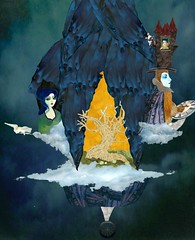
--Remedios Varo


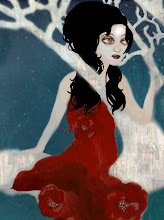
(Slideshow is of Artwork by Remedios Varo)
By believing passionately in something that still does not exist, we create it. The nonexistent is whatever we have not sufficiently desired.
--Franz Kafka

Showing posts with label Hard-Boiled Wonderland. Show all posts

Monday, July 18, 2011

Ars Memoria with Cat


Ars Memoria with Cat by Zoe Blue


“Every event in the visible world is the effect of an ‘image,’ that is, of an
idea in the unseen world. Accordingly, everything that happens on earth is only
a reproduction, as it were, of an event in a world beyond our sense perception;
as regards its occurrence in time, it is later than the supra-sensible event.
The holy men and sages, who are in contact with those higher spheres, have
access to these ideas through direct intuition and are therefore able to
intervene decisively in events in the world. Thus man is linked to heaven, the
suprasensible world of ideas, and with earth, the material world of visible
things to form with these a trinity of primal powers” (Occult America, Mitch
Horowitz).


This drawing has formed as a process of exploring so many different ideas, it’s difficult to put them all down in a manner that seems even in the least bit linear, i.e. following logically from one point to another without jumping around all over the place. But here’s an attempt.

In one of my favorite books of all time, Hard-Boiled Wonderland and the End of the World, author Haruki Murakami explores, among other things, the idea that a central mental image drives everything that occurs to us and around us in the physical world. The image could be of a small, idyllic village surrounded by a high wall, with a few people placed in various spots. Maybe there’s snow. What happens is this: the snow will mean something, maybe cold, isolation, loneliness (maybe beauty, perfect smoothness and clarity, crisp clean air in your lungs). The way each of the people are dressed will give some hint as to profession or place in society, which in turn means something about the “types” of people you expect to see (and therefore see), and the way the village is structured or something about the walls can tell you something of the rules governing interaction or the innate behavior of the villagers towards each other. This meaning-laden image is the way you see the world. It will control your behavior, your interactions, and it will color the behavior of others, giving it meaning that it might not otherwise have. It will decide what kind of news you receive, what kinds of problems or miracles you are aware of, etcetera. Now, for part of your life (I’ve rambled on and on about this here before, and suggested that this “part” of your life lasts about five years), you are creating that image. Afterwards, you are driven by it, a little slave imagining himself as a free-willed being (so yes, you are both free-willed and fated).
What I’m insisting here is, if you commit yourself to the process, you can change that image later.

So here’s the girl’s image, shown via a cut-away of her skull: a princess trapped in a tower, waiting for her savior. There are monsters above her, and below her is a long way to fall, and she is weeping (her tears slide down and mingle with her hair, finally creating a small pool or lake in the ruins of an old castle below). And she is waiting. Because in all the stories, if the princess is good and beautiful, and she waits, her prince will come and fix things right up.

So she accepts certain details in the world, which you can see throughout. The spires of the church (tower) hold up a drawer borrowed from Dalí to hold the pomegranate, sometimes called an apple, which represents the sinful bite that Eve took which sent us all spiraling away from the garden of Eden. The fact that the two fruits are confused is interesting if we keep in mind the older story of Persephone, who was kidnapped and taken to Hades against her will (princess trapped in an upside-down tower). In that story, she would have been freed, when her location was finally discovered, except that in the meantime, she’d eaten three tiny pomegranate seeds—out of hunger, not sin—and anyone who has eaten in Hades stays in Hades (although later, it is worked out that she will stay down there for one month for each seed out of every year, thus creating winter). So, just like in the garden, the memory of what she has already done continuously punishes her, puts her in a place of darkness and suffering and brings winter and death to the whole world. Because that is the story that is told. Because why? God is not big enough to forgive even that transgression? Zeus is not strong enough to tell Hades to stick it? Sometimes we know that the monsters (and devils) are a figment of our imagination; sometimes we don't. Sometimes, we believe in a god, and we imagine him with hideous attributes. Here, the pomegranate is in the drawer of her false heart—her mirror-left, not her real left. That’s important.


“There was a time prior to the 20th century when imagination and memory were
seen as one and the same thing, Ars Memoria. Memoria was the old term for both.
It included the idea of memory, imagination, the unconscious and reverie. James
Hillman writes, “Memoria was described as a great hall, a storehouse, a theatre
packed with images. And the only difference between remembering and imagining
was the memory images were those to which a sense of time had been added, that
curious conviction that they had once happened” (Hillman, Healing Fiction).


She angles her head and gaze towards a particular constellation, that of the Centaur. According to Wikipedia, “This half-human and half animal composition has led many writers to treat them as liminal beings,” that is, beings occupying the uncertain boundary between two worlds. That is what I want him to do here. First, he is between animal and man, also he is between the stars and the earth; this centaur is her prince, not the one she is to wait for, but the one she is imagining; not simply a man, not simply human, but something more. And she will push him to become real. He drops to earth, attempting to incarnate, first as the two horse-headed men, a concept borrowed from the maquettes of Clive Hicks-Jenkins, who flounder in the pool of tears, not quite what she needs, and then as the two horsemen, leaving the ruins to travel up the path. She imagines him in the stars, she imagines him in the reflection in the water, and he struggles to solidify, to incarnate out of that faint line of light in the sky, out of that faint reflection, and finally, he does. He becomes flesh. He becomes these horseback twins. A different constellation altogether. Gemini.

Centaurs were generally, in mythology, basically rowdy teenagers—but there was a very notable exception, named Chiron. Chiron “represents honor, moderation, and tempered masculinity” (Wikipedia), and he is a doctor. That connects him to the horseman holding the caduceus; of the Gemini twins, who were once upon this earth as Castor and Pollux, one is a medical man (the other is a boxer, so, again a liminal area, two distinct sides of masculinity: the listening and healing, and the fighting). And Castor and Pollux bring us back to the title and the opening quote; they bring us back to Ars Memoria, because history tells us, or mythology tells us, or someone’s memory, anyway, that the Ars Memoria was born in the rubble of a natural/ supernatural disaster, helped along by the twin gods Castor and Pollux:
A man named Simonedes had been hired to give a flowery speech honoring the host of a huge banquet in an elaborately wealthy hall. He had, in a manner that was not unknown at the time, introduced his introduction with yet another flowery speech, this one honoring the twin gods (who were later turned into the Gemini constellation). Afterwards, the host had given Simonedes only half of his pay, snidely remarking that he could get the other half from Castor and Pollux, since they were so great.

And he did. There came a knock at the door, and Simonedes was called to respond to the summons of two unknown men. As he exited the hall, seeking his callers in vain, the building collapsed behind him, killing everyone inside. The bodies were so mutilated, they could not be identified, and it was by visualizing the great table and the interactions of the people at it that Simonedes was able to identify each corpse so that the families could give them a proper burial. Thus began the Ars Memoria, a method of active, visual, representative memory, so successful that it was referred to by some as witchcraft—a deadly accusation at times--, and it was, in fact, believed by its users to offer some control over the physical world (again, twisting memory and imagination into a single thing, again operating in liminal space).

The idea here is that she finds some obscure detail, some story that maybe shouldn’t resonate with her, and she focuses on it until it does. She’s unhappy with her lot, so she looks outside her lot. She finds some idea, she commits to it, and she makes it real. She is trapped, her life mapped out before her by the image she created before she knew what she was doing, created really by the circumstances of some mixture of her genes and her “lot” in the first five years of her life, and yet, if she unfocuses her eyes until something bizarre and outside her reality can be picked up and pounced upon, if she focuses hard on some meaningless detail completely outside her normal experience, she can reroute her associations, she can change everything. Her memory of how she got there, and her understanding of how to get out. Ars Memoria. With cat, which I’ll get to now.


III. They head up the hill, which we see is only a mantel, the mantel borrowed from Remedios Varo’s “Embroidering the Earth’s Mantel,” where she reflected on the feeling of a Catholic female, who at once creates the world but takes no part in it herself, cloistered away from events and color and living, trapped high up in a tower with her had down, focused on the rules of her task. In her painting, Varo imagined and then incarnated an escape, a hidden embroidered detail of herself and her lover climbing down the wall and into the world. Here, we are doing the same, first in the form of the cat, who, far from feeling trapped in the tower, uses it as a better vantage point from which to leap for a star, thus pushing the constellation of the centaur to earth and beginning the minute changes that grow into other changes, that butterfly-effect which rolls around this little universe. Underneath the pathway is the dark and shadowy forest of the unknown, where our once weeping princess is now swathed in an explorer’s attire, and she is wandering off the edge of the universe. She is followed, not led, by her saint—


IV. St. Mark: patron saint of painters, interpreters, and law-clerks, (shown as) a lion, which brought to mind, for me, the green lion of alchemy, and he was actually accused, in his time, of sorcery (witchcraft, again!). These leaves all around, the ones swirling down from the sky, burrowing out of the cathedral and landing on the tops of the trees which hold up the path over the dark and frightening forest—these leaves and the blooms here and there are of the datura plant, of special use to witches, especially for love potions. As is usually the case with a witch’s weed, too much is poison, but just enough can do some pretty amazing things. Among the effects of ingestion of datura are “a complete inability to differentiate reality from fantasy, and amnesia. (Just a side note to the curious, I don’t recommend eating it. You have to really, really know what you’re doing, or it’s really, really bad news.)


Back to Saint Mark, so we can go back to that rubble from which everything is arising: tradition had it that St. Mark’s boat was blown by accident to Venice, and that angels came to him saying he would be buried there, so, many years after his death two Venetian men stole his remains from Alexandria and brought them home with them, ostensibly to protect them from desecration at the hands of the Saracens. A church began to be built to house the remains, and during the building, those relics were lost. Upon completion of construction, “it was resolved, in June 1094, to keep a fast throughout the city, and to make a most solemn procession through the church, without devout supplication to the Almighty that He would be pleased to reveal the place of concealment of the holy relics. And, lo! While the procession was moving, of a sudden light broke from one of the piers, a sound of cracking was heard, bricks fell upon the pavement, and there, within the pier, was beheld the body of the saint, with the arm stretched out, as if he had moved it to make an opening in the masonry” (Curiosities of Popular Customs and of Rites, William Shepard Walsh). So, the constellation is brought to earth via a mighty leap from the cat escaping the tower; the centaur goes through one permutation that doesn’t serve him well, there in the lake created by a waterfall of tears and tumbling hair crashing down over the rubble of the great disaster which started the whole history of the Ars Memoria, out of which finally emerge Castor and Pollux, the twins who saved Simonedes from the disaster, as a gracious show of gratitude for his public praise—twins who here embody the man and horse combination, one the fighter and one the healer; but also, if we concentrate on the detail of this rubble-with-spring borne of tears and birthing new creatures (in whatever form we need them to be in order to make sense of them), we can just imagine that St. Mark was also unearthed from that ripped open building, and alive, why not, and also…a big cat. So there he is, calmly following our now intrepid explorer through the darkest, unknown regions of her own mind and off the edge of the universe--

V. –which does, in fact, curve up around that other (Leo the lion, the big cat, of course) constellation to continue in some other form with people of a castle: the red queen and her puppet, the as-yet-unenlightened Alice in a topiary garden of not-quite-real people and, well, cat. It looks like, perhaps, an old attempt at a fantasy escape which didn’t quite work out for her (well, she woke up, right?).


Detail of Ars Memoria with Cat by Zoe Blue


“It’s a poor sort of memory that only works backwards” (White Queen, Through the Looking Glass).

In argument form: Things don’t change through a process of logic. It’s a focus on detail that ends up making a huge perspective shift of the sort that ends up somehow changing the universe—tomorrow, you wake up, and things are completely different, yet we believe that all of history as moved us inexorably to this moment. One example of this is what happens to your life when you focus on all your weaknesses, your failings, your inabilities, and then go out and try to do something. Spend a week like that and then share your life story with someone, and you know what it will sound like: a laundry-list of disasters and tragic flaws and chance occurrences that insisted on a hopeless existence (the theme of the movie Babel comes to mind). On the other hand, don’t spend a week like that. Why would you? The way we tell a story, from a ghost story around the campfire to bedtime story for a little one (that we don’t want to scare) to the story of our own lives (even the evening news! That counts!) is the way we form our own lives. It’s Ars Memoria, both memory and invention, past and future, and now.

Saturday, October 24, 2009

The Nature of the Absurd: the End of the World and its Beginning


"Lullaby of Uncle Magritte"
(All images in this post by Michael Cheval)


"Existir debe ser una imagen, en la que flotamos para no hundirnos." --Gabriel Pacheco
Which, loosely translated, is: "Existence is an image in which we float to protect ourselves from drowning." Drowning, perhaps, in the frightful chaos that is endless possibility. If the physicists are right, and everything is occurring all the time, and every possibility is played out somewhere, and nothing is either created or destroyed, but simply always is, then the thing that would define life as we experience it might simply be an image. Let me back up a few steps:

We know that the world is teeming with atoms, that in each sliver of each nail curving over the tip of a finger, we carry thousands of atoms. The air around us is not empty; it is packed with jostling objects. Probably, when we are born, we can see all of them. I imagine it takes us days and then weeks and months to learn to ignore certain atoms and group together others, coming to see them as one object as opposed to many. What I'm saying is, we learn what to see and what to ignore. I think that the other thing we develop in those first few years is a latent image, a picture that symbolizes what we come to call the world. An image which defines not just what's visible, but what's possible.


"Terra Incognita"


"Anna"

In the book Hard-Boiled Wonderland and the End of the World, Haruki Murakami writes about just such an image. He divides the book into alternate chapters, the first set being about a young man navigating a mysterious world of scientific intrigue, conspiracy, and personal danger, and the second set describing that young man's experiences in a seemingly idyllic but very isolated community. The community is surrounded by a high wall, to which the gatekeeper holds the only key. Beautiful, golden-furred unicorns are let out to the fields beyond the wall every day and brought in to sleep every night. As winter descends upon the population, the beautiful horses lose their vibrant color and begin to drop from starvation and cold. There are some hard, fast rules to living in this community--which one is not permitted to leave--, rules which especially include doing the job assigned to you when you arrive and minding your own business. In these rules, one begins to see the connection between the alternating chapters, the thread that holds the two seemingly unconnected stories together.

There is, of course, a lot more going on in the story, but this is the part I want to think about here: the strange, isolated locale is his latent image; it's how he defines the world. The existence of the place, how he got there, the larger meaning of why he's there, the reason he can't leave and the particular job he's been assigned, these things all just are; there's no real explanation for any of it, none of it makes too much sense, things just are a certain way, and you don't question them. When, in his "other life," he passes a stranger on the street who might need help or who might be trying to get his attention, he tells himself: none of your business. He has no lasting relationships, mostly visits prostitutes, lives alone. He does his job because it's his job--he doesn't even understand the larger purpose of that job, mainly because he doesn't ask about it. All of his behaviors in the world of scientific intrigue, the "waking" world, are explained by the slow, quiet chapters set in that idyllic community. Because of this image he carries, because of that view of the world, his options in life are severely limited, and are, at the time of the story, about to come to an end altogether.

The golden unicorns are the beasts of the earth who carry the suffering and the weight of our sins. Each year, with the coming of winter, they die slowly and miserably, and each year in the spring they are somehow replenished. This (death and resurrection) is a motif present in every single manmade myth I can think of. This is a motif that explains for him, satisfactorily at first, why some people suffer and others don't. As the story progresses, he begins to realize that the unicorns exist because he asks no questions, because he chooses, in essence, not to care about the people around him. Because he isolates himself, because every aspect of his world is a discrete, unconnected bit in its place which has nothing to do with anything else. He slowly begins to feel responsibility for those creatures, for the stories, dreams and memories (the untold stories, dreams and memories of those around him which needed somewhere to go, somewhere to be held) that they carry with them to their graves.

As the narrator discovers the stories held in the skulls of these beautiful beasts, he also discovers love. Love comes to him at first as a simple curiosity: who is this woman working next to me? What makes her so silent, and what would make her laugh instead? He wonders. Love is wonder.
That simple curiosity changes a main attribute of his latent image. He no longer feels bound by the rules and idiosyncrasies of that strange, isolated landscape and its brutish gate-keeper. He begins looking, not for an escape for himself, but for the story of this woman who has changed the way he views the world: the story she has somehow lost, a loss which haunts her, which binds her to the place. He begins to care more about what another needs than what he himself simply wants. As a result, his life in the outside (scientific, waking) world begins to change.

At the end of the novel, it is not clear what will happen; it is only clear that things have changed drastically, and with those drastic changes comes the possibility of an entirely new life, instead of that End of the World which had been hovering above his head throughout the novel.
And now we come to the point of all this here.


"Covert Fruits of Enlightenment"


"Heritage of Future"


This is art; this is why we paint, why we tell stories: to expand the possibilities of the image we live in, to make more things visible, thus making them possible. To create and explore the feeling of wonder. Art comes out of dissatisfaction, out of some desperation to change what we see around us and the ways in which what we see limits us. Art comes out of hope for something else. It is a form of magic, but it is a totally logical magic. Because, returning to the science at the beginning of this post (and in other posts here), what we see is not all that's in front of us; it's simply what we have chosen out of all that's in front of us. What we've chosen to believe, what we permit ourselves to see. Art is a refusal of limitations, it is an exploration into the absurd, into absurdities which through familiarity become normal, not only possible but plausible, not only plausible but mundane.


"A la Guerre Comme la Guerre"


In Michael Cheval's paintings, we see moments of time colliding; threads from one world seeping into another as a path you might follow to change life story-lines; life on its stage with the fine strings controlling our actions caught, momentarily, like a photo somehow capturing the hand of God. He paints using the language of dreams, juxtaposing things that "shouldn't" exist together in an often otherwise realistic style, making it easier to accept.


"March of the Lonely Hearts"


"The Little Mermaid"

The language of dreams makes sense here, as dreams are essentially re-workings of our latent images. Each dream that we have is a moving image that provides a metaphor for our belief systems, the belief systems that control us like little puppets during our "waking" hours. When we analyze those dreams, we put those images back into words, and then we have three things to work with: what happened to me yesterday; the images in my dream last night; the particular words I used to describe those images this morning. When we hold those three things next to each other, patterns emerge. We become more aware of our unconscious belief systems, we begin to "see" the strings controlling our every move.


"Art of Diplomacy II"


"Art of Diplomacy III"


"Evolution"

In her book Sleep On It, Jane Theresa Anderson tells us:

"Consider the Colorado experiment where Dr J. Stoyva fitted volunteers with spectacles that turned the world upside down. They had to wear the glasses for several days, and, during that time, they gradually saw the world the right way up again. The brain could not match the incoming visual information with other incoming information (such as touch or sound), or with its ‘internal model’ of what the world should be like, so it simply changed its perception and turned the images upside down again. When the volunteers’ spectacles were taken off again, guess what? They immediately saw the world upside down again, this time with their own ‘bare’ eyes. Within a short time, the brain adjusted by inverting the incoming messages to make everything fit in with the expected view.

This is, in fact, what happens after birth. The physics of the eye is much like the physics of the camera. The retina, at the back of the eye, is like the photographic film in the camera, and the world’s image appears inverted on this screen. The message sent to the baby’s brain is one of an inverted world. Trial and error soon gives feedback to the brain that what it sees is not, apparently, what it feels, hears or moves around in. The brain turns the image round accordingly.

So it is seen, from our earliest days, that our brain works to alter incoming messages about its sensory environment if they do not fit in with its expectations. The great magicians and illusionists rely on the brain’s stubborness in seeing what it expects to see, rather than what it actually does see! Such is the art of deception. We cannot necessarily trust the brain with what it deciphers and concludes about the waking realities of our environment. It does an incredibly good job, but it does not always get the picture right. It may perceive alternative realities that are not there at all. Just as often, though, it may apply rational restraint, and cause us to discount its genuine experience of dimensions beyond those of waking life. Can we, then, ever trust our neurophysiological wiring to distinguish between ‘real’ and ‘unreal’?"


"Zenith of Time"


"Cock'n'Bull Story Tellers"


"Perfect Stranger"


And then comes the trick of painting, or, for those who don't paint, the trick of visualization, or of story-telling.
Here's some science that turns the above experiment from bad news into good:According to Lynne McTaggart in The Intention Experiment,

"Research with EEGs has shown that the electrical activity produced by the brain is identical whether we are thinking about doing something or actually doing it. In weight lifters, for instance, EEG patterns in the brain that would be activated to produce the actual motor skills are activated while the skill is simply being simulated mentally. Just the thought is enough to produce the neural instructions to carry out the physical act.
...
When an athlete performs, the nerves that signal to the muscles along a particular pathway are stimulated and the chemicals that have been produced remain there for a short period. Any future stimulation along the same pathways is made easier by the residual effects of the earlier connections. We get better at physical tasks because our signaling from intention to actions has already been forged. It is not unlike a train track laid down through wild, inhospitable country. Future performances improve because your brain already knows the route and follows the track already laid down. Because the brain does not distinguish between doing something specific and just thinking about doing it, mental rehearsal lays down the tracks just as well as physical practice does. The nerves and muscles create a pathway just as sound as one produced through repeated practice.

Nevertheless, there are a few important differences between mental and physical practice. With physical practice, when you practice too much, you become fatigued, and fatigue causes electrical interference and blockage along the tracks. With mental intention, no roadblocks ever appear, no matter how much you practice in your head."


Later she continues,

"In 1961, Neal Miller, a behavioral neuroscientist at Yale University, first proposed that people can be taught to mentally influence their autonomic nervous system and control mechanisms such as blood pressure and bowel movements, much as a child learns to ride a bicycle. He conducted a series of remarkable conditioning-and-reward experiments on rats. Miller discovered that if he stimulated the pleasure center in the brain, his rats could be trained to decrease their heart rate at will, control the rate at which urine filled their kidneys, even create different dilations in the blood vessels of each ear.
...
Hypnosis is also a type of intention--an instruction to the brain during an altered state. Hypnotists continually demonstrate that the brain or body is susceptible to the power of directed thought [and that directed thought is most powerful when presented in image form, as opposed to word form].
One dramatic example of the power of mental suggestion concerned a small group of people with a mysterious congenital illness called ichthyosiform erythroderma, known disparagingly as fish-skin disease because unsightly fish-like scales cover most of the body. In one study, five patients were hypnotized and told to focus on a part of their body and visualize the skin becoming normal. Within just a few weeks, 80 percent of each patient's body had completely healed. The skin remained smooth and clear.

Through hypnotic intention, spinal-surgery patients about to undergo their operations have reduced blood loss by nearly half, simply by directing their blood supply away from the site of the surgery. Pregnant women have been able to turn their babies from breech positions, burn victims have sped up their healing, and people suffering hemorrhages in the gastrointestinal tract have willed their bleeding to stop. Clearly, during an altered state, roughly corresponding to the hyperalert state of intense meditation, conscious thought can convince the body to endure pain, cure many serious diseases, and change virtually any condition."


How does this relate? Say you have a dream where you are trying to get somewhere, but everything on the planet seems to be intent on interfering. You have trouble walking, you keep getting phone calls, your car won't start, there's traffic, the crowds at the airport are unmanageable, your confirmed seat has been given away, the plane left early. This dream is the type of latent image I've been talking about here: it is a metaphor for a belief system, for the belief that you'll never get to your goal, because the world is against you (or something similar). After a dream like this, you might use a visualization technique in which you re-enter the dream, using all your senses (hearing, smelling, touching, etc), and unravel each problem. Traffic looks insane, but as you're approaching the knot, a policeman appears and quickly alleviates the situation, creating an opening that clears the scene almost instantly. Your seat's been given away, but at the last minute, someone else cancels, or a clerical error is discovered which opens up a seat for you. The pilot realizes he forgot his lunch and taxis back to his parking spot, where you get on. The point is not that each action which unravels the problem make sense; in fact, it probably won't, because it's the very absurdity of the new act which lets you know that the possibilities available in your world view (and waking life) are being expanded.


"On the Way of Destiny"


"Bouquet of Metaphors"


Painter Michael Cheval defines absurdity as a "“game of the imagination, where all ties are carefully chosen to construct a literary plot.” A plot he himself has created. An intentional plot.

Lethebasher describes Cheval's paintings thus: "The shape of a dress or a faucet will become another object, a surreal object, such as a table or a horn instrument; but it will retain the original shape of the dress or the faucet. Such are Cheval’s games of the imagination; we do not always know what we are looking at. The eye must adjust to the picture object-by-object as it simultaneously takes in a new chessboard of reality."
That is to say, instead of instantly recognizing the logic which unites the parts of the painting, one has to investigate, piece by piece, discovering and entering another world as one goes. Objects that one recognizes are shown in at first unrecognizable situations or uses, which after that initial moment make some sort of (absurd) sense.


"Cavalier of Flitting Past"

You can, after all, see how the connection was made between the wide (isn't it actually absurd in itself?) ruff (collar) and a seashell. And we all know that the seashell carries the sound of the sea...the voices in that sound..the lost souls, the mermaids, the siren calls... Perhaps the man is merely the anthropomorphizing of a sea gull--maybe that explains the aviator cap and goggles, the empty bird cage in his hand the titular "flitting past". Perhaps not...


"Down to Earth"


So: to expand the boundaries of the possible, to begin anew, we must give in to wonder, be curious, explore. We must invest in absurdities, feel and smell the impossible, concentrate on dreams, and perhaps...
simply ignore reality when it interferes...
One step in this process, for me, is enjoying art like this.


"Echo Hunting"

“Absurdity, like any other genre, has its own rules. But it implies everything that is outlying of common rules and boundaries.”
Michael Cheval