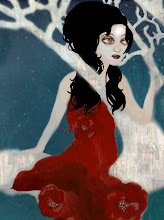
The Homesick Willow
First, I have to confess that this artist is so spectacular, and so thorough in his own research and story-telling, that I didn't have to do any work for this post. What I'm really doing here is attempting to spread the tale of his existence, so that everyone will go and visit his amazing and informative blog site--a real treasure chest of inspiring, spooky, and otherwise magical creatures from lore and history that he has given faces to. I hope that all my friends here will take part in his "kooky pets" endeavor as well.
All the following text is his own.
"Art and Illusion are the keys to my work. I believe that we are all surrounded by a supernatural world of creatures and living forms. They co-habit with us, they influence our thoughts, feelings and actions and are present in the most important moments of our life. Sometimes we notice these energies with our minds, other times we can sense them with our spirit and even see them with our physical eyes. My passion is to make visible this invisible world to your eyes.
...
I knew the bohemian life of Madrid in the 80’s and met the most diverse artists and peculiar people in tiny attics and ‘tertulia cafes’; I traveled by myself along the woods, mountains, caves, and coasts of Spain and filled my bag with stories and anecdotes; I took part in surrealistic experimental sessions to stimulate the imagination hosted by reputed Spanish Children’s literature authors; I lived in a Volkswagen van for six months and traveled around France, England and Scotland, selling my sculptures and etched engravings of fantastic creatures in street markets… Then I decided it was time to sit at the drawing board and start putting all this on paper."

Portrait of Lady Zakharova
“Portrait of Lady Zakharova” is my latest illustration. It’s a pencil drawing that was later digitally colored. I’m very satisfied with this technique and I have enjoyed doing this particular piece and drawing all the textures in detail very much. I’ve decided that I will be using this same technique for my forthcoming portfolio work. In fact, this one is going to be printed in postcards soon and sent to different editors and magazines in the U.S. and Canada.
I also enjoyed getting into the personality of this peculiar character: Lady Zakharova. The more I worked on it, the deeper I got into her mysterious and irresistible figure. Here is a little information about her fascinating story:
“Raisa Zakharova: one of the most enigmatic figures from the Victorian era related with spiritualism circles. About her intriguing figure, there is not much for certain. The records about her life are numerous and contradictory. If there is one thing about her life that could be taken as a certainty it that she was extremely skilled at turning her own persona into a irresistible subject of conversation in the tea parties of Victorian society.
She was born in the Ukraine circa 1820 and was the only daughter of diplomat at the service of Alexander I. In 1836, she met German magician and illusionist Folker Krause and joined him as a partenaire on his theater performances and started studying the world of occult sciences. It was during a performance in London’s Drury Lane Theater that Raisa lost her right eye in a mis fortunate mistake during the execution of one of the magic numbers, which consisted of stopping an arrow shot by her husband with a bow through her own will power.
The most mis fortunate stroke of the Krauses’ life was when the recently created secret services of Imperial Russia accused them of espionage during their tours around Europe. Although there is no real historical evidence, it’s believed that they were both severely tortured, provoking the death of Folker Krause. As legend has it, Lady Zakharova was forced to witness the killing of her husband in agony in order so that the torturers could obtain a confession from her. It’s been also said that, after being raped and her hands cut off, she escaped from her executors by using some sort of control tricks or mental powers. She run away to France and soon after she reestablished herself in London were she rapidly gained a reputation in the spiritualism circles.
Contemporary witnesses and the social tabloids described her uneasy figure. Even with a disfigured face and two artificial hands -which were custom designed for her by a reputed automaton builder- she was considered one of the most beautiful ladies in London and supposedly had affairs with many relevant personalities. During the 1840’s, she invoked the curiosity of London aristocrats, intellectuals and artists by holding séances where she would use a ventriloquist doll to channel the spirit of her deceased husband. She was accused of fraud for using a simple ventriloquist trick but at some stage the doll apparently started producing ectoplasm. It’s also been said that the information appearing in the communications was pretty accurate and some of the prophetic messages from the allegedly spirit of Folker Krause were later proven. Amongst the many prophecies recorded there is a particular one that points to a black man leading North America in the 2000’s.
To add more mystery to the figure of Raisa Zakharova, many believed that the doll that she used for her paranormal communications was actually a mummy of her husband, whose corpse she preserved and got mummified by a Chinese taxidermist.”
The size of the original drawing of this piece is 16″ high, so there’s quite a lot more detail than you can see on the web site. Actually I’m planning on getting it printed in posters for sale sometime in the future. Here I have included an enlarged excerpt of the image so you can see it in detail. Hope you enjoy this piece as much as I did while making it!"
[For fascinating memorabilia the artist found in old papers etc on these characters, see his scans and explanations here:
http://www.koldobarroso.com/lady-zakharovas-memorabilia/]

Hitzakun
(From the Kooky Character Workshop)
"This story is related to my cultural heritage and my ancestors, in the mountains of the Basque Country. They used to talk an ancient language called Euskera, a very rare language which origins still remain unknown by the scholars which stayed isolated for many centuries from other cultures in the mountains and woods in Euzkadi.
During the 19th century, Euskera was considered pagan and it started getting banned by the powers. My ancestors were punished severely if they were caught talking Euskera and children were forced to learn and only speak Castillian, commonly known as Spanish.
It was during those times that people started talking about their encounters with a mysterious figure, a half animal half human spirit of the woods, who ran through the Basque mountains with a large book in his hand. The legend tells how this creature was aware of the disappearance of the old language and he would hide in the dark beneath the people to write down all the words in his book. He was called Hitzakun: the word saver.
Later in the 1930’s, during the Fascist dictatorship in Spain, the punishments got even more severe with whoever dared to talk Euskera and celebrate Basque traditions. During 40 long years, many people forgot how to talk their own language until it was recovered in the schools by the rise of democracy. Today, nobody seems to see this creature anymore, but some people ensure that his book remains in good hands in secrecy and it was in fact very useful towards the recovery of the Basque language during the 1980’s.
Some people believe that he still lives in the heart of the Basque woods, though. And in the summertime, he likes to sit in the dark, close to the campers, and listen to them talk about their stories about the modern world in modern slang and keeps putting them in his book."

The Mesmerizer, based on a story by ETA Hoffman, an incredible horror-tales writer, who is described thusly by Wikipedia:
"Hoffmann is one of the best-known representatives of German Romanticism, and a pioneer of the fantasy genre, with a taste for the macabre combined with realism that influenced such authors as Edgar Allan Poe (1809–1849), Nikolai Gogol (1809–1852), Charles Dickens (1812–1870), Charles Baudelaire (1821–1867), Fyodor Dostoevsky (1821–1881), and Franz Kafka (1883–1924). Hoffmann's story Das Fräulein von Scuderi is sometimes cited as the first detective story and a direct influence on Poe's "The Murders in the Rue Morgue"."
A selection of his tales is available on-line for your reading pleasure here:
http://www.litgothic.com/Authors/hoffmann.html
To join the Kooky Pet workshop:
http://www.koldobarroso.com/join-the-kooky-pet-workshop/
His website in general:
http://www.koldobarroso.com/




 Posts
Posts