member of:Observers of the Interdependence of Domestic Objects and Their Influence on Everyday Life


This group has been active for a long time and has already made some remarkable assertions which render life simpler from the practical point of view. For example, I move a pot of green color five centimeters to the right, I push in the thumbtack beside the comb and if Mr. A (another adherent like me) at this moment puts his volume about bee-keeping beside a pattern for cutting out vests, I am sure to meet on the sidewalk of the avenida Madero a woman who intrigues me and whose origin and address I never could have known...
--Remedios Varo


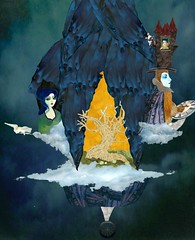
(Slideshow is of Artwork by Remedios Varo)
By believing passionately in something that still does not exist, we create it. The nonexistent is whatever we have not sufficiently desired.
--Franz Kafka

Showing posts with label mia araujo. Show all posts

Tuesday, March 29, 2011

Tango in a Box III


"Dreamcatcher" by Mia Araujo

Part One is here.


Chapter TWO


Where my new lease on life really started was before they even caught Johnny, with me in this shit-hole bar in the middle of the city that for right now is my college town, because, contrary to what you might think, my utter terror of human contact does not make me want to be alone, and so that is where I take my books to study. I once read that Glenn Gould, in a fit of panic when his photographic memory wasn’t kicking in in time for a last-minute cram session the day before a concert, turned on every noisemaking machine in the vicinity so as to interrupt the death-grip his conscious was exercising over the lens. Moments later, he’d polished off one of Beethoven’s masterpieces. That’s like the bar: every noisemaking machine in the vicinity, all drowning out the death-grip my conscious has on my lens. Not that I’ve got photographic memory. It’s just that, given enough time and peace and quiet to think about something, I can’t. So, I take my physics textbook to the bar. The most cramped one, with the worst music and foulest air, so that, given the options, my brain is desperate to wrap itself around this impossible shit and disappear into it.


So that’s where I found out about reality streams, parallel universes, and Steven Hawking’s worm holes. That’s where I read about Shrodinger’s cat, forever trapped in a cardboard box, waiting for you to decide if he’s been poisoned or not by opening the door. Because until you open the door, he’s both alive and dead. When you open the door, you’re choosing a reality stream, the course of the next second in history, you control the life or death of another creature. At least the creature this you is watching. As soon as it’s open, you’ve picked your stream, and the live cat is licking some other you’s hand.


So, if you’re still with me here, you’re thinking, I was right, I really am God. Then the next thing you’re thinking is, give me a break.


Some might say that scientists are just the priests of this century, that this is then fantasy, or, from the other direction, heresy, but these are the declarations of some bright and beautiful men, and, I think it’s necessary to add here, they did some experiments. The last experiment you did where you called on God to make your kitty unflatten and peel itself off the street in front of your home, well, how’d it turn out? What I’m saying is, maybe there’s some God in all of us.


What I’m saying is, what if learning from our mistakes means we switch up the cardboard flap we opened and give the cat some tuna for being so agreeable?


I know what you’re thinking. At the time, me too, I was thinking, this is a textbook?


I turned to focus on the television set, a good digestive aid for all kinds of discomforts, and soon I was thinking of Johnny, of where he might be, where he wasn’t. I was thinking, this life isn’t a tango. Then I discovered I’d been ignoring a young man’s attentions and I turned just in time for my expression to match the vomit leaving his mouth for my pants.


I hadn’t even taken the exam on this stuff when all of a sudden the TV turned into a joyous parade of Johnny’s mug and profile behind a string of numbers. And that’s when I started taking physics seriously.


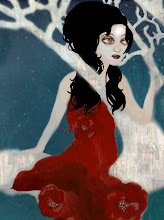
"Sleepwalker's Serenade" by Mia Araujo


*******


The theory is, everything is happening at once. In order to sort things out for comprehension, the brain has to bracket certain areas, much as you would a long math equation in order to complete parts leading up to the whole. Look again at the math equation: all points are existing already. You bracket the section of the equation that spells line, and you see a line. You shift your brackets slightly and now you see a plane. Or a point. Are they already in the equation? Yes. Existing all at once? Yes. The brackets are your paradigm. What you see is what you’re prepared to see. Our brain does this, puts everything into a linear time scale, each point is a place, an occurrence in its surrounding environment. Space and time brackets.


Everything is happening right now, at once. Your mother is not dead, she is focused on another point right now, where you are not looking.


Time travel is not leaping backwards and forwards in time, it is merely bracketing elsewhere. Somewhere, all your possible futures are played out, and all the choices you didn’t make, you made. Don’t like this one? Switch reality streams. Find the other.


Your life becomes like channel-surfing.


Remorse is ridiculous, but not for the reasons you’ve been told. It’s ridiculous to ignore it, because remorse is the pull of your body towards the choice it would have preferred. It’s ridiculous like watching a stupid show is ridiculous when the remote control is in your hands.


The problem I’m having is, school isn’t the kind of place where you get to explore your options the way I’m needing to explore them. The problem is, physics professors are all going to make you go back and study the basics of physics before you get to this, to the really useful information. The problem is, I’d have to spend semesters on Newtonian physics before I’d ever even get to the real discussions about this chapter, the one that’s going to change everything.


Left to my own devices, where I go is to Madame Belaire’s home. It’s right on the bus line, and she’ll read your palm for a nominal fee.


Don’t get me wrong. This is completely academic.


*******


"Hands That See" by Mia Araujo

Tuesday, May 12, 2009

Mia Araujo

Mia was born and raised in L.A., and she graduated as valedictorian from LA's Otis College of Art and Design in 2007. She also recently won the "Shepard Fairey in DC" contest. For larger views of her work, go to http://www.art-by-mia.com/
I recommend it, because there are hundreds of little details you don't want to miss.

From BLOG PHOTOS

"The Inventress"

When you go to her website and click on gallery, you will find thumbnails representing several shows her work has been featured in. If you click on the second one, "Overdose" Hi-Fructose Group Show, you will find the painting "The Inventress," which you click on to get a huge, browser-sized image. Then you can begin to see what I mean about the details. Just in her hair, there are princesses, marionettes, broken puppets, masks, the inner workings of a clock, a lamp, and a complex pair of eyeglasses much like Johnny Depp wore in Tim Burton's Sleepy Hollow. A kidnapper runs off with his prize, up the thick, ropey branches of tree that seem to have developed as an extension of her chestnut hair. Beside her floats the head of a modern, handsome Frankenstein, being polished by a little man hidden in the hair just behind her ear. Snow white owls fly by, and Dracula looks on from a corner seemingly pulled from an old German Expressionist era movie. And that's just the top of the painting, there's another entire world down below, in the waters reaching up to her chest. I imagine her to be creating these worlds, populating the earth with the figures and creatures of her imagination and dreams.

She gives some background on the above piece on her blog (www.miaillustration.blogspot.com):
"This painting started off being based on the Tales of Hoffman, and in fact E.T.A. Hoffman’s literature in general. For those of you who’ve not heard of him, he is most famous for writing the Nutcracker, and most of his stories also deal with inanimate, often mechanical objects coming to life in a fantastical way. They are macabre fairy tales written in a time where Romanticism ended and the Enlightenment began, so there is always tension between the imagination and reason. There is also a fragmentary nature to the Tales of Hoffman in the many interwoven narratives, and a gothic influence through which his characters are tormented on their paths to happiness. I tried to give a sense of all this in the piece.

Interestingly for me, I noticed many parallels in these stories with the way in which my mind works during the creative process. At first glance in my mind’s eye, it appears that I have dozens of ideas vying for attention, but upon closer inspection I find that some of these are half –finished, missing an arm or a leg like some of the creatures in this piece…there are also thoughts that frighten or torment me, as well as beautiful thoughts that inspire and excite me, and these coexist side by side, creating a dynamic habitat for my new piece to be born in. Again, I wanted the objects and characters in this piece to reflect this.

Finally, it just so happens that my mind is a constant battlefield for my intellectual side and my imagination to jostle upon, much like the stuff in Hoffman’s stories…plus I couldn’t resist throwing in some of the ‘30s horror film imagery that I love so much, alongside the fanciful whimsical stuff to portray the sinister, gothic aspects of Hoffman, that lurk beneath the light-hearted magic."

On her website, it states: "Mia believes that all individuals contain an entire universe within them. Her recent work strives to represent the unseen forces at work within the subject--spirits, inner demons, conflicting emotions, and the imaginations."

From BLOG PHOTOS

"Needles in a Haystack"

In an interview with Arrested Motion, she says: "Lately a lot of my pieces have been based on well-known stories...and I usually have another theme that I'm trying to get across by using those stories...sleeping/dreaming, imagination, death/rebirth of the inner self. I start conceptualizing by making a list of words and imagery that inspire me and then fixate on one mental image for the whole piece which I will sketch out...I work out the figure first, and then start drawing out the mini-narrative characters into the composition in whichever way they flow. So there is a spontaneity to it. Sometimes I'll want to include a sphinx or an apatosaurus, say, but if it doesn't work anywhere in the piece, then I won't use it. Each piece has mysteries even to me, and new meanings arise from the different elements than I intended."


Mia makes the blueprint for her work on tracing paper and transfers it with chalk-carbon paper onto a maple panel. She paints with acrylics. Her favorite color is Naphthol Crimson, because it "plays well with others."

From BLOG PHOTOS

"Across the Nile" (another one that MUST be viewed large)

"The view outside my [studio] window is an amazing eucalyptus forest, with hundreds of monarch butterflies in the wintertime. There is also a red-tailed hawk nest and I can see the birds take flight without having to get up from my chair. It’s absolutely unbelievable."


From BLOG PHOTOS

GILL:
"One of my three main pieces for my senior thesis on solitude. Each character embodies different aspects of how solitude is positive and important for the personal development of an individual.
This is Gill, and she represents self-discovery and exploration:"
Gill has made a little fishbowl through which all her limbs come out to wrap protectively around it. Her neck pulls up out of the back and her head enters the bowl. The fishbowl, that little bit of the world we see in our lives, and also a separate place, safe and secure, though clear enough to see out of into the distance... On the other hand, where all the others around her carry umbrellas, she has captured the water and dives into it, makes it a part of herself.

From BLOG PHOTOS

"Anatomy of a Somnambulist"

Mia says: "Submerged in sleep, a somnambulist that has been sleep-walking for years, and whose dreamscapes have created a habitat about her."

From BLOG PHOTOS

"Dreamcatcher"

Though the dreamcatcher is a Native American--especially Ojibwa-- tradition, made to capture the darker forces that enter the air at night to infuse your wandering soul with fear, this painting struck me as having a sort of Mexican Day of the Dead flavor, where two fearful things, Death and Separation, are overcome in a big, colorful party where you and your lost loved ones can once again connect, converse, and share a meal. Note the skeletal rabbit-type playing violin in the lower right corner, the vivid fortune-teller red of the somnambulist's hair, the flowers she arises from, the hybrid log-cutter, and the disembodied merry-go-round.

Wednesday, March 18, 2009

Manual Of Detection: by Jedediah Berry


This book is perfect. The character that guides us (named Unwin) is a clerk, suddenly promoted to the level of detective and feeling lost, drowning, completely out of his element. He has no wish to be a detective and tries very hard to return to his position as clerk, where he has worked to become quite highly appreciated. However, in order to return to his clerkness, he must find the missing detective for whom he clerks. The further we delve into the case that forces him to continue in his promoted status, the more things become like a dream. And, in fact, it is in a dream that he meets with his missing detective, who tries to give him clues from his own bathtub. This scene is important, and will repeat later in the novel:

In this dream he had risen from bed and gone to take a bath, only to find the bathtub occupied by a stranger, naked except for his hat, reclining in a thick heap of soap bubbles. The bubbles were stained gray around his chest by the ashes from his cigar. His flesh was gray, too, like smudged newsprint, and a bulky gray coat was draped over the shower curtain. Only the ember of the stranger's cigar possessed color, and it burned so hot it made the steam above the tub glow red.
Unwin stood in the doorway, a fresh towel over his arm, his robe cinched tight around his waist. Why, he wondered, would someone go through all the trouble of breaking in to his apartment, just to get caught taking a bath?
The stranger said nothing. He lifted one foot out of the water and scrubbed it with a long-handled brush. When he was done, he soaped the bristles, slowly working the suds into a lather. Then he scrubbed the other foot.
Unwin bent down for a better look at the face under the hat brim and saw the heavy, unshaven jaw he knew only from newspaper photographs. It was the Agency operative whose case files were his particular responsibility.
“Detective Sivart,” Unwin said, “what are you doing in my bathtub?”

(pp9-10)

The novel follows the logic of a dream, which is to say that each thing that happens follows, makes sense, is logical, but not in any of the ways you would have expected, and only within an environment that has the vivid, perfect oddness of an almost-lucid dream. And that is what the novel is, it's a mixture of hard-boiled detective fiction and lucid dreaming. And then you, the reader, arrive at chapter 13. Chapter 13 is a jewel, and it makes everything that came before it more perfect. At the beginning of that chapter, there is described a liminal space, thus following from my usual blog entries, so I will quote it here. The chapter is titled “On Cryptography:”

A distance of perhaps fifty paces separated him from the chairs, one pink, the other pale green. Unwin felt drawn to the warmth of the electric light, to the languid music playing there, to the voice that could only have been Miss Greenwood's. It looked to him as though a cozy parlor had been set down in the middle of a cavern. He went toward it, feeling alone and insubstantial. He could not see his arms or his legs, could not see his own shoes. All he could see were the chairs, the lamp, and the phonograph. All he could hear was the music.
The floor was flat and smooth. A floor like that should have set his shoes squeaking, but they were muffled—by the darkness itself, Unwin thought. He kept his mouth shut tight. He did not want to let any of the darkness in.
He stopped at the edge of the blue rug and stood very still. Here was a boundary between worlds. In the one were chairs, and music, and light. In the other there were none of these things, nor even the words for chair, or music, or light.


The book has everything: creepy, shadowy criminals straight from an abandoned carnival, mesmerizing beauties, treachery, deceit, love, a haunting melody, and a fine mist of rain over it all. Finishing it is waking up from a dream and wishing you could dive back in.
Go and read it now!


From Blogger Pictures

Mia Araujo "Sleepwalker's Serenade"