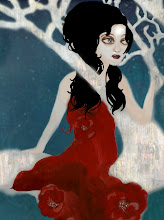
Our co-hort in all things fabulous, Vesna, has a two-page spread of poetry in the September, 2011 issue of Pink Panther Magazine. You can see the entire magazine here with hyperlinks or you can buy a print copy here.
The amazing cover, a painting by Janelle McKain:
Vesna's pages:
..in which you will see her lovely daughter Mila, and several of her poems, including this jewel:
Cogito ergo sum
A thought
Like a fish
Slippery
Promising it will grant me 3
wishes
once I hold it
And I am trying to catch it
Swimming in my own anatomy
Trying to draw a map
Lost in the labyrinth of my own
being.
Each left and right turn
has a “because”
But most of all
I really enjoy
Feeling lost.
--Vesna
Congratulations!! :)
Saturday, September 3, 2011
Thursday, September 1, 2011
The Five Keys
I finally got my hands on a copy of the gorgeous book “The Five Keys to the Secret World of Remedios Varo.”
One of the things I have always liked about Remedios Varo’s work is the mysterious yet cohesive narrative present in her images. The Surrealist Movement was full of heady ideas and the study of dreams and alchemical traditions and psychology, but in general, its artists rather strictly adhered to a tradition of uncensored, automatic work: they painted dreams and bizarre pairings but made no effort to pull them together into some semblance of order. While Varo utilized many surrealist techniques, such as decalcomania, and firmly embedded her images in dreamy and surreal atmospheres, the paintings she presented in the last, explosively productive years of her life show a definite narrative purpose. In her essay In Search of the Miraculous, Tere Arcq meticulously outlines the connection Varo had made with the Russian mystic Gurdjieff’s group. She asks,
“What spurred her to distance herself from the automatist experimentation evident in her early works? One possible reason may lie in how Gurdjieff conceived of art. The Russian suggested that there were two kinds of art: objective and subjective. In objective art, the artist creates, but not so in subjective art: ‘With him ‘it is created’[…]this is where the whole difference lies.’ And this difference also lies at the heart of Gurdjieffian thought: man is a machine unable to do anything, to have control over his life and his fate—things simply happen to him. Only when he begins to do work on himself can man cease to be a machine and attain awareness. The subjective artist is a man-machine—an automaton that is incapable of doing anything…”
In the image above, the women are almost completely machine. They move about on wheels instead of feet, which in her own visual vocabulary would make them almost primates:
IMAGE: “Homo Rodans,” Varo’s “archeological discovery” built from the bones of fish and poultry, for which she produce an accompanying study in stuffy academic language.
Tiny wings direct their movement. Their source of happiness is the shop where they can receive updated parts:
Arcq says, “To Gurdjieff, the automaton is an inferior being, a potential being that requires intense inner work to achieve a state of higher consciousness. Remedios Varo moved away from automatism because she was no longer an automaton…”
Where her Surrealist counterparts were focusing on the nightmarish visions that the events of the wars around them and the behaviors of the people involved might easily provoke, Varo was moving towards something else. Though she, too, suffered the dangers and upheavals of war—the Spanish Revolution and the armies of Hitler—she seemed to be approaching something better rather than running away. She arrived at her last home, in Mexico, and put her mind to study and creation, joining groups founded by the Russian mystics Gurdjieff and Ouspensky, analyzing her dreams and concocting recipes to control them with her friend Carrington, and painting.
Again from Arcq: “The Russian mystic P.D. Ouspensky stated that art is a means of knowledge and that by devoting himself to creation, the artist opens his mind to a multiplicity of possibilities, and is able to reveal enigmas and lead humankind toward the sphere of the unknown…so that his work might become the vehicle for the revelation of a higher reality.”
This is the purpose, to me, of art—of all creativity: not to mirror our worst side, to show us the beasts within and the darkness we are capable of—all of that is clear as day, in front of us, and is already presented to us on the television anyway. The purpose is to create a door in the wall, or at least a clerestory, some way for those of us in the gutter, as Wilde so famously said, to gaze upon the stars.
We contain the entire universe, all of its multiple versions, within us,
and to choose to enact the weakest, basest narrative is mindless, incomprehensible.
In the painting below, “The Red Weaver,” the eponymous weaver is fading into shadow, melting into the wall. In the background, two old skins hang from the ceiling and one from the wall. The red blood of life pulses through the weave of her creation as it lifts itself towards the window and out of the cramped room to sail through the sky.
Oppose this with the messy machinations of the puppets of astrological forces here:
or the repetitive, plodding (mechanical) movements those forces compel here:
In her essay, "Dreams of Alchemy," Fariba Bogzaran brings all of this together, saying :
"Although Remedios Varo was not interested in illustrating her dreams as some Surrealists did, many of her paintings suggest a complex 'dream-like' but conscious narrative with a wide range of possibilities, as is often experienced in lucid dreams where the dreamer gains awareness that he or she is dreaming and becomes a co-creator with the unconscious world (162)."
Therein lies the distinction: she is not an automaton, calling upon the knowledge of the subconscious and then doing no more than recording its suggestions. She has woken inside the dream, realized it is *a* dream, and reached out with her fingers to nudge certain details into place, to improve it. When Engel talks of her paintings, he also compares them to dreams: "In her best paintings, each of these locales convinces us that it is the one and only center of the universe, just as a compelling dream must depict not merely a reality but reality itself."
First, by her meticulous attention to detail, and through the use of surrealist techniques such as decalcomania, which allow for textures unattainable with a brush, she creates a world outside the normal realm of possibility, and makes it real, makes it convincing.
IMAGE: (the clouds of the sky are created using a technique called decalcomania, which involves pressing the paint between two sheets of paper and pressing the resulting pattern onto the canvas.)
IMAGE: (the tiny world looks just like ours, only now we see it from a "fourth" dimension, with its creators present. The curvature of the earth and the folds of mountains makes sense in this view)
Then, she subverts that "reality," with even further detail:
The creators, Catholic school-girls trapped in a tower under the watchful and all-powerful gaze of the matron, endlessly weave a world they are never able to partake in. All the beautiful water! The oceans, the mountains! Secretly, the girl to the left has found a way out: if she is truly making this world, then how could she not? She creates a lover, and she plots their escape. Any minute now, they will solidify, and, reaching the earth below, be free. When we look at the world around us, every detail seems so firm, so real, and so the reality we believe we are seeing seems objective, permanent, unchangeable. But the same is true in a dream, until we wake from it. With this small detail, Varo shows us, that through a creative act (no matter how tiny), we can alter reality in massive ways; this idea is one of the main building blocks of all her work.
PART TWO
Another Gurdjieffan theme that finds life in Varo's paintings is again an idea purported by the new physics, and one that also fits in neatly with the idea of the entire world as a dream (one from which we don't particularly want to wake up, but in which we want to become aware): that is the idea that everything is alive. In the 1950s, a painter named Christopher Fremantle led lessons in Gurdjieff's teaching in Varo's neighborhood in Mexico. One experiment he liked them to practice weekly involved both professional artists and amateurs to take up their drawing pencils and paints and create. In an interview with Lillian Firestone, one of the group's members, Arcq learned about these sessions: "The study focused on observation: they would observe an object for a lengthy period, and then capture the impressions that the object in question had caused in them. 'No inanimate object was seen to be completely devoid of movement[...] We saw the 'livingness' even of rocks[...] Even a perfectly round orange was revealed as a complex kingdom of curves and whorls.'"
There are several things to think about in the above image. There is the life present in things, for example, that we see peeling itself out of the table, the chair-back, the walls, the sprouting carpet, and the dancing chair. The first thing the face emerging from the table makes me think of is the idea that the atoms that make up my body are constantly interchanging with those of everything around me, for example the table I am sitting. And if I sit at that table for 10-12 hours every day for 40 years, how much of that table has memories from my own existence inside it? Could anyone ever see those memories? Could anyone ever interact with them? Could they influence the behavior of the next person sitting at that desk? Could that person learn from my mistakes and gain strength from my strengths?
Recently, I ran across the word "spectrality," in an essay about De Chirico, Magritte, Balthus and Ernst from the catalogue of the 2010 show at the Palazzo Strozzi involving the works of all four. In talking about De Chirico and Ernst, the author writes, "In Ernst's view, the painter's job is to record what he 'sees' with his mind's eye, allowing his own will to interfere as little as possible. He inherited De Chirico's belief in the independent life of matter, taking the concept of 'spectrality'--in which concrete elements take on unexpected meanings--to new heights through his use of collage... The trends in European painting between World War I and the 1930s that opted for a realism capable of hinting at a 'second life' in things that transcended their purely visible aspect, were undeniably influenced by De Chirico's metaphysical art."
A concrete element-- for example, the table in "Visit to the Past," now takes on another meaning: that of the past. The table is not merely furniture; it is the carrier of memories, it is part of a room that has had life in it before the entrance of this new woman, it was once a central part of someone else's life in that room. Beyond that, it was once a collection of chunks of wood that a carpenter smoothed into planks, sealed against damage. and fixed into its present shape. It contains the love of that carpenter's hands, love that developed out of a life to lead those hands to work with wood. Before that, it was a tree, or several trees, and it lived in a forest, *it lived* amongst other trees and birds and animals, and if you lay your head on that table, ear down, you can hear the stream trickling over rocks in the distance. In this painting, all those things, all the lives that were ever connected in some way with that table, are here now. Around the legs of the table, grass and flowers grow again. A breeze blows, and a branch in the shape of a chair bobs and tilts.
That is the Surrealist definition of 'spectrality,' but in our everyday world, yourdictionary.com offers another--it is the noun form of the adjective 'spectral,': of, having the nature of, or like a specter; phantom; ghostly. This definition merges two of the ideas in this drawing: the ghost of the past and the thin, illusory (phantom) sheen of image that "reality" really is.
Engel describes the above painting: “In this complex and moving work, the forces of order (mathematical formulas, perfect geometric solids, the logic of musical theory) find themselves fiercely at odds with the chaotic disintegration of the room itself: the floor tiles buckle up from sprouting weeds, a bird has constructed a nest in the fabric of a chair, the scientist’s drawers and trunk are overflowing with debris, and, of course, the walls themselves are decomposing.” This conflict is there because, as we look around us, we are placing an order woven simply by faith and perspective as only a thin layer, a holograph, over the chaos of teeming atoms—parallel realities, endless possibilities. Your atoms, which are constantly interchanging with the atoms of the desk in front of you, the keyboard, the doorknobs, the grain of the wood flooring, the carpet fibers; there is no real distinction. There is no real reason you couldn't part the walls and pass through to the other side.
There is much, much more in this book. And the paintings are large, clear, and in beautiful color, with details pulled out and magnified. There are sketches, and images of hand-written dream-creating recipes, and the examples of her work range from her beginning Surrealist works in Europe to the unique style she created once she'd settled in Mexico. There are essays focusing on the architecture in her work, on the effect of dreams on her work, on the impact of all the time in cafes working on exquisite corpses, and on the beliefs of Gurdjieff's students and their expression in her work. It is gorgeous, a must-have.
One of the things I have always liked about Remedios Varo’s work is the mysterious yet cohesive narrative present in her images. The Surrealist Movement was full of heady ideas and the study of dreams and alchemical traditions and psychology, but in general, its artists rather strictly adhered to a tradition of uncensored, automatic work: they painted dreams and bizarre pairings but made no effort to pull them together into some semblance of order. While Varo utilized many surrealist techniques, such as decalcomania, and firmly embedded her images in dreamy and surreal atmospheres, the paintings she presented in the last, explosively productive years of her life show a definite narrative purpose. In her essay In Search of the Miraculous, Tere Arcq meticulously outlines the connection Varo had made with the Russian mystic Gurdjieff’s group. She asks,
“What spurred her to distance herself from the automatist experimentation evident in her early works? One possible reason may lie in how Gurdjieff conceived of art. The Russian suggested that there were two kinds of art: objective and subjective. In objective art, the artist creates, but not so in subjective art: ‘With him ‘it is created’[…]this is where the whole difference lies.’ And this difference also lies at the heart of Gurdjieffian thought: man is a machine unable to do anything, to have control over his life and his fate—things simply happen to him. Only when he begins to do work on himself can man cease to be a machine and attain awareness. The subjective artist is a man-machine—an automaton that is incapable of doing anything…”
Towards the Happiness of Women
IMAGE: “Homo Rodans,” Varo’s “archeological discovery” built from the bones of fish and poultry, for which she produce an accompanying study in stuffy academic language.
Tiny wings direct their movement. Their source of happiness is the shop where they can receive updated parts:
Towards the Happiness of Women, detail from book
NOTE: images marked "from the book" can be seen at a much bigger size.
Arcq says, “To Gurdjieff, the automaton is an inferior being, a potential being that requires intense inner work to achieve a state of higher consciousness. Remedios Varo moved away from automatism because she was no longer an automaton…”
Where her Surrealist counterparts were focusing on the nightmarish visions that the events of the wars around them and the behaviors of the people involved might easily provoke, Varo was moving towards something else. Though she, too, suffered the dangers and upheavals of war—the Spanish Revolution and the armies of Hitler—she seemed to be approaching something better rather than running away. She arrived at her last home, in Mexico, and put her mind to study and creation, joining groups founded by the Russian mystics Gurdjieff and Ouspensky, analyzing her dreams and concocting recipes to control them with her friend Carrington, and painting.
Again from Arcq: “The Russian mystic P.D. Ouspensky stated that art is a means of knowledge and that by devoting himself to creation, the artist opens his mind to a multiplicity of possibilities, and is able to reveal enigmas and lead humankind toward the sphere of the unknown…so that his work might become the vehicle for the revelation of a higher reality.”
This is the purpose, to me, of art—of all creativity: not to mirror our worst side, to show us the beasts within and the darkness we are capable of—all of that is clear as day, in front of us, and is already presented to us on the television anyway. The purpose is to create a door in the wall, or at least a clerestory, some way for those of us in the gutter, as Wilde so famously said, to gaze upon the stars.
We contain the entire universe, all of its multiple versions, within us,
Center of the Universe
and to choose to enact the weakest, basest narrative is mindless, incomprehensible.
In the painting below, “The Red Weaver,” the eponymous weaver is fading into shadow, melting into the wall. In the background, two old skins hang from the ceiling and one from the wall. The red blood of life pulses through the weave of her creation as it lifts itself towards the window and out of the cramped room to sail through the sky.
Oppose this with the messy machinations of the puppets of astrological forces here:
Sympathy, from the web
or the repetitive, plodding (mechanical) movements those forces compel here:
In her essay, "Dreams of Alchemy," Fariba Bogzaran brings all of this together, saying :
"Although Remedios Varo was not interested in illustrating her dreams as some Surrealists did, many of her paintings suggest a complex 'dream-like' but conscious narrative with a wide range of possibilities, as is often experienced in lucid dreams where the dreamer gains awareness that he or she is dreaming and becomes a co-creator with the unconscious world (162)."
Therein lies the distinction: she is not an automaton, calling upon the knowledge of the subconscious and then doing no more than recording its suggestions. She has woken inside the dream, realized it is *a* dream, and reached out with her fingers to nudge certain details into place, to improve it. When Engel talks of her paintings, he also compares them to dreams: "In her best paintings, each of these locales convinces us that it is the one and only center of the universe, just as a compelling dream must depict not merely a reality but reality itself."
Embroidering the Earth's Mantel, from the book
cropped to avoid book crease
First, by her meticulous attention to detail, and through the use of surrealist techniques such as decalcomania, which allow for textures unattainable with a brush, she creates a world outside the normal realm of possibility, and makes it real, makes it convincing.
IMAGE: (the clouds of the sky are created using a technique called decalcomania, which involves pressing the paint between two sheets of paper and pressing the resulting pattern onto the canvas.)
IMAGE: (the tiny world looks just like ours, only now we see it from a "fourth" dimension, with its creators present. The curvature of the earth and the folds of mountains makes sense in this view)
Then, she subverts that "reality," with even further detail:
Detail from Embroidering the Earth's Mantel, from the book
The creators, Catholic school-girls trapped in a tower under the watchful and all-powerful gaze of the matron, endlessly weave a world they are never able to partake in. All the beautiful water! The oceans, the mountains! Secretly, the girl to the left has found a way out: if she is truly making this world, then how could she not? She creates a lover, and she plots their escape. Any minute now, they will solidify, and, reaching the earth below, be free. When we look at the world around us, every detail seems so firm, so real, and so the reality we believe we are seeing seems objective, permanent, unchangeable. But the same is true in a dream, until we wake from it. With this small detail, Varo shows us, that through a creative act (no matter how tiny), we can alter reality in massive ways; this idea is one of the main building blocks of all her work.
PART TWO
Another Gurdjieffan theme that finds life in Varo's paintings is again an idea purported by the new physics, and one that also fits in neatly with the idea of the entire world as a dream (one from which we don't particularly want to wake up, but in which we want to become aware): that is the idea that everything is alive. In the 1950s, a painter named Christopher Fremantle led lessons in Gurdjieff's teaching in Varo's neighborhood in Mexico. One experiment he liked them to practice weekly involved both professional artists and amateurs to take up their drawing pencils and paints and create. In an interview with Lillian Firestone, one of the group's members, Arcq learned about these sessions: "The study focused on observation: they would observe an object for a lengthy period, and then capture the impressions that the object in question had caused in them. 'No inanimate object was seen to be completely devoid of movement[...] We saw the 'livingness' even of rocks[...] Even a perfectly round orange was revealed as a complex kingdom of curves and whorls.'"
Visit to the Past (from book)
There are several things to think about in the above image. There is the life present in things, for example, that we see peeling itself out of the table, the chair-back, the walls, the sprouting carpet, and the dancing chair. The first thing the face emerging from the table makes me think of is the idea that the atoms that make up my body are constantly interchanging with those of everything around me, for example the table I am sitting. And if I sit at that table for 10-12 hours every day for 40 years, how much of that table has memories from my own existence inside it? Could anyone ever see those memories? Could anyone ever interact with them? Could they influence the behavior of the next person sitting at that desk? Could that person learn from my mistakes and gain strength from my strengths?
Recently, I ran across the word "spectrality," in an essay about De Chirico, Magritte, Balthus and Ernst from the catalogue of the 2010 show at the Palazzo Strozzi involving the works of all four. In talking about De Chirico and Ernst, the author writes, "In Ernst's view, the painter's job is to record what he 'sees' with his mind's eye, allowing his own will to interfere as little as possible. He inherited De Chirico's belief in the independent life of matter, taking the concept of 'spectrality'--in which concrete elements take on unexpected meanings--to new heights through his use of collage... The trends in European painting between World War I and the 1930s that opted for a realism capable of hinting at a 'second life' in things that transcended their purely visible aspect, were undeniably influenced by De Chirico's metaphysical art."
A concrete element-- for example, the table in "Visit to the Past," now takes on another meaning: that of the past. The table is not merely furniture; it is the carrier of memories, it is part of a room that has had life in it before the entrance of this new woman, it was once a central part of someone else's life in that room. Beyond that, it was once a collection of chunks of wood that a carpenter smoothed into planks, sealed against damage. and fixed into its present shape. It contains the love of that carpenter's hands, love that developed out of a life to lead those hands to work with wood. Before that, it was a tree, or several trees, and it lived in a forest, *it lived* amongst other trees and birds and animals, and if you lay your head on that table, ear down, you can hear the stream trickling over rocks in the distance. In this painting, all those things, all the lives that were ever connected in some way with that table, are here now. Around the legs of the table, grass and flowers grow again. A breeze blows, and a branch in the shape of a chair bobs and tilts.
That is the Surrealist definition of 'spectrality,' but in our everyday world, yourdictionary.com offers another--it is the noun form of the adjective 'spectral,': of, having the nature of, or like a specter; phantom; ghostly. This definition merges two of the ideas in this drawing: the ghost of the past and the thin, illusory (phantom) sheen of image that "reality" really is.
Harmony (from web)
Detail of Harmony (from book)
Engel describes the above painting: “In this complex and moving work, the forces of order (mathematical formulas, perfect geometric solids, the logic of musical theory) find themselves fiercely at odds with the chaotic disintegration of the room itself: the floor tiles buckle up from sprouting weeds, a bird has constructed a nest in the fabric of a chair, the scientist’s drawers and trunk are overflowing with debris, and, of course, the walls themselves are decomposing.” This conflict is there because, as we look around us, we are placing an order woven simply by faith and perspective as only a thin layer, a holograph, over the chaos of teeming atoms—parallel realities, endless possibilities. Your atoms, which are constantly interchanging with the atoms of the desk in front of you, the keyboard, the doorknobs, the grain of the wood flooring, the carpet fibers; there is no real distinction. There is no real reason you couldn't part the walls and pass through to the other side.
There is much, much more in this book. And the paintings are large, clear, and in beautiful color, with details pulled out and magnified. There are sketches, and images of hand-written dream-creating recipes, and the examples of her work range from her beginning Surrealist works in Europe to the unique style she created once she'd settled in Mexico. There are essays focusing on the architecture in her work, on the effect of dreams on her work, on the impact of all the time in cafes working on exquisite corpses, and on the beliefs of Gurdjieff's students and their expression in her work. It is gorgeous, a must-have.
Wednesday, August 24, 2011
Happy Birthday
“The fact is that every writer creates his own precursors. His work modifies our conception of the past, as it will modify the future.”—Borges, in his essay “Kafka and his Precursors.”
Borges, photo by Paola Agosti
Today is the 112th birthday of Jorge Luis Borges. He grew up in a house of books, played with his sister and their shared imaginary friends in the hallways of libraries and pathways of gardens, and spoke Spanish and English so interchangeably that he recalls being well-along in childhood before he understood that they were separate languages. (http://www.sccs.swarthmore.edu/users/00/pwillen1/lit/index3.htm) He grew up in Argentina, Switzerland, and Spain, picking up more languages along the way. His first shy foray into the publishing world of poetry was in 1923, with a cover bearing a woodcut made by his sister Norah and the project financed by his father. And he gave it away “often surreptitiously, such as slipping copies into the pockets of editor’s overcoats!” (Ibid). By the 1930s, he was gaining recognition as a writer, but the economy was such that he needed a more dependable income, and so he began nine years of painful drudgery in a library, surrounded by colleagues with no interest in the books they catalogued.
Everything changed in 1938. His father died, and he himself hovered in a liminal world of fevered nightmare, wounded, infected, and hallucinating in the hospital for a month. He awoke terrified that this illness would have destroyed his creativity, and that terror drove him to focus and to take chances which soon resulted in Pierre Menard, Author of Don Quixote and Tlon, Uqbar, Orbis Tertius.
(Don Quixote, his image a map of his life, dreams, and memories, both completely false and imaginatively edited. Painting by Octavio Ocampo.)
He also wrote political essays, which landed him a promotion when Juan Peron rose to power: Inspector of Poultry and Rabbits in the Public Markets.” He deferred, commenting that “dictatorships foment subservience, dictatorships foment cruelty; even more abominable is the fact that they foment stupidity. To fight against those sad monotonies is one of the many duties of writers.” (Ibid).
Tlon, Uqbar, Orbis Tertius is a fantastic example of how.
TLON, UQBAR, ORBIS TERTIUS
“For one of those gnostics, the visible universe was an illusion or (more precisely) a sophism.”
In the first part of this story, the narrator stumbles upon his first hint of the existence of Uqbar, a country to whom 4 pages in some exemplars of a particular encyclopedia are given, though no other proof of its presence in the world seems obtainable. He describes the confusion created by this discovery, as he searches through atlases, news articles and other encyclopedias for any mention of the land named Uqbar. And he gives the highlights of what he learns from those four strange, solitary pages.
“The section on Language and Literature was brief. Only one trait is worthy of recollection: it noted that the literature of Uqbar was one of fantasy and that its epics and legends never referred to reality, but to the two imaginary regions of Mlejnas and Tlön...”
In the second part, the narrator discovers, entirely by chance, a copy of the Hlaer to Jangr volume of the First Encyclopedia of Tlön:
“Two years before I had discovered, in a volume of a certain pirated encyclopedia, a superficial description of a nonexistent country; now chance afforded me something more precious and arduous. Now I held in my hands a vast methodical fragment of an unknown planet's entire history, with its architecture and its playing cards, with the dread of its mythologies and the murmur of its languages, with its emperors and its seas, with its minerals and its birds and its fish, with its algebra and its fire, with its theological and metaphysical controversy. And all of it articulated, coherent, with no visible doctrinal intent or tone of parody.”
He, along with others who have now stumbled upon these oddities, are convinced that no less than a team of “tlönistas” must be out there, creating the history, geography, poetry, art, architecture, mathematics, etc of this imaginary planet—one person would not suffice. The breadth of “knowledge” about the place is too much.
He says: “At first it was believed that Tlön was a mere chaos, and irresponsible license of the imagination; now it is known that is a cosmos and that the intimate laws which govern it have been formulated, at least provisionally.”
He then goes on to describe the language of the southern hemisphere of Tlön and extends directly from that language to everything else about it: existence upon it, the belief systems, the essence of its people:
“The nations of this planet are congenitally idealist. Their language and the derivations of their language - religion, letters, metaphysics [emphasis mine]- all presuppose idealism. The world for them is not a concourse of objects in space; it is a heterogeneous series of independent acts. It is successive and temporal, not spatial. There are no nouns in Tlön's conjectural Ursprache, from which the "present" languages and the dialects are derived: there are impersonal verbs, modified by monosyllabic suffixes (or prefixes) with an adverbial value. For example: there is no word corresponding to the word "moon,", but there is a verb which in English would be "to moon" or "to moonate." "The moon rose above the river" is hlor u fang axaxaxas mlo, or literally: "upward behind the onstreaming it mooned."”
What does this mean? What does it mean to say that there are no nouns, that everything is a verb? We can understand, if we speak this way, that the entire world is an act of creation, that we are not describing, but creating, that nothing simply is, it lives. What is a rock? To us, it is a thing. But if it can be described only using verbs, then we must understand that it exists for a purpose; it has its own existence, and without that purpose, it would not be. This makes me think of lucid dreaming, and—wait for it—Ars Memoria. If you were to fully analyze a scene in a dream, you would be thinking of the symbolic value of each object in the room or the landscape—the table, the chairs, the stain on the wall, the rock beside the path you were taking that you barely looked at. Why are those things there, in the dream? Your mind created them—each item, each speck on each item was created, intentionally. (The pipe is not just a pipe.) And if we were to say that the same is true of everything we see when waking? That would be part of the practice of Ars Memoria: to see the many possible meanings and links from each object and event to another, in order to better understand everything (thus memory is no issue) and eventually, to be able to affect those things through the mind. Don’t like the rock? The rock disappears. Poof.
The language of the northern hemisphere is different. There are only monosyllabic adjectives there, and a thing or an event is “named” by some combination of those adjectives. This means, in reality, that most things and events can only be described in a particular way once—thus, every moment of life is its own. There’s no such thing as a sunset, there is only the particular one that you are describing:
“There are objects composed of two terms, one of visual and another of auditory character: the color of the rising sun and the faraway cry of a bird. There are objects of many terms: the sun and the water on a swimmer's chest, the vague tremulous rose color we see with our eyes closed, the sensation of being carried along by a river and also by sleep. These second-degree objects can be combined with others; through the use of certain abbreviations, the process is practically infinite. There are famous poems made up of one enormous word. This word forms a poetic object created by the author.”
And then, Borges drops this bomb: “They know that a system is nothing more than the subordination of all aspects of the universe to any one such aspect.” This subordination is exactly what he has been describing. It is not merely a linguistic subordination of all words to the category “verb.” It is the subordination of every thought to that system of linguistic delivery. And stop for a moment to think about what this means if one spends all day making simplistic, vague sentences composed of infantile vocabulary, especially in the service of spreading scandals so common that their descriptions are merely fill-in-the-name-of-the-scandalizer forms.
Back to the story, we can see how language then affects math, which is still yet an expression of their beliefs: “maintain that the operation of counting modifies the quantities and converts them from indefinite into definite sums. The fact that several individuals who count the same quantity would obtain the same result is, for the psychologists, an example of association of ideas or of a good exercise of memory, “ and also: “The basis of visual geometry is the surface, not the point. This geometry disregards parallel lines and declares that man in his movement modifies the forms which surround him.”
Let’s hope so. But more than hoping, let us be purposeful in our movements.
Then there is a postscript. The narrator uneasily recounts the events that have occurred more recently and the massive changes they have brought to society. The action really begins when some princess receives an expected package, and one of the items inside is an unknown element: a compass, and on it is inscribed something in a language of Tlön. “Such was the first intrusion of this fantastic world into the world of reality.”
Suddenly, the world is inundated with information from this once-unreal planet. And then…:
“Almost immediately, reality yielded on more than one account. The truth is that it longed to yield. Ten years ago any symmetry with a resemblance of order - dialectical materialism, anti-Semitism, Nazism - was sufficient to entrance the minds of men. How could one do other than submit to Tlön, to the minute and vast evidence of an orderly planet?”
It isn’t that this is a foreign activity to us. It isn’t foreign at all. Not just the terrifying sweep of Nazism, but the very vast and detailed world which we claim to see in front of us right this minute could be no more than a dream, a perception, an organization of countless, teeming atoms into shapes and acts based on nothing more than a single (yet complex) belief--that Central Image I keep rambling about here. So, if the nightly news makes you sick to your stomach, maybe…
We could write another story. Draw a different picture.
The story is free to read and extremely highly recommended and linked HERE (English is on one side and Spanish is on the other; this is where I got the English quoted above.)
Labels:
ars memoria,
jorge luis borges,
lucid dream,
octavio ocampo,
orbis tertius,
tlon,
uqbar
Subscribe to:
Posts (Atom)