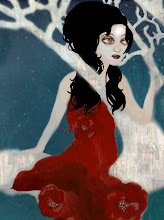
member of:Observers of the Interdependence of Domestic Objects and Their Influence on Everyday Life


This group has been active for a long time and has already made some remarkable assertions which render life simpler from the practical point of view. For example, I move a pot of green color five centimeters to the right, I push in the thumbtack beside the comb and if Mr. A (another adherent like me) at this moment puts his volume about bee-keeping beside a pattern for cutting out vests, I am sure to meet on the sidewalk of the avenida Madero a woman who intrigues me and whose origin and address I never could have known...
--Remedios Varo


(Slideshow is of Artwork by Remedios Varo)
By believing passionately in something that still does not exist, we create it. The nonexistent is whatever we have not sufficiently desired.
--Franz Kafka

Showing posts with label original fiction. Show all posts

Tuesday, June 19, 2012

Not Defeated: Humans, Non-Humans, and Sveta Dorosheva

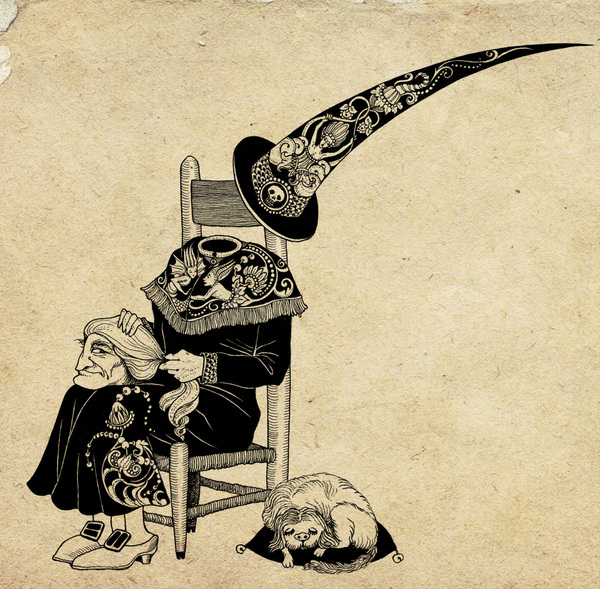
Image by Sveta Dorosheva

"In those days, the world of mirrors and the world of Man were not, as now, isolated from each other. What's more, they were distinct; neither the beings, nor the colors, nor the forms were the same from one world to the other. Both kingdoms, the specular and the human, lived in peace; one could pass through any mirror as a doorway between them. One night, the people of the mirror invaded Earth. Their force was great, but after many bloody battles, the magical arts of the Yellow Emperor prevailed. He pushed back the invaders, imprisoned them in the mirrors, and forced them to repeat, as if sleep-walking, all the acts of Man. He took from them their strength and their form and reduced them to mere servile reflections. Nevertheless, one day they will shake themselves from this magical slumber. The first to awake will be the Fish. In the depths of the mirror, we will note a fragile line, and the color of that line will be one like no other. The other forms will follow. Gradually, they will differ from us; gradually, they will cease to imitate us. They will break the barriers of glass or metal, and this time, they will not be defeated..."
--Jorge Luis Borges (my translation)
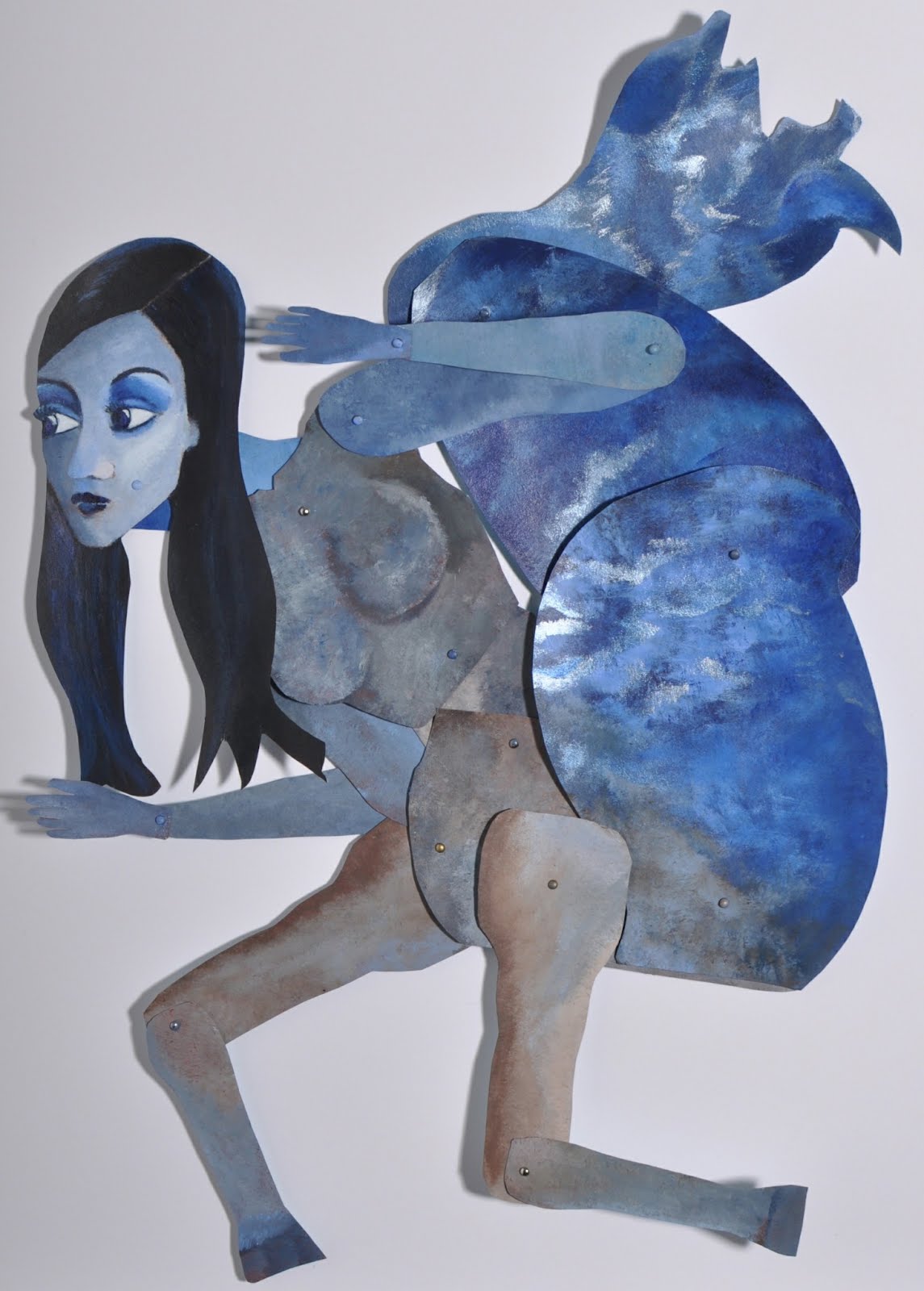


Maquette (by zoe) in the style taught by Clive Hicks-Jenkins


I've worked with this idea before, with the idea that the creatures behind the glass that he's describing, endlessly repeating the actions they see in front of them, endlessly *being* whatever they see in front of them----that those creatures are humans. Us. That we are the ones trapped in the glass, enchanted.

Borges' yellow emperor tries to keep us all the same--automatons who endlessly repeat what we see and slavishly hold to habits built before we were really conscious, when we should instead be protean, ever-shifting and changing--that is the way one lives forever (your atoms constantly shifting into other things)... a habit just has to end, at some point.

In the book Moonwalking with Einstein, Joshua Foer delves into the history of the Ars Memorativa (see link to side and also previous posts for more on the topic) during his year-long study with modern masters of that technique. He describes a patient of A.R. Luria, a Russian journalist referred to in psychological literature as S., who had an incredible, incredibly speedy memory, just by nature. His memory was so amazing, his boss pushed him to get it studied. Luria discovered that S. would see an image for every word he heard, so that the word blue would immediately put into his mind a blue flag waving from a window, and the word red instantly translated as a man in a red shirt walking towards him. Every word yielded an image, and those images held together to solidify everything he heard--to transform, as if liquid to ice, wisps of thought and the rhythms of sound into solid experiences. And so it was that he was constantly dreaming--he was awake and experiencing this life but also dreaming the symbols of meaning, right there as he spoke to you or walked or shopped for groceries. This is what the rest of us do at night, while we're sleeping, while our bodies rest and we close our eyes to keep out new information: our minds translate the events of the day into symbols that make up our internal landscape, our mind-map; it makes bizarre and fascinating and sometimes embarrassing associations (like the kinds the memory masters recommend you make when you're trying to create mnemonics), thus solidifying your memory (which isn't to say you will, without effort, easily be able to pull that knowledge into your conscious mind, later). S. dreamt while awake.

If you study your dreams, you discover those bizarre associations, you uncover why your mind made them, and you learn something much deeper about yourself.

This means that we are creatures who learn by dreaming. What could be more wondrous?
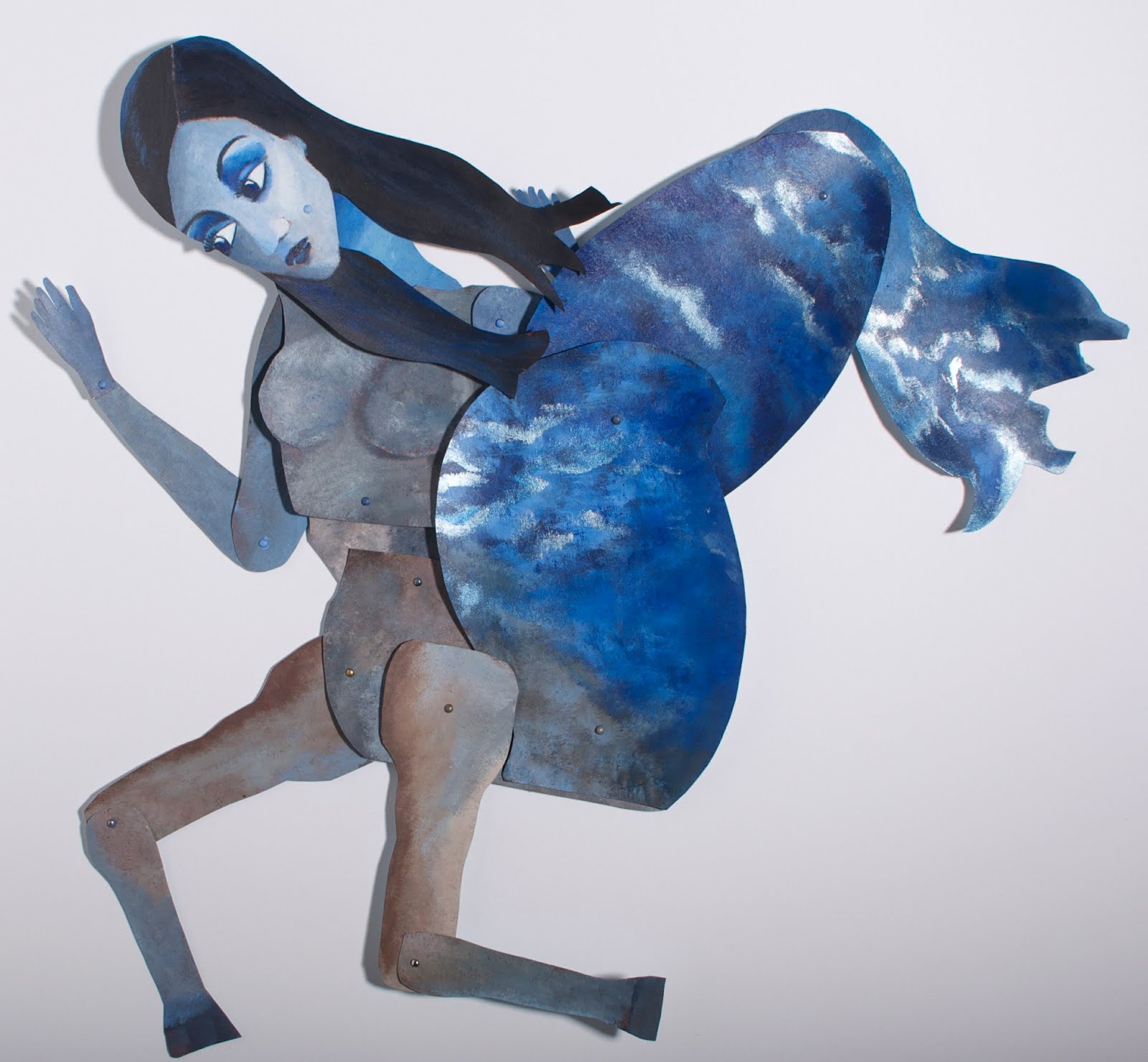


Maquette Pose II


II

Ars Memoria, or Ars Memorativa, the Memory Arts, they teach us that to remember something, we must really, really know it. And they recommend a process much like what S. did naturally.
Here is the technique, as explained by my "dream detective" (whom you may remember from HERE), Nick, to Chloe, his co-worker, and Helena, their client, who has suffered a blow to the head that gave her amnesia (obviously one of his more wordier moments):

“I have discussed with you before the Ars Memorativa. This activity will elaborate my point.” I lick my lips. “And hopefully resolve many more of our issues.” I pause to savor the flavor whiskey has given my coffee.
...
“Indeed. The Art of Memory. Memory being both the house of recall and the source of creativity. The idea is that we must truly know something in order to remember it well. The information becomes a solid prop in our minds, available for shifting, turning, placing next to other objects, and standing on its head. One mundane object, a blandly everyday sort of knowledge, stood on its head, might then yield a great invention. So, how do we come to truly know something? We translate it. Say I want to remember a particular experiment run by a particular scientist named Charles Tart. I will create a house for this knowledge, or better, use a building or an area I am familiar with--even a garden, or a walk I go on often.
Say I’m using my office building. I start at the front door. Charles Tart is entering--how will I make his entrance memorable, and how will I make his name memorable?  I might think of Prince Charles, doing something lewd or violent or ridiculous. Or I might use the name Chuck, and turn our scientist into a woodchuck 
(photo of a woodchuck taken from the Dover Library Site)

“--yes, and the woodchuck, instead of chewing wood, is munching on a tart. What flavor of tart...?” My mind revels in the possibilities. I sniff at them cautiously. “Granny Smith Apples,” I exclaim, “which are, themselves, tart! So, a little woodchuck, munching on a tart tart is at my front door.” I spin to Chloe. “Or do you prefer Prince Charles with a famously trashy tart on his arm?”
“Apples,” she answers calmly. “Because many other words might come to mind with the other image.”
I grin at her appreciatively. “You are a natural talent for this, as I have said many times.” I swivel back to Helena, giving her full eye treatment. I am talking about hypnosis, after all.
“Charles Tart has run many studies of hallucinated realities, especially of the consensual sort, which is the research I’d like to put in my office here, so let’s put our woodchuck in a tie-dye t-shirt. Everyone game?” 
Helena stares at me warily.  
“Helena doesn’t know our offices,” Chloe points out. 
“This is true,” I close my eyes and take another swig of coffee. “Your point prevails. We’ll use this cafe. At the front door is a woodchuck in a tie-dye t-shirt munching on an apple tart. His eyes are running from the tartiness of it. His little nose scrunches in on itself. He smells like wet animal, but that smell is being just slightly overpowered, right now, by the wonderful, heavenly smell of baked pie crust and hot apples.” I breathe in deeply. “Are we all together?” There is no answer, so I open my eyes.
Oddly, both ladies wear the same non-expression.
“OK,” I gather my thoughts. “The woodchuck comes in, but no one sees him, because no one expects to see him, because he is a woodchuck. He jumps up and down excitedly at the sight of so many people who could be his friends, but still no one notices him. He gets upset. His tart is crumbling. So what does he do?”
These identical faces look back at me.“Come on,” I plead with Chloe. “He’s upset. He wants to see a psychiatrist, to discuss his pain. So we’ll put Freud in the room--he was willing to see all kinds of strange and unexpected things, right? Freud sees him. Freud is sitting,” I spin on my stool away from the window bar and towards the room, and the girls slowly follow, “there.” I point to the big, black leather couch in the corner. “Freud is on the couch, get it?” I grin, but don’t wait for any boring non-responses. “Freud waves our antsy woodchuck over, swings his legs down and leans far over so that his head reaches the head of the woodchuck, and gazes into his eyes. ‘You are getting very sleepy,’ he says. ‘Very, verrrrry, sleeeepy.” I draw the words out, making a little hum afterwards. “Watch the woodchuck’s eyes grow rounder and rounder, maybe they spin in circles, and the last of his tart crumbles to the floor. Why?” I pounce, to see if anyone’s listening.
“Because he’s losing his ego,” Chloe drawls.
“Ah!! The lovely Chloe!” I cry. “Do you follow?” I check with Helena.
She nods and drinks her coffee, not looking at me. That’s ok. I’m used to working like this. And I didn’t always have a lovely assistant.“So, the tart is crumbled on the floor, his eyes are spinning, and he wheels on his heel and touches the closest person, who frowns, trying to figure out what just altered in her universe. Pay attention, now. He has seemingly only chosen the closest person, but if you look carefully, you will see he has very cleverly selected the loveliest, bustiest woman in the cafe. She is wearing a bright red dress with amazing cleavage. Her lipstick matches the dress, and her hair is jet black. She has dazzling eyes. They are green. Her dazzling green eyes look down to see what is grasping her arm. The woodchuck says, ‘You are getting sleepy, verrrry sleeeepy.’”I pause only for effect, but Chloe jumps in. I knew she would like this game.
“And her red dress falls to the floor,” she smirks. “In a pile right next to his tart. Because she’s lost all ego-concerns, and has returned to her natural state of oneness with the universe.”Helena is not looking at either of us. She has her entire face crammed into her coffee cup, like she might just disappear inside.
I clap Chloe on the back appreciatively. “Well done. Indeed. Is anyone going to forget what we have so far?”
Helena makes a snorting noise into her cup. Is there even coffee left in there? Is she trying to lick the bottom?
“I can wait, if you want a refill,” I offer.
She puts the cup down, her face red.
“The point of the exercise is to make all the pieces unforgettable. When you’re doing it yourself, you don’t have to worry what others might think, and you will find, also, that once you get into the meat of what you’re trying to remember, the way you order things hones your knowledge of the material. The ancients used this method, for example, to memorize speeches or long, culturally important stories. Some users, especially in the time of Giordano Bruno, believed that they could alter their physical reality--we will get to that in a moment, although the very example we’re using here is an altering of reality. Let’s finish up.” I take a deep breath.“The woodchuck, in his own mind, is, of course, a most handsome prince. He owns a large castle, right next to the ancient oak right across the street there,” I swivel back to the window and point. I swivel back to the room. “In his mind, he is walking with the lovely lady back to his castle. Now, here’s the trick that Charles Tart discovered. Our little hungry woodchuck, who let’s not forget is in real life quite the scientist, ran some tests with college students and discovered that, A, one hypnotized person can hypnotize another person, and B, when that person does so, those two people share the same hallucination. The two college students in this landmark test went to an island and spent time on the beach together, having conversations without opening their physical mouths, and they both returned to normalcy and relayed those conversations in full detail to the scientists separately. Without time to discuss them beforehand.”
“You’re making this up,” Helena states flatly.
“Absolutely not,” I respond firmly. “Western science, my dear. The brain is an amazing world. You can look it up when you get home. In fact, please do. Now, for the Ars Memorativa, we would go through the cafe, putting details of his study in various loci, always moving in a sensible direction, on a path which we would then be able to easily follow anytime we wanted to review our knowledge of the subject. For example, in this cafe, we might start at the front door and go counterclock-wise, always, in our minds, when we are reviewing the information. That way, one thing leads to another. This way,” I point at Chloe, behaving as pedantically as possible, “you won’t have to carry that hideously, monstrously massive text with you everywhere you go. It can be displayed, like proper art, on your desk or your mantel. For the other problems at hand,” I swivel back to Helena, noting that my constant swiveling has been causing her some jumpiness, “we will take a sort of backwards use of this process..."
III

This is also, basically, what an artist does: re-pairs symbols in previously un-thought-of ways to make us perceive something in our reality we have started to forget or ignore, through habit.

As Ernst Gombrich says (quoted in The Age of Insight), the biological function of art is "rehearsal, a training in mental gymnastics which increases our tolerance of the unexpected."
So that we can see more, even things and beings whose existence don’t fit within the confines of our conceptions of reality (like a woodchuck in a tie-dye t-shirt, entering the cafe eating a tart apple tart). Because science shows us (see http://zoe-in-wonderland.blogspot.com/2009/06/perceived-reality-part-iv-dont-let.html Missing the Gorillas) that what falls outside our expectations falls outside our vision. We miss it completely.

In Age of Insight, Eric Kandel credits Freud with showing that we are largely driven by unconscious forces, habits we learned in very early childhood. Modern biologist Bruce Lipton explains now that we act with our conscious minds less than 10% of the time. Gurdjieff, a philosopher in the 1900s, expressed a similar idea, only with a mildly creepier tone: that we are as automata, only alive in the barest sense, and acting automatically and without thought in general--almost always. Remedios Varo, a student of Gurdjieff, often explored this idea in her paintings:
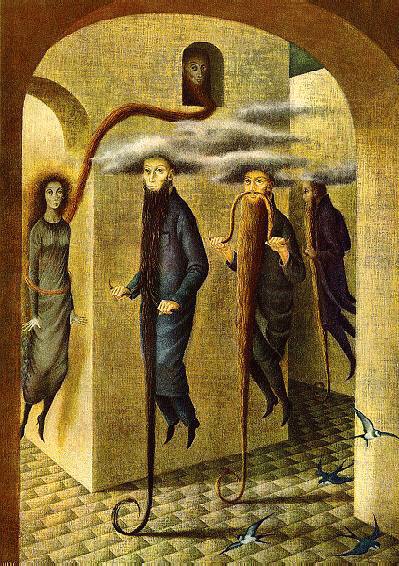


(Above and below: Images by Remedios Varo)
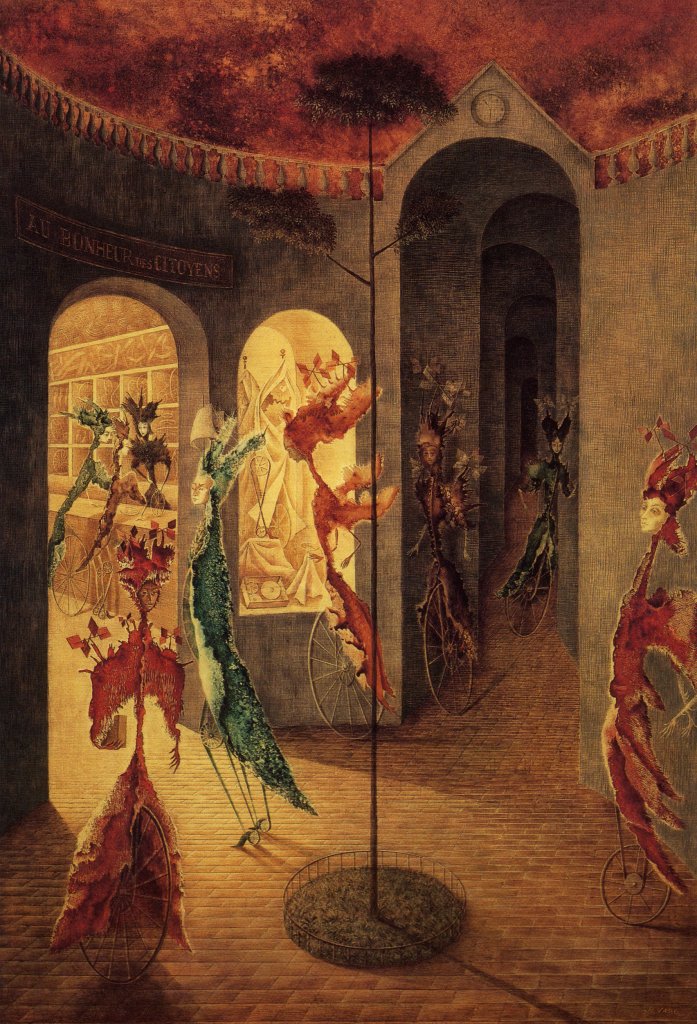


And she claimed to be a member of a group called Observers of the Interdependence of Domestic Objects and Their Influence on Everyday Life, which she described as follows:

“This group has been active for a long time and has already made some remarkable assertions which render life simpler from the practical point of view. For example, I move a pot of green color five centimeters to the right, I push in the thumbtack beside the comb and if Mr. A (another adherent like me) at this moment puts his volume about bee-keeping beside a pattern for cutting out vests, I am sure to meet on the sidewalk of the avenida Madero a woman who intrigues me and whose origin and address I never could have known...”

That idea goes straight back to the Ars Memoria. Many people in history thought that these arts could be used in a magical sense, to somehow give the student special power in the physical universe. How? By doing what an artist does, by doing what Remedios suggests above. By doing what Luria’s patient S. did: 


“Let’s say I’m going to the dentist...I sit there and when the pain starts I feel it...it’s a tiny, orange-red thread. I’m upset because I know that if this keeps up, the thread will widen until it turns into a dense mass...So I cut the thread, make it smaller and smaller, until it’s just a tiny point. And the pain disappears” (32, Moonwalking with Einstein).

Just like that, he changed his physical reality.

So, how do we become less automatic beings? How do we grasp more of our power, see more of our surroundings, enjoy more of our lives? By doing something that puts what we “know” on its head. By seeing differently.

Well, slightly more:

There’s another case, just as striking, described in Age of Insight, of Josef Breuer’s patient Anna O. (Bertha Pappenheim), who suffered a loss of sensation and left-side paralysis, as well as speech and hearing problems. The description is written by Freud:

“In her waking state the girl could no more describe than other patients how her symptoms had arisen, and she could discover no link between them and any experiences of her life. In hypnosis she immediately discovered the missing connection. It turned out that all her symptoms went back to moving events which she had experienced while nursing her father; that is to say, her symptoms had a meaning and were residues or reminiscences of those emotional situations. It was found in most instances that there had been some thought or impulse which she had had to suppress while she was by her father’s sick-bed, and that, in place of it, as a substitute for it, the symptom had afterwards appeared. But as a rule the symptom was not the precipitate of a single such ‘traumatic’ scene, but the result of a summation of a number of similar situations. When the patient recalled a situation of this kind in a hallucinatory way under hypnosis and carried through to its conclusion, with a free expression of emotion [italics mine], the mental act which she had originally suppressed, the symptom was abolished and did not return. By this procedure Breuer succeeded, after long and painful efforts, in relieving his patient of all her symptoms.”
It’s not just noticing the symbols--it’s immersing yourself in the emotion of a scene, and immersing yourself in the motion of change.
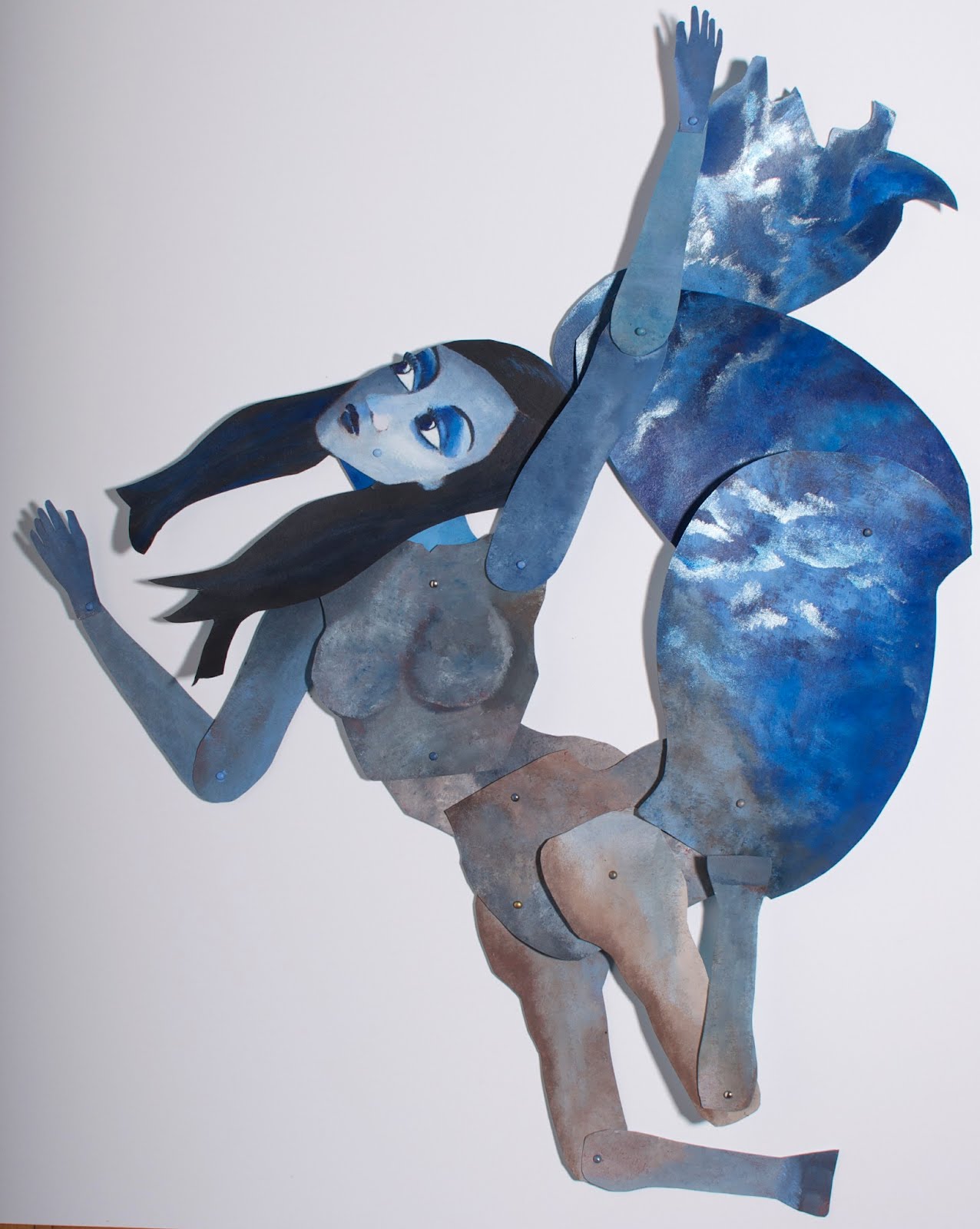

(Maquette, Pose III)
IV



(above image by Sveta Dorosheva...Is this how we tell a story? It just all comes out, alive...)


Now, another thing I am thinking about as I work on the composition of this painting, is the artwork of Sveta Dorosheva. She has been working on a book for about three years about the human world, “as seen through the eyes of fairy-tale creatures. They don't generally believe in people, but some have travelled to our world in various mysterious ways. Such travelers collected evidence and observations about people in this book. It's an assortment of drawings, letters, stories, diaries and other stuff about people, written and drawn by fairies, elves, gnomes and other fairy personalities. These observations may be perplexing, funny and sometimes absurd, but they all present a surprised look at the things that we, people, take for granted." (Source)


(illustration by Sveta Dorosheva, matched with the Ben Franklin quote: "Man is an animal capable of producing tools.")


This is the idea: to become less automatic, because we are no longer taking ourselves and the world for granted. To be surprised, always, and attentive in that surprised way. Here is a non-human asking, What is a human? For an answer, he has Ben Franklin’s quote. And what image does that create for this non-human?
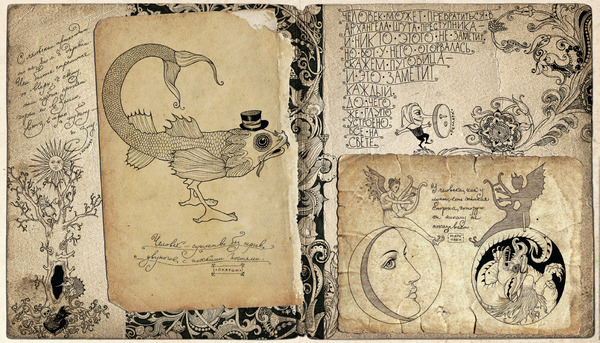
(above image by Sveta Dorosheva)

Or he turns to Plato, who says: “A man is a two-legged creature with flat fingernails and no feathers.” See it, above?
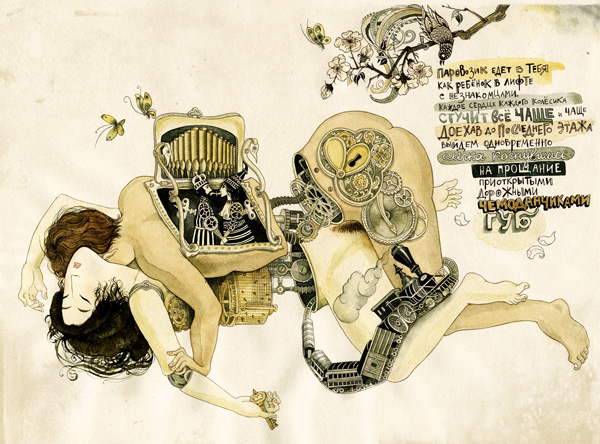


(Above image by Sveta Dorosheva)

And above? You see the mixing of flesh, or carnal activity, and machinery: opening the rib cage, you have the habit behind this act, the fairy-tale, wind-up act of love passed down through the stories of the ages-- to begin events, the woman unlocked the man with the key in her right hand. So. Will they become more than that? Of course they will ;) This isn’t a nightmare!

So, back to Borges: why a fish? Did we really evolve from the sea? Arise out of the swirling depths, the chaos, slithering until we grew feet and stood up? Could we go back? Will we ever learn to breathe in water as we do in air, thus greatly enlarging the world we can be part of? After all, our bodies are largely water! But we need land and sea, the reclining grace of a mermaid but also the forceful gallop of a horse, charging ahead. And then we need the clock parts from which we are tearing free, we need to see them flung to the side. The truth is (right now, to me): we are not, any of us, just one thing--that thought needs to strike me two or three times, each time I make a decision, every time I breathe. Everything I look at, I need to be able to see from several directions, and I can't really do that from just one mind, so I have to learn to share that space in my cranium. With, as Walt Whitman said, the multitude that I am...


Tuesday, April 26, 2011

Who's Ready for Some Pills?

Part One is HERE.


Having dropped all prescribed meds, now, my thinking is crystal-clear. The sense of emergency is back, eating my food, ruining perfectly healthy conversations.
But I’m not losing sight.
The only thing I might regret, I’m thinking, is having flushed all my Adderall. This is while I’m scrubbing someone’s day-old sprayed diarrhea off the toilet bowl of my local chain bookstore in my best skirt. That was not the extended release formula, that eases you into a calm wakefulness until bedtime. That was old-style flavor, the pill that makes you giddy and grits your teeth, makes you ok to put off things you really wanted to do because you know you can do them later, you’re never going to sleep again. At least, initially.
I’m wondering why it is the closing crew thought this would be easier to take care of in the morning. I’m wondering if the lady that missed the bull’s eye, was she thinking maybe she’d catch cooties from the public toilet if she leaned down to wipe up her own shit? But really, mainly what I’m thinking is, I’ve got to get out of here.
Looking down into the toilet, the other thing it’s reminding me of, other than my job in general, is those pills. In the headiness of my grand statement about The Way I’m Going to Live My Life, I failed to consider what I could make on the streets with them.
As opposed to, say, $7 an hour.
I’m thinking about going back to that doctor, paying for the office visit as, say, an investment.
And seeing as I don’t have any health insurance to stop me, I’m thinking how many doctors could I visit before it stops being profitable.
I’m thinking all this and the manager pokes her head in, and with her ex-grade-school teacher pretend-friendly voice, she singsongs: “How clean are you trying to get it in there? You’re almost missing the morning meeting!”
Not the one about the frequent-buyer discount cards?
My best skirt, it’s got a wet spot on it now that’s seeping through to my skin. I’m not sure where it came from.
“You haven’t even wiped down the sink area yet,” she’s saying, and I can hear her breath coming out in little grunts as she stoops to pick up stray paper towels.
I’m still weighing the meeting versus the crusty diarrhea when I remember all the Paxil and Prozac and Celexa piled up in my cabinets.
These doctors, they’re like little prostitutes. That first impression, it’s all they need. They just match it up to whatever the sales rep told them, and bam, the fifteen minute session’s over and your pocket’s empty. It’s all about that first meeting, because after that, you’re too numb to complain. Some of these drugs, they’ll tell you in the research, they might even increase the instance of suicide. All of a sudden, it doesn’t seem like such a big deal after all, pulling that trigger.
People get so lost in life. Like all of us here at the bookstore. In school or suddenly finished with school, we’ve discovered we like to read and we’ve discovered we need an income, and here’s this no-brainer: work in a bookstore. It’s low-key, buys you a little time to start your own novel or work on your paintings, or figure out how you’re going to find a real wage but without selling your soul, and on top of everything, you can hang around with people who like books, you can read books, you can discuss books with customers, recommend your favorites, Your Life and Books. So you start your job and you find out it’s like shelving at WalMart, it’s like dusting at WalMart, it’s like cleaning the toilets at WalMart. Your boss used to be the boss at WalMart. No one wants you chatting on the clock when you could be looking busy, it needs to be clear to everyone who’s a customer and who’s a friend of yours that came in to say hello, and there is certainly not ever a time when you might be leaned up against the help-desk waiting to help someone, and reading a book.
Lit. class, it leads you to think certain things about life. The workplace quickly puts an end to all that. So it’s no real task to understand that plenty of people, not just those of us who grew up in the foster system, are cramming themselves into a ball on that couch with a broken facial expression and a broken method of self-expression, waiting for someone to explain to them why they failed The Test, after studying so hard. And then they’re handed some pills, pills which clear up nothing.
After all the different doctors, all with the same solution-style for any problem, I’ve got a good half a year’s supply of apathy and cobwebs for your head in my cabinet.
My boss, she’s making huffy, stamping noises while she squeaks cleaner liquid around the mirror. God forbid these people be forced to behold their beauty through a few smudges, it’d be almost like zits.
My boss, she doesn’t just toss the used paper towels into the trash can, she smacks the little flippy lid around so I can hear it rock and know she’s angry.
I’m thinking, you probably can’t get much for Celexa and Prozac and Paxil on the streets these days, seeing as the companies are so eager to pass them out. But that’s not to say they don’t have their uses.
I’ve taken my little name tag off now, and I’m scraping at a stubborn spot, and she says, “Whenever you’re done doing whatever it is you’re doing, you can come to the meeting.”
I continue scraping at the shit stain. What do these people eat? I don’t hear any slammy noises, so my guess is she’s waiting for me right there, and I don’t have to peek around the corner to know she’s got her arms folded across her chest and a squeezed-up smile on her face like your teacher’s when you’re fucking up a presentation in front of Important People.
The problem with my boss is, she could really use some Prozac. At this stage, with her anxiety levels, she might need a cocktail of some sort, two nice, calming, anti-unhappy pills. Maybe three.
She’s just so unhappy.
Finally, I just start unraveling the toilet paper. Fuck this place. I stuff as much as I can into the toilet and lift my foot up to flush. As I walk out of the stall, I don’t wash my hands. I grab hers, instead, and open the door. “Let’s get to that meeting,” I say.

Wednesday, April 20, 2011

Tango in a Box IX

Emily and Her Troll Head, by Travis Louie


Part One is HERE.


When you start your life out like I did, waiting for mom and dad to come home until the police come and it’s already been dark outside long enough for you to pee on yourself twice wrapped up inside the curtains holding your breath in case someone else is in the house with you, when you start out there, waiting, peeing again as strange men finally break open the front door and start flipping on all the lights, calling your name even though you’ve never heard their voices before, well, the relationships you’re going to build after that are heavily affected.


By the time your second mommy doesn’t come home, well, you’re sort of building a pattern, and then you might say all your relationships are the same. They’re all with DFACS psychologists and psychiatrists. Social workers. Teachers who go the extra mile. They all want to talk to you about what happened, meaning they want to be your friend. You bump around to different schools and different homes and different shrinks and you begin to think that that’s what a friend is, the guy who sits down with you and says, “Let’s start from the beginning.”


Because the people who don’t talk to you like that, regular everyday people, well, you can’t help but notice that if they look at you at all, it’s to check their reflection out in your glasses.


And then came Johnny. Johnny looked at my purple and black eye folding over on itself and just never asked “What happened?”

Because, it’s kind of obvious, isn’t it?

I mean, they have the folder right there in front of them, right?

And the prescription pad’s already out, they already know what they’re going to prescribe you, but they, like everyone else, they think that that’s the question that sets them apart from the crowd, the one that shows they care:

“Do you want to talk about what happened?”

And Johnny, he wasn’t checking his nose in my glasses, either. He looked straight at me, but I never had to formulate any stupid goddamned sentences to express my feelings about the burglars who turned out to be cops who kidnapped me and never let me see my mom and dad again.

Friday, April 8, 2011

Tango in a Box VIII

PART ONE IS HERE


Mad Bunny Has Many Friends, by Yves Lecoq


You’d think all kinds of dates would stick in your memory. Like the day your parents died, for instance. But I didn’t know how to read a calendar then, and besides, it took me a while to get just what, exactly, was going on.


After that, every day’s so fucked up, just none of them stand out.


Except January 8. January 8, Johnny told me he’d been accepted to hotshot school for math geniuses. Johnny could kill some math. He never bothered to study, but you could see it. Everything he did was perfect, like it would fit in an equation.


Like one time, because I was failing math, Johnny whipped around my book and stared at it for a few seconds, and he started pulling it all out of a hat, like a rabbit. Johnny talked, and I could see math, like colored handkerchiefs, all knotted together. I asked him where he learned all that and he said it was just all up there in his head. He said, “It’s up there in yours, too, you just ignore it.”

Anyway, I remember it was January 8 he told me he was leaving, because January 7 was the day he almost kissed me. His thumb was underneath my chin and my heart let go of all my blood at once. Tingling it all out to the edge of my skin and my knees disappeared, but it had to happen, right? I mean, after all this time?


Learning to Fly, First Lesson, by Yves Lecoq


But it didn’t happen. It didn’t happen, and the next day, he was so excited, he spun me in the air. He said I brought him good luck.


This hotshot school, it was on the wrong side of the country. I didn’t feel like good luck.


Johnny, then he started acting like he was my big brother. He got this look on his face and he said, “You’ve got to get serious.” He said, “The only way out of this place is flying.” He said, “You’ve gotta stop fucking around.”


We were in the mall, and everybody else’s life was still going on around us. Their smiling jaws were still flapping as if their stupid little town wasn’t in the process of losing its only asset.


He put his finger under my chin again, but all he did was say, “Don’t disappoint me.”


*******


by Yves Lecoq


On an earlier January 7th, the one that came the year I caught up with my age group in reading but not in math— not, my teacher pointed out, because I didn’t understand, but because I was sloppy--, my first foster mother explained to me that she was going to adopt me. “This means,” she said, “that daddy and I will be your daddy and mommy forever.”


This would mean something to me later, but at the moment, I just tried to make my expressions match hers, so she’d know I was listening.


That January 8th, my new forever mommy didn’t come home and daddy wouldn’t take his face out of his hands, and as I was watching him, a trickle of pee ran down my leg and then the policemen took me back to the station with them.


You might think all these coincidences are impossible, but you’d be wrong. All the world’s religions developed from the desire to please whatever force out there was capable of such symmetry, such perfectly ordered chaos, such endless possibilities in devastation.


Snowflakes, snowdrifts, avalanches. The perfectly patterned fur of a tiger. A volcano.


Our fear of the number 13 stems from our re-creation as a patriarchal society. 13 was good luck for the pagan goddesses. For witches. But good luck for them meant bad luck to those that came after. The number represented an order of things beneficial to the wrong party.


Seven was how many fingers I held up when I met my first new mommy. Seven was the day on the calendar she pointed to when she said, “By this time next month, it’ll be official.”


Even now, when I go to the grocery store, which isn’t often, I buy the seventh box or bag or can of whatever item on the shelf. If I ride the bus, I only sit if the seventh seat is open, that’s the first one on the driver’s side after the three vertical seats. For a long time, if I had to say something, I said it seven times, and I dug in my heels for most of the way through a second year of 7th grade, making no progress, a defense which finally caught the attention of DFACS employees who, upon investigating, found me needing three fingers and an elbow re-broken and set straight, freeing me at last from that cursed house.


*******

Thursday, April 7, 2011

Tango in a Box VII


Chef II, by Lawrence Winram
Part One is HERE.


Tango in a Box, Part 7/8


So the next time I go to see Johnny in prison, Sir’s not there, but he asks, first thing, did I find out about the anatomy classes.


Conemen, by Lawrence Winram


I tell him it takes a long goddamned time to get to anatomy class.


That’s followed by this wretched silence, and I’m racking my brain to see if I have any memories of swearing at him like that, but I don’t find any.


I cram my hands between my knees and watch them, all twisted up. It’s still quiet, I mean, between us, so I start smudging my right toe with my left toe.


Johnny says, “Sit up for chrissakes.”


My right hand is so far under my legs, it’s pulling my right shoulder across in front of me. I yank both hands up and they go straight to tuck my hair behind my ears and my ass slides down the seat until I’m almost like him.


The problem is, Sir wants organs. Not for him, for other people, like when you donate your organs. Only he’s not planning to donate.


You can see that Sir missed out on some basic biology courses. What’s going on in Johnny’s head, I don’t know.


The bodies you cut up in anatomy, well, they’ve been dead a while.


So Johnny explains to me, from his usual slouch, feet planted about hip-width apart, his ass at the edge of the seat closest to me, his hands resting on his thighs, he says, “Yeah, but someone’s gotta know how to take the organs out.”


Am I awake? My mouth wants to say something awful, you can tell by the way it flaps, by the way my brain has to perform an emergency shutdown to prevent word formation.


Regret, hope, they’re still a few steps ahead here.


And I can’t believe I’m suggesting this, but what I hear come out of my mouth in the end is, “There’s an easier way.”


I’m thinking of foster mommy number three and her perfectly manicured nails and high cheekbones. Before I met her, her hairdresser had burnt the skin off the right side of her face, and the skin transplant that followed was the opening of a new vision of perfection. The drug companies, they’re greedy for meninges, those little membranes around the brain and spinal cord, just right for the medications used in those skin transplants. Next came the eye tucks, courtesy of the muscle membranes of some butchered corpse’s thighs.


Anna, by Lawrence Winram


Vital organs are so picky about when they’re taken from the body. A chunk of thigh will wait on you for a good bit of time before refusing to help out. The image of me, slicing some corpse’s thigh and digging out the muscles, is making me forget where I am.


*******


Of course, I have my own plan for all this, and it’s got nothing to do with anatomy. And, like I said, nothing to do with lawyers. Physics, that’s where we’re going to find our solution.


Think of everything being made up of little atoms. In humans, the atoms that make us up keep changing out. Every seven years, they're completely changed out, you're not just replacing parts, you've got a whole new car. The atoms that are in me now could later be part of you, or part of the table we’re sitting at.


Really, if you follow the panpsychic implications of all this--and that's physics panpsychic, nothing to do with Madame Belaire--, you're in a constant dynamic with all the conscious particles around you, particles residing in both animate and inanimate objects.


Technically, Johnny should be able to convince the walls to just let him pass.


I just haven't figured out the logistics yet.


Behind the Sky, There is a Wall, by Yves Lecoq


*******

Wednesday, April 6, 2011

Tango in a Box VII

Johnny’s roommate in prison, well, he’s a tall black man. Sir, he’s been in prison since he was twelve, but when he got there, his name was Willie. He doesn’t say much, either, but you always get the point.

Johnny brings him out for the first time not too long after my 34D bra played witness to his lawyer’s ego. There’s not actually a visitor for Sir, but, like I said, he’s been there a long time, so he gets to come out anyway.


When he talks, he talks to the empty seat in front of him, which is next to me. I spend most of the visit trying to remember to inhale without forgetting to keep track of my bladder. If I didn’t love Johnny, if I hadn’t spent the last several years hating myself for losing him, I would hate him right now. I think he must be punishing me. But he doesn’t even mention the lawyer.


Sir, what he’s interested in is my education. He’s looking at the chair next to me, he’s fascinated by anatomy. I tell him I haven’t gotten there yet.


Biology, Chemistry, Organic Chemistry, well, they take a while.


He asks me when I’ll be getting to anatomy. I stare at my fingernails carefully. I try to remember, I had a doctor once who told me, the way to stay in the room when your head really, really is fighting to get out, is to focus really, really hard on part of the other person’s body. I can’t look at him, not even at his fingernails, so I’m trying to substitute, here. Little spikes of hard skin push away from all my nails. Underneath the nails is clean and I wonder if it’s because I ate everything.


“I’m not in med-school yet,” I say, and I’m carefully tasting each word, sure I’m saying it out loud, even though the whole room’s taken on a kind of distant, hollow feeling. “In biology,” I say, “the closest thing is cutting open a frog.”


Sir, he says everyone should study their body carefully, know it well. He says I have a privileged position, getting to see the insides of one up close, to touch them.


“Actually,” I say, “I’m not in that position. I even have a little trouble with it. For instance, I vomited when we cut open the frog. In front of everyone.”


Lost all Sense of Time, by Lawrence Winram

Sir, he wants to know when the next semester starts, the earliest I could be taking this anatomy class, overcoming my fears.


Johnny, he hasn’t said anything. He’s leaned back in his seat with his legs hip-width apart, he’s definitely watching me. I'm thinking I must be dreaming, because nothing is making any sense.


The story on Sir is, his big brother was baby-sitting him and some business complications came to the door. You might think that little Willie, finding himself in the midst of a good-sized crew of agitated cocaine addicts, would be nervous. Maybe fearful. Looking around, he might be trying to find a place to hide, wait things out.

But someone’s girlfriend, powder flaking from her nose, came to the front and pointed a curved red nail in his brother’s face, her lips bunching together every time her mouth closed and her neck bobbing back and forth, tossing little blonde curls around. Little Willie snaked his hand into his brother’s pocket and tugged. The girl’s knee sprayed little chunks of white and red, and her mouth fished open.

You might have guessed by now, Willie’s older brother, he’s not the most together, most organized criminal out there.

The story on Sir is, he had served his time plus six months when he committed his second crime, which was beating his prison counselor’s head into the desk until he was unconscious.

Sir says, “You’ll be fine.”

My mouth opens and I say “In Shah Allah.”

Now Sir looks at me. “What did you say?” he says.

But I’m looking at Johnny, now, and I’m saying, “So I guess you gave up on that math stuff, then.”

And Sir says again, “What did you say?”

And then Johnny says, “Yeah, I guess so.”


*******

Monday, April 4, 2011

Tango in a Box VI

Part One is here.


When you can see his eyes, Johnny’s got ears like perfect shells. Not all folded up like everyone else’s, but smooth with long water-polished ripples. If I have to look at him when he’s talking, I focus on his lips, because it helps me remember I’m trying to listen to him talking, but it’s his eyes I’m thinking about anyway. When you can’t see his eyes, he looks like someone you would ignore on the street, he’s not a sunglasses kind of man. All the threat that moves the world and makes each breath come out just in time to jump that next step so there’s no chance to think is in his eyes. When he laughs, it makes me deliriously afraid. I close my eyes tight, and I remember the red wet animal flipping around the tops of slightly crooked teeth and the lips starting a slow curve upwards. That slow curve, even just in my memory, it’s like a trigger, my body immediately ups the oxygen intake to prepare for intense activity. I’d say, “In-Shah-Allah.” He’d laugh. The pacifier popped in and he’d grab my hand and we were running. Whatever we’d done, there was always lots of noise behind us, but all I could see was Johnny’s back and hair in front of me, making everything else rush into streaks of color. I’d focus until the halo of white pushed the colors away from us, and then we were in the car and the rest of the world rushed back to me all at once. The impact of the wind, the car’s throttle and the rattle of its muffler. The sun glinting harsh across the windshield and us, laughing.

*******


Hog Belly Dance, by AZ Rainman of the Independents
In front of me is this impossible man, fat like a tent, kicking up his legs and catching himself with his palms on the floor, throwing himself from one palm to the other. I imagine him as a puppet, someone from the fourth dimension is yanking him from side to side, from palm to palm, up to his feet and down to his hands, entertaining all of us here with the idea of a leaping, dancing tank. As I watch him, someone is trying to convince me of the mundane. I do not say, “Don’t bore me.” I do not say, “Compare, dear audience, that which is before you with that which is next to me.” The thing I notice is, if I had seen him sitting, I would have figured this dancer couldn’t get up by himself. The other thing I notice is, his face is the color of what I got when I asked for well-done, and he’s breathing so hard I can smell his breath from here. The lawyer sitting with me, he’s a vegetarian, and he’s looking at my plate. He says, “You might send that back.” Obviously, he’s never worked in food service. The place, it’s very Middle-Eastern, so we’re sitting on these huge cushions, perfect for disappearing into the corner. The dancer, he’s definitely Middle-Eastern, because no self-respecting white man that size would get up off the couch. The lawyer’s telling me how famous Johnny is. He’s been all over the TV for years. He says, “You see bank robberies all the time in the movies, but they don’t really happen that often in real life. And when they do, the guy’s in jail before the movie’s credits would be done rolling.” I’m thinking, if the cook’s already pissed in this, it’s probably crawling with hepatitis. The lawyer says, “It’s not a matter of appealing in this case.” The tank throws himself down to his right palm and kicks his left foot up in the air, alternating from palm to palm, foot to foot. Sweat sprays onto my steak. The lawyer says, “Between state and federal, Johnny’s never going to get walked out the front door of that place.” And then there’s the dead security guards, at the one place where the video tape got all twisted up and useless. A miracle. “Otherwise, he might have gotten the chair,” says the lawyer, and he makes a loud motion like he’s brushing dirt off his hands, holding them up for me to see, fingers splayed. He’s so impressed, it could only be an act of God— so he can’t take credit. The situation is this: I don’t give a shit what this guy thinks. He’s a lawyer, wrong field. I’m here because I haven’t figured out a way to explain my plan to Johnny yet. Or exactly how to carry it out. The reason I’m still here is, my eyes have glued my ass to the seat. Every time the tank flips, my mind screams amazement. Right now, it’s peripheral vision, but I swear the guy is bouncing on one foot and kicking the other out over and over as he turns in circles on one palm. Right now, I’m thinking about memory. I’m remembering where the psychology textbooks tell us that a whole bunch of people watching the same thing will not remember the same incident when asked about it later. For instance, your average, averagely fearful white suburbanite will tell you that the perpetrator was a tall black man. Thirteen people present at the same bank robbery will all point confidently at someone different in a line up: someone who was in Germany at the time, someone they saw on the news, one of the other victims. Anyone the police officer next to them seems keen on. A tall black man. This is your mind, having bracketed the world into patterns, seeing what it expects to see. It’s called the Bartlett Effect. People get frightened in these scenarios. If your mind can’t grasp what it sees, it’ll do a little overdubbing, see something it can grasp. So I’m thinking, it might be hard to see the power we have over our future, but some part of us, at least, seems to have all kinds of power over the present and past. Right now, you’ll focus on what’s key to your survival or sanity: the gun in your face, the dancing whale. So that tomorrow, I’ll remember this impossibly large man leaping from side to side on the palms of his hands like I couldn’t when I was a six-year-old ball of explosive fearless energy. Tomorrow, this asshole will daydream in the shower about my dark green turtleneck stretched tight across a padded and stuffed 34D bra. It’ll never occur to him that I didn’t say anything through the whole meeting in which I’m pretty sure we were supposed to discuss some type of plan of prison-release, like mine, for example. Me, I’m thanking God this guy’s dancing so I won’t have to remember anything I’m supposed to be listening to.
*******


Source photo of the above, by Sideshow Mom

Friday, April 1, 2011

Tango in a Box V


From the Las Vegas Cirque du Soleil. Artist Unknown)


PART ONE IS HERE


The third time I met Johnny, I was still on my second set of foster parents, and I thought he must have spent the evening with them while I wasn’t looking. He didn’t say anything about my bruises, so I figured I shouldn’t say anything about his and instead I said, “There’s a circus in the theater parking lot.” And: “I’ve never been to the circus.”


He grinned and we were off, and I felt this bubble swelling in me, and when the man did a double flip off the back of his horse and landed perfectly, I was catapulted from my seat, I squeaked.


We cut out of the tent through the side and wandered around and I tried to make my breath fit back in my chest but I couldn’t focus, there were all these lights and sounds and I didn’t want to shut them off.


Behind this one tent, we suddenly found ourselves part of a gaggle of performers. A tall Russian man in tights was walking beside me and I was following a clown whose lady’s teased up bangs reached the top of his thighs. I looked up at Johnny, but he was looking straight ahead like nothing was happening, even as the woman practiced little leaping turns from one side of him to the other, her tutu sparkling pink and silver in the lights. We moved like that, all of us, across the lot until suddenly, it was too much for me, I had to stop, doubled over, leaning on my knees.


And then he helped me up a little hill outside the gates and we just sat and watched from a distance until the lights blinked out for the night.


*******


"The Lesser of Three" by Bill Carman


By Bill Carman


*******


Another disaster in the chain of disasters that is my life was my third foster mommy. My third foster mommy, she was so kind, she said there was no reason why I should have to carry all that emotional baggage around on my own. “And,” she said, “we’re certainly not qualified to help.”


The problem was, I was just so moody. The problem was, I wouldn’t let anyone touch me. The problem was, I had painted more than half the window panes in my room black, leaving exactly seven panes see-through in each of the three floor-to-ceiling windows. She thought maybe I was involved in a cult.

The problem was, the whole time she’d be talking to me, she’d see me mumbling something, and she wasn’t sure it was prayers. The problem was, if I said anything at all, I said it seven times.

I could understand her concern. I didn’t think she was safe around me, either. One of us wasn’t.


The doctor where she took me was a special friend of hers. He squeezed her hand before she left. Foster dad number three was an electrical engineer, he was somewhere on the other side of the country. He traveled a lot.

The doctor promised to take good care of me.

What he meant was, he was going to hand me over to someone he suspected would. What he meant was, he’d be there when she came to pick me up.

The guy who got stuck with me was an intern. That meant he’d be around a lot, like all night.

I walked on the other side of the hall from him.

On the wall right next to the room I was supposed to sleep in, there was a painting of an upset-looking woman. Later, my first non-repeated sentence would be, “She’s broken”. Like me, I meant.

The intern, he had another theory. He said Picasso would say she’s more whole than anyone we’ve ever seen in a photo or portrait. Picasso would say we’re seeing all the sides of her at once, each one fully developed.

The intern, he had a lot of theories. He had one about foster mother number three and the doctor, for example.

That first day, before he handed me off to the intern, the doctor said to me, “So I guess you’re Irish.”

I was silent.

Seven times is a lot of energy, you choose your words carefully. And your audiences.

The intern, though, he didn’t ask anything that first day. When I stopped to stare at Dora Maar, he stopped too. He looked at her as long as I did, and he didn’t say anything either.


By Bill Carman

Wednesday, March 30, 2011

Tango in a Box IV


"Grey Matter Meddling" by Michael Demeng


Part One is here.

In the 1800s, back when everyone was getting their palms and cards read, even kings, there was this guy named Slade. Slade wouldn’t just tell you your future, he would let you talk to your past. Slade was the guy you went to when you wanted your dead grandfather to rock the table or blow on the candles, just so you could feel his presence again. Slade, though, he was making some big dollars, so he got hauled off to jail, for fraud. So far, this is all pretty everyday.


The big deal about Slade was, all of a sudden, a bunch of scientists crawled out of the woodwork and into the courtroom for his trial. And these weren’t scientists he had conjured up himself, either. These were some of the world’s top physicists. Future Nobel Prize winners.


These guys said Slade had a gift.


The idea was, Slade was reaching into the fourth dimension, the one you and I can’t see, and moving things around. This is what I want to do.


And you’ve got to admit, these people, these palm readers and fortune tellers, they aren’t such sticklers about prerequisites. You give them a little money, and they’ll share what they know.


Not like the university, where you can promise them your first-born, and they won’t give you shit.


by Michael DeMeng


The bus drops me directly in front of Madame Belaire’s house. The doors close behind me, and the bus sucks all the air around into a dirty swirl, flapping my hair across my face and stinging my eyes. Maybe I’m too open to suggestion, but the whole world seems deserted and still once the bus is gone. I realize I’ve been standing there too long when I notice the woman in the doorway.


Madame Belaire, she’s just what you’re thinking. I’m looking down at her and all I see is eyes and folds. Maybe I’m too open to suggestion, but from the minute I step inside, I can feel her little black eyeballs clawing around in my brain. My eyes refuse to avert themselves from hers.


I’m shuffling cards that don’t really fit in my hands, thinking my question: what am I doing here? I try to concentrate, but she’s still staring at me, and I have to focus more and more on inhaling. Exhaling. I picture Johnny in jail and tell myself that this is an emergency. Don’t panic.


Madame Belaire snatches the cards and I mutter, “In Shah Allah.” My stomach starts a list of complaints, making me more irritable and slightly less open to suggestion, and then I begin to wonder if her own hunger or mood might affect the way the cards read? Maybe her stomach grumbles, and they say Cook the child.


Madame Belaire says, “Shut up and concentrate.”


I tear my eyes from the little piece of skin I’d been pulling off my index finger and say, “Excuse me?”


Madame Belaire’s putting down the second line of cards, and she doesn’t look up. First, I wonder if I actually asked out loud. Next, I wonder if she actually talked out loud. I decide the best bet is to blank my mind completely. That way, anyone that comes into it, I’ll notice.


“This here,” Madame Belaire says, with her fingernail on a drawing of a letter and a feather pen, “means you’re getting messages from far away. Because it’s pointing this way,” she points, “it’s going to change everything for you.” Madame Belaire says, “Forget about your plans.”


I look at the letter. The problem is, that could mean anything. My body spasms and I’ve forgotten about my bladder for just a second too long when I realize it’s just a cat that jumped into my lap. I shift in my seat, hoping it’s not enough to show through my jeans. Madame Belaire doesn’t look up. The cat paws at my jeans, slicing my legs underneath, and decides on a spot to settle in.


“This here,” Madame Belaire says, the black fingernail on a mountain. “This means you don’t forget about your plans. So you’re going to suffer,” she says. She stares at the cards and doesn’t say anything for so long, I start to wonder if it’s my stomach or hers that’s complaining. I stare at the cards, wishing I knew what she was seeing, hoping she doesn’t really know what I’m thinking. Which is how can I chuck this cat off my lap so it will stop clawing my goddamned leg.


She makes a clicking noise and the cat drops to the floor and waits at her feet. She lifts him up into her lap and rubs his head. He sits quietly, purring. Then she reaches a hand under the table and pulls up a small box, from which she draws another set of cards. Staring at the layout on the table, and completely ignoring me, she shuffles the cards slowly and methodically. Finally she chooses a single card and puts the rest of the stack to the side.


She nods. “Hecate,” she mutters. She grunts quietly.


Vitriol, by Michael DeMeng


I lean forward to peer at the card. A man sits in lotus position, floating in the middle of the card. The closer I look, the better I see he is sitting on the horizon, balanced calmly on the skin of the ocean. One hand stretches forward, holding a staff, the end of which is a woman’s conscious head, and the woman is gazing past us into the ether beyond. Or whatever. The whole thing is reflected in the water--though, since she’s not saying anything and there’s nothing else for me to do, I keep staring until I discover that neither her expression nor the man’s are accurate reflections.


She continues silently watching the cards. I wonder if she’s pissed about the cat. I wonder if I smell like urine. She stands up suddenly, and leaves the room. The cat remains in the seat and begins to suck his claws clean, watching me thoughtfully. I drop my eyes back to the card and edge it towards me with a finger, biting my own nails nervously. The colors of this set are more vivid, much more interesting than the other set. My eyes kind of cross, and then I realize there’s a third version of the pair, traced out in the stars. A door slams, and Madame is back in front of me, where she sits to open a pomegranate. She doesn’t say anything, she doesn’t look at me. In my mind, I’m screaming. In my mind, my pants are dry, and I’m walking out of here, unconcerned. Then I’m screaming again. A letter from far away? A mountain? Who is she kidding? She reaches out and slides her wet thumb across my palm, stretching it open for a moment. She offers me some of the pink, squishy seeds, and in the ten thousand years it takes me to get them to my mouth, I imagine all the different ways a body can become a corpse after poisoning.


I swallow. She nods and grunts some more. “That will hold you here,” she says.


"Vitriol" by Michael DeMeng

Tuesday, March 29, 2011

Tango in a Box III


"Dreamcatcher" by Mia Araujo

Part One is here.


Chapter TWO


Where my new lease on life really started was before they even caught Johnny, with me in this shit-hole bar in the middle of the city that for right now is my college town, because, contrary to what you might think, my utter terror of human contact does not make me want to be alone, and so that is where I take my books to study. I once read that Glenn Gould, in a fit of panic when his photographic memory wasn’t kicking in in time for a last-minute cram session the day before a concert, turned on every noisemaking machine in the vicinity so as to interrupt the death-grip his conscious was exercising over the lens. Moments later, he’d polished off one of Beethoven’s masterpieces. That’s like the bar: every noisemaking machine in the vicinity, all drowning out the death-grip my conscious has on my lens. Not that I’ve got photographic memory. It’s just that, given enough time and peace and quiet to think about something, I can’t. So, I take my physics textbook to the bar. The most cramped one, with the worst music and foulest air, so that, given the options, my brain is desperate to wrap itself around this impossible shit and disappear into it.


So that’s where I found out about reality streams, parallel universes, and Steven Hawking’s worm holes. That’s where I read about Shrodinger’s cat, forever trapped in a cardboard box, waiting for you to decide if he’s been poisoned or not by opening the door. Because until you open the door, he’s both alive and dead. When you open the door, you’re choosing a reality stream, the course of the next second in history, you control the life or death of another creature. At least the creature this you is watching. As soon as it’s open, you’ve picked your stream, and the live cat is licking some other you’s hand.


So, if you’re still with me here, you’re thinking, I was right, I really am God. Then the next thing you’re thinking is, give me a break.


Some might say that scientists are just the priests of this century, that this is then fantasy, or, from the other direction, heresy, but these are the declarations of some bright and beautiful men, and, I think it’s necessary to add here, they did some experiments. The last experiment you did where you called on God to make your kitty unflatten and peel itself off the street in front of your home, well, how’d it turn out? What I’m saying is, maybe there’s some God in all of us.


What I’m saying is, what if learning from our mistakes means we switch up the cardboard flap we opened and give the cat some tuna for being so agreeable?


I know what you’re thinking. At the time, me too, I was thinking, this is a textbook?


I turned to focus on the television set, a good digestive aid for all kinds of discomforts, and soon I was thinking of Johnny, of where he might be, where he wasn’t. I was thinking, this life isn’t a tango. Then I discovered I’d been ignoring a young man’s attentions and I turned just in time for my expression to match the vomit leaving his mouth for my pants.


I hadn’t even taken the exam on this stuff when all of a sudden the TV turned into a joyous parade of Johnny’s mug and profile behind a string of numbers. And that’s when I started taking physics seriously.


"Sleepwalker's Serenade" by Mia Araujo


*******


The theory is, everything is happening at once. In order to sort things out for comprehension, the brain has to bracket certain areas, much as you would a long math equation in order to complete parts leading up to the whole. Look again at the math equation: all points are existing already. You bracket the section of the equation that spells line, and you see a line. You shift your brackets slightly and now you see a plane. Or a point. Are they already in the equation? Yes. Existing all at once? Yes. The brackets are your paradigm. What you see is what you’re prepared to see. Our brain does this, puts everything into a linear time scale, each point is a place, an occurrence in its surrounding environment. Space and time brackets.


Everything is happening right now, at once. Your mother is not dead, she is focused on another point right now, where you are not looking.


Time travel is not leaping backwards and forwards in time, it is merely bracketing elsewhere. Somewhere, all your possible futures are played out, and all the choices you didn’t make, you made. Don’t like this one? Switch reality streams. Find the other.


Your life becomes like channel-surfing.


Remorse is ridiculous, but not for the reasons you’ve been told. It’s ridiculous to ignore it, because remorse is the pull of your body towards the choice it would have preferred. It’s ridiculous like watching a stupid show is ridiculous when the remote control is in your hands.


The problem I’m having is, school isn’t the kind of place where you get to explore your options the way I’m needing to explore them. The problem is, physics professors are all going to make you go back and study the basics of physics before you get to this, to the really useful information. The problem is, I’d have to spend semesters on Newtonian physics before I’d ever even get to the real discussions about this chapter, the one that’s going to change everything.


Left to my own devices, where I go is to Madame Belaire’s home. It’s right on the bus line, and she’ll read your palm for a nominal fee.


Don’t get me wrong. This is completely academic.


*******


"Hands That See" by Mia Araujo