member of:Observers of the Interdependence of Domestic Objects and Their Influence on Everyday Life


This group has been active for a long time and has already made some remarkable assertions which render life simpler from the practical point of view. For example, I move a pot of green color five centimeters to the right, I push in the thumbtack beside the comb and if Mr. A (another adherent like me) at this moment puts his volume about bee-keeping beside a pattern for cutting out vests, I am sure to meet on the sidewalk of the avenida Madero a woman who intrigues me and whose origin and address I never could have known...
--Remedios Varo


(Slideshow is of Artwork by Remedios Varo)
By believing passionately in something that still does not exist, we create it. The nonexistent is whatever we have not sufficiently desired.
--Franz Kafka

Showing posts with label zoe jordan. Show all posts

Thursday, July 19, 2012

Angels and Demons


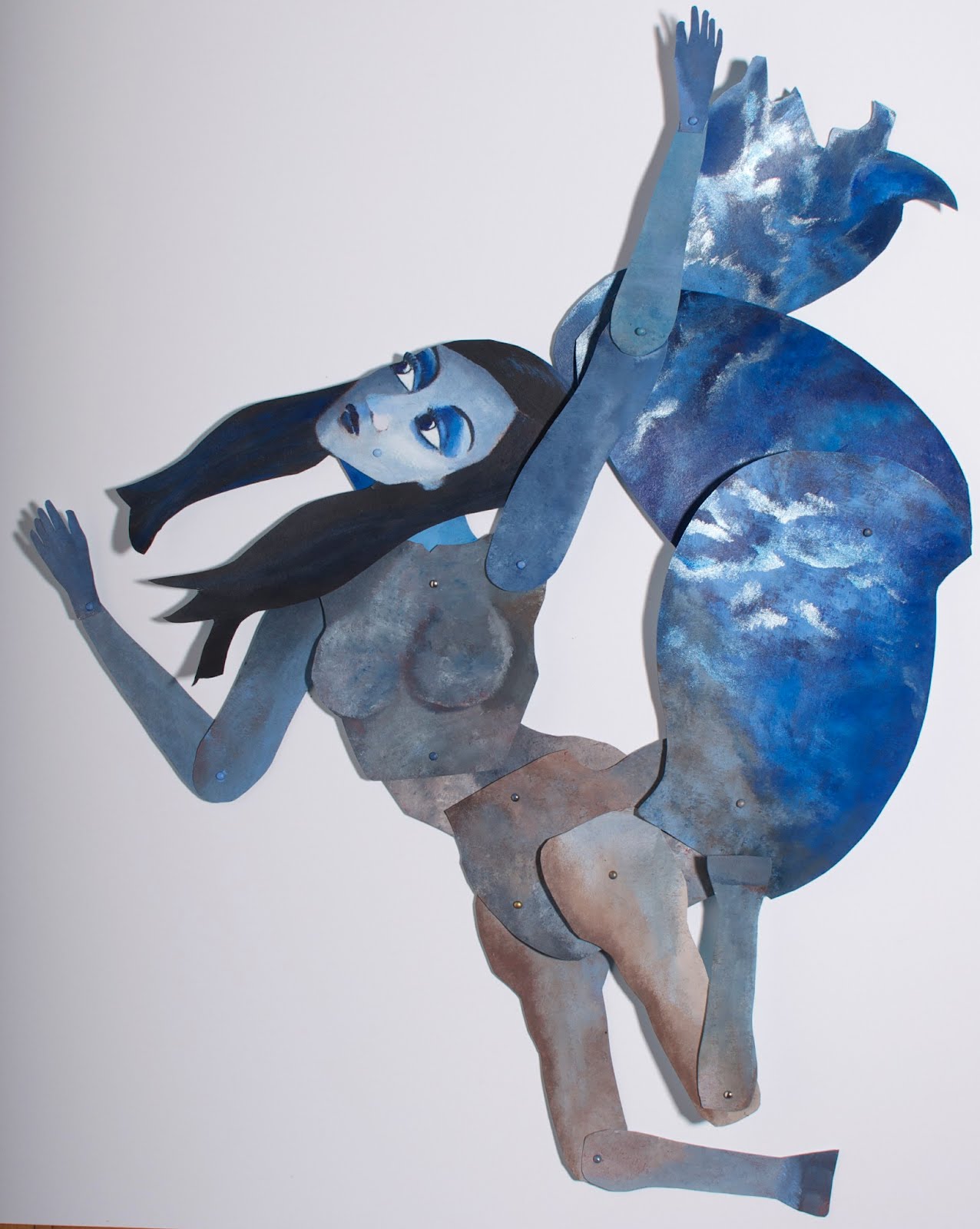
Cavorting Demon Maquette, face based on a Noh mask.

Several weeks ago, I posted a segment from a Borges story in which there were two worlds, each on opposing sides of any mirrored surface; in that story, those living on one of those sides, as a result of a curse, was forced to do no more than mimic the actions of others. I posited that ours was that side, and that, the more I read on neuroscience and memory and habit, the more it seems that our lives are constant repetitions of habits we began very, very early in life. I also told the story of a Russian reporter identified only as S. by his doctor, A.R. Luria, who unconsciously applied a marvelous technique, pretty much exactly like that recommended by the Ars Memoria, in order to instantly file information for recall--instantly, as it came at him. He did this via vivid symbols, and one of those symbols, a red-orange thread, represented pain. He saw the pain, and then was able to control it by snipping away at the incarnadine thread in his mind until it disappeared, and along with it, the pain.

But he was studied precisely because most of us can’t do that. Because his ability was an anomaly.
Right?


Then I came upon the book Monsters and Magic Tricks, or There’s No Such Thing as Hypnosis?, in which the author, Steve Heller, describes the processes by which we learn to move around in the world and memorize facts and form habits as basically variations of hypnosis. He claims that hypnosis is a process we often undergo: imagine yourself, as a small child, your parent squatting in front of you, straightening your collar, telling you very seriously: it is very important to listen to what the teacher says. It is very important that you behave. What your teacher says will embed itself in your brain, even without effort on your part. Even if you don’t consciously remember it.

You learn a vocabulary, a language, methods of communicating both verbal and non-verbal, and you learn how people interact and what is expected and who is important and what kinds of goals to take seriously, all of these things, before you’re even of an age where you can consciously remember any of them. So they are remembered beneath the surface. They affect your behavior without you noticing. 
And this idea is supported by study after study being processed now--our conscious decision-making forms a very small percentage of our lives. Most of the time, we are on autopilot. (Now, think again of that yellow emperor).
He gives a very basic example, which can then be broadened to apply to less “mathematical” topics, by asking the question what is 2 + 2?:
“I am confident that you would respond with the correct answer. If you were asked how you knew the answer, you might reply that you learned it as a child. In other words, the question itself caused you to go back into your personal history and find the ‘proper’ associational connection. You would have done that instantly, without conscious awareness of the process.”
The above example also explains why we work so much on auto-pilot: otherwise, we would be constantly over-burdened with very basic things. Instead, we see the red light and automatically stop the car--which is a good thing.
Heller writes that we can counter that automatism, the result of so much hypnosis (even now, as we drool in front of the television or flick through image after image on the internet, barely stopping, taking in information without consciously processing it), with a sort of self-hypnosis. Which is really no more than a very focused form of imagining, using all five senses.
Some examples he gives of working with patients reminded me immediately of the Russian journalist, S:
“For example, a woman was complaining of a severe headache in my office. She said that it was so bad that she didn’t think we could continue our session. I asked her to close her eyes, and see what color her headache was. She looked at me as if I was crazy. Of course, she was right. I just get paid well for it. Finally, she shrugged her shoulders and closed her eyes. After a short time, she informed me that she did have a picture of colors, and that ‘it seems to be bright reds and oranges.’  I then instructed her to listen to the steady sound of her breathing, and with each exhalation, she would breathe more and more of those colors out of her system. She was told to continue until she could see it ‘all’ across the room, as if a painting hanging on the wall. It was several minutes before she signaled that the picture was on the wall. I asked her to see someone walking into the room, taking the picture off the wall, and to hear that person’s footsteps as he walked out of the room. In less than five minutes she terminated the hypnotic state that she had spontaneously achieved, with the headache gone (pp.43-44).”
Now, not only did he hypnotize her, or have her self-hypnotize, and use her imagination to review the pain, he did it in a very specific way: he shifted her ‘feeling’ sense, her focus on what he calls the kinesthetic system, to her visual and audio sense. He moved the pain from a feeling to an image, then added sound to remove it completely. This was not a one-off:
“Case 13: Patient was a 57-year-old male hospitalized with terminal cancer which had metastasized through areas of his skeletal system. He was in intensive care and, in spite of four to five injections of morphine daily along with oral pain medications, he was suffering intractable pain, insomnia and extreme agitation. His physician asked me to see him about pain control as well as reduction of the patient’s agitated state.When first seen, the patient was complaining in a very harsh tone about his pain. He was thrashing in the bed, and generally being verbally hostile to everyone (Which, given his circumstances, was to a degree understandable). I noticed that his room contained a portable stereo, a small radio and a small tape recorder. Based on the way he was using his voice (complaining, harsh tone, using many words), and the equipment I had observed, it would be a good guess to assume that he was highly auditory. Since his cancer was causing him pain (throwing him into nearly constant kinesthetic), I knew I needed to get him back to, and then anchor him into, auditory with his visual as a backup system...After introducing myself and gathering some information about his hobbies (he loved listening to music), as well as some areas he felt competent in (one of which was working with wood), I was ready to proceed... I then asked him to close his eyes and listen to what his pain sounded like. He stared at me in disbelief...”
After some effort, he was convinced, and he soon described the pain as a “terrible grinding sound.” He was asked to (with eyes closed) think of a woodworking tool which sounded like it, and he was able also to do that. He was told to get a very clear picture of it in his mind.
“I then asked him to ‘see’ that tool or machine across the room in his mind’s eye, and to speed it up as fast as he could. Within several seconds, he nodded again. I then instructed him to ‘see’ the tool or machine slowing down, little by little until it had stopped.”
He was also successful in removing his pain, and over the next week came of a majority of his pain medications and was in a much better mood, able to move out of intensive care and soon returned to living at home.

Maquettes:Automaton Shell and Escaping Brain Demon
Now for exorcising the demons of bad habits (even if you like them, as I’ve grown inordinately fond of this demon over the last few weeks): altering the habit, being alive instead of automatic, using all your senses as you recreate yourself in your mind into some being that would not even have been possible in your “old” mindset, but is now natural. And then that new you discards its old shell, pushes through the mirror--greatly expanding its universe (possibilities)--and continues on.
I haven’t yet settled on a composition, but I’ve been playing:


For your amazement: mirroring, and something to remind us all of the fact that there is no such thing as impossible:

(Maquettes by Zoe, photos by Gabriel)

Tuesday, June 19, 2012

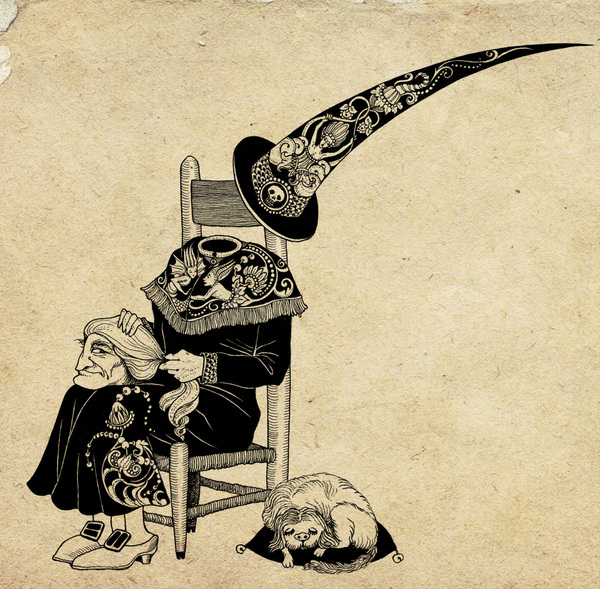
Not Defeated: Humans, Non-Humans, and Sveta Dorosheva

Image by Sveta Dorosheva

"In those days, the world of mirrors and the world of Man were not, as now, isolated from each other. What's more, they were distinct; neither the beings, nor the colors, nor the forms were the same from one world to the other. Both kingdoms, the specular and the human, lived in peace; one could pass through any mirror as a doorway between them. One night, the people of the mirror invaded Earth. Their force was great, but after many bloody battles, the magical arts of the Yellow Emperor prevailed. He pushed back the invaders, imprisoned them in the mirrors, and forced them to repeat, as if sleep-walking, all the acts of Man. He took from them their strength and their form and reduced them to mere servile reflections. Nevertheless, one day they will shake themselves from this magical slumber. The first to awake will be the Fish. In the depths of the mirror, we will note a fragile line, and the color of that line will be one like no other. The other forms will follow. Gradually, they will differ from us; gradually, they will cease to imitate us. They will break the barriers of glass or metal, and this time, they will not be defeated..."
--Jorge Luis Borges (my translation)


Maquette (by zoe) in the style taught by Clive Hicks-Jenkins


I've worked with this idea before, with the idea that the creatures behind the glass that he's describing, endlessly repeating the actions they see in front of them, endlessly *being* whatever they see in front of them----that those creatures are humans. Us. That we are the ones trapped in the glass, enchanted.

Borges' yellow emperor tries to keep us all the same--automatons who endlessly repeat what we see and slavishly hold to habits built before we were really conscious, when we should instead be protean, ever-shifting and changing--that is the way one lives forever (your atoms constantly shifting into other things)... a habit just has to end, at some point.

In the book Moonwalking with Einstein, Joshua Foer delves into the history of the Ars Memorativa (see link to side and also previous posts for more on the topic) during his year-long study with modern masters of that technique. He describes a patient of A.R. Luria, a Russian journalist referred to in psychological literature as S., who had an incredible, incredibly speedy memory, just by nature. His memory was so amazing, his boss pushed him to get it studied. Luria discovered that S. would see an image for every word he heard, so that the word blue would immediately put into his mind a blue flag waving from a window, and the word red instantly translated as a man in a red shirt walking towards him. Every word yielded an image, and those images held together to solidify everything he heard--to transform, as if liquid to ice, wisps of thought and the rhythms of sound into solid experiences. And so it was that he was constantly dreaming--he was awake and experiencing this life but also dreaming the symbols of meaning, right there as he spoke to you or walked or shopped for groceries. This is what the rest of us do at night, while we're sleeping, while our bodies rest and we close our eyes to keep out new information: our minds translate the events of the day into symbols that make up our internal landscape, our mind-map; it makes bizarre and fascinating and sometimes embarrassing associations (like the kinds the memory masters recommend you make when you're trying to create mnemonics), thus solidifying your memory (which isn't to say you will, without effort, easily be able to pull that knowledge into your conscious mind, later). S. dreamt while awake.

If you study your dreams, you discover those bizarre associations, you uncover why your mind made them, and you learn something much deeper about yourself.

This means that we are creatures who learn by dreaming. What could be more wondrous?


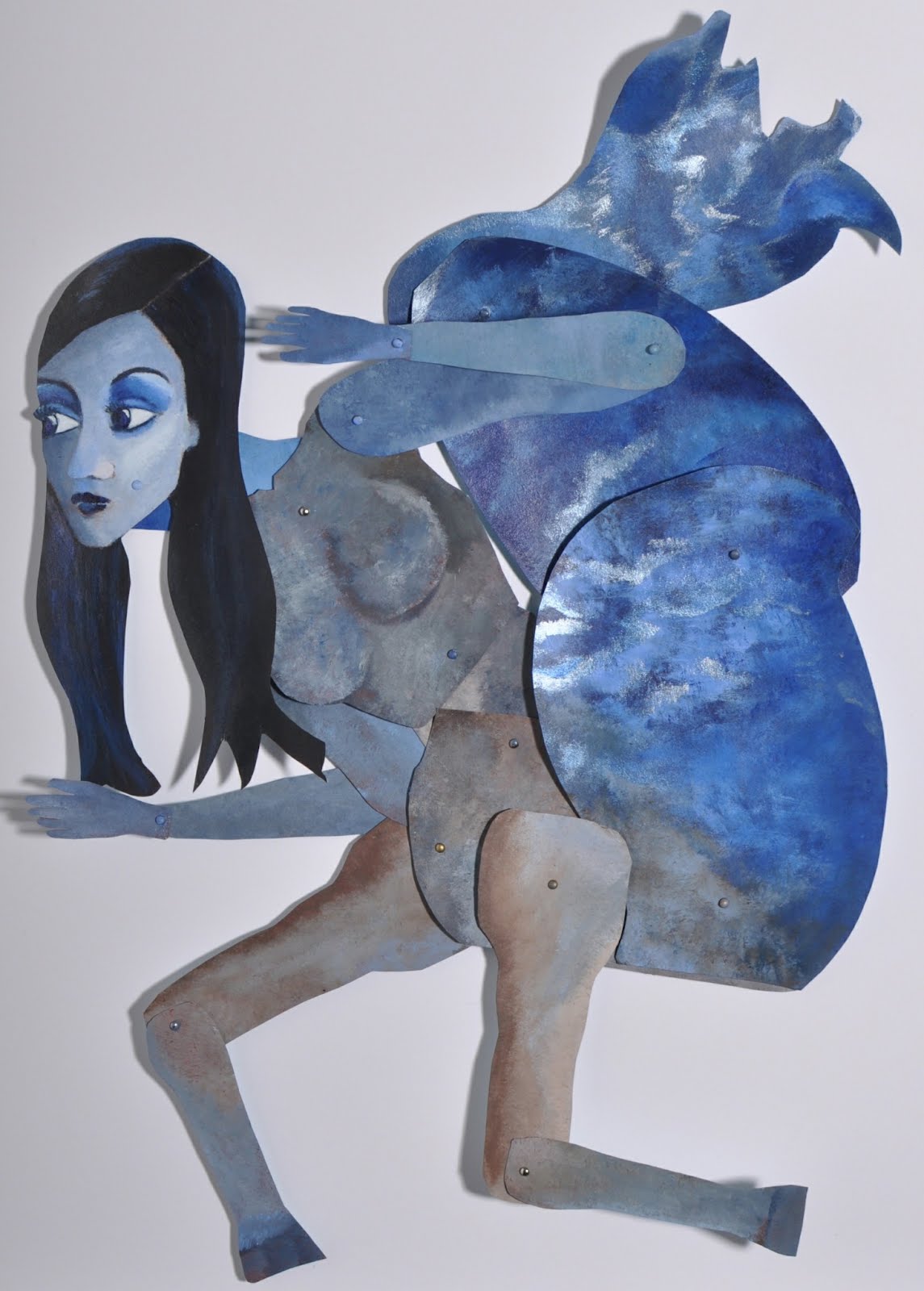
Maquette Pose II


II

Ars Memoria, or Ars Memorativa, the Memory Arts, they teach us that to remember something, we must really, really know it. And they recommend a process much like what S. did naturally.
Here is the technique, as explained by my "dream detective" (whom you may remember from HERE), Nick, to Chloe, his co-worker, and Helena, their client, who has suffered a blow to the head that gave her amnesia (obviously one of his more wordier moments):

“I have discussed with you before the Ars Memorativa. This activity will elaborate my point.” I lick my lips. “And hopefully resolve many more of our issues.” I pause to savor the flavor whiskey has given my coffee.
...
“Indeed. The Art of Memory. Memory being both the house of recall and the source of creativity. The idea is that we must truly know something in order to remember it well. The information becomes a solid prop in our minds, available for shifting, turning, placing next to other objects, and standing on its head. One mundane object, a blandly everyday sort of knowledge, stood on its head, might then yield a great invention. So, how do we come to truly know something? We translate it. Say I want to remember a particular experiment run by a particular scientist named Charles Tart. I will create a house for this knowledge, or better, use a building or an area I am familiar with--even a garden, or a walk I go on often.
Say I’m using my office building. I start at the front door. Charles Tart is entering--how will I make his entrance memorable, and how will I make his name memorable?  I might think of Prince Charles, doing something lewd or violent or ridiculous. Or I might use the name Chuck, and turn our scientist into a woodchuck 
(photo of a woodchuck taken from the Dover Library Site)

“--yes, and the woodchuck, instead of chewing wood, is munching on a tart. What flavor of tart...?” My mind revels in the possibilities. I sniff at them cautiously. “Granny Smith Apples,” I exclaim, “which are, themselves, tart! So, a little woodchuck, munching on a tart tart is at my front door.” I spin to Chloe. “Or do you prefer Prince Charles with a famously trashy tart on his arm?”
“Apples,” she answers calmly. “Because many other words might come to mind with the other image.”
I grin at her appreciatively. “You are a natural talent for this, as I have said many times.” I swivel back to Helena, giving her full eye treatment. I am talking about hypnosis, after all.
“Charles Tart has run many studies of hallucinated realities, especially of the consensual sort, which is the research I’d like to put in my office here, so let’s put our woodchuck in a tie-dye t-shirt. Everyone game?” 
Helena stares at me warily.  
“Helena doesn’t know our offices,” Chloe points out. 
“This is true,” I close my eyes and take another swig of coffee. “Your point prevails. We’ll use this cafe. At the front door is a woodchuck in a tie-dye t-shirt munching on an apple tart. His eyes are running from the tartiness of it. His little nose scrunches in on itself. He smells like wet animal, but that smell is being just slightly overpowered, right now, by the wonderful, heavenly smell of baked pie crust and hot apples.” I breathe in deeply. “Are we all together?” There is no answer, so I open my eyes.
Oddly, both ladies wear the same non-expression.
“OK,” I gather my thoughts. “The woodchuck comes in, but no one sees him, because no one expects to see him, because he is a woodchuck. He jumps up and down excitedly at the sight of so many people who could be his friends, but still no one notices him. He gets upset. His tart is crumbling. So what does he do?”
These identical faces look back at me.“Come on,” I plead with Chloe. “He’s upset. He wants to see a psychiatrist, to discuss his pain. So we’ll put Freud in the room--he was willing to see all kinds of strange and unexpected things, right? Freud sees him. Freud is sitting,” I spin on my stool away from the window bar and towards the room, and the girls slowly follow, “there.” I point to the big, black leather couch in the corner. “Freud is on the couch, get it?” I grin, but don’t wait for any boring non-responses. “Freud waves our antsy woodchuck over, swings his legs down and leans far over so that his head reaches the head of the woodchuck, and gazes into his eyes. ‘You are getting very sleepy,’ he says. ‘Very, verrrrry, sleeeepy.” I draw the words out, making a little hum afterwards. “Watch the woodchuck’s eyes grow rounder and rounder, maybe they spin in circles, and the last of his tart crumbles to the floor. Why?” I pounce, to see if anyone’s listening.
“Because he’s losing his ego,” Chloe drawls.
“Ah!! The lovely Chloe!” I cry. “Do you follow?” I check with Helena.
She nods and drinks her coffee, not looking at me. That’s ok. I’m used to working like this. And I didn’t always have a lovely assistant.“So, the tart is crumbled on the floor, his eyes are spinning, and he wheels on his heel and touches the closest person, who frowns, trying to figure out what just altered in her universe. Pay attention, now. He has seemingly only chosen the closest person, but if you look carefully, you will see he has very cleverly selected the loveliest, bustiest woman in the cafe. She is wearing a bright red dress with amazing cleavage. Her lipstick matches the dress, and her hair is jet black. She has dazzling eyes. They are green. Her dazzling green eyes look down to see what is grasping her arm. The woodchuck says, ‘You are getting sleepy, verrrry sleeeepy.’”I pause only for effect, but Chloe jumps in. I knew she would like this game.
“And her red dress falls to the floor,” she smirks. “In a pile right next to his tart. Because she’s lost all ego-concerns, and has returned to her natural state of oneness with the universe.”Helena is not looking at either of us. She has her entire face crammed into her coffee cup, like she might just disappear inside.
I clap Chloe on the back appreciatively. “Well done. Indeed. Is anyone going to forget what we have so far?”
Helena makes a snorting noise into her cup. Is there even coffee left in there? Is she trying to lick the bottom?
“I can wait, if you want a refill,” I offer.
She puts the cup down, her face red.
“The point of the exercise is to make all the pieces unforgettable. When you’re doing it yourself, you don’t have to worry what others might think, and you will find, also, that once you get into the meat of what you’re trying to remember, the way you order things hones your knowledge of the material. The ancients used this method, for example, to memorize speeches or long, culturally important stories. Some users, especially in the time of Giordano Bruno, believed that they could alter their physical reality--we will get to that in a moment, although the very example we’re using here is an altering of reality. Let’s finish up.” I take a deep breath.“The woodchuck, in his own mind, is, of course, a most handsome prince. He owns a large castle, right next to the ancient oak right across the street there,” I swivel back to the window and point. I swivel back to the room. “In his mind, he is walking with the lovely lady back to his castle. Now, here’s the trick that Charles Tart discovered. Our little hungry woodchuck, who let’s not forget is in real life quite the scientist, ran some tests with college students and discovered that, A, one hypnotized person can hypnotize another person, and B, when that person does so, those two people share the same hallucination. The two college students in this landmark test went to an island and spent time on the beach together, having conversations without opening their physical mouths, and they both returned to normalcy and relayed those conversations in full detail to the scientists separately. Without time to discuss them beforehand.”
“You’re making this up,” Helena states flatly.
“Absolutely not,” I respond firmly. “Western science, my dear. The brain is an amazing world. You can look it up when you get home. In fact, please do. Now, for the Ars Memorativa, we would go through the cafe, putting details of his study in various loci, always moving in a sensible direction, on a path which we would then be able to easily follow anytime we wanted to review our knowledge of the subject. For example, in this cafe, we might start at the front door and go counterclock-wise, always, in our minds, when we are reviewing the information. That way, one thing leads to another. This way,” I point at Chloe, behaving as pedantically as possible, “you won’t have to carry that hideously, monstrously massive text with you everywhere you go. It can be displayed, like proper art, on your desk or your mantel. For the other problems at hand,” I swivel back to Helena, noting that my constant swiveling has been causing her some jumpiness, “we will take a sort of backwards use of this process..."
III

This is also, basically, what an artist does: re-pairs symbols in previously un-thought-of ways to make us perceive something in our reality we have started to forget or ignore, through habit.

As Ernst Gombrich says (quoted in The Age of Insight), the biological function of art is "rehearsal, a training in mental gymnastics which increases our tolerance of the unexpected."
So that we can see more, even things and beings whose existence don’t fit within the confines of our conceptions of reality (like a woodchuck in a tie-dye t-shirt, entering the cafe eating a tart apple tart). Because science shows us (see http://zoe-in-wonderland.blogspot.com/2009/06/perceived-reality-part-iv-dont-let.html Missing the Gorillas) that what falls outside our expectations falls outside our vision. We miss it completely.

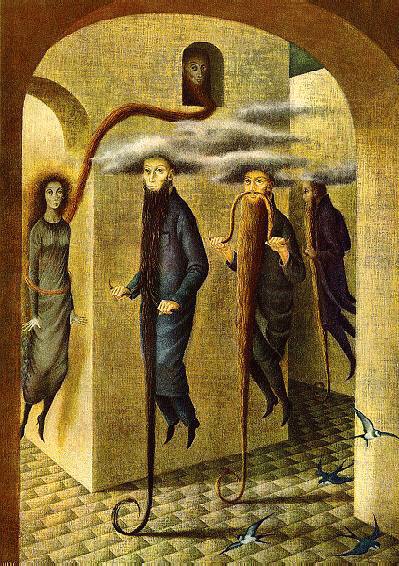
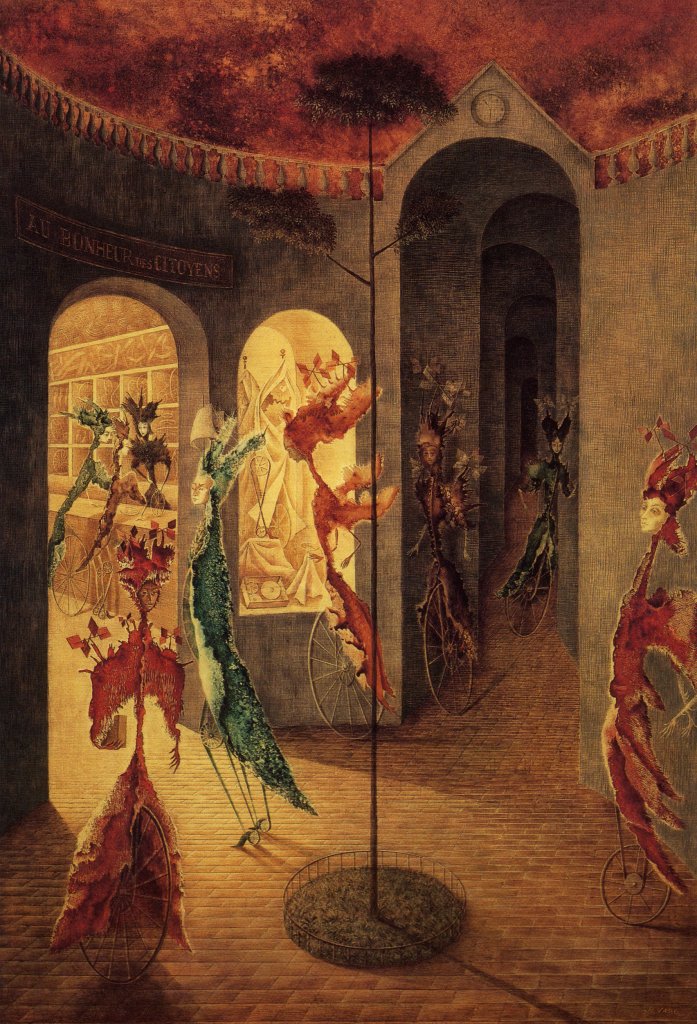
In Age of Insight, Eric Kandel credits Freud with showing that we are largely driven by unconscious forces, habits we learned in very early childhood. Modern biologist Bruce Lipton explains now that we act with our conscious minds less than 10% of the time. Gurdjieff, a philosopher in the 1900s, expressed a similar idea, only with a mildly creepier tone: that we are as automata, only alive in the barest sense, and acting automatically and without thought in general--almost always. Remedios Varo, a student of Gurdjieff, often explored this idea in her paintings:


(Above and below: Images by Remedios Varo)


And she claimed to be a member of a group called Observers of the Interdependence of Domestic Objects and Their Influence on Everyday Life, which she described as follows:

“This group has been active for a long time and has already made some remarkable assertions which render life simpler from the practical point of view. For example, I move a pot of green color five centimeters to the right, I push in the thumbtack beside the comb and if Mr. A (another adherent like me) at this moment puts his volume about bee-keeping beside a pattern for cutting out vests, I am sure to meet on the sidewalk of the avenida Madero a woman who intrigues me and whose origin and address I never could have known...”

That idea goes straight back to the Ars Memoria. Many people in history thought that these arts could be used in a magical sense, to somehow give the student special power in the physical universe. How? By doing what an artist does, by doing what Remedios suggests above. By doing what Luria’s patient S. did: 


“Let’s say I’m going to the dentist...I sit there and when the pain starts I feel it...it’s a tiny, orange-red thread. I’m upset because I know that if this keeps up, the thread will widen until it turns into a dense mass...So I cut the thread, make it smaller and smaller, until it’s just a tiny point. And the pain disappears” (32, Moonwalking with Einstein).

Just like that, he changed his physical reality.

So, how do we become less automatic beings? How do we grasp more of our power, see more of our surroundings, enjoy more of our lives? By doing something that puts what we “know” on its head. By seeing differently.

Well, slightly more:

There’s another case, just as striking, described in Age of Insight, of Josef Breuer’s patient Anna O. (Bertha Pappenheim), who suffered a loss of sensation and left-side paralysis, as well as speech and hearing problems. The description is written by Freud:

“In her waking state the girl could no more describe than other patients how her symptoms had arisen, and she could discover no link between them and any experiences of her life. In hypnosis she immediately discovered the missing connection. It turned out that all her symptoms went back to moving events which she had experienced while nursing her father; that is to say, her symptoms had a meaning and were residues or reminiscences of those emotional situations. It was found in most instances that there had been some thought or impulse which she had had to suppress while she was by her father’s sick-bed, and that, in place of it, as a substitute for it, the symptom had afterwards appeared. But as a rule the symptom was not the precipitate of a single such ‘traumatic’ scene, but the result of a summation of a number of similar situations. When the patient recalled a situation of this kind in a hallucinatory way under hypnosis and carried through to its conclusion, with a free expression of emotion [italics mine], the mental act which she had originally suppressed, the symptom was abolished and did not return. By this procedure Breuer succeeded, after long and painful efforts, in relieving his patient of all her symptoms.”
It’s not just noticing the symbols--it’s immersing yourself in the emotion of a scene, and immersing yourself in the motion of change.


(Maquette, Pose III)
IV


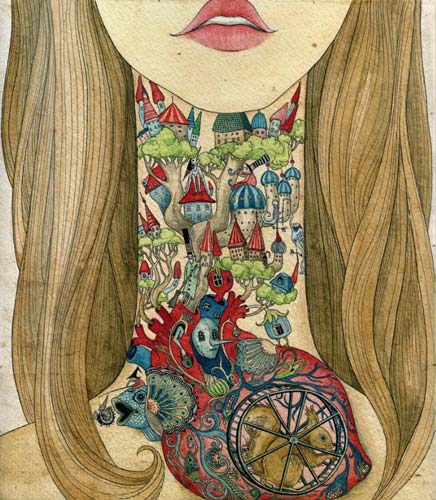
(above image by Sveta Dorosheva...Is this how we tell a story? It just all comes out, alive...)


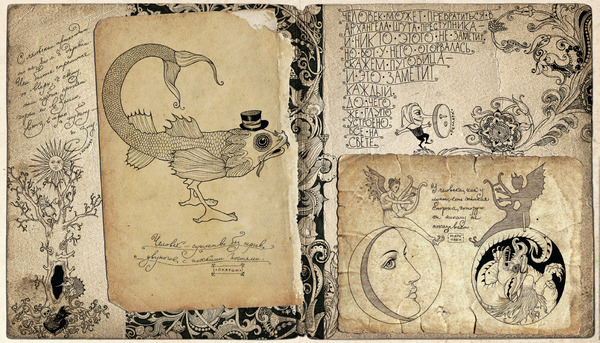
Now, another thing I am thinking about as I work on the composition of this painting, is the artwork of Sveta Dorosheva. She has been working on a book for about three years about the human world, “as seen through the eyes of fairy-tale creatures. They don't generally believe in people, but some have travelled to our world in various mysterious ways. Such travelers collected evidence and observations about people in this book. It's an assortment of drawings, letters, stories, diaries and other stuff about people, written and drawn by fairies, elves, gnomes and other fairy personalities. These observations may be perplexing, funny and sometimes absurd, but they all present a surprised look at the things that we, people, take for granted." (Source)


(illustration by Sveta Dorosheva, matched with the Ben Franklin quote: "Man is an animal capable of producing tools.")


This is the idea: to become less automatic, because we are no longer taking ourselves and the world for granted. To be surprised, always, and attentive in that surprised way. Here is a non-human asking, What is a human? For an answer, he has Ben Franklin’s quote. And what image does that create for this non-human?

(above image by Sveta Dorosheva)

Or he turns to Plato, who says: “A man is a two-legged creature with flat fingernails and no feathers.” See it, above?


(Above image by Sveta Dorosheva)

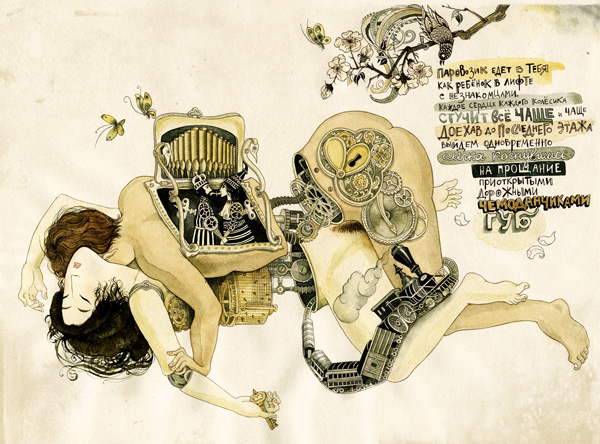
And above? You see the mixing of flesh, or carnal activity, and machinery: opening the rib cage, you have the habit behind this act, the fairy-tale, wind-up act of love passed down through the stories of the ages-- to begin events, the woman unlocked the man with the key in her right hand. So. Will they become more than that? Of course they will ;) This isn’t a nightmare!

So, back to Borges: why a fish? Did we really evolve from the sea? Arise out of the swirling depths, the chaos, slithering until we grew feet and stood up? Could we go back? Will we ever learn to breathe in water as we do in air, thus greatly enlarging the world we can be part of? After all, our bodies are largely water! But we need land and sea, the reclining grace of a mermaid but also the forceful gallop of a horse, charging ahead. And then we need the clock parts from which we are tearing free, we need to see them flung to the side. The truth is (right now, to me): we are not, any of us, just one thing--that thought needs to strike me two or three times, each time I make a decision, every time I breathe. Everything I look at, I need to be able to see from several directions, and I can't really do that from just one mind, so I have to learn to share that space in my cranium. With, as Walt Whitman said, the multitude that I am...


Tuesday, May 22, 2012

Agwe And Erzulie

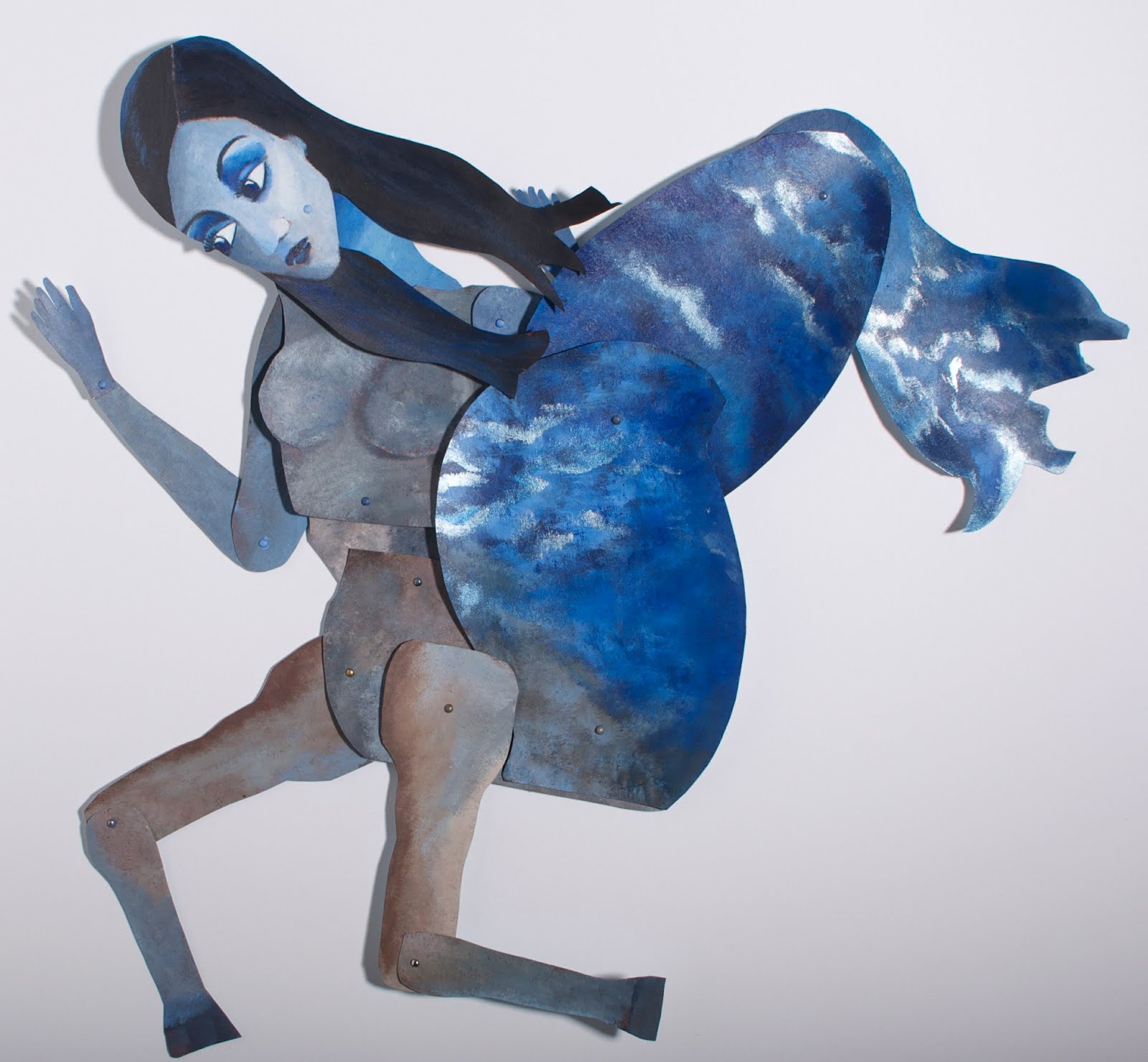
Agwe And Erzulie as St. Ulrich and St. Afra

(Press to see larger images...)

Erzulie is the Queen of Impossible Demands, and her demands make the world so. She has three husbands and various lovers, but is also known for her virginal, child-like nature. She demands that her followers live their lives with joy, throwing worries aside and lavishing her with expensive and 'frivolous' gifts, perfumes and layer upon layer of finery, and that everyone wear his or her best attire for her parties, regardless of the intense heat or the fact that an earthquake just hit, or the possibility that no one has any money.

Working with the maquettes, a technique learned from
Clive Hicks-Jenkins

Her three husbands cover all of life, with lovers filling in like variations on a theme--for detail, for variety: 
Agwe and Damballa rule the sea and the sky, respectively--that is, everything; both the unformed chaos of the deep, churning waters of creation and its thinning and separating out into sky to form the globe. Ogun is the warrior, the masculine, the machete, the force which must not turn against the people (the self)--perhaps he represents the distinction between force (to break things open and push into the new) and power (to keep things the same at all costs).  He is known for his miracles, and one mounted by him will often poke himself or run himself through with the blade without injury, or wash his hands in flaming rum without suffering later.

In her successful demands for whatever her heart desires, she is much like St. Rita, who from her deathbed in the dead of winter requested a fig and a rose from her favorite garden, and got them. 
Interestingly, the word rose developes from the Sanskrit root vrt. Vrt leads to the Gothic wairth, the Old Nordic verdh, and the Anglo-Saxon weordh, all of which mean "to unroll, to become, to come into being" (Nada Brahma: The World is Sound). It is also the root for the names of two of the three ancient Norse goddesses of fate, Urth and Verthandi.  Aramaic and Arabic took this root and unfurled it into varda and vard, or rose, Greek dropped the v and gave us rodos, or rose, and Hebrew gives us wered, which is bud (that which comes into being) and rose (that which has become)-- thus bringing into the meaning of the word not only the unfurling of life but the fact that life has already unfurled, that we are circling it, observing. Observing in the sense of the Observer of modern physics, who influences which reality will vibrate with life right now just by perceiving it. And there we circle back to the contemporary English word "word." As in, God spoke, and there was life. The word is the beginning, and from it unfurls the bud of life. Rita said, bring me a rose, and it was so, and from that came a world where one could request from her other such 'impossibilities.' Erzulie decided that the heat was impossible and she wanted to be able to breathe underwater. She spoke, and the water rushed forth, and from it an appropriate husband, Agwe, on his horse.

The world is not a solid rock of reality. It is your next breath, unfurling into your expectations.


Maquettes, cropped for panel

As the slaves in North America were not allowed to practice their religion of voodoo, they would take images of saints as representations of their own loa, thereby encoding their reverence and faith in the language of the ruling Catholics. Agwe was 'represented' by St. Ulrich, who was often depicted carrying a fish, or riding a horse which had such power that it could cross the ocean without drowning. Here is Agwe, as St. Ulrich, emerging from the chaotic waters of Erzulie's creation, on his water-formed horse. 
Erzulie is usually depicted as the Black Madonna, but I have chosen St. Afra, a Cypriot saint who was described both as a prostitute of the temples and as a virgin martyr, giving her a rather distinct similarity to Erzulie. She also happens to share a crypt with St. Ulrich, and so their pairing seems natural. Their relationship is very circular, she creates him creates her, it is a dance, and the horse forms from the waves and leaps forward to surge Agwe upwards into being.

Different lighting to show how the gold leaf changes as you move across the room:


All images in this post by Zoe Jordan. All photos by Gabriel.


Thursday, May 17, 2012

Eidetic Image III, Ars Memoria, and Cats


This is my little prince, Haruki, named after the author Haruki Murakami:


(Laughter is the Best Medicine, photo by Gabriel)

He has also modeled for me often.
And this is my first attempt at a lino print:


Cat in Blue Moonlight


And while I'm posting about excellent medicine, I would like to share an interview I stumbled across from Ode Magazine between Jurrian Kamp and Biologist Bruce Lipton. The discussion centers around the change in Lipton's studies from being centered around a belief in the power of genetics to shape our lives (fate in terms of behavior and physical health) to being centered around the idea that not just our environment, but more how we perceive our environment shapes our lives (again: both physical health and behavior) Kamp explains Lipton's studies:

Lipton’s discoveries are part of an emerging new biological paradigm that presents a radically different view of the evolution of life: epigenetics. Epi means “above” in Greek, so epigenetics means control above the genes. 'It turns out that as we move from one environment to another environment, we change our genetic readout,' Lipton says. 'Or if we perceive that our environment is not supporting us, then that perception also changes our genetics.' 

So, following the ideas in posts I and II on this topic, he's defining the underlying 'image' we carry around in our deep subconscious which explains what we can see of this world, what we will miss, our health, our happiness, wars, famine, and violence (yes!) as DNA. His "picture" is, in fact, a coded sequence. That coded sequence may have a gene in it that practically guarantees cancer. So that's the fated outcome of that picture. Then it becomes sort of an emergency to change the picture, yes?


We are masters of our genetics rather than victims of our hereditary traits. Our fate is really based on how we see the world or on how we have been programmed to experience it.


Again, his science supports the idea we have seen in other belief systems that for some reason, you tend to produce your underlying image before the age of five: 

...neuroscience reveals a startling fact: We only run our lives with our creative, conscious mind about 5 percent of the time. Ninety-five percent of the time, our life is controlled by the beliefs and habits that are programmed in the subconscious mind. You may hold some positive thoughts but that has very little influence on your life because of the limited amount of time you actually run with your conscious mind.”
Kamp says: "Lipton explains that there is a good reason for the automatic “playback” function of the subconscious mind. As children, we learn to walk. While we do so, our lives are determined by the process. It takes all our energy and attention. The same happens when we learn to drive later in life. But once we have acquired these new habits, the subconscious mind automates the procedure. Whatever seemed almost overwhelmingly difficult at one point now is simple. We don’t even think about it anymore when we put one foot in front of the other or drive home from work.
However, we don’t just record simple motor functions like walking or driving. In the same way, we also record perceptions and behaviors. And we do most of this recording in the womb, during the second trimester of pregnancy, and during the first six years of our lives. “The fundamental programs in your subconscious mind are not your own wishes and desires,” Lipton points out. “They are behaviors you copied from other people, primarily your parents and your family and community. Your beliefs are actually their beliefs, their wishes and desires. You are ‘playing’ behaviors that were downloaded into you when you were a small child. And it is not very likely that these behaviors are what you are looking for today. You are sabotaging yourself!


He explains that this automatic behavior is not something you can talk to or reason with; we have all, I'm sure noticed that we can make the same 'realizations' about how we should feel or behave in a certain circumstance over and over without it ever actually happening. That's because those beliefs are recorded well below logic, in an emotive memory--I believe a more symbolic memory. We have to speak to those symbols, find them and move them around, in order to have the impact we want. 

Mr. Lipton suggests that there have been good results in this sort of thing using hypnosis or subliminal tapes; in his own book (Biology of Belief), he outlines a simple technique he calls PSYCH-K which he claims has profound results.

He also makes another interesting point about health that matches what dream theory tells us. That point is about the cohesiveness of reality. He explains that what we perceive as an individual, a person, our 'self', is really a community of some 50 trillion or so cells. And the extension of that is that really, each of us is a cell in one "giant collaborative superorganism." He calls what we are doing to each other with crime, terrorism, violence, and theft, is nothing more than an autoimmune disease: the body fighting itself in a senseless act.

But most interesting about his article was that, just like in the example used in the Second Post on this topic, Dr. Lipton uses love as the re-creator of the 'universe' as you know it.

Kamp (the interviewer) explains: "When we fall in love, our conscious minds, with our wishes and desires, are running almost full-time--not 5 percent of the time, but 95 percent. That condition can be life-changing." This is what Lipton calls the honeymoon effect--those moments when the universe is heaven, because we are creating it from desire, instead of passively watching it from the cage created by the disempowering beliefs of an utterly dependent child subconsciously soaking in the fears and angers of the adults around him in an attempt to stay safe.

Mariiiiiiiia!!!!


Another excellent discovery which continues in this vein and links it to another topic I've explored here, Ars Memoria (here, here, here and here ...not exhaustive :P) is this TEDtalks video of Joshua Foer on memory. He reminds us that memories (like the one of Maria) make us who we are. They build upon that basic, defining image you have and solidify it (because you're perceiving your experience of living through the holograph of that image), give it new symbols to work with--basically each memory becomes an extension of visual vocabulary.

Here's the thing: by 'outsourcing' our memory skills to devices, we make ourselves even more passive 'participants' in our own lives.  I think here about how a cat finds his way home without GPS or Google Maps, even when you've accidentally let him out of your car somewhere halfway across the country when you got out to get gas, somewhere he/she had never been before.  Why can't we find our way out of a small forest if we stumble off the beaten path? 

When you're active about your memory making, especially when you're using this 'memory palace' technique Foer describes (an ancient technique, outlined also in earlier posts under Ars Memoria), you are actively placing symbols in the structure that symbolizes your 'self' to your mind: the palace, your home. Now, to some extent, those symbols, and what you are inclined to do with them, are going to be led by your genetic code, your childhood-created, subconscious image defining the world and the relationships and movements that can be made within it. A trick that memory champions use to subvert that--a trick that goes way back past the ancient Greek practitioners--is to posit ridiculous, senseless objects, characters, and relationships to undercut your natural tendency to adhere to your previously defined, underlying logic.  The ancients felt that if you perfected these memory techniques, you would have something akin to magical powers; you would be able to magically alter the world around you. I would posit that you would be altering your perception of what is possible--you would be altering what you could see. When Einstein labeled certain events 'spooky action at a distance,' he was talking about actions which had results that could not be explained, mainly because we are not able to see all the teeming, shivering atoms that make up the universe. Everything is touching. If you could see those atoms, the action wouldn't seem so spooky. In this video, Joshua Foer talks about 'elaborative encoding,' and tells us that the distinctions noted in brain studies of memory champions were not in size or structure but rather in the fact that they were using spacial recognition areas of the brain when memorizing information (for example, lists of numbers)--meaning, again, image and also spatial relationship between images: just like that secret, subconscious, not fully-understood, explored, or even recognized Palace your mind created before you turned five. In the video, he walks you through some techniques to do some heavy remodeling in that memory palace, and therefore, if all this follows, some heavy remodeling of the planet.

Enjoy!

Monday, April 9, 2012

Santa Caterina and her Violetta


"Every disease is a musical problem; every cure is a musical solution."--Novalis


Santa Caterina de Vigri and her Violetta

In the Church of Corpus Domini, Bologna, Santa Caterina de Vigri sits upright on view, her flesh-color ranging from a brick-red to black and still cleaving to her bones though she died in 1463. She is the only such saint to sit upright, and her shrine miraculously survived the same bombing raids of 1943 which destroyed all the surrounding decorations and building. Next to her sits her violetta, created by Andrea Amati (1413-63), which is the oldest known surviving stringed instrument. So, the saint, uncorrupted, and her instrument, also able to out-survive its contemporaries.

According to Marina Warner, in her well-packed and fascinating book Phantasmagoria, "The word 'galvanize' has at least two meanings: applied to metals, it means coating iron or steel with zinc through an electrolytic process in order to protect it from corrosion [italics mine]; figuratively, it means something closer to [Luigi] Galvani's work, the revitalization of a moribund or torpid organism: 'I was galvanized into action.'" These two meanings, both relating quite well to the hope presented by the incorrupt body of a saint that waits its resurrection with its bones still holding it together, and also both relating to her violetta in a manner we will attend to momentarily, are especially interesting here because Mr. Luigi Galvani himself is entombed right across the nave from her.

Luigi Galvani (1737-98) was a physiologist and professor of medicine, the one who first introduced an electric shock into a frog’s corpse and beheld that it caused the animal to kick its legs. This opened up a variety of excited questions about a possibly attainable source of life-force, leading to all sorts of other experiments, and tales like Mary Shelley’s Frankenstein. Luigi’s nephew, Giovanni Aldini, tried this same electrification on human corpses, bringing their limbs to jump and their faces to become quite expressive, and then moved the process to the living via the mentally-ill, thus beginning electroshock therapy in an attempt to bring life back to a frozen (terrified, confused, overwhelmed) mind.

Christopher Turner gives a fantastic description of the famous hypnotist Franz Mesmer’s ‘galvanizing’ use of electricity in the Spring 2006 Issue of Cabinet Magazine:

“In a medical museum in Lyon there is a strange tub-like object constructed of oak and decorated with lengths of ornately woven rope. About six inches in from the rim, eight evenly spaced iron rods sprout up from a highly polished lid. In the eighteenth century, a group of patients would sit or stand around this device in such a way as to press the afflicted areas of their bodies against these moveable metal wishbones and, bound to the instrument by the ropes, would link fingers to complete an "electric" circuit. The atmosphere in which these sessions took place was heavy with incense and séance-like; the music of a glass harmonica (invented by Benjamin Franklin) provided a haunting soundtrack, and thick drapes, mirrors, and astrological symbols decorated the opulent, half-lit room.

Franz Anton Mesmer, the legendary Viennese healer, hypnotist, and showman, would enter this baroque salon of his own invention wearing flamboyant gold slippers and a lilac silk robe. He would prowl around the expectant, highly charged circle, sending clients into trances with his enthralling brown-eyed stare. By slowly passing his hands over patients' bodies, or with a simple flick of his magnetized wand, Mesmer would provoke screams, fits of contagious hysterical laughter, vomiting, and dramatic convulsions. These effects were considered cathartic and curative. When a patient's seizures became so exaggerated as to be dangerous or disruptive, Mesmer's valet, Antoine, would carry him or her to the sanctuary of a mattress-lined "crisis room" where the screams would be muffled.

The baquet, as Mesmer named his vessel, parodied the contemporary craze for medical electricity. Pharmacists and apothecaries frequently prescribed shock treatment, especially in attempts to cure paralysis, and often exposed the sick to a more general "electrical aura" as a healing agent. Benjamin Franklin, then American ambassador to France, was fond of demonstrating the power that could be harnessed in a Leyden jar, the prototype of the modern battery, by using one to send a bolt of electricity through a chain of people. (One medical electrician claimed not only to have shot a charge through 150 guardsmen, but to have made a kilometer-long line of monks simultaneously jump into the air.)”

Mesmer’s baquet was much like Franklin’s battery, a huge reservoir to take in and save Mesmer’s own magnetic-electric inner fire and spread it amongst the members of his rather large groups of patients, all at once.

“In England, such [medical] applications were encouraged by Newton’s suggestions, thrown out in a number of queries at the end of the 1713 edition of his Optics, that the animal spirits or nervous fluid which communicated impulses from the brain to the muscles might be related to a subtle ethereal or electrical fluid that constituted a kind of universal medium in the universe. Hints such as these, combined with the strong inherited tendency to think of electricity as a vapor or effluvium, made it easy to see electricity as a mediator between microcosm and macrocosm, and as the principle of life itself. In America, where electrotherapies formed a strong field of what has been called “electrical humanitarianism,” Dr. T. Gale wrote in his Electricity, Or Etherial Fire, Considered (1802) that electricity was a kind of universal atmosphere, which all living creatures inhabited and respired.” --Steven Connor

Now, it is still true that we use electric paddles to try to revive a (very recently deceased) corpse even today, and very often with success. The question is mainly how to navigate that shadowy, sometimes grisly space between life-saving techniques and Frankenstein, while also somehow sidestepping the messier areas of mass-hysteria and public fainting-spells. But inside that space is a fascinating realm involving the electric impulses that communicate information between synapses in your brain and, again, music. Oliver Sacks thoroughly explores this realm in his book Musicophilia.  

He describes, for example, a man who discovered his first interest and immense talent in his late forties, directly after being struck by lightning.  But there are less far-flung examples of the intense connection between electricity, life, and music in the stories of some epileptic patients:

-"Jon S., a robust man of forty-five, had been in perfect health until January of 2006. His working week had just started; he was in the office on a Monday morning, and went to get something from the closet. Once he entered the closet, he suddenly heard music--'classical, melodic, quite nice, soothing...vaguely familiar...It was a string instrument, a solo violin.'
He immediately thought, 'Where the hell is that music coming from?' There was an old, discarded electronic device in the closet, but this, though it had knobs, had no speakers. Confusedly, in a state of what he later called 'suspended animation,' he groped for the controls of the device to turn the music off. 'Then,' he says, 'I went out.' A colleague in the office who saw all this described Mr. S. as 'slumped over, unresponsive,' in the closet, though not convulsing.
Mr.S's next memory was of an emergency medical technician leaning over him, questioning him."
Sacks asked him about this music, but he could not sing it himself and didn't know what it was, though he felt it familiar.
"I told him that if he ever did hear this music--on the radio, perhaps--he should note what it was and let me know. Mr. S. Said that he would keep his ears open, but as we talked about it, he could not help wondering whether there was just a feeling, perhaps an illusion, of familiarity attached to the music, rather than an actual recollection of something he had once heard. There was something evocative about it, but elusive, like the music heard in dreams."

And then, as I was saving the information I’m working on about the saint, I came across the quote from Hugh Jackson via Oliver Sacks about a ‘doubling of consciousness’ that occurs during the seizures such as the one her violin is creating. What was once her and some paper dolls is now her and dancers--real, alive--, her as part of the show, the musician for the dancers, the one giving them their rhythm, storyline, electricity. She is part of something, something that matters. That’s the other consciousness, the one outside of the four sides of her box.

So, electricity is everywhere. Trees make a little bit, running it through their bark. Your heart works via electricity it generates from potassium, sodium and calcium. Communication is run between the synapses in your brain via electricity. There’s of course lightning. And humans are making more and more electricity even outside of their bodies using a variety of tools. And all of this has a music to it.

Christina Kubisch is an artist who explores this connection between electricity and music from a completely different direction than Galvani, Sacks, Shelley, or even Santa Caterina. She has had a certain type of headphones created which a user takes along with a map of an area (meant only as an inspiration and a guide, but in no way a limiting force) in order to hear the music created by all the electric fields surrounding us every day. She explained how she taps into these ‘Invisible Cities’ of sound in an interview with Cabinet Magazine:

“--How do the headphones actually work?
--Every current in an electrical conductor—for example a wire or a cable—generates an electromagnetic field. These currents can be “musical,” like the signals running through loudspeaker cables; or they can come from electrical activity in the infrastructures of buildings or cities. The magnetic component of these fields is picked up by the sensor coils in the headphones. And, after amplification, these signals are made audible by the little speaker systems in the headphones. So if there’s an electromagnetic field (say, an underground cable) and another one nearby (say, the headphones), the fields pick up each other. The sound jumps through the air from one to the other.”

“--I’m struck by the similarity between some of these sounds and minimalist techno: PanSonic or Alva Noto, for example.
--Yes. There are some sounds that, when I listen to them for half an hour, sound to me like LaMonte Young. The tram in Bratislava, for example, is almost like a choir: a chord, three sounds together that are changing, but each at a different level... Subways, buses, and trains are especially musical, maybe because they depend upon a constant flow of electricity. There’s a wonderful subway in China that sounds to me like electronic music of the 70s... Airplanes, though, sound really ugly: very high, thin, and noisy.”
...
This summer I put on my headphones during a very strong thunderstorm. There was no electricity, because all the power had gone out. But, when I recorded, I got the sounds of natural electricity, which was wonderful. The recording is so strange: very low, but very clear... At two points, you hear voices. You can’t understand the words, but you can tell that they are voices. I knew that electricity could transport voices, but I had never heard it before. It’s quite breathtaking when you hear things like that. This is nature, too—electrical nature!”


Somehow, electricity is there in the force of life, and somehow, music is involved. Think about shamanic, hypnotic drumming, about the heights of ecstasy some reach at jam sessions of their favorite bands--such heights that they are willing to drop everything and follow the band around. Think about the chanters in ancient masses, about techno-music, about binaural beats. And that makes the quote at the top of the post make more sense: problems occur when the rhythm of your life gets out of whack--somehow, the vibrations are off, the energy isn’t there, the organs falter and the synapses sleep late because the alarm never went off.

In an interview with Steve Silberman of Wired Magazine about the studies that went into Musicophilia, Oliver Sacks stated : "The therapeutic power of music hit me dramatically in 1966, when I started working with the Awakenings patients at Beth Abraham in the Bronx. I saw post-encephalitics who seemed frozen, transfixed, unable to take a step. But with music to give them a flow, they could sing, dance, and be active again. For Parkinsonian patients, the ability to perform actions in sequence is impaired. They need temporal structure and organization, and the rhythm of music can be crucial. For people with Alzheimer's, music incites recall, bringing the past back like nothing else."

There it is again, that image of re-infusing a corpse with life, and this time the electricity is created with music--its flow (like electricity) and its rhythmic pulse. It is the first step those post-encephalitics were unable to take; once the music gave them that first step and a current to follow, they were able to ride it.

There was another thought I was chewing on here, with the saint and her violin:
There is a difference between skill and possession. And what you want (even, I would argue, as a doctor) is possession, because if a person is ill, it is from not following the logic (rites, rituals, rules, rhythms) of the reigning forces or melodies (‘gods’) of existence. Only that force understands its own logic, or those in choreography with it. And everything you see is a symbolic aspect of that logic (recall the post on Eidetic Images), including illness. Music historically has much to do with trance, both as a result of possession or not. That trance is the opportunity for something higher and more general than your ego to take over your body. That is the electricity created. In the painting above, St. Catherine is possessed. She is an electric force, radiating. And she is bringing that electricity into the forms, making them alive through her music, infusing the air and their limbs with the tango of their love, that “fire that consumes without leaving ashes” (Vannoccio Biringuccio, 1540).

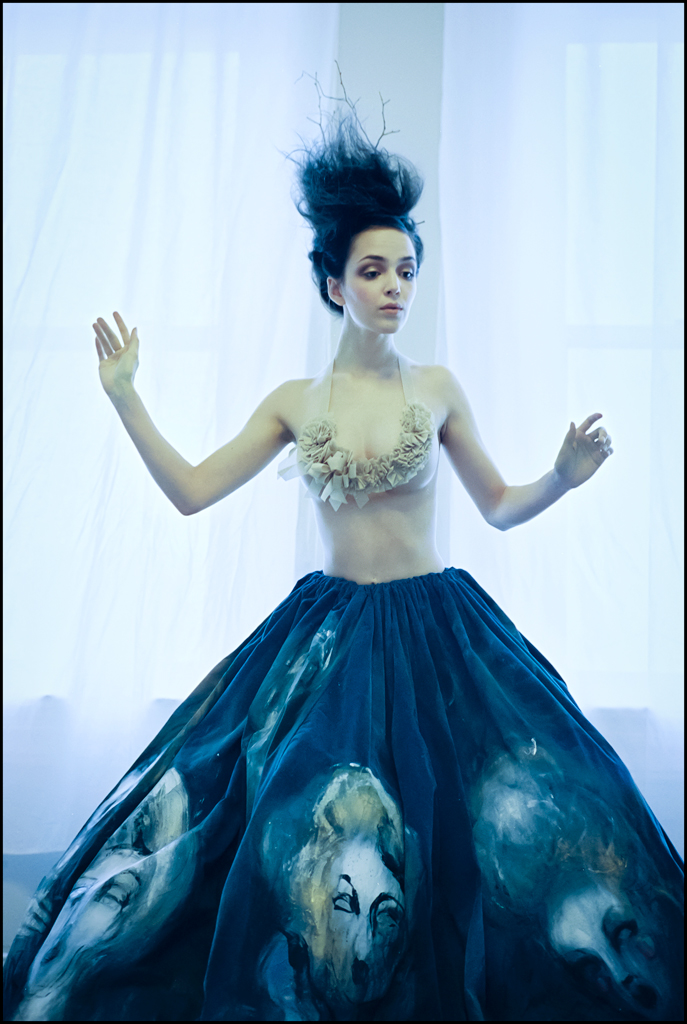
[Please note: the skirt was inspired by the one worn by the model in this Ryan Muirhead photo. The idea of a chaotic waters filled with spirits that she brought to the surface and to life appealed to me.]