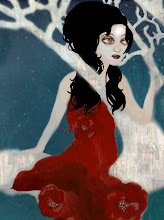
member of:Observers of the Interdependence of Domestic Objects and Their Influence on Everyday Life


This group has been active for a long time and has already made some remarkable assertions which render life simpler from the practical point of view. For example, I move a pot of green color five centimeters to the right, I push in the thumbtack beside the comb and if Mr. A (another adherent like me) at this moment puts his volume about bee-keeping beside a pattern for cutting out vests, I am sure to meet on the sidewalk of the avenida Madero a woman who intrigues me and whose origin and address I never could have known...
--Remedios Varo


(Slideshow is of Artwork by Remedios Varo)
By believing passionately in something that still does not exist, we create it. The nonexistent is whatever we have not sufficiently desired.
--Franz Kafka

Showing posts with label St. Rita. Show all posts

Tuesday, May 22, 2012

Agwe And Erzulie

Agwe And Erzulie as St. Ulrich and St. Afra

(Press to see larger images...)

Erzulie is the Queen of Impossible Demands, and her demands make the world so. She has three husbands and various lovers, but is also known for her virginal, child-like nature. She demands that her followers live their lives with joy, throwing worries aside and lavishing her with expensive and 'frivolous' gifts, perfumes and layer upon layer of finery, and that everyone wear his or her best attire for her parties, regardless of the intense heat or the fact that an earthquake just hit, or the possibility that no one has any money.

Working with the maquettes, a technique learned from
Clive Hicks-Jenkins

Her three husbands cover all of life, with lovers filling in like variations on a theme--for detail, for variety: 
Agwe and Damballa rule the sea and the sky, respectively--that is, everything; both the unformed chaos of the deep, churning waters of creation and its thinning and separating out into sky to form the globe. Ogun is the warrior, the masculine, the machete, the force which must not turn against the people (the self)--perhaps he represents the distinction between force (to break things open and push into the new) and power (to keep things the same at all costs).  He is known for his miracles, and one mounted by him will often poke himself or run himself through with the blade without injury, or wash his hands in flaming rum without suffering later.

In her successful demands for whatever her heart desires, she is much like St. Rita, who from her deathbed in the dead of winter requested a fig and a rose from her favorite garden, and got them. 
Interestingly, the word rose developes from the Sanskrit root vrt. Vrt leads to the Gothic wairth, the Old Nordic verdh, and the Anglo-Saxon weordh, all of which mean "to unroll, to become, to come into being" (Nada Brahma: The World is Sound). It is also the root for the names of two of the three ancient Norse goddesses of fate, Urth and Verthandi.  Aramaic and Arabic took this root and unfurled it into varda and vard, or rose, Greek dropped the v and gave us rodos, or rose, and Hebrew gives us wered, which is bud (that which comes into being) and rose (that which has become)-- thus bringing into the meaning of the word not only the unfurling of life but the fact that life has already unfurled, that we are circling it, observing. Observing in the sense of the Observer of modern physics, who influences which reality will vibrate with life right now just by perceiving it. And there we circle back to the contemporary English word "word." As in, God spoke, and there was life. The word is the beginning, and from it unfurls the bud of life. Rita said, bring me a rose, and it was so, and from that came a world where one could request from her other such 'impossibilities.' Erzulie decided that the heat was impossible and she wanted to be able to breathe underwater. She spoke, and the water rushed forth, and from it an appropriate husband, Agwe, on his horse.

The world is not a solid rock of reality. It is your next breath, unfurling into your expectations.


Maquettes, cropped for panel

As the slaves in North America were not allowed to practice their religion of voodoo, they would take images of saints as representations of their own loa, thereby encoding their reverence and faith in the language of the ruling Catholics. Agwe was 'represented' by St. Ulrich, who was often depicted carrying a fish, or riding a horse which had such power that it could cross the ocean without drowning. Here is Agwe, as St. Ulrich, emerging from the chaotic waters of Erzulie's creation, on his water-formed horse. 
Erzulie is usually depicted as the Black Madonna, but I have chosen St. Afra, a Cypriot saint who was described both as a prostitute of the temples and as a virgin martyr, giving her a rather distinct similarity to Erzulie. She also happens to share a crypt with St. Ulrich, and so their pairing seems natural. Their relationship is very circular, she creates him creates her, it is a dance, and the horse forms from the waves and leaps forward to surge Agwe upwards into being.

Different lighting to show how the gold leaf changes as you move across the room:


All images in this post by Zoe Jordan. All photos by Gabriel.


Monday, March 5, 2012

The Cabinet of St. Rita

The Cabinet of St. Rita
(Press image for more detail)
Acrylic on panel 24x36 
zoe jordan

The Patron Saint of Impossible Dreams and Abused Women 
makes an exit with fig paint on a moon palette.
(See more on her here.)

Thursday, August 5, 2010

Some Excitement

Two of my images were included in this month's issue of Pink Panther Magazine.


The focus this month is on domestic violence. My ink drawing of St. Rita, the patron saint of abused women, whom I have blogged about before here, is on page 80:


and "Lost Race Found" is also in there:


The magazine is really beautifully done; they have a gorgeous layout, interesting articles, and a lot of beautiful artwork. You can read it on their website, linked above.
Thanks!

Wednesday, November 4, 2009

The Big Picture, Part 3

the big picture ii

My new painting of Rita, the patron saint of abused women, lost causes, and impossible dreams, blogged here and here.

Friday, October 30, 2009

The Big Picture

The Big Picture


(more on St. Rita of Cascia, patron saint of impossible dreams)

This is the biggest drawing I have made, 18 inches by 24. I am working also on a color version, but I'm not happy with it yet :)

There are many details that make the fig tree a good companion for a saint. First of all, that it will grow out of rock, like an orchid, only gigantic; that it could even grow out of the "ruins" of our civilization.

It is now believed that fig trees were the first plant species to be bred for food, some 11,000 years ago in the Middle East--several hundred years before wheat cultivation began. Because its wood is terribly difficult to chop down and provides nothing of interest to our markets, its existence in places like Queensland's national and state parks has saved those areas, and their other trees, from logging. The roses shown here are Alain Blanchard, from the species "Rosa gallica," which, according to Wikipedia, is one of the earliest cultivated species of roses.

As you might recall from my last post on St. Rita, one of her miraculous aspects was her ability to acquire a fig and a rose from a favorite garden in the dead of winter simply by wishing it so. Here, her presence has caused both to bloom from the same fig tree. After all, many things come from a fig tree: according to legend, underneath it, Buddha found enlightenment, and from between its roots sprung the Sarasvati* river; according to a NASA clean air study, the weeping fig also produces clean air, processing out our nasty pollutants--bringing us back full circle in this post and in the world, with new life forming from our ruins--by way of the fig tree.

You can see if you zoom in that as she sits in the curve of the tree trunk, it's as if she's pushing the bark outwards in waves--that is how I imagine it looks when reality "shifts" to allow an impossibility new space in the world. Being a saint, she lets the bird take the fig.


*note: The Sarasvati River was originally personified in the Hindu religion as Saraswati, the Hindu goddess of knowledge, though through time, she developed into a separate entity. It is a very special river in ancient Hindu texts.

bark and roses

Friday, September 25, 2009

Ghosts and Impossible Dreams

Rita

(the frame is gold leaf and shiny:)
This painting began as an exploration of a segment from Borges' Book of Imaginary Beings, in which he described a curse created by "The Yellow Emperor" which kept a whole other world confined inside the reflective surfaces of our own world, and how one day that curse would be broken. When I was making the drawing for it, I was thinking of humans, of us being the ones trapped inside the mirrors--trapped by perceptions of the world and its possibilities that we'd developed before we were even conscious of what we were doing, perceptions handed down to us by our parents, society, ill-managed emotions, fears, etc. I was thinking about it in the sense of our "true selves" being something completely foreign, even unrecognizable to this somnolent being that wanders through each day, making often meaningless, rote motions at dictated times (coffee, job, study, gym, drive, pick up the kids, whatever your life is, etc) in an effort to pass "correctly" or safely through yet another day. To make it. My thinking was that most of the time, our perception of what is possible is limited to what we've already seen done; thus, most of the time, we're merely mimicking--mirroring--what is already before us, unable to believe past what we can see and into the wild, chaotic space beyond it. So this moment of freedom from the curse would be that moment of passing through the mirror, becoming (once more) real, alive.


Or, in quantum physics, it is said that all the possible outcomes of the choices that we're faced with at each moment are played out in some space and time, and each of those spaces and times are called parallel realities. Sometimes these realities are symbolized as bubbles jostling each other in endless space. The mirror, then, might be the thin skein of the bubble separating one reality from another. One choice from another. One me (one you) from another.


After I made the drawing, but was still unsatisfied with my understanding of the passage, I stumbled upon the story of St. Rita, and I found in her the woman, the human part of the spirit here painted breaking out from her illusory prison and into a new world. This creature is St. Rita, leading us directly into the impossible.


The Italian St. Rita, as is usually the case with the saints, greatly desired to join a convent as a young child, but was prevented. In obedience to her parents, at 12 years old she married, and bore her violent and otherwise criminally-inclined husband two sons. He beat her continually and otherwise brought her not much happiness, but she stayed with him, and towards the end of his life even managed to convert him to Catholicism and a new path. This was one of the first steps towards what she would become: the patron saint of impossible dreams and lost causes--and abused women.
Shortly after his conversion, her husband was ambushed and killed, and Rita was forced to channel her energies towards protecting the souls of her sons, who wanted to avenge their father's death. She prayed that God not allow their souls to be sullied by such an act as murder, and they instead died within the year. At that point, she returned to her attempts to join a convent, but was refused, several times, because of her status as widow and mother (as opposed to virgin, the requirement for a bride of Christ).


However, she persevered, and one morning, the good nuns awoke to find that she had been spirited into the locked convent in the middle of the night by her own patron saints. Feeling they could not ignore such a clear statement from God, they permitted her to stay.


Later, on her death bed in the convent, she made another impertinent request. She asked that a visitor bring her a fig and a rose from a garden she had always loved. The problem, of course, was that it was the dead of winter, and there would be no figs and no roses.


But, of course, there were. The visitor went to the garden she'd named, and found there just the fig and just the rose, and brought them to Rita.

So here, instead of the olive branch, St. Rita holds out the fig branch: her offering of the impossible, made so by dreaming it was so.. The fig branch is the first object to pass through the mirror, her dreams and desires leading her out into a new reality.


I had wanted a hybrid creature of some sort, as it would be one of "us" becoming something we had not before recognized as possible or real. Typically female (me first! :)), she is part fish because Borges said the first to escape the prison would be the fish: maybe because of the image of the fish growing legs and departing from the sea to begin the next stages of its evolution (towards humanity?), maybe because of the image of primordial chaos as a kind of sea that the first forms of organized life came out of, maybe because a fish first appears in your vision as a flash, a line of color, and only afterwards as a full being.
And then I thought she would need land-legs, and powerful ones, made for galloping.


And speaking of passing to the other side, or passing between worlds, according to Ursula Bielski, in her book Chicago Haunts: Ghostlore of the Windy City:
"One All Souls Day, November 2, in the early 1960s, those 15, all faithful parishioners of St. Rita Church, were gathered for a prayer service there to benefit the souls of the dead. In the midst of their efforts, the organ began to play on its own, unleashing a chaotic string of shrill tones. The hands of the church clock began to spin wildly in opposite directions. As the organ churned out its ghastly offerings, the congregation beheld six monk-like figures, three draped in white and three in black, poised on either side of the instrument. Shocked but mobilized, the petitioners rushed to flee by the doors, which refused to open. They watched in horror as the figures began to glide down to the main floor, floating through pews above ground and towards the front of the church. In the organ's final shriek of discord, an unseen voice implored, 'Pray for us.' At that point the doors blew open, allowing the congregation to escape the dreadful scene."