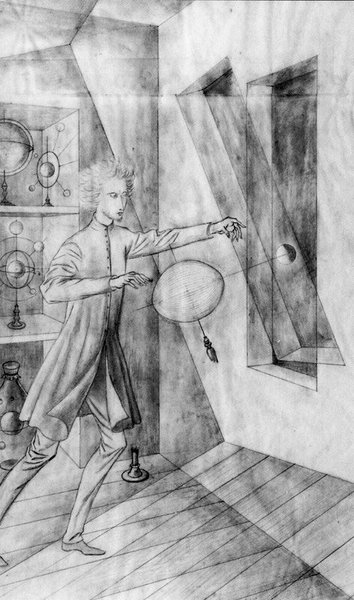
member of:Observers of the Interdependence of Domestic Objects and Their Influence on Everyday Life


This group has been active for a long time and has already made some remarkable assertions which render life simpler from the practical point of view. For example, I move a pot of green color five centimeters to the right, I push in the thumbtack beside the comb and if Mr. A (another adherent like me) at this moment puts his volume about bee-keeping beside a pattern for cutting out vests, I am sure to meet on the sidewalk of the avenida Madero a woman who intrigues me and whose origin and address I never could have known...
--Remedios Varo


(Slideshow is of Artwork by Remedios Varo)
By believing passionately in something that still does not exist, we create it. The nonexistent is whatever we have not sufficiently desired.
--Franz Kafka

Showing posts with label Vesna. Show all posts

Saturday, January 18, 2014

Maki Horanai: Creating the Universe


by Maki Horanai

Ocean whispers.
I am hopping on that sound.

Feeling the tickle of the roots from my toes,
I am departing from the ground.

My bird soul is gently lifting off,
Simply defying gravity.

Brushing the Moon and the deep Sky,
Into the Gold background I fly.

                   --Vesna

by Maki Horanai


Maki Horanai's paintings are moments in which quietly-focused beings create the details of the world we find most startling or inspiring.
Above, the figure pulls the sky over the burning gold fire of the firmament, perhaps to 'ease' the burn of the sun and stars, protect our fragile flesh, allow us life. The sky crosses outside of the canvas, reminding us that this is not a painting, it's an act, a moment of magic which directly affects us. Birds cross from the sky, across the gold and into the red (pulse of life) of the dress, their flight covering layers of being... It is an act of love, a defiance of gravity.

Maki Horanai: Creation of the Forest Song
In Creation of the Forest Song, the mother and child have created a nest, with an egg or a piece of land/rock and a small sapling, to give the bird a place to safely create its song. At the table are other little bits of creation. The child (with a 'child-like' eye, curiosity, and faith) is the one with angelic wings, the one who has produced the safe place for the little bird.


"Carried Away," by Maki Horanai

A figure reads a book, the ideas working through his mind and body via the pedals and wings and pumping upwards, again into a billowing cloud of golden flame (the fires of creation), to make a small community, a place of human life, trees, mountains, a lake. The ideas grow wings, become alive, real...

by Maki Horanai
And another such beings rides a horse, carrying a small rock or egg with life creeping out of it in the form of a small, glowing seedling. Civilization seems to grow only as a development from this creative impulse and focus and care; the horse itself is stone and yet the figure rides, and spanning out from the pair are cities, and three significant stars, like some cross between the 'Guiding Light' and the three wise men.


by Maki Horanai
by Maki Horanai
She creates the window frame and a square of blue sky for the bird out of endless space; on her back is a hand-wound gramophone to teach the music.

by Maki Horanai

by Maki Horanai
"My work has been strongly influenced by the nature of my childhood. I grew up in snowy villages along the sea coast in northern Japan. The severe power of the ocean, together with the pure, clean, quiet atmosphere are deeply embedded in my memory. When I was sleeping, the sound of waves was always in my ears. Away from city lights and tall buildings, the stars and moon were always present overhead at night.
I adore the gold background of old paintings of both the east and west, and, as I started to paint, elements of this style surfaced in my work. The works of Giotto (14th century), Fra Angelico (15th century) and Kano Eitoku (16th century) have particularly impressed me.
I’m not consciously aware of the meaning of my paintings as I work. If I know it, then probably I can’t paint. Towards the end of each painting, stories make themselves known to me."--Maki Horanai

by Maki Horanai

by Maki Horanai
The text: "Some years ago I was standing on the shore, watching the crescent moon in the sky. It was very close to the ocean, almost touching it...I was wondering what kind of sound the moon makes as it descends into the sea." The painting on the left is "The mind in the heart of the moon," the center painting is "on the path down to the sea", and the third is "spinning slowly."

by Maki Horanai
"Nurturing Music" by Maki Horanai

"Unfinished Constellation" by Maki Horanai
She now lives in Queensland, where she holds yearly exhibitions at Marks and Gardner Gallery on Tamborine Mountain.
"Moments of Connection with the Universe," by Maki Horanai
by Maki Horanai
Discovered Via Birdy, who also is offering for the second year the Snail Circle--this was really wonderful the first year and I encourage *everyone* to join: you are paired with one other snail-mailer per month, to whom you send a hand-written letter which includes (along with whatever else you write) a passage from a book by which you are currently being blown away. From this, you are certain to be exposed to many new books you otherwise would have missed, and many new friends all over the world. Join us by dropping her an email.

Sunday, July 21, 2013

St. Fevronia IV: Perfect Abandon

St. Fevronia IV: Perfect Abandon
Acrylic on Panel 18 x 24 by zoe blue


In his article Dream Theory in Malaya,* the anthropologist Kilton Stewart described his study of the utilization of dreams in Senoi society. The Senoi were an isolated tribe of the Malay Peninsula at the time of his writing and research, in 1935; his interest in them was piqued by the fact that they seemed able to keep other tribes at bay without the use of violence, simply through a reputation for witchcraft: he thus set about to study the way that they used lucid dreaming and dream interpretation as a major part of that perceived power to manipulate the world around them. 

Their response to dreams of falling struck him particularly, as it did me:

“The simplest anxiety or terror dream I found among the Senoi was the falling dream. When the Senoi child reports a falling dream, the adult answers with enthusiasm, ‘That is a wonderful dream, one of the best dreams a man can have. Where did you fall to, and what did you discover?’ ...The child at first answers, as he would in our society, that it did not seem so wonderful, and that he was so frightened that he awoke before he had fallen anywhere.

‘That was a mistake,’ answers the adult-authority. ‘Everything you do in a dream has a purpose, beyond your understanding while you are asleep. You must relax and enjoy yourself when you fall in a dream. Falling is the quickest way to get in contact with the powers of the spirit world, the powers laid open to you through your dreams. Soon, when you have a falling dream, you will remember what I am saying, and as you do, you will feel that you are traveling to the source of the power which has caused you to fall.

‘The falling spirits love you. They are attracting you to their land, and you have but to relax and remain asleep in order to come to grips with them. When you meet them, you may be frightened of their terrific power, but go on. When you think you are dying in a dream, you are only receiving the powers of the other world, your own spiritual power which has been turned against you, and which now wishes to become one with you if you will accept it."

The astonishing thing is that over a period of time, with this type of social interaction, praise, or criticism, imperatives, and advice, the dream which starts out with fear of falling changes into the joy of flying.”

This struck me as the perfect description for passing through Borges’ mirror to the other, less automatic, more alive (terrifying, unknown) universe; a passing which I have also depicted as the plunge into an underwater universe as taken by the people following St. Fevronia under threat of annihilation by the soldiers of Batu Khan. Falling comes somewhere between floating and flying, and in this lucid-dreaming version is a perfect abandon. 

In that post-painting haze, as I was trying to organize my thoughts about this plunge-float-fall, I stumbled upon a book with an intriguing title: Time Distortion in Hypnosis, 


 by Linn Cooper and Milton Erickson. The sensation of floating, like the sensation of falling, carries with it a suspension of time, and it is somewhere in that suspension that we can find the ‘source of the power’ Stewart was referring to in his study. In their book, Cooper and Erickson detailed the studies they had managed in which they taught their subjects to greatly distort time, a difficult concept to grasp mentally, for which they gave the examples of dream-time and those expanded moments of fear for one’s life:

“Thus, a young man who very nearly ran his car over a cliff while taking his fiancee for a drive, reported that the time interval during which they were in danger seemed to be very long. In analyzing certain other aspects of his experience, he told of doing an amount of thinking and reflecting that was appropriate to a long interval. In other words, the seeming duration was long. However, on considering the number of feet which the car had slid with locked wheels and its probable speed when the emergency occurred, he was able to calculate that the clock reading during the emergency was but a few seconds.”

You have a lot of things going on internally at all times, most of which you are unaware of--including not only things like breathing but also things like the decision about what to see --but in moments of intense focus, like the above car accident, you can more actively take in all those details that some part of your brain is always filing away somewhere: for example, the minute movements of facial muscles, subtle clues in body language, calculating your opponent’s next swing, the precise amount you should turn the wheel to avoid oncoming traffic, remembering to relax your body before impact and focusing on the breaths you are taking, how loud they might be if a predator is present, and how they are affecting your body’s ability to move and process information. A person who has this focus at all times would have immense communicative abilities, as well as a fantastic control over the ability to pull opportunities towards him and dangers away from him. As noted, we usually only experience that focus during those moments of intense terror or danger, but aren’t meditation, hypnosis, and lucid dreaming exactly this sort of pausing and stretching of time?

What all that suggests is this: what’s important is not how long a second takes, but rather how much you can consciously extract from that second.
The second itself is apparently very, very relative. A good example of this relativity is given early on in the book with the task of picking cotton given to the subjects in two different ways. In the first test, the subject was hypnotized, placed in a mental cotton field, and asked to pick four rows of cotton, signaling the experimenter when the task was complete. It took her 217 seconds to complete the task, and she told the experimenter that she had picked 719 cotton bolls:

“She picked with her right hand part of the time, and with her left hand part of the time, shifting the bag accordingly. She picked only ripe bolls, leaving the green ones alone. Sometimes she stopped and brushed the leaves aside to make sure that she hadn’t missed any. She didn’t hurry, but she worked steadily. It was late afternoon, and the woods along the west edge of the field cast a shadow. She stated that she seemed to have been working about an hour and twenty minutes.”

Then the same task was given, but this time instead of the limit being four rows, the limit was one hour and twenty minutes. The subject was hypnotized, placed in the mental cotton field, and given three seconds--this fact was unknown to her. After three seconds, the experimenter had her blank her mind, stopping everything, then asked her to report. This time, she had picked 862 bolls, again without hurry. The felt time was an hour and twenty minutes. Asked to describe the experience, she remember detail, and she felt the time pass. The result suggests that the last second was actually decisive: at that point, the subject’s mind felt that the entire experience should be over, and it filled in the story, detail by detail.

Doesn’t that make you wonder where all your memories come from?

To further investigate, the doctors tried introducing sound to the test. Given a ten-second experiment, they would chime a knife against a glass 4 seconds in, without any warning given to the subject. The subject may have been preparing a meal as his or her task, and would then report a phone ringing or dropping a pitcher to the floor--his hallucinated experience would include a confabulation to make sense of the sound that his ears had picked up. The most interesting thing about that is how he managed to drop the pitcher before he heard the sound, so that the timing of it hitting the floor would match the sound of its contact. How did that happen?

What if everything, your entire life story, is happening all at once? What if all you think you have ever experienced is a pattern, which you are focusing on during this second, a pattern which explains world politics, the music your neighbor is playing, the proliferation of weapons at your local school, your food allergies, your preferences in a significant other, the quality of the education you have gotten, what you’re wearing right now? What if you’re really starting from that last second--the second right now--and explaining it all to yourself in high speed that feels like the normal unfolding of an entire life? What counts, what matters, if that’s the case, is the pattern, yes? Like a fractal, unfolding in each snowflake, each furl of a leaf, the placement of the planets. Like each bit of information contained in a hologram.

Cooper and Erickson worked with several musicians, and got some rather interesting results, exemplified in the reports of a professional violinist, who used her “special time” (what they called those gloriously long seconds) to review and practice violin pieces, describing them in a manner reminiscent of the eye-flickering it takes Neo to learn Jujutsu in the Matrix. She would play not just the entire piece, but also difficult passages over and over, strengthening her actual finger memory, her general technique, and her performance ability in the process.

The authors suggest that the reason musical subjects are able to both hear long pieces of music and practice them in such short periods of time is because “a piece of music is a pattern, extended in experiential time...” and another subject described her experience with this “special time” similarly:

“I can see the beginning and the end of everything I do in a trance. Like a dream, it’s a round thing--it’s not a progression. In music you have to begin at the beginning and play it through to the end, but in a painting you can see it all at once.”

I stayed up late reading all this, and the next morning in an incredible moment of synchronicity, I woke up with this poem waiting for me from Vesna, who had not seen or heard anything about this painting or the book I was reading, though everything in the poem, from its ‘all-at-once’ nature to the gradation of colors seems related, to me:


Where do I begin
If not from the end?
The breadcrumbs of memories will take me
Where I need to be


The Black will fade
Into Indigo
Purple
and Blue


Absorbed in soliloquy
Embracing the mystery


Where do I begin
If not from the end?


In the above painting, St. Fevronia has taken the plunge: she is relaxed, floating or falling towards another pattern, another universe entirely, in a moment of intense focus and need that somehow feels like joy. The blue (moonlit) hellebores are here again because it is all a matter of perception.


*Stewart later wrote Pygmies and Dream Giants , a book which wielded a great influence on the development of dream theory. Note that UCSC research professor G. William Domhoff (who was not there for the study) began around 1985 to argue that Stewart inflated and embellished his findings, and he claims that there is no evidence that this analysis of falling dreams belongs to the Senoi. Since my interest is in the idea the analysis itself provides, not who created it, I will leave that argument to others.

Tuesday, May 14, 2013

Santa Caterina II

Santa Caterina II, black ink 19x24, by zoe blue


“Leap, and the net will appear.” --variously attributed to American naturalist John Burroughs, Gaelyn Foley, Julia Cameron, and also an “unknown” Zen source.

Fly

come on
uncling
unwrap
your wing
confuse
the gravity
with your
lovely personality
don’t feed
the fear
not even
with a bite
just fly baby
enjoy the flig
ht

--Vesna


In the Church of Corpus Domini, Bologna, Santa Caterina de Vigri sits upright on view, her flesh ranging from a brick-red to black and still cleaving to her bones, though she died in 1463. She is the only such saint to sit upright, and her shrine miraculously survived the bombing raids of 1943 which destroyed the building in which she sits. Next to her sits her violetta, created by Andrea Amati (1413-63), which is the oldest known surviving stringed instrument. So, the saint, uncorrupted, remains with her instrument, a fellow-survivor. She sits across the nave from the tomb of Luigi Galvani, famous for his attempts to show electricity as the ‘spark’ of life with his seizing frogs, experiments which led later to tales like Frankenstein and the reality of electroshock therapy and cardiac paddles. His life gave meaning to the word galvanize, which means not only to give life to the moribund but also to protect from corrosion. The elements of this nave scene led me to consider the connections between electricity, music, and incorruptibility.

The mysterious creative power of music has been expressed visually in several of my favorite Remedios Varo paintings: for example the mother-of-pearl-faced musician creating a structure from the sounds of his clarinet, or the musician freeing birds from crystal cages by playing her bow across beams of sunlight. Might music itself be the life-spark that Galvani was looking for? The source of the rhythm and melody that synchronize us into being, harmonize into personality and memory, the whole cloth of our existence?

In This is Your Brain on Music, Daniel Levitin explains:


"Contrary to the old, simplistic notion that art and music are processed in the right hemisphere of our brains, with language and mathematics in the left, recent findings from my laboratory and those of my colleagues are showing us that music is distributed throughout the brain. Through studies of people with brain damage, we’ve seen patients who have lost the ability to read a newspaper but can still read music, or individuals who can play the piano but lack the motor coordination to button their own sweater. Music listening, performance, and composition engage nearly every area of the brain that we have so far identified, and involve nearly every neural subsystem. Could this fact account for claims that music listening exercises other parts of our minds; that listening to Mozart twenty minutes a day will make us smarter?"

Could it even be that the music itself is the method by which the pieces of our brain communicate with each other? If each neuron gives off a spark, like electricity, wouldn’t that electricity have its own beat and lyricism, just like all the other currents of electricity that surround us invisibly in our world, which Kubisch gave voice to with her headphones? And if so, then it would be important to keep those elements in sync with each other, in rhythm. To have concordance between the left brain and the right, between the amygdala and the cerebellum, between the serotonin and the dopamine. Perhaps this is why pharmaceuticals have had such a large failure rate with emotional and mental illnesses--it’s not a matter of a certain number of neurons or interactions; it’s a matter of harmony. Even with just an octave’s worth of notes, Levitin tells us, there are endless possibilities for a melodic line and its harmonizations, and when you add in tempo, rhythm and timbre, the possible variances multiply exponentially. It makes sense that each of us would have a unique balance; it makes sense that each of us would be our own song. Now, studies show that Alzheimer’s patients and parkinsonian patients as well as patients with the inability to form new memories can miraculously function under particular musical circumstances. In his Musicophilia, Oliver Sacks describes the 
“extraordinary powers of music with our post-encephalitic patients--its power to ‘awaken them at every level: to alertness when they were lethargic, to normal movements when they were frozen, and, most uncannily, to vivid emotions and memories, fantasies, whole identities which were, for the most part, unavailable to them....[And] It is music that the parkinsonian needs, for only music, which is rigorous yet spacious, sinuous and alive, can evoke responses that are equally so. And he needs not only the metrical structure of rhythm and the free movement of melody--its contours and trajectories, its ups and downs, its tensions and relaxations--but the ‘will’ and intentionality of music, to allow him to regain the freedom of his own kinetic melody.”

Stepping off the edge of the universe, Caterina II by zoe blue


And what about the expansion of perception? Levitin tells us:

“[Miles] Davis famously described his improvisational technique as parallel to the way that Picasso described his use of a canvas: The most critical aspect of the work, both artists said, was not the objects themselves, but the space between objects. In Miles’s case, he described the most important part of his solos as the empty space between notes, the “air” that he placed between one note and the next. Knowing precisely when to hit the next note, and allowing the listener time to anticipate it, is a hallmark of Davis’s genius. This is particularly apparent in his album Kind of Blue.”

It’s as if that’s the way they create a new path in the world, because the spaces between the notes or the objects is where your expectations are formed. Those spaces, instead of just handing you something, are rather training your mind to expect that thing, and then reinforcing that expectation. They change your perceptual reality by changing your expectations--then you look away from the paintings or step away from the speakers, and all of your brain, which was involved in that experience of listening, as stated above, has been nudged in a new direction, which has repercussions: symbolic, perhaps, but you are now operating with a new broadness of rhythmic or tonic possibility. The electricity of your mind, your being’s music, now opens to more than it did before. 

For the drawing, I was focusing on the idea of music being the animating electricity that Galvani was talking about, because it’s what gives us the ‘spark.’ If electricity is how a person’s billions of neurons communicate, and the rhythmic coherence of all their firings is what holds a body together; if Christina Kubisch has shown that electricity always has sound, its own music even though outside our limited range of hearing; then couldn’t you see music as the juice giving life to the body--or even see the body, or the less tangible ‘person,’ as an expression of a particular music? And that music is how we communicate with the entire universe (even a black hole is a low B flat), being in sync or out, discordant or concordant, and how well our lives “go” probably has a lot to do with that.   The idea of the ink is the connectedness, in both negative and positive space, of all of it: the birds singing, the man conducting even as he leaps into the void, the girl sailing out of the void--perhaps because of the motion of his arms or the sound of the violin, or the rhythm of the swirling birds, or some mixture of all of that together with whatever the tree’s input happens to be --but she's not just falling in a terrifying swoop. That electricity slowly rises, through granite, through roots, through the biped, through the birds, and into the universe as pure song.

If we do understand music to be our essence, how can we consent to live without harmony, to bludgeon our own internal rhythm and spark with the mechanized drumbeat of unchosen routine? An awareness of our lives as a symphony with the universe must surely persuade us to take the chance, to expand the harmonies and concordant possibilities in our own contribution to its music.
from Caterina II by zoe blue


The idea is to stop. Listen to the birds, to your heartbeat, to your own breath. Listen to the pull your whole being has towards something. Ignore the part of you that’s focused on what you want to escape, and pay attention to the part of you that has a magnetic pull, a pulse, a compulsion, however senseless, towards. Play that tune. Dance. Leap.

James Rhodes, who is performing at the Soho Theater this summer was the first classical pianist to be signed to Warner Bros records--the world’s largest rock label, and under their label put out ‘Bullets and Lullabies’, a number one iTunes album, in 2010. He wrote an editorial for the April 26, 2013 issue of the Guardian which he titled with the great words of Charles Bukowski: ‘Find what you love and let it kill you,’ where he exhorts us to : 

“Do the maths. We can function - sometimes quite brilliantly - on six hours' sleep a night. Eight hours of work was more than good enough for centuries (oh the desperate irony that we actually work longer hours since the invention of the internet and smartphones). Four hours will amply cover picking the kids up, cleaning the flat, eating, washing and the various etceteras. We are left with six hours. 360 minutes to do whatever we want. Is what we want simply to numb out and give Simon Cowell even more money? To scroll through Twitter and Facebook looking for romance, bromance, cats, weather reports, obituaries and gossip? To get nostalgically, painfully drunk in a pub where you can't even smoke?”…“What if you could know everything there is to know about playing the piano in under an hour (something the late, great Glenn Gould claimed, correctly I believe, was true)? The basics of how to practise and how to read music, the physical mechanics of finger movement and posture, all the tools necessary to actually play a piece - these can be written down and imparted like a flat-pack furniture how-to-build-it manual; it then is down to you to scream and howl and hammer nails through fingers in the hope of deciphering something unutterably alien until, if you're very lucky, you end up with something halfway resembling the end product.”…“What if, rather than paying £70 a month for a gym membership that delights in making you feel fat, guilty and a world away from the man your wife married you bought a few blank canvases and some paints and spent time each day painting your version of "I love you" until you realised that any woman worth keeping would jump you then and there just for that, despite your lack of a six-pack? I didn't play the piano for 10 years. A decade of slow death by greed working in the City, chasing something that never existed in the first place (security, self-worth, Don Draper albeit a few inches shorter and a few women fewer). And only when the pain of not doing it got greater than the imagined pain of doing it did I somehow find the balls to pursue what I really wanted and had been obsessed by since the age of seven – to be a concert pianist. Admittedly I went a little extreme – no income for five years, six hours a day of intense practice, monthly four-day long lessons with a brilliant and psychopathic teacher in Verona, a hunger for something that was so necessary it cost me my marriage, nine months in a mental hospital, most of my dignity and about 35lbs in weight. And the pot of gold at the end of the rainbow is not perhaps the Disney ending I'd envisaged as I lay in bed aged 10 listening to Horowitz devouring Rachmaninov at Carnegie Hall.”

And yet, it gives him more than the years of greed in the city; it gives him so much, he would never turn back. It gives him so much, he’s hollering for the rest of us to come join him--not on his path, but on our own. It’s worth it, he says.   

Do not miss his video here--either the introduction or the playing.


Leap, and the net will appear.

Again, from Vesna:

The awareness of your existence
draws
a smile after smile on my face
Feeling filthy rich
like an arabian princess
Smile is a new currency
It is all mixed up
The economy and the fantasy
I am almost sure
we are not crazy

Vesna ©
16-05-2011


*PS
The elm flowers are also there for a reason, but I will stop now. If you use this image for any sort of meditation of your own, please let me know your results!!

Thursday, April 4, 2013

A Dream of You


black ink, by zoe blue


A Dream of You
a poem by Vesna


You truly stop to smell the roses
You notice the dew on the leaves
You can read from the bark on the trees
Nature’s little secrets open to play for you
Like the vintage musical boxes

Your step is light
Even if your coat looks heavy
You are different
Distant, attractive yet unattainable
Like a sailing ship at the horizon

Here, on the other side of the things
Where the dreams gather to rest
I met a Dream of You
Beautiful like the clef and the notes
Awaiting the One to make music with


notes from zoe:
So, I was caught by the light step despite the heavy coat, and the ship in the distance... and while I was thinking about composition, I found the stories of St. Zita and St. Vincent, whose are both honored at the Basilica of San Frediano in Lucca. St. Zita was a maid, and she was taking bread from the house of her wealthy employers to feed the poor. Someone told on her, and her employers confronted her, telling her to open her coat and show them what she was carrying. Disappointed and ashamed, she slowly opened her coat, and piles of daffodils fell out, but no bread. She is, like St. Fevronia, one who was able to overwhelm the violence of others by nothing more than their own radiance; as a result she went from a simple harassed maid to respected leader of the house despite several difficulties.

After St. Vincent was martyred, a flock of ravens protected his body from the vultures until others could come retrieve it and give it a proper burial, which they did at what is now called Cape St. Vincent, where the ravens continued their guard over his shrine to such a visible extent that Muslim geographer Al-Idrisi (1099-1165) gave the shrine its name Kanisah al-Ghurab (Church of the Raven). In this particular drawing, I didn’t focus on the birds being ravens because I wanted them to be smaller, but it is interesting to note that ravens have a special place in many traditions as mediators between life and death; in Sweden they can be considered the ghosts of murder victims, and in some areas of far-east Russia, Kutkh, a trickster, is a raven who creates himself from an old fur coat.

The pairing gave me a heavy coat which could disappear from both ends.

Saturday, January 28, 2012

Timing is Everything


Timing is Everything, Zoe Jordan
(Please click on images for larger version)


The idea here is again about Yin/Yang and the balance of light and dark (see Wade Davis post), and the forest and night being where we can go to get past the conscious territory and its rules, taboos, and glaring spotlight of social structure and performance and the related heritage and traditions, which generally not only keep us from exploring new ideas but, more than that, keep us from even realizing there’s anything beyond that blinding spotlight. We can’t even conceive of it. The woods at night take us  far beyond our remembered history and our great books filled with warnings and listings of our failings and battles and weakness. And deep in the darkness of the woods is Erzulie, the Black Madonna, who is so far outside the spotlight she can’t even conceive of our failings and weaknesses. This is Erzulie, who expects lavish attention, love, and childlike, free behavior beyond what responsible adults think is logical or even acceptable.

Back again to the subject of Yin and Yang, only this time to the liminal space, that edge between them, the fuzzy part where you squint, realizing something is just past your field of vision, and what is that? You step into that space, leaning forward--there’s still floor underneath you, but it feels precarious. How do you know there isn’t a great yawning pit just out of sight? Suddenly, there is the possibility of asymmetry--maybe it will be like the astronaut discovering life without gravity. The floor doesn’t do what it’s supposed to, and suddenly, you’re on your head.


Sketch for Phenomenon of Weightlessness, by Remedios Varo. A North American astronaut contacted Varo after seeing the painting to tell her how precisely it expressed what the experience had been like.

In The Hare with Amber Eyes, Edmund de Waal describes his favorite Netsuke, the tiny, beautiful carvings from wood or ivory that used to be used to balance your coin purse over your belt:
“They are always asymmetric, I think with pleasure. As with my favorite Japanese tea- bowls, you cannot understand the whole from a part....This was a netsuke of a very ripe medlar fruit, made out of chestnut wood in the late eighteenth century in Edo, the old Tokyo. In autumn in Japan you sometimes see medlars; a branch hanging over a wall of a temple or from a private garden into a street of vending machines is impossibly pleasing. My medlar is just about to go from ripeness to deliquescence. The three leaves at the top feel as if they would fall if you rubbed them between your fingers. The fruit is slightly unbalanced: it is riper on one side than the other.”

This idea, that you can’t know the whole from a part--that the whole is more than its parts--is difficult to hold on to. Art has generally seemed to me to be about balance, about placing things so that no one part outweighs the others, so that each part fits together, like a puzzle. But that little bit of imbalance, that little bit of asymmetry, that is the liminal space that we are really always seeking. That is the unsteady ground, between what you already knew and what you might yet find. That is the part that tells you you are still alive, that more is coming, that the world is bigger than you thought.
And so it becomes clear that the art itself is the imbalance; as you paint or write, you are creating something just outside the realm of the known, just off the tip of the balance of things. Thus you make a doorway, or a liminal space, where one can get lost in contemplation and come out of the woods in a different place.

An object carries with it its own history, “the sensuous, sinuous intertwining of things with memories.” But what if you don’t know the stories? You could seek them out, as he does, adding weight to the tiny thing, making it more alive and more active in your life. Or, or--you could make them up. The object has weight, and the story you will create around it is thus given a weight that makes it real, and a trajectory that brings it into your possession. You give the object, and therefore yourself, that history, and then you are moving forward, into the future, from a different place. Your “here” has shifted. The ground has shifted. You passed through a liminal zone, a wormhole if you like. The object becomes memory, talisman, amulet. You carry it, and it reminds you of who you are and where you have come from, and you forget, or it ceases to matter, that you created all of that back-story from a wild grasping at air as you tumbled down the rabbit hole in the dark. The story is real because it landed you on your feet, and here you are...

Kitty and clockworks


There are a few shared stories in this drawing: Castor and Pollux, Neptune, St. Ulrich and Agwe; the Green Man as he is linked to the Black Madonna also known as Erzulie; the famous hanging gardens of Babylon (with its forest of thick, tall trees planted, unbelievably, atop columns under which visitors could stroll and the entire thing green and lush in the midst of the desert); the Tower of Babel and the looming, layered crowding babel of metropolis and Metropolis. The night and the forest and the dark cellars of the unknown. The cuckoo bird that escapes the confines of time. The cat that sees all. They are all thrown together, a jumble of stories and pathways and perspectives, and somewhere in there is your perfect path, that somehow, somehow, you are landing on, even though there are so many other places to land.


Green Man and Erzulie


In a previous drawing of Agwe and Erzulie, I had shown the story of the saint syncretized with Agwe, Ulrich, and his horse that could walk on water by giving the horse a fish tail. Later, I discovered that Castor and Pollux (explored HERE  ) were also said to ride hippocampi and protect sailors, and then Neptune and Poseidon (who created horses out of the froth and foam of breaking waves), with the same tasks. I had paired Ulrich with St. Afra, who had been said to be both a virgin and a temple prostitute for one of the pagan goddesses; Agwe is paired with Erzulie, who is both a virgin and a wife to three husbands and a lover to many more; Neptune’s two paredrae are Salacia and Venilia, one who represents the overpowering, gushing forces of water, and the other the still, tranquil, quiet waters. All of these powerful beings push up forcefully from the deep, dark waters of chaos, from the collective unconscious, from the place where dark and light are perfectly balanced and unified; all of them are able to travel across the line separating the living and the dead. In this drawing, I was thinking also of the Green Man, the ancient being forming out of the darkness of the woods, still partially hidden behind the foliage, and his link to the 12th-century Sufi saint Khidr, who is “the principle mediating between the imaginary realm and the physical world.” (Tom Cheetham, Wiki). “There are legends of him [Khidr]  in which, like Osiris, he is dismembered and reborn; and prophecies connecting him, like the Green Man, with the end of time. His name means the Green One or Verdant one, he is the voice of inspiration to the aspirant and committed artist. He can come as a white light or the gleam on a blade of grass, but more often as an inner mood. The sign of his presence is the ability to work or experience with tireless enthusiasm beyond one’s normal capacities” (William Anderson, Green Man: The Archetype of Our Oneness with the Earth).
That--the tireless enthusiasm, the push beyond one’s normal capacities--is what Erzulie expects of all of us. One of her most striking aspects is her demand for luxury, finery, attention, love and play beyond the logic of economy, the heat of her festival days, and life’s other commitments. She is never satisfied. And she insists on imagining beyond possibility. And the Green Man he’s talking about here, Khidr, is represented in iconography with a fish, or as a fish; he meets Moses in Chapter 18 of the Quran ‘at the junction of the two seas’ to teach him the two sides of many events which may seem at first to be ‘good’ or ‘evil’ but could be the opposite, bringing us back to yin and yang. The junction of the two seas.  He is also like Erzulie in a bizarre ambiguity--he is a very young man with a long white beard (the Green Man has historically been associated with something very ancient, but is also quite virile, right?).


The vines stretch from her to him or from him to her. Her body is a framework for pulsing life and the thumping and fluttering and bursting free of spirit; a face rests atop this as a symbol of all that lies beneath. Here, the vines wrapping around the Green Man are disgorged from her mouth and eyes instead of his. They are inextricably linked. Erzulie is deeply syncretized with the Black Madonna of Czestochowa, whose icons are reproduced complete with the scarring given the original by two thieves who unsuccessfully tried to steal her from her home. It is a common behavior of Black Madonnas (statues, more often than not) to refuse to be told where to go:

“Many have mysterious provenance: they appeared miraculously in wells, ghost ships, trees or caves...These statues demonstrate supernatural power, making themselves light or heavy or refusing to stay where they are placed. The identify where they are hidden via apparitions and dreams [which connects them directly to the Artnap story that Vesna is writing, in which the two larger characters above were born, which has to do with the painting of a certain saint that would be sold if the painter had not somnolently buried it somewhere unknown. She has hired the detective to find her steadily disappearing paintings and locate the source of the problem.] They choose the sites of their own shrines” (Encyclopedia of Spirits, by Judika Illes).

The Czestochowa icon is one of the more famous. It was said to be painted one a tabletop built by Jesus, and to have travelled and passed in ownership across the centuries until it came to rest in a Pauline monastery in Poland.

“In 1439, Hussites (Protestants) attacked the monastery and attempted to remove the icon. One man struck the Madonna with his saber. He instantly fell to the floor writhing in pain and died. The icon was stolen, but arriving at the city limits, the thieves' horses refused to budge. The thieves found they could not leave town until they abandoned the Black Madonna, now covered in blood and dirt. The horses immediately moved and a miraculous healing spring emerged at the spot.
Saber scars on her cheek and the arrow wound in her throat remain visible. Polish soldiers brought copies of her image to Haiti. The wounds on her cheek resemble African tribal marks, and the Black Madonna of Czestochowa is now intensely identified with the Vodou lwa Ezili [Erzulie] Dantor” (Illes).

The Black Madonnas are known for their intense miracles, including the resurrection of the dead and buried. For C. G. Jung, she was the archetype of the dark feminine, “that which is unconscious, unpredictable and mysterious in humans and in the Godhead. She represents the existential terror one has to face in the ‘dark night of the soul’”.

Now, moving from these two to the Okapi and Phaeton’s sisters in their transition into weeping Poplars. Phaeton was young and inexperienced and lost control of the sun's chariot, plunging it to the Earth and scorching all of Africa. An enraged Zeus hurled him into the river Eridanos. There, his sisters gathered and wept, turning into "amber-teared" poplar trees. They represent many things, including eternal life and everlasting love, and the white poplar was planted and lives forever in the Eleusian Fields in honor of Persephone, who lived both below the earth and above it; amongst death for part of the year and bringing rebirth to those above for the other part. The Poplar tree has leaves of two colors (back to our theme of yin and yang, dark and light), which are also mythologically explained as representative of Herakles' ability to go back and forth from the underworld--all of this symbolizing, to me, one's ability to (repeatedly!) go into the unknown and come back out with some saving grace.
For this also, I have presented the Okapi amongst them, once thought extinct, but very much alive. The poplars are rooted in the earth, inexorably connected to the deep waters from which one of our many-named hero rises, and they reach up to the sky and out of their own realm into the 'outer' world, along with the birds.

One last thing about the 'underworld': When Herakles went down there, though it wasn't one of his tasks, one of the things he did was rescue Theseus. Theseus had gone down to rescue/kidnap Persephone, but having been tricked by Hades to sit down and eat first, he sat in the chair of forgetfulness. It is forgetfulness we must guard against when digging into the unknown and spending time underneath things; imbalance on the side of darkness (ie too much time spent there) is what leads us to the atrocities mentioned in this post.


So, that’s the scene for those who brave the basement stairs (here made of a combination of the stairs from  Asphalt, shown in a photo in Lotte Eisner’s The Haunted Screen and Clive Hicks-Jenkins set for the theater production Little Shop of Horrors. ). The whole scene unfolds behind the bark of the Baobab.