member of:Observers of the Interdependence of Domestic Objects and Their Influence on Everyday Life


This group has been active for a long time and has already made some remarkable assertions which render life simpler from the practical point of view. For example, I move a pot of green color five centimeters to the right, I push in the thumbtack beside the comb and if Mr. A (another adherent like me) at this moment puts his volume about bee-keeping beside a pattern for cutting out vests, I am sure to meet on the sidewalk of the avenida Madero a woman who intrigues me and whose origin and address I never could have known...
--Remedios Varo


(Slideshow is of Artwork by Remedios Varo)
By believing passionately in something that still does not exist, we create it. The nonexistent is whatever we have not sufficiently desired.
--Franz Kafka

Showing posts with label birds. Show all posts

Friday, May 30, 2014

Theodora and the Birds Part II

Maquettes created in the style taught by Clive Hicks-Jenkins for compositional study.
may my heart always be open to little
birds who are the secrets of living
whatever they sing is better than to know
and if men should not hear them men are old

may my mind stroll about hungry
and fearless and thirsty and supple
and even if it’s sunday may i be wrong
for whenever men are right they are not young

and may myself do nothing usefully
and love yourself so more than truly
there’s never been quite such a fool who could fail
pulling all the sky over him with one smile

–E.E. Cummings


In my previous post on fungi, I quoted David Abrams’ suggestion that shamans go about trying to expand their knowledge past what their specifically human senses can teach them by binding their perception, and then their nervous systems, to those of another animal--by learning to experience the world as that other animal, and thus obtain information otherwise hidden from them. In Becoming Animal, Abrams suggests that a big part of what we could learn from any animal would be to listen to the whole of our bodies, to even allow the information coming in through our skin and ears and noses and eyes to overwhelm and silence the voice in our heads with whom we usually spend our days.

“Never having separated their sentience from their sensate bodies—having little reason to sequester their intelligence in a separate region of their skull where it might dialogue steadily with itself—many undomesticated animals, when awake, move in a fairly constant dialogue not with themselves but with their surroundings. Here it is not an isolated mind but rather the sensate, muscled body itself that is doing the thinking, its diverse senses and its flexing limbs playing off one another as it feels out fresh solutions to problems posed, adjusting old habits (and ancestral patterns) to present circumstances.
This kind of distributed sentience, this intelligence in the limbs, is especially keen in birds of flight. Unlike most creatures of the ground, who must traverse an opaque surface of only two-plus dimensions as we make our way through the world, a soaring bird continually adjusts minute muscles in its wings to navigate an omnidimensional plenum of currents and interference patterns that alter from moment to moment—an unseeable flux compounded of gusting winds and whirling eddies, of blasts and updrafts and sudden calms, of storm fronts, temperature gradients, and countless other temperamental vectors and flows that may invisibly and at any moment impinge upon your feathered trajectory—whether from in front or above or below, shoving you from one side or the other or from several directions all at once. Flying is an uninterrupted improvisation with an unseen and wildly metamorphic partner.”

Many animals in the world’s forest will keep a keen attention to the songs and silences of the birds, using them to locate any change--dangerous or not-- in the forest’s activities, such as the arrival of a human, or a fox, or the approach of a storm, all information that can be gathered from the bird’s unique access to the sounds and scents on the breeze, to changes in its eddies and flows, and also to their brilliant perspective allowed by quick access to great heights.

So it was that Abrams’ studies with a particular Shaman in Nepal, Sonam, focused on developing a relationship with a bird: the raven. His studies, however, began slowly, and the methods recall the idea explored in my first St. Theodora post, of the story of our loss of Eden perhaps actually being one about our new focus on transcending the landscape around us and being above it; our loss, therefore, of the ability to feel the garden or paradise, and to understand the language of its parts--a loss which left us bereft, and very much alone. So Sonam first had Abrams focus his eyes on a rock, for hours at a time. Then he had him focus on a point just inside the rock, then on a point in the air somewhere between himself and the rock. Then he asked him to focus his eyes and his ears on that point in the air between himself and the rock. Each request provoked some new difficulty, as you can imagine, and took focus, and time, to accomplish.
During all this time, Abrams’ understanding of his senses and how they communicate with each other and deepen each other was developing, as was his sense of the rock, and also the air. He says:

“The strangest thing about my time with Sonam and his wife, Jangmu, was how deeply I came home to myself during those days and nights. Rather than sampling alien practices and exploring beliefs entirely new to me, it was the quality of my own felt experience that became ever more fascinating, the carnal thickness underlying even my most ephemeral daydreams. From that first evening in their house, I found myself noticing ordinary, physical sensations much more vividly than I had realized was possible. As though something in my hosts’ way of moving somehow untied and dispersed all my abstract reflections. The churning of words within my head simply fell silent when I was anywhere around Sonam, freeing my awareness to witness the unique intensities of particular textures, smells, and sounds as these registered along my skin or in the depths of my viscera. Their home, with its stone walls, had a palpable density that hunkered close as I slept on the mud-caked floor across from Sonam and Jangmu, and when I awoke in the mornings I seemed to emerge from my private dreams into the wider dreaming of this breathing house nested within the broad imagination of the bouldered hillside.
[...]
And herein was the strangeness: the more my consciousness sank into the muscled thickness of my animal flesh, the more I could feel the tangible earth around me swell and breathe and move within itself—trees, riverbanks, and boulders quietly responding to all the happenings in their vicinity.[...] As though by dissolving my detached cogitations into the sensory curiosity of my body, I had slipped into alignment with the sentience of the land itself. Awakening as this upright, wide-eyed, smooth-skinned thing, I noticed that all the other things around me were also awake.
[...]Hence I began to feel far more palpably present, and real, to the rocks and the shadowed cliffs than I’d felt before. I felt that I was known to these mountains now. This experience—this awareness of my elemental, thingly presence to the tangible things that surround me—has remained, for me, the purest hallmark of magic, the very signature of its uttermost reality. Magic doesn’t sweep you away; it gathers you up into the body of the present moment so thoroughly that all your explanations fall away: the ordinary, in all its plain and simple outrageousness, begins to shine—to become luminously, impossibly so. Every facet of the world is awake, and you within it. The deeper I slid into the material density of the real, the more I found that there was nothing determinate or predictable about existence. Actuality, this inexhaustible mystery, cannot be domesticated. It is wildness incarnate. Reality shapeshifts.”

Maquettes made by Zoe Blue

Maquettes made by Zoe Blue

This segment of his book struck me as so completely in tune with the process Katharine Butler Hathaway described, in her memoirs, as a method of releasing herself from the monstrous grip of terrors and self-destructive beliefs both as she lay strapped tight to her board, day in and day out, for those ten years of her childhood, and as she tried to develop as an adult afterwards, with the physical and emotional difficulties caused by her disfigurement. She would focus on some ordinary thing around her-- a chair, a door, a table-- focus on it, not as a superior being but in appreciation, until she began to see what an amazing object it really was, until she began to feel the object’s uniqueness, it’s aliveness. And from that feeling, she was able to realize a certain magic to all parts of the universe, and it became apparent to her--it became overwhelmingly clear--that all kinds of things were possible, that all kinds of amazing possibilities lay in front of her. And she went about them. It is true, what Abrams says. Reality shapeshifts. Nothing is determinate or predictable about existence--it’s only when your awareness barely skips over what’s around it that things seem so solid, unchangeable, and pre-ordained.

Nothing is even determinate about your own body. As his studies progressed from rock to air to raven, as he began to learn the dancing motions of the bird, and the feeling between its shoulder blades brought to him by his prolonged exercises of attention, he became able to experience things very differently. He developed his focus on the bird to the extent that Sonam finally came to him with a new request: to bring his tactile sense--his full bodily sense--into the exercise. He wanted him to focus his entire body to the place where his two eyes converged onto the body of the raven.

He explained this by talking about the fire in the hearth and the water in a small nearby brook. He wanted Abrams to look not only with his eyes, and he wasn’t asking him to reach out his hand touch the fire or the water; he wanted him to feel himself as the fire, to feel the heat building in his chest, radiating outward, to feel the easing of his muscles and the cooling of his organs with the fluid motion of the water. What he wanted Abrams to do was to approach that shamanic magic of entering the bird’s body.

“After several days of exasperated effort spent on the baffling task set for me, the fruition arrived unexpectedly, when I’d given up for the afternoon and was making my way back toward the hut. A couple hundred yards along the trail I came upon a raven crossing the dirt to peck at the corpse of a small rodent. As the bird leaned forward, I felt something inside me tip forward as well, and lost my balance for a moment. I regained my equilibrium as the bird kept pecking at the carcass, but now couldn’t help noticing a sensation in my neck every time the raven reached its beak toward the ground. After a few tries, the bird succeeded in loosening a large morsel from the remains, and swooped up onto a shelf of rock with the gore in its beak; as it did so I felt a sudden weightlessness in my chest which abated as the raven settled onto the ledge. Had I really felt that? Yes!!! I knew immediately that this was what Sonam had been nudging me toward. The sensations were subtle, but unmistakable. As if the bird outside me had somehow awakened an analogue of itself inside my own muscles. Or, rather, as if the raven were not only pulling apart that bit of blood and meat out there on the rock ledge, but was also doing so in here, within my own organism.”

After some practice, he became more able to feel most of the things he saw with his eyes, so that he was able to experience the gentle motions of a field of flowers in the breeze or the weight of a heavy load carried by a child, or even sensations related to particular types of clouds. 

Since the theories of evolution suggest that we have done much of this before--transforming from fish to lizard to bird, or stretching out deep inside the soil as seemingly endless mycelial mats--perhaps what is really happening with this kind of intensely focused perception is an entry into non-linear time: into the same Dreamtime he talked about in The Spell of the Sensuous. He explains there that the Dreamtime is not a time properly understood to be in the past, a time which is over, even though it is the time which tells the story that explains the shape of the land and the relations of the people and other animals and the plants that make it up. It is like that latent image--a story you tell yourself about yourself which then controls what you see, what you miss, what ‘happens’ around you. It is a dream, and as in a dream, all the animate and inanimate beings around you quiver with a certain magic, which physics calls potential, and which can be seen, even, at some incredibly microscopic level where the vibration of your atoms becomes apparent. That is a time which is also a place, and you can move around within it and, if you focus, feel it from a different part of your consciousness--say, that of a bird. And if you can experience the story you are a part of from a different angle, then you have loosened the chains of your own character-arc, and reality shape-shifts around you (and inside you).

Maquettes by Zoe Blue


And this brings me back to St. Theodora, to her desire for her hair to become the trees, her blood the water to feed them, and her body a church. Reading Abrams’ Becoming Animal, I begin to see that church as the temple, the space in which the different aspects of the earth meet, change one another, and disperse again:

“Was this, then, the truth of perception—the body subtly blending itself with every phenomenon that it perceives? During those days, it began to seem as though my body was not, properly speaking, mine, but rather a piece of the sensuous world—and seeing was a steady trading of myself here with the things seen there, so that this sensitive flesh became a kind of distributed thing, and the visible terrain a field of feeling. And yet, as I noted—scribbling—in my journal, there was still distance and depth. The commingling of myself with things did not dissolve the distance between us, and so the sentience at large was hardly a homogeneous unity or bland “oneness,” but was articulated in various nodes and knots and flows that shifted as I moved within the broad landscape: that round rock overhanging the cliff’s edge feels like the right knee of the valley, as that jostling bunch of trees across the river far below seems an agitation within the groin of the world, and the ribbon of water way down there is now, yes, a thread of icy clarity winding up my spine. Perception alters, and with it the earth. The magician’s body is a kind of cauldron brewing potions that alter their powers according to the precise blend of senses involved; he offers these in turn to his apprentice, whose creaturely body slowly awakens, loosening itself from societal, fear-induced constraints.”

So Theodora moves, with deer-like grace and care, through the forest. She dons her cape of feathers for a shamanic dance, and meets with her familiar, at his moment of transition between lizard and bird, and experiences the world as a flux, as a moment, briefly lucid and amazed at the precise creativity of her own dreaming mind.


Maquettes of St. Theodora and her Bird-Lizard Companion
by Zoe Blue

Thursday, April 4, 2013

A Dream of You


black ink, by zoe blue


A Dream of You
a poem by Vesna


You truly stop to smell the roses
You notice the dew on the leaves
You can read from the bark on the trees
Nature’s little secrets open to play for you
Like the vintage musical boxes

Your step is light
Even if your coat looks heavy
You are different
Distant, attractive yet unattainable
Like a sailing ship at the horizon

Here, on the other side of the things
Where the dreams gather to rest
I met a Dream of You
Beautiful like the clef and the notes
Awaiting the One to make music with


notes from zoe:
So, I was caught by the light step despite the heavy coat, and the ship in the distance... and while I was thinking about composition, I found the stories of St. Zita and St. Vincent, whose are both honored at the Basilica of San Frediano in Lucca. St. Zita was a maid, and she was taking bread from the house of her wealthy employers to feed the poor. Someone told on her, and her employers confronted her, telling her to open her coat and show them what she was carrying. Disappointed and ashamed, she slowly opened her coat, and piles of daffodils fell out, but no bread. She is, like St. Fevronia, one who was able to overwhelm the violence of others by nothing more than their own radiance; as a result she went from a simple harassed maid to respected leader of the house despite several difficulties.

After St. Vincent was martyred, a flock of ravens protected his body from the vultures until others could come retrieve it and give it a proper burial, which they did at what is now called Cape St. Vincent, where the ravens continued their guard over his shrine to such a visible extent that Muslim geographer Al-Idrisi (1099-1165) gave the shrine its name Kanisah al-Ghurab (Church of the Raven). In this particular drawing, I didn’t focus on the birds being ravens because I wanted them to be smaller, but it is interesting to note that ravens have a special place in many traditions as mediators between life and death; in Sweden they can be considered the ghosts of murder victims, and in some areas of far-east Russia, Kutkh, a trickster, is a raven who creates himself from an old fur coat.

The pairing gave me a heavy coat which could disappear from both ends.

Wednesday, February 9, 2011

Birdcage


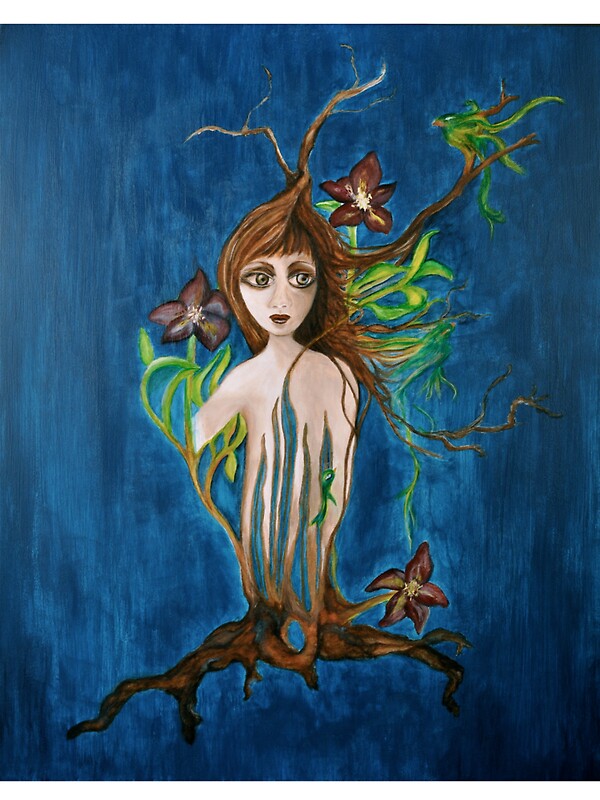
The cage of her body splits open, allowing the release of her soul into a purer form-- the first and second birds flower from her hair/branches; the third pushes through the now-vertical cage of her ribs. Though she is rooted, she is rooted in self, still free to transform. Remember, matter is neither created nor destroyed...it just changes form, it becomes so new, you don't even recognize it.

Thursday, February 3, 2011

You Have a Song Bird


"You have a Songbird that lives on the back of your head. It sings a song unique to you-- a song that reminds you of what you truly want to do with your life. You cannot see it, but you can hear it. You cannot prove the song to another, but you can feel the vibration of the music. Sometimes the noise from the outside world muffles the song or you play deaf because you are afraid to acknowledge it... And if you get too far off your path the Songbird will turn around and give you a brilliant, tough-love peck... it may even draw blood. It will do what it needs to in order for you to pay attention and remember."
--Martique Lorray

Martique Lorray's artwork is alive, and always reminding you to be. There is a primitive sense to the creatures and images that's melded impeccably with a carefully-studied technique. The above songbird is painted on wood, and the bird seems to swirl out of a knot and into the woman's face. If I had looked closely enough at the bare wood, before Martique had painted onto it, could I have already seen this bird and this woman forming into each other?


"The Leaper is the courageous element jumping into the unknown. The Leaper lives in the forest. All of its senses are heightened--the ears are up, the eyes are wide, the body is extended. It is being led by its white, innocent hands, which will always navigate the Leaper through the darkness of the forest to its destination."


The Trickster-- A creature that makes you look twice, that teases you, that makes you think about what you saw, what you are seeing, what is real. Here, the horse looks twice at you...
All of the above images are from Martique Lorray's portfolio entitled "Sexy Beast," which can be found among other portfolios on her website.


(Owl Eye, by Martique Lorray)

She creates something you haven't seen before, but something you recognize. Magic. And so it makes sense that amongst her paintings you would find this one, called Isis and Osiris.


Isis is a goddess of magic, "the matron of nature and magic" (Wikipedia). In fact, in the ancient Egyptian stories, she was able to use her magic to bring together the scattered bones of her murdered husband Osiris and breathe life back into them. This death and rebirth was ritualistically recreated every year in pre-Christian times, and her tears at his death were believed to be the reason for the seasonal flooding of the Nile. This story resonates still today, with the awful violence of "civilization" tearing us (one) into pieces and scattering the severed, wounded pieces far and wide across the world. Artists, writers, dancers, creators: these people put us back together, breathe life into us, and paint new doors in the walls for us to walk through into new worlds. Here, the two are nesting birds, symbols of transformation, transcendence....nesting in a verdant, fertile green...

Her newest portfolio, "The Weight Lifters," will be unveiled tomorrow night (February 4, 2011) at 6 at the Lark and Key Gallery (Southend) in Charlotte, North Carolina. Her oil paintings will be up until March 26th. She says of this new series: "When life gets hard, or heavy, that's when she sends them--the Weight Lifters. They can't solve, but they can relieve some of the burden for a time. They can't be seen, but they're close. When we sigh, that's a signal that they've attached. Pay attention. You can feel it. We don't realize how much there is to soothe."


This is art at its finest: somehow both primal and studied, and always leading the viewer to the best of him/herself.

Saturday, February 27, 2010

Brewing Birds

Brewing Birds (Sunken Garden Dream)

Sunken Garden: Brewing the Birds
black ink on bristol 300 paper, 19 inches x 24 inches


(Note: there are little secrets in this drawing, but you'll have to press the image for a larger version...Have fun!)

This is another drawing for a larger collaboration with Vesna, so I’m just going to put a few notes about what I was thinking about while I was drawing. The overall story involves to young ladies who become neighbors, and a strange garden. Here, it’s a sunken garden, deep in the woods, revealed only at the full moon and in the direct path of the moon beams. Underneath the table are the Hellebores I blogged about here. They are there for the sanity they bring, as defined by me, of course. The flowers and leaves of the Hellebore grow directly into the beakers at the base of the table, and through a system of tubes are brought to mix with the dew forming off the petal of a Canterbury Bell.

Campanula medium (biennial), known as Canterbury Bells: Note that the root of its name, Campana, is Latin for bell. That fits well with the story I found in A Contemplation upon flowers: garden plants in myth and literature (which I keep using, and recommend),
“The source of the common name is an English legend in which three wicked young men were turned into swans by a priest and were forced to fly endlessly for a thousand and one years. On one flight over Canterbury, they heard the nearby ringing of the Christian church bells. They were awed by the sound and the spell was broken [note here: awe breaks the spell of a curse...]. They fell to earth at Canterbury where St. Augustine found them lost and bewildered and led them into the church. As they went inside, little bell-shaped flowers...sprang up from the ground where they stepped. These flowers were dedicated to St. Augustine and later to St. Thomas a Becket, murdered in the cathedral at Canterbury in 1170.”

Some of the variations of the Bellflower give edible roots and salad leaves.
But, as always, on the one side a plant is good, but misused it’s not so good; and it’s important to know the distinctions between the different types of bellflower--and there are more than 300 species:

“The bluebells of Scotland have made their way into legend as well. No one would dream of picking bluebells, for they are the auld-man’s-bell, the bell of the resident ghost of the graveyard who comes out on stormy nights. If one hears his sweet ringing of the bluebells above the thunder, death will come within a fortnight. Hence, the flowers are to remain unmolested, according to legend.”

Here, the birds are miraculously formed (I find that to be a miracle, not a curse!) out of the mists created by the careful mixing and heating of Hellebore essence and the lunar dew formed on the petal of a Canterbury Bell, which has mysteriously grown onto a vine that stretches from the one lady to the other.
Because this is an internal transformation, an alteration of perception to “see” in a more expanded sense, beyond the limitations of the patterns we are raised with and socialized into--beyond those and into that which is so strange we can not even imagine it--she cooks herself in the cauldron, stirring in careful circles around the small pond. To aid her in such a feat, the pot comes equipped with a small mechanical paddling system, which she can turn on by pulling the small cord in her right hand.


Now, I want to revisit the Hellebore a little bit, because it really has a fascinating and illuminating history. In A Contemplation upon Flowers, Ward retells a story Selma Lagerlof recounted from old European legends in the December 1907 issue of Good Housekeeping (Lagerlof was the first woman to win a Nobel Prize for Literature).
“According to her story, long ago, every Christmas Eve a portion of Goinge Forest in Sweden turned into a beautiful garden. The sole witnesses of the transformation, however, were the poor Robber family, who had been banished from the city for stealing a neighbor’s cow for food. Hoping to get her husband pardoned, the exiled wife agreed to reveal the location of the flower garden to the abbot and a gardener brother one Christmas Eve. The brother, jealous because his own garden in the abbey was not nearly so beautiful as that in the forest, cursed the garden, saying that it must be the work of the Evil One if the garden was known only to the outlaws. At his words, darkness sank over the garden and it became frozen and covered with snow. The old abbot died in the sudden snow, clutching a pair of roots in his hand...”
Later, the roots were planted in the abbey’s garden, and they began to yearly produce the Christmas Rose.

This claim of the Evil One’s influence, as opposed to miraculous growth, is one that has often been leveled at those with a green thumb and the knowledge to use plants for healing, as we all know from the wretched human history of witch trials, particularly as related to this plant, but it stresses the importance of careful use of knowledge--because what is in one case miraculous can in another be poisonous (too much of a good thing, etc). An interesting comment was made in Scott’s Letters on Demonology and Witchcraft, when he described seeing “Wretches fitter for a course of Hellebore [as a cure to their apparent insanity] than for the stake.” And it’s possible they were on their way to the stake for using Hellebore!
So, as lazy half-knowledge is dangerous, and jealousy of knowledge is dangerous, and fear of the unknown that others are bringing to light is dangerous, these miraculous things are often kept secret, their effects circulate slowly, and so there is still suffering. And these dangers, all associated with knowledge and gardens and women, well... they are an old story.

Monday, January 18, 2010

Arrival of the Birds

“What is to give light must endure burning.” --Viktor Frankl
Arrival of the Birds, by Zoe Blue


In the medieval bestiaries, the salamander (from the Greek salambeander, or chimney-sweep) is defined as a creature impervious to fire. Often, the salamander is depicted not only in the midst of flames, but also by an apple tree, with an old man looking rather ill and holding a bitten apple collapsing next to it, showing the salamander’s dark reputation for poisoning fruit. According to The Medieval Bestiary, one bestiary shows “the salamander as a snake spiraling up an apple tree; the snake has an apple in its mouth, making the scene very similar to some manuscript illustrations of the temptation of Eve.A man holding an apple stands near the tree, a hand to his head and looking sick.” I’ve chosen to pursue a different aspect of the poison stories, however: I would rather suggest that this whole idea of the apple that causes so many problems in The Garden (which some say was actually a pomegranate--and I’ll come back to that) is really fear of the new. Everything is set in Eden: the rules are in place, the Father runs things. Then the children reach the age where they become their own people. It becomes time for the old order to undergo an upheaval, for changes to be made, for the young to implement their own ideas. This part of the process of life shows up in all mythologies. For example, in the ancient Greek myths, Cronus, the youngest of the Titans, overthrew his father and became the new ruler, and then tried to have all his own children killed so that the same could not be done to him. But one of his sons, Zeus, escaped, and he grew up to overthrow his father and become the new leader. In those stories (as in the story of Oedipus), the idea of the “Old Guard” trying to hold onto its power past its time is shown in a particularly ugly light--as killing one’s own children. But in the story of Adam and Eve, it is the “upstarts” that become the sinners. The idea of assuming they might one day know as much as or more than their father is unforgivable, and the day they choose not to follow his rules is the day we all become exposed to the idea of an eternity of burning in hellfire. The depiction of the salamander poisoning the apple tree shows another possibility for this story, however.
As St. Augustine says, not all that burns perishes in the fire; some fire is cleansing, in fact. And the salamander, here, is an animal that can walk through fire, bringing you to the other side. So though Eve eats the apple that this salamander/snake has offered, and apple depicted (in a sense) as having been poisoned by the one offering it, she is not necessarily then condemned to burn eternally in hell-she could, instead, ride out of the fire on the back of the salamander--that is, she could follow her new ideas through the difficult process of “revolution” and into a new, fresh world.
So, the woman riding the salamander here could be Eve, though when I was drawing her, I was thinking of St. Sophia, who was born two months premature, at the end of the frost but in the midst of a village fire. She was brought into a world in flames and as soon as she was born, her family evacuated the village along with everyone else. She became the saint responsible for the end of winter, and was called upon to protect the harvest from late frosts. So she is a good representative for the end of the old ways, of something "frozen" in place, and the process--the fire of passion--that leads one to the new. The flames thaw that ice, and allow for new growth.
And here, it’s interesting to note that the tradition of stringing up lights during the winter holidays dates back to festivals surrounding the winter solstice--the longest night of the year--when fires were lit in an effort to coax light back to the world. The end of the old year, the beginning of the new.
And as for that apple that might really be a pomegranate--that brings us to another Greek myth, the myth of Persephone (or the Roman Proserpina), who was abducted by Hades and brought to the Underworld to be his wife. Her mother turned the world dark and wintry as she searched for her missing daughter. When Persephone was found, it was discovered that she had eaten of the pomegranate that she’d been offered while in the Underworld, and the rules stated that whoever ate while in the Underworld stayed in the Underworld. However, because no one wanted the world to be dark and wintry forever, the gods got together and forced a compromise on Hades which allowed Persephone to rejoin her mother for part of the year, during which Spring would come and the world would flower again. So, though she ate of a forbidden fruit, which condemned her to eternity in the underworld, Persephone was able to survive it--and to bring new life to earth.

In his book “A New Earth,” Ekhart Tolle adds another detail to the life of the salamander (an amphibious lizard) as he describes the slow and difficult process some water creatures underwent, facing down the difficulties of gravity and air in order to learn to live on dry land. First, they only lived in water, then, slowly, they became able to drag themselves out for small amounts of time, until finally they could travel farther and farther away from the water and still survive. In the book, he posits that it is unlikely those creatures would have gone through such a struggle if it had not been necessary, by some danger, or some new lack of nutrients, to do so. Because of their need to shed the old way of life, they became entirely new. And then:
“Most crawling reptilians, the most earthbound of all creatures, have remained unchanged for millions of years. Some, however, grew feathers and wings and turned into birds, thus defying the force of gravity that had held them for so long. They didn’t become better at crawling or walking, but transcended crawling and walking entirely.”
Thus, even the laws of genetics were overcome--no rule, it seems, is all that hard or fast when necessity strikes. If we want to enough, we can pass through the fires of hell and keep walking. If we so desire, we can quit walking entirely, and fly.

So that is the story here: She rides on the back of the salamander through the flames, which become wings for the salamander. Notice its offspring, leaping with new found wings from the tree. Notice the long body of the next-generation bird, and then the smaller, rounder form of the highest one. Sophia/Eve/Persephone’s snowy dress falls away, and the new material blooms Fire Lilies (not the orange lilies, but the ones which depend on fire in order to flower*), one of which she breaks off to offer her ride. A pomegranate tree blooms from the flames, new leaves and blooms and fruit forming on its trunk, distinct from the snow-covered hedge and frozen fountain further behind.

This drawing is my addition to the post “may my heart always be open to little,” on continuum, with the e.e.cummings poem of that title:

may my heart always be open to little
birds who are the secrets of living
whatever they sing is better than to know
and if men should not hear them men are old

may my mind stroll about hungry
and fearless and thirsty and supple
and even if it's sunday may i be wrong
for whenever men are right they are not young

and may myself do nothing usefully
and love yourself so more than truly
there's never been quite such a fool who could fail
pulling all the sky over him with one smile

- ee cummings


*I used the ones in the Taschen Book of Botanical Prints as my models. The hedge and gate were borrowed from the beautiful lawn of Clive Hicks Jenkins.

Thursday, November 12, 2009

Transformation: Erzulie-Ewa and the Green Lion

Transformation: Erzulie-Ewa and the Green Lion


In Candomblé Ketu, Ewá represents the water element, and is the goddess of enchantment, beauty, and harmony. Like Erzulie, in the related Voodoo pantheon, she is universally loved and loving and "represents all that is fragile and sensitive." According to Morwyn, in Magic from Brazil, "Euá was so beautiful that men would fight to the death to possess her. In order to stop the carnage she changed herself into a puddle of water that evaporated to the sky, condensed into a cloud, and fell as rain. Thus she is known as the deity of transformation."
The story resonates a bit with the Biblical flood, the idea of a transformative force, a cleansing force, that comes through water, which itself is not only representative of cleansing but also of emotions (think how we describe a "torrent" of emotions "flooding" over us or "bubbling" or "welling" up, or how we might call a relationship "stagnant," or we might keep our emotions "bottled" up or "dammed" up). Here, that positive emotion, Ewá's sense of love, rises above the violence of all those men who want her, and washes it away.

In Sacred Possessions, Vodou, Santeria, Obeah, and the Caribbean, Lizabeth Paravisini-Gebert writes about a book called The Cathedral of the August Heat:

"The life-giving power of Vodou pervades the entire text. The veve, or mysical sign, for Erzulie, goddess of the erotic and divinity of dreams, presides over the first part of the novel. The power of Erzulie--'her elan, all the excessive pitch with which the dreams of men soar, when, momentarily, they can shake loose the flat weight, the dreary, reiterative demands of necessity'--imbues this section of the text. Conceived in the spirit of expansiveness characteristic of the cult of Erzulie, where all anxieties, all urgencies vanish, the section ends with the prefiguration of the power of laughter, the volcanic laughter that erupts in the world of the lost people like a seismic shock, spreading through the Caribbean region. The supernatural laughter corresponds to the image of the netherworld in folk tradition as the place to which fear has fled after its defeat by laughter. Folk laughter, the cosmic laughter of the lost people, represents the end of the 'mystic terror of the authority and truth of the past, still prevailing but dying, which has been hurled into the underworld'--the defeat of the forces that have zombified the people..."


The story of Erzulie, the story of Ewá, also reminds me of the Chinese bodhisattva Guan Yin, who also caused a massive transformation, defeating violence: during an unjust and forced visit to the Underworld, she was so overwhelmed with compassion for the souls which suffered untold tortures there, her very love transformed that hell into a paradise. She changed, simply by being full of compassion, the very order of things (something to think about the next time someone calls you a naive utopian). She is, like Ewá and Erzulie, the patroness of mothers and of sailors, and she can be called upon to bring rain;

"Other gods are feared, she is loved...Her throne is upon the Isle of Pootoo [P’u T’o], to which she came floating upon a water-lily. She is the model of Chinese beauty, and to say a lady or a little girl is a ‘Kuan Yin’ is the highest compliment that can be paid to grace and loveliness."--Source.


Alchemists, the precursors to our modern chemists, also strove for major transformation. The endless writings on the steps necessary to transmute base metals into gold are thought by some to have been mere code for a higher transmutation, an internal transmutation, in which the base form of the self becomes light, reaches higher consciousness. Alchemists sought to create an elixir of healing and eternal life, and one of the code names for that ultimate elixir was "the remedy of the green lion."


Here, she is decked out in finery and jewels, as Erzulie, who ignores utterly all the stresses of economics and regular old checkbook balancing, always demands for her ceremonies. As her dress melts into water which settles into a small lake, her scarf billows out into clouds which begin to detach in the form of birds. All of this takes place by a tall tree reaching in all directions, which represents the presence of Legba, Loa of the crossroads, who must be called upon in order to achieve any contact with the Vodou pantheon or the spirit world. Between them paces the green (I promise, he's green, or will be soon) lion.

Friday, July 31, 2009

A Week of Kindness?


(Cover)

This post was cleaned up considerably by the multi-talented Gabriel. Don't miss his monkey!

According to this website:
"Une semaine de bonte was finished in three weeks during the artist's visit with friends in Italy in 1933. The fateful events of that year in Ernst's homeland, including the Nazis' condemnation of his work, may account for the mood of catastrophe that pervades this collage "novel.""
...
In his earliest collage books Ernst generally made up completely new scenes out of many separate pieces, but for most of Une semaine de bonte he used complete existing illustrations as base-pictures, altering them with pasted-on additions. His base-pictures were chiefly the relatively crude and usually lurid wood-engraved illustrations of French popular fiction that were plentiful in the books and periodicals of the late nineteenth century. The subject matter of such literature was torrid love, torture, crimes passionnels and the subsequent incarcerations and executions (by guillotine), hatreds and jealousies among the very wealthy and the very indigent: the inferior spawn of Eugene Sue and Emile Zola. Ernst made his trip to Italy with a suitcase full of such pages."


According to Ian Turpin, in his Phaidon book Max Ernst, "The Dada revolt took a number of forms, from the overtly political to a faith in a new art as the only possible saviour of mankind...it was this latter aspect that attracted Ernst on his discharge from the army in 1917...Ernst's contribution to the Dada attack on both modernist art and accepted values in general was collage," where he could juxtapose bizarre elements to "attack contemporary values in general, particularly the reliance on reason."

Text from Werner Spies, introduction to "Max Ernst: A Retrospective"

"The joins and overlappings [between pieces of the collage] had to be concealed from the viewer. This is why Ernst frequently published his composite imagery only in printed form, in photographic reproduction or in versions later touched up with watercolour. Thanks to these tactics of concealment he succeeded in presenting collage as that which he thought it should be: a completely developed and autonomous system in which the origin of the separate elements is submerged in the final, total image. He was out to produce irritating imagery in which, as in the perfect crime, every clue to its identity had been erased. The joins between the collage elements, moreover, were not so much physical as mental in nature. The hinges linking one piece of source material with another had to remain invisible..."


Collage would thus offer, to my mind, a way of rebuilding the world, in the manner of the Foucault/Borges quote at the side of this blog, in which the elements of the world are re-ordered, the logic of organization completely re-thought and re-structured, and we place things that were never before imagined paired together, and we try this thing (life, society) again. This text, Une Semaine de Bonte seems to focus its efforts on showing how bizarrely paired are the things of the world we live in right now, this "Creation of God's" that has somehow showed itself to be a monster, a monster developed, perhaps, from the clash of our true desires for life with the repressive and unnatural structures of society. This book was created during a period of great disillusionment and fierce rejection of what was seen as a violent, dangerous, insane authority--ALL authority, in fact. This was the mood of the period immediately following World War I. Here is a collection of some of the images, divided into day-sections, of Une Semain de Bonte, along with my thoughts on what he might have been doing with this work:


Sunday's Title Page

Ernst breaks the week into its individual days, giving each day a title page which announces its "element" (four of which are alchemical elements, in their order of use by alchemists) and an "example," or representative of that element, along with a-theoretically, at least--related quote. Each title page is followed by a collection of collages following the stated theme.


(Sunday)


(Sunday)


(Sunday)


(Sunday)


(Sunday)

Sunday, which is the Christian day of rest, not the day of creation--in his book is the day of mud, which to me would, in this book, symbolize the act of creation, as the first man is made from mud, here symbolized by the male, aggressive and passionate king of the jungle: the lion. This begins the book with the creation of man and his sort of violent position as the leader of the world, which goes well with a patriarchal form of religion, and then immediately subverts it, by creating that man on the day religiously and very seriously set aside as the day of rest, the day God did not create man.


(Monday)


(Monday)


(Monday)

What he seems to be creating here is a more "honest"--that is, a more surreal, vicious, illogical and frightening--version of the Christian creation story, the seven days in which God created the world. The title then, is ironic--it's a rejection of the idea that it was any kindness at all to have created this world as it is. Throughout, he seems to suggest also that part of the (massive) problem with the world is the very underlying system of beliefs that created it; for example, the rules and regulations governing the way humans view each other, judge each other, and interact with each other.
Supporting this theory, on The second day, water (represented by water) appears. Water is not only a feminine element, it is also the element symbolic in dreams (with which these surrealists were as obsessed as I) with emotional states and your level of success in dealing with them. A stagnant pool suggests one thing about your emotional life, whereas a glorious afternoon sailing on an endless ocean suggests another. You can become overcome by a tidal wave, you can be overly concerned about the presence of the pee-pee of others in a public pool, you might suddenly discover you're able to breathe underwater. In many of Ernst's watery scenes, some people can walk on the water, while others drown. At any rate, in the first image, a bridge is broken off, and an undeveloped (the joints are still apparent as with a doll) female appears as part of the wreckage. Formed from Adam's rib? In the next image, she is more wholly human, though naked. And then she appears, all sauced-up with the top of the shell (reference to Aphrodite, rising from the water on a shell?) on her head...


(Tuesday)


(Tuesday)


(Tuesday)


(Tuesday)


(Tuesday)

The third day brings in the dragons and serpents, which to me would represent the appearance of the devil in the garden, with his fabulous offerings.


(Wednesday)

(Wednesday)


(Wednesday)

(Wednesday)

Day four leads us to the story of Oedipus, an obsession of Freud's that perhaps caused him to lose a little balance (note: for a fantastic opposing view on the Oedipal complex, read An Interpretation of Murder, an excellent novel and representation of this time period, with excellent insight on the psychological ideas that were then developing). In Wednesday's section (Blood and Oedipus), he introduces improper relations, and an interesting note here is that he was at this time, in a taboo marriage with a cousin--so this idea of relationships prohibited by closeness of blood was a bitter one. Yesterday, the demons came, and today the love that might save me from those demons is prohibited--perhaps even a demon itself. For some reason, Oedipus is conflated in his mind with bird-headed humans--why? Ernst had an obsessive relationship with birds in his paintings, and often showed them caged, or trapped in some other way. As a child, he was informed of the birth of his sister at the same time as the death of his pet cockatoo, and the event was to stand over the rest of his life like a dark shadow. He described it (in the third person) thus: "In his imagination he connected both events and charged the baby with the extinction of the bird's life...A dangerous confusion between birds and humans became encrusted in his mind." The suffering of the war and the way that human beings were treating each other, in what "Ernst regarded as the failure of reconciliation between conscious and unconscious, reason and intuition," (17 Phaidon, Max Ernst, Turpin) was a topic that he was consistently commenting on in his art work; he was very aware of unconscious/subconscious psychological forces and their symbols from university studies as well as from the Surrealist group's obsession with Freud, and in a description of this work of collage as compared to his other works, Turin has written: "The characters of Une Semaine de Bonte are in general both closer to the picture-plane and larger in relation to the surrounding space...There is consequently a feeling not so much of a conflict between conscious and unconscious, as of a direct assault by the latter on the former"(17). If we take this work to be that, and we take his tendency to show birds in a trapped state--trapped by the oppressive, guilt-ridden lives of humans, perhaps, then the bird-headed creatures of Wednesday might represent all that life (subconscious desires; repressed activities, feelings, and sexuality; creative urges) that we have suppressed, finding its way out into the light of the world, as it will, in its own, monstrous form. The reference to Oedipus might also refer to the sense of being crippled, trapped, and condemned by the generation before us, and also feeling so much remorse for our own unnatural actions that we might desire to gouge out our eyes rather than continue to see the results of that. The improper relation to our own blood might have more to do with war, here, than sex.


(Thursday, Rooster)


(Thursday, Rooster)


(Thursday, Easter Island)


(Thursday, Easter Island)

"Those among them who are merry sometimes turn their behinds toward the sky and cast their excrement in the face of other men; then they strike their own bellies lightly." .. "Laughter is probably doomed to disappear."--Marcel Schwob (quoted from two separate works). From these opening quotes, the element (darkness), and its representative (the Rooster's Laughter), I see Thursday as Purgatory--our current plight. A plight which because of our unwillingness or inability to turn away from the hypnotic (think of the impending Hitler, think Franco) force of rigid, tyrannical, repressive structures that are against our nature, against the nature of the universe, even, we face the loss of laughter (surprise, joy--which the rooster's laugh is but a sick twisting of), and sink closer and closer to the bottom (darkness, hell). Within the overall structure of the "Week of Kindness," this is the the descent into banality and its natural evolution into hell itself. Here we see images of torture, suicide, stalking, and freakish experiments. The second representative of darkness is Easter Island, which is present as a series of large, blocky masks, as if the stone sculptures had grown bodies, dressed in contemporary attire, and begun taking part in society.
Why Easter Island as a representative of the darkness, the dark side of man, the purgatory present as a path to hell? According to Wikipedia, on Easter Island, "For unknown reasons, a coup by military leaders called mararoa had brought a new cult based around a previously unexceptional god Makemake. The cult of the birdman...was largely to blame for the island's misery of the late 18th and 19th centuries. With the island's ecosystem fading, destruction of crops quickly resulted in famine, sickness and death." As Ernst already had an association formed in his mind between birds and man's evil, the Easter Island heads then become almost parallel to the laughing rooster heads as a sign of our descent.


Friday's element is sight, and its given manifestation is the interior of sight. He divides the section into the "First Visible Poem," (where he quotes Paul Eluard: "And I object to the love of ready-made images in place of images to be made.") the "Second Visible Poem,"


(Friday, Second Poem)

and the Third, which is very short, consisting of a row of handshakes, and a row of eyeballs gazing at each other, both rows with eggs stationed in various places.
Saturday's element is unknown, but its example is "The Key to Songs," and the section is opened with a silent quote. The images seem to be of women in various states of falling.


(Saturday)


(Saturday)

My feeling is that these last two days refer to the duty of turning inwards (the interior of sight), to come to understand and process who we are and who we could be, what exists underneath our daily routine and daily submissions: it is a refusal of "ready-made images," and an exhortation to begin creating our own (for example, collage...). To look at ourselves and to connect with ourselves (the rows of eyeballs, the rows of handshakes). To be willing to take the leap, as it were, to experience the sense of falling that comes from disconnecting with our current supporting structure in search of a new way of living. To cut and paste from the "lurid" stories around us until we have a new cohesive image, one that makes better (even if not logical) sense.


I end here with what I imagine to be Ernst's response to this week of unkindness:


"The Virgin Spanking the Christ Child Before Three Witnesses: Andre Breton, Paul Eduard, and the Painter"

The Full Text

Note: Each day's section opens with a quote from a surrealist text. I didn't touch most of the quotes, but would be fascinated to hear what anyone else has to say about them. The link to the full book is offered to the right of this blog. This is just the structure of the entire body, as I see it, but there is an awful lot going on in each collage.