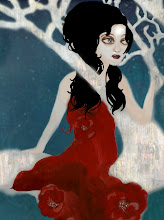
member of:Observers of the Interdependence of Domestic Objects and Their Influence on Everyday Life


This group has been active for a long time and has already made some remarkable assertions which render life simpler from the practical point of view. For example, I move a pot of green color five centimeters to the right, I push in the thumbtack beside the comb and if Mr. A (another adherent like me) at this moment puts his volume about bee-keeping beside a pattern for cutting out vests, I am sure to meet on the sidewalk of the avenida Madero a woman who intrigues me and whose origin and address I never could have known...
--Remedios Varo


(Slideshow is of Artwork by Remedios Varo)
By believing passionately in something that still does not exist, we create it. The nonexistent is whatever we have not sufficiently desired.
--Franz Kafka

Showing posts with label e.e.cummings. Show all posts

Friday, May 30, 2014

Theodora and the Birds Part II

Maquettes created in the style taught by Clive Hicks-Jenkins for compositional study.
may my heart always be open to little
birds who are the secrets of living
whatever they sing is better than to know
and if men should not hear them men are old

may my mind stroll about hungry
and fearless and thirsty and supple
and even if it’s sunday may i be wrong
for whenever men are right they are not young

and may myself do nothing usefully
and love yourself so more than truly
there’s never been quite such a fool who could fail
pulling all the sky over him with one smile

–E.E. Cummings


In my previous post on fungi, I quoted David Abrams’ suggestion that shamans go about trying to expand their knowledge past what their specifically human senses can teach them by binding their perception, and then their nervous systems, to those of another animal--by learning to experience the world as that other animal, and thus obtain information otherwise hidden from them. In Becoming Animal, Abrams suggests that a big part of what we could learn from any animal would be to listen to the whole of our bodies, to even allow the information coming in through our skin and ears and noses and eyes to overwhelm and silence the voice in our heads with whom we usually spend our days.

“Never having separated their sentience from their sensate bodies—having little reason to sequester their intelligence in a separate region of their skull where it might dialogue steadily with itself—many undomesticated animals, when awake, move in a fairly constant dialogue not with themselves but with their surroundings. Here it is not an isolated mind but rather the sensate, muscled body itself that is doing the thinking, its diverse senses and its flexing limbs playing off one another as it feels out fresh solutions to problems posed, adjusting old habits (and ancestral patterns) to present circumstances.
This kind of distributed sentience, this intelligence in the limbs, is especially keen in birds of flight. Unlike most creatures of the ground, who must traverse an opaque surface of only two-plus dimensions as we make our way through the world, a soaring bird continually adjusts minute muscles in its wings to navigate an omnidimensional plenum of currents and interference patterns that alter from moment to moment—an unseeable flux compounded of gusting winds and whirling eddies, of blasts and updrafts and sudden calms, of storm fronts, temperature gradients, and countless other temperamental vectors and flows that may invisibly and at any moment impinge upon your feathered trajectory—whether from in front or above or below, shoving you from one side or the other or from several directions all at once. Flying is an uninterrupted improvisation with an unseen and wildly metamorphic partner.”

Many animals in the world’s forest will keep a keen attention to the songs and silences of the birds, using them to locate any change--dangerous or not-- in the forest’s activities, such as the arrival of a human, or a fox, or the approach of a storm, all information that can be gathered from the bird’s unique access to the sounds and scents on the breeze, to changes in its eddies and flows, and also to their brilliant perspective allowed by quick access to great heights.

So it was that Abrams’ studies with a particular Shaman in Nepal, Sonam, focused on developing a relationship with a bird: the raven. His studies, however, began slowly, and the methods recall the idea explored in my first St. Theodora post, of the story of our loss of Eden perhaps actually being one about our new focus on transcending the landscape around us and being above it; our loss, therefore, of the ability to feel the garden or paradise, and to understand the language of its parts--a loss which left us bereft, and very much alone. So Sonam first had Abrams focus his eyes on a rock, for hours at a time. Then he had him focus on a point just inside the rock, then on a point in the air somewhere between himself and the rock. Then he asked him to focus his eyes and his ears on that point in the air between himself and the rock. Each request provoked some new difficulty, as you can imagine, and took focus, and time, to accomplish.
During all this time, Abrams’ understanding of his senses and how they communicate with each other and deepen each other was developing, as was his sense of the rock, and also the air. He says:

“The strangest thing about my time with Sonam and his wife, Jangmu, was how deeply I came home to myself during those days and nights. Rather than sampling alien practices and exploring beliefs entirely new to me, it was the quality of my own felt experience that became ever more fascinating, the carnal thickness underlying even my most ephemeral daydreams. From that first evening in their house, I found myself noticing ordinary, physical sensations much more vividly than I had realized was possible. As though something in my hosts’ way of moving somehow untied and dispersed all my abstract reflections. The churning of words within my head simply fell silent when I was anywhere around Sonam, freeing my awareness to witness the unique intensities of particular textures, smells, and sounds as these registered along my skin or in the depths of my viscera. Their home, with its stone walls, had a palpable density that hunkered close as I slept on the mud-caked floor across from Sonam and Jangmu, and when I awoke in the mornings I seemed to emerge from my private dreams into the wider dreaming of this breathing house nested within the broad imagination of the bouldered hillside.
[...]
And herein was the strangeness: the more my consciousness sank into the muscled thickness of my animal flesh, the more I could feel the tangible earth around me swell and breathe and move within itself—trees, riverbanks, and boulders quietly responding to all the happenings in their vicinity.[...] As though by dissolving my detached cogitations into the sensory curiosity of my body, I had slipped into alignment with the sentience of the land itself. Awakening as this upright, wide-eyed, smooth-skinned thing, I noticed that all the other things around me were also awake.
[...]Hence I began to feel far more palpably present, and real, to the rocks and the shadowed cliffs than I’d felt before. I felt that I was known to these mountains now. This experience—this awareness of my elemental, thingly presence to the tangible things that surround me—has remained, for me, the purest hallmark of magic, the very signature of its uttermost reality. Magic doesn’t sweep you away; it gathers you up into the body of the present moment so thoroughly that all your explanations fall away: the ordinary, in all its plain and simple outrageousness, begins to shine—to become luminously, impossibly so. Every facet of the world is awake, and you within it. The deeper I slid into the material density of the real, the more I found that there was nothing determinate or predictable about existence. Actuality, this inexhaustible mystery, cannot be domesticated. It is wildness incarnate. Reality shapeshifts.”

Maquettes made by Zoe Blue

Maquettes made by Zoe Blue

This segment of his book struck me as so completely in tune with the process Katharine Butler Hathaway described, in her memoirs, as a method of releasing herself from the monstrous grip of terrors and self-destructive beliefs both as she lay strapped tight to her board, day in and day out, for those ten years of her childhood, and as she tried to develop as an adult afterwards, with the physical and emotional difficulties caused by her disfigurement. She would focus on some ordinary thing around her-- a chair, a door, a table-- focus on it, not as a superior being but in appreciation, until she began to see what an amazing object it really was, until she began to feel the object’s uniqueness, it’s aliveness. And from that feeling, she was able to realize a certain magic to all parts of the universe, and it became apparent to her--it became overwhelmingly clear--that all kinds of things were possible, that all kinds of amazing possibilities lay in front of her. And she went about them. It is true, what Abrams says. Reality shapeshifts. Nothing is determinate or predictable about existence--it’s only when your awareness barely skips over what’s around it that things seem so solid, unchangeable, and pre-ordained.

Nothing is even determinate about your own body. As his studies progressed from rock to air to raven, as he began to learn the dancing motions of the bird, and the feeling between its shoulder blades brought to him by his prolonged exercises of attention, he became able to experience things very differently. He developed his focus on the bird to the extent that Sonam finally came to him with a new request: to bring his tactile sense--his full bodily sense--into the exercise. He wanted him to focus his entire body to the place where his two eyes converged onto the body of the raven.

He explained this by talking about the fire in the hearth and the water in a small nearby brook. He wanted Abrams to look not only with his eyes, and he wasn’t asking him to reach out his hand touch the fire or the water; he wanted him to feel himself as the fire, to feel the heat building in his chest, radiating outward, to feel the easing of his muscles and the cooling of his organs with the fluid motion of the water. What he wanted Abrams to do was to approach that shamanic magic of entering the bird’s body.

“After several days of exasperated effort spent on the baffling task set for me, the fruition arrived unexpectedly, when I’d given up for the afternoon and was making my way back toward the hut. A couple hundred yards along the trail I came upon a raven crossing the dirt to peck at the corpse of a small rodent. As the bird leaned forward, I felt something inside me tip forward as well, and lost my balance for a moment. I regained my equilibrium as the bird kept pecking at the carcass, but now couldn’t help noticing a sensation in my neck every time the raven reached its beak toward the ground. After a few tries, the bird succeeded in loosening a large morsel from the remains, and swooped up onto a shelf of rock with the gore in its beak; as it did so I felt a sudden weightlessness in my chest which abated as the raven settled onto the ledge. Had I really felt that? Yes!!! I knew immediately that this was what Sonam had been nudging me toward. The sensations were subtle, but unmistakable. As if the bird outside me had somehow awakened an analogue of itself inside my own muscles. Or, rather, as if the raven were not only pulling apart that bit of blood and meat out there on the rock ledge, but was also doing so in here, within my own organism.”

After some practice, he became more able to feel most of the things he saw with his eyes, so that he was able to experience the gentle motions of a field of flowers in the breeze or the weight of a heavy load carried by a child, or even sensations related to particular types of clouds. 

Since the theories of evolution suggest that we have done much of this before--transforming from fish to lizard to bird, or stretching out deep inside the soil as seemingly endless mycelial mats--perhaps what is really happening with this kind of intensely focused perception is an entry into non-linear time: into the same Dreamtime he talked about in The Spell of the Sensuous. He explains there that the Dreamtime is not a time properly understood to be in the past, a time which is over, even though it is the time which tells the story that explains the shape of the land and the relations of the people and other animals and the plants that make it up. It is like that latent image--a story you tell yourself about yourself which then controls what you see, what you miss, what ‘happens’ around you. It is a dream, and as in a dream, all the animate and inanimate beings around you quiver with a certain magic, which physics calls potential, and which can be seen, even, at some incredibly microscopic level where the vibration of your atoms becomes apparent. That is a time which is also a place, and you can move around within it and, if you focus, feel it from a different part of your consciousness--say, that of a bird. And if you can experience the story you are a part of from a different angle, then you have loosened the chains of your own character-arc, and reality shape-shifts around you (and inside you).

Maquettes by Zoe Blue


And this brings me back to St. Theodora, to her desire for her hair to become the trees, her blood the water to feed them, and her body a church. Reading Abrams’ Becoming Animal, I begin to see that church as the temple, the space in which the different aspects of the earth meet, change one another, and disperse again:

“Was this, then, the truth of perception—the body subtly blending itself with every phenomenon that it perceives? During those days, it began to seem as though my body was not, properly speaking, mine, but rather a piece of the sensuous world—and seeing was a steady trading of myself here with the things seen there, so that this sensitive flesh became a kind of distributed thing, and the visible terrain a field of feeling. And yet, as I noted—scribbling—in my journal, there was still distance and depth. The commingling of myself with things did not dissolve the distance between us, and so the sentience at large was hardly a homogeneous unity or bland “oneness,” but was articulated in various nodes and knots and flows that shifted as I moved within the broad landscape: that round rock overhanging the cliff’s edge feels like the right knee of the valley, as that jostling bunch of trees across the river far below seems an agitation within the groin of the world, and the ribbon of water way down there is now, yes, a thread of icy clarity winding up my spine. Perception alters, and with it the earth. The magician’s body is a kind of cauldron brewing potions that alter their powers according to the precise blend of senses involved; he offers these in turn to his apprentice, whose creaturely body slowly awakens, loosening itself from societal, fear-induced constraints.”

So Theodora moves, with deer-like grace and care, through the forest. She dons her cape of feathers for a shamanic dance, and meets with her familiar, at his moment of transition between lizard and bird, and experiences the world as a flux, as a moment, briefly lucid and amazed at the precise creativity of her own dreaming mind.


Maquettes of St. Theodora and her Bird-Lizard Companion
by Zoe Blue

Thursday, October 14, 2010

Happy Birthday

Photo by Edward Steichen; ca. 1926
Marion Morehouse (Cummings' common-law wife);dress designed by Louiseboulanger
Image by © Condé Nast Archive/CORBIS


Today is the birthday of E.E.Cummings. He wrote his first poem when he was three:

"Oh,the pretty birdie,O;/with his little toe,toe,toe!"

He served in the ambulance corps in World War I, and for his dislike of war and his lack of dislike for the German population, he was detained in a concentration camp for 3 1/2 months before his father managed his release by writing the president. For the first part of his imprisonment, his family was led to believe he had drowned in a submarine mishap. About that experience, Cummings wrote a novel called The Enormous Room. In the novel, he describes imprisonment:
It is like a vast grey box in which are laid helter-skelter a great many toys, each of which is itself completely significant apart from the always unchanging temporal dimension which merely contains it along with the rest. I make this point clear for the benefit of any of my readers who have not had the distinguished privilege of being in jail. To those who have been in jail my meaning is at once apparent; particularly if they have had the highly enlightening experience of being in jail with a perfectly indefinite sentence. How, in such a case, could events occur and be remembered otherwise than as individualities distinct from Time Itself? Or, since one day and the next are the same to such a prisoner, where does Time come in at all? Obviously, once the prisoner is habituated to his environment, once he accepts the fact that speculation as to when he will regain his liberty cannot possibly shorten the hours of his incarceration and may very well drive him into a state of unhappiness (not to say morbidity), events can no longer succeed each other: whatever happens, while it may happen in connection with some other perfectly distinct happenings, does not happen in a scale of temporal priorities--each happening is self-sufficient, irrespective of minutes, months and the other treasures of freedom.

This sort of claustrophobia, this imprisonment inside a sameness of possibly endless time-space, instead of driving him mad, seemed to provide him with an incredible sense of this moment, right here, right now. This moment as the only moment that will exist. And then any memories were thus moments in themselves, taken out of time, like the toys in the enormous room he describes. In the following poem, we see that child-like understanding of time most of us lose along the way:

in time of daffodils (who know

in time of daffodils (who know
the goal of living is to grow)
forgetting why, remembering how
in time of lilacs who proclaim
the aim of waking is to dream,
remember so (forgetting seem)
in time of roses (who amaze
our now and here with praise)
forgetting if, remember yes
in time of all sweet things beyond
whatever mind may comprehend,
remember seek (forgetting find)
and in a mystery to be
(when time from time shall set us free)
forgetting me, remember me

His syntax adds to the sensation of "now," "now," and "now:" every word and every line are to be savored separately and then together, in various permutations--think of pausing, with the line break after " in time of all sweet things beyond...." and then, come back, and emphasize beyond with "whatever mind may comprehend," but also that line leads to the next, saying whatever your mind may think it has found (comprehended), "remember seek (forgetting find)."

In one section of the autobiography, he begins a description of a fellow prisoner thus:
He is, of all the indescribables I have known, definitely the most completely or entirely indescribable. Then (quoth my reader) you will not attempt to describe him, I trust.--Alas, in the medium which I am now using a certain amount or at least quality of description is disgustingly necessary. Were I free with a canvas and some colours ... but I am not free. And so I will buck the impossible to the best of my ability. Which, after all, is one way of wasting your time.
But I think he means, one way of making the most of your time. As that is what he and most artists do:"buck the impossible." Create the impossible, making not a poem or a painting or a dance, but an event, a moment outside of time, one of those amazing, astonishing "toys" which holds a child's (our) attention outside the stream of his/her/our life, a moment of glimmering truth, of total possibility, when nothing yet is, because everything could be.
After all, prison is a waste of time (read that both ways). What he does here is turn prison, that enormous room, into a collection of "toys" which can be enjoyed by us, we who are outside that prison and even outside that time. He thus bends time and space. He bucks the impossible. He turns a waste of time into art.


Despite his imprisonment at the hands of the French military, he remained a lifelong lover of Paris, and stayed there many times throughout his life. There, he befriended Picasso, for whom he wrote a poem which ends with the line "you hew form truly," and in which he describes his art:
"presents always
shut in the sumptuous screech of
simplicity"


a line which could easily be used to describe his own poetry.
He himself painted, for example this Self-Portrait with Sketchpad:


as well as this portrait of fashion model Marion Morehouse, with whom he lived from 1934 until his death in 1962:


XII

my love is building a building
around you, a frail slippery
house, a strong fragile house
(beginning at the singular beginning

of your smile)a skilful uncouth
prison, a precise clumsy
prison(building thatandthis into Thus,
Around the reckless magic of your mouth)

my love is building a magic, a discrete
tower of magic and(as i guess)

when Farmer Death(whom fairies hate)shall

crumble the mouth-flower fleet
He'll not my tower,
laborious, casual

where the surrounded smile

hangs

breathless

Monday, January 18, 2010

Arrival of the Birds

“What is to give light must endure burning.” --Viktor Frankl
Arrival of the Birds, by Zoe Blue


In the medieval bestiaries, the salamander (from the Greek salambeander, or chimney-sweep) is defined as a creature impervious to fire. Often, the salamander is depicted not only in the midst of flames, but also by an apple tree, with an old man looking rather ill and holding a bitten apple collapsing next to it, showing the salamander’s dark reputation for poisoning fruit. According to The Medieval Bestiary, one bestiary shows “the salamander as a snake spiraling up an apple tree; the snake has an apple in its mouth, making the scene very similar to some manuscript illustrations of the temptation of Eve.A man holding an apple stands near the tree, a hand to his head and looking sick.” I’ve chosen to pursue a different aspect of the poison stories, however: I would rather suggest that this whole idea of the apple that causes so many problems in The Garden (which some say was actually a pomegranate--and I’ll come back to that) is really fear of the new. Everything is set in Eden: the rules are in place, the Father runs things. Then the children reach the age where they become their own people. It becomes time for the old order to undergo an upheaval, for changes to be made, for the young to implement their own ideas. This part of the process of life shows up in all mythologies. For example, in the ancient Greek myths, Cronus, the youngest of the Titans, overthrew his father and became the new ruler, and then tried to have all his own children killed so that the same could not be done to him. But one of his sons, Zeus, escaped, and he grew up to overthrow his father and become the new leader. In those stories (as in the story of Oedipus), the idea of the “Old Guard” trying to hold onto its power past its time is shown in a particularly ugly light--as killing one’s own children. But in the story of Adam and Eve, it is the “upstarts” that become the sinners. The idea of assuming they might one day know as much as or more than their father is unforgivable, and the day they choose not to follow his rules is the day we all become exposed to the idea of an eternity of burning in hellfire. The depiction of the salamander poisoning the apple tree shows another possibility for this story, however.
As St. Augustine says, not all that burns perishes in the fire; some fire is cleansing, in fact. And the salamander, here, is an animal that can walk through fire, bringing you to the other side. So though Eve eats the apple that this salamander/snake has offered, and apple depicted (in a sense) as having been poisoned by the one offering it, she is not necessarily then condemned to burn eternally in hell-she could, instead, ride out of the fire on the back of the salamander--that is, she could follow her new ideas through the difficult process of “revolution” and into a new, fresh world.
So, the woman riding the salamander here could be Eve, though when I was drawing her, I was thinking of St. Sophia, who was born two months premature, at the end of the frost but in the midst of a village fire. She was brought into a world in flames and as soon as she was born, her family evacuated the village along with everyone else. She became the saint responsible for the end of winter, and was called upon to protect the harvest from late frosts. So she is a good representative for the end of the old ways, of something "frozen" in place, and the process--the fire of passion--that leads one to the new. The flames thaw that ice, and allow for new growth.
And here, it’s interesting to note that the tradition of stringing up lights during the winter holidays dates back to festivals surrounding the winter solstice--the longest night of the year--when fires were lit in an effort to coax light back to the world. The end of the old year, the beginning of the new.
And as for that apple that might really be a pomegranate--that brings us to another Greek myth, the myth of Persephone (or the Roman Proserpina), who was abducted by Hades and brought to the Underworld to be his wife. Her mother turned the world dark and wintry as she searched for her missing daughter. When Persephone was found, it was discovered that she had eaten of the pomegranate that she’d been offered while in the Underworld, and the rules stated that whoever ate while in the Underworld stayed in the Underworld. However, because no one wanted the world to be dark and wintry forever, the gods got together and forced a compromise on Hades which allowed Persephone to rejoin her mother for part of the year, during which Spring would come and the world would flower again. So, though she ate of a forbidden fruit, which condemned her to eternity in the underworld, Persephone was able to survive it--and to bring new life to earth.

In his book “A New Earth,” Ekhart Tolle adds another detail to the life of the salamander (an amphibious lizard) as he describes the slow and difficult process some water creatures underwent, facing down the difficulties of gravity and air in order to learn to live on dry land. First, they only lived in water, then, slowly, they became able to drag themselves out for small amounts of time, until finally they could travel farther and farther away from the water and still survive. In the book, he posits that it is unlikely those creatures would have gone through such a struggle if it had not been necessary, by some danger, or some new lack of nutrients, to do so. Because of their need to shed the old way of life, they became entirely new. And then:
“Most crawling reptilians, the most earthbound of all creatures, have remained unchanged for millions of years. Some, however, grew feathers and wings and turned into birds, thus defying the force of gravity that had held them for so long. They didn’t become better at crawling or walking, but transcended crawling and walking entirely.”
Thus, even the laws of genetics were overcome--no rule, it seems, is all that hard or fast when necessity strikes. If we want to enough, we can pass through the fires of hell and keep walking. If we so desire, we can quit walking entirely, and fly.

So that is the story here: She rides on the back of the salamander through the flames, which become wings for the salamander. Notice its offspring, leaping with new found wings from the tree. Notice the long body of the next-generation bird, and then the smaller, rounder form of the highest one. Sophia/Eve/Persephone’s snowy dress falls away, and the new material blooms Fire Lilies (not the orange lilies, but the ones which depend on fire in order to flower*), one of which she breaks off to offer her ride. A pomegranate tree blooms from the flames, new leaves and blooms and fruit forming on its trunk, distinct from the snow-covered hedge and frozen fountain further behind.

This drawing is my addition to the post “may my heart always be open to little,” on continuum, with the e.e.cummings poem of that title:

may my heart always be open to little
birds who are the secrets of living
whatever they sing is better than to know
and if men should not hear them men are old

may my mind stroll about hungry
and fearless and thirsty and supple
and even if it's sunday may i be wrong
for whenever men are right they are not young

and may myself do nothing usefully
and love yourself so more than truly
there's never been quite such a fool who could fail
pulling all the sky over him with one smile

- ee cummings


*I used the ones in the Taschen Book of Botanical Prints as my models. The hedge and gate were borrowed from the beautiful lawn of Clive Hicks Jenkins.

Tuesday, June 30, 2009

Perceived Reality, Part IV: Don't Let Dullards Interfere with Your Ability to See

listen:there’s a hell
of a good universe next door;let’s go
—e.e.cummings

From codex seraphinianus


"Discover for yourself, reader, such wonders as the purple-caged citrus, the spider-web flower, the parfait protea, and the ladder weed. This is a world inhabited by weird half-sentient flora such as the tadpole tree and the meteor-fruit, by the lacy flying-saucer fish, the wheeled caterpillar-rumped horse, and the metamorphic bicranial rhino. The planet’s sentient species are here as well—races like the Garbage-Dwellers, the Road-Traffic and the Yarn People, and the exotic Rodent-Skin Wearers… Nor can we forget to mention the Homo-Saurians, whose unusual sexual life-cycle is graphically described." (From the inside jacket of the Codex Seraphinianus)


In 1940, Jorge Luis Borges wrote Tlon, Uqbar, Orbis Tertius, a fascinating account of the accidental discovery of an irregular addition to volume XLVI of a set of encyclopedias. The addition described the language, arts, geography, and history of an otherwise seemingly non-existent country, Uqbar, and its discovery left its two readers completely flummoxed. After a passage of time, the narrator happens upon another odd text, this time an entire volume which seems to have no twin in the world, and this time the entire book is devoted to the description of a planet, Tlön. He tells us:

(translations to English from http://www.coldbacon.com/writing/borges-tlon.html)
"Two years before I had discovered, in a volume of a certain pirated encyclopedia, a superficial description of a nonexistent country; now chance afforded me something more precious and arduous. Now I held in my hands a vast methodical fragment of an unknown planet's entire history, with its architecture and its playing cards, with the dread of its mythologies and the murmur of its languages, with its emperors and its seas, with its minerals and its birds and its fish, with its algebra and its fire, with its theological and metaphysical controversy. And all of it articulated, coherent, with no visible doctrinal intent or tone of parody."


From codex seraphinianus


He goes on to describe some of the characteristics of this planet, for example the languages of the northern hemisphere, which are based almost entirely on the "monosyllabic adjective. The noun is formed by an accumulation of adjectives. They do not say "moon," but rather "round airy-light on dark" or "pale-orange-of-the-sky" or any other such combination. In the example selected the mass of adjectives refers to a real object, but this is purely fortuitous. The literature of this hemisphere (like Meinong's subsistent world) abounds in ideal objects, which are convoked and dissolved in a moment, according to poetic needs. At times they are determined by mere simultaneity. There are objects composed of two terms, one of visual and another of auditory character: the color of the rising sun and the faraway cry of a bird. There are objects of many terms: the sun and the water on a swimmer's chest, the vague tremulous rose color we see with our eyes closed, the sensation of being carried along by a river and also by sleep. These second-degree objects can be combined with others; through the use of certain abbreviations, the process is practically infinite. There are famous poems made up of one enormous word. This word forms a poetic object created by the author."

From codex seraphinianus


In a postscript to the story, the narrator explains that new information has come to light, clarifying some of the mysteries surrounding the planet Tlön. A written confession has been discovered, detailing the existence of a secret society through several generations which sought to prove to a, in their eyes, "nonexistent God that mortal man was capable of conceiving a world." In a creepy turn of events, objects begin to appear which corroborate the actual existence of the planet, the first such object a compass with Tlön script on its metal case. Such intrusions of fantasy into the real world escalate until finally, the history of Tlön is being taught in the schools, Earth's science and archeology--its memories-- are being pushed aside for their Tlön counterparts, and the children are being taught to speak the language of Tlön. The story becomes a completely peaceful takeover of the planet Earth by a non-existent alien race.
From codex seraphinianus


From codex seraphinianus


From codex seraphinianus


In 1976, Italian artist Luigi Serafini began work on just such a project--though I make no claims as to his hopes for a takeover of the planet. It is a masterfully illustrated encyclopedia of an unknown planet, with each illustration described, detailed, and explained in an unrecognizable alphabet. The alphabet has defied the attempts, so far, of linguists to break its code, even though a Rosetta Stone is given in the book--to another unknown language. According to Wikipedia, "Serafini has stated that the script of the Codex is asemic, and that his experience in writing it was closely similar to automatic writing." Though the writing has yet to be deciphered, many studies of it have been made. There is, for example, a brief analysis on the page (http://www.math.bas.bg/~iad/serafin.html):

"Which brings us back to the writing system. (I'm only discussing words written in majuscules here -- titles of chapters, sections, subsections and paragraphs, for the most part.) Several dozen different characters appear in them, far too many for the writing system to be an alphabet, and there are too many long words for it to be a syllabary. Some characters occur very many times, others only once or twice.
What is even more striking, however, is the tendency of the characters, even the less frequent ones, to reoccur within the same word or group of words (e.g., within the titles of the various subsections and paragraphs in a section). If a character occurs in a word at all, there's a good chance that it occurs there at least twice -- perhaps thrice in a row (which is next to unseen in any sort of phonetic writing system), up to six times altogether. It is as if the headers of most pages in an English book were such words as bookkeeper, googol, grammar, Ouagadougou and Wassamassaw. "


The numbering system has been deciphered. Meaning, it is an actual working system, though completely foreign to us. It is explained fully on the same webpage, with a few added notes:

"Telefol counting starts with the fingers of the left hand (1 being the pinky), progresses from the thumb (5) to the wrist, lower arm, elbow, upper arm and shoulder (6--10), the side of the neck, ear and eye (11--13) and thence through the nose (14) and right eye (15) to the right pinky finger (27). The Telefol idea of a very large number is kakkat=14*27=378. "

The book is filled with fantastic images.

The structure of the book is as follows:

"The Codex is divided into eleven chapters, partitioned into two sections. The first section appears to describe the natural world, dealing with flora, fauna, and physics. The second deals with the humanities, the various aspects of human life: clothing, history, cuisine, architecture and so on. Each chapter seems to treat a general encyclopedic topic. The topics of each separate chapter are as follows:

* The first chapter describes many alien types of flora: strange flowers, trees that uproot themselves and migrate, etc.

From codex seraphinianus


* The second chapter is devoted to the fauna of this alien world, depicting many animals that are surreal variations of the horse, hippopotamus, rhinoceros, birds, etc.
From codex seraphinianus


From codex seraphinianus


* The third chapter deals with what seems to be a separate kingdom of odd bipedal creatures, apparently engineered for various purposes.
* The fourth chapter deals with something that seems to be physics and chemistry, and is by far the most abstract and enigmatic.
* The fifth chapter deals with bizarre machines and vehicles.

From codex seraphinianus


From codex seraphinianus


* The sixth chapter explores the general humanities: biology, sexuality, various aboriginal peoples, and even shows examples of plant life and tools (such as pens and wrenches) grafted directly into the human body.


* The seventh chapter is historical. It shows many people (some only vaguely human) of unknown significance, giving their times of birth and death. It also depicts many scenes of historical (and possibly religious) significance. Also included are examples of burial and funereal customs.
* The eighth chapter depicts the history of the Codex's alien writing system.
From codex seraphinianus


* The ninth chapter deals with food, dining practices, and clothing.
* The tenth chapter describes bizarre games (including playing cards and board games) and athletic sports.
From codex seraphinianus


* The eleventh chapter is devoted entirely to architecture."
(FROM WIKIPEDIA, with images inserted from various sites.)


On the page http://www.believermag.com/issues/200705/?read=article_taylor, Justin Taylor claims:
"As a book-object...the Codex’s only real precursor [!] is The Voynich Manuscript. Discovered by the Polish book collector Wilfrid M. Voynich in a wooden chest at an Italian Jesuit college in 1912, the heavily illustrated manuscript was worked on by top code-crackers during World War II. They failed. It’s never been deciphered. Theories on its origin and significance abound, including the theory that the manuscript is a fraud perpetrated by Voynich himself, but the most popular and conclusive theory attributes the work to Roger Bacon, the medieval Franciscan friar who, in his Letter Concerning the Marvelous Power of Art and Nature and the Nullity of Magic, noted that 'certain persons have achieved concealment by means of letters not then used by their own race or others but arbitrarily invented by themselves.'”


One thing should be pointed out here: the author of this codex is still very much alive. Meaning, we could have a full translation and explanation any day now. But I don't think we will.

From codex seraphinianus


According to Shelley Jackson, author of Patchwork Girl,
"It’s important that it bothers you with the feeling that there is some content that you ought to be able to extract from it in a normal discursive kind of way. It’s meant to appeal to the rational or exegetical urge. It wants to be interpreted but it won’t let you, and it’s very interesting the way it teasingly asks to be read and then refuses. You could see this as a really really elaborate inkblot. It’s never going to completely yield to you in the sense of giving you insight into the artist’s intentions, so it kind of reverts you back on yourself and makes you notice what you’re noticing and notice the associations that you make. It’s a kind of springboard for your own creative musings.”


And I think that's key: your own creative musings. Keep that in mind for a minute.

Several years ago, there was an experiment run by a psychologist named Daniel Simmons. He showed the test subjects a video of groups of guys in black shirts and white shirts, tossing basketballs back and forth to each other on a court. He told the subjects to count the number of times a basketball got passed between the guys in white shirts. Halfway through the video, a gorilla-suited woman walked across the basketball court, and hardly anyone noticed. Why? Because they'd already been told what the important information was. How do you miss a gorilla? By working from a framework that causes your subconscious to discard the presence of the gorilla as unimportant information, before its presence even registers in your subconscious. And this experiment has been repeated many times, in various places, with the same results.

So I'm going to end here by pointing you back to the Foucault quote in my sidebar, where he refers to an excerpt of another Borges work, these quotes together reminding me of the importance of exposing yourself to as many outlandish and impossible modes of thinking as possible, and as often as possible, in order to erase more and more of the boundaries and limitations on your own system of thought, and thus your own ability to see all the gorillas that might be passing in front of you.

The Codex Seraphinianus is today's offering.


Note: YouTube user shivabel has uploaded this lovely, generous video of a large excerpt from the Codex Seraphinianus, showing you many, many more of the fantastic illustrations. The video is set to music by Penguin Cafe Orchestra: