member of:Observers of the Interdependence of Domestic Objects and Their Influence on Everyday Life


This group has been active for a long time and has already made some remarkable assertions which render life simpler from the practical point of view. For example, I move a pot of green color five centimeters to the right, I push in the thumbtack beside the comb and if Mr. A (another adherent like me) at this moment puts his volume about bee-keeping beside a pattern for cutting out vests, I am sure to meet on the sidewalk of the avenida Madero a woman who intrigues me and whose origin and address I never could have known...
--Remedios Varo


(Slideshow is of Artwork by Remedios Varo)
By believing passionately in something that still does not exist, we create it. The nonexistent is whatever we have not sufficiently desired.
--Franz Kafka

Showing posts with label magic. Show all posts

Tuesday, August 26, 2014

Theodora III


As I began painting this creature, caught in the midst of transformation, first in her shamanic dress with her guiding creatures-- in the process of developing their own feathers--I came upon the book The Spell of the Sensuous and began exploring the idea that the tale of the Loss of Eden may be one of the human desire to transcend the environment, in the process losing the ability to listen to and respond to--communicate with--the environment. That painting was a gift, and so I made maquettes of the creatures to keep me company as I thought about those ideas, and in the process of putting them together, she gained some deer-like aspects and full-blown wings. In this painting, I wanted to emphasize that the environment is not separate from her, that the whole painting is one being, there is a whole, and this is just the view I have of it right now. 

As I worked on it, I discovered the book Deep: Freediving, Renegade Science, and What the Ocean Tells Us about Ourselves, by James Nestor, and learned of a whole realm of language humans know nothing about and are only now trying to study, the language of cetaceans:

“Sperm whales produce four distinct vocalization patterns: normal clicks, for tracking down prey at distances of more than a mile; creaks, which sound, despite their name, like machine-gun fire, for homing in on close-range prey; codas, the patterns used during social interactions; and slow clicks, which no one quite understands. One theory is that bulls use slow clicks to attract females and scare off other males. The clicks are very similar to dolphin clicks but more complex. 
Coda clicks, the focus of Schnöller’s work, are used only during socializing and are significantly different from clicks used to aid perception and navigation. They sound unremarkable to the human ear—something like the tack-tack-tack of marbles dropped on a wood table. But when the clicks are slowed down and viewed as a sound wave on a spectrogram, each reveals an incredibly complex collection of shorter clicks inside it. 
Inside those shorter clicks are even shorter clicks, and so on. The more closely Schnöller focused in on a click, the more detailed it became, unfolding on his computer screen like a Russian nesting doll. 
An average click lasts anywhere from twenty-four milliseconds (thousandths of a second) to seventy-two milliseconds. Inside these clicks are a series of microclicks, which themselves are separated by microseconds, and so on. All these tiny clicks inside the coda are transmitted at very specific and distinct frequencies. There could be even shorter, organized click patterns within these microclicks, but Schnöller’s machines—which record at 96,000 Hz, the highest speed available on most modern audio equipment—aren’t fast enough to process them. 
Schnöller tells me that sperm whales can replicate these clicks down to the exact millisecond and frequency, over and over again. They can also control the millisecond-long intervals inside the clicks and reorganize them into different structures, in the same way a composer might revise a scale of notes in a piano concerto. But sperm whales can make elaborate revisions to their click patterns, then play them back in the space of a few thousandths of a second. 
‘When you think about it, human language is very inefficient, it is very prone to errors,’ Schnöller says. Humans use phonemes—basic units of sound, like kah, puh, ah, tee—to create words, sentences, and, ultimately, meaning. (English has about forty-two phonemes, which speakers shuffle around to create tens of thousands of words.) While we can usually convey phonemes clearly enough for others to understand them, we can never fully replicate them the same way each time we speak. The frequency, volume, and clarity of the voice shifts constantly, so that the same word uttered twice in a row by the same person will usually sound discernibly different, and will always show clear differences on a spectrogram. Comprehension in human language is based on proximity: If you enunciate clearly enough, another speaker of the same language will understand you; if you bungle too many vowels and consonants, or even pronunciation (think of French or a tonal Asian language), then communication is lost. Schnöller’s research suggests that sperm whales don’t have this problem.”

Sperm whales are apparently the loudest animals on Earth--as far as we know--and if they want to yell, their clicks will out-perform 2,000 pounds of TNT exploding about 60 meters away. That maximum sound, 236 decibels, is just 4 decibels away from boiling the water around them into vapor, and is already too loud for air, where it can’t be heard. These whales have huge brains, with very developed auditory processors and a neocortex (that higher-level functioning section humans are so proud of) about six times larger than ours. And, “in 2006, researchers at New York City’s Mount Sinai School of Medicine discovered that sperm whales had spindle cells, the long and highly developed brain structures that neurologists associate with speech and feelings of compassion, love, suffering, and intuition—those things that make humans human. Sperm whales not only have spindle cells, but have them in far greater concentration than humans do.”

So it would seem that they might be able to tell us something, if we were able to go down into the water with them, where it’s possible to hear them, and then focus our hearing processes a lot more so we could catch all those microclicks. Then, of course, would come the process of translation. 

Dolphins also use this clicking form of communication, and it was in reading about them that I was really knocked over, that I was really reminded of how Abrams had so carefully tied magic together with the ability to shift one’s perspective “sideways,” into another life-form. Like sperm whales, dolphins also use the clicking sounds as a sonar, via a melon beneath their lower jaw, which is covered in data points--thousands compared to our two ears. With the information gained, a dolphin can ‘see’ a shape up to six miles away, or a foot underneath the sand. And not just through sand, but through skin--this sonar process would allow a dolphin swimming next to you to look into your brains and heart. Some researchers, like Fabrice Schnöller, are starting to think that it’s not just that the dolphins can construct sonographic images via sound, but that they can actually share those images with each other, via holographic communication: “This nonverbal form of communication allows cetaceans to share fully rendered three-dimensional images with other cetaceans, the same way you might snap a photograph on your smartphone and send it to a friend. Schnöller believes cetaceans can share what they’re thinking and seeing with one another without ever opening their ears, or their eyes.”

So, in this method of communication, in this form of language, we have several “magical”, “superhero” abilities: X-ray vision, incredible distance vision, and telepathy. Not to mention any questions about whether those holographic images are creations of group belief--that is, worlds-- that the dolphins swim into together, meaning, maybe they are creating their “Dreamtime” as they click.

You might be thinking, well, but humans don’t have a melon with a thousand points of data-retrieval, so, you know, too bad. 

But you know better, right?

In the book, Nestor interviews Brian Bushway, a former student of and current colleague of Daniel Kish, who founded World Access for the Blind. Brian, who has been blind since he was fourteen, can be seen here as an adult, riding his mountain bike and teaching other blind people move around using echolocation:


  I first read about Daniel Kish in an article for Men’s Journal by Michael Finkel, which I also recommend reading in its entirety, where Finkel describes Kish’s abilities and his clicks, and shares part of his own brief lessons in echolocation:

“He is so accomplished at echolocation that he's able to pedal his mountain bike through streets heavy with traffic and on precipitous dirt trails. He climbs trees. He camps out, by himself, deep in the wilderness. He's lived for weeks at a time in a tiny cabin a two-mile hike from the nearest road. He travels around the globe. He's a skilled cook, an avid swimmer, a fluid dance partner. Essentially, though in a way that is unfamiliar to nearly any other human being, Kish can see.

[...]

“I listen as Kish opens a cabinet and rummages amid his pots. He returns and stands behind me. "Make a click," he says.
It's a terrible click, a sloppy click; what Kish calls a "clucky click." Kish's click is a thing of beauty – he snaps the tip of his tongue briefly and firmly against the roof of his mouth, creating a momentary vacuum that pops upon release, a sound very much like pushing the igniter on a gas stove. A team of Spanish scientists recently studied Kish's click and deemed it acoustically ideal for capturing echoes. A machine, they wrote, could do no better.

My click will work for now. Kish tells me that he's holding a large glass lid, the top to a Crock-Pot, a few inches in front of me. "Click again," he says. There's a distinct echo, a smearing of sound as if I'm standing in my shower. "Now click," he says. The echo's gone. "I've lifted it up. Can you tell?"

I can, quite clearly. "Click again," he instructs. "Where is it?" I click; there's no echo.

"It's still lifted," I say.

"Try again," says Kish. "But move your head, listen to your environment."

I turn my head to the right and click. Nothing. Then I click to the left. Bingo. "It's over here," I say, tilting my head in the direction of the lid.

"Exactly," says Kish. "Now let's try it with a pillow."

If you look at the chart below, created by Abstruse Goose, you’ll see that both our sight and our hearing make us aware of a woefully small amount of the information available in our environment.  But Finkel points out that if we translated the amount of light variety we can pick up into sound terminology, we would say we can see “less than one octave of frequency.” We hear much ‘better’ than we see, much more.


“Kish does not go around clicking like a madman. He uses his click sparingly and, depending on his location, varies the volume. When he's outside, he'll throw a loud click. In good conditions, he can hear a building 1,000 feet away, a tree from 30 feet, a person from six feet. Up close, he can echolocate a one-inch diameter pole. He can tell the difference between a pickup truck, a passenger car, and an SUV. He can locate trail signs in the forest, then run his finger across the engraved letters and determine which path to take. Every house, he explains, has its own acoustic signature.
He can hear the variation between a wall and a bush and a chain-link fence. Bounce a tennis ball off a wall, Kish says, then off a bush. Different response. So too with sound. Given a bit of time, he can echolocate something as small as a golf ball. Sometimes, in a parking garage, he can echolocate the exit faster than a sighted person can find it.
[...]
Kish hears the sonic reflections from his click even in a place teeming with ambient noise. ‘It's like recognizing a familiar voice in a crowd,’ he says. The load upon his mind is undoubtedly immense. Yet he casually processes everything, constructing and memorizing a mental map of his route, all while maintaining an intricate conversation with me. It's so extraordinary that it seems to border on the magical.”

There we are again, with that word.


Friday, May 30, 2014

Theodora and the Birds Part II

Maquettes created in the style taught by Clive Hicks-Jenkins for compositional study.
may my heart always be open to little
birds who are the secrets of living
whatever they sing is better than to know
and if men should not hear them men are old

may my mind stroll about hungry
and fearless and thirsty and supple
and even if it’s sunday may i be wrong
for whenever men are right they are not young

and may myself do nothing usefully
and love yourself so more than truly
there’s never been quite such a fool who could fail
pulling all the sky over him with one smile

–E.E. Cummings


In my previous post on fungi, I quoted David Abrams’ suggestion that shamans go about trying to expand their knowledge past what their specifically human senses can teach them by binding their perception, and then their nervous systems, to those of another animal--by learning to experience the world as that other animal, and thus obtain information otherwise hidden from them. In Becoming Animal, Abrams suggests that a big part of what we could learn from any animal would be to listen to the whole of our bodies, to even allow the information coming in through our skin and ears and noses and eyes to overwhelm and silence the voice in our heads with whom we usually spend our days.

“Never having separated their sentience from their sensate bodies—having little reason to sequester their intelligence in a separate region of their skull where it might dialogue steadily with itself—many undomesticated animals, when awake, move in a fairly constant dialogue not with themselves but with their surroundings. Here it is not an isolated mind but rather the sensate, muscled body itself that is doing the thinking, its diverse senses and its flexing limbs playing off one another as it feels out fresh solutions to problems posed, adjusting old habits (and ancestral patterns) to present circumstances.
This kind of distributed sentience, this intelligence in the limbs, is especially keen in birds of flight. Unlike most creatures of the ground, who must traverse an opaque surface of only two-plus dimensions as we make our way through the world, a soaring bird continually adjusts minute muscles in its wings to navigate an omnidimensional plenum of currents and interference patterns that alter from moment to moment—an unseeable flux compounded of gusting winds and whirling eddies, of blasts and updrafts and sudden calms, of storm fronts, temperature gradients, and countless other temperamental vectors and flows that may invisibly and at any moment impinge upon your feathered trajectory—whether from in front or above or below, shoving you from one side or the other or from several directions all at once. Flying is an uninterrupted improvisation with an unseen and wildly metamorphic partner.”

Many animals in the world’s forest will keep a keen attention to the songs and silences of the birds, using them to locate any change--dangerous or not-- in the forest’s activities, such as the arrival of a human, or a fox, or the approach of a storm, all information that can be gathered from the bird’s unique access to the sounds and scents on the breeze, to changes in its eddies and flows, and also to their brilliant perspective allowed by quick access to great heights.

So it was that Abrams’ studies with a particular Shaman in Nepal, Sonam, focused on developing a relationship with a bird: the raven. His studies, however, began slowly, and the methods recall the idea explored in my first St. Theodora post, of the story of our loss of Eden perhaps actually being one about our new focus on transcending the landscape around us and being above it; our loss, therefore, of the ability to feel the garden or paradise, and to understand the language of its parts--a loss which left us bereft, and very much alone. So Sonam first had Abrams focus his eyes on a rock, for hours at a time. Then he had him focus on a point just inside the rock, then on a point in the air somewhere between himself and the rock. Then he asked him to focus his eyes and his ears on that point in the air between himself and the rock. Each request provoked some new difficulty, as you can imagine, and took focus, and time, to accomplish.
During all this time, Abrams’ understanding of his senses and how they communicate with each other and deepen each other was developing, as was his sense of the rock, and also the air. He says:

“The strangest thing about my time with Sonam and his wife, Jangmu, was how deeply I came home to myself during those days and nights. Rather than sampling alien practices and exploring beliefs entirely new to me, it was the quality of my own felt experience that became ever more fascinating, the carnal thickness underlying even my most ephemeral daydreams. From that first evening in their house, I found myself noticing ordinary, physical sensations much more vividly than I had realized was possible. As though something in my hosts’ way of moving somehow untied and dispersed all my abstract reflections. The churning of words within my head simply fell silent when I was anywhere around Sonam, freeing my awareness to witness the unique intensities of particular textures, smells, and sounds as these registered along my skin or in the depths of my viscera. Their home, with its stone walls, had a palpable density that hunkered close as I slept on the mud-caked floor across from Sonam and Jangmu, and when I awoke in the mornings I seemed to emerge from my private dreams into the wider dreaming of this breathing house nested within the broad imagination of the bouldered hillside.
[...]
And herein was the strangeness: the more my consciousness sank into the muscled thickness of my animal flesh, the more I could feel the tangible earth around me swell and breathe and move within itself—trees, riverbanks, and boulders quietly responding to all the happenings in their vicinity.[...] As though by dissolving my detached cogitations into the sensory curiosity of my body, I had slipped into alignment with the sentience of the land itself. Awakening as this upright, wide-eyed, smooth-skinned thing, I noticed that all the other things around me were also awake.
[...]Hence I began to feel far more palpably present, and real, to the rocks and the shadowed cliffs than I’d felt before. I felt that I was known to these mountains now. This experience—this awareness of my elemental, thingly presence to the tangible things that surround me—has remained, for me, the purest hallmark of magic, the very signature of its uttermost reality. Magic doesn’t sweep you away; it gathers you up into the body of the present moment so thoroughly that all your explanations fall away: the ordinary, in all its plain and simple outrageousness, begins to shine—to become luminously, impossibly so. Every facet of the world is awake, and you within it. The deeper I slid into the material density of the real, the more I found that there was nothing determinate or predictable about existence. Actuality, this inexhaustible mystery, cannot be domesticated. It is wildness incarnate. Reality shapeshifts.”

Maquettes made by Zoe Blue

Maquettes made by Zoe Blue

This segment of his book struck me as so completely in tune with the process Katharine Butler Hathaway described, in her memoirs, as a method of releasing herself from the monstrous grip of terrors and self-destructive beliefs both as she lay strapped tight to her board, day in and day out, for those ten years of her childhood, and as she tried to develop as an adult afterwards, with the physical and emotional difficulties caused by her disfigurement. She would focus on some ordinary thing around her-- a chair, a door, a table-- focus on it, not as a superior being but in appreciation, until she began to see what an amazing object it really was, until she began to feel the object’s uniqueness, it’s aliveness. And from that feeling, she was able to realize a certain magic to all parts of the universe, and it became apparent to her--it became overwhelmingly clear--that all kinds of things were possible, that all kinds of amazing possibilities lay in front of her. And she went about them. It is true, what Abrams says. Reality shapeshifts. Nothing is determinate or predictable about existence--it’s only when your awareness barely skips over what’s around it that things seem so solid, unchangeable, and pre-ordained.

Nothing is even determinate about your own body. As his studies progressed from rock to air to raven, as he began to learn the dancing motions of the bird, and the feeling between its shoulder blades brought to him by his prolonged exercises of attention, he became able to experience things very differently. He developed his focus on the bird to the extent that Sonam finally came to him with a new request: to bring his tactile sense--his full bodily sense--into the exercise. He wanted him to focus his entire body to the place where his two eyes converged onto the body of the raven.

He explained this by talking about the fire in the hearth and the water in a small nearby brook. He wanted Abrams to look not only with his eyes, and he wasn’t asking him to reach out his hand touch the fire or the water; he wanted him to feel himself as the fire, to feel the heat building in his chest, radiating outward, to feel the easing of his muscles and the cooling of his organs with the fluid motion of the water. What he wanted Abrams to do was to approach that shamanic magic of entering the bird’s body.

“After several days of exasperated effort spent on the baffling task set for me, the fruition arrived unexpectedly, when I’d given up for the afternoon and was making my way back toward the hut. A couple hundred yards along the trail I came upon a raven crossing the dirt to peck at the corpse of a small rodent. As the bird leaned forward, I felt something inside me tip forward as well, and lost my balance for a moment. I regained my equilibrium as the bird kept pecking at the carcass, but now couldn’t help noticing a sensation in my neck every time the raven reached its beak toward the ground. After a few tries, the bird succeeded in loosening a large morsel from the remains, and swooped up onto a shelf of rock with the gore in its beak; as it did so I felt a sudden weightlessness in my chest which abated as the raven settled onto the ledge. Had I really felt that? Yes!!! I knew immediately that this was what Sonam had been nudging me toward. The sensations were subtle, but unmistakable. As if the bird outside me had somehow awakened an analogue of itself inside my own muscles. Or, rather, as if the raven were not only pulling apart that bit of blood and meat out there on the rock ledge, but was also doing so in here, within my own organism.”

After some practice, he became more able to feel most of the things he saw with his eyes, so that he was able to experience the gentle motions of a field of flowers in the breeze or the weight of a heavy load carried by a child, or even sensations related to particular types of clouds. 

Since the theories of evolution suggest that we have done much of this before--transforming from fish to lizard to bird, or stretching out deep inside the soil as seemingly endless mycelial mats--perhaps what is really happening with this kind of intensely focused perception is an entry into non-linear time: into the same Dreamtime he talked about in The Spell of the Sensuous. He explains there that the Dreamtime is not a time properly understood to be in the past, a time which is over, even though it is the time which tells the story that explains the shape of the land and the relations of the people and other animals and the plants that make it up. It is like that latent image--a story you tell yourself about yourself which then controls what you see, what you miss, what ‘happens’ around you. It is a dream, and as in a dream, all the animate and inanimate beings around you quiver with a certain magic, which physics calls potential, and which can be seen, even, at some incredibly microscopic level where the vibration of your atoms becomes apparent. That is a time which is also a place, and you can move around within it and, if you focus, feel it from a different part of your consciousness--say, that of a bird. And if you can experience the story you are a part of from a different angle, then you have loosened the chains of your own character-arc, and reality shape-shifts around you (and inside you).

Maquettes by Zoe Blue


And this brings me back to St. Theodora, to her desire for her hair to become the trees, her blood the water to feed them, and her body a church. Reading Abrams’ Becoming Animal, I begin to see that church as the temple, the space in which the different aspects of the earth meet, change one another, and disperse again:

“Was this, then, the truth of perception—the body subtly blending itself with every phenomenon that it perceives? During those days, it began to seem as though my body was not, properly speaking, mine, but rather a piece of the sensuous world—and seeing was a steady trading of myself here with the things seen there, so that this sensitive flesh became a kind of distributed thing, and the visible terrain a field of feeling. And yet, as I noted—scribbling—in my journal, there was still distance and depth. The commingling of myself with things did not dissolve the distance between us, and so the sentience at large was hardly a homogeneous unity or bland “oneness,” but was articulated in various nodes and knots and flows that shifted as I moved within the broad landscape: that round rock overhanging the cliff’s edge feels like the right knee of the valley, as that jostling bunch of trees across the river far below seems an agitation within the groin of the world, and the ribbon of water way down there is now, yes, a thread of icy clarity winding up my spine. Perception alters, and with it the earth. The magician’s body is a kind of cauldron brewing potions that alter their powers according to the precise blend of senses involved; he offers these in turn to his apprentice, whose creaturely body slowly awakens, loosening itself from societal, fear-induced constraints.”

So Theodora moves, with deer-like grace and care, through the forest. She dons her cape of feathers for a shamanic dance, and meets with her familiar, at his moment of transition between lizard and bird, and experiences the world as a flux, as a moment, briefly lucid and amazed at the precise creativity of her own dreaming mind.


Maquettes of St. Theodora and her Bird-Lizard Companion
by Zoe Blue

Tuesday, May 20, 2014

On Reading Mushrooms


Photo by Steve Axford (Blue Leratiomyces)
Mr. Axford says: "My photography has been my avenue into this world as it slows me down and allows me to look at things more closely."


All images in this post are Steve Axford’s marvelous fungi photos (VIA).


Photo by Steve Axford
He says, "While doing this [photography] I have developed an acute interest in the way things fit together (the ecology).  Nothing exists in isolation and the more you look, the more you find. "

Photo by Steve Axford (Blue Leratiomyces)


Photo by Steve Axford


The world’s largest organism--that we know of so far-- is a thousand-acre fungal (mycelial) mat in Oregon’s Blue Mountains. It covers 2,384 acres, or 10 square km, or 4 square miles. Its age estimation is based on its current growth rate as 2,400 years old, but some place it at 8,650 years. The fungi of its genus, Armillaria, produce yellow capped and sweet mushrooms, so-called Honey Mushrooms. Unfortunately, everything I found about them discussed their pathogenicity (they kill conifers), but there are some pretty amazingly helpful (in my human opinion) fungi out there also.

In the February 2008 issue of Sun Magazine, Derrick Jensen interviews Paul Stamets, saying in his introduction:
“When we think of fungi, most of us picture mushrooms, those slightly mysterious, potentially poisonous denizens of dark, damp places. But a mushroom is just the fruit of the mycelium, which is an underground network of rootlike fibers that can stretch for miles. Stamets calls mycelia the “grand disassemblers of nature” because they break down complex substances into simpler components. For example, some fungi can take apart the hydrogen-carbon bonds that hold petroleum products together. Others have shown the potential to clean up nerve-gas agents, dioxins, and plastics. They may even be skilled enough to undo the ecological damage pollution has wrought.
Since reading Mycelium Running, I’ve begun to consider the possibility that mycelia know something we don’t. Stamets believes they have not just the ability to protect the environment but the intelligence to do so on purpose. His theory stems in part from the fact that mycelia transmit information across their huge networks using the same neurotransmitters that our brains do: the chemicals that allow us to think. In fact, recent discoveries suggest that humans are more closely related to fungi than we are to plants.
Almost since life began on earth, mycelia have performed important ecological roles: nourishing ecosystems, repairing them, and sometimes even helping create them. The fungi’s exquisitely fine filaments absorb nutrients from the soil and then trade them with the roots of plants for some of the energy that the plants produce through photosynthesis. No plant community could exist without mycelia.’

Photo by Steve Axford (Snowball)


Stamets talks in the interview of a type of fungus (Curvularia) that grows on certain grasses at Yellowstone’s hot springs and Lassen Volcanic Park which allow the grasses to survive contact with water up to 160 degrees (F). After a series of laboratory surprises, scientists discovered that it wasn’t just the fungus but the fungus paired with a virus which transferred this ability to withstand heat to the grasses it was symbiotically living with. This raised the question from the interviewer of where, in the three, did one organism stop and the other begin, since the abilities of one were apparently enjoyed via osmosis by another? Stamets’s response includes an intriguing idea springing from the existence of the immense Oregonian mycelial mat mentioned above:

“Well, humans aren’t just one organism. We are composites. Scientists label species as separate so we can communicate easily about the variety we see in nature. We need to be able to look at a tree and say it’s a Douglas fir and look at a mammal and say it’s a harbor seal. But, indeed, I speak to you as a unified composite of microbes. I guess you could say I am the “elected voice” of a microbial community. This is the way of life on our planet. It is all based on complex symbiotic relationships.
A mycelial “mat,” which scientists think of as one entity, can be thousands of acres in size. The largest organism in the world is a mycelial mat in eastern Oregon that covers 2,200 acres and is more than two thousand years old. Its survival strategy is somewhat mysterious. We have five or six layers of skin to protect us from infection; the mycelium has one cell wall. How is it that this vast mycelial network, which is surrounded by hundreds of millions of microbes all trying to eat it, is protected by one cell wall? I believe it’s because the mycelium is in constant biochemical communication with its ecosystem.
I think these mycelial mats are neurological networks. They’re sentient, they’re aware, and they’re highly evolved. They have external stomachs, which produce enzymes and acids to digest nutrients outside the mycelium, and then bring in those compounds that it needs for nutrition. As you walk through a forest, you break twigs underneath your feet, and the mycelium surges upward to capture those newly available nutrients as quickly as possible. I say they have “lungs,” because they are inhaling oxygen and exhaling carbon dioxide, just like we are. I say they are sentient, because they produce pharmacological compounds — which can activate receptor sites in our neurons — and also serotonin-like compounds, including psilocybin, the hallucinogen found in some mushrooms. This speaks to the fact that there is an evolutionary common denominator between fungi and humans. We evolved from fungi. We took an overground route. The fungi took the route of producing these underground networks that are highly resilient and extremely adaptive: if you disturb a mycelial network, it just regrows. It might even benefit from the disturbance.”

Panus Fasciatus Photo by Steve Axford

Where does “me” end and the Confederate Jasmine I’m inhaling begin? Is it possible that I could “bind” with another animal--say, a cat-- and somehow share, as this grass shares with that virus and that fungus, abilities and knowledges? Is that, in fact, what shamans are doing, with their animal familiars? David Abrams suggests as much in his book, Becoming Animal:

“Science has tried to push past the carnal constraints on our knowledge by joining deductive reason to the judicious application of experiment. Traditional, tribal magicians or medicine persons take a different approach. They seek to augment the limitations of their specifically human senses by binding their attention to the ways of another animal. Steadily training his focus upon the patterned behavior of another creature—observing it closely in its own terrain, following and interpreting its tracks, becoming familiar with its calls and its styles of stalking or foraging—the medicine person renders himself vulnerable to another, non-human form of experience.
The more studiously an apprentice magician watches the other creature from a stance of humility, learning to mimic its cries and to dance its various movements, the more thoroughly his nervous system is joined to another set of senses—thereby gaining a kind of stereoscopic access to the world, a keener perception of the biosphere’s manifold depth and dimensionality. Like anything focused upon so intently, the animal ally will begin visiting the novice shaman’s dreams, imparting understandings wholly inaccessible to her waking mind. She may spend a whole night journeying as that other animal, stalking her prey and sometimes killing and devouring it, before awakening in this two-legged form. Most importantly, because the young shaman is now informed by two very different sets of senses, her allegiance to her own single species begins to loosen; she begins to catch glimpses of a shimmering, ever-shifting lattice of affiliations and filamental web that binds all beings. Now and then she may catch herself pondering matters less from a human angle than from the perspective of the forest or the river valley as a whole...”
Panus Lecomtei, Photo by Steve Axford

In an interview with Scott London, Abrams suggests that in our culture, we retain this ability, but only (usually) in one way--the way you are practicing right now:

“We are the culture of the alphabet, and the alphabet itself could be seen as a very potent form of magic. You know, we open up the newspaper in the morning and we focus our eyes on these little inert bits of ink on the page, and we immediately hear voices and we see visions and we experience conversations happening in other places and times. That is magic!
It's outrageous: as soon as we look at these printed letters on the page we see what they say. They speak to us. That is not so different from a Hopi elder stepping out of her pueblo and focusing her eyes on a stone and hearing the stone speak. Or a Lakota man stepping out and seeing a spider crawling up a tree and focusing his eyes on that spider and hearing himself addressed by that spider. We do just the same thing, but we do it with our own written marks on the page. We look at them, and they speak to us. It's an intensely concentrated form of animism. But it's animism nonetheless, as outrageous as a talking stone.”

It’s a very different way to consider the act of reading-- and somehow makes it seem more possible that with the same sort of effort one put into reading a book, one could learn to see through the eyes of a cat or a bird. One could learn to look at the forest as a whole, and feel the balance or imbalance of its resources and relations. One’s brain could then press past the mere thoughts of  “man” and experience something vastly different...

Photo by Steve Axford

But for more on the miraculous nature of mushrooms, watch this TedTalk:


Wednesday, April 23, 2014

Earth Day Saint: The Spell of the Sensuous

St. Theodora by Zoe Blue

Happy (late) Birthday, Vesna!
“The most sophisticated definition of “magic” that now circulates through the American counterculture is “the ability or power to alter one’s consciousness at will.” No mention is made of any reason for altering one’s consciousness. Yet in tribal cultures that which we call “magic” takes its meaning from the fact that humans, in an indigenous and oral context, experience their own consciousness as simply one form of awareness among many others. The traditional magician cultivates an ability to shift out of his or her common state of consciousness precisely in order to make contact with the other organic forms of sensitivity and awareness with which human existence is entwined. Only by temporarily shedding the accepted perceptual logic of his culture can the sorcerer hope to enter into relation with other species on their own terms; only by altering the common organization of his senses will he be able to enter into a rapport with the multiple nonhuman sensibilities that animate the local landscape. It is this, we might say, that defines a shaman: the ability to readily slip out of the perceptual boundaries that demarcate his or her particular culture—boundaries reinforced by social customs, taboos, and most importantly, the common speech or language—in order to make contact with, and learn from, the other powers in the land. His magic is precisely this heightened receptivity to the meaningful solicitations—songs, cries, gestures—of the larger, more-than-human field.
Magic, then, in its perhaps most primordial sense, is the experience of existing in a world made up of multiple intelligences, the intuition that every form one perceives—from the swallow swooping overhead to the fly on a blade of grass, and indeed the blade of grass itself—is an experiencing form, an entity with its own predilections and sensations, albeit sensations that are very different from our own.”
(Abram, David (2012-10-17). The Spell of the Sensuous: Perception and Language in a More-Than-Human World)

What if the ancient story of the Garden of Eden is the loss, in monotheistic culture, of this magic? What if our expulsion, our great sin is that we stopped listening to, stopped attuning ourselves with, all the other consciousnesses around us, and began to see only human intelligence as any intelligence at all? The word, Paradise, comes from the Persian term for an enclosed garden. Our loss of Paradise may have been our loss of the ability to immerse ourselves in that garden...to feel the pulse of its life, to share perception with its creatures and plants, to comprehend their communications.


St. Theodora by Zoe Blue: horns are mother-of-pearl


The author of The Spell of the Sensuous, David Abram, paid his way through school by working as a magician, and later studied the plays on perception that magic used and how they might aid a psychologist, using sleight-of-hand techniques to help people who were difficult to treat via regular psychotherapy. He then went to study with Shamans in various regions of the world, to better understand the malleability of perception. What he learned there re-focused his attentions on the rest of the world--that is, the non-human parts of it--in a fascinating manner that he describes and explores in this book.

“In Koyukon belief, the other animals and the plants once shared a common language with human beings. This was in the Distant Time (Kk’adonts’idnee), a time during which all living beings 'shared one society and went through dreamlike transmutations from animals or plants to humans, and sometimes back again.' We will postpone until the next chapter the question of whether the stories told of the Distant Time by the Koyukon people depict an originary time 'long ago' in the past—as they are often interpreted according to the linear-historical view of time first imported into the Koyukon territory by Catholic missionaries—or whether the Distant Time is more coherently understood as a unique dimension or modality of time, one that is more integral to the living present than it is to the historical past. In any case, and despite the apparent differentiation of animal and human languages since, or outside of, the Distant Time, the various discourses of humans and animals still overlap and interpenetrate in the everyday experience of Koyukon persons.”

He gives wonderful examples of that overlap of languages:

“The interpenetration of human and nonhuman utterances is particularly vivid in the case of numerous bird songs that seem to enunciate whole phrases or statements in Koyukon. Many bird calls are interpreted as Koyukon words.… What is striking about these words is how perfectly they mirror the call’s pattern, so that someone [outside the tribe] who knows birdsongs can readily identify the species when the words are spoken in Koyukon. Not only the rhythm comes through, but also some of the tone, the “feel” that goes with it.
[...]
Hence the whirring, flutelike phrases of the hermit thrush, which sound in the forest thickets at twilight, speak the Koyukon words sook’eeyis deeyo—“it is a fine evening.” The thrushes also sometimes speak the phrase nahutl-eeyh—literally, “a sign of the spirit is perceived.” The thrush first uttered these words in the Distant Time, when it sensed a ghost nearby, and even today the call may be heard as a warning.”

If our loss of Eden was much like the story of Babel--an inability to comprehend the communications of other creatures, life-forms, or even other humans via a loss of ability or perhaps just willingness to take the time and effort necessary to immerse ourselves in the perceptual experience of those other forms or beings, then a return to Eden would be the opposite: Paradise would be the ability to shift our entire being to feel the world’s communications to us, thus being able to respond appropriately. Everything would fall into place: Magic.

St. Theodora's Companion, Zoe Blue


One of the suggestions the author makes towards this end comes from his study of the storytelling techniques of different tribes such as the Aborigines in Australia and their song cycles, and where a person is “conceived.”

“What, then, is the Dreamtime—the Jukurrpa, or Alcheringa—that plays such a prominent part in the mythology of Aboriginal Australia? It is a kind of time out of time, a time hidden beyond or even within the evident, manifest presence of the land, a magical temporality wherein the powers of the surrounding world first took up their current orientation with regard to one another, and hence acquired the evident shapes and forms by which we now know them. It is that time before the world itself was entirely awake...”

The above reminds me of the idea of a latent image, of the belief landscape that lies underneath every occurrence and interaction in your life. Abram then goes on to talk about how the world “got” (or gets, continuously) its form, which is a tale told by song, a song which travels the whole landscape of the country via the path of the Ancestor which first walked, creating the landscape as he did so:

"The distance between two significant sites along the Ancestor’s track can be measured, or spoken of, as a stretch of song, for the song unfolds in an unbroken chain of couplets across the land, one couplet 'for each pair of the Ancestor’s footfalls.' The song is thus a kind of auditory route map through the country; in order to make her way through the land, an Aboriginal person has only to chant the local stanzas of the appropriate Dreaming, the appropriate Ancestor’s song.”

Then comes the immersion, the sort of hypnosis, that the song provides:

“Knowledge of distant parts of one’s song cycle—albeit in one’s own language—apparently enables a person to vividly experience certain stretches of the land even before he or she has actually visited those places. Rehearsing a long part of a song cycle together while sitting around a campfire at night, Aboriginal persons apparently feel themselves journeying across the land in their collective imagination...”

In this culture, as in the others he studied, a sense of place is fundamental to being. A person feels his environment as a part of himself. Abrams gives fascinating examples from the Apache culture and the Aboriginal culture which describe a great power in storytelling, singing, and words themselves which all describe an immersion in the landscape that is very different from what most modern life experiences. But back to Eden:

“The Dreamtime is not, like the Western, biblical notion of Genesis, a finished event; it is not, like the common scientific interpretation of the “Big Bang,” an event that happened once and for all in the distant past. Rather, it is an ongoing process—the perpetual emerging of the world from an incipient, indeterminate state into full, waking reality, from invisibility to visibility, from the secret depths of silence into articulate song and speech. That Native Australians chose the English term “Dreaming” to translate this cosmological notion indicated their sense that the ordinary act of dreaming participates directly in the time of the clan Ancestors, and hence that that time is not entirely elsewhere, not entirely sealed off from the perceivable present.”

Shiny horns (and companion)
Zoe Blue


Here, Dreamtime is the “time” of the creation of the world--not the distant past, but an underlying, symbolic, living layer--something to interact with, to pay attention to, something to know. If we look for a way to see that time in space, Abrams suggests thinking of the “future” as the horizon, or the other side of the trees in front of you; the “past,” then, is the detail in the rings of those trees, the archeological finds in the soil underneath, including the type of sediment or rock that gives a precise accounting of the conditions in the area for the previous thousands of years; the present is the very air you are breathing, all the scents and textures and thoughts and songs and tiny bits of the insides of every other being breathing that same air right now. All those things are “invisible” to you, yet they are right here, right now--present, past, future, making up one landscape that you are a part of--and that you can alter.

Learning to pay such an immersed attention to all aspects of our entire environment right now is a step towards rediscovering Eden. And, just like modern psychology suggests that we would be well-served to step back, especially in tense situations, and re-view our surroundings from the perspective of a fly on the wall, “propelling [our] awareness laterally” is also a tool of the shaman:

“The traditional or tribal shaman, I came to discern, acts as an intermediary between the human community and the larger ecological field, ensuring that there is an appropriate flow of nourishment, not just from the landscape to the human inhabitants, but from the human community back to the local earth. By his constant rituals, trances, ecstasies, and “journeys,” he ensures that the relation between human society and the larger society of beings is balanced and reciprocal, and that the village never takes more from the living land than it returns to it—not just materially but with prayers, propitiations, and praise.
[...]
Any healer who was not simultaneously attending to the intertwined relation between the human community and the larger, more-than-human field, would likely dispel an illness from one person only to have the same problem arise (perhaps in a new guise) somewhere else in the community. Hence, the traditional magician or medicine person functions primarily as an intermediary between human and nonhuman worlds, and only secondarily as a healer. Without a continually adjusted awareness of the relative balance or imbalance between the human group and its nonhuman environ, along with the skills necessary to modulate that primary relation, any “healer” is worthless—indeed, not a healer at all. The medicine person’s primary allegiance, then, is not to the human community, but to the earthly web of relations in which that community is embedded—it is from this that his or her power to alleviate human illness derives—and this sets the local magician apart from other persons.”

So, again, that immersion in the landscape, that attention to the placement of objects and the interactions of the living beings around you, and the practiced ability to tune into those other perspectives--to be those other beings, at different times--, brings one to paradise: balance, and health, and magic. It is the garden, the Earth itself that is Paradise.


Throughout the book, Abrams explores the way that developing and using a phonetic alphabet has changed the human relationship with the landscape and turned our attention inward, detaching us from our environment and our surroundings in a way that has had rather extreme consequences, both for human health and for environmental health. But he is careful to point out that his point is not to blame our current situation on writing; rather it is to encourage us to pay attention to our way of thinking, and to work on it, to make “an attempt to think in accordance with our senses, to ponder and reflect without severing our sensorial bond with the owls and the wind [...] a style of thinking, then that associates truth not with static fact, but with a quality of relationship.”

In The Little Locksmith, Katharine Butler Hathaway describes the night terrors that she suffered, the times of overwhelming panic, while she lay strapped to her board, immobile and of uncertain future, for ten long years as a child. Later, when she was able to get up and move around, she still suffered these crippling panics, as she faced her extreme difference and the things that she believed it would keep her from experiencing in this world--things like social inclusion and romantic love (she was, however, incorrect about both). She talks through her memoir of the process of writing being her savior, but also says that often when she needs it most desperately, when she feels those terrors, she is unable to function as a writer, she can’t find that place. But then she discovers this method-- a method of immersion much like what Abrams suggests, though she is not particular about the type of environment:

“After I had discovered my eyes I taught myself to remember them whenever the horrors struck me. No matter what might be happening to me, no matter how crazy and frightened I might feel, there was always the great visible world before me, and I could look at it. When a moment of terror came I could look at a chair, or at a table or at a door, and by deliberately and faithfully looking at it and really seeing it with my whole attention, with the intense and humble selfless concentration of an artist, of a child, of a van Gogh, I could realize and see the chair, or the table, or whatever the object happened to be that was in front of me [thus drawing her out of herself], as I had never realized and seen it before; and it became for me in that moment an object of love, full of mystery and meaning, because the entire visible world became, when I really looked at it, lovable, mysterious, and significant. An ecstasy filled my hand and I began to work. And so I found out where I was to go. For by setting myself to work with the aim of translating my wonderful delight and realization of things into words and sentences I could deliberately cultivate the delight and prolong its visitations until it became the element within which I lived, safe at last, happy and invulnerable.”

She uses writing to extend those moments of immersion in the real world, to further their relations to her life, to imagine them outwards. Writing, then, becomes her savior, enables her to detach herself from her own perspective and immerse herself in another:

“Even in the midst of my sickness, when I had believed I never would write again, the healthy instinct began to work when one day I had reached over from my bed to get a pencil and paper out of the drawer of the night table beside me and I wrote down on a little block of pink paper an idea for a novel that had fallen like a seed into my mind from listening to my nurse tell the story of her life.[...] It filled me with excitement and anticipation. It happened that for me and my purpose it was a living seed. Out of it a story grew and kept on growing year after year, curving like a vine first in one direction and then in another, yet creating and maintaining by means of its own mysterious will its own equilibrium and design. It grew as knowingly as a beautiful and intricate shell forms itself, or is formed by its soft, amorphous, yet accurately guided inhabitant. It was mysterious and beautiful to me, not necessarily to anybody else. But that was enough. I was in love with it, spellbound. It was a story about two sisters who lived in an old yellow farmhouse on the edge of Danvers. I watched every fly that crawled over the kitchen table in that imagined farmhouse, and I smelled every cake and loaf of bread the sisters made, and I heard the stamping footsteps of their father coming in from the snow. [...] I was able to build up for myself what appeared to be an invulnerable calmness and joy, and a complete indifference to my own personal life except that it should remain empty and leave me free to live wholly in this new element which was not the real world but a kind of mirror element in which the essence and movement of the real world was reflected, as in a fortune-teller’s crystal.”

A living seed, which curves like a vine, which grows into new relations between new people, each of whom offer her other perspectives, unique from her own. And she spends time with them, develops them, heals with them--and part of her process is going out, alone (which was a startling concept in itself at the time, for any woman), and purchasing and renovating a home in Castine. That purchase was chosen because of the place itself--a certain magic she felt it had. It was a place with legends of its own which were attached to the very land, and even behaviors that were associated with weather patterns. From her time there, she went out into the world, traveling --again alone-- to Europe to become part of the Surrealist circle, an artist in her own right, and falling in love, falling out of love, recovering, and then falling in love again, this time to marry.

It is an intriguing suggestion, that immersion in place and “propelling [our] awareness laterally,” might be just the technique to practicing true, transformational magic. That, like the shaman, we might ourselves become, for the moment, a bird or a monkey or a horned beast, and then “come back” to ourselves with new, impossible information. One step closer to Paradise.

As I studied fire and firing neurons and their rhythms and the heat of dance, I also delved into the tales of St. Caterina of Bologna; as I explored the realm on the other side of the mirror or at the bottom of the lake, and the idea of having a fish-tail, I discovered the tales of St. Fevronia. I often like to have a Saint or figure that has a religious or mythological (intensely emotional and heavily symbolic) significance; the figures help to solidify ‘theory’ and emblemize ideas...they also thus serve as meditation aids. For the garden/earth ideas I am exploring, I’ve had no such figure to draw upon, not until the day I finished this painting, when I stumbled upon the story of Saint Theodora of Vasta. She was a woman in 11th-Century Greece who disguised herself as a man in order to join the militaristic defense of her city against raiding bandits. In an event that seems to me to precisely reflect the ideas above, she was, while disguised as a man and fighting with weapons, killed, and as she died, she made a request to God to turn her body into a Church, her hair into trees, and her blood into the water for those trees. A church was indeed built upon her grave, and as you can see from the below photos, trees did in fact begin to grow out of its roof. According to legend, a river re-directed itself to flow under the church; it wasn’t until 2003 that geologists were able to use high-frequency georadar to see that the trees were actually growing up through the walls--until then, there appeared to be no root system at all for the trees. It is not easily explainable how the church has survived for hundreds of years with the weight of 17 holly and maple trees growing on its roof (some of them over 98 feet high). The existence of the building at this point really begs for such a transformational mythology to explain it.

Photo of St. Theodora's Chapel from ListofWonders.com

Photo from Xristianos.gr

Interior of chapel, to show that you cannot see the trees from the inside..
Photo from Panoramio.com


The Passionflower the monkey holds is based upon the one drawn by Maria Sybilla Merian, which was used for the cover of Amazing Rare Things. The lizard-to-bird transition comes from here. The pomegranates were at the request of the birthday recipient of this painting, Vesna.

Tuesday, September 17, 2013

Disarm: A Miracle


"I believe that the purpose of art is to come up with ways to transform our most negative instincts into creative instincts."--Pedro Reyes

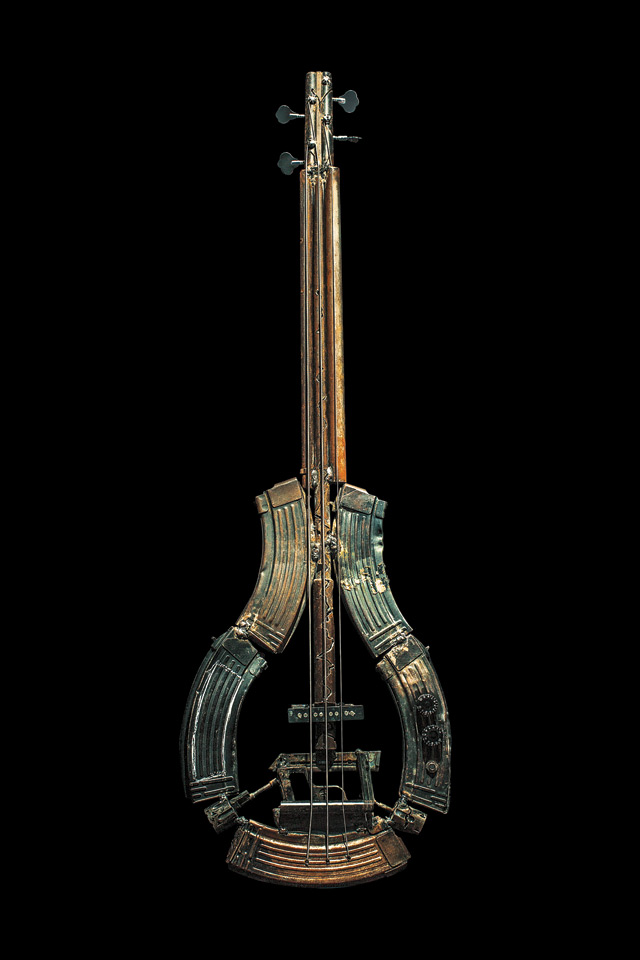
In 2008, artist Pedro Reyes implemented a project in the city of Culiacán (Mexico) by which he campaigned for voluntary donation of weapons, which could be exchanged for a coupon that local stores would honor for domestic appliances or electronics. He ended up collecting 1527 weapons, 40% of which were military, high-powered automatic weapons. The weapons were crushed, melted, and sent to a factory to create exactly 1527 shovels. The shovels were then distributed to schools and other institutions to be used for the planting of 1527 trees.


Through this project, he was exploring the transformation--alchemical, really--of an "agent of death" into an "agent of life." And then someone told him about a mass of weapons that had not been voluntarily given up, but rather taken in the raids and arrests of cartel members.


These weapons had been dismantled (made unusable) and were scheduled to be buried, but Reyes had in mind another alchemical project, instead. A massive project, a study of sound and technology as well as sculpture.

He says, "I'm taking this piece of metal, this pistol, which represents our instinct of killing each other, and I'm turning it into a (musical) instrument which is, ultimately, the most sophisticated form of communication on the planet."


On his own blog (here quoted from Colossal), Pedro Reyes says of the project that "It’s difficult to explain but the transformation was more than physical. It’s important to consider that many lives were taken with these weapons; as if a sort of exorcism was taking place the music expelled the demons they held, as well as being a requiem for lives lost."


It occurs to me that as a musician, it would be amazing to have made your own instrument, a unique instrument for yourself, which is also a sculpture--not factory-made, not something you dumped a bunch of money on-- which would also serve as a talisman, really. What could have claimed your life, what promised only horror, now you have transformed, as if in a lucid dream, into a luminous voice that expresses an entirely different intention. The instrument itself represents evolution, and each time you picked it up, there would be a sense of reverence, a sense of possibility, and a sense of your own magical power.

Enjoy the video!


Mr. Reyes will be giving a talk on this project at the Carnegie Museum of Art in Pittsburgh, PA on October 5, from 5-7 PM.
Via Colossal.

Thursday, June 27, 2013

Made By Hand, Part II

Section of the riddle clock created by Devin Montgomery

The Midnight Clock, a fully functioning clock marking 24 hours and the approximate times of sunrise, midday, sunset, and midnight, holds a riddle that teases you to discover and move various keys, in a particular order and at a particular time of day or night, in order to finally discover a hidden compartment. The clock is made for a treasure of your choosing to be hidden inside, the example given being a book.

The creator, Devin Montgomery, says:

“Fiction is filled with hidden doorways, destinations, and treasures--think of Tolkein’s secret door to Durin, Rawling’s platform 9 3/4, or Lewis’s wardrobe--but we rarely find them in real life. The Midnight Clock changes that.”

You can join the other supporters of this enterprise here.

Saturday, March 23, 2013

Minute Observation


Water City, by Beatrice Coron
[All of the artwork in this post is hand-cut tyvek, by Beatrice Coron. This medium is particularly effective for showing the interconnectedness of all things, as it is absence, in many cases, which defines what you see in her works.]

NOTE: For those of you who find the silver-on-black not so conducive to reading, this has also been posted here.


I am not actually a solid form; rather, I am a perceived collection of shivering atoms which are --individually-- constantly in motion, ever-traveling, from me to the sidewalk, to Mary's shoe, to the handsome man’s hand she shook, to the cat he pets, to the bird that just barely brushes that cat with its wing, teasing her, to the raindrop that filters through that wing on the way down to the top of your head, wherever you are. That’s one of my atoms that just landed on you, by the way, quickly becoming part of you--or one that I called “my” several months ago, and in the meantime, as it traveled, that atom  corresponded with other atoms via electrical impulse. So, why do we continue to insist that our consciousness (personhood? identity?--all that electrical communication behind our decision-making processes--) stops where the dermis meets the air? Konnikova explains in Mastermind that although 10 billion bits of information will hit our retinas at one time, of that, only 10 thousand will make it to our visual cortex, where only ten percent of the area is actually dedicated to perceiving that information. How much is there, right in front of us, yet invisible? And could that not be, for example, where all those parallel universes we hear about exist? The universe, then, would be huge and constantly growing--a weaving, just like the old myths suggested in the tales of the three Fates--and what we experience out of all that is simply selective filtering, the detachment of a single thread. 


Arbre de vie, by Beatrice Coron: here absence and presence alternatively define space--the
tree versus the buildings, for example.


Of course, the filtering is necessary: everything is too much. Konnikova reminds us that “a lack of filtering ability is the hallmark of many psychiatric conditions”--seeing more than one possibility at a time puts you out of sync with each one of them. Once the experience is chosen, once you have sunk fully into a personality, with its particular visual/aural/textural patterns, the other options might as well not be there. Those of us experiencing one particular existence are all, therefore, sharing information at some level--whether it be subliminally, via community and cultural heritage, via genetics, or even via that silent communication of shifting atoms, we agree to chunk certain aspects of the seething information in front of us in similar ways (think of The Matrix, with all those ones and zeros which somehow create the same ‘world’ in front of each participant). 
So we should recognize that the circumference of objects isn’t nearly as solid as it appears; also, that on some level we are absolutely, always communicating with those hazy objects around us; and that therefore, it’s sort of ridiculous to think that it isn’t worth it to try to make that communication more conscious: telepathy, telekinesis, magic.


Beatrice Coron’s Unicity, from the series Personal Cities.
[You are made up of all your stories, but also other people’s stories: not just because
of those atoms floating around and through other people, but also because what others have
already done somehow delineates what you think of as possible. They make up the world as
you know it so far.]
Electric from the Identity Project by Beatrice Coron


Making that communication between atoms more conscious takes effort, of course. The first effort is to realize how much we are missing; one way is to pause, un-focus our gaze a bit and unfilter for a moment. Take the time to really, really see. A wondrous example of this particular effort is detailed through the pages of Gordon Dahlquist’s The Different Girl, in which such attention to detail is part of the conscious process of becoming human. Four girls, handmade by scientists in some dystopian future, are in the process of learning how to formulate the questions they want to answer themselves (as opposed to merely responding to those asked by the scientists). Whereas by “nature,” they observe all details and catalogue them, without the particular questions of their creators serving to frame that observation in a certain manner, the information isn’t really processed. They are, as the book opens, at the point in their existence where their creators are slowly teaching them how to formulate their own method of processing information, and a major step in doing so is for each of them to explore bits of the island they live on alone--for the first time, not as a group of four, often escorted. The idea is disconcerting, to begin with, a little frightening, but we watch as they learn to manage it. That process is something we, too, as humans, only do in small ways. The magic that I mentioned above is a result of looking out at the world without the restrictions of consensual reality--by yourself, not with the other minds that you generally process information with--and forming your own parameters for how you look at it and give it meaning. For them, because they were handmade and not born, this is a process that they can maneuver consciously, with awareness, because they’re not forming that ego and that set of parameters as a three-year-old human.
At the beginning of the book, all four girls still go everywhere together, and Veronika, the girl remembering the story to us, describes the regular patterns of their days. One regular activity, part of their schooling, was to take a ten minute walk outside before they entered the classroom:

“This meant we could go anywhere we wanted, pick up anything, think of anything, only we had to be at the classroom in ten minutes, and then we had to talk about what we’d done or where we’d been. Sometimes Irene walked with us, which made it strange when we were back in the classroom, because we’d have to describe what we’d done, even though she’d been with us the entire time. But we learned she was listening to how we said things, not what, and to what we didn’t talk about as much as what we did. Which was how we realized that a difference between could and did was a thing all by itself, separate from either one alone, and that we were being taught about things that were invisible.…One day we finished our ten-minute walk and, like always, each took a seat on our own bench. Irene and Robbert told us to pay attention to little things as much as big--at how little things made big things--so that morning we stood in the grass, which came to our faces, and paid attention to the insects buzzing around the feathered tops of the stalks, and to the warmth of the sun, and how cool the grass still was around our feet, and that there were different insects down there, hopping. That was what Isobel said, because she went first. The rest of us said the same thing, except Eleanor, who saw a little brown bird fly past, looking for bugs.”

As you read the novel, you begin to realize what a difference there is between the way you usually observe things and the way you could observe things. It’s not just the insane amount of detail, it’s the type of detail. These characters are consciously processing things the rest of us leave to our subconscious. They are observing the way science dreams it observes, the way scientists constantly insist that we should observe--except these girls, unlike scientists, have not yet decided which details it is logical to observe. 
The story begins, the patterns are explained, and then they begin to change. For the first time, the girls are sent in four different directions for their walks, this time for 30 minutes, all to come back and describe what they observed without the collective knowledge to work from. Veronika goes out to the dock. Her observational skill reminded me of Sherlock’s, but mixed with a sense of the vertiginous newness of being one, alone:

“Walking onto the dock was a little like walking alone into the middle of the ocean, especially when I looked back and saw the island behind me.The dock had metal cleats for the boat to tie up but no railing, so I was careful to walk in the exact center and stop before reaching the far end, which was the rule to keep everyone safe if they happened to fall down. It took twelve minutes to walk from the buildings to the dock, so I knew that with the return time I had six minutes to stand and look, at the big things and at the little. First, I crouched and studied the wooden planks. I peeled away a splinter and the wood underneath was a different color. I found two boards that had warped enough to open a crack between them, and through it I saw the water. Or I could see shadows, but I knew the shadows were the water--which made me think of the difference between water in the sunlight and water in the dark, and whether, since sunlight went through the water they were even the same thing at all, and which had come first. Was dark water somehow more natural? Or was the dark ocean incomplete and the sunny ocean the finished version, like a sandwich with the final layer of mustard? Irene liked mustard on her sandwiches except for peanut butter, but she only ate peanut butter when there wasn’t anything else, which is one way we knew the supply boat would be coming: sandwiches without mustard.Before I left I looked up and saw two seagulls, so close that I could imagine how soft their feathers would be to touch. I watched until they disappeared around the other side of the island. I knew it would actually take me longer to go uphill than to go down, but still I stayed on the dock, surrounded by the idea of being alone. Another invisible.”


Sirenes, by Beatrice Coron.  [The light upon/filtering through the dark water
creates the form of these sirens.]


That decision to stay makes her five minutes late, which is a huge abnormality. The girls, of course, can always tell the time, internally, and they are able to measure precisely how long each of their actions takes. So the first thing Robbert wants to know when she gets back is if she realizes that she’s late:

“I told him that yes, I did know, but that I was in the middle of looking at things and thought that the looking was more important than the getting back. Robbert stopped me again. Then he asked me why I thought that--why did I possibly think that was true?”

She made a choice, without the input of anyone else, and in fact, against the input of her instruction (to be back in thirty minutes). She enters the classroom and details what she saw.

“Then Isobel told about her trip to the cliffs, and everything began to change, like the air in a room getting colder when a door is opened, because I realized that I was looking at Isobel like the others had looked at me......I was outside of everything they said [as each described her own experience], like I listened to their stories through a window. I could imagine everything they said--I understood the words, but the understanding happened in me by myself, not in me with them...we all seemed to enjoy our time alone, but then felt strange when the others talked about their times alone, which didn’t make sense.”

It does make sense, though. What she’s describing, there, is something more than one of us listening to a coworker describe her trip to Belize that she enjoyed while the rest of us were shuffling through sub-zero temperatures to a cubicle. This moment is more like the one that happens when you first realize that Suzie goes home to six brothers and sisters and plays with a nanny in something called a garden, and that she has puppies which have names and snuggle up to her in the bed, whereas you have one brother and a cat, and you live in an apartment. Suzie has Tickle-me-Elmo, and you do not. Veronika learns that same thing in a very different, more empowering way: this is the moment where Veronika realizes that things are not the same for all, that she is unique, and can have her own experience of life. And what we can take away from her realization is the same thing she’s supposed to be taking from it: how to pay attention without outside influence (or, Konnikova would say: how to pay attention while at least aware of those outside influences that are always there)--how to pay attention in the particular way that only I can. The distinction is empowering, the distinction is where my own personal magic will come from. Veronika’s tale is a fantastic experience of the process of being human, of pushing past habit and automatism (See St. Fevronia) to be alive.


Balloon City, by Beatrice Coron: disconnected/connected worlds. What might
they look like? How are they separate and yet connected?


IMAGINATION

The second effort towards that consciousness of the communications between atoms is to rewrite our understanding of such things, to re-teach our imagination how to explore in that area, so that it might come up with some solid hypotheses to investigate. For that, we have to overcome powerful cultural barriers that have so far limited our imagination in order to keep its ideas within the constraints of our shared reality.

That step is difficult, but it’s been done many times before. The practice of science itself, for example, also takes an immense amount of imagination:

“‘It strikes me, my good Lestrade, as being just a trifle too obvious. You do not add imagination to your other great qualities, but if you could for one moment put yourself in the place of this young man, would you choose the very night after the will had been made to commit your crime? Would it not seem dangerous to you to make so very close a relation between the two incidents? Again, would you choose an occasion when you are known to be in the house, when a servant has let you in? And, finally, would you take the great pains to conceal the body, and yet leave your own stick as a sign that you were the criminal? Confess, Lestrade, that all this is very unlikely.’But Lestrade just shrugs his shoulders. What does imagination have to do with it? Observation and deduction, sure: these are the lynchpins of detective work. But imagination? Isn’t that just a flimsy retreat of the less hard-minded and scientific professions, those artistic dalliers who couldn’t be further from Scotland Yard? Lestrade doesn’t understand just how wrong he is—and just how central a role imagination plays, not just to the successful inspector or detective but to any person who would hold himself as a successful thinker. If he were to listen to Holmes for more than clues as to a suspect’s identity or a case’s line of inquiry, he would find that he might have less need of turning to him in the future. For, if imagination does not enter into the picture—and do so before any deduction takes place—all of those observations, all of that understanding of the prior chapters will have little value indeed. Imagination is the essential next step of the thought process. It uses the building blocks of all of the observations that you’ve collected to create the material that can then serve as a solid base for future deduction, be it as to the events of that fateful Norwood evening when Jonas Oldacre met his death or the solution to a pesky problem that has been gnawing at you at home or at work. If you think that you can skip it, that it is something unscientific and frivolous, you’ll find yourself having wasted much effort only to arrive at a conclusion that, as clear and obvious as it may seem to you, could not be further from the truth.What is imagination, and why is it so important? Why, of all things to mention to Lestrade, does Holmes focus on this particular feature, and what is it doing in something as strict-sounding as the scientific method of the mind? Lestrade isn’t the first to turn his nose up at the thought of imagination playing a role in good old scientific reason, nor is Holmes alone in his insistence to the contrary. One of the greatest scientific thinkers of the twentieth century, Nobel-winning physicist Richard Feynman, frequently voiced his surprise at the lack of appreciation for what he thought was a central quality in both thinking and science. ‘It is surprising that people do not believe that there is imagination in science...The great difficulty is in trying to imagine something that you have never seen, that is consistent in every detail with what has already been seen, and that is different from what has been thought of; furthermore, it must be definite and not a vague proposition. That is indeed difficult.’”Konnikova, Maria (2013-01-03). Mastermind: How to Think Like Sherlock Holmes (pp. 112-113). Viking Adult. Kindle Edition. (Emphasis mine).

Difficult, but precisely what we’re talking about here.

So, if we were going to, today, make this effort? While thinking about how we would do so, I was fascinated to learn, rather by accident, yet more about hypnosis and self-hypnosis. You may recall my previous post on the Russian journalist S. and his ability to remove pain through a hypnotic imaging associated with Ars Memoria techniques, or the post on Monsters and Magic Sticks, where a patient with a crippling migraine was able to enter a hypnotic state and remove her pain via the mental act of throwing it (symbolically) as paint against an opposite wall. I have also talked here about Charles Tart and his experiments at Stanford University in which two hypnotized subjects led each other deeper and deeper into the hypnotic state until they were sharing a mental space all their own, having silent conversations and experiencing the same physical surroundings and reality of an island beach while those watching them still believed them to be sitting wordlessly in a lab, being tested. 

Imagine my surprise to find that such things were being discussed, tested, and experienced all the way back in the 1800s. In her book Ghost Hunters, Deborah Blum writes about physicist William Barrett, for example. Completely uninterested in Spiritualism or Psychic Studies, when asked about the topic, he had suggested rather flippantly that it was all due to hallucinations--still a common “scientific” response. Then he had a mind-changing experience. In 1875, he was south of Dublin, visiting friends who had begun conducting experiments in hypnosis (or mesmerism) with local villagers in the countryside. 

“When hypnotized, one of the girls seemed sometimes to make an uncanny connection to another person’s thoughts. Barrett, suspecting trickery, some kind of signaling, decided to lend a scientist’s hand. He blindfolded the girl and then asked his friend to perform a selected series of interactions with the hypnotized girl. As Barrett later wrote, “If [the friend] placed his hand over the lighted lamp, the girl instantly withdrew hers, as if in pain. If he tasted salt or sugar, corresponding expressions of dislike and approval were indicated by the girl.” Occasionally, the girl seemed also to inexplicably know some of what Barrett was pondering as he ran the experiments. Not precisely, but close enough, a ‘more or less distorted reflection of my own thought.’” Blum, Deborah (2007-05-29). Ghost Hunters: William James and the Search for Scientific Proof of Life After Death (Kindle Locations 1234-1240). Penguin Books. Kindle Edition. 

Barrett wrote about these experiments and received only the fury of the scientific community. How could he possibly? How could he lower the reputation, the standard set by science, by asking these questions? How could he publicly detail unapproved observations?

So, he set up a new test, with more subjects, and more stringent rules. He chose his participants based on the responses to a public call for any who had shown aptitude in the popular parlor activity, “The Willing Game,” which was not an exceptionally careful method of seeing if the group could will another guest to do something without actually telling him what that thing was.

Then he set to testing them.

“His results, summarized in the esteemed journal Nature, detailed test after test, done with a carefully chosen set of people, identified through their willing-game success or other evidence of mind-reading abilities. Among them were three young girls, daughters of a Presbyterian minister, who seemed startlingly responsive to Barrett’s mental instructions. Barrett assured readers that he took constant measures to prevent cheating in the experiments. For one series, he settled the girls in the family parlor and then closed himself up in their father’s study. Once seated at the heavy oak desk, Barrett began slowly listing household objects on a sheet of paper. The only instructions he gave the girls were to bring him the object that entered their minds. Only after they’d brought one object to the study—and he’d either accepted it or told the bringer to try again—would another command be put to paper. ‘Having fastened the doors, I wrote down the following articles, one by one, with the results stated: hairbrush, correctly brought; wine glass, correctly brought; orange, correctly brought; toasting-fork, wrong on first attempt, right on second; apple, correctly brought; smoothing-iron, correctly brought; tumbler, correctly brought; cup, correctly brought; saucer, failure.’ Lucky guesses were certainly possible, but, Barrett thought, not to this degree of consistency. Further, there could be no accusations of secret nudge-and-wink techniques, as with the willing game, ‘for there was no contact, and in some trials (as in the foregoing) the percipient was out of sight and hearing.’ It was possible that the girls had cheated, but it was difficult to see exactly how. Barrett’s requests had sometimes been impromptu, and when they weren’t, he hadn’t discussed them...”
Eusapia Palladino

Blum’s book is full of detailed descriptions of more experiments like the above one and different from it, the responses to each of the scientific community and the general community, the scandals and the successes. It is a fascinating read, and full of meticulous research. For the purposes of brevity, however, we will here skip forward to our atomic-level associations with objects; from telepathy we now pass to telekinesis.

Some of the most fantastic writing in Ghost Hunters comes during Blum’s descriptions of Eusapia Palladino and her sessions of telekinesis, first run by Richet, a doctor from the Salpetriere in France. As with all the experiments detailed in the book, hers had their detractors and suffered plenty of ridicule, but Blum deals with those topics exceedingly well, and they are as good a reason as any (many) to read the book itself. I would like to focus on two elements of the Palladino experiments, however: the telekinesis itself, and the subject’s significant lack of cultural restrictions--her imagination:

“Richet’s family owned a tiny island in the Mediterranean, just off the French Riviera, tucked amid three famously beautiful islands called the Isles of Gold. Ile Roubaud was a rocky scrap of land, scrubbed by light and polished by water. Only three buildings occupied the island. The Richet family summer cottage, though not large, bristled with towers, turrets, verandas, and porches. Nearby stood a lighthouse and a simple cottage for the lighthouse keeper. 
The simplest route there was to sail through the French government’s salt lagoons, where the dried layers of sea salt were prepared for sale. The salt ponds gave the voyage to Ile Roubaud a slightly unreal feeling, a passage through a landscape of almost blinding white where the sun dazzled on the crystal layers rimming the water. Beyond, across a blue sparkle of sea, lay the small island, encircled by pinwheeling seabirds. Richet thought it the perfect place to run tests on a troublesome medium. He would search her, isolate her on the island, and then he would see what happened to her so-called powers in the luminous light of Ile Roubaud. 
In the summer of 1894, Richet invited a small party to join him for the grand experiment. His guests—and witnesses and collaborators—were Fred Myers, Oliver Lodge, the Polish psychologist Julien Ochorowicz, and Richet’s personal secretary, who would be there to take notes.
“Lodge remembered the journey to Richet’s island as something of a comedy of errors...[Blum details some of their mishaps]...With some difficulty, [Lodge and Myers] hired a boat and made their way past the white glimmer of the salt lagoons, guarded by soldiers installed to protect the government’s lucrative monopoly on salt sales, apparently bent on preventing the theft of a single white crystal. ‘The salt monopoly has curious results,’ Lodge noted in his diary. ‘It appeared that the peasantry were forbidden to take a bucket of water out of the sea.’ The French soldiers returned the stares of the voyaging English-men; the air was filled with the dry creak of seagull voices overhead. Lodge feared that this was going to be a very odd visit. In that, he would be proved absolutely correct.”
…
“The sittings were held in the evenings, and the researchers had been instructed not to socialize beforehand with their captive medium. The group did gather for dinner, cooked and served by the lighthouse keeper’s wife. These meals tended to lapse into cacophony. The investigators conversed in French. Eusapia spoke Italian, in the Neapolitan dialect, loudly. She liked to shout down her companions, demanding that they listen to her life stories, over and over. She particularly liked to recall the dramas of her life, and she not only verbally re-created the moments, she acted them out in style. When she told of the brigands of her childhood—thieves who had reportedly killed her parents—she did it by leaping onto the table and, in Lodge’s fascinated words, ‘waving kitchen knives about like sabers.’”

And now, to the psychic events themselves:

“Each night, one of them—usually Richet’s secretary—took notes. The others took turns holding the medium’s hands and feet and even her head. Sometimes they used a traplike device designed by Ochorowicz, which caged her feet and caused a bell to ring if she moved them. Lodge and Myers found the medium just as puzzling as Richet had warned them she would be. A music box sitting on the table began to play and then rose to press against Myers’s chest. When it dropped to the floor, Myers stumbled forward. Something was pushing him from behind, he called out; would they please go look at it? His colleagues could hear a slapping sound against Myers’s back, but there was nothing there. A white protuberance suddenly extended from the medium, stretching in the dim light until it prodded Myers in the chest. He flinched back; it was fingerless, but it felt, he said, like a hand grasping his ribs. There were nights when a brass key sailed off the library table to fit itself into a door lock. Other times, a strange yellow and blue glimmer of light winked on, off, on again in the empty air. And there was that strange wind, rising out of a vacant corner, stirring the edges of the room.” Ghost Hunters 

There is so much more to her character, though, and to her abilities, and to the experiments that were run on her, both successfully and disastrously. Just for her story, this is a fascinating book. But the upshot is, this woman, Eusapia Palladino, was extraordinarily unbound by social conventions: she offered sex to everyone--recall this is the Victorian era--even the married scientists who tested her; she made a game out of cheating whenever she could figure out a way to; she was brash and loud and uncontrollable, and her moods affected everyone. And she was also unaffected by the rules of communication between objects. She could throw things, create a breeze, or push you over without the use of her hands or feet. Her will, in all senses, was impressive.

A PURPOSE FOR THE NEWLY SEEN

“A piece of human brain the size of a grain of sand contains one hundred thousand neurons, two million axons and one billion synapses all talking to each other. The number of permutations and combinations of activity that are theoretically possible in each of our heads exceeds the number of elementary particles in the universe.” Robotham, Michael (2012-01-26). Shatter (Joseph O'Loughlin) (Kindle Locations 85-87). Little, Brown and Company. Kindle Edition. (Fiction, but the above is true).


(Above) Small World, by Beatrice Coron.
and
(Below) La Republique des Livres, also Beatrice Coron.


If there really are these parallel realities, every permutation existing already somewhere in one of the many universes, only we can’t see them, why is that? Is that because they are the information our visual system filters out? Is it because all possibilities exist already in our brains, as ideas, and we simply choose one to believe and experience, ignorant of all the rest, or disregarding it as fantasy? I say simply, but of course the process seems anything but. How do we choose? Subconsciously. Our thought processes, culturally and experientially created before we were born and then briefly afterwards, before we were conscious of the process of decision-making, are like a prison cell, trapping us (this is the free will versus fate argument, right here) forever in a path that we may not like at all. The difference, then, between a true magician (as opposed to a stage magician) and me, is that he changes what he does not like. I have been exploring mountains of options for learning to change things in that manner in this blog: using the memory skills of Ars Memoria, paired with the object-interaction ideas of Varo or Feng Shui; symbolic actions based in images our dreams give us; and self-hypnosis, an idea of becoming, at least briefly, a witness to our surroundings instead of a participant in them. For example, in Barrett’s experiments, above, when the subjects become able to experience another’s sense of taste, or another’s thought process. 
Konnikova also mentions an act similar to this in her Mastermind, when she lays out the theory studied by Ethan Kross and walks us through one of his experiments:
“Try this exercise. Close your eyes.[...]Think of a specific situation where you felt angry or hostile, your most recent fight with a close friend or significant other, for instance. Do you have a moment in mind? Recall it as closely as you can, as if you were going through it again. Once you’re done, tell me how you feel. And tell me as far as you can what went wrong. Who was to blame? Why? Do you think it’s something that can be fixed? Close your eyes again. Picture the same situation. Only now, I want you to imagine that it is happening to two people who are not you. You are just a small fly on the wall, looking down at the scene and taking note of it. You are free to buzz around and observe from all angles and no one will see you. Once again, as soon as you finish, tell me how you feel. And then respond to the same questions as before. You’ve just completed a classic exercise in mental distancing through visualization. It’s a process of picturing something vividly but from a distance, and so, from a perspective that is inherently different from the actual one you have stored in your memory. From scenario one to scenario two, you have gone from a concrete to an abstract mindset; you’ve likely become calmer emotionally, seen things that you missed the first time around, and you may have even come away with a slightly modified memory of what happened. In fact, you may have even become and better at solving problems overall, unrelated to the scenario in question.” Konnikova, Maria (2013-01-03). Mastermind: How to Think Like Sherlock Holmes (p. 148). Viking Adult. Kindle Edition. 

How? By becoming a fly on the wall. Via meditation, one of the many names for a particular activity some saints knew as praying, some spiritualists knew as trance--shamans, mediums, yogis, sufis--the idea, throughout time, is that, if you want to get out of the trap you feel your self to be, then...get out of it. See differently. Once you see outside your own perspective, your own perspective can change, and voila: you are someone else. 
Unfilter.
You’ve been living the life of Mr. X, believing what he believes, remembering what he remembers the way he remembers it. Back up, watch Mr. X from a distance, see what he’s doing as not what you’re doing, but as the actions of a third person. Perhaps take up a pencil, and narrate your day or the problem you’re picking at from a third person viewpont. Address it as if it were the story of someone else, and pay attention to things like: what’s behind Mr. X? What’s in his peripheral vision that he’s not paying attention to? Who just spoke to him that he didn’t even acknowledge? What passed by, while he was screaming at the top of his lungs, in the midst of the argument? Take in way more detail than you thought was even possible, adjust your focus on some other part of the universe in the story, some strange detail.
For example, Mr. X is having his screaming fit, feeling entirely trapped in frustrating impossibility. On the table to his right, which he brushed up against, grasping it for stability when he felt he might pass out from the stress of the situation, there is a book chronicling the life and works of Remedios Varo. It is open to the page about the intense magic power of what others have known as Feng Shui. You stop watching him and lean over it, learning a bit about her contemporary society, and the people in your own society who have an interest in her work, life or time-period. You move over to your laptop, making contact with one of them in order to pose a question, which they answer, which sends you off to another contact to ask a different question-- in ever more tangential circles, further and further out, the lives these other people with a shared interest lead, the things they ‘know’ which you had never heard of before, and suddenly, you’re remembering your own past differently, because you’re remembering the things--long buried or even misrepresented--which led you to this, very different place in the universe, the one in which Remedios Varo plays such a key part. You’re remembering how you tried to draw as a child but your mother kept pointing with irritation at the horse-legs sprouting from the bird’s body and telling you you’ve got it wrong, but now you’re discovering the Hippogriff, an image which for ages and ages has represented impossible love, because it combines the bodies of predator and prey into one superior creature. You’re discovering that there’s a whole genre of painters and artists who place items together which “don’t belong,” and they get along quite well. You’ve started painting in an attempt to capture the feel of the images you see which you can’t own, adding your own little details and objects, and then everywhere begin to discover references to just those types of juxtaposition (haven’t you ever noticed that when you first learn a new word, you begin seeing it everywhere, though before you never once saw it??). 
You now hardly even remember the apoplectic moment Mr. X was having--the memory is so hazy, in fact, it’s as if it were someone else’s, because it holds no importance in your present life. You’re remembering differently, and your dreams of the future are different, and you re-discover things and people you thought were long lost, or find things and people you thought were non-existent, impossible, even. Suddenly, you are Mr. Y. Do you see?
You have changed streams, you have created a wormhole. And it had nothing to do with strenuous lab-work and breaking the speed of light in your billion-dollar apparatus. You have changed the past as well as the future, because you have realized that things happened in your past which previously you did not remember, and you have forgotten things completely that were once defining moments, and because the new memories have been threaded together with present events in a way that opens the life before you in previously impossible ways. 

Enjoy: