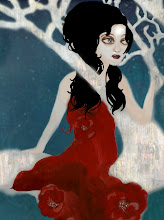
Water City, by Beatrice Coron
[All of the artwork in this post is hand-cut tyvek, by Beatrice Coron. This medium is particularly effective for showing the interconnectedness of all things, as it is absence, in many cases, which defines what you see in her works.]
NOTE: For those of you who find the silver-on-black not so conducive to reading, this has also been posted here.
I am not actually a solid form; rather, I am a perceived collection of shivering atoms which are --individually-- constantly in motion, ever-traveling, from me to the sidewalk, to Mary's shoe, to the handsome man’s hand she shook, to the cat he pets, to the bird that just barely brushes that cat with its wing, teasing her, to the raindrop that filters through that wing on the way down to the top of your head, wherever you are. That’s one of my atoms that just landed on you, by the way, quickly becoming part of you--or one that I called “my” several months ago, and in the meantime, as it traveled, that atom corresponded with other atoms via electrical impulse. So, why do we continue to insist that our consciousness (personhood? identity?--all that electrical communication behind our decision-making processes--) stops where the dermis meets the air? Konnikova explains in Mastermind that although 10 billion bits of information will hit our retinas at one time, of that, only 10 thousand will make it to our visual cortex, where only ten percent of the area is actually dedicated to perceiving that information. How much is there, right in front of us, yet invisible? And could that not be, for example, where all those parallel universes we hear about exist? The universe, then, would be huge and constantly growing--a weaving, just like the old myths suggested in the tales of the three Fates--and what we experience out of all that is simply selective filtering, the detachment of a single thread.

Arbre de vie, by Beatrice Coron: here absence and presence alternatively define space--the
tree versus the buildings, for example.
Of course, the filtering is necessary: everything is too much. Konnikova reminds us that “a lack of filtering ability is the hallmark of many psychiatric conditions”--seeing more than one possibility at a time puts you out of sync with each one of them. Once the experience is chosen, once you have sunk fully into a personality, with its particular visual/aural/textural patterns, the other options might as well not be there. Those of us experiencing one particular existence are all, therefore, sharing information at some level--whether it be subliminally, via community and cultural heritage, via genetics, or even via that silent communication of shifting atoms, we agree to chunk certain aspects of the seething information in front of us in similar ways (think of The Matrix, with all those ones and zeros which somehow create the same ‘world’ in front of each participant).
So we should recognize that the circumference of objects isn’t nearly as solid as it appears; also, that on some level we are absolutely, always communicating with those hazy objects around us; and that therefore, it’s sort of ridiculous to think that it isn’t worth it to try to make that communication more conscious: telepathy, telekinesis, magic.
Beatrice Coron’s Unicity, from the series Personal Cities.
[You are made up of all your stories, but also other people’s stories: not just because
of those atoms floating around and through other people, but also because what others have
already done somehow delineates what you think of as possible. They make up the world as
you know it so far.]
Electric from the Identity Project by Beatrice Coron
Making that communication between atoms more conscious takes effort, of course. The first effort is to realize how much we are missing; one way is to pause, un-focus our gaze a bit and unfilter for a moment. Take the time to really, really see. A wondrous example of this particular effort is detailed through the pages of Gordon Dahlquist’s The Different Girl, in which such attention to detail is part of the conscious process of becoming human. Four girls, handmade by scientists in some dystopian future, are in the process of learning how to formulate the questions they want to answer themselves (as opposed to merely responding to those asked by the scientists). Whereas by “nature,” they observe all details and catalogue them, without the particular questions of their creators serving to frame that observation in a certain manner, the information isn’t really processed. They are, as the book opens, at the point in their existence where their creators are slowly teaching them how to formulate their own method of processing information, and a major step in doing so is for each of them to explore bits of the island they live on alone--for the first time, not as a group of four, often escorted. The idea is disconcerting, to begin with, a little frightening, but we watch as they learn to manage it. That process is something we, too, as humans, only do in small ways. The magic that I mentioned above is a result of looking out at the world without the restrictions of consensual reality--by yourself, not with the other minds that you generally process information with--and forming your own parameters for how you look at it and give it meaning. For them, because they were handmade and not born, this is a process that they can maneuver consciously, with awareness, because they’re not forming that ego and that set of parameters as a three-year-old human.
At the beginning of the book, all four girls still go everywhere together, and Veronika, the girl remembering the story to us, describes the regular patterns of their days. One regular activity, part of their schooling, was to take a ten minute walk outside before they entered the classroom:
“This meant we could go anywhere we wanted, pick up anything, think of anything, only we had to be at the classroom in ten minutes, and then we had to talk about what we’d done or where we’d been. Sometimes Irene walked with us, which made it strange when we were back in the classroom, because we’d have to describe what we’d done, even though she’d been with us the entire time. But we learned she was listening to how we said things, not what, and to what we didn’t talk about as much as what we did. Which was how we realized that a difference between could and did was a thing all by itself, separate from either one alone, and that we were being taught about things that were invisible.…One day we finished our ten-minute walk and, like always, each took a seat on our own bench. Irene and Robbert told us to pay attention to little things as much as big--at how little things made big things--so that morning we stood in the grass, which came to our faces, and paid attention to the insects buzzing around the feathered tops of the stalks, and to the warmth of the sun, and how cool the grass still was around our feet, and that there were different insects down there, hopping. That was what Isobel said, because she went first. The rest of us said the same thing, except Eleanor, who saw a little brown bird fly past, looking for bugs.”
As you read the novel, you begin to realize what a difference there is between the way you usually observe things and the way you could observe things. It’s not just the insane amount of detail, it’s the type of detail. These characters are consciously processing things the rest of us leave to our subconscious. They are observing the way science dreams it observes, the way scientists constantly insist that we should observe--except these girls, unlike scientists, have not yet decided which details it is logical to observe.
The story begins, the patterns are explained, and then they begin to change. For the first time, the girls are sent in four different directions for their walks, this time for 30 minutes, all to come back and describe what they observed without the collective knowledge to work from. Veronika goes out to the dock. Her observational skill reminded me of Sherlock’s, but mixed with a sense of the vertiginous newness of being one, alone:
“Walking onto the dock was a little like walking alone into the middle of the ocean, especially when I looked back and saw the island behind me.The dock had metal cleats for the boat to tie up but no railing, so I was careful to walk in the exact center and stop before reaching the far end, which was the rule to keep everyone safe if they happened to fall down. It took twelve minutes to walk from the buildings to the dock, so I knew that with the return time I had six minutes to stand and look, at the big things and at the little. First, I crouched and studied the wooden planks. I peeled away a splinter and the wood underneath was a different color. I found two boards that had warped enough to open a crack between them, and through it I saw the water. Or I could see shadows, but I knew the shadows were the water--which made me think of the difference between water in the sunlight and water in the dark, and whether, since sunlight went through the water they were even the same thing at all, and which had come first. Was dark water somehow more natural? Or was the dark ocean incomplete and the sunny ocean the finished version, like a sandwich with the final layer of mustard? Irene liked mustard on her sandwiches except for peanut butter, but she only ate peanut butter when there wasn’t anything else, which is one way we knew the supply boat would be coming: sandwiches without mustard.Before I left I looked up and saw two seagulls, so close that I could imagine how soft their feathers would be to touch. I watched until they disappeared around the other side of the island. I knew it would actually take me longer to go uphill than to go down, but still I stayed on the dock, surrounded by the idea of being alone. Another invisible.”

Sirenes, by Beatrice Coron. [The light upon/filtering through the dark water
creates the form of these sirens.]
That decision to stay makes her five minutes late, which is a huge abnormality. The girls, of course, can always tell the time, internally, and they are able to measure precisely how long each of their actions takes. So the first thing Robbert wants to know when she gets back is if she realizes that she’s late:
“I told him that yes, I did know, but that I was in the middle of looking at things and thought that the looking was more important than the getting back. Robbert stopped me again. Then he asked me why I thought that--why did I possibly think that was true?”
She made a choice, without the input of anyone else, and in fact, against the input of her instruction (to be back in thirty minutes). She enters the classroom and details what she saw.
“Then Isobel told about her trip to the cliffs, and everything began to change, like the air in a room getting colder when a door is opened, because I realized that I was looking at Isobel like the others had looked at me......I was outside of everything they said [as each described her own experience], like I listened to their stories through a window. I could imagine everything they said--I understood the words, but the understanding happened in me by myself, not in me with them...we all seemed to enjoy our time alone, but then felt strange when the others talked about their times alone, which didn’t make sense.”
It does make sense, though. What she’s describing, there, is something more than one of us listening to a coworker describe her trip to Belize that she enjoyed while the rest of us were shuffling through sub-zero temperatures to a cubicle. This moment is more like the one that happens when you first realize that Suzie goes home to six brothers and sisters and plays with a nanny in something called a garden, and that she has puppies which have names and snuggle up to her in the bed, whereas you have one brother and a cat, and you live in an apartment. Suzie has Tickle-me-Elmo, and you do not. Veronika learns that same thing in a very different, more empowering way: this is the moment where Veronika realizes that things are not the same for all, that she is unique, and can have her own experience of life. And what we can take away from her realization is the same thing she’s supposed to be taking from it: how to pay attention without outside influence (or, Konnikova would say: how to pay attention while at least aware of those outside influences that are always there)--how to pay attention in the particular way that only I can. The distinction is empowering, the distinction is where my own personal magic will come from. Veronika’s tale is a fantastic experience of the process of being human, of pushing past habit and automatism (See St. Fevronia) to be alive.

Balloon City, by Beatrice Coron: disconnected/connected worlds. What might
they look like? How are they separate and yet connected?
IMAGINATION
The second effort towards that consciousness of the communications between atoms is to rewrite our understanding of such things, to re-teach our imagination how to explore in that area, so that it might come up with some solid hypotheses to investigate. For that, we have to overcome powerful cultural barriers that have so far limited our imagination in order to keep its ideas within the constraints of our shared reality.
That step is difficult, but it’s been done many times before. The practice of science itself, for example, also takes an immense amount of imagination:
“‘It strikes me, my good Lestrade, as being just a trifle too obvious. You do not add imagination to your other great qualities, but if you could for one moment put yourself in the place of this young man, would you choose the very night after the will had been made to commit your crime? Would it not seem dangerous to you to make so very close a relation between the two incidents? Again, would you choose an occasion when you are known to be in the house, when a servant has let you in? And, finally, would you take the great pains to conceal the body, and yet leave your own stick as a sign that you were the criminal? Confess, Lestrade, that all this is very unlikely.’But Lestrade just shrugs his shoulders. What does imagination have to do with it? Observation and deduction, sure: these are the lynchpins of detective work. But imagination? Isn’t that just a flimsy retreat of the less hard-minded and scientific professions, those artistic dalliers who couldn’t be further from Scotland Yard? Lestrade doesn’t understand just how wrong he is—and just how central a role imagination plays, not just to the successful inspector or detective but to any person who would hold himself as a successful thinker. If he were to listen to Holmes for more than clues as to a suspect’s identity or a case’s line of inquiry, he would find that he might have less need of turning to him in the future. For, if imagination does not enter into the picture—and do so before any deduction takes place—all of those observations, all of that understanding of the prior chapters will have little value indeed. Imagination is the essential next step of the thought process. It uses the building blocks of all of the observations that you’ve collected to create the material that can then serve as a solid base for future deduction, be it as to the events of that fateful Norwood evening when Jonas Oldacre met his death or the solution to a pesky problem that has been gnawing at you at home or at work. If you think that you can skip it, that it is something unscientific and frivolous, you’ll find yourself having wasted much effort only to arrive at a conclusion that, as clear and obvious as it may seem to you, could not be further from the truth.What is imagination, and why is it so important? Why, of all things to mention to Lestrade, does Holmes focus on this particular feature, and what is it doing in something as strict-sounding as the scientific method of the mind? Lestrade isn’t the first to turn his nose up at the thought of imagination playing a role in good old scientific reason, nor is Holmes alone in his insistence to the contrary. One of the greatest scientific thinkers of the twentieth century, Nobel-winning physicist Richard Feynman, frequently voiced his surprise at the lack of appreciation for what he thought was a central quality in both thinking and science. ‘It is surprising that people do not believe that there is imagination in science...The great difficulty is in trying to imagine something that you have never seen, that is consistent in every detail with what has already been seen, and that is different from what has been thought of; furthermore, it must be definite and not a vague proposition. That is indeed difficult.’”Konnikova, Maria (2013-01-03). Mastermind: How to Think Like Sherlock Holmes (pp. 112-113). Viking Adult. Kindle Edition. (Emphasis mine).
Difficult, but precisely what we’re talking about here.
So, if we were going to, today, make this effort? While thinking about how we would do so, I was fascinated to learn, rather by accident, yet more about hypnosis and self-hypnosis. You may recall my previous post on the Russian journalist S. and his ability to remove pain through a hypnotic imaging associated with Ars Memoria techniques, or the post on Monsters and Magic Sticks, where a patient with a crippling migraine was able to enter a hypnotic state and remove her pain via the mental act of throwing it (symbolically) as paint against an opposite wall. I have also talked here about Charles Tart and his experiments at Stanford University in which two hypnotized subjects led each other deeper and deeper into the hypnotic state until they were sharing a mental space all their own, having silent conversations and experiencing the same physical surroundings and reality of an island beach while those watching them still believed them to be sitting wordlessly in a lab, being tested.
Imagine my surprise to find that such things were being discussed, tested, and experienced all the way back in the 1800s. In her book Ghost Hunters, Deborah Blum writes about physicist William Barrett, for example. Completely uninterested in Spiritualism or Psychic Studies, when asked about the topic, he had suggested rather flippantly that it was all due to hallucinations--still a common “scientific” response. Then he had a mind-changing experience. In 1875, he was south of Dublin, visiting friends who had begun conducting experiments in hypnosis (or mesmerism) with local villagers in the countryside.
“When hypnotized, one of the girls seemed sometimes to make an uncanny connection to another person’s thoughts. Barrett, suspecting trickery, some kind of signaling, decided to lend a scientist’s hand. He blindfolded the girl and then asked his friend to perform a selected series of interactions with the hypnotized girl. As Barrett later wrote, “If [the friend] placed his hand over the lighted lamp, the girl instantly withdrew hers, as if in pain. If he tasted salt or sugar, corresponding expressions of dislike and approval were indicated by the girl.” Occasionally, the girl seemed also to inexplicably know some of what Barrett was pondering as he ran the experiments. Not precisely, but close enough, a ‘more or less distorted reflection of my own thought.’” Blum, Deborah (2007-05-29). Ghost Hunters: William James and the Search for Scientific Proof of Life After Death (Kindle Locations 1234-1240). Penguin Books. Kindle Edition.
Barrett wrote about these experiments and received only the fury of the scientific community. How could he possibly? How could he lower the reputation, the standard set by science, by asking these questions? How could he publicly detail unapproved observations?
So, he set up a new test, with more subjects, and more stringent rules. He chose his participants based on the responses to a public call for any who had shown aptitude in the popular parlor activity, “The Willing Game,” which was not an exceptionally careful method of seeing if the group could will another guest to do something without actually telling him what that thing was.
Then he set to testing them.
“His results, summarized in the esteemed journal Nature, detailed test after test, done with a carefully chosen set of people, identified through their willing-game success or other evidence of mind-reading abilities. Among them were three young girls, daughters of a Presbyterian minister, who seemed startlingly responsive to Barrett’s mental instructions. Barrett assured readers that he took constant measures to prevent cheating in the experiments. For one series, he settled the girls in the family parlor and then closed himself up in their father’s study. Once seated at the heavy oak desk, Barrett began slowly listing household objects on a sheet of paper. The only instructions he gave the girls were to bring him the object that entered their minds. Only after they’d brought one object to the study—and he’d either accepted it or told the bringer to try again—would another command be put to paper. ‘Having fastened the doors, I wrote down the following articles, one by one, with the results stated: hairbrush, correctly brought; wine glass, correctly brought; orange, correctly brought; toasting-fork, wrong on first attempt, right on second; apple, correctly brought; smoothing-iron, correctly brought; tumbler, correctly brought; cup, correctly brought; saucer, failure.’ Lucky guesses were certainly possible, but, Barrett thought, not to this degree of consistency. Further, there could be no accusations of secret nudge-and-wink techniques, as with the willing game, ‘for there was no contact, and in some trials (as in the foregoing) the percipient was out of sight and hearing.’ It was possible that the girls had cheated, but it was difficult to see exactly how. Barrett’s requests had sometimes been impromptu, and when they weren’t, he hadn’t discussed them...”
Eusapia Palladino
Blum’s book is full of detailed descriptions of more experiments like the above one and different from it, the responses to each of the scientific community and the general community, the scandals and the successes. It is a fascinating read, and full of meticulous research. For the purposes of brevity, however, we will here skip forward to our atomic-level associations with objects; from telepathy we now pass to telekinesis.
Some of the most fantastic writing in Ghost Hunters comes during Blum’s descriptions of Eusapia Palladino and her sessions of telekinesis, first run by Richet, a doctor from the Salpetriere in France. As with all the experiments detailed in the book, hers had their detractors and suffered plenty of ridicule, but Blum deals with those topics exceedingly well, and they are as good a reason as any (many) to read the book itself. I would like to focus on two elements of the Palladino experiments, however: the telekinesis itself, and the subject’s significant lack of cultural restrictions--her imagination:
“Richet’s family owned a tiny island in the Mediterranean, just off the French Riviera, tucked amid three famously beautiful islands called the Isles of Gold. Ile Roubaud was a rocky scrap of land, scrubbed by light and polished by water. Only three buildings occupied the island. The Richet family summer cottage, though not large, bristled with towers, turrets, verandas, and porches. Nearby stood a lighthouse and a simple cottage for the lighthouse keeper.
The simplest route there was to sail through the French government’s salt lagoons, where the dried layers of sea salt were prepared for sale. The salt ponds gave the voyage to Ile Roubaud a slightly unreal feeling, a passage through a landscape of almost blinding white where the sun dazzled on the crystal layers rimming the water. Beyond, across a blue sparkle of sea, lay the small island, encircled by pinwheeling seabirds. Richet thought it the perfect place to run tests on a troublesome medium. He would search her, isolate her on the island, and then he would see what happened to her so-called powers in the luminous light of Ile Roubaud.
In the summer of 1894, Richet invited a small party to join him for the grand experiment. His guests—and witnesses and collaborators—were Fred Myers, Oliver Lodge, the Polish psychologist Julien Ochorowicz, and Richet’s personal secretary, who would be there to take notes.
“Lodge remembered the journey to Richet’s island as something of a comedy of errors...[Blum details some of their mishaps]...With some difficulty, [Lodge and Myers] hired a boat and made their way past the white glimmer of the salt lagoons, guarded by soldiers installed to protect the government’s lucrative monopoly on salt sales, apparently bent on preventing the theft of a single white crystal. ‘The salt monopoly has curious results,’ Lodge noted in his diary. ‘It appeared that the peasantry were forbidden to take a bucket of water out of the sea.’ The French soldiers returned the stares of the voyaging English-men; the air was filled with the dry creak of seagull voices overhead. Lodge feared that this was going to be a very odd visit. In that, he would be proved absolutely correct.”
…
“The sittings were held in the evenings, and the researchers had been instructed not to socialize beforehand with their captive medium. The group did gather for dinner, cooked and served by the lighthouse keeper’s wife. These meals tended to lapse into cacophony. The investigators conversed in French. Eusapia spoke Italian, in the Neapolitan dialect, loudly. She liked to shout down her companions, demanding that they listen to her life stories, over and over. She particularly liked to recall the dramas of her life, and she not only verbally re-created the moments, she acted them out in style. When she told of the brigands of her childhood—thieves who had reportedly killed her parents—she did it by leaping onto the table and, in Lodge’s fascinated words, ‘waving kitchen knives about like sabers.’”
And now, to the psychic events themselves:
“Each night, one of them—usually Richet’s secretary—took notes. The others took turns holding the medium’s hands and feet and even her head. Sometimes they used a traplike device designed by Ochorowicz, which caged her feet and caused a bell to ring if she moved them. Lodge and Myers found the medium just as puzzling as Richet had warned them she would be. A music box sitting on the table began to play and then rose to press against Myers’s chest. When it dropped to the floor, Myers stumbled forward. Something was pushing him from behind, he called out; would they please go look at it? His colleagues could hear a slapping sound against Myers’s back, but there was nothing there. A white protuberance suddenly extended from the medium, stretching in the dim light until it prodded Myers in the chest. He flinched back; it was fingerless, but it felt, he said, like a hand grasping his ribs. There were nights when a brass key sailed off the library table to fit itself into a door lock. Other times, a strange yellow and blue glimmer of light winked on, off, on again in the empty air. And there was that strange wind, rising out of a vacant corner, stirring the edges of the room.” Ghost Hunters
There is so much more to her character, though, and to her abilities, and to the experiments that were run on her, both successfully and disastrously. Just for her story, this is a fascinating book. But the upshot is, this woman, Eusapia Palladino, was extraordinarily unbound by social conventions: she offered sex to everyone--recall this is the Victorian era--even the married scientists who tested her; she made a game out of cheating whenever she could figure out a way to; she was brash and loud and uncontrollable, and her moods affected everyone. And she was also unaffected by the rules of communication between objects. She could throw things, create a breeze, or push you over without the use of her hands or feet. Her will, in all senses, was impressive.
A PURPOSE FOR THE NEWLY SEEN
“A piece of human brain the size of a grain of sand contains one hundred thousand neurons, two million axons and one billion synapses all talking to each other. The number of permutations and combinations of activity that are theoretically possible in each of our heads exceeds the number of elementary particles in the universe.” Robotham, Michael (2012-01-26). Shatter (Joseph O'Loughlin) (Kindle Locations 85-87). Little, Brown and Company. Kindle Edition. (Fiction, but the above is true).
(Above) Small World, by Beatrice Coron.
and
(Below) La Republique des Livres, also Beatrice Coron.

If there really are these parallel realities, every permutation existing already somewhere in one of the many universes, only we can’t see them, why is that? Is that because they are the information our visual system filters out? Is it because all possibilities exist already in our brains, as ideas, and we simply choose one to believe and experience, ignorant of all the rest, or disregarding it as fantasy? I say simply, but of course the process seems anything but. How do we choose? Subconsciously. Our thought processes, culturally and experientially created before we were born and then briefly afterwards, before we were conscious of the process of decision-making, are like a prison cell, trapping us (this is the free will versus fate argument, right here) forever in a path that we may not like at all. The difference, then, between a true magician (as opposed to a stage magician) and me, is that he changes what he does not like. I have been exploring mountains of options for learning to change things in that manner in this blog: using the memory skills of Ars Memoria, paired with the object-interaction ideas of Varo or Feng Shui; symbolic actions based in images our dreams give us; and self-hypnosis, an idea of becoming, at least briefly, a witness to our surroundings instead of a participant in them. For example, in Barrett’s experiments, above, when the subjects become able to experience another’s sense of taste, or another’s thought process.
Konnikova also mentions an act similar to this in her Mastermind, when she lays out the theory studied by Ethan Kross and walks us through one of his experiments:
“Try this exercise. Close your eyes.[...]Think of a specific situation where you felt angry or hostile, your most recent fight with a close friend or significant other, for instance. Do you have a moment in mind? Recall it as closely as you can, as if you were going through it again. Once you’re done, tell me how you feel. And tell me as far as you can what went wrong. Who was to blame? Why? Do you think it’s something that can be fixed? Close your eyes again. Picture the same situation. Only now, I want you to imagine that it is happening to two people who are not you. You are just a small fly on the wall, looking down at the scene and taking note of it. You are free to buzz around and observe from all angles and no one will see you. Once again, as soon as you finish, tell me how you feel. And then respond to the same questions as before. You’ve just completed a classic exercise in mental distancing through visualization. It’s a process of picturing something vividly but from a distance, and so, from a perspective that is inherently different from the actual one you have stored in your memory. From scenario one to scenario two, you have gone from a concrete to an abstract mindset; you’ve likely become calmer emotionally, seen things that you missed the first time around, and you may have even come away with a slightly modified memory of what happened. In fact, you may have even become and better at solving problems overall, unrelated to the scenario in question.” Konnikova, Maria (2013-01-03). Mastermind: How to Think Like Sherlock Holmes (p. 148). Viking Adult. Kindle Edition.
How? By becoming a fly on the wall. Via meditation, one of the many names for a particular activity some saints knew as praying, some spiritualists knew as trance--shamans, mediums, yogis, sufis--the idea, throughout time, is that, if you want to get out of the trap you feel your self to be, then...get out of it. See differently. Once you see outside your own perspective, your own perspective can change, and voila: you are someone else.
Unfilter.
You’ve been living the life of Mr. X, believing what he believes, remembering what he remembers the way he remembers it. Back up, watch Mr. X from a distance, see what he’s doing as not what you’re doing, but as the actions of a third person. Perhaps take up a pencil, and narrate your day or the problem you’re picking at from a third person viewpont. Address it as if it were the story of someone else, and pay attention to things like: what’s behind Mr. X? What’s in his peripheral vision that he’s not paying attention to? Who just spoke to him that he didn’t even acknowledge? What passed by, while he was screaming at the top of his lungs, in the midst of the argument? Take in way more detail than you thought was even possible, adjust your focus on some other part of the universe in the story, some strange detail.
For example, Mr. X is having his screaming fit, feeling entirely trapped in frustrating impossibility. On the table to his right, which he brushed up against, grasping it for stability when he felt he might pass out from the stress of the situation, there is a book chronicling the life and works of Remedios Varo. It is open to the page about the intense magic power of what others have known as Feng Shui. You stop watching him and lean over it, learning a bit about her contemporary society, and the people in your own society who have an interest in her work, life or time-period. You move over to your laptop, making contact with one of them in order to pose a question, which they answer, which sends you off to another contact to ask a different question-- in ever more tangential circles, further and further out, the lives these other people with a shared interest lead, the things they ‘know’ which you had never heard of before, and suddenly, you’re remembering your own past differently, because you’re remembering the things--long buried or even misrepresented--which led you to this, very different place in the universe, the one in which Remedios Varo plays such a key part. You’re remembering how you tried to draw as a child but your mother kept pointing with irritation at the horse-legs sprouting from the bird’s body and telling you you’ve got it wrong, but now you’re discovering the Hippogriff, an image which for ages and ages has represented impossible love, because it combines the bodies of predator and prey into one superior creature. You’re discovering that there’s a whole genre of painters and artists who place items together which “don’t belong,” and they get along quite well. You’ve started painting in an attempt to capture the feel of the images you see which you can’t own, adding your own little details and objects, and then everywhere begin to discover references to just those types of juxtaposition (haven’t you ever noticed that when you first learn a new word, you begin seeing it everywhere, though before you never once saw it??).
You now hardly even remember the apoplectic moment Mr. X was having--the memory is so hazy, in fact, it’s as if it were someone else’s, because it holds no importance in your present life. You’re remembering differently, and your dreams of the future are different, and you re-discover things and people you thought were long lost, or find things and people you thought were non-existent, impossible, even. Suddenly, you are Mr. Y. Do you see?
You have changed streams, you have created a wormhole. And it had nothing to do with strenuous lab-work and breaking the speed of light in your billion-dollar apparatus. You have changed the past as well as the future, because you have realized that things happened in your past which previously you did not remember, and you have forgotten things completely that were once defining moments, and because the new memories have been threaded together with present events in a way that opens the life before you in previously impossible ways.
Enjoy:


 Posts