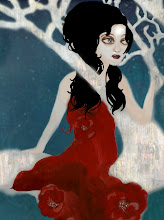
member of:Observers of the Interdependence of Domestic Objects and Their Influence on Everyday Life


This group has been active for a long time and has already made some remarkable assertions which render life simpler from the practical point of view. For example, I move a pot of green color five centimeters to the right, I push in the thumbtack beside the comb and if Mr. A (another adherent like me) at this moment puts his volume about bee-keeping beside a pattern for cutting out vests, I am sure to meet on the sidewalk of the avenida Madero a woman who intrigues me and whose origin and address I never could have known...
--Remedios Varo


(Slideshow is of Artwork by Remedios Varo)
By believing passionately in something that still does not exist, we create it. The nonexistent is whatever we have not sufficiently desired.
--Franz Kafka

Showing posts with label clive hicks-jenkins. Show all posts

Tuesday, February 4, 2014

Toy Theater


Toy Theater by Zoe Blue


 I've been working on a drawing for a painting in which the world of puppetry has begun to slowly creep its way in, a sure sign of my little brain's gnawing on the problem of 3D puppet-creation for the puppet challenge over at Clive's blog.

Toy Theater by Zoe Blue


The theater is a small detail of the painting, but, in the spirit of the maquettes, also once a challenge, and also brought to life to serve as models, I decided to flesh it out, making my first foray into the world of three-dimensions.

Toy Theater by Zoe Blue

The base and frame of the stage are wooden, which Gabriel helped me with, kindly protecting my little sloppy fingers from their assured destruction.

Toy Theater by Zoe Blue

Somewhere out there is a certain beautiful blonde who will recognize a pomegranate and fancy boots.

Tuesday, January 14, 2014

On Art and Science

Book by Poly Potter
Cover painting by Clive Hicks-Jenkins


“For you will learn to see most acutely out of/ the corner of your eye/ to hear best with your inner ear.”--John Stone

Established in the early 1990s, Emerging Infectious Diseases sought to bring both academic communities and public health communities timely information on emerging health issues. With such a goal, it was (and remains) important to reach as broad an audience as possible; it was intended not as an reference archive, but as a tool for greater communication. The founders and editors of the journal go about this task in a variety of ways, for example with web-publication as well as print, and with the inclusion of a section entitled  Another Dimension, which is a segment devoted to essays, short stories and poems relating to philosophical issues of science and health. Another method is by drawing the reader in with a full-color work of art emblazoned on its cover, which Managing Editor Poly Potter ties to the theme of each month’s journal in an introductory essay. Those covers, along with some of the most popular of the essays, have finally been bound--in the year of her retirement from the journal--into a beautiful book, wrapped in a painting by Clive Hicks-Jenkins. 


In her introduction to the book, Poly explains: “Art humanizes and enhances science content and educates readers outside their areas of expertise about important unnoticed connections. Art accomplishes this by infusing scientific findings with empathetic understanding--in a literal way, through the faces and places of traditional painting or completely in the abstract through new ways of seeing. Beauty, color, emotion, style, and the eccentricity and vitality associated with the artists’ lives and times, against the formality of technical prose, open up the possibility, indeed the capacity, for alternative interpretation of data, by introducing the metaphor. The metaphor, according to Aristotle, owes its strength to making possible ‘an intuitive perception of the similarity of dissimilars,’ by implying likeness. A bird is not human, but a single element in its appearance can invoke humanity, just as a single element in a plant’s appearance can distinguish its species.” xi

But--

“Amidst general enthusiasm about the use of fine art on our journal covers, some readers do question the ‘gratuitous’ use of color by a publication about science, decrying the cost and professing little interest in links to other disciplines. Science reviewers routinely reject Another Dimension manuscripts as ‘belonging in other venues,’ even when the science information given in lay terms is sound. And some in the art community are skeptical about links to science. Copyright permission requests for art images to use on the covers of Emerging Infectious Diseases have often been rejected by art institutions on the grounds that the art has nothing to do with disease emergence and might be degraded by any association with infection, even if the artists themselves have met untimely deaths from such infections or their community was ravaged by the plagues detailed between the journal covers. ‘For you can be trained to listen only for the oboe/ out of the whole orchestra.’[The line of poetry is from John Stone, cardiologist and poet, a contributor to the Another Dimension segment.]." xiii


What has come of it all is a beautiful coffee-table book with both pages of clusters of paintings and full-page covers (Picasso's La Guernica is a two-page spread that I couldn’t fit on my scanner), all in brilliant color and beautifully reproduced. But even more are the essays that link the art, the artist, the time period, the scientific theme of that month’s journal, and us. It is a book to dip into and discover new things, over and over.

Some of the pages feature several covers, while others are full-page spreads.


Painting by Archibald Motley


Sometimes it is the theme of the particular painting she focuses on to find her connections, other times it is the broader themes of a life’s output, and the impact of the personal history of the artist, as in the essay about Edvard Munch’s cover image:

Painting by Edvard Munch

From her essay on the above cover:

“‘Illness, insanity, and death...kept watch over my cradle and accompanied me all my life,’ noted innovative Norwegian artist Edvard Munch. Deeply affected by the untimely death of his mother when he was 5 and his 15-year-old sister when he was 14, he devoted his early artistic efforts to painting their predicament and the ravages of tuberculosis, ‘the wan face in profile against the pillow, the despairing mother at the bedside, the muted light, the tousled hair, the useless glass of water.’”
[...]
Munch studied in Oslo and traveled extensively to Italy, Germany, and France, where he took in the influences of his contemporaries (Toulouse-Lautrec, van Gogh, Gaughin), who were turning the angst of modern civilization into symbolism and stark expressionism. Preoccupation with decadence and evil pervaded the artistic and literary climate of the day. Darkness and horror inspired deeply personal, highly expressive art in a variety of styles, all of which fit under the umbrella of symbolism, as long as they embodied its peculiarly gloomy state of mind. The movement’s emphasis on inner vision rather than observation of nature captured Munch’s haunted imagination and engaged his moody genius.”
She goes on to talk about his interest in psychology and his ability to express terror and anxiety without monsters, but through unnatural colors and a sense of anxious movement. Then she talks of the painting itself,
“In Self-Portrait after the Spanish Flu, the tormented painter appears judge and victim of this pandemic killer. The terse yet unsteady demeanor, the puffy discolored glare, the quivering lines of fever and chills, only highlight the despair and isolation of the ‘grippe’ patient...”

...and so the art-lover learns something of the particular symptoms of the harsh epidemic...


Image by Fred Machetanz

The essays constantly remind the reader about learning to see in new ways, about studying something foreign until you can see the quality that makes it not so far from your own experience, and then expanding your understanding from there. In her essay on Fred Machetanz’s painting, which graced the January 2008 cover, she tells us:

“The art editor of Scribner’s once joked about a Machetanz painting, ‘You’ve put a cherry collored head on that Eskimo.’ The painter corrected him, ‘If you see an Eskimo under a golden pink sun, you’re going to see a red exactly like that...People don’t realize the colors that we get here. And then we have a longer change to look at those colors’ because of the long hours of daylight in the summer and late spring.”

In the cover painting, he showed a theme of everyday life for Eskimo men of his time (around 1935) which I would posit is not very similar to the everyday life of most of the readers of the journal. But the essay links this human experience to the disease issues of the Arctic regions, including those borne of the recent heating trends that are changing the environment and living conditions there so drastically.

Wood-Block Print by Hokusai


The essay on Hokusai is full of fascinating information, from start to finish, and again, you find the emphasis on keeping the wider view, or sometimes just refuse the usual view:

“In a traditional society of Confucian values and rigid regimentation, Hokusai was bohemian. Eccentric, rebellious, and temperamental, he cared nothing about convention and was reputed to move each time the notorious clutter and disorder of his home became unbearable. Legend has it that when invited once to paint maple leaves floating on the Tatsuta River, he drew a few blue lines and then repeatedly imprinted atop the scroll chicken’s feet he had dipped into red color. When his contemporaries drew the shoguns and samurai, he portrayed the common people, and when he painted landscapes, it was strictly from his own point of view.”

An interesting result of his stubborn insistence on his own point of view was that he mastered the techniques of his contemporaries not only in his own culture, but also in European culture, integrating different features until he had created something “which appeared Japanese to outsiders and Western to the Japanese.”

The theme of the month’s journal was water-related illnesses, and Hokusai’s tiny fisherman, facing this giant wave, presented to her an image of “human plight against overwhelming force,” which linked easily to many of the issues in that month’s journal, some of which were brought about in response to the 2004 tsunami.

Painting by Stelios Faitakis


A popular graffiti and mural artist, Greek painter Stelios Faitakis (whom I've written about before here) says of his art: “From the beginning, I chose to paint narrative pictures, like a still from a theatrical play: human characters in some environment doing some action--the simplest scenario possible,’ with hidden meanings, ‘as an extra for the more demanding eyes.’”
Here, the pathogen-vector, more commonly known as a bug, is front-and-center to the piece, hovering over everything....

The Call, by Remedios Varo
(sorry, this scan didn't process very well...)


Remedios Varo’s Call lit up the cover of the November 2004 issue, focusing on Women and Infectious Disease, and the author explored her particular blend of science and magic:

“To this expansive world, Varo brought knowledge of engineering construction, painstaking attention to detail, a penchant for philosophical discourse, and fascination with alchemy and the occult. The result was a personal approach to surrealism, the unified vision of a fantastic world inhabited by creatures of the imagination, moving freely in and out of consciousness, proposing new solutions, offering alternative interpretations.”

In this issue are studies focused on diseases that affect women, and Poly’s essay highlights the social issues which add to the difficulties of finding and implementing treatments and cures:

“Mysterious and provocative, the architectural stage is cluttered with conflicting clues. The walls are tall; the windows small and out of reach; the sky inflamed; the morbid folds props of oppression. Yet the floor is elaborately tiled, the doorways arched, the steps well-tended.  The stage is firmly cast; oppression is institutionalized. 

Varo’s enigmatic Call, part dream, part symbolic reality, seems at once a calling and a call to action. The flaming figure wears the signs and halo of science. Bathed in the light of knowledge, she steps forward boldly to dispel the darkness. In the painter’s surreal universe as well as ours, the female phantoms on the wall stand for poverty, confinement, disease. Overlooked by societies, biomedical research, and health care systems; battered by AIDS, malaria, and other infections; victimized by globalization; and stigmatized by the very diseases that confine and kill them, women slumber in the shadows. The flaming figure’s flask contains the science. Her call is a wake-up call.”


“It is difficult /to get the news from poems/ yet men die miserably every day/ for lack/ of what is found there.”--William Carlos Williams


Enjoy it!

Wednesday, December 11, 2013

Challenge: Puppetry


Clive Hicks-Jenkin's puppets for the 2013 performance of The Mare's Tale by Mid Wales Chamber Orchestra

Clive Hicks-Jenkin's puppets for the 2013 performance of The Mare's Tale by Mid Wales Chamber Orchestra

Clive Hicks-Jenkin's Expressionist Stair-Set for the 2013 performance of The Mare's Tale by Mid Wales Chamber Orchestra

Inspired by the astonishing emotional complexity of the interactions between Clive's puppets, his screen animations of 2D maquettes, and human actors and musicians in the 2013 performance of The Mare's Tale by the Mid Wales Chamber Orchestra, there has been an outpouring of interest in all things puppetry moving around the blogosphere. The fantastic result is a new challenge over at Clive's blog, calling all available hands to get building.

Logo created by Peter Slight, curator of the Puppet Challenge. Click for Link.

In preparation for the challenge, to help with ideas and to underline the fact that there are many, very different styles and materials available to the new puppeteer, Clive has been posting (and will continue to do so) about great puppets both ancient and modern-- his site has become a veritable museum of delightful discoveries...

"The Chinese shadow-puppet tradition is said to date from the reign of the Emperor Wu in the Han Dynasty. When his favourite concubine died, he ordered his court officials to bring her back to life. An articulated ‘puppet’ in her likeness was made of donkey-skin, and the concubine was conjured for the Emperor by means of moving lamps projecting her puppet-shadow onto a screen." --Clive


"In the Javanese shadow-puppet tradition of Wayang Kulit, the word for the shadow-screen is Kelir, and just as the puppet-master is obscured from the audience by this fragile veil, it’s believed that the ‘mover of the world’, the Jagatkarana, is hidden from mortal sight by the screen that separates the planes of existence."--Clive

He tells us that though they would only ever perform as shadows on a screen, great attention was given to the colors and decorations that were considered a gift of thanks and reverence to the shadow puppet itself:


Such shadow puppets would be a logical next step for those of us who took to the lessons on maquette- building from Clive here, and took part in the previous challenge and exhibition here. (Don't miss parts II and III, following that.)
Mare Maquette created by Clive Hicks-Jenkins for On-Screen Animations during the Mare's Tale performance this year.
But, for a more three-dimensional approach, there is also the possibility of a glove puppet, like Clive's Ogre:
Ogre Glove Puppet by Clive Hicks-Jenkins
or like this Mr. Punch, by Julian Crouch:
Julian Crouch and his Mr. Punch

Then there are metal puppets, exemplified by the Theatre le Licorne's Spartacus set and crew:
Theatre le Licorne's Spartacus

Theatre le Licorne's Spartacus

Theatre le Licorne's Spartacus

And then there is always, for the bravest among us, the inspiration offered by the puppets (and their puppeteers) of 69˚S, created by Erik Sanko and Jessica Grindstaff of Phantom Limb:


As with all projects on Clive's site, this one introduces you to all kinds of inspiration, both from him and from the comments boxes below his posts, where I discovered a new artist, Jill Desborough, also a puppeteer, among other things...

Mrs. Thackery, by Jill Desborough

Mrs. Pincher, by Jill Desborough


The Crow by Jill Desborough


It caught my eye that she also had created an etching and aquatint Anatomical Alphabet, which was another challenge put together on Clive's site here.
A is for Articulated, by Jill Desborough

C is for Codpiece by Jill Desborough

I love the way she draws out the letter in unexpected details...
O is for Ornamented by Jill Desborough

E is for Eyes by Jill Desborough
And she also has this lovely Trojan Horse Statue:
Into the City by Jill Desborough

Into the City by Jill Desborough

As contributors sign up for the challenge, I am discovering a slew of new artists...

There's Rachel Larkins, who creates lovely automata:

Automaton by Rachel Larkins. The mirror shows the back side of the doll.

Design sheet and Automaton by Rachel Larkins

...here in action:


There are the strange and miraculous creations of Hussam Elsherif:

by Hussam Elsherif

by Hussam Elsherif

by Hussam Elsherif

And there are the illuminations of Stuart Kolakovic:

Detail from the Death of King Arthur, by Stuart Kolakovic

Wenceslas, by Stuart Kolakovic 
Wenceslas, by Stuart Kolakovic


....and there are many other wondrous artists I have met before there--go and see, and take up the challenge!!


Friday, May 3, 2013

The Relationship Between Invisible Internal Objects


The Princess: Maquette for Animation by Clive Hicks-Jenkins
In his address to the parents of incoming freshman at the Boston Conservatory this year,  Karl Paulnack spoke of the ancient connections between astronomy, "the study of relationships between observable, permanent, external objects" and music, "the study of relationships between invisible, internal, hidden objects." He detailed some immensely powerful moments in more recent history in which humans turned to music to do what none of the other things we cling to for survival could manage: save us.

He also told them:
The responsibility I will charge your sons and daughters with is this: 'If we were a medical school, and you were here as a med student practicing appendectomies, you'd take your work very seriously because you would imagine that some night at two AM someone is going to waltz into your emergency room and you're going to have to save their life. Well, my friends, someday at 8 PM someone is going to walk into your concert hall and bring you a mind that is confused, a heart that is overwhelmed, a soul that is weary. Whether they go out whole again will depend partly on how well you do your craft.'"

It is a speech that is not to be missed, and so for those of us who missed it, it becomes necessary to go here and read it, now. It's only a few minutes of your life, but key minutes.

On a related note, Artist Clive Hicks-Jenkins is collaborating with the Mid Wales Chamber Orchestra to  present The Soldier's Tale (Stravinsky/Ramuz):


Joseph the Soldier, and his Soul, the Violin, by Clive Hicks-Jenkins

It is a tale which doubts not at all the deep connection between music and the soul, and the damnation of losing them.

Don't miss that:


Thursday, July 19, 2012

Angels and Demons


Cavorting Demon Maquette, face based on a Noh mask.

Several weeks ago, I posted a segment from a Borges story in which there were two worlds, each on opposing sides of any mirrored surface; in that story, those living on one of those sides, as a result of a curse, was forced to do no more than mimic the actions of others. I posited that ours was that side, and that, the more I read on neuroscience and memory and habit, the more it seems that our lives are constant repetitions of habits we began very, very early in life. I also told the story of a Russian reporter identified only as S. by his doctor, A.R. Luria, who unconsciously applied a marvelous technique, pretty much exactly like that recommended by the Ars Memoria, in order to instantly file information for recall--instantly, as it came at him. He did this via vivid symbols, and one of those symbols, a red-orange thread, represented pain. He saw the pain, and then was able to control it by snipping away at the incarnadine thread in his mind until it disappeared, and along with it, the pain.

But he was studied precisely because most of us can’t do that. Because his ability was an anomaly.
Right?


Then I came upon the book Monsters and Magic Tricks, or There’s No Such Thing as Hypnosis?, in which the author, Steve Heller, describes the processes by which we learn to move around in the world and memorize facts and form habits as basically variations of hypnosis. He claims that hypnosis is a process we often undergo: imagine yourself, as a small child, your parent squatting in front of you, straightening your collar, telling you very seriously: it is very important to listen to what the teacher says. It is very important that you behave. What your teacher says will embed itself in your brain, even without effort on your part. Even if you don’t consciously remember it.

You learn a vocabulary, a language, methods of communicating both verbal and non-verbal, and you learn how people interact and what is expected and who is important and what kinds of goals to take seriously, all of these things, before you’re even of an age where you can consciously remember any of them. So they are remembered beneath the surface. They affect your behavior without you noticing. 
And this idea is supported by study after study being processed now--our conscious decision-making forms a very small percentage of our lives. Most of the time, we are on autopilot. (Now, think again of that yellow emperor).
He gives a very basic example, which can then be broadened to apply to less “mathematical” topics, by asking the question what is 2 + 2?:
“I am confident that you would respond with the correct answer. If you were asked how you knew the answer, you might reply that you learned it as a child. In other words, the question itself caused you to go back into your personal history and find the ‘proper’ associational connection. You would have done that instantly, without conscious awareness of the process.”
The above example also explains why we work so much on auto-pilot: otherwise, we would be constantly over-burdened with very basic things. Instead, we see the red light and automatically stop the car--which is a good thing.
Heller writes that we can counter that automatism, the result of so much hypnosis (even now, as we drool in front of the television or flick through image after image on the internet, barely stopping, taking in information without consciously processing it), with a sort of self-hypnosis. Which is really no more than a very focused form of imagining, using all five senses.
Some examples he gives of working with patients reminded me immediately of the Russian journalist, S:
“For example, a woman was complaining of a severe headache in my office. She said that it was so bad that she didn’t think we could continue our session. I asked her to close her eyes, and see what color her headache was. She looked at me as if I was crazy. Of course, she was right. I just get paid well for it. Finally, she shrugged her shoulders and closed her eyes. After a short time, she informed me that she did have a picture of colors, and that ‘it seems to be bright reds and oranges.’  I then instructed her to listen to the steady sound of her breathing, and with each exhalation, she would breathe more and more of those colors out of her system. She was told to continue until she could see it ‘all’ across the room, as if a painting hanging on the wall. It was several minutes before she signaled that the picture was on the wall. I asked her to see someone walking into the room, taking the picture off the wall, and to hear that person’s footsteps as he walked out of the room. In less than five minutes she terminated the hypnotic state that she had spontaneously achieved, with the headache gone (pp.43-44).”
Now, not only did he hypnotize her, or have her self-hypnotize, and use her imagination to review the pain, he did it in a very specific way: he shifted her ‘feeling’ sense, her focus on what he calls the kinesthetic system, to her visual and audio sense. He moved the pain from a feeling to an image, then added sound to remove it completely. This was not a one-off:
“Case 13: Patient was a 57-year-old male hospitalized with terminal cancer which had metastasized through areas of his skeletal system. He was in intensive care and, in spite of four to five injections of morphine daily along with oral pain medications, he was suffering intractable pain, insomnia and extreme agitation. His physician asked me to see him about pain control as well as reduction of the patient’s agitated state.When first seen, the patient was complaining in a very harsh tone about his pain. He was thrashing in the bed, and generally being verbally hostile to everyone (Which, given his circumstances, was to a degree understandable). I noticed that his room contained a portable stereo, a small radio and a small tape recorder. Based on the way he was using his voice (complaining, harsh tone, using many words), and the equipment I had observed, it would be a good guess to assume that he was highly auditory. Since his cancer was causing him pain (throwing him into nearly constant kinesthetic), I knew I needed to get him back to, and then anchor him into, auditory with his visual as a backup system...After introducing myself and gathering some information about his hobbies (he loved listening to music), as well as some areas he felt competent in (one of which was working with wood), I was ready to proceed... I then asked him to close his eyes and listen to what his pain sounded like. He stared at me in disbelief...”
After some effort, he was convinced, and he soon described the pain as a “terrible grinding sound.” He was asked to (with eyes closed) think of a woodworking tool which sounded like it, and he was able also to do that. He was told to get a very clear picture of it in his mind.
“I then asked him to ‘see’ that tool or machine across the room in his mind’s eye, and to speed it up as fast as he could. Within several seconds, he nodded again. I then instructed him to ‘see’ the tool or machine slowing down, little by little until it had stopped.”
He was also successful in removing his pain, and over the next week came of a majority of his pain medications and was in a much better mood, able to move out of intensive care and soon returned to living at home.

Maquettes:Automaton Shell and Escaping Brain Demon
Now for exorcising the demons of bad habits (even if you like them, as I’ve grown inordinately fond of this demon over the last few weeks): altering the habit, being alive instead of automatic, using all your senses as you recreate yourself in your mind into some being that would not even have been possible in your “old” mindset, but is now natural. And then that new you discards its old shell, pushes through the mirror--greatly expanding its universe (possibilities)--and continues on.
I haven’t yet settled on a composition, but I’ve been playing:


For your amazement: mirroring, and something to remind us all of the fact that there is no such thing as impossible:

(Maquettes by Zoe, photos by Gabriel)