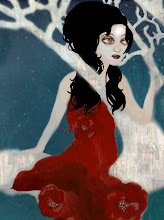
member of:Observers of the Interdependence of Domestic Objects and Their Influence on Everyday Life


This group has been active for a long time and has already made some remarkable assertions which render life simpler from the practical point of view. For example, I move a pot of green color five centimeters to the right, I push in the thumbtack beside the comb and if Mr. A (another adherent like me) at this moment puts his volume about bee-keeping beside a pattern for cutting out vests, I am sure to meet on the sidewalk of the avenida Madero a woman who intrigues me and whose origin and address I never could have known...
--Remedios Varo


(Slideshow is of Artwork by Remedios Varo)
By believing passionately in something that still does not exist, we create it. The nonexistent is whatever we have not sufficiently desired.
--Franz Kafka

Showing posts with label art and science. Show all posts

Saturday, January 25, 2014

The Reincarnation of Remedios

"Still Life Reviving," by Remedios Varo

Among the notes, stories, and letters that she never published is a letter Remedios Varo wrote to --if it was in her usual manner-- someone whose address she picked out of the phone book, probably for his very interesting name, or the very interesting name of his street, or some other significant detail. In this letter, she presents herself as the reincarnated spirit of someone he once knew:


“My dear sir,
I have allowed a prudent amount of time to pass, and now I see--that is--I feel certain that your spirit is in an advantageous state for communicating with me. I am a reincarnation of a girlfriend you had long ago. She was not exceptionally favored, speaking in terms of physical appearance: large nose, freckled skin, red hair, and a bit underweight. Fortunately, my current incarnation has only conserved the red hair as a physical feature. The rest...my friend, hot stuff! Greek nose, seductive curves-- without being fat, I benefit from unparalleled abundances and, bottom line....so I have a few wrinkles? An insignificant detail equivalent to the noble patina that all objects of good quality attain.
This reincarnation wasn’t simple.  After traveling first through the body of a cat, then through an unknown creature belonging to the world of speed--that is to say, one of those who pass through us at more than 300,000 km/second (which is why we don’t see them), then my spirit poured itself, unexplainably, into the heart of a piece of quartz. Thanks to an abominable storm, the electrical phenomena turned in my favor and lightning struck said piece of quartz, rescuing my spirit, which spiraled out to rest in the body of a woman of ample flesh who happened to be around. I am satisfied with my current circumstance, so I am taking a chance, writing you with the hopes that you haven’t forgotten me.[...]” (my translation)

Note that she passes through all these lives while the guy she’s writing to is still hanging around in his one, unchanging (unevolving) mind-body--her travels through life have been so extraordinary that she is no longer the same person at all, though physically it might seem that all she's done is gain a few pounds and a few wrinkles...

“The Immured,” by Remedios Varo; Maybe the atoms of the people who lived there before now form part of the wall; maybe their human forms are not complete because they still shed atoms, some forming the bird, others growing into a yellow flower, watered by the umbrella someone left behind which will now--won’t it--carry some piece of the couple with it when it is next taken somewhere else..

Bill Bryson starts out his Brief History of Nearly Everything  in a manner reminiscent of Varo’s letter:
“Welcome. And congratulations. I am delighted that you could make it. Getting here wasn’t easy, I know. In fact, I suspect it was a little tougher than you realize.
To begin with, for you to be here now trillions of drifting atoms had somehow to assemble in an intricate and curiously obliging manner to create you. It’s an arrangement so specialized and particular that it has never been tried before and will only exist this once.”

He goes on to say something that suggests Varo’s following the right path:
“The average species on Earth lasts for only about four million years, so if you wish to be around for billions of years, you must be as fickle as the atoms that made you. You must be prepared to change everything about yourself--shape, size, colour, species affiliation, everything--and to do so repeatedly....So at various periods over the last 3.8 billion years you have abhorred oxygen and then doted on it, grown fins and limbs and jaunty sails, laid eggs, flicked the air with a forked tongue, been sleek, been furry, lived underground, lived in trees, been as big as a deer and as small as a mouse, and a million things more.”

So, spend time understanding cat-hood, upping your velocity, and experiencing yourself as the jewel you have actually been and still, in some sense, are--because you need to be ready. (And all this practice is great for developing a wider perspective, which might just allow you to see the necessary steps to your next evolution more clearly.)

by Remedios Varo
In The Book of Barely-Imagined Beings, a 21st century bestiary in which he describes the impossibility of living beings we know actually exist and the amazing ways in which those creatures interact with the same universe we do, Caspar Henderson says of the Sponge:


“But perhaps the greatest wonder is the insight sponges offer into how animal and human life as we know it came to be. The story starts with the discovery, first reported in 1907, that some species can be strained through a mesh so fine that only individual cells pass through and yet – in the right circumstances – form a new, fully functioning animal. And it continues with the realization that choanocytes, the cells central to a sponge’s functioning, closely resemble single-celled animals called choanoflagellates. 

Choanoflagellates are plankton: tiny protozoans that feed on even tinier bacteria. Thousands or even millions will be in a bucket of water hauled from coastal seas. They often thrive on their own but they also tend to form colonies of cells that are all alike but benefit by sticking together. This characteristic is far from unique; many bacteria and single-celled organisms do the same. What is unique is that the genes choanoflagellates use to manufacture proteins that stick their cells together are very like the genes found in all multicellular animals for the same purpose. Indeed, the match is so close that it seems almost certain that we evolved from them.”

So: divide the whole into all its little parts and then....create a new whole. Fully functioning, there it is. And humans developed from the same basic parts. So, if you were, like me, snorting with laughter as you read her letter to her estimable remembered “friend,” think again. Maybe you, too, have a cat tail .

Simpatía, by Remedios Varo: She has *several* cat tails.


Tuesday, January 14, 2014

On Art and Science

Book by Poly Potter
Cover painting by Clive Hicks-Jenkins


“For you will learn to see most acutely out of/ the corner of your eye/ to hear best with your inner ear.”--John Stone

Established in the early 1990s, Emerging Infectious Diseases sought to bring both academic communities and public health communities timely information on emerging health issues. With such a goal, it was (and remains) important to reach as broad an audience as possible; it was intended not as an reference archive, but as a tool for greater communication. The founders and editors of the journal go about this task in a variety of ways, for example with web-publication as well as print, and with the inclusion of a section entitled  Another Dimension, which is a segment devoted to essays, short stories and poems relating to philosophical issues of science and health. Another method is by drawing the reader in with a full-color work of art emblazoned on its cover, which Managing Editor Poly Potter ties to the theme of each month’s journal in an introductory essay. Those covers, along with some of the most popular of the essays, have finally been bound--in the year of her retirement from the journal--into a beautiful book, wrapped in a painting by Clive Hicks-Jenkins. 


In her introduction to the book, Poly explains: “Art humanizes and enhances science content and educates readers outside their areas of expertise about important unnoticed connections. Art accomplishes this by infusing scientific findings with empathetic understanding--in a literal way, through the faces and places of traditional painting or completely in the abstract through new ways of seeing. Beauty, color, emotion, style, and the eccentricity and vitality associated with the artists’ lives and times, against the formality of technical prose, open up the possibility, indeed the capacity, for alternative interpretation of data, by introducing the metaphor. The metaphor, according to Aristotle, owes its strength to making possible ‘an intuitive perception of the similarity of dissimilars,’ by implying likeness. A bird is not human, but a single element in its appearance can invoke humanity, just as a single element in a plant’s appearance can distinguish its species.” xi

But--

“Amidst general enthusiasm about the use of fine art on our journal covers, some readers do question the ‘gratuitous’ use of color by a publication about science, decrying the cost and professing little interest in links to other disciplines. Science reviewers routinely reject Another Dimension manuscripts as ‘belonging in other venues,’ even when the science information given in lay terms is sound. And some in the art community are skeptical about links to science. Copyright permission requests for art images to use on the covers of Emerging Infectious Diseases have often been rejected by art institutions on the grounds that the art has nothing to do with disease emergence and might be degraded by any association with infection, even if the artists themselves have met untimely deaths from such infections or their community was ravaged by the plagues detailed between the journal covers. ‘For you can be trained to listen only for the oboe/ out of the whole orchestra.’[The line of poetry is from John Stone, cardiologist and poet, a contributor to the Another Dimension segment.]." xiii


What has come of it all is a beautiful coffee-table book with both pages of clusters of paintings and full-page covers (Picasso's La Guernica is a two-page spread that I couldn’t fit on my scanner), all in brilliant color and beautifully reproduced. But even more are the essays that link the art, the artist, the time period, the scientific theme of that month’s journal, and us. It is a book to dip into and discover new things, over and over.

Some of the pages feature several covers, while others are full-page spreads.


Painting by Archibald Motley


Sometimes it is the theme of the particular painting she focuses on to find her connections, other times it is the broader themes of a life’s output, and the impact of the personal history of the artist, as in the essay about Edvard Munch’s cover image:

Painting by Edvard Munch

From her essay on the above cover:

“‘Illness, insanity, and death...kept watch over my cradle and accompanied me all my life,’ noted innovative Norwegian artist Edvard Munch. Deeply affected by the untimely death of his mother when he was 5 and his 15-year-old sister when he was 14, he devoted his early artistic efforts to painting their predicament and the ravages of tuberculosis, ‘the wan face in profile against the pillow, the despairing mother at the bedside, the muted light, the tousled hair, the useless glass of water.’”
[...]
Munch studied in Oslo and traveled extensively to Italy, Germany, and France, where he took in the influences of his contemporaries (Toulouse-Lautrec, van Gogh, Gaughin), who were turning the angst of modern civilization into symbolism and stark expressionism. Preoccupation with decadence and evil pervaded the artistic and literary climate of the day. Darkness and horror inspired deeply personal, highly expressive art in a variety of styles, all of which fit under the umbrella of symbolism, as long as they embodied its peculiarly gloomy state of mind. The movement’s emphasis on inner vision rather than observation of nature captured Munch’s haunted imagination and engaged his moody genius.”
She goes on to talk about his interest in psychology and his ability to express terror and anxiety without monsters, but through unnatural colors and a sense of anxious movement. Then she talks of the painting itself,
“In Self-Portrait after the Spanish Flu, the tormented painter appears judge and victim of this pandemic killer. The terse yet unsteady demeanor, the puffy discolored glare, the quivering lines of fever and chills, only highlight the despair and isolation of the ‘grippe’ patient...”

...and so the art-lover learns something of the particular symptoms of the harsh epidemic...


Image by Fred Machetanz

The essays constantly remind the reader about learning to see in new ways, about studying something foreign until you can see the quality that makes it not so far from your own experience, and then expanding your understanding from there. In her essay on Fred Machetanz’s painting, which graced the January 2008 cover, she tells us:

“The art editor of Scribner’s once joked about a Machetanz painting, ‘You’ve put a cherry collored head on that Eskimo.’ The painter corrected him, ‘If you see an Eskimo under a golden pink sun, you’re going to see a red exactly like that...People don’t realize the colors that we get here. And then we have a longer change to look at those colors’ because of the long hours of daylight in the summer and late spring.”

In the cover painting, he showed a theme of everyday life for Eskimo men of his time (around 1935) which I would posit is not very similar to the everyday life of most of the readers of the journal. But the essay links this human experience to the disease issues of the Arctic regions, including those borne of the recent heating trends that are changing the environment and living conditions there so drastically.

Wood-Block Print by Hokusai


The essay on Hokusai is full of fascinating information, from start to finish, and again, you find the emphasis on keeping the wider view, or sometimes just refuse the usual view:

“In a traditional society of Confucian values and rigid regimentation, Hokusai was bohemian. Eccentric, rebellious, and temperamental, he cared nothing about convention and was reputed to move each time the notorious clutter and disorder of his home became unbearable. Legend has it that when invited once to paint maple leaves floating on the Tatsuta River, he drew a few blue lines and then repeatedly imprinted atop the scroll chicken’s feet he had dipped into red color. When his contemporaries drew the shoguns and samurai, he portrayed the common people, and when he painted landscapes, it was strictly from his own point of view.”

An interesting result of his stubborn insistence on his own point of view was that he mastered the techniques of his contemporaries not only in his own culture, but also in European culture, integrating different features until he had created something “which appeared Japanese to outsiders and Western to the Japanese.”

The theme of the month’s journal was water-related illnesses, and Hokusai’s tiny fisherman, facing this giant wave, presented to her an image of “human plight against overwhelming force,” which linked easily to many of the issues in that month’s journal, some of which were brought about in response to the 2004 tsunami.

Painting by Stelios Faitakis


A popular graffiti and mural artist, Greek painter Stelios Faitakis (whom I've written about before here) says of his art: “From the beginning, I chose to paint narrative pictures, like a still from a theatrical play: human characters in some environment doing some action--the simplest scenario possible,’ with hidden meanings, ‘as an extra for the more demanding eyes.’”
Here, the pathogen-vector, more commonly known as a bug, is front-and-center to the piece, hovering over everything....

The Call, by Remedios Varo
(sorry, this scan didn't process very well...)


Remedios Varo’s Call lit up the cover of the November 2004 issue, focusing on Women and Infectious Disease, and the author explored her particular blend of science and magic:

“To this expansive world, Varo brought knowledge of engineering construction, painstaking attention to detail, a penchant for philosophical discourse, and fascination with alchemy and the occult. The result was a personal approach to surrealism, the unified vision of a fantastic world inhabited by creatures of the imagination, moving freely in and out of consciousness, proposing new solutions, offering alternative interpretations.”

In this issue are studies focused on diseases that affect women, and Poly’s essay highlights the social issues which add to the difficulties of finding and implementing treatments and cures:

“Mysterious and provocative, the architectural stage is cluttered with conflicting clues. The walls are tall; the windows small and out of reach; the sky inflamed; the morbid folds props of oppression. Yet the floor is elaborately tiled, the doorways arched, the steps well-tended.  The stage is firmly cast; oppression is institutionalized. 

Varo’s enigmatic Call, part dream, part symbolic reality, seems at once a calling and a call to action. The flaming figure wears the signs and halo of science. Bathed in the light of knowledge, she steps forward boldly to dispel the darkness. In the painter’s surreal universe as well as ours, the female phantoms on the wall stand for poverty, confinement, disease. Overlooked by societies, biomedical research, and health care systems; battered by AIDS, malaria, and other infections; victimized by globalization; and stigmatized by the very diseases that confine and kill them, women slumber in the shadows. The flaming figure’s flask contains the science. Her call is a wake-up call.”


“It is difficult /to get the news from poems/ yet men die miserably every day/ for lack/ of what is found there.”--William Carlos Williams


Enjoy it!