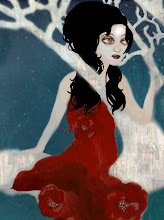
member of:Observers of the Interdependence of Domestic Objects and Their Influence on Everyday Life


This group has been active for a long time and has already made some remarkable assertions which render life simpler from the practical point of view. For example, I move a pot of green color five centimeters to the right, I push in the thumbtack beside the comb and if Mr. A (another adherent like me) at this moment puts his volume about bee-keeping beside a pattern for cutting out vests, I am sure to meet on the sidewalk of the avenida Madero a woman who intrigues me and whose origin and address I never could have known...
--Remedios Varo


(Slideshow is of Artwork by Remedios Varo)
By believing passionately in something that still does not exist, we create it. The nonexistent is whatever we have not sufficiently desired.
--Franz Kafka

Showing posts with label voodoo. Show all posts

Saturday, September 21, 2013

Papa Legba

Papa Legba Maquette by zoe blue
Papa Legba is sometimes an old man, sometimes a young man, almost always with a top hat and cane. He has one foot in your habitual ways (the "real world"), and one foot in fresh possibility; the border he crosses is the liminal space in which you are offered or forced to accept an alteration in your perspective in order to survive--a wormhole. No voodoo ceremony can begin without him: he is the one who allows the worlds of loa and humans to meet.  This connection between worlds is frequently represented by a special tree, its roots reaching deep into the underworld, its trunk and branches thrusting into our reality and through to the heavens. He is syncretized with St. Peter, who holds the keys to the gates of heaven, waiting for our arrival. Papa Legba's key plants into the ground via his cane, to connect with those spirits underneath: for example, those we have lost, ancestors. The key grows into a support for him, and also a snake (dweller of the worlds below). His scarf, a bird, covers any calls to the over-world spirits, those in the heavens, that we aspire to, that we desire to live through us. The bird-soul transcends the old. Papa Legba changes from old to new, from human to not, from alive to dead and back again. And he’s looking at you.

Papa Legba Maquette by zoe blue
Maquettes in the style taught by Clive Hicks-Jenkins
What is this key? Papa Legba is the language loa, he translates your cry of pain into a question, your inability to express your needs and desires into a new universe, where those needs and desires are so natural, they are easily communicated.  Languages and stories (and symbols) are used in society to tie everyone together into a community, to a consensual reality, to the same (overall) patterns of understanding.  As long as we’re using the shared image-meanings, then we follow the same story of humanity. If we want a different story, what then? What can Legba do? He can give us a key--that is, access to other symbols, or other ways to see your own. He can give new meaning to what is already there before you, unlocking its other possible meanings, translating it, thereby changing the world.


Everyone has personal symbols. Even if we aren’t aware of them, they rear up in our dreams and they modify our behavior (sometimes in ways that directly clash with societal mores); they are there, underneath, as a part of who we are. We all begin as synaesthetes, in fact, combining our understanding of the world across pairings from various senses. Alexandra Horowitz talks about this in her book On Looking, Eleven Walks with Expert Eyes:

“What the infant sees, for instance, is something quite fuzzier and more dazzling than what the normal adult sees: babies are very nearsighted and they lack the clouded filters that take bright light down a notch. Even more critically, the world is not yet organized into discrete objects for these new eyes: It is all light and dark, shadow and brightness. To the newborn infant, there is no ‘crib,’ no ‘mama’ and ‘daddy,’ no floor no wall no window no sky. Much of this can be seen, but none can yet be made sense of. 

Information taken in by the eyes might be processed in any part of the brain--it could be the visual cortex, leading to an inchoate ‘seeing’; but it could also be the motor cortex, leading to a leg kicking; or the auditory cortex, in which case a nearby teddy bear may be experienced as a bang, or a ringing, or a whisper. There is good reason to believe that this kind of synesthesia is the normal experience for infants. Synesthesia--literally ‘joining of sensations’-- is a somewhat rare and highly improbable form of perception in adults[....]

While tasting sounds or smelling letters is viewed as aberrant (if conducive to creativity) among adults, those eminently creative infants may sense the world with crossed wires all the time. Heinz Werner, a German psychologist of the early twentieth century, called this the ‘sensorium commune’: a primordial way of experiencing the world, pre-knowledge and pre-categorization. Researchers have found remnants of this perceptual organization in adults: on being shown drawings of curly lines, adults tend to characterize the lines as ‘happy’; descending lines, ‘sad’; sharp lines, ‘angry.’ To feel a tone, as though one were inside a vibrating bell, is to see glimpses of your vestigial sensorium commune.

But mostly, we ignore that feeling; we do not label lines as being happy or vexed or gloomy. One theory of synesthesia holds that the synapses connecting neurons identifying shapes and those leading to the experience of taste get snipped sometime in the first few years of life. This may be the simple result of our lack of attention to the connection.”

Lack of attention. That’s precisely it. The important objects, experiences, and details--that is, the ones clearly marked by our parents, extended family, teachers, priests, politicians, etc as important--are granted our attention and they develop. But the other connections, the other details, are still there in your brain. They still exist as a part of you. And in some other universe, you are living according to those connections. If you can find them, from here, you can go there

If synesthesia is conducive, as Horowitz suggests, to creativity, why not seek out such connections? In fact, isn’t that exactly the Art of Memory, the Ars Memoria? Recall that the process is to break an idea down into images, sounds, smells--some kind of symbols--which help you to hold together the disparate parts of the idea. A woodchuck holding a crumbling, tart apple tart, enters the cafe and tries to find a friend. His crumbling tart, the couch where Freud sits, the woman in the red dress all come together in a way particular to you, meaningful to you, and this process of knitting together the symbols not only helps your recall of the information, but guides you to realize, accidentally, other previously unseen connections between things, which leads directly to creativity and invention. This is, I believe, the magic that the practitioners of Ars Memoria were suspected of: by shifting around seemingly symbolic objects in their minds--Varo’s pot of green paint, her stencil for cutting out vests--, they affected the outside world. 


In his book, Wizard: The Life and Times of Nikola Tesla, Mark Seifer describes a moment of such odd connections in which Tesla went from nearly killing himself (through physical and mental exhaustion) in an effort to solve a problem to its sudden, clearly laid-out solution, via a gorgeous sunset and a Goethe poem. He was struggling to design a way to harness AC power without any ‘cumbersome’ intermediaries, and the struggle took every minute of his time, and he drove himself so hard that he suffered a nervous collapse, which took on the aspect of a severe attention to detail:

“I could hear the ticking of a watch…three rooms [away]. A fly alighting on a table…would cause a dull thud in my ear. A carriage passing at a distance…fairly shook my whole body…I had to support my bed on rubber cushions to get any rest at all…The sun’s rays, when periodically intercepted, would cause blows of such force on my brain that they would stun me…In the dark I had the sense of a bat and could detect the presence of an object…by a peculiar creepy sensation on the forehead.” A respected doctor “pronounced [his] malady unique and incurable.” Desperately clinging to life, Tesla was not expected to recover.”


His friend Szigeti took him out to the park to try to get him moving around. They went at sunset, and suddenly, the beauty of the scenery caused Tesla to burst into spontaneous recitation: 

‘See how the setting sun, with ruddy glow, 
The green-embosomed hamlet fires.
He sinks and fades, the day is lived and gone. 
He hastens forth new scenes of life to waken. 
O for a wing to lift and bear me on, 
And on to where his last rays beckon.’
(From Goethe’s Faust

“As I uttered these inspiring words,” Tesla declared, “the truth was (suddenly) revealed. I drew with a stick on the sand the diagrams shown six years later in my address before the American Institute of Electrical Engineers…Pygmalion seeing his statue come to life could not have been more deeply moved.”


The association between sunset, Faust, and successfully harnessing AC power is still lost on me, but the world has been changed as a result of his connection of those things: power floods our homes, lights our nights, keeps the stereo on and the clothes clean and me instantly connected to friends across the world. All of these things were once unimaginable. Impossible. 


Yet, here we are.

**Update: please follow the link in Niklas' comment, the essay is fantastic!!

Thursday, November 12, 2009

Transformation: Erzulie-Ewa and the Green Lion

Transformation: Erzulie-Ewa and the Green Lion


In Candomblé Ketu, Ewá represents the water element, and is the goddess of enchantment, beauty, and harmony. Like Erzulie, in the related Voodoo pantheon, she is universally loved and loving and "represents all that is fragile and sensitive." According to Morwyn, in Magic from Brazil, "Euá was so beautiful that men would fight to the death to possess her. In order to stop the carnage she changed herself into a puddle of water that evaporated to the sky, condensed into a cloud, and fell as rain. Thus she is known as the deity of transformation."
The story resonates a bit with the Biblical flood, the idea of a transformative force, a cleansing force, that comes through water, which itself is not only representative of cleansing but also of emotions (think how we describe a "torrent" of emotions "flooding" over us or "bubbling" or "welling" up, or how we might call a relationship "stagnant," or we might keep our emotions "bottled" up or "dammed" up). Here, that positive emotion, Ewá's sense of love, rises above the violence of all those men who want her, and washes it away.

In Sacred Possessions, Vodou, Santeria, Obeah, and the Caribbean, Lizabeth Paravisini-Gebert writes about a book called The Cathedral of the August Heat:

"The life-giving power of Vodou pervades the entire text. The veve, or mysical sign, for Erzulie, goddess of the erotic and divinity of dreams, presides over the first part of the novel. The power of Erzulie--'her elan, all the excessive pitch with which the dreams of men soar, when, momentarily, they can shake loose the flat weight, the dreary, reiterative demands of necessity'--imbues this section of the text. Conceived in the spirit of expansiveness characteristic of the cult of Erzulie, where all anxieties, all urgencies vanish, the section ends with the prefiguration of the power of laughter, the volcanic laughter that erupts in the world of the lost people like a seismic shock, spreading through the Caribbean region. The supernatural laughter corresponds to the image of the netherworld in folk tradition as the place to which fear has fled after its defeat by laughter. Folk laughter, the cosmic laughter of the lost people, represents the end of the 'mystic terror of the authority and truth of the past, still prevailing but dying, which has been hurled into the underworld'--the defeat of the forces that have zombified the people..."


The story of Erzulie, the story of Ewá, also reminds me of the Chinese bodhisattva Guan Yin, who also caused a massive transformation, defeating violence: during an unjust and forced visit to the Underworld, she was so overwhelmed with compassion for the souls which suffered untold tortures there, her very love transformed that hell into a paradise. She changed, simply by being full of compassion, the very order of things (something to think about the next time someone calls you a naive utopian). She is, like Ewá and Erzulie, the patroness of mothers and of sailors, and she can be called upon to bring rain;

"Other gods are feared, she is loved...Her throne is upon the Isle of Pootoo [P’u T’o], to which she came floating upon a water-lily. She is the model of Chinese beauty, and to say a lady or a little girl is a ‘Kuan Yin’ is the highest compliment that can be paid to grace and loveliness."--Source.


Alchemists, the precursors to our modern chemists, also strove for major transformation. The endless writings on the steps necessary to transmute base metals into gold are thought by some to have been mere code for a higher transmutation, an internal transmutation, in which the base form of the self becomes light, reaches higher consciousness. Alchemists sought to create an elixir of healing and eternal life, and one of the code names for that ultimate elixir was "the remedy of the green lion."


Here, she is decked out in finery and jewels, as Erzulie, who ignores utterly all the stresses of economics and regular old checkbook balancing, always demands for her ceremonies. As her dress melts into water which settles into a small lake, her scarf billows out into clouds which begin to detach in the form of birds. All of this takes place by a tall tree reaching in all directions, which represents the presence of Legba, Loa of the crossroads, who must be called upon in order to achieve any contact with the Vodou pantheon or the spirit world. Between them paces the green (I promise, he's green, or will be soon) lion.

Thursday, September 3, 2009

Why is the Airplane Erasing the Sky?

A story by Vesna, illustration by zoe.

Ghede


"Why is the airplane erasing the sky?" she said. I had no idea what is she talking about. It took me a little while to get in synch with her thoughts. My thoughts were busy knocking on the doors of possible tomorrows, looping through never-ending list of things that are waiting to be done during the day. Her question made me aware. Aware of her little hand, of her great wisdom, of beautiful possibilities that are here and now... if we look carefully. "What do you mean, airplane is erasing the sky?" I asked her. I felt like talking to the Little Prince, feeling a bit ashamed being in the role of an adult who doesn't get it! "Look." She answered simply. Yes, that's all it takes. Just look. It clicked in my mind.
A blue, bright blue sky has been clearly erased by the airplane, leaving behind the white trace, as if all we can see now is the paper on which the drawing has been made. I felt suddenly so much joy.
As if: her question erased that boring never-ending task list;
As if: all the doors of tomorrows are now wide open for us, if we decide to go through them;
As if: nothing else really matters but to look at this drawing around us from different perspectives and hold hands.
Once again I have realized that I need so much to learn from my child. I just simply forgot to look.
Many years later I met somebody who is an adult but never forgot to look. She became my friend instantly, my inspiration and support. I never met anybody who can look and see so much, who gives so generously and makes everything more interesting.This is her painting of the airplane erasing the sky and her imaginative vision.
This is a true story.
Vesna


My thoughts while making the drawing:
So, when i was thinking about the image Vesna had given me of erasing the sky, I thought I would make it so that he was clearing space for a new "world." When I was thinking about two worlds, or being able to see into more than one world, I thought about Ghede, a voodoo loa. He is usually shown with a top hat, and sunglasses with one eyeglass cut out--this shows that he can see into two worlds, the "outside," and "the world beyond" (or inside...). He acts as psychopomp, moving the dead to their realm (and he's called on to communicate with them), but also he's a great healer, a trickster, and, especially a protector of children and pregnant women. So he is there at the very beginning of this life, and also at the end, when you travel to a different life. Maybe he's there when your soul enters a new form, I'm not sure--but that would fit with the theme here :)Because St. Gerard Majella is a saint famous for protecting children and pregnant women, and because he is usually shown in icons with a skull (although i don't know why), he was syncretized with Ghede. Also, he is known for the gift of prophesy and the gift of bilocation, making him a great match for Ghede. So, my main themes were: being able to see into more than one world at once (knowing many things as a result) and protecting/ nurturing children. I made it sort of circular by having the birds (sky creatures) come out from the "edge" of the central world, out of a blank space, as if the different worlds maybe circled into one another (also, note that the stairs keep going down behind them, they circle both up and down). I was thinking that the two girls were the same girl, at different points in their lives, but it doesn't have to be that way. The plane is also a kite, completely under the control of the long, stretched-out arm of God (who can touch the ground and the sky at the same time), who is seen here visiting us and entertaining the child in the form of Ghede or St. Gerard.

Wednesday, August 12, 2009

Agwe and Erzulie

St. Ulrich and St. Afra; Agwe and Erzulie

Also known as St. Ulrich and St. Afra
acrylic, 16x20
The inspirations for this one are here.

Wednesday, August 5, 2009

Today's Saint

Some of you have already seen this on my Flickr page from a few days ago, but I forgot to post it here, so:


St. Ulrich and St. Afra; Agwe and Erzulie
(St. Afra's feast day is today, Aug. 5)


St. Afra (died 304) was a Cypriot woman, who was converted in Augsberg, Germany as she hid Bishop Narcissus of Girona from the Roman authorities. She was caught, of course, sheltering the bishop, and as a result burned to death (thus the wings of flame). There are conflicting stories about her, one stating that she was a prostitute in the Temple of Venus (thus she is partly formed of water, here), and the other that she died a virgin. The discrepancy in stories is one reason I chose her to represent Erzulie instead of the Virgin Mary (whom she is syncretized with in Voodoo); Erzulie is presented as innocent and virginal, but also as married to three other Loa, (one being Agwe) and having numerous lovers. For some reason, this is not a contradiction in her case. She is universally adored, all her husbands know about each other, they know of all her lovers, and they are not bitter, because they know that she has that much love. It is possible that Christianity also at one point mirrored this contradiction in Mary--why else a virgin mother, with the same name as the most beloved prostitute and the very first Christian evangelist?--but I felt that it was more succinct in the case of Afra. Also, she shares Church and crypt with St. Ulrich, who happens to be the saint syncretized with Agwe, who, as I mentioned, is one of the husbands of Erzulie.

"Voudoun has given woman, in the figure of Erzulie, exclusive title to that which distinguishes humans from all other forms: their capacity to conceive beyond reality, to desire beyond adequacy, to create beyond need. In Erzulie, Voudoun salutes woman as the divinity of the dream, the Goddess of Love, the muse of beauty." 138The Divine Horsemen

One of the most striking aspects of the traditions surrounding the devotions to Erzulie is that they always end with her weeping. Erzulie is lovely, beautiful, and she has the adoration of all men, yet she does not strike hateful jealousy in the women, because of her child-like innocence. She induces wonder and care, she is like a child. And, though she begins all celebrations in her honor filled with giddiness and pleasure at the excess of beautiful and expensive things that are always lavished on her parties, she slowly grows sad, accusing the people of not honoring her enough, not giving her enough, not loving her enough. In Maya Deren's book "The Divine Horsemen," she suggests that this is just another aspect of her child-like behavior (along with an "impatience with economies, with calculation, even with careful evaluation" 139), that you cannot give a child enough attention to satiate its need, and that those present at the devotions understand this and soothe her. I feel, however, that perhaps Erzulie is right. We do not devote enough of our attentions to child-like wonder, to endless and all-enveloping love--if we did, the world would be a much different place.


"As any water deity does, Agwe symbolizes the intuitive knowledge held within, the deep connection to eternal movements and powerful forces."
Source: Sosyete du Marche

St. Ulrich (born 890; the first saint that the Vatican officially canonized) rebuilt St. Afra's church in Augsburg, Germany, which they are both now the patron saints of, and his sarcophagus is there along with hers in the crypt. He is often, thus, shown in icons alongside her. Because of his ability to change any meat given to him or that he is giving away into fish on Fridays, he is often depicted holding fish, which is why his icons became symbolic of Agwe, the Loa of the deep waters, of the emotional depths, of the chaos before creation. He was also a good choice because many of his icons show him riding his horse across waters so deep that his companions are all drowning behind him. As I didn't want to draw drowning men, I decided to make his horse's special abilities apparent in some other way.

Tuesday, July 21, 2009

Experimentation and the Spirit

This month, I decided to experiment with some of the techniques utilized by the artists whose work I've been studying here, and I tried two different techniques that were pretty much a total departure from the drawings I usually do (I usually use some combination of inks and oil pastels). I tried a black-ink drawing, and I tried acrylic paints--which I've tried once or twice before, but always as a way of"coloring in," whereas this time I learned that you can thin the paint and put layer upon layer, which allows you to shade and creates a sense of depth.


A meeting with Legba and Simbi


In the tradition of Voodoo, there is one God, but he is so distant from his creation that the faithful don't pray to him. They pray instead to the loa, who are somewhat like the saints of Christianity in that they serve as intermediaries between God and humanity. When slaves were taken to the Americas from Africa, they brought with them their belief systems and rituals, songs and dances; they were forbidden, however, their religious practices. So they learned to disguise them. The loa took the faces of Christian saints who showed in their iconography or stories some correspondence to their own stories and symbols in a process called syncretization (which has happened at nearly every convergence of differing religious traditions as subjugated peoples attempt to protect their own traditions while outwardly seeming to accept those of the dominant social or political group). For example, St. Peter, the man at the pearly gates who decides if you can enter or not, was syncretized with Papa Legba, the loa of the crossroads and the Sun. Legba is the first loa you call to, the first one you welcome into your ceremony: "Open the road for me...do not let any evil spirits bar my path." Legba is the loa not just of the roads pointing north, south, east, and west, but also the road from the heavens to the underworld, and that road's intersection with the horizontal plane of our daily existence. As the master of the crossroads, he speaks all languages: "In Haiti, he is the great elocution, the voice of God, as it were" (Wikipedia). You call to him first because there can be no communication between a mortal and any loa without Legba. You call to him first because he opens the gates.

Simbi is also a crossroads loa, his symbol being a snake in a field of crosses, and he "straddles the waters above and the waters below the earth, which are understood either as the heavenly and the abysmal waters, or as the sweet and salt waters" (117 Divine Horsemen, Maya Deren). He is the patron of rains (bringing food and life) and the patron of magicians (including medicinal "magic"). Rigaud (Secrets of Voodoo) refers to him as a sort of Mercury or Hermes, who bears the soul to all places and carries messages to and from Legba (the Sun).

Here, the tree represents the crossroads, the trunk reaching up and down, the roots spreading out and down, the branches spreading out and up. Out of the roots a snake forms, and from his breath of flames comes a train to transport you to whatever level you wish to explore and communicate with. Two spirits rise out of the train to meet you...

St. Murgen, La Sirene

St. Murgen, la Sirene

Guided by a siren song and propelled by the force of her spirit, with an eye fixed firmly on the future, the woman is already disappearing, becoming other, as she navigates towards new shores. Though I made the underlying sketch too light for the layering process of paints and therefore actually had to paint with no sketch at all, which left me totally out of control as to what the end picture was, I really liked the way the colors change with each layer. There's a kind of depth to paints that feels an awful lot like magic. I've read in a lot of the artists' descriptions that they use charcoal for their sketches on the canvas, and though I'm not sure I'll do anything that dark, I will try being a little more forceful with the drawing stage next time.
Note: "La Sirene" is the aquatic form of Erzulie, the Madonna and protector of women and children, (and also both a virgin and married to three men), in the Voodoo Pantheon. After painting this, I went looking around for stories about sirens. Borges details various descriptions and myths surrounding Sirens in his Libro de los Seres Imaginarios (Book of Imaginary Beings), for example:
"La Odisea refiere que las sirenas atraían y perdían a los navegantes y que Ulises, para oír su canto y no perecer, tapó con cera los oídos de los remeros y ordenó que lo sujetaran al mástil. Para tentarlo, las sirenas le ofrecieron el conocimiento de todas las cosas del mundo." ("The Odyssey tells that the Sirens attract and shipwreck seamen, and that Ulysses, in order to hear their song and yet remain alive, plugged the ears of his oarsmen with wax and had himself lashed to the mast. The Sirens, tempting him, promised him knowledge of all the things of this
world"). But then later, Borges says, "En el siglo vi, una sirena fue capturada y bautizada en el Norte de Gales, y figuró como una santa en ciertos almanaques antiguos, bajo el nombre de Murgen." ("In the sixth century, a Siren was caught and baptized in northern Wales and in certain old calendars took her place as a saint under the name Murgen.")

I couldn't just let that pass. So I went looking for other references, and FOUND SOME, for example, on the Catholic Answers Forum:

And then there's St. Murgen of Inver Ollarba, who garners a mention in the seventeenth-century Annals of the Kingdom of Ireland. Her legend is possibly the most bizarre in hagiography, surpassing even St. Christopher of the Dog's Head, St. James the Cut to Pieces or St. George of Cappadocia with his four separate martyrdoms. Murgen began life as a girl named Liban, whose background is lost in a muddle of folkloric confusion. She seems to have been either of mortal or of Daoine Sidhe parentage, and swept into the sea in the year 90 with her dog, who was transformed into an otter. At some point during her first year underwater, she was turned into a merrow or muirruhgach, the Gaelic word for siren or mermaid. She spent three hundred years with the tail of a salmon, swimming the Irish sea with her pet otter.

Around 390 (or possibly 558), a ship destined for Rome took her in from the seas, having heard her angelic singing. The cleric Beoc, a vicar of Bishop St. Comgall of Bangor, was on board, and she pleaded him to take her ashore at Inver Ollarba up the coast. On his return from Rome, after reporting to Pope Gregory of Comgall's deeds in office, he fulfilled his promise and Liban was taken ashore in a boat half-filled with water by another fellow, Beorn.

Instantly, a dispute started over who had authority over her with Beoc, Beorn and St. Comgall all pressing their case. It fell to Beoc after they placed her in a tank of water on a chariot and the chariot stopped in front of Beoc's parish church. There, she was given the choice of being baptized, after which she would die immediately and go to heaven, or living another three hundred years--the number she had spent as a mermaid--and then going on to paradise. She chose the first, was baptized by St. Comgall with the name of Murgen, or, "sea-born," and died in the odor of sanctity. Of course, this was all in the days before canonizations became the exclusive and infallible province of Rome. That being said, the Teo-da-Beoc, or, church of Beoc, was the site of many miracles wrought in her name, and paintings of this singular saint still remain there to this day.


Apparently, somewhere around the Middle Ages, the distinctions between sirens and mermaids got a little muddled.


I'm really wandering around here, because this doesn't relate to the painting at all, but I also found a poem by Margaret Atwood called "The Siren Song" that I found hysterical. I'll leave you with that:

This is the one song everyone
would like to learn: the song
that is irresistible:

the song that forces men
to leap overboard in squadrons
even though they see beached skulls

the song nobody knows
because anyone who had heard it
is dead, and the others can’t remember.
Shall I tell you the secret
and if I do, will you get me
out of this bird
suit?
I don’t enjoy it here
squatting on this island
looking picturesque and mythical
with these two feathery maniacs,
I don’t enjoy singing
this trio, fatal and valuable.

I will tell the secret to you,
to you, only to you.
Come closer. This song

is a cry for help: Help me!
Only you, only you can,
you are unique

at last. Alas
it is a boring song
but it works every time.