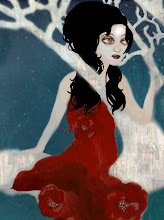
Agwe And Erzulie as St. Ulrich and St. Afra
(Press to see larger images...)
Erzulie is the Queen of Impossible Demands, and her demands make the world so. She has three husbands and various lovers, but is also known for her virginal, child-like nature. She demands that her followers live their lives with joy, throwing worries aside and lavishing her with expensive and 'frivolous' gifts, perfumes and layer upon layer of finery, and that everyone wear his or her best attire for her parties, regardless of the intense heat or the fact that an earthquake just hit, or the possibility that no one has any money.
Erzulie is the Queen of Impossible Demands, and her demands make the world so. She has three husbands and various lovers, but is also known for her virginal, child-like nature. She demands that her followers live their lives with joy, throwing worries aside and lavishing her with expensive and 'frivolous' gifts, perfumes and layer upon layer of finery, and that everyone wear his or her best attire for her parties, regardless of the intense heat or the fact that an earthquake just hit, or the possibility that no one has any money.

Working with the maquettes, a technique learned from
Clive Hicks-Jenkins
Her three husbands cover all of life, with lovers filling in like variations on a theme--for detail, for variety:
Agwe and Damballa rule the sea and the sky, respectively--that is, everything; both the unformed chaos of the deep, churning waters of creation and its thinning and separating out into sky to form the globe. Ogun is the warrior, the masculine, the machete, the force which must not turn against the people (the self)--perhaps he represents the distinction between force (to break things open and push into the new) and power (to keep things the same at all costs). He is known for his miracles, and one mounted by him will often poke himself or run himself through with the blade without injury, or wash his hands in flaming rum without suffering later.
In her successful demands for whatever her heart desires, she is much like St. Rita, who from her deathbed in the dead of winter requested a fig and a rose from her favorite garden, and got them.
Interestingly, the word rose developes from the Sanskrit root vrt. Vrt leads to the Gothic wairth, the Old Nordic verdh, and the Anglo-Saxon weordh, all of which mean "to unroll, to become, to come into being" (Nada Brahma: The World is Sound). It is also the root for the names of two of the three ancient Norse goddesses of fate, Urth and Verthandi. Aramaic and Arabic took this root and unfurled it into varda and vard, or rose, Greek dropped the v and gave us rodos, or rose, and Hebrew gives us wered, which is bud (that which comes into being) and rose (that which has become)-- thus bringing into the meaning of the word not only the unfurling of life but the fact that life has already unfurled, that we are circling it, observing. Observing in the sense of the Observer of modern physics, who influences which reality will vibrate with life right now just by perceiving it. And there we circle back to the contemporary English word "word." As in, God spoke, and there was life. The word is the beginning, and from it unfurls the bud of life. Rita said, bring me a rose, and it was so, and from that came a world where one could request from her other such 'impossibilities.' Erzulie decided that the heat was impossible and she wanted to be able to breathe underwater. She spoke, and the water rushed forth, and from it an appropriate husband, Agwe, on his horse.
The world is not a solid rock of reality. It is your next breath, unfurling into your expectations.

Maquettes, cropped for panel
As the slaves in North America were not allowed to practice their religion of voodoo, they would take images of saints as representations of their own loa, thereby encoding their reverence and faith in the language of the ruling Catholics. Agwe was 'represented' by St. Ulrich, who was often depicted carrying a fish, or riding a horse which had such power that it could cross the ocean without drowning. Here is Agwe, as St. Ulrich, emerging from the chaotic waters of Erzulie's creation, on his water-formed horse.
Erzulie is usually depicted as the Black Madonna, but I have chosen St. Afra, a Cypriot saint who was described both as a prostitute of the temples and as a virgin martyr, giving her a rather distinct similarity to Erzulie. She also happens to share a crypt with St. Ulrich, and so their pairing seems natural. Their relationship is very circular, she creates him creates her, it is a dance, and the horse forms from the waves and leaps forward to surge Agwe upwards into being.
Different lighting to show how the gold leaf changes as you move across the room:


All images in this post by Zoe Jordan. All photos by Gabriel.


 Posts
Posts