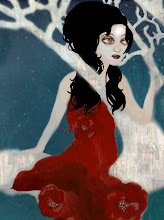
member of:Observers of the Interdependence of Domestic Objects and Their Influence on Everyday Life


This group has been active for a long time and has already made some remarkable assertions which render life simpler from the practical point of view. For example, I move a pot of green color five centimeters to the right, I push in the thumbtack beside the comb and if Mr. A (another adherent like me) at this moment puts his volume about bee-keeping beside a pattern for cutting out vests, I am sure to meet on the sidewalk of the avenida Madero a woman who intrigues me and whose origin and address I never could have known...
--Remedios Varo


(Slideshow is of Artwork by Remedios Varo)
By believing passionately in something that still does not exist, we create it. The nonexistent is whatever we have not sufficiently desired.
--Franz Kafka

Showing posts with label poetry. Show all posts

Thursday, April 4, 2013

A Dream of You


black ink, by zoe blue


A Dream of You
a poem by Vesna


You truly stop to smell the roses
You notice the dew on the leaves
You can read from the bark on the trees
Nature’s little secrets open to play for you
Like the vintage musical boxes

Your step is light
Even if your coat looks heavy
You are different
Distant, attractive yet unattainable
Like a sailing ship at the horizon

Here, on the other side of the things
Where the dreams gather to rest
I met a Dream of You
Beautiful like the clef and the notes
Awaiting the One to make music with


notes from zoe:
So, I was caught by the light step despite the heavy coat, and the ship in the distance... and while I was thinking about composition, I found the stories of St. Zita and St. Vincent, whose are both honored at the Basilica of San Frediano in Lucca. St. Zita was a maid, and she was taking bread from the house of her wealthy employers to feed the poor. Someone told on her, and her employers confronted her, telling her to open her coat and show them what she was carrying. Disappointed and ashamed, she slowly opened her coat, and piles of daffodils fell out, but no bread. She is, like St. Fevronia, one who was able to overwhelm the violence of others by nothing more than their own radiance; as a result she went from a simple harassed maid to respected leader of the house despite several difficulties.

After St. Vincent was martyred, a flock of ravens protected his body from the vultures until others could come retrieve it and give it a proper burial, which they did at what is now called Cape St. Vincent, where the ravens continued their guard over his shrine to such a visible extent that Muslim geographer Al-Idrisi (1099-1165) gave the shrine its name Kanisah al-Ghurab (Church of the Raven). In this particular drawing, I didn’t focus on the birds being ravens because I wanted them to be smaller, but it is interesting to note that ravens have a special place in many traditions as mediators between life and death; in Sweden they can be considered the ghosts of murder victims, and in some areas of far-east Russia, Kutkh, a trickster, is a raven who creates himself from an old fur coat.

The pairing gave me a heavy coat which could disappear from both ends.

Wednesday, November 23, 2011

Now Showing: Clive Hicks-Jenkins and the Miraculous


“The Rapture,” by Clive Hicks-Jenkins
The story of the Archangel Raphael includes many adventures and extends to the sounding of the trumpet at the end of times and the beginnings of the day of Final Judgment. He is the Angel of Healing Waters, blowing along their surface to remove whatever suffering is within them. He is also the companion of Tobias, a young man betrothed to a woman so cursed her seven previous engagements ended in the death of the fiancé on the night of the wedding. He instructs Tobias to catch a fish from those waters over which he holds such sway, and he burns the heart and liver to drive away the demon that defeats her so, then uses the gallbladder to heal his father’s blindness.
This is an angel that sees all; you can see that much from the expression on his face. He sees the beginnings of our world in the chaos of the waters and the ends of them are carried in his breath, part of which is always held in waiting for God’s command to blow the final trumpet. In Clive’s above portrayal of Raphael, you can see the foliage embroidered on his jacket; the wings hold the waters of the earth and the waters of chaos, the feathers of birds, and the constellations of the night sky. He carries the universe and all its stories and maps—imagined, fantasized, and followed--on his back.
And from all that, he can give to us the gift of a second sight of sorts, and here he does. We are presented with a dizzying aerial view, a very full view of the earth. To Tobias, who is turned away from us, he gives some other, secret knowledge not imparted to us. And yet another view is present: the dog’s. Clive’s Jack, carried along in the fray, sees *us*.

The above painting was the result of a collaboration with the poet Damien Walford Davis.
The Rapture 

Earlier that day,
sensing something archangelic in the air, they cordoned off .

the cool piazza, locked the domed
basilica, closed the crossing .

to the island charnel house and church.
When the quattrocento stage was set, .

they sent the scapegoat out, the lure –
fishing-rod in hand, patched terrier .

to heel – and drew the blackout curtains
close. When he walked in later, .

brilliant as the fish he held, they gathered
round to touch his suit and sun-bleached .

hair: So did it speak? they asked, afraid;
What colour were its wings? And did it .

burn? No words, he said, or fire;
but from that height I saw beyond .

the valley to an exit road where drones
then jetplanes strafed a speeding column .

black, and men crept into holes, their
pounded flesh the many colours of his wings. .

Damian Walford Davis 2011

“Nest” by Clive Hicks-Jenkins I have written about Clive’s portrayals of St. Kevin and the Blackbird and St. Herve and the wolf before [here] http://zoe-in-wonderland.blogspot.com/2009/10/creatures-of-earth-art-of-clive-hicks.html, but for his new show at the Martin Tinney Gallery in Wales beginning November 24, 2011, the evolution of his portrayal of these saints has been amazing, unfolding their stories in new directions and reigniting the potency of their meaning in our lives. This new collection of works seems to emphasize the idea of the entire world being present in the form of a Guardian, in this case a saint. In the story of St. Kevin, a bird comes to rest in his outstretched hand and stays to build its nest and lay its eggs and raise its young to first flight. The saint carries the life and safety of the forest in himself for the bird, and that incarnates as foliage on his flesh. After studying these works, you could enter the forest and see the larger shape of St. Kevin embracing you; as you peer up at the night sky, you could see, outside the smaller forms of the tales of Gemini, Cygnus, and Ursa Major, outside the patterns we use to map out our histories and our futures, the overarching story of Raphael and his healing waters. His wings alone carry all our stories of suffering and its defeat; they are larger than any of those stories—larger than all of them, even. He is himself giant and Romanesque, and the weight of all he carries and all he sees is present on his face. And it is therefore not ours to carry. That’s important. And it is the purpose, isn’t it, of those stories?
“Held,” by Clive Hicks-Jenkins This all-encompassing form is even more interesting when we think of the boxed-in sensation of the story of St. Kevin: he is trapped, in one spot, for the entire building of the nest, the gestation of the egg, and the birth and total dependence of the chick until it is able to leave on its own. The shape of Clive’s drawings underlines that sensation: St. Kevin barely fits the frame, his muscular torso contorts painfully. Yet he becomes the tree, the foliage sprouting across his chest, an impossible patience taking root within him—he creates the world the bird needs; he becomes it. Of tattoos, Clive notes: “…the irreversible is always alarming. But then life is irreversible, and that’s what makes it poignant, exciting, tragic…indeed just about anything you care to call it.” And in fact, the bird has already flown off in these new images, underlining the permanent, irreversible aspect of his decision: he is still rooted to the spot, growing into the landscape that chose him.

“Tobias and the Angel,” by Clive Hicks-Jenkins Clive writes: “The large chiaroscuro study of Tobias and the Angel (the detail above repays clicking on to see a magnified version) is progressing in rather unexpected ways. I’ve been exploring tone and texture to conjure angelic wings and garments that are a step onward from what I’ve attempted in the past. Something happened with the mark-making, transforming what I’d intended to be a tweed-textured jacket into a weave far stranger, almost suggesting a matador’s glittering ‘suit of lights’ oddly combined with the spotted markings of a big cat. This wasn’t at all the direction I’d planned, but now I’m hooked.” These marks then developed further, through a hearty back-and-forth with the readers of his artlog (a lively and energetically collaborative space in itself), to show constellations, smoke, plumage, and water. All this would later have to be translated to the color “version:” “Just the base colours of phthalocyanine blue and cobalt turquoise being worked in at the moment, after which I’ll start laying in the patterning. It’s a long job as the markings suggest turbulent waves, flow patterns, constellations and overlapping pinions, so there’s nothing for it but to keep my concentration fixed and to work work work…” [then] “Back to wings again today, and the task of suggesting colour, iridescence and texture. Water-flow, pinions, ruffles, scales and constellations of stars are a few of the ideas worked into these. Paint has been brushed, smeared, sanded back and scratched through with engraving needles. It’s a slow process but I’m getting there.” Though many of the works for this show are done in black conte over white Arches paper, the acrylic works that he has created show an amazing development of color. A palette already phenomenal—truly, the first thing to draw me into his works in the beginning—has become miraculous. The glowing honey color of Raphael’s jacket, the astonishing shimmer he has created in the wings, and the blues of St. Herve’s face are the openings to a new world in themselves. See the peace in Herve’s face tucked up trustingly against the wild snarl of the wolf. See again, that eye: the central eye of the piece, the wild wolf that sees you watching him, and is not moved.
“Hold,” by Clive Hicks-Jenkins

Tuesday, July 6, 2010

The Visionary


Poem by Vesna, illustration by me :)


The Visionary

For everybody else
it was a piece of dry land.
The land with lots of small rocks,
just randomly placed, with no beauty in their shape;
invaluable rocks, sharp and grey.
He saw it as the beautiful garden.

For everybody else
it was a path to somewhere else.
Somewhere where it is greener, softer, more colourful, more comfortable.
Somewhere that you hurry towards
to get away from this place.
He saw it as the ultimate destination.

For everybody else
the wind on that hill was harsh.
The wind that takes hats off, messes up hair.
The wind that brings the rain;
the wind you want to stop.
He saw it as a sign of life.

He moved the rocks,
he made the garden.
He stayed on that path,
he made it his ultimate destination.
He used the wind
at the end to fly away.

--Vesna


(zoe: I figured he'd need some water on his rock, so there's the tree aloe and the baby albatross. an albatross can fly for five years over the seas without ever stopping on land, even sleeping while it's flying...and the baby seems pretty large to me, and looks like it's wearing a judge's wig. :))

Friday, March 13, 2009

Liminal Spaces


In the images of Velimir Trnski, you can see various worlds overlapping and becoming each other.. the figure in the foreground, the painting in the background, colors and shapes.


The same feeling is offered by this poem, by Octavio Paz, for which experience I leave you in silence (first in Spanish, then in English):

COMO QUIEN OYE LLOVER

Óyeme como quien oye llover,
ni atenta ni distraída,
pasos leves, llovizna,
agua que es aire, aire que es tiempo,
el día no acaba de irse,
la noche no llega todavía,
figuraciones de la niebla
al doblar la esquina,
figuraciones del tiempo
en el recodo de esta pausa,
óyeme como quien oye llover,
sin oírme, oyendo lo que digo
con los ojos abiertos hacia adentro,
dormida con los cinco sentidos despiertos,
llueve, pasos leves, rumor de sílabas,
aire y agua, palabras que no pesan:
lo que fuimos y somos,
los días y los años, este instante,
tiempo sin peso, pesadumbre enorme,
óyeme como quien oye llover,
relumbra el asfalto húmedo,
el vaho se levanta y camina,
la noche se abre y me mira,
eres tú y tu talle de vaho,
tú y tu cara de noche,
tú y tu pelo, lento relámpago,
cruzas la calle y entras en mi frente,
pasos de agua sobre mis párpados,
óyeme como quien oye llover,
el asfalto relumbra, tú cruzas la calle,
es la niebla errante en la noche,
como quien oye llover
es la noche dormida en tu cama,
es el oleaje de tu respiración,
tus dedos de agua mojan mi frente,
tus dedos de llama queman mis ojos,
tus dedos de aire abren los párpados del tiempo,
manar de apariciones y resurrecciones,
óyeme como quien oye llover,
pasan los años, regresan los instantes,
¿oyes tus pasos en el cuarto vecino?
no aquí ni allá: los oyes
en otro tiempo que es ahora mismo,
oye los pasos del tiempo
inventor de lugares sin peso ni sitio,
oye la lluvia correr por la terraza,
la noche ya es más noche en la arboleda,
en los follajes ha anidado el rayo,
vago jardín a la deriva
entra, tu sombra cubre esta página.


Listen to me as one listens to the rain,
not attentive, not distracted,
light footsteps, thin drizzle,
water that is air, air that is time,
the day is still leaving,
the night has yet to arrive,
figurations of mist
at the turn of the corner,
figurations of time
at the bend in this pause,
listen to me as one listens to the rain,
with eyes open inwards, asleep
with all five senses awake,
it's raining, light footsteps, a murmur of syllables,
air and water, words with no weight:
what we were and are,
the days and years, this moment,
weightless time and heavy sorrow,
listen to me as one listens to the rain,
wet asphalt is shining,
steam rises and walks away,
night unfolds and looks at me,
you are you and your body of steam,
you and your face of night,
you and your hair, unhurried lightning,
you cross the street and enter my forehead,
footsteps of water across my eyes,
listen to me as one listens to the rain,
the asphalt's shining, you cross the street,
it is the mist, wandering in the night,
it is the night, asleep in your bed,
it is the surge of waves in your breath,
your fingers of water dampen my forehead,
your fingers of flame burn my eyes,
your fingers of air open eyelids of time,
a spring of visions and resurrections,
listen to me as one listens to the rain,
the years go by, the moments return,
do you hear your footsteps in the next room?
not here, not there: you hear them
in another time that is now,
listen to the footsteps of time,
inventor of places with no weight, nowhere,
listen to the rain running over the terrace,
the night is now more night in the grove,
lightning has nestled among the leaves,
a restless garden adrift--go in,
your shadow covers this page.

Wednesday, March 11, 2009

Rethinking poetry


photo by Jordan Matter.


Billy Collins reading "Budapest," set to a beautifully and cleverly matched computer animation by Julian Grey of Headgear: