|
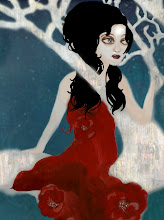
| Who art thou, White Face? by Leonora Carrington image taken from Leonora Carrington: Surrealism, Alchemy and Art by Susan L Aberth PRESS for larger image |
“the real voyage of discovery consists not in seeking new landscapes but in having new eyes” — marcel proust
The paintings of Leonora Carrington are filled with odd creatures in the midst of ritualistic activities and unusual interactions. Their intense colors and inherent strangeness bring you to the mindset of a dream, and they offer a doorway outside of your own world, the usual time and space. She draws you into a liminal space: the in-between, the not-quite-real, but somehow almost recognizable.
 |
The Floor 4706th, by Leonora Carrington
|
In The Floor 4706th, four tall, white, yellow-eyed dogs, three with swords serving as pseudo-unicorn horns, stand at the threshold of a doorway. They appear to be trying to leave the wrong way, pressing towards the edge of the door instead of passing easily through it. But we can see, inside that edge, a ghostly horse and shadowy rider. Above them, a transparent, full moon hangs, and behind them, a small bath of water is receiving its blessing, the stars and sun just lining up to transform it into something more than water. Birds, also not completely incarnated in the dogs’ universe, sail by, somehow below the floor. Two worlds are present here, overlapping. Will the dogs press through, cross the wormhole whose presence they have somehow divined? What will that mean for them? What does it mean for us? Who are the dogs?
 |
| Neighborly Advice, by Leonora Carrington |
Memories can overlap in space like this; for example in Neighborly Advice, a hall much like the one in the grand house Leonora grew up in shows (perhaps) a game of hide-and-seek. Behind it, upstairs, there are many more characters in the midst of games and activities, all ghosted in white: are these the memories of the house? Are they the memories of the young mother? Of her neighbor? The scene recalls a comment made by Marian Leatherby in the Hearing Trumpet:
“You may not believe in magic but something very strange is happening at this very moment. Your head has dissolved into thin air and I can see the rhododendrons through your stomach. It’s not that you are dead or anything dramatic like that, it is simply that you are fading away and I can’t even remember your name. I remember your white flannels better than I can remember you. I remember all the things I felt about the white flannels but whoever made them walk about has totally disappeared. So you remember me as a pink linen dress with no sleeves and my face is confused with dozens of other faces, I have no name either.”
There, too, the thing remembered is overlaid onto the scene in front of her.
Another possibility as to what the dogs are sensing (and it’s important to notice that it’s dogs that are sensing it--they have different senses than we do, more on that later), of course, is what we call a haunting, where one activity from long ago or far into the future suddenly somehow becomes visible to us in our time--why? how? What were we doing at that moment that they were also doing, or feeling that they were also feeling? What parallel emotion or action linked us? Maybe this is the thin skin dividing parallel universes which we could also define as worlds of alien entities--
 |
| Friday the 13th, by Leonora Carrington taken from Leonora Carrington: Surrealism, Alchemy and Art by Susan L Aberth |
In her Friday the 13th music is what brings about the overlap between two “worlds.” Here, the other world is portrayed as distinctly “alien,” with the associated symbolic vocabulary of a spaceship (though with Carrington’s very own design, it’s true...). The spaceship has landed before the performance of a small band of musicians, who continue to play as if perhaps this is just what happens when they get together.
What if perception has a ‘key,’ a timbre, a resonating note? Carrington and Varo both studied the ideas of Gurdjieff, who apparently had a theory about musical octaves and reality (which I have not read yet); have these musicians tuned themselves to a frequency which allows two perceptual fields to resonate in unison, thus allowing one “world” to see another? Could it also have to do with ‘timing’-- beings from each world resonating at the same time, in rhythm, even, so that the same note is hit simultaneously?
In Ikon, the same sense of liminality is expressed via shadows: you see the posed hand, the bald head, the head of the winged dog, all in solid colored form and all repeated once more--perhaps those are shadows, but perhaps instead they are patterns: the world expecting the act, or the act fitting into its space in the world. In that sense the title, Ikon, takes on extra significance.
II. What is the point of taking you into these liminal zones?
In Dreaming Yourself Awake, Alan Wallace explains the significance of working from within this liminal state in order to effect changes in the waking, ‘real’ world, by explaining the Buddhist philosophy that the waking world is actually just another level of dreaming, but one on which it is much harder to make physical alterations. He suggests that by focusing on how you can make alterations while lucidly dreaming, you can enact similarly-themed changes while awake. Your body learns its perceptive power. The idea of the powers of the mind to alter reality was very present in Leonora’s thinking; one excellent example is expressed in Down Below, a short autobiographical story she wrote detailing her flight from Saint-Martin, where she had experienced an idyllic life with Max Ernst before his internment in a concentration camp, and the flight’s sudden interruption by her incarceration in a madhouse in Spain:
“In Saint-Martin next morning, the school mistress gave me papers stamped by the town hall, which made it possible for us to depart. Catherine got the car ready. All my willpower strained towards that departure. I hurried my friends. I pushed Catherine toward the car; she took the wheel; I sat between her and Michel. The car started. I was confident in the success of the journey, but terribly anguished, fearing difficulties which I thought inevitable. We were riding normally when, twenty kilometres beyond Saint-Martin, the car stopped; the brakes had jammed. I heard Catherine say: “The brakes have jammed.” ‘Jammed!’ I, too, was jammed within, by forces foreign to my conscious will, which were also paralyzing the mechanism of the car. This was the first state of my identification with the external world. I was the car. The car had jammed on account of me, because I, too, was jammed between Saint-Martin and Spain. I was horrified by my own power. At that time, I was still limited to my own solar system, and was not aware of other people’s systems, the importance of which I realize now.” 167, House of Fear: Down Below. (Leonora Carrington)
As she begins to feel herself overwhelmed by the nightmare that is wrapping her and all that she knows into a suffocatingly small space with only one possible outcome, her nerves become so raw, her attention so sharp (link to Legba/Tesla), that she begins to pick up on how what happens inside her reverberates outside her. One might argue that such an assumption is a reflection of the mental break she is beginning to experience, but I would argue that it’s the rest of the world that is acting “insanely,” and her refusal to accept its logic as a sensible or reasonable parameter is hardly lunacy. She becomes lucid while awake: some part of her tries to point out that she could effect change from outside those parameters, and she sees it happening, but does not know what to do with it.
Alan Wallace, whose book Dreaming Yourself Awake serves as a guide of sorts to knowing ‘what to do with that,’ states:
“You may have noticed that by anticipating something within a lucid dream, that event will take place. In my case, when I find myself in one of my “anxious traveler” dreams, become lucid, catch myself thinking, “I think I’ve missed my flight,” I’ll glance out the airport window and, sure enough, there goes my plane taking off from the runway. I may know that I am dreaming and that the airport is not real, but there goes my plane anyway. You can use anticipation consciously to maintain lucidity. If, for instance, you think, “I bet my best friend Carl is going to walk through the door now,” often that is precisely what will happen. Then you can link such self-fulfilling prophesies into sequences. “Now Carl is going to play an accordion. The accordion is going to turn into a vintage Ferrari, and we are going to drive the coast of the French Riviera. Perhaps there will be a sunset. . . . Oh look! There it is!,” and so on.”
Expectation alters what will happen next, even if it makes no sense in context--in fact, it is expectation that makes it seem to make sense. This is true of the waking world.
While she’s imprisoned in the institution, Carrington begins to explore the implications of such lucidity. And when she gets out and begins painting again, that alchemy of changing expectations in order to change events, is the task to which she puts herself.
 |
| Grandmother Moorehead's Aromatic Kitchen, by Leonora Carrington |
In the painting above, a supernatural event takes place in a completely domestic setting: the kitchen. All the women wear disguises, or ritualistic costume; and there is a magic circle, replete with symbols, magic garlic, a strange puff of funneling air that seems to startle everyone--even the giant white goose and her indescribable companion. An important component of the artist’s work within the liminal space is redefining the meanings of objects. Cooking, here, metamorphoses from miserable-drudgery-assigned-to-women, and a way to keep them chained to the domestic sphere to powerful, spiritual and alchemical, secret underground magic.
Carrington explored this theme often, and she and her close friend Varo were well-known for having friends over and subjecting them to all kinds of bizarre oddities presented as food. Varo also wrote out recipes--which included hats and bricks in the ingredients-- to call upon certain dreams, or avoid others; in The Hearing Trumpet, the main character, Marian Leatherby, puts forth the idea that “The person who controls the distribution of food has almost unlimited power in a society such as ours.”
Orenstein, in her analysis of the painting The Chrysopeia of Mary the Jewess, notes that “Both food, and art, enter the body--the eyes and the mouth, and then actually work to transform the being who has ingested them. In that sense they are similar to alchemy, for they both chemically transform the person who has prepared them. The Artist, the Alchemist, the Cook are all affected and changed, themselves, by the process involved in performing their arts.”
A creative act changes the creator and the ‘audience,’ or the receiver. The cooking imagery is symbolic: the change that takes place inside you when you experience her painting is not a warm fuzzy feeling, it is not a mere brightening of your day. It is a chemical change, it is a change at the atomic level, and it affects the way those atoms that are a part of you now will act when they become a part of the person you just shook hands with, and when they become a part of his daughter, when he sings her to sleep at night. This is where Einstein’s ‘spooky action at a distance’ takes on mythic proportions: you see her painting, you enter her painting, you understand something new; for that gasp of realization, somewhere, there exists an instant, though distant, parallel response. The world outside also changes. In those moments where you stand before a painting and lose the rest of the world, something deep inside you changes. Somewhere, in your own memory palace (whether you have trained to become familiar with that palace or not), in that latent image that for you defines and arranges the universe and its possibilities, something has shifted. It has been cooked; it has changed from a liquid to a solid.
That call to change the symbolism and thus the mythology driving our society was something Leonora did share with the Surrealists. As many artists and writers of this movement met at the Villa Air-bel, hiding out as they struggled to obtain escape Visas by any means possible before capture by the Nazis, they also took on collective activities to redefine the universe in a way that made some space in it for them; one of those activities was the creation of a new Tarot deck:
“Breton was convinced that all the surrealists must defy the spirit of Fascism “by singing, playing, and laughing with the greatest joy.” He had a new plan to distract his friends from the bleakness that lay lodged in the heart like broken glass. At Air-Bel they were to undertake a collective work of art. They would invent a new deck of cards. They would need new suits to replace the diamonds, hearts, spades, and clubs of the old deck and new figures to replace the heraldic military figures of king, queen, and jack. André immediately went to the public library on the Place Carli in Marseille to research the origins and history of the game. To his deep satisfaction, he discovered that modifications to the game over the centuries had always taken place in times of great military reversals or defeats. The surrealists wanted a game relevant to their universe, and a deck reflecting their fascination with magic, alchemy, and psychic phenomenon. They settled on four suits: Love (a flame), Dream (a black star), Revolution (a bloody wheel), and Knowledge (a door lock). The genius, the siren, and the magus replaced the royal cards. The most daunting task was to pick the figures that would become the new face cards. These they drew from the surrealist pantheon: the genius, siren and magus of Love were Baudelaire, La Religieuse Portugaise (author of the Portuguese Letters), and the poet Novalis. The figures of Dream were: Lautréamont, Alice in Wonderland, and Freud. The genius of Revolution was the Marquis de Sade, with Lamiel, a character in a novel by Stendhal, as the siren, and Pancho Villa as the magus, while the hierarchy of Knowledge was represented by Hegel, the Swiss medium Hélène Smith, and the medieval alchemist, Paracelsus. The joker was the ultimate trickster, Alfred Jarry’s Ubu Roi.15” Sullivan, Rosemary (2009-10-13). Villa Air-Bel (p. 322).
 |
La Maja del Tarot, 1965, Leonora Carrington; not from the Villa games
|
In the Hearing Trumpet, Carmella and Marian play a similar game, where from a mere name they not only create a physical person, but his tastes and habits and a likely future in which they will interact with him, all merely possibilities which they switch around and alter with ease: meaning and reality absolutely being created. The reasoning for the existence of others is clearly linked, in this moment, to who they are and their moods:
“‘Ever since I stole the Paris telephone directory from the consulate I have increased my output [of letters to random people]. You have no ideas of the beautiful names in Paris. This letter is addressed to Monsieur Belvedere Oise Noisis, rue de la Rechte Potin, Paris IIe. You could hardly invent anything more sonorous even if you tried. I see him as a rather frail old gentleman, still elegant, with a passion for tropical mushrooms which he grows in an Empire wardrobe. He wears embroidered waistcoats and travels with purple luggage.’‘You know Carmella I sometimes think that you might get a reply if you didn’t impose your imagination on people you have never seen. Monsieur Belvedere Oise Noisis is undoubtedly a very nice name, but suppose he is fat and collects wicker baskets? Suppose he never travels and has no luggage, suppose he is a young man with a nautical yearning? You must be more realistic I think.’You are sometimes very negative minded Marian, although I know you have a kind heart, that is no reason that poor Monsieur Belvedere Oise Noisis should do anything so trivial as collecting wicker baskets. He is fragile but intrepid, I intend to send him some mushroom spore to enrich the species which he had sent from the Himalayas.’ There was not more to be said so Carmella read the letter. She was pretending to be a famous Peruvian alpinist who had lost an arm trying to save the life of a grisly bear cub trapped on the edge of a precipice. The mother bear had unkindly bitten off her arm. She went on to give all sorts of information about high altitude fungus and offered to send samples. It seemed to me that she took too much for granted” (9).
But what if she did send the samples? Varo and Carrington did write letters to unknown recipients, and did treat those recipients in the letters as if they were on some common professional ground. What if Varo, or Carmella, sent the spores? What if Monsieur Belvedere Oise Noisis found them fascinating and looked up their provenance and their history and then delved into a study which took him on to travels he never otherwise would have taken? And if he there discovered the love of his life, or the cure for the common cold, or a way (yes, mushrooms can do this) to clean up giant oil spills naturally--when before he was simply a bank clerk--would that not be magic?
And what if we were better able to change our own stories of ourselves so casually? It would be terribly difficult to feel trapped or overwhelmed or destroyed by events, then!
 |
| La Reina de los Mandriles, Leonora Carrington |
III. The Real World
Andre Breton, “Father” of the Surrealists, had been a medical soldier in the first World War, where he saw first-hand the kind of strain such bizarre and horrible violence put on the human mind (not only his own). He was only nineteen years old at the time, and apart from his stretcher runs to the front lines to pick up the wounded, he was assigned to a neuropsychiatric hospital in northeastern France, to assist the director with victims of shell-shock, a brand new disease. He took particular interest in one of the patients that had been sent to them, yanked from the front because of excessive “recklessness”:
“During bombardments the soldier had stood exposed on the parapets reaching up for the grenades flying by and redirecting them with his fingers. He said the ‘make-believe’ shells could do him no harm. He believed the injuries on the bodies of his fellow soldiers were makeup and the corpses were made of wax. He believed the whole spectacle of World War I had been staged for his personal entertainment. Breton was aghast but also fascinated to watch the minds of his shell-shocked patients invent their own realities. It sparked his fascination with the phenomenon of psychic automatism. He began to read Freud and his French counterparts, and eventually took a post under Joseph Babinski, then famous as a clinical neurologist. Among his psychiatric patients, Breton found “the route-map for the great artistic journey of the coming century: the journey to the interior.” Sullivan, Rosemary (2009-10-13). Villa Air-Bel (p. 103).
With horrors like that going on all around, you find yourself, as Victor Serge said in his memories of WWII, with nothing for it but to fight for an impossible escape. You have to create a non-existent path, in your mind. So how do you go from simply escaping into your mind--that is, going mad-- to bringing the escape you found inside your mind out into the world, and making it real?
Some people have managed this transport. They are magicians. It seems to me that Carrington and Varo managed this. Leonora Carrington, in the midst of her flight from a collapsing France, in front of the police, went completely inside her mind. She threatened out loud to assassinate Hitler, she raged against the insanity of the world outside, and she was committed for it to an asylum, where she was subjected to chemically-induced seizures that were the medical equivalent of a soldier’s torture. At one point, a distant cousin who was a medical doctor in Spain came and got her removed from that asylum, and her family (her father was a very wealthy industrialist who believed that only criminals ‘such as’ the poor and the homosexual would pursue a career in art) responded by sending company representatives to escort her to a new asylum in Africa. Leonora managed to escape her escorts and their nefarious plans by slipping out the back of a cafe during a meal, fleeing to the Mexican embassy, and marrying her friend Renato Leduc in order to get passage to Mexico.
But let’s not forget the thing that happened in her mind. Not just before the internment, but during it as well. She escaped internment, but still suffered its effects: tales abounded of her strange behavior, of showering fully clothed in someone else’s house and returning to his armchair dripping wet; of spreading mustard on her feet in the midst of a meal in a restaurant. She had suffered a serious break with a seriously distressing reality, and while she was still unwell, was subjected to torture. Leonora Carrington went somewhere far, far away in her own mind, but she made it back.
Susan Aberth relates that Pierre Mabille offered Leonora a copy of his own book on magical traditions in many societies, an act he felt had an impact on her struggles at the time. He said,
“By reading many folk stories she found again the same symbolic images that had been part of her own experience of insanity. She also found planetary and numerological symbols with which things, even the most insignificant ones, transformed into symbols because she had the habit of seeing them more transcendently than utilitarian.”
She found what Jung termed the collective unconscious; she discovered that, far from having disappeared off the deep end into somewhere no one had been before and no one could come back from, she had gone to a place connected to all of us, that those we call magicians come back from. She realized that what she had seen was a different layer of existence, a layer well underneath the one the world was so busily destroying, a layer that, if explored and made visible, might help to heal the minds of those around her by making visible “impossible” escapes.
 |
Sidhe, the White People of the Tuatha de Danaan: “My love for the soil, nature, the gods was given to me by my mother’s mother who was Irish from Westmeath, where there is a myth about men who lived underground inside the mountains, called the ‘little people’ who belong to the race of the ‘Sidhe’. My grandmother used to tell me we were descendants of that ancient race that magically started to live underground when their land was taken by invaders with different political and religious ideas. They preferred to retire underground where they are dedicated to magic and alchemy, knowing how to change gold. The stories my grandmother told me were fixed in my mind and they gave me mental pictures that I would later sketch on paper” (12, Susan Aberth quoting Leonora Carrington)
|
And so, though the acts and powers of Hitler, Mussolini, and Franco have been stopped, a child today looking at a painting of Carrington (or Varo) can still be utterly and completely changed. The power a dictator has, the power anything has over you is in the idea that inside that power lies the only possible path for you. The moment in which you realize that is not the case is momentous, that shimmering moment in which the senseless image before you vibrates with life and meaning and a door swings open on the other side of the world, to wait for you.
And, if you happen to be lucky enough to be anywhere near Dublin, Ireland, here is a treat for you: The Irish Museum of Modern Art is having a show of Leonora Carrington's works which will focus on the aspects of Celtic Lore that influenced her art. They are also producing a show catalogue that will include many unpublished writings of Carrington. Go.
 |
| Sculpture by Leonora Carrington, image taken from Leonora Carrington: Surrealism, Alchemy and Art by Susan L Aberth |


 Posts