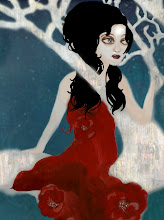
member of:Observers of the Interdependence of Domestic Objects and Their Influence on Everyday Life
This group has been active for a long time and has already made some remarkable assertions which render life simpler from the practical point of view. For example, I move a pot of green color five centimeters to the right, I push in the thumbtack beside the comb and if Mr. A (another adherent like me) at this moment puts his volume about bee-keeping beside a pattern for cutting out vests, I am sure to meet on the sidewalk of the avenida Madero a woman who intrigues me and whose origin and address I never could have known... --Remedios Varo
(Slideshow is of Artwork by Remedios Varo)
By believing passionately in something that still does not exist, we create it. The nonexistent is whatever we have not sufficiently desired. --Franz Kafka
she says: "When making art, I attempt to gather threads of the mythic, the terrible, the fantastic: imagined fragments of eternal chaos, order, beings, and creatures that sparkle and fester beneath the thin film of reality that hems in our everyday lives, and weave visual tapestries with these threads. I strongly believe in the importance of what Bruno Schulz called modern mythologizing, making sense of reality by creating myths to suit humankind through every age and culture. The artist has a unique ability to interpret and represent reality (and all that creeps beneath its surface) in an endless variety of shades and stripes and languages, dressed in cloaks of whimsy, delight, and horror. I'm plotting away in my own little corner of the world trying to do just that. The past few years have been spent in an effort to develop my own visual vocabulary through which to weave such tapestries."
and a video by anna, also known as distantmirrors on youtube, of the art work of claude verlinde and the mysterious music of thomas newman:
plus a few left out of the playlist because of the nasty watermark. i'll leave it to you to figure out where i got them, haha. i even recommend visiting the site, because there are many more there, and they are larger than they can be here.
I meant to make my own post today, but there is so much out there that is incredible. And much of it reminds of the theme here, so.
by George Underwood. Also from him, something reminding of the jester:
and here's the jester tight-roping across liminal spaces (in my mind, anyway :))
Visit his page to see about a million other works, including a variety of book covers and album covers. And his minotaur:
Then, from Jake Baddeley:
"Musical Chair"
This one is called A Key for All Doors:
And this one reminds of the control of the board (the chess board, for any new-comers)--over someone who could otherwise be spinning wildly and gracefully in the air:
Like this:
And see how this one wanders out of a sketch/dream and into the world:
In response to the news of the day... Here is a video of defying gravity, which we should all do, in every sense of the phrase, if we are to escape the laws and limits of the “board”...... i don't know how Erika Janunger did this, but she did, and that means something.
Introducing it, I'd like to quote Tom Robbins, a master of defying gravity, from an essay called “In Defiance of Gravity,” from which I borrow the title of this entry. He begins the essay contemplating a leap off a bridge and wondering how he has come to that point, and he realizes that it's from having taken too big a share of some painfully depressing fiction. He then goes on to wonder what the point of such a style of fiction is. He is not, and nor am I, suggesting that we should eschew topics that matter, difficult topics, out of a desire to always feel warm and fuzzy, he is merely addressing the way in which we decide to go about exploring those topics, and the goal we have in mind when we do so. Are we hoping to convince others that, as hip-hop stars like to “spit” nobody knows the trouble I've seen... (hm. I may have mis-stated my source, there)? Are we hoping to spread the misery around a bit? To ensure that no bright corner, no last bastion of innocence remains? Or are we trying to solve a problem?
It's my opinion that if we're trying to solve a problem, we should suggest solutions. Possibilities. Possibilities, preferably, that adhere to Einstein's statement that if at first the thing doesn't seem absolutely impossible (absurd, even), then it's not even worth considering. That is the realm of art: painting doorways onto walls. Finding secret passageways:
(Orange Grove, by Jacek Yerka)
Refusing the trap of darkness and despair: (Illegal Production of Light, by Jacek Yerka)
In that essay, Tom Robbins calls upon an ancient ideal, that of the Joker or the Fool (see blog “Liminal Spaces”), what the Tibetans call “crazy wisdom:”
"Crazy wisdom is, of course, the opposite of conventional wisdom. It is... wisdom that flouts taboos in order to undermine their power; wisdom that evolves when one, while refusing to avert one's gaze from the sorrows and injustices of the world, insists on joy in spite of everything; wisdom that embraces risk and eschews security; wisdom that turns the tables on neurosis by lampooning it; the wisdom of those who neither seek authority nor willingly submit to it."
Lightness of heart creates light, I think. Buoyancy, I mean.
So, that video:
For more photos of Jacek Yerka's artwork, I recommend:
In keeping with the theme of dissolving the rules of the board, turning a heavily regulated square with distinctly outlined, limited possible positions into, well, wonderland, I am here posting a few of my paintings:
Winter Queen Rides the Baku
The Baku is a mythological character, which, according to Nicholas Christopher, has a lion's head, a horse's body, and tiger's paws. He eats bad dreams. Here the queen rides him off the board, or the edge of the world.
And then there's the member of the court that never bothers with the court rules, or cultural rules:
Court Jester
This is the joker, present on three levels of life or three universes: the "normal" one; the emerging reflection from the water (i.e. the emotional realm; in dream theory, water usually represents emotions, and then supposedly every person and thing in your dream represents some aspect of you, the dreamer, and so it's as if the physical world is only a reflection of the emotional world inside you-- so actually, which jester here is the reflection?); and the distant reflection-- so far away, it's a constellation, like a macrocosm version of the pair (jester and female mask), again like in dreaming or like fractals: snowflakes, for example, are set up the same as fractals, meaning one snowflake is made up of a gazillion miniature versions of the whole snowflake-- so here, the entire universe is the same jester and his female mask or consort or presence, replicated however many times until it makes a constellation, and then the constellation is replicated however many times until it makes a universe, and so on. Like the way myths are reflections, and they have their representatives in the stars, and how the jester normally carries a mirror so he can show us our "true selves' " part in his behavior. Or the way sometimes you have to look at something a million different ways before it makes sense.
I put a few of my paintings into a video called “Liminal Spaces,” which I'll post here:
Set to Air's "Empty Houses," and guarded by Gabriel's "Dreamland Security."
liminal |limnl| adjective technical 1 of or relating to a transitional or initial stage of a process. 2 occupying a position at, or on both sides of, a boundary or threshold. ...exploring the space between dreaming and waking, between universes, between "streams" of reality, between the subjective and the objective, etc....
And, According to Wikipedia: "Liminality (from the Latin word līmen, meaning "a threshold") is a psychological, neurological, or metaphysical subjective, conscious state of being on the "threshold" of or between two different existential planes, as defined in neurological psychology (a "liminal state") and in the anthropological theories of ritual by such writers as Arnold van Gennep, Victor Turner, and others. In the anthropological theories, a ritual, especially a rite of passageinvolves some change to the participants, especially their social status.
The liminal state is characterized by ambiguity, openness, and indeterminacy. One's sense of identity dissolves to some extent, bringing about disorientation. Liminality is a period of transition where normal limits to thought, self-understanding, and behavior are relaxed - a situation which can lead to new perspectives.
People, places, or things may not complete a transition, or a transition between two states may not be fully possible. Those who remain in a state between two other states may become permanently liminal."
Because we should all take as many trips down the rabbit hole as possible...
Maggie Taylor's photography (and her website) has that mysterious, impossible feel to it that lends itself well to Alice in Wonderland. The book "Maggie Taylor's Landscape of Dreams" is also oddly fascinating.
Another excellent interpreter of Alice in Wonderland, but in an entirely different vein, and in black and white, is Abelardo Morell.
He also uses a technique called camera obscura, which is when a room is closed off except for a pinprick of light from the outside, and a large format camera is left with an open shutter for a long period of time. The effect is, to me, like a visualization of the modern theories in physics which suggest that many realities are occurring in the same space, that parallel universes overlap. It just takes a very intense sort of visual ability to perceive them...
That they are set in bedrooms adds a dream-like quality: if you were lying down in the bed, maybe with your eyes closed, this is what you would see...
And then, I love his photos of the Romeo and Juliet set at the Met:
And then, if you need more help getting past Newtonian Physics, Economic Laws, and other Useless Rules, I recommend Haruki Murakami's "Hard-Boiled Wonderland and the End of the World."
“This book first arose out of a passage in [Jorge Luis] Borges, out of the laughter that shattered, as I read the passage, all the familiar landmarks of my thought—our thought that bears the stamp of our age and our geography—breaking up all the ordered surfaces and all the planes with which we are accustomed to tame the wild profusion of existing things, and continuing long afterwards to disturb and threaten with collapse our age-old distinction between the Same and the Other. This passage quotes a ‘certain Chinese encyclopaedia’ in which it is written that ‘animals are divided into: (a) belonging to the Emperor, (b) embalmed, (c) tame, (d) suckling pigs, (e) sirens, (f) fabulous, (g) stray dogs, (h) included in the present classification, (i) frenzied, (j) innumerable, (k) drawn with a very fine camelhair brush, (l) et cetera, (m) having just broken the water pitcher, (n) that from a long way off look like flies’. In the wonderment of this taxonomy, the thing we apprehend in one great leap, the thing that, by means of the fable, is demonstrated as the exotic charm of another system of thought, is the limitation of our own, the stark impossibility of thinking that.”
Michel Foucault, The Order of Things (New York: Pantheon, 1970) xv.
"Everything leads me to think that, in the near future, reality will be considered exclusively as a mere state of depression and inactivity of the mind" --Salvador Dali


 Posts