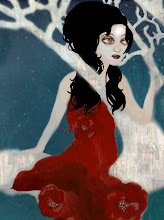
Angels and Demons, II
illuminated
a pure heart and a full moon
inspirational
a pure heart and a full moon
inspirational

Here is the newest installment in my little series of images inspired by Borges’ yellow emperor, the central figure of a story in which the beings trapped in the world through the looking glass are expected, sometime in the future, to escape the chains that bind them, as puppets, to only repeat and reflect, and become whole beings, able to pass the gates of glass and overwhelm their previous captors. It is my belief that we are the ones repeating, repeating, sad little automatons (puppets with no visible strings) of war and melodrama.
As I’ve been working on this painting, I’ve stumbled across all sorts of ideas that seemed to me to feed this take on the tale. One of them is the Brocken Specter. In his "Memories, Dreams, Reflections," Carl Jung wrote:
As I’ve been working on this painting, I’ve stumbled across all sorts of ideas that seemed to me to feed this take on the tale. One of them is the Brocken Specter. In his "Memories, Dreams, Reflections," Carl Jung wrote:
“...I had a dream which both frightened and encouraged me. It was night in some unknown place, and I was making slow and painful headway against a mighty wind. Dense fog was flying along everywhere. I had my hands cupped around a tiny light which threatened to go out at any moment... Suddenly I had the feeling that something was coming up behind me. I looked back, and saw a gigantic black figure following me... When I awoke I realized at once that the figure was a "specter of the Brocken," my own shadow on the swirling mists, brought into being by the little light I was carrying.”
In reality, this ‘spectre’ can be created in any mountain region (though it is named after the Brocken mountain in central Germany where it is common and which was also famous for Walpurgis night witches’ revels); it is an enlarged, gigantic version of one’s own shadow created against mist or clouds by the sun shining down on the observer from behind.
The encouraging aspect of this dream to me would be the idea that whatever awful creature is behind you (chasing you, threatening you) is no more than the shadow cast by the light ahead--or within. Once you move, so as to not block the light, the monster disappears.
So, what light do you look at yourself under? How does your shadow shape up?

(demon maquette)
I had created some maquettes (example above) to work with as I played with this idea: the automaton shedding her puppet-shell, the demon who controlled her mind and actions toppling out as her skull swung open, and her new figure crossing breeds and much more territory as her size grew. She had hooves, for drive and power and animal passion; she had a mermaid tail because Borges had prophesied that it would be the fish who first passed through the mirror.
Then I discovered that, actually, there was yet another reason for her to have mermaid qualities; yet another tale in which one could pass through a reflection into a completely different universe: the Legend of Kitezh.
That legend has it that in 1237, the Mongol leader Batu Khan was moving through the lands of Russia, conquering everything along the way. He heard of the great palace of the Grand Prince of Vladimir, Georgy II, on the shores of Svetloyar Lake, and led his army through the woods in search of the town. A resident, tempted terribly by the devil, was driven against himself to help them, and they were able to discover the walls of the town. They found that it had no fortifications, and, surprised by the citizens’ decision to pray instead of fight, saw their chance and took it. As they made their last push to breach the walls, fountains of water began to spew up from the ground inside, pushing the attackers back and drowning the city--submerging it completely. The gleaming gold of a cathedral dome was the last to disappear.
More legend, of course, but they say that you can still hear people singing and church bells chiming from under Lake Svetloyar. And particularly pious individuals can follow the lights of religious processions taking place down there. Rimsky-Korsakov made an opera based on the legend.
Here’s the key idea, though: this was a town drowned for protection, not punishment. And only the pure of heart can find it--it’s protected completely by the talisman of prayer. Like Abracadabra, you have to find the right words to let you in. In fact, in Rimsky-Korsakov’s version, it’s a saint, Saint Fevronia, whose prayers for a shield result in a protective shroud for the city, rendered in the form of a golden fog, which hides it as it descends into the lake.
So, how does one go about being pure of heart? What is purity of heart? Where do we find the magic words?
Then I discovered that, actually, there was yet another reason for her to have mermaid qualities; yet another tale in which one could pass through a reflection into a completely different universe: the Legend of Kitezh.
That legend has it that in 1237, the Mongol leader Batu Khan was moving through the lands of Russia, conquering everything along the way. He heard of the great palace of the Grand Prince of Vladimir, Georgy II, on the shores of Svetloyar Lake, and led his army through the woods in search of the town. A resident, tempted terribly by the devil, was driven against himself to help them, and they were able to discover the walls of the town. They found that it had no fortifications, and, surprised by the citizens’ decision to pray instead of fight, saw their chance and took it. As they made their last push to breach the walls, fountains of water began to spew up from the ground inside, pushing the attackers back and drowning the city--submerging it completely. The gleaming gold of a cathedral dome was the last to disappear.
More legend, of course, but they say that you can still hear people singing and church bells chiming from under Lake Svetloyar. And particularly pious individuals can follow the lights of religious processions taking place down there. Rimsky-Korsakov made an opera based on the legend.
Here’s the key idea, though: this was a town drowned for protection, not punishment. And only the pure of heart can find it--it’s protected completely by the talisman of prayer. Like Abracadabra, you have to find the right words to let you in. In fact, in Rimsky-Korsakov’s version, it’s a saint, Saint Fevronia, whose prayers for a shield result in a protective shroud for the city, rendered in the form of a golden fog, which hides it as it descends into the lake.
So, how does one go about being pure of heart? What is purity of heart? Where do we find the magic words?

(church domes peek out)
David Foster Wallace, in a speech he gave three years before his death, spoke a bit about not being automatic:
It is extremely difficult to stay alert and attentive, instead of getting hypnotized by the constant monologue inside your own head (may be happening right now). Twenty years after my own graduation, I have come gradually to understand that the liberal arts cliché about teaching you how to think is actually shorthand for a much deeper, more serious idea: learning how to think really means learning how to exercise some control over how and what you think. It means being conscious and aware enough to choose what you pay attention to and to choose how you construct meaning from experience. Because if you cannot exercise this kind of choice in adult life, you will be totally hosed. Think of the old cliché about ‘the mind being an excellent servant but a terrible master.’....”
Being aware enough to choose what you pay attention to is the old trick I keep butting heads with here: not being led by that latent image, that understanding of the world you formed when just a toddler, that perceptual frame that dictates what you can see and what you will miss. He is saying the same thing: your life is habit, it is automatic; the point of education is to re-become alive.
He goes on to say:
“[T]he real value of a real education [has] almost nothing to do with knowledge, and everything to do with simple awareness; awareness of what is so real and essential, so hidden in plain sight all around us, all the time, that we have to keep reminding ourselves over and over:
‘This is water.’
‘This is water.’
It is unimaginably hard to do this, to stay conscious and alive in the adult world day in and day out. “
In fact, I would argue that doing so is the way to a purity of heart: by being alive, we are able to see in front of us: fresh eyes. By being automatic, we live our lives under the seemingly unbreakable sway of the curse of the Yellow Emperor (what Wallace refers to as “being hosed”).
In a letter to his son, Ted Hughes wrote about the child inside us, a child who lives always underneath the armor of the self we have created to protect it. That armor becomes our existence, our automatic existence, and it is only when the child comes out--which is often only when the automatic ‘person’ is defeated in some big way by an experience, unfortunately, that tears down his armor--that we feel alive, real, able to interact "live" with our own experience. That child is pure of heart, it is our creative instinct, our clean love for the world, and life, and color, and bunny rabbits. We need to know how to let it out without something awful breaking apart the armor--to break it from the inside, instead of having it crushed from the outside. To experience the possible joys, instead of only the terrors. Then, we can discover what grand, fairy-tale-esque creatures we might actually really be underneath all that metal and gearing; we can live in a world of our own making:
“The analogy between the artist and the child is that both live in a world of their own making,” wrote Anaïs Nin in her diary in 1945.
We break through the armor by creating, by feeling what we are creating (see “eidetic image”), by immersing ourselves in that creation and believing it exists (this of course insists that you are creating something that is not itself horrible). We create the world as we go.
It is extremely difficult to stay alert and attentive, instead of getting hypnotized by the constant monologue inside your own head (may be happening right now). Twenty years after my own graduation, I have come gradually to understand that the liberal arts cliché about teaching you how to think is actually shorthand for a much deeper, more serious idea: learning how to think really means learning how to exercise some control over how and what you think. It means being conscious and aware enough to choose what you pay attention to and to choose how you construct meaning from experience. Because if you cannot exercise this kind of choice in adult life, you will be totally hosed. Think of the old cliché about ‘the mind being an excellent servant but a terrible master.’....”
Being aware enough to choose what you pay attention to is the old trick I keep butting heads with here: not being led by that latent image, that understanding of the world you formed when just a toddler, that perceptual frame that dictates what you can see and what you will miss. He is saying the same thing: your life is habit, it is automatic; the point of education is to re-become alive.
He goes on to say:
“[T]he real value of a real education [has] almost nothing to do with knowledge, and everything to do with simple awareness; awareness of what is so real and essential, so hidden in plain sight all around us, all the time, that we have to keep reminding ourselves over and over:
‘This is water.’
‘This is water.’
It is unimaginably hard to do this, to stay conscious and alive in the adult world day in and day out. “
In fact, I would argue that doing so is the way to a purity of heart: by being alive, we are able to see in front of us: fresh eyes. By being automatic, we live our lives under the seemingly unbreakable sway of the curse of the Yellow Emperor (what Wallace refers to as “being hosed”).
In a letter to his son, Ted Hughes wrote about the child inside us, a child who lives always underneath the armor of the self we have created to protect it. That armor becomes our existence, our automatic existence, and it is only when the child comes out--which is often only when the automatic ‘person’ is defeated in some big way by an experience, unfortunately, that tears down his armor--that we feel alive, real, able to interact "live" with our own experience. That child is pure of heart, it is our creative instinct, our clean love for the world, and life, and color, and bunny rabbits. We need to know how to let it out without something awful breaking apart the armor--to break it from the inside, instead of having it crushed from the outside. To experience the possible joys, instead of only the terrors. Then, we can discover what grand, fairy-tale-esque creatures we might actually really be underneath all that metal and gearing; we can live in a world of our own making:
“The analogy between the artist and the child is that both live in a world of their own making,” wrote Anaïs Nin in her diary in 1945.
We break through the armor by creating, by feeling what we are creating (see “eidetic image”), by immersing ourselves in that creation and believing it exists (this of course insists that you are creating something that is not itself horrible). We create the world as we go.

Hellebores, which have been cultivated by humans for longer than almost any other plant, have been, since ancient times, a cure for insanity. In Christian lore, a disconsolate companion of the shepherds, a girl with no means for a gift for the Christ-child, was taken by an angel, who touched the barren, deep-winter ground where her tears were falling, and drew up a bloom (thus the hellebore is known as the Christmas Rose). Later, it was a shield against witches and demons, spells and enchantments. Quite recently, in English and French history, it was planted in almost every garden right by the door to the country house, to keep out evil. Other folklore instructs us to put a bowl of blooms in a room that has just suffered arguments or tragedy or other evils, and the scent itself will soothe the atmosphere to tranquility. According to the Anatomy of Melancholy, even if you felt yourself sane, you might take it to “quicken your wits.” And Paracelsus told us, “...he that knows well how to make use of it, hath more art than all their books contain, or all the doctors in Germany can show.” All around, a useful, beautiful plant.
Now, again, referring to the role of the Hellebore as a cure for insanity, I would posit that it cures the insanity of this world, the terrible automatisms we find ourselves enacting, what we call normal, what we call “reality.” It makes us see differently, feel a different air, be aware of a different scent, exist in another place:
So here, St. Fevronia pushes her way through a curtain of moonlit blooms, suspended in her own moment of existence, the tips of the golden onion domes just peeking out at her feet.
**This bloom, as a medicine, is like anything else: you must find the right balance, the correct dose for your person. Too much, and you, like Alexander the Great, will meet a poisoned end. As Wallace stated, above: attention is key.


 Posts
Posts