member of:Observers of the Interdependence of Domestic Objects and Their Influence on Everyday Life


This group has been active for a long time and has already made some remarkable assertions which render life simpler from the practical point of view. For example, I move a pot of green color five centimeters to the right, I push in the thumbtack beside the comb and if Mr. A (another adherent like me) at this moment puts his volume about bee-keeping beside a pattern for cutting out vests, I am sure to meet on the sidewalk of the avenida Madero a woman who intrigues me and whose origin and address I never could have known...
--Remedios Varo


(Slideshow is of Artwork by Remedios Varo)
By believing passionately in something that still does not exist, we create it. The nonexistent is whatever we have not sufficiently desired.
--Franz Kafka

Showing posts with label michael talbot. Show all posts

Tuesday, August 31, 2010

Lucy's Eyes


“I do not think that 70 years is the time of a man or woman, nor that 70 millions of years is the time of man or woman, nor that years will ever stop the existence of me, or anyone else.”
—Walt Whitman

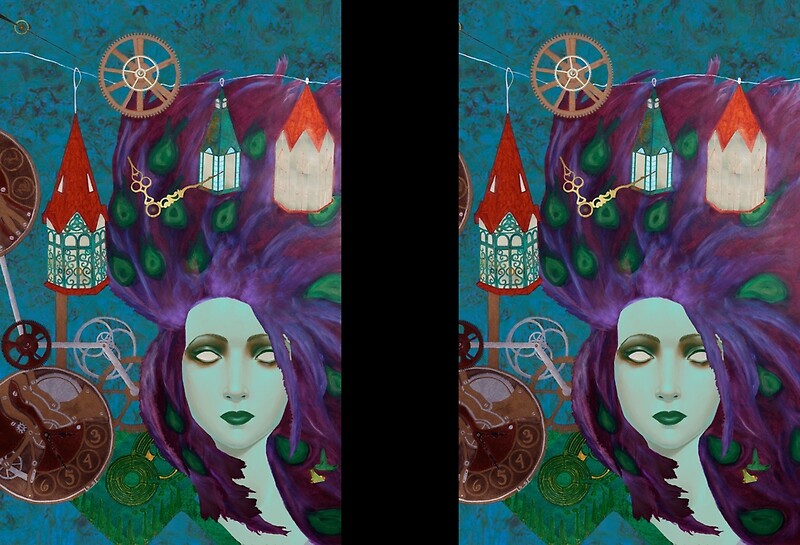
Saint Lucy decided at an early age that she did not want to be with a man; she preferred to give her self completely to God, though she lived in a time when it was not permitted to follow Christian beliefs. To deflect the attentions of a suitor who was captivated by the beauty of her eyes, she carved them out and sent them to him. Miraculously, she was still able to see—whether with new eyes that God gave her, as in some stories, or by some higher sight, as in others. I have chosen something along the middle path here, giving her the many eyes of a peacock’s tail, which serves also as a sort of halo. Lucy also faithfully braved the dangers of guilt by association, regularly taking bread to the Christians that were already in hiding from the authorities. Eventually, she was denounced as a Christian by another spurned suitor, and after various failed attempts, the Roman soldiers succeeded at killing her.

The idea of sight coming from somewhere other than the eyes is one that can be found in many fables, tales, myths, and religions. There are those even in the current scientific community who spend their lives seeking out and testing those who claim to have some other sort of sight—into the silent thoughts of others, into the future, across great distances, or into other realms where ghosts, angels, and demons reside. It is suggested that the earliest mention of such abilities is found in the Odyssey, but second sight is very common to the lore of the Scottish Highlands and the Icelandic sagas, and precognition is widely accepted among the Native Americans as well as tribes across South Africa and New Zealand.

In The Holographic Universe, Michael Talbot tells the following story about an event concerning a hypnotist his father had hired to entertain at a party and a family friend, named Tom, who agreed to play guinea pig for the evening:

“Tom proved to be a very good subject, and within seconds the hypnotist had him in a deep trance. He then proceeded with the usual tricks performed by stage hypnotists. He convinced Tom there was a giraffe in the room and had Tom gaping in wonder. He told Tom that a potato was really an apple and had Tom eat it with gusto. But the highlight of the evening was when he told Tom that when he came out of trance, his teenage daughter, Laura, would be completely invisible to him. Then, after having Laura stand directly in front of the chair in which Tom was sitting, the hypnotist awakened him and asked him if he could see her.

Tom looked around the room and his gaze appeared to pass right through his giggling daughter. ‘No,’ he replied…Then the hypnotist went behind Laura so he was hidden from Tom’s view and pulled an object out of his pocket. He kept the object carefully concealed so that no one in the room could see it, and pressed it against the small of Laura’s back. He asked Tom to identify the object. Tom leaned forward as if staring directly through Laura’s stomach and said that it was a watch. The hypnotist nodded and asked if Tom could read the watch’s inscription. Tom squinted as if struggling to make out the writing and recited both the name of the watch’s owner (which happened to be a person unknown to any of us in the room) and the message. The hypnotist then revealed that the object was indeed a watch and passed it around the room so that everyone could see that Tom had read its inscription correctly.” (141)

So, what was Tom seeing the watch with, then? Was he really seeing through his daughter? Or was he seeing the watch by seeing the thoughts in the hypnotist’s head? What is that?

While working on this painting, I came across yet another story, this one about an autistic girl, who has of course been subjected to many recorded medical studies since her abilities were noticed. Blind from birth, this girl wanders around by herself without running into things by making little chirping noises which somehow act as a sonar, as in the case of bats. She also always knows what time it is, though she has never seen a clock…

In this icon of St. Lucy, I have chosen time as that which is being re-envisioned, or seen new. The various clock pieces come apart, reconfigure, and tumble about through space; some of them are organic, forming the labyrinths where the Christians Lucy must feed hide from the monsters, requiring her to find her way by following an inner radiance and sureness of step, that is, by faith and by transcending (thus the birds) her physical handicap.

(Two heavy influences on my thinking about this work: Tlon, Uqbar, Orbis Tertius by Jorge Luis Borges, and How to Create a Universe that Doesn’t Fall Apart Two Days Later by Philip K. Dick).

Thursday, March 19, 2009

Consensual "Reality"

Charles Tart, a professor of psychology at the Davis campus of the university of California "found two graduate students, Anne and Bill, who could go into deep trance and were also skilled hypnotists in their own right. He had Anne hypnotize Bill and after he was hypnotized, he had Bill hypnotize her in return. Tart's reasoning was that the already powerful rapport that exists between hypnotist and subject would be strengthened by using this unusual procedure.

He was right. When they opened their eyes in this mutually hypnotized state everything looked gray. However, the grayness quickly gave way to vivid colors and glowing lights, and in a few moments they found themselves on a beach of unearthly beauty. The sand sparkles like diamonds, the sea was filled with enormous frothing bubbles and glistened like champagne, and the shoreline was dotted with translucent crystalline rocks pulsing with internal light. Although Tart could not see what Anne and Bill were seeing, from the way they were talking, he quickly realized they were experiencing the same hallucinated reality.

Of course, this was immediately obvious to Anne and Bill and they set about to explore their newfound world, swimming in the ocean and studying the glowing crystalline rocks. Unfortunately for Tart they also stopped talking, or at least they stopped talking from Tart's perspective. When he questioned them about their silence they told him that in their shared dreamworld they were talking, a phenomenon Tart feels involved some kind of paranormal communication between the two.

In session after session Anne and Bill continued to construct various realities, and all were as real, available to the five senses, and dimensionally realized, as anything they experienced in their normal waking state. In fact, Tart resolved that the worlds Anne and Bill visited were actually more real than the pale, lunar version of reality with which most of us must be content. As he states, after 'they had been talking about their experiences to each other for some time, and found they had been discussing details of the experiences they had shared for which there were no verbal stimuli on the tapes, they felt they must have actually been in the nonworldly locales they had experienced.

Anne and Bill's ocean world is the perfect example of a holographic reality-- a three-dimensional construct created out of interconnectedness, sustained by the flow of consciousness, and ultimately as plastic as the thought processes that engendered it. "

--pp 143-44 The Holographic Universe, Michael Talbot


A visual aid:
Embroidering the Earth's Mantle, Remedios Varo

A view of the convent student's life (as she was, in fact, a convent student)...


Embroidering the Earth's Mantel


--and rebellion...
My apologies for this photo, taken from the computer's "eye," but here is a close-up of the shadow just visible underneath the left-hand slit, through which the world's mantel, which the girls embroider but cannot take part in, falls:


Photobucket


Here, Varo and her lover abscond: Varo has "used this most genteel of domestic handicrafts to create her own hoped-for escape. Unlike Rapunzel and the Lady of Shalott, Varo's young heroine imprisoned in the tower is not merely a metaphor for confinement, but also an agent of her own liberation." --p21, Janet Kaplan, Unexpected Journeys


So, she has taken the reality accepted by others, the reality she was born into, and created something else of it-- using the tools that "reality" gave her, she escaped into a dream, which now (in the painting) exists. There is physical evidence. Soon, as the couple descends, all will see them, and they will become part of the accepted reality.

She spent much of her life in escape attempts, and that fact is shown in her paintings time after time. Her first escape:
Escape


was with Gerardo Lizarraga, whom she married briefly, thus escaping the socially confining role of "daughter" and freeing herself to live away from home, where she could act more freely. Her family supported her artistic endeavors, allowing her to go to art school, and in fact she had learned to draw by endlessly copying her father's engineering drafts as a child, but still she felt the weight of disapproval from society as a whole and especially from her older brother. She was escaping academic art to join political artists and to move on to the bohemian artist's life; she was escaping the confining and disapproving gaze to which she was wholly subject as a "minor" (unmarried):


Rupture


(entitled: Rupture-- she breaks with her old life and begins anew.)
Though the marriage didn't last long, she and Lizarraga remained friends to the end of her life, and were always near each other. This painting, "Huyendo," shows not only the idea of escape but also a visual theme that would be repeated often throughout her works, that of self-propelled beings, whose capes act as sails, umbrellas as ships; often their coats will open slightly to reveal that their feet are wheels, or their mustaches will serve as handlebars, steering the curve of their beards. Varo also was forced in her life to flee Franco's Spain, and then the Nazis in France, and she settled, finally, in Mexico, where her particular style became fully developed.
Another major theme was the magical nature of connection and creation. Varo was extremely interested in the occult, alchemy, and mysticism, and it showed in the magic potions, test tubes, and beakers scattered throughout her paintings. Her characters often had the ability to pull music from the air or the light, or by careful placement of important objects (flowers, leaves, mathematical formulas, rocks) :


Harmony
(again, I apologize, another "computer eye" photo)
Remedios Varo

as well as to create life (here, "a scientist-artist in the persona of Wisdom-- the owl--sits at a desk drawing a bird. Using primary colors distilled from the atmosphere, she draws with a pen that is connected through a violin to her heart. Moonlight--the domain of both owl and woman--, captured and magnified through a triangular lens, illuminates the drawing, stimulating the drawn birds to come to life and take flight out a window" 181 Janet Kaplan):
Photobucket

because (and this brings us back to the quoted hypnosis) all things and all beings were mysteriously interconnected.
Destiny
The artist's task was to find and emphasize those connections, to bring them to their highest point of power, thus escaping the seeming rigidity of forms by discovering their true potential for metamorphosis, for transcendence. Magic.

Friday, February 27, 2009

Perception and "Reality"

I am looking here for solid visual aids and powerful emotive stimuli to help my subconscious along in its attempts to accept the idea that there are many universes, and that those many universes may in fact all be overlapping, occupying the same space; that it's not immense speed that we need in order to visit other streams of reality, it's simply a more masterful application of our visual capabilities, of our awareness. My conscious mind accepts the new physics. Greedily. Now I must train the rest of me.
This is a record of that search, and also a record of my own attempt to create doorways out of walls, and windows out of mountains. Following that visual theme, I'll start with a story borrowed from “The Holographic Universe,” by Michael Talbot, in which he relates an experience with a hypnotist his father had hired to entertain some friends at his house. The hypnotist performed a variety of the usual tricks with his subject, a friend of the author's father, named Tom:
“But the highlight of the evening was when he told Tom that when he came out of trance, his teenage daughter, Laura, would be completely invisible to him. Then, after having Laura stand directly in front of the chair in which Tom was sitting, the hypnotists awakened him and asked him if he could see her.
“Tom looked around the room and his gaze appeared to pass right through his giggling daughter. 'No,' he replied. The hypnotist asked Tom if he was certain, and again, despite Laura's rising giggles, he answered no. Then the hypnotist went behind Laura so he was hidden from Tom's view and pulled an object out of his pocket. He kept the object carefully concealed so that no one in the room could see it, and pressed it against the small of Laura's back. He asked Tom to identify the object. Tom leaned forward as if staring directly through Laura's stomach and said that it was a watch. The hypnotist nodded and asked if Tom could read the watch's inscription. Tom squinted as if struggling to make out the writing and recited both the name of the watch's owner (which happened to be a person unknown to any of us in the room) and the message. The hypnotist then revealed that the object was indeed a watch and passed it around the room so that everyone could see that Tom had read its inscription correctly.
“When I talked to Tom afterward, he said that his daughter had been absolutely invisible to him. All he had seen was the hypnotist standing and holding a watch cupped in the palm of his hand. Had the hypnotist let him leave without telling him what was going on, he never would have known he wasn't perceiving normal consensus reality.” (141)

That's what I mean when I say I want to make doorways out of walls.

The part of the puzzle I feel is represented by the chess board, if I continue following the imagery of Alice in Wonderland, is the social conditioning that limits what we see. For example, there is the Bartlett Effect. The Bartlett Effect is a major problem when the only evidence you have in investigating a crime is eye-witness testimony. Numerous experiments have shown that several people all present at the same event won't see the same thing. Your average, averagely fearful white suburbanite will tell you that the perpetrator was a tall black man. Thirteen people present at the same bank robbery will all point confidently at someone different in a line up: someone who was in Germany at the time and so couldn't have been there, someone they saw on the news, one of the other victims. Anyone the police officer next to them seems keen on. This is your mind, having bracketed the world into patterns, seeing what it expects to see. People get frightened in these scenarios, and if your mind can’t grasp what it sees, it’ll do a little overdubbing--see something it can grasp. In fact, according to current neuroscience, we actually “see” very little. We take in a bit of information through our eyes, and our brain fills in the rest based on memory, past experience-- what we expect. The breakdown can be somewhere close to 50/50: fifty percent of what we think we're seeing is in fact only what we're expecting to see based on a combination of what we've seen before and our inherited cultural expectations. (And then, a lot of what we've seen before was already based on those inherited cultural expectations...)
The following section of a BBC documentary on the brain plays with this idea a bit:


Now, if all that's true, then all kinds of amazing, impossible things could be happening right in front of us all the time, and we just don't see them. Right?

Rob Gonsalves' paintings are another fantastic representation of how training yourself to see from more than one perspective at once can allow you to see more than one existence at a time. Here's hoping this becomes a talent off the canvas as well: