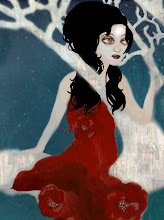
(The Book of Knowledge by Brett Ryder; discovered via Phantasmaphile)
“--Let us make a pact, she said. To madness at every juncture!
--To madness! Said Selah.” –The Way Through Doors (by Jesse Ball)
As I was preparing the last post on Ars Memoria (which probably serves as a sort of “Part One” to this post), I stumbled upon a book by Jesse Ball entitled The Way Through Doors. This is a book that has now been underlined heavily and filled with notes, and I was amazed at how it seemed to be almost a response to the question of how one goes about implementing the idea of re-arranging one’s knowledge of the world and one’s memory in order to consciously influence the present and future.
Selah Morse is out and about one day when he is struck by a lovely girl standing and looking up at a window in the building she has just exited. Horrified, he watches as a car strikes her, throwing her body into the air, and then drives off. She lands directly on her head. Selah rushes her to the hospital, where he soon puts himself into the position of boyfriend and caretaker of a girl with no memory. A girl he names Mora Klein. To keep her awake, and to help her jog her memory, he is to tell her stories of her own life. He begins by backing up only slightly, and re-telling very recent events with little differences here and there. Occasional differences. He begins the story with a bold lie, that of his own role, but only in exasperation with hospital bureaucracy and out of a desire to stay on hand and to help; after that, he takes little baby-steps into the world of lying—or creating. This is how the author creates the novel, and this is how Selah creates a life.
So, at first there are small differences. And sometimes, he backs up and re-writes a scene again. What is he doing? He is deciding his life. He is falling in love. He is shedding his old skin, putting on a fresh suit. He rewrites his entry into a new career, where he meets the message-taker named Rita, and she waits while he tries on his new “uniform,” an expensively-tailored suit:
“It fit perfectly. Pants, shirt, vest. There was even a pocket watch. My old clothes I put into a chute labeled,
THE FIRE THAT AWAITS US.”
I am reminded here of a quote from Bill Bryson’s A Short History of Nearly Everything, in the chapter in which he explains “How to Build a Universe.” First, he underlines the fact that before you build this universe, there is nothing. “Naturally,” he says, “you will wish to retire to a safe place to observe the spectacle” of your big bang. But there is no such safe place, because before there is your universe, there is nothing. No space, no darkness, no time, no past. Then he says:
“The average species on earth lasts for only about four million years, so if you wish to be around for billions of years, you must be as fickle as the atoms that made you. You must be prepared to change everything about yourself—shape, size, color, species affiliation, everything—and to do so repeatedly.”
Selah, and for that matter, Jesse Ball, does not go quite that far, as he stays human (though not everyone does) and keeps wearing his new suit, but he is willing to undergo supreme feats of physical labor, life-style change, and human-life-rule-bending. He does not protest when he finds he must go down to the bowels of the earth in order to get to the top of the highest building, or when he has to come to the same place three different times—each time by some new, even more impossible path—before he will be allowed upstairs to see the woman he seeks, Mora, the woman he is steadfastly working to invent. When the world breaks its own rules and throws everything upside-down (just as it did Mora), he adapts. A fantastic version of this occurs at The Beard House, where he enters and then hears the bolt slide shut behind him, and he is told he can never leave. The rules of the house are absurd, perhaps violently so, but he finds his feet quickly basically by acting as one does when confronted by a monster in a dream: remembering that the world is infinitely malleable, and that the one thing one must remember (I must remember this in a nightmare, but Selah applies it to reality, which is, I believe, the whole goal of learning to dream lucidly: to live lucidly) is that we make the world as we go. Every evil thing anyone says to you in a dream is a thing you are saying to yourself, and it follows that the same is true when you believe yourself to be awake. Selah applies this knowledge in his response to Caroline, the lady of the house. She very politely introduces herself and generously offers to get her guests a drink, yet responds venomously when they concede that a drink would be nice. This theme is played through several variations until finally Selah calmly takes hold of the servant’s chord and pulls. A resident gasps in shock, then cowers beneath a desk. The lady of the house storms in, asking who dares to be so bold, and Selah says, I did it. Now, bring me my drink. And on the double.
“—Very good sir, said Caroline, curtsying.
She left the room.
The guess artist and Piers Golp looked each other in shock.
--Not bad, said the guess artist. But how are we to get out of here?
--I have an idea, said S.”
Selah also tries telling the story from different perspectives, switching sometimes into third-person narratives, and sometimes having to pull himself out of a story before things get too hairy. For example, in one section, the man “seeking” the woman is named Loren Darius, and the woman is Ilsa, but as the story develops, he becomes too enmeshed in the emotional details and psychology of the character. He has been handed a curse, and he sinks into it, drowns in it, drives himself mad. The reader's anxiety grows also, what will happen? Just as he is about to break into violence, he’s stopped by another version of himself, his self in the new suit, who is now some stranger in a bar. A black-bearded blacksmith tells him,
“--You sit here a moment.
Loren sat. His mind was in a seething fury.
The young man in the blue-gray suit came over and patted him on the shoulder.
--My friend, he said, this is for you.
He pressed an orange into Loren’s hand. But it was not just any orange. It was the orange that Loren had been about to eat when news had come to him of his parents’ death. How had the orange been preserved so long? How could it still be fresh? Yet it was. Loren peeled the orange, and it was as perfect a fruit as he had ever seen. He took a portion and put it in his mouth, and the taste filled him. It was full of freshness and new promise, the lifting of obligation. He gave pieces of the orange to everyone in the room, and they all ate, smiling.
The young man knelt by Loren and whispered in his ear:
--Though we pass away now, the world will return to you again; fear not.
For at that moment the black-bearded blacksmith began to speak, and all that he said became more and more certain until only his subject remained.”[Italics mine]
And from there, a different version of a different aspect of the story begins. This time narrated by some other aspect of the author/dreamer/ narrator. The whole world changes. The anger of Loren is lost, the all-consuming rage and loss he had been driven by stops, and the world begins again, fresh as an orange, as a morning glass of juice. And everyone drinking the juice shares in the story, listens, experiences, and believes, and that,
My friends,
Is what makes something real.
If I dream a dream, and you dream it too, then it can’t really be “just” a dream, right? This is why we tell stories of what happened to us. We repeat the good things, the amazing things, the miracles we have experienced, over and over, and in as many different ways as is possible so that the people listening or reading will feel what we felt, because if they feel it, they believe it, and if they believe it, it’s real. So what happens if we start telling the bad stories over and over again? To everyone who will listen?
Hopefully, a black-bearded blacksmith will come grab us by the arm, sit us down, and tell us a better story.
As the narrator tells us,
“Strength is nothing, ferocity is a plaything; when life is waged as a war, grace is the only virtue, grace shown through nimbleness.”
Or, if you wish to exist for billions of years, be prepared to change completely, to do many 180-degree turns, to be knocked across the street and land on your head and wake up in a Czech hotel as a cockroach. To mix metaphors. To grow fur, change gender, learn to cross streams of reality and come out the other side.
Over and over again in this blog, I have written about the idea (as in the last post) of Murakami’s central image, as developed in Hard-Boiled Wonderland and the End of the World, an image that defines and then controls the way you see the world around you (I’ve posited, along with others, that this image is developed within the first five years of a person’s life). Jesse Ball’s The Way Through Doors also explores that central image, this time expressed as a map drawn on a kerchief hidden up Selah’s sleeve:
“...when you are a child, somewhere between two and four years of age, a night comes that you have a dream. In that dream you dream your entire life, from start to finish, with all its happinesses, its disappointments, its loves, its hates, its pains, its joys. Your entire life. The dream should have to last an equivalent amount of time, but somehow it happens in just one night…
Most people forget their dream. In fact, everyone forgets most of it. However, I was a precocious child. That morning I was left alone by myself with a large sheet of paper and a bucket of crayons. While my dream was still fresh in my head, I constructed a map of my life, using symbols and writing down what I could. Somehow I realized that to write too much would ruin it, and would make me sad in the end. Therefore, what I wrote down were mostly clues as to how to manage the difficult parts.” (78)
Now, if this dream were completely subconscious, that is, if he had indeed forgotten it as soon as he woke up, he would simply be trapped in the image. He would be propelled forward by it, trapped inside the invisible walls of the image, never to escape. But he remembers guideposts. Only guideposts. Not details—details would also trap him. If the whole path is already completely defined, then you simply follow it, right? What the map he has made shows us is that each signpost that he’s made can be interpreted in various ways, and that is what he is doing throughout the book; he is trying out different meanings for them, the different possible paths from each one.
Early in the book, the narrator meets up with the Guess Artist, and this artist accompanies him until the end. What is a guess artist? He is a man who stands on the pier under an awning and guesses what you are thinking. Different people will walk up and ask, what am I thinking? He has a rule: he always gets at least two guesses (at some points in his past, he has asked for three). Usually, the first one, as detailed and meaningful as it might be, is not the “correct” thought, though sometimes it is still a thought belonging to that person. He doesn’t just guess a sentence, he guesses a situation--an image, you might say—which encapsulates not just a present fleeting thing, an addition to the grocery list, but a situation in the person’s life, and how it relates to that person’s life, and that person’s questions regarding both those things.
“—You are both thinking the same thing, said the guess artist. You are wondering whether the sun will ever go down, since you have been traveling now for six years on airplanes, staying ahead of the sun, and you have finally decided today to let yourselves see a sunset.
--That’s not true, said June. I design robots for use in private industry. We have an apartment on the West Side.
--Okay, said the guess artist. Three chances, right?
--Okay, said June. Shoot.
--You’re thinking about the cat you had when you were a child. There was one spot on its fur, to the left of its tail, which would never sit smoothly. The fur always stuck up. Somehow you thought that because the fur was always sticking up there, the world could never reward anyone with exactly what they wanted. This belief was for a long time unconscious in your head, but earlier today you realized why you believe what you believe. Furthermore, now you feel that it is certainly true. The cat died when you were nine. It is buried by the gate of your parents’ house in Tensshu.
--What is the cat’s name? asked June.
--You are being very careful not to think of the cat’s name, said the guess artist.
Then his expression changed. He looked at Takashi.
--The cat’s name was Octopus.
June gave Takashi a withering look.
--Don’t you have any self-control? she asked.
Takashi shrugged.
June looked at the guess artist.
--You’re pretty good, she said”
Several things are happening here. First, we can see how a single childhood image (even one that isn’t instantly unraveled into an entire dream-life which encapsulates every waking detail that later unravels in your world) can control the beliefs and therefore the actions and therefore the possibilities of a person. Also, we get a glimpse into what an artist or writer does. He or she looks at the people passing by and imagines whole lives, scenarios—the central mental image and its resulting possibilities—which might belong to them. Based on what? Based on the image of that person: the hairstyle, body language, sway of the hips, curve of the ear, glint of light off the eye, clothing, jewelry, skin-color. See how much an image means? See how much it influences? In your dreams, your different beliefs come up and talk to you as characters. They look and act a certain way, and they influence your feelings and dream-actions in a certain way. They are telling you, if you pay attention, something about your life. And if you remember that you are dreaming, if you remember that you are in control, if you remember that at any time, you can jump into a different character and look at things differently (they are all you!!!) you can completely change that other character’s behavior, too. As Selah does with Caroline. And in this novel, Selah is doing what the guess artist does; he is imagining full scenarios, completely new ones—for he is not tied the way we usually think we are to a single scenario. Mora doesn’t remember anyway, and he only has guideposts on his map.
The trick, maybe, is only to completely immerse yourself when you like what’s happening. Otherwise, climb out. Change your name. Cut your hair. WAKE UP.
Selah gives the reader a little more help than that, even. He is by vocation a pamphleteer, currently at work on what will be his greatest pamphlet ever, that of a World’s Fair full of only the most impossible and amazing things of the world—like the best dream ever, the story you always wanted to tell, the story of a wide-eyed child back from the most wondrous trip into the world he’s ever made: “and then, and then, and then…!” (Because what you focus on forms the world.) But he has previously written other pamphlets, including “The Foreknowledge of Grief,” which explains how to find (create) the love of your life, his own advice, which is what he’s now trying to follow. (He has a plan; he’s trying to make it real.)
“First, he says, you have to go out into the world. This is not a simple matter of going outside one’s door. No, that is simply going out. That’s what one does when one is on the way to the store to buy a loaf of bread, some cheese, and a bottle of wine. When one goes out into the world, one is shedding preconceptions of past paths and ideas of past paths, and trying to move freely through an unsubstantiated and new geography.
So, one goes out into the world, and then one wanders about.”
And that is what he does. And as he wanders, the rules change, Mora morphs from Rita to Ilsa to Sif and back again to Mora and Sif and Rita and Ilsa. And then….
Read the book.


 Posts
Posts