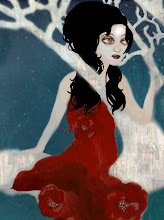
member of:Observers of the Interdependence of Domestic Objects and Their Influence on Everyday Life


This group has been active for a long time and has already made some remarkable assertions which render life simpler from the practical point of view. For example, I move a pot of green color five centimeters to the right, I push in the thumbtack beside the comb and if Mr. A (another adherent like me) at this moment puts his volume about bee-keeping beside a pattern for cutting out vests, I am sure to meet on the sidewalk of the avenida Madero a woman who intrigues me and whose origin and address I never could have known...
--Remedios Varo


(Slideshow is of Artwork by Remedios Varo)
By believing passionately in something that still does not exist, we create it. The nonexistent is whatever we have not sufficiently desired.
--Franz Kafka

Tuesday, May 12, 2009

Mia Araujo

Mia was born and raised in L.A., and she graduated as valedictorian from LA's Otis College of Art and Design in 2007. She also recently won the "Shepard Fairey in DC" contest. For larger views of her work, go to http://www.art-by-mia.com/
I recommend it, because there are hundreds of little details you don't want to miss.

From BLOG PHOTOS

"The Inventress"

When you go to her website and click on gallery, you will find thumbnails representing several shows her work has been featured in. If you click on the second one, "Overdose" Hi-Fructose Group Show, you will find the painting "The Inventress," which you click on to get a huge, browser-sized image. Then you can begin to see what I mean about the details. Just in her hair, there are princesses, marionettes, broken puppets, masks, the inner workings of a clock, a lamp, and a complex pair of eyeglasses much like Johnny Depp wore in Tim Burton's Sleepy Hollow. A kidnapper runs off with his prize, up the thick, ropey branches of tree that seem to have developed as an extension of her chestnut hair. Beside her floats the head of a modern, handsome Frankenstein, being polished by a little man hidden in the hair just behind her ear. Snow white owls fly by, and Dracula looks on from a corner seemingly pulled from an old German Expressionist era movie. And that's just the top of the painting, there's another entire world down below, in the waters reaching up to her chest. I imagine her to be creating these worlds, populating the earth with the figures and creatures of her imagination and dreams.

She gives some background on the above piece on her blog (www.miaillustration.blogspot.com):
"This painting started off being based on the Tales of Hoffman, and in fact E.T.A. Hoffman’s literature in general. For those of you who’ve not heard of him, he is most famous for writing the Nutcracker, and most of his stories also deal with inanimate, often mechanical objects coming to life in a fantastical way. They are macabre fairy tales written in a time where Romanticism ended and the Enlightenment began, so there is always tension between the imagination and reason. There is also a fragmentary nature to the Tales of Hoffman in the many interwoven narratives, and a gothic influence through which his characters are tormented on their paths to happiness. I tried to give a sense of all this in the piece.

Interestingly for me, I noticed many parallels in these stories with the way in which my mind works during the creative process. At first glance in my mind’s eye, it appears that I have dozens of ideas vying for attention, but upon closer inspection I find that some of these are half –finished, missing an arm or a leg like some of the creatures in this piece…there are also thoughts that frighten or torment me, as well as beautiful thoughts that inspire and excite me, and these coexist side by side, creating a dynamic habitat for my new piece to be born in. Again, I wanted the objects and characters in this piece to reflect this.

Finally, it just so happens that my mind is a constant battlefield for my intellectual side and my imagination to jostle upon, much like the stuff in Hoffman’s stories…plus I couldn’t resist throwing in some of the ‘30s horror film imagery that I love so much, alongside the fanciful whimsical stuff to portray the sinister, gothic aspects of Hoffman, that lurk beneath the light-hearted magic."

On her website, it states: "Mia believes that all individuals contain an entire universe within them. Her recent work strives to represent the unseen forces at work within the subject--spirits, inner demons, conflicting emotions, and the imaginations."

From BLOG PHOTOS

"Needles in a Haystack"

In an interview with Arrested Motion, she says: "Lately a lot of my pieces have been based on well-known stories...and I usually have another theme that I'm trying to get across by using those stories...sleeping/dreaming, imagination, death/rebirth of the inner self. I start conceptualizing by making a list of words and imagery that inspire me and then fixate on one mental image for the whole piece which I will sketch out...I work out the figure first, and then start drawing out the mini-narrative characters into the composition in whichever way they flow. So there is a spontaneity to it. Sometimes I'll want to include a sphinx or an apatosaurus, say, but if it doesn't work anywhere in the piece, then I won't use it. Each piece has mysteries even to me, and new meanings arise from the different elements than I intended."


Mia makes the blueprint for her work on tracing paper and transfers it with chalk-carbon paper onto a maple panel. She paints with acrylics. Her favorite color is Naphthol Crimson, because it "plays well with others."

From BLOG PHOTOS

"Across the Nile" (another one that MUST be viewed large)

"The view outside my [studio] window is an amazing eucalyptus forest, with hundreds of monarch butterflies in the wintertime. There is also a red-tailed hawk nest and I can see the birds take flight without having to get up from my chair. It’s absolutely unbelievable."


From BLOG PHOTOS

GILL:
"One of my three main pieces for my senior thesis on solitude. Each character embodies different aspects of how solitude is positive and important for the personal development of an individual.
This is Gill, and she represents self-discovery and exploration:"
Gill has made a little fishbowl through which all her limbs come out to wrap protectively around it. Her neck pulls up out of the back and her head enters the bowl. The fishbowl, that little bit of the world we see in our lives, and also a separate place, safe and secure, though clear enough to see out of into the distance... On the other hand, where all the others around her carry umbrellas, she has captured the water and dives into it, makes it a part of herself.

From BLOG PHOTOS

"Anatomy of a Somnambulist"

Mia says: "Submerged in sleep, a somnambulist that has been sleep-walking for years, and whose dreamscapes have created a habitat about her."

From BLOG PHOTOS

"Dreamcatcher"

Though the dreamcatcher is a Native American--especially Ojibwa-- tradition, made to capture the darker forces that enter the air at night to infuse your wandering soul with fear, this painting struck me as having a sort of Mexican Day of the Dead flavor, where two fearful things, Death and Separation, are overcome in a big, colorful party where you and your lost loved ones can once again connect, converse, and share a meal. Note the skeletal rabbit-type playing violin in the lower right corner, the vivid fortune-teller red of the somnambulist's hair, the flowers she arises from, the hybrid log-cutter, and the disembodied merry-go-round.

Monday, May 11, 2009

Dreaming

click to comment
"Underneath Your Eyelids," Agnieszka Szuba

"William Stanley Merwin (born 30 September 1927 ) is an American poet. He made a name for himself as an anti-war poet during the 1960s. Later, he would evolve toward mythological themes and develop a unique prosody characterized by indirect narration and the absence of punctuation. In the 80s and 90s, Merwin's interest in Buddhist philosophy and deep ecology also influenced his writing. He continues to write prolifically, though he also dedicates significant time to the restoration of rainforests in Hawaii, where he currently resides.

Merwin has received many honors, including the Pulitzer Prize for Poetry (in both 1971 and 2009) and the Tanning Prize, one of the highest honors bestowed by the Academy of American Poets, as well as the Golden Wreath of the Struga Poetry Evenings." (wikipedia)

click to comment
"Succubus," Agnieszka Szuba


click to comment
"In the Chamber of Miracles and Fears," Agnieszka Szuba

Two days ago, I posted a poem of his I had stumbled across on language, which got me looking through his poetry again, which led me to making another post :)

In 1971, Merwin donated the money from his Pulitzer Prize award to the draft resistance movement, simultaneously publishing his objections to the Vietnam War in the New York Review of Books.

His poem, Ogres, which is also a form of protest against war, is a favorite of mine, as it makes me think of dream theories and the necessity of applying them to everyday life. One of the main principles to remember when studying your dreams is that every character in them is actually an aspect of you. You may dream of your husband, wife, mother, neighbor, or the bully in your school, but in your dream each of them is representing some aspect of you that has been prevalent in some internal conflict or that has been the guiding force in your actions over the previous 24-48 hours. And so the idea is not to wake up and go let that person have it for cheating or abandoning or otherwise violating you, but rather to figure out where you have been doing such a thing to yourself--what talent or interest you've been neglecting, where you've been cheating yourself.
If I could look at the waking world in that way, I would spend less time angry, and more time solving problems and drinking magic potions :) The poem Ogres hinges on that idea.

click to comment
"Theatre of Things Unknown and Unseen"
Agnieszka Szuba


Here's that poem:

OGRES
-W.S. Merwin-

All night waking to the sound
of light rain falling softly
through the leaves in the quiet
valley below the window
and to Paula lying here
asleep beside me and to
the murmur beside the bed
of the dogs’ snoring like small
waves coming ashore I
am amazed at the fortune
of this moment in the whole
of the dark this unspoken
favor while it is with us
this breathing peace and then I
think of the frauds in office
at this instant devising
their massacres in my name
what part of me could they have
come from were they made of my
loathing itself and dredged from
the bitter depths of my shame

--W.S.Merwin--

And here's a playlist of some more dream-related images created by Agnieszka Szuba:

Jerry N. Uelsmann

Jerry Uelsmann works in a darkroom, creating multiple exposure images, meaning he uses many negatives to produce a single print, and sometimes as many as seven enlargers to work with one print. He started using this process in the 1950s and 60s. "He originally believed that using a camera could allow him to exist outside of himself, to live in a world captured through the lens." (Wikipedia)

According to his website, he "received a Guggenheim Fellowship in 1967 and a National Endowment for the Arts Fellowship in 1972. He is a Fellow of the Royal Photographic Society of Great Britain, a founding member of The Society of Photographic Education and a former trustee of the Friends of Photography."

Photobucket

He says:
"When I studied photography at RIT each darkroom had one enlarger. Then when I started teaching we had a group darkroom. I was still using one enlarger, which was labor intensive for multiple printing. One day while I was waiting for some prints to wash, I looked across at the enlargers and thought to myself that if I had the negatives in different enlargers and simply moved the paper, the speed with which I could explore things or line them up would increase a hundred times. That was the moment that changed the way I worked with multiple images."

jerry n uelsmann

"During the early 1960s I was the only photographer in an art department at the University of Florida at Gainesville. I worked with painters and sculptors who were interacting with their art as it was being created. That’s when the post-visualization idea occurred; that the darkroom could serve as a visual research lab. I spend much time in my darkroom building images from separate negatives, hopefully into something cohesive. My main technique involves combination printing. I did not invent this method; it was widely used by Oscar Rejlander and Henry Peach Robinson in the 1850s. When I began re-investigating darkroom options I was reminded of the saying that “nothing is new except what has been forgotten.”

"My creative process begins when I get out with the camera and interact with the world. A camera is truly a license to explore. There are no uninteresting things. There are just uninterested people. For me to walk around the block where I live could take five minutes. But when I have a camera, it could take five hours. You just engage in the world differently. If you can get to a point where you respond emotionally, not intellectually, with your camera there’s a whole world to encounter. There’s a lot of source material once you have the freedom of not having to complete an image at the camera.
Of course as I developed a way of building images in the darkroom, this also fed back into the way in which I saw the world. So if I find an interesting tree or rock I think, “Gee, that could be a wonderful background for something.” I begin to build a vocabulary based on things that I encounter and then I start photographing things specifically for use in my darkroom. I may photograph objects on a light box so they have a white background or shoot things on black velvet so I can sandwich those negatives later in the darkroom."

jerry n uelsmann

But my initial approach is very non-intellectual. I just can’t emphasize that enough. Today there is a lot of conceptually based art that begins with a particular theory and then the individual makes the images to fit. It’s like an assignment, all planned and then they just follow through and do the work. My approach is a lot less premeditated."

jerry n uelsmann


"Of course, in order to make art, the frustration of not working has to be greater than the frustration of working. I try to push images as far as I can. Sometimes I go too far, then as time passes, I think, “That was stupid or overkill” or whatever. But you have to go to those places. You can’t just say, “We have an hour to talk on the phone, let’s only be profound.” You start wherever you can and then you work at it.

For me, every year I produce at least 100 different images and at the end of the year, I try to sit back and look at them and find ten that I like. Many years, it’s hard to find those ten. "

jerry n uelsmann

“I often get called a surrealist because people like labels, and I like being part of that tradition though I don't really consider myself a surrealist. I like art that is inner-directed. I like to explore my own innermost realities.”


"Although photographers must contend with implied veracity they are always inventing other realities. The “straight” photograph does not literally replicate a scene. An Ansel Adams picture of Yosemite is not what you experience when you go there. There is always a transition that breaks from reality. Photographic veracity is an effective tool because it implies a real situation and allows the viewer to respond to it accordingly."


His wife is Maggie Taylor, whose work I have blogged about before here. She also works with a collage process of photography. Her work is in color, and though she started out using traditional negatives, she has since switched to digital processing, using a lot of 19th century images.
“I'm more interested in quirky characters, so a lot of the people I use tend to look Victorian. I see them as actors on a stage, and there is usually a story to go along with the image. But I like for it to be open-ended, so people can use their imaginations. I think we both like surrealism, but it's not a conscious thing. We both like narrative and symbolism.”
They live in Gainsville, Florida.


A Playlist of Uelsmann's photos is here

"The camera is a license to explore. It grants you societal permission to go out and interact with the world. It gives value to my life. Even if I did not have the finished images that I made, I still would be content with all the experiences that the photographing has given me."--Jerry N. Uelsmann