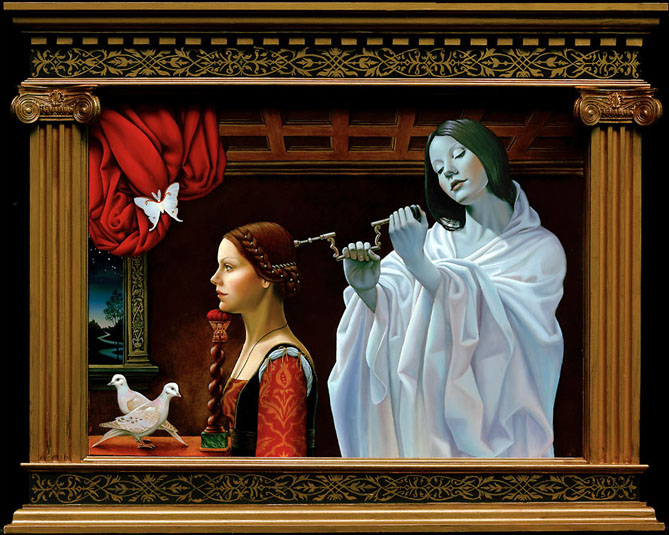
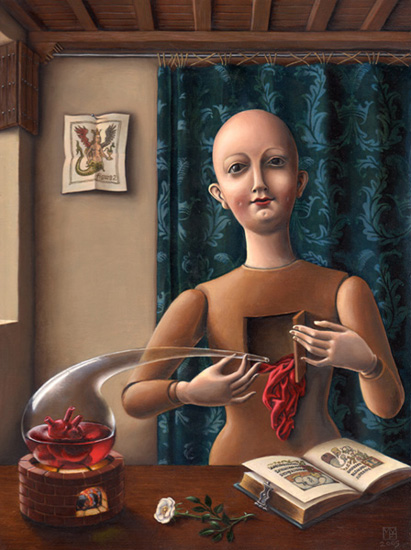
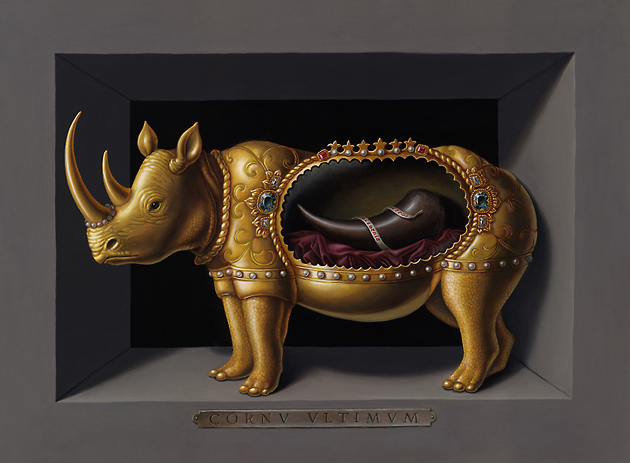
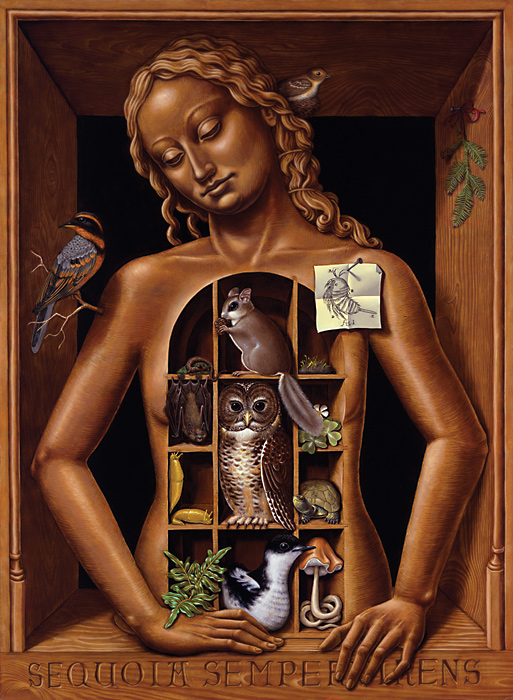
member of:Observers of the Interdependence of Domestic Objects and Their Influence on Everyday Life


This group has been active for a long time and has already made some remarkable assertions which render life simpler from the practical point of view. For example, I move a pot of green color five centimeters to the right, I push in the thumbtack beside the comb and if Mr. A (another adherent like me) at this moment puts his volume about bee-keeping beside a pattern for cutting out vests, I am sure to meet on the sidewalk of the avenida Madero a woman who intrigues me and whose origin and address I never could have known...
--Remedios Varo


(Slideshow is of Artwork by Remedios Varo)
By believing passionately in something that still does not exist, we create it. The nonexistent is whatever we have not sufficiently desired.
--Franz Kafka

Showing posts with label contemporary painters. Show all posts

Tuesday, May 13, 2014

Samantha Keely Smith


Mutiny, 2012, by Samantha Keely Smith

Please press the images to see larger versions.


Vestige, 1998, by Samantha Keely Smith


Alley, 1998, by Samantha Keely Smith


Samantha Keely Smith first began painting her dreams, pulling strange, overlapping worlds with gleaming or ghostly figures in natural settings. She had recurring dreams, from childhood, that she feels may have come from a past life. As she painted them, their reason for existence began to clarify itself to her, and she was less haunted by them. She then moved into a deeper place, where words and particular shapes and beings no longer seemed “whole” enough to express what she was now struggling to express. After that came layer upon sometimes destroyed layer of motion and intense color, as if she were re-forming the chaos of the psychological underpinnings (memory, fear, dream, will-to-act, fantasy, all swirling around each other, conflicting with each other, making shifting alliances) of what we perceive as the solid, physical world into a more open-ended image we could stand before and perhaps even try to understand. 

Shift, by Samantha Keely Smith--You can see "another" world underneath...
Maybe, then, from that chaos, without the authoritarian, pre-defined, concrete, unchangeable image we call “reality” super-imposed on top of it, we could re-define the outlines of the world created by those psychological underpinnings, changing the universe as we stand there, and then leave the room to discover some miraculous occurrence. The world we see is not the only world there to experience...


Kindred by Samantha Keely Smith(The sea and the sky consider a trade, the sun jumps in to join...)

“What I'm trying to talk about or discover is really this whole notion of another existence coexisting with the one we see in reality, and the possibility of past lives, the spirit world and all that--the idea of being constrained by the here-and-now and the hold that earthly things have on us, our spirit, our soul."

Cantos, by Samantha Keely Smith


She says: "... I see the images the way you see things with your peripheral vision because they're so fleeting that I can never be totally sure of what I've seen...I only know a painting is finished when I can see there is nothing 'off' about it, and that it feels like what I saw in that first fleeting glimpse."

Vessel, by Samantha Keely Smith (look closely!)

"There are two worlds that exist together, and there is one that pushes against the other, that claims the other doesn’t, or need not, exist. " --To me, those two worlds are the one we easily see and the one that is harder for us to see: the one we want to believe in, want to believe into existence. That is the one that takes work, focus, concentration, because it contradicts the version handed to us on a plate.

Surfacing, by Samantha Keely Smith

VIA.


Monday, January 9, 2012

Madeline von Foerster and the Impossible


Above: Self-Portrait, by Madeline von Foerster

If we see what we see and miss what we don’t see because of a perceptual bias, and that perceptual bias is based on cultural lessons and experiential lessons in the first five years of life, then it would seem we are forever trapped in a spiral created by things that occurred long before we realized we had any agency in our own lives. That’s the subconscious, generally perceived to be much more powerful than your conscious, and the entity responsible for subverting all those little chants (I can do this, I can do this) and plans you make in your life. You think you want to do something, but your subconscious thinks differently, and it always wins. Or you think you saw something, but really, your subconscious didn’t agree with what was there, and so it overdubbed the situation (see psych studies of the fallibility of eyewitness accounts).

The coding that your subconscious uses is symbolic. I’ve studied it often through this blog as a latent image, a sort of symbolic painting encapsulating a feeling and a series of relationships that defines how you will interpret your experiences and the world around you. To get an idea of where you are right now, you might capture a dream and pick apart all of the symbols in it--the atmosphere, location (indoors? outdoors?), the colors, the people and their attitudes, the relationships between people, people and objects, objects and objects. As was explored in the last post, architecture, geography, weather--all these things are alive, somehow, they are talking to you and you are talking to them, even though you’re not aware of those conversations. You can explore that notion through your dreams, with the intensified emotions and moods often found there, and then you can change your latent image, your map of your life, by altering pieces of the dream, sinking back into the feeling of the dream, and changing it, consciously. Then it helps to bring that image into the physical world. A painting or a collage with all the representational pieces, plus your alterations...and when you look at it, pause a moment, and feel the change that you made again. Then keep track of the seemingly unrelated changes that begin to take place in your life.


Madeline said about her above self-portrait, “During a previous period of depression in my life, I often experienced a severe sensation of pressure in my cranium. It sometimes felt so unbearable I wished I had a hole in my head! A friend told me, “Maybe you just need to be trepannated!” It was a revelation to discover that this surgery existed and was used therapeutically for centuries.”

In fact, it is a still-used process in cases of traumatic brain injuries, and there are also those who self-trepanate in an effort to reach higher consciousness. In 1965, a Dutchman named Bart Hughes performed this surgery on his own, believing that this act would relieve his brain of cerebrospinal fluid, thus allowing for more blood in the brain, which he theorized would make him some cross between high and enlightened.   

In a response to a post on this painting at neurophilosophy.wordpress.com (link to the right in the blogroll), a reader named Morgaine commented: “I’m thinking that to the extent she believed trepanation might relieve pressure, painting it (imaging in such detail) could have tricked her body into thinking she was actually doing a procedure that would lessen pressure on her skull, with her belief/hope (placebo) bolstering her immune system – countering whatever functions may have gone awry contributing to her headache. But also her use of image and attention could have directly changed other facets of physiology such as blood pressure and heart rate…which in turn could have affected her headache.”

Given the choice between Hughes’ method and von Foerster’s...well. Easy choice.

Madeline came back to this post to respond to this idea, and gave another example (more difficult) of the same type of mind-body experience: “The most powerful example of this was when a musician friend asked me to paint the cover art for an album he was making, his own kind of healing catharsis ten years after his wife’s suicide. Even though the image I created was largely peaceful, there was definitely some tension and sorrow in it. During the time I spent on the painting, I experienced horrible sadness, loss, and desolation. If I had had any kind of belief in the supernatural, I would have sworn that I was being inhabited by the woman’s ghost, because I had no great problems in my own life, and the emotions did not feel like my own. But of course it was the manifestation of this imagery/symbolic neurofeedback you describe. By the end of the work I felt a sense of release and peace.”

The idea of being inhabited by the woman’s ghost is such an apt description: we take things into ourselves, much like a haunting. When we focus on a certain feeling, we bring it to life and give it a body to move around in. When we focus on pain, we give pain a body so that it may haunt the world.

(by Madeline von Foerster)

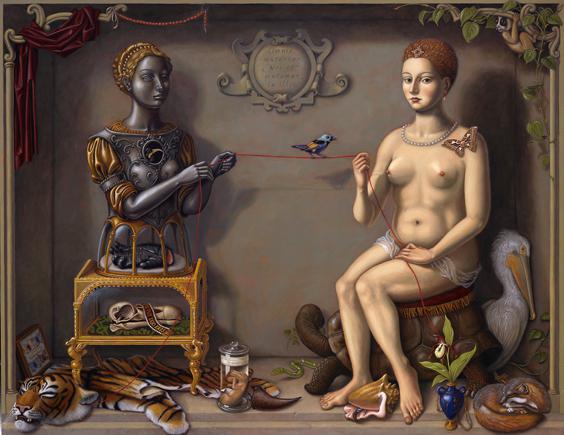
Two major themes of Madeline con Foerster’s work are extinction and preservation. She has series of paintings based on the old Cabinets of Curiosities that were the precursors to the modern museum and on Reliquaries, those icons or statues with openings or drawers for the bones or other personal mementos of saints one finds in cathedrals.


She notes an odd disconnect between those things that are so beautiful, that we love, but that we will drive to extinction in order to ‘own’ them. In a video made about her painting “The Red Thread” (below), she gives an example of that:
“...the bird called the Great Auk that was made extinct a while back and I think when there were something like 40 of the birds left...38 of the were killed for museum specimens.”


I was immediately reminded of the passage in Out of Africa, by Isaak Denisen, in which she kills an iguana to capture the color and flash of its skin, perhaps to make something out of it, and makes an important discovery:

“In the reserve I have sometimes come upon the iguanas, the big lizards, as they were sunning themselves upon a flat stone in a river-bed. They are not pretty in shape, but nothing can be imagined more beautiful than their colouring. They shine like a heap of precious stones or like a pane cut out of an old church window. When, as you approach, they swish away, there is a flash of azure, green, and purple over the stones, the colour seems to be standing behind them in the air, like a comet's luminous tail.

Once I shot an iguana. I thought that I should be able to make some pretty things from his skin. A strange thing happened then, that I have never afterwards forgotten. As I went up to him, where he was lying dead upon his stone, and actually while I was walking the few steps, he faded and grew pale; all colour died out of him as in one long sigh, and by the time that I touched him he was grey and dull like a lump of concrete. It was the live impetuous blood pulsating within the animal which had radiated out all that glow and splendour. Now that the flame was put out, and the soul had flown, the iguana was as dead as a sandbag.

Often since I have, in some sort, shot an iguana, and I have remembered the one in the Reserve. Up at Meru I saw a young Native girl with a bracelet on, a leather strap two inches wide, and embroidered all over with very small turquoise-coloured beads which varied a little in colour and played in green, light blue, and ultramarine. It was an extraordinarily live thing; it seemed to draw breath on her arm, so that I wanted it for myself, and made Farah buy it from her. No sooner had it come upon my own arm than it gave up the ghost. It was nothing now, a small, cheap, purchased article of finery. It had been the play of colours, the duet between the turquoise and the 'nègre' -- that quick, sweet, brownish black, like peat and black pottery, of the Native's skin that had created the life of the bracelet.

In the Zoological Museum of Pietermaritzburg, I have seen, in a stuffed deep-water fish in a showcase, the same combination of colouring, which there had survived death; it made me wonder what life can well be like, on the bottom of the sea, to send up something so live and airy. I stood in Meru and looked at my pale hand and at the dead bracelet. It was as if an injustice had been done to a noble thing, as if truth had been suppressed. So sad did it seem that I remembered the saying of the hero in a book that I had read as a child: "I have conquered them all, but I am standing among graves."

In a foreign country and with foreign species of life one should take measures to find out whether things will be keeping their value when dead. To the settlers of East Africa I give the advice: 'For the sake of your own eyes and heart, shoot not the Iguana.'”


Redwood Cabinet, by Madeline von Foerster

Madeline says: “The wooden ‘cabinets’ in my paintings typically represent a single tree species and are filled or surrounded with other species that rely on the tree (or the ecosystem where it grows) for their survival” (Source: Orion, June 2011). Through the glow of her spectacular technique mixing egg tempera and oil paints, and by pulling together as many of the ‘collection’ of interacting entities as she can, she returns color and life, at some level, to these endangered or missing species. This act can have larger consequences than you might think.


Above: The Red Thread, by Madeline von Foerster

The process, to me, ties back in with the whole idea of a latent image: she is re-imagining the world with these beings in it, in full color and vibrancy, and she is reminding us, by showing us their beauty through her wonderful technique, that we love them. In the above painting, The Red Thread, your eye can move left to right, from loss to life, the thread/vein of those now extinct is re-infused with life (perhaps by the bird?) and goes through the arms of the female, and into her lap, from which it trails to living, breathing creatures. I almost like to see the turtle melding with the pelican to create some other, not-yet-know creature, a cryptid, perhaps. There are those who face the world’s ridicule and bravely strike out to seek such cryptids, and to seek out those creatures we believe to be extinct. And sometimes they find them:

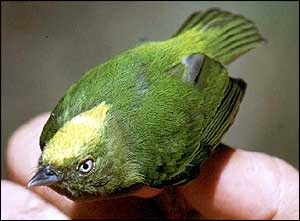
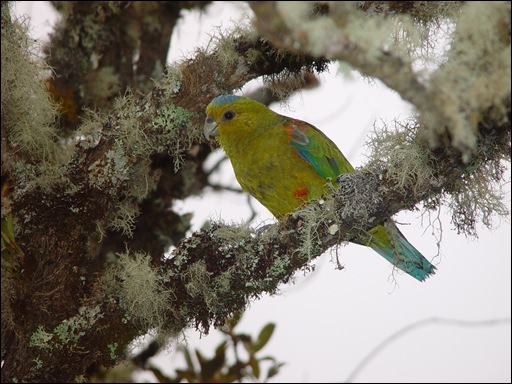
“Recently, researchers in Tanzania spotted a Lowe's servaline genet, a graceful, mongoose-like carnivore last seen in 1932, and widely considered to be extinct. Not long before that, the golden-crowned manakin, a South American bird, resurfaced for the first time since its discovery in 1957.” --(Source: When "Ghost" Species Return From Extinction; Scott Wiedensaul;Special for National Geographic News; July 9, 2002)


Above: the genet: Photo: Museo delle Scienze (Trento Museum of Science) as part of the TEAM Network Partnership/ www.teamnetwork.org

Above: the golden-crowned manakin, photo by Fabio Olmos

Above: the rediscovered Fuerte’s Parrot in Colombia. Photo by ProAves Colombia
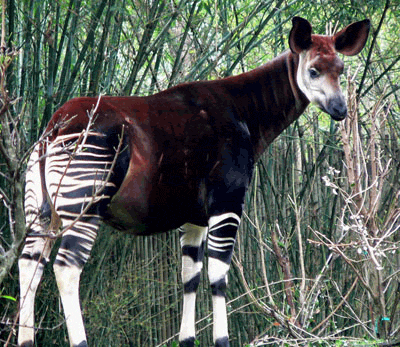
The Okapi, also believed for a long time to be extinct. Source: http://www.learnanimals.com/okapi/pictures.php
Look at the amazing patterns and color! How could you miss this animal?
...
“On occasion, the ghosts return after an absence that covers not decades, but centuries. The plump seabird known as the cahow, or Bermuda petrel, was considered extinct as early as 1620, eaten out of existence by hungry Europeans who plucked the tame bird from its nest burrows. Yet in 1951, a tiny colony was found on a rocky islet off Bermuda, where they had managed to avoid notice for more than 300 years. Nor is that the most extreme example. In the Canary Islands, a large species of lizard was rediscovered in 1999, a full five centuries after its supposed extinction.” (Wiedensaul)

This is magic: look again.  I’ve argued many times here that by seeing a harmful and vicious world, we make it so; by focusing on stories of doom and hatred and the endless cycle of killing, we make those stories stronger and more real. They reverberate in the universe and come back to us, the echo hollow and pained. Magic is where we focus on the story of something else, thereby making it more real. Imagine being the intrepid explorer that insists she will find a new cahow. She wants a world with a cahow in it, and she goes off on the most ridiculous, scientifically unfounded search one can imagine, calling upon herself the ridicule of her entire professional community and anyone else who might happen to pass the television when her expedition is mentioned.   She (or he) changed the world.


Nelson’s small-eared shrew; photo by Lazaro Guevara

For 109 years, the shrew was believed to be extinct, until Fernando Cervantes and Lazaro Guevara went searching for it in the forest slopes of the San Martin Tuxtla volcano. To imagine the difficulty of this ridiculously impossible search, take out your ruler. The shrew is less than 10 centimeters long from nose to tail. They live on this volcano, which erupted in 1793, destroying every living piece of vegetation around its crater--vegetation which regrows to be a cloud forest, one characterized by having a persistent canopy-level cloud cover.
Yet they found them. Nelson’s small-eared shrew lives.

One more: for the past 60 years, the Ascension Island parsley fern was believed to be extinct. In 2010, Olivia Renshaw and Stedson Shroud were repelling down the island’s Green Mountain, a steep volcano, when they saw--by chance-- 4 tiny, sickly parsley ferns. What is spectacular about this story is that they were not only able to see this plant, know that they were seeing it, believe it--and see from the image below how tiny it is--

Image by ZUMA press.

but they also were willing to slide down the volcano side, surrounded by safety ropes and the imminent threat of death, twice a week to nurse the plant back to health. Then they collected a few small sample spores to take to London’s Royal Botanic Gardens at Kew, where 60  are now growing in cultures.

Wiedensaul ends his article by saying: “This is still a wide and infinitely surprising world we live in, and...conservationists have learned never to say never when it comes to lost species.”

Madeline says something very similar: “It is my hope that art-makers worldwide succeed in our mammoth task -- that of changing the current omnicidal tide of culture -- before everything worth saving on this planet has been razed, or eaten. I believe there is still time to make a new myth. There is still a chance for imagination to rise to power.”
And she is leading in that rise with her work, is she not? Thank you, Madeline.

Tuesday, June 28, 2011

Dancer, Actor, Puppeteer, Choreographer, Director, Painter…

A New, Gorgeous Book of Art:


The first thing that strikes me about Clive Hicks Jenkins’ art is the motion of it. Always, there is a sense of an action not quite complete on the canvas, a life un-stilled by the process of its recording by the artist. The figures, shadows, and hidden recesses in his massive conté drawings, prints, and paintings, as well as in his sketches are all seething with life. And none of it is sterile motion—the figures move with purpose, driven by an uncontrollable emotion. As Marly Youmans describes “The Congregation of Birds” in her chapter of this new monograph, “The legs are drawn upward in a posture that at once suggests slumber, dance, and leaping” (109).


St. Francis is thus caught not in one moment of time, but in his being. His knees are red from kneeling, and indeed, maybe he is just now dropping to them, or rising from them, but whatever the motion is, it is some ecstatic motion, full of the joy of being and worshipping and proclaiming his love.

Each painting starts with sketches, and you can imagine the atelier littered with them, some taped to the wall or the easel, some scattered across the floor for the artist to dance across, eyeing them from all directions and from all positions, and in motion. A sketch becomes a maquette, a flat puppet of moving parts which then gets tacked on the wall, only to shift and leap and twist into some other position every time the artist turns his back until suddenly, everything is exactly as it should be, the core of the character is somehow distilled in a particular motion, and the painting begins.

Here is another fact of Clive’s painting techniques which many of the authors in this book touch on: every canvas begins with red. Red oxide paint covers every inch, and is there beneath every figure, forming what Clive describes as the life-blood pulsing just beneath the skin, which you can sometimes just see, as in the St. Francis painting, where, as Youmans points out, the kneeling has left its mark, or the hint of the stigmata ghosts along his foot; or in this painting of St. Hervé and the Wolf, the heat of the complex emotions between the two burns through.


There is a miraculous moment in this monograph, when Marly Youmans writes a fictional piece alongside the painting “Touched,”


a story which glows and unravels and sharpens with the intensity of a perfect, lucid dream. In this dream, Clive is taking tea with Jean Cocteau:

The most marvelous light, Cocteau says, gesturing at a raspberry-coloured tree. He sloshes tea on the tablecloth in his enthusiasm.
The clothes of the painter and Cocteau are dusted in lime-green. A few petals cling to their jackets and hair. The two drink more tea and talk about dreams and visions while clouds draw blue shadows over them and then pass by. The sunlight steadies.
Nothing appears soft-edged or blurred. Everything stands distinct in the light. Every line is as strong as the facet of a crustal, every colour as rich as a jewel.”

At this point, something miraculous occurs, which I will leave you to discover in the book itself. Marly follows the moment of revelation thus:

The clarity of a dream, he says.
The light increases enormously, and the paths and trees burn, every pebble and twig distinctly present. The painter’s hands tremble as he drinks in the brilliance and crisp edges of the garden, the glimpses of saints, and the young Virgin, her crimped hair verring from her head like a cockeyed halo.
This is what I wanted, he thinks, more light and every intent so clear. Colour that says anything is possible. Nothing hidden (104, Youmans).”

And that is what he achieves, as well, and the book is full of examples of it, large, lush reproductions on almost every page. There is a wide range of writing-style in here; all of it is fascinating. Kathe Koja describes the dance of the maquettes with a wonderful lyricism, and explores another of the main draws—for me—to Clive’s art: where it takes you. As she quotes him in a description of the beginnings of his journey through the theatre-life, she grasps hold of a powerful and telling phrase:

Clive Hicks-Jenkins: I used to be a puppeteer, my first job after I left ballet school. It was a serious company, presenting an intriguing blend of techniques…I became expert with marionettes, learned the techniques of black theatre, was deft with shadow puppets and rod puppets of all persuasions…As a dancer, I appeared with puppets as my partners.
By the time I was through, I had been spoiled for my initial choice of career as a dancer. Too many ideas flying around my head! Instead I evolved into a choreographer, a stage director and designer, and I carried with me the puppeteer’s love of masks, mechanical simulacra, and sleight-of-hand.


“‘Sleight of hand’ is an apt, and delicious, description for the basis of the painter’s art: deft, arduous, painstaking motor skill yoked with the power to make of what is not there, what is; not to deceive but to enlarge the experience of seeing, and enable the eye and the heart to take in what the creating, presenting mind intends: a man, a saint, a bird or a beast, where there are ‘really’ only strokes of colour on a flat plain. Is art ‘real’? Yes. And no (142, Koja).”

Not to deceive but to enlarge the experience of seeing. Exactly.


And back to the collection of moments or emotions caught in each of his paintings that makes each of them so un-still, so alive: that feeling is—it must be—a result of the contact between the painted and the painter, a moment described once in the old myths of the sculptor whose Venus came to life: he had formed her, yet she already ‘was,’ and the creator and created met in that electric moment of the not-real revealing itself as real.

“…a maquette is posed, exercised, put through various paces on the studio wall, but the ultimate gift of this dance is neither completely controllable nor wholly imagined beforehand: the maquette’s own being is a gift to Hicks-Jenkins in his process, and to the finished piece of work as a whole (146, Koja).”


Anita Mills also addresses this motion. She goes through the artist’s old sketch books and describes the moment when she feels he came to that particular ability, that unique talent of combining all his talents into one, or choreographing and taking part in a dance with the scene unfolding beneath his hand. Surprisingly, this moment occurred not in a ‘narrative’ painting (in the usual sense of the word!), but in plein air drawing—in landscape sketches, when he suddenly realized that he wasn’t making maps or topographical records; he was capturing the mood, motion, weather—the life of the moment. And as she states, ..."he has a deft ability to abstract a subject, distilling it to its most essential spirit (131 Mills)."


Before this review becomes longer than the book itself, I should close with a few clear statements about it. First of all, it’s big, and hardbound, and heavy (and red), and yet I have carried it with me everywhere ever since it arrived in the mail. It is full of large, gorgeous reproductions spanning Clive’s entire career, from a lovely drawing of Nefertiti impressively rendered by an awe-struck nine-year-old through stage sets and costume designs from his theatre days, and right up to his most recently (at this time) shown work, “Christ Writes in the Dust: The Woman Caught in Adultery.” The writing throughout is a fantastic mix of biography, analysis, and creative response, and on every page there is something to make you stop, ponder, and dream. And create.
I couldn’t recommend it more highly.
--zoe

Thursday, April 28, 2011

Climb Higher


(Not Your Usual Saint)..All artwork in this post is by Stelios Faitakis.


Stelios Faitakis’ works show influences of Byzantine iconography, Japanese Ukiyo-e woodblock prints, Gustav Klimt’s swirling golden designs, and the Mexican muralists of Diego Rivera’s time: The working class, muscular and giant in their presence, take on the ominous power of grey factories, military planes, masked policemen, and many-headed (human-headed!) hydras against a shimmering golden backdrop. They are often haloed. The world is stacked, layer upon layer, and there are wood-block waves and flames and ghostly heads. Everything swirls together to create a painting or a mural that is completely “Faitakis.”


Above, on the ground we have destruction: a tsunami (notice the bodies and planks in the water), a monster led by human minds with a forking, satellite-tail, and a dark, polluting factory. There is no dry land; there is no safe footing. But there is a ladder; with some struggle, one can pull oneself out and up and into the soft gold “heavens.” The ugly disaster of physical life is contrasted with the golden eternity of a higher spiritual work.


Faitakis feels that art is part of human growth, and is a method of communication that is best when understood by all viewers. He longs to cover the “ugly” walls of Athens with public works, narratives of the average man overcoming his own monstrosity--and he has begun this daunting task already.


Trees as martyrs?


Discovered HERE.

Thursday, March 24, 2011

Tango in a Box

Tango in a Box, by Juarez Machado


So, I thought I'd try something out, sort of guinea-pig you guys. I've put various excerpts from stories I've written up here before, but most of those stories ended up being pretty long, too long to continue in a blog. But there's this one story that's short-ish. So I thought I'd subject you to it in its entirety, piece by piece, several times a week (with interludes to tell you about various artistic heroes, of course) until it's done. We'll see how it goes.

Tango in a Box is a story about a college student whose life changes drastically as she reconnects with someone who was greatly important to her in her adolescence when he is suddenly imprisoned. The Machado painting is relevant in various ways, but mostly because of the size of the room the couple is dancing in. Picasso's Portrait of Dora Maar also plays a pretty big role, so I'll introduce her in this post as well.


Now, for parts One and Two:


Tango in a Box

In the one-room weekly where I live, the floor is lined with Portraits of Dora Maar, leaning up against the wall. I painted them. I have no other artistic ability, and I don’t mean other than painting. I mean other than painting Dora Maar. The room I live in, it’s on the seventh floor. It’s the seventh room on the seventh floor and there are seven Portraits of Dora Maar lined against the walls with a bed in the middle, so don’t plan on doing any effective pacing. There used to be a TV, but I made them take it out, so now there’s room for two whole folding chairs, one for me and one for my book bag.

******* *******


Chapter One

Already I can’t breathe, and the weight of the door slamming behind me pushes the air further from my chest. As the next door opens and the bright glare of the room emerges, filled with faces and motion and a hum that grows ever-louder as my attention struggles to manage this second sense, hearing, I run my fingers behind my neck, underneath my hair and seize a chunk. I tug until the pain begins to wash out my other senses and I can walk towards the first set of empty plastic bucket chairs and ball myself up out of the way.


The wait is interminable, and I have to stay conscious for all of it, afraid he won’t recognize me, not expecting me. Right now, my eyes are almost tearing from staring so hard at the door on the far side of the room where I figure he should come out. Right now, I’m trying to ignore the man in the grouping of chairs next to me, in a seemingly stream-of- consciousness monologue berating a small child for showing disrespect towards her mother, who adds her tongue-clicks and loud sighs, repeating the lines she especially likes and interjecting shrill, drawling I means and can you even believes. The smell of perfume is overpowering, and my head is swimming, right now I’m chewing my lip and kicking my leg in unison with the berated child.


When I finally see him, my body flushes and swells with blood and I watch myself shoot to my feet and fling an arm in the air, waving him down.


Right now, he’s staring at me. He looks down and then to one side, and then everywhere but at me as he walks towards me. He sits in a slouch, his feet firmly planted a good distance from each other and his hands on his thighs. He looks at me again.


Right now, I’m stuttering. I’m seeing this isn’t where he planned on the grand reunion. I say, “I know this, I mean, this isn’t.”


Inside my head, we’ve had some great conversations today.


I say, “Look,” and then I take a deep breath and when I let go of it, “Look, you’re all over the TV, even without one, I couldn’t miss you.”


I’m making sense, now, right?


Johnny’s smoldering rage is starting to look like a sneer, but still, no expressions I recognize on him. I pinch the piece of skin between my thumb and forefinger, just to be sure. I say, “Well. I knew you couldn’t have... I came to tell you…”


Now I’m not sure what he’s doing, I can’t even look at him. I breathe. I rub my left thigh, smooth it down, push my right jean leg into my right thigh, breathe again. I look up. Johnny, he’s staring at me instead of talking and so I decide it’s my job to smooth over all the discomfort verbally. I talk about how none of this matters, about how I’m going to get him out of here. When I can’t think of what to say, or when I forget how to form syllables, I just stutter. I think, he’s really glad to see me, this is going well. I think, he’s just in shock. I apologize a few more times, just to be safe.


“No,” says Johnny, and when I look up his face is very still, like he’s listening, and my breathing starts to slow back into a normal rhythm, the colors in the room start to separate and deepen. “You’re fine,” he says. Then he’s silent again.


He leans forward a little, and he’s thinking about what he’s going say, I think it must be for the first time in his life. He says, “How did you get them to let you in?”


“It’s because I drove so far,” I say, my face is trying to smile and I start to hiccup. “I said I was your stepsister, I said we’ve always gotten on badly, but with God’s help we can change that now.”


“You said all that, and in complete sentences,” Johnny says, like he’s reading a teleprompter, but I know him, I can hear him trying not to laugh. So I laugh.


“I practiced,” I say, pressing my jeans into my thighs again, left thigh, right thigh, quick breaths. I’m starting to worry they might kick me out of here, these hiccups are going to take down the walls.


He leans forward, looking around as he puts a hand, just for a second, over my hand, stopping everything, then returns to his slouch.


“Relax.”


I flush and look at the floor. Another year goes by.


He goes back to the teleprompter: “So what have you been doing, all this time.”


I shrug, still looking down. Is it polite to talk about college courses, right now? I concentrate on not pressing my jeans down, and say, again, “I’m going to get you out of here.”


He nods. He’s looking around again, and he leans forward, and he says, like he’s spelling the words, “When are you coming again?”


Hiccuping, stuttering, I’m thinking why don’t I just not leave, but I say “How about next week, I mean, if that’s ok.”


Johnny says, “That’ll be great.” He’s still not looking at me. Finally he says, “What sort of sisterly name did you give them, and I’ll put it on my list.”


Shit.


I hiccup again.


“I’m sorry, I just, I told them, I didn’t think, I just told them Bethany.”


But Johnny’s smiling, still looking at me, his eyes still on my face, smiling. He says, “No that’s great, Bethany, perfect. It’s better that way anyway.”


*******

Friday, March 11, 2011

Perception is Reality


(please press image to see larger version)

Sakah Galerie is located in the Saint Etienne district of Toulouse, described by its owners as “a charming enclave where streets are intertwined and lost playing hide and seek with the light from the sky and the shadows of history .” From March 5- April 20, 2011, they are presenting the works of Anne Bachelier, whom I’ve written about before here, and Catherine Chauloux.


La Balade du Mandarin

Catherine Chauloux uses a fascinating combination of styles, textures, and techniques in each painting to create a layering so full it brings the painted fantasy into a multi-dimensional existence—into reality. Above, you can see the flat, one-dimensional representation of a beast in the yellow and red ochres and bulbous central shape of old cave-paintings, though thickly plastered on like a fresco. The figures in front join us, the viewer, straddling the gap between us and the creature painted on the wall—the fullness of their bodies and clothing contrasting strongly with the painted, stylistic creature, bringing them into three dimensions.


Aigle Royal Air

In Aigle Royal, she adds anachronism to further fill out the image: the huge bird lumbers along on its long claws, steered by a World War II pilot, pushing its head through the cave wall to look out into the future at its passenger, sitting down for tea on her European antique armchair, her opera glasses swinging freely. This is the new physics: this is all times overlapping, being seen at once, waiting for a viewer with his or her particular perspective to come and decide what is really going on. In her paintings, Catherine shows the world through space instead of the way we usually look at it: through the filter of time. One space across time?—The actual bird, the impression of the bird on a first artist, the cave or rock wall it was painted on, a plane flying overhead, a woman in a newly-built home with antique furniture—all of these melt together in the space you’re standing (sitting) in now, the painting in front of you. Maybe the filter isn’t space, after all; maybe it’s the impact of great heights, a meditation on flights of nature, of miraculous machinery, of fancy (hence the silver tea service and the opera glasses). Whatever it is, it’s a filter that Ms. Chauloux gives you, the viewer, artfully.


Note the head pulling itself off the wall, thus bridging the one-dimensional existence and the three-dimensional existence with his awareness and experience of both.


La Course

And in La Course, the cave-painting style is mixed with the much later fresco technique of thickly “plastered” on color. Notice how the outer edges of the thick blue material around the woman’s waist is still of that texture, still part of the “wall,” where the rest of her fills out towards you in an “easel” style that makes the figure all the more real for the contrast. She is pulling out of the past, out of the painter’s imagination and into your world. She is pulling you into the painter’s imagination. Or her memory. Or the memory of our shared consciousness.


Or, indeed, memories of an alternate history, as in the image above, where some hybrid cheetah-giraffe has been melded with a chariot. Or at least the plans were made, and the only “sketchy” part was the attachment of the wheels.


Autruche Gordini


Dame Chevalier


Moby Dick

But there is an even further effect: she is not suggesting—or it doesn’t seem so to me—that you be pulled in passively, that you continue to stand there until you’re bored and move on to the next painting. In Moby Dick (above), we can see a much higher purpose. Here, the whale who drives the tragic tale is thrice-underlined as man-made—for it is the idea of the whale, the idea of revenge, the idea of being completely lost in the vast depths of the chaotic (stormy) elements (think of the ancient Biblical tale of Jonas)that makes the story so destructive. Here, not only is the whale in the one-dimensional style, it is mechanical, and a man in period dress is calmly measuring its dimensions, as if still putting it together (still working towards his own destruction/demise?), his plans strewn about the floor behind him. There is a small joke in here: a “real” whale seems to have been swallowed by the monstrous mechanical contraption, and you can see its tail peeking out the back-end. But in the upper left-hand corner, the painter takes the entire story to task. She is escaping it, pulling her body out of the painting, and at the same time painting over it. No more whale.
You are creating what you see. You are choosing what, of all the things forming out of the atoms around you at once, to perceive. Chauloux is an artist after my own heart, energetically erasing the tragedy with a coat of fresh paint.


By Anne Bachelier


By Anne Bachelier

She shares her current show with another painter who draws her images out from the mists, pulling aside the curtains of the pre-formed universe so that we may, for a moment, meet the gaze of the actors in those mysterious events Anne Bachelier has chosen to make real. Above, you can see three levels of existence: the central red figure, the figures swinging around her head, and the ones marching along at ankle-height.


By Anne Bachelier


In Bachelier's images, you can see the many layers of volition, many creatures holding many strings, dreaming the world or directing its marionettes…

You can read my earlier post on the work of Anne Bachelier here and see her own gorgeous blog here .