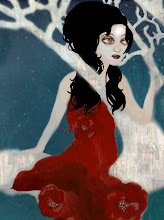
member of:Observers of the Interdependence of Domestic Objects and Their Influence on Everyday Life


This group has been active for a long time and has already made some remarkable assertions which render life simpler from the practical point of view. For example, I move a pot of green color five centimeters to the right, I push in the thumbtack beside the comb and if Mr. A (another adherent like me) at this moment puts his volume about bee-keeping beside a pattern for cutting out vests, I am sure to meet on the sidewalk of the avenida Madero a woman who intrigues me and whose origin and address I never could have known...
--Remedios Varo


(Slideshow is of Artwork by Remedios Varo)
By believing passionately in something that still does not exist, we create it. The nonexistent is whatever we have not sufficiently desired.
--Franz Kafka

Showing posts with label Marly Youmans. Show all posts

Tuesday, June 28, 2011

Dancer, Actor, Puppeteer, Choreographer, Director, Painter…

A New, Gorgeous Book of Art:


The first thing that strikes me about Clive Hicks Jenkins’ art is the motion of it. Always, there is a sense of an action not quite complete on the canvas, a life un-stilled by the process of its recording by the artist. The figures, shadows, and hidden recesses in his massive conté drawings, prints, and paintings, as well as in his sketches are all seething with life. And none of it is sterile motion—the figures move with purpose, driven by an uncontrollable emotion. As Marly Youmans describes “The Congregation of Birds” in her chapter of this new monograph, “The legs are drawn upward in a posture that at once suggests slumber, dance, and leaping” (109).


St. Francis is thus caught not in one moment of time, but in his being. His knees are red from kneeling, and indeed, maybe he is just now dropping to them, or rising from them, but whatever the motion is, it is some ecstatic motion, full of the joy of being and worshipping and proclaiming his love.

Each painting starts with sketches, and you can imagine the atelier littered with them, some taped to the wall or the easel, some scattered across the floor for the artist to dance across, eyeing them from all directions and from all positions, and in motion. A sketch becomes a maquette, a flat puppet of moving parts which then gets tacked on the wall, only to shift and leap and twist into some other position every time the artist turns his back until suddenly, everything is exactly as it should be, the core of the character is somehow distilled in a particular motion, and the painting begins.

Here is another fact of Clive’s painting techniques which many of the authors in this book touch on: every canvas begins with red. Red oxide paint covers every inch, and is there beneath every figure, forming what Clive describes as the life-blood pulsing just beneath the skin, which you can sometimes just see, as in the St. Francis painting, where, as Youmans points out, the kneeling has left its mark, or the hint of the stigmata ghosts along his foot; or in this painting of St. Hervé and the Wolf, the heat of the complex emotions between the two burns through.


There is a miraculous moment in this monograph, when Marly Youmans writes a fictional piece alongside the painting “Touched,”


a story which glows and unravels and sharpens with the intensity of a perfect, lucid dream. In this dream, Clive is taking tea with Jean Cocteau:

The most marvelous light, Cocteau says, gesturing at a raspberry-coloured tree. He sloshes tea on the tablecloth in his enthusiasm.
The clothes of the painter and Cocteau are dusted in lime-green. A few petals cling to their jackets and hair. The two drink more tea and talk about dreams and visions while clouds draw blue shadows over them and then pass by. The sunlight steadies.
Nothing appears soft-edged or blurred. Everything stands distinct in the light. Every line is as strong as the facet of a crustal, every colour as rich as a jewel.”

At this point, something miraculous occurs, which I will leave you to discover in the book itself. Marly follows the moment of revelation thus:

The clarity of a dream, he says.
The light increases enormously, and the paths and trees burn, every pebble and twig distinctly present. The painter’s hands tremble as he drinks in the brilliance and crisp edges of the garden, the glimpses of saints, and the young Virgin, her crimped hair verring from her head like a cockeyed halo.
This is what I wanted, he thinks, more light and every intent so clear. Colour that says anything is possible. Nothing hidden (104, Youmans).”

And that is what he achieves, as well, and the book is full of examples of it, large, lush reproductions on almost every page. There is a wide range of writing-style in here; all of it is fascinating. Kathe Koja describes the dance of the maquettes with a wonderful lyricism, and explores another of the main draws—for me—to Clive’s art: where it takes you. As she quotes him in a description of the beginnings of his journey through the theatre-life, she grasps hold of a powerful and telling phrase:

Clive Hicks-Jenkins: I used to be a puppeteer, my first job after I left ballet school. It was a serious company, presenting an intriguing blend of techniques…I became expert with marionettes, learned the techniques of black theatre, was deft with shadow puppets and rod puppets of all persuasions…As a dancer, I appeared with puppets as my partners.
By the time I was through, I had been spoiled for my initial choice of career as a dancer. Too many ideas flying around my head! Instead I evolved into a choreographer, a stage director and designer, and I carried with me the puppeteer’s love of masks, mechanical simulacra, and sleight-of-hand.


“‘Sleight of hand’ is an apt, and delicious, description for the basis of the painter’s art: deft, arduous, painstaking motor skill yoked with the power to make of what is not there, what is; not to deceive but to enlarge the experience of seeing, and enable the eye and the heart to take in what the creating, presenting mind intends: a man, a saint, a bird or a beast, where there are ‘really’ only strokes of colour on a flat plain. Is art ‘real’? Yes. And no (142, Koja).”

Not to deceive but to enlarge the experience of seeing. Exactly.


And back to the collection of moments or emotions caught in each of his paintings that makes each of them so un-still, so alive: that feeling is—it must be—a result of the contact between the painted and the painter, a moment described once in the old myths of the sculptor whose Venus came to life: he had formed her, yet she already ‘was,’ and the creator and created met in that electric moment of the not-real revealing itself as real.

“…a maquette is posed, exercised, put through various paces on the studio wall, but the ultimate gift of this dance is neither completely controllable nor wholly imagined beforehand: the maquette’s own being is a gift to Hicks-Jenkins in his process, and to the finished piece of work as a whole (146, Koja).”


Anita Mills also addresses this motion. She goes through the artist’s old sketch books and describes the moment when she feels he came to that particular ability, that unique talent of combining all his talents into one, or choreographing and taking part in a dance with the scene unfolding beneath his hand. Surprisingly, this moment occurred not in a ‘narrative’ painting (in the usual sense of the word!), but in plein air drawing—in landscape sketches, when he suddenly realized that he wasn’t making maps or topographical records; he was capturing the mood, motion, weather—the life of the moment. And as she states, ..."he has a deft ability to abstract a subject, distilling it to its most essential spirit (131 Mills)."


Before this review becomes longer than the book itself, I should close with a few clear statements about it. First of all, it’s big, and hardbound, and heavy (and red), and yet I have carried it with me everywhere ever since it arrived in the mail. It is full of large, gorgeous reproductions spanning Clive’s entire career, from a lovely drawing of Nefertiti impressively rendered by an awe-struck nine-year-old through stage sets and costume designs from his theatre days, and right up to his most recently (at this time) shown work, “Christ Writes in the Dust: The Woman Caught in Adultery.” The writing throughout is a fantastic mix of biography, analysis, and creative response, and on every page there is something to make you stop, ponder, and dream. And create.
I couldn’t recommend it more highly.
--zoe

Sunday, September 26, 2010

Jenna's Tattoo

(This is one of a series of stories I am working on that center around a certain, as-yet-unnamed luxury hotel and its inhabitants, both living and haunting.)

NOTE: All artwork in this post by painter Steve Cieslawski.


Derrick’s pythons developed early in his life, in the elevator shaft of his parents' hotel.

The elevator shafts--there were two--stretched up the sides of the skyscraper like two glass thermometers measuring the wealth of their passengers in degrees. Perfect in every other way, the hotel often had a problem with the elevator on the right, which those outside of the hotel could provide the cause of--if only asked--as they were often offered a clear view of the pale blonde boy scrambling up in the steely morning light. His parents, however, turned a blind eye to this bizarre activity, as almost anything that occupied him at a distance pleased them to no end.

What they didn’t know about were his resultant regular visits to the thirteenth floor.

Unreachable by elevator, the thirteenth floor had been built at only three-quarters height, but in a hotel like this, that still left space to hang from a trapeze. And that was where Derrick had met Jenna’s soul, hanging from a trapeze.


Theater of Memory
(Notice the characters in their performance in her belly...)

Jenna’s soul had occupied the hotel’s 13th floor, along with the souls of several other people, since the explosive street riots of the previous century which had developed soon after a Very Important Politician, in the heady arrogance of new love and imagined moral superiority, had publicly discarded his old Mistress--who had, unfortunately for him and many others, by this time already become a cultural icon. Jenna had the entire story of the city’s rise and fall tattooed on her body. It began on her pinky toe. This is how Derrick would first recognize Jenna’s body later, as an adult and in the outside world: he had spent so long staring at her toes as a boy, toes which would later be enticingly exposed in the expensive pumps she favored. Also, there was her slavish fascination with fashion, which was really just her worldly body’s confused attempt to grasp the color, meaning, and artistic fullness of the tattoos hidden just underneath her skin, on her soul. Her fashion, of course, was always falling short, being the story-less version.

Jenna’s soul’s pinkie-toe was a snow-petal, from the Jissen flower native to the First Mistress’ region. Jissen was also the stage-name of that Mistress, so named for the pale white veils she removed, slowly, over the course of several hours, in an ancient art of dance designed to remove men’s inhibitions in flesh and in pocket. The flower grew only on the highest, snowcapped mountaintop of her family’s region, a mountain whose jealous spirit more often than not burned trespassers with flames of ice and blinding light. Only the poorest of the poor, and only those poor who had been trained since birth to face the difficulties of the search, dared to cross the first skirts of the mountain in search of her flower. And only those chosen by some higher being survived the journey.

Thus the blossoms brought prices higher than any jewel on the market. One blossom, kept planted in its original clay and dampened daily, would live forever. The tears it shed after that daily misting ceremony were collected in small glass jars painted with the likeness of the bloom and sold as perfume to the most elite ladies across the world. If a single petal were to be extracted from the bloom, the rest immediately died, but that one petal, stroked across the skin before it, too, wilted, would remove all wrinkles or other scars of living from the flesh.

Every decade had its claims of Jissen-hunting success.

Jissen the dancer’s flawless, pearly flesh, costly beyond the dreams even of those who were permitted to see her dance, promised life everlasting, but did not belong to her. It belonged to the man who had discovered her. That man, unfortunately for her and many others, was The Politician.


*****
But back to Jenna's soul, and her tattoo.


Flight of the Architect


The petal was hooked by one claw from one long, twiggy leg attached to a long, thin, white bird. The leg was long, but the neck was longer, and the bird twisted and stretched far up the inside of Jenna’s soul’s leg, curling its head down coquettishly at almost the very last minute. It didn’t take up much space, horizontally speaking, but it held its own, attention-wise. Jenna called it Laa Fuba, the Guardian of Long Futures.

“Long, long ago,” she began the tale gravely, turning Derrick’s chin with one light finger to guide his gaze to her eyes, “during previous Dark Times, the End of the World was signaled by the Plague of the Angry Bees.” The bees, looking quite angry indeed, swarmed thickly around her ankle.

“The bees came slowly,” she continued. “The debilitating effects following stings here and there were first thought to be a virus, to which the children especially were susceptible. The children began staying in, which brought hard times for the people, as every hand was needed in most farming tasks.”

She lifted his chin again.

“And then the adults began to fall. They fell in the fields, they fell in the streets, they fell from their chairs at the dinner table. And soon everywhere there was the sound of angry bees, and the streets became filled with the whipping swarms.” She held his eyes with hers. “They heard that sound for many generations in their sleep. For them, the bogey man was a swarm, drawing up from the dust in the darkness.”

“And then the rumors began of the Land of Lakes, the Flatlands, where nothingness stretched forever and ever, interrupted only by nothingness that was reflective and wet. Strange breeds and outlaws lived there, and they were not areas visited much by the people of the farming and town communities. Who even knew how those strange breeds survived, or what threats they might pose?” Jenna paused, looking away, stretching one arm thinly into the air and wrapping it behind her shoulder. She pulled gently on it with her other hand and exhaled, then lifted her body into a backbend and continued with her story, Laa Fuba now flirting with the other side of the hallway:

“The rumors said that in the Land of Lakes, the bees had come and gone and no one had been harmed. Contingencies of men, wrapped in monstrosities concocted of branches and leaves and reeking, bee-repellant saps and animal skins, began journeying into the Flatlands to find the secret that would save their families and their lives. And after many, many weeks and many, many months, long after the ones they’d left behind were certain of their demise along the way, they returned. Carrying eggs.”

Jenna began to crawl, in her backbend, around the hallway. Backwards and forwards, and all around Derrick. Derrick felt his face growing pink. Derrick felt everything growing and pink. After his last visit, he thought he’d never be able to think of anything but toes ever again, yet here he was, developing a fetish for feathers.

“It was the Laa Fuba that saved them. Those long, white, graceful birds of the Flatlands ate the infected bees. They seemed uninterested in regular, every day bees. They ate the sick bees, and the sick bees turned them pink.”

Derrick, thinking she was teasing him, blushed a deeper red.

“And that was all. They turned pink and that was all.” She kicked her legs over, flipping back onto her feet, then sliding her arms between her legs on the ground and squatting to tuck her neck under and curve her back the other way. He stared at the gaping orange lips of a carp gasping at him from the base of her neck.

Jenna reached up for the trapeze and began to twist slowly from a hang. “From then on, in all of the villages, they had breeding farms for the long white bird. And the times of health were called the “Fluttering of Great White Wings,” and they had festivals to honor the bird every year, and the villages and towns were filled with the fluttering of white wings, and one, central float was dedicated to the miraculous pink of their savior.”

Her feet curled and slowly slid up the rope on the right side of the bar. She twisted to a handstand, then let go with her hands, her ankles gripping the rope.

“The float was a giant fuschia boa, its feathers made of silks and cashmeres, panties and socks, everything soft that could be dyed and tied to long and tangled ropes, and they would push the float up the great hill in the center of the village, everyone struggling behind it, and then with one great heave, they pushed it over the top, and the little man-made feathers would flutter wildly in the wind as it sailed back down the other side.” She twisted some more, grasping the opposite rope with her hands then stretching her hands and feet away from each other, curving back, her belly out.

“But even after all that, they still forgot. They still ended up in the Next Dark Times.”

And then she had to quit talking, from exertion.


"Fateful Meeting"


On an older post in this blog, author Marly Youmans recommended the art of Steve Cieslawski, and I instantly fell in love. I chose his work for this post because of the plethora of liminal spaces like the thirteenth floor in the tale, where one world's arches and floors form the strange sky of another, where a full-color, living head tells stories from a distant, black and white past, and where, incredibly, you can see the flames of the past resolve and settle into the red hair of certain lovely souls gliding through a Sea of Tranquility...the story of the past marking us in very particular, very individual ways, beneath the skin, in the marrow, even changing our DNA...


Philsopher's Twin


Madonna


Sea of Tranquility


"Civilized Discourse"