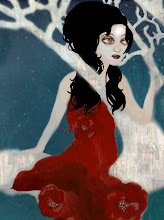
member of:Observers of the Interdependence of Domestic Objects and Their Influence on Everyday Life


This group has been active for a long time and has already made some remarkable assertions which render life simpler from the practical point of view. For example, I move a pot of green color five centimeters to the right, I push in the thumbtack beside the comb and if Mr. A (another adherent like me) at this moment puts his volume about bee-keeping beside a pattern for cutting out vests, I am sure to meet on the sidewalk of the avenida Madero a woman who intrigues me and whose origin and address I never could have known...
--Remedios Varo


(Slideshow is of Artwork by Remedios Varo)
By believing passionately in something that still does not exist, we create it. The nonexistent is whatever we have not sufficiently desired.
--Franz Kafka

Showing posts with label Steve Cieslawski. Show all posts

Monday, October 11, 2010

Ruzi

Theater of Memory, by Steve Cieslawski

(This is one of a series of stories I am working on that center around a certain, as-yet-unnamed luxury hotel and its inhabitants, both living and haunting. The first segment is here.)
All artwork in this post by painter Steve Cieslawski.)


Ruzi


Like Derrick’s small family unit, others also lived in various suites in his mother’s grand hotel. Ruzi, the surgeon, lived just below them and took dinner every evening at the same time in the restaurant at ground level.

No bones about it, little Derrick liked to stare. When he was curious, he found a way to climb onto or get around or dig into whatever it was he was curious about, and in this case, he stood not politely close to the table of the surgeon and stared unabashedly until the man decided to pull out a chair for him.

It was the carp-shaped, gloriously orange silk tie that grasped the boy and refused to let go. And it was Ruzi who took the boy with him into the world of tie-and-hat boutiques to start his own collection. Ruzi did not, however, wear such ties when he met with patients. And these are patients and meetings we might look to for more information about the man, as he was the only surgeon I have heard of that could take dinner at the same time every night.


Ruzi’s story began, as most stories do, with a monster.

Ruzi was an exceptionally talented surgeon, able to keep a primary presence in general surgeries and also dabble in a specialization of neurological procedures. The monster was not so talented. But it was large, and hairy, and sort of specially ugly, if that counts. It lived under Ruzi’s bed, and, as a result, Ruzi liked to avoid the bed as much as possible. So he stayed in his office, meeting with patients, reading the latest literature on the latest procedures, and communicating with other doctors.
When he had to sleep, the monster would be there to interfere all night, whispering in his ear the nasty stories of his childhood, roaring fire against his tightly closed eyelids, jumping over him and onto him and twisting up all the sheets. And Ruzi would give up early and go into the office.

And so he was, in terms of his livelihood, very successful.

And then came the suicide.

It was a woman that had come to him, because of his reputation, to have her stomach stapled. She had tried many things, in her quest to lose weight, many diets and many pills, including a short and quite illegal dance with amphetamines, tendered by a neighborhood teenager whom she had caught trying to steal pieces from her Tiffany Glass collection. When she came upon Ruzi, he had been unable to focus on her, and she had not succeeded in deciding whether it was his own personal demons or hers that kept his eyes averted.

The surgery was not a strange one, he had performed it many times, and being overweight was almost a cliché in this country which he had adopted as his own. He only half-attentively reassured her as he organized his schedule to fit her in and pulled together recommendations for post-surgery exercise coaches and nutrition counselors. He showed her lots of charts and many before and after pictures, and in general droned.

Patients still considered themselves lucky, because he spent all that time in the room with them. But not this one. Not Lola. Because Lola was used to the people who were forced into communications with her talking at her like this, all trying to avoid something (her grotesque fatness) by running their mouths on and on about something else, sort of distractedly. This type of communication was, in her mind, intimately tied to her shame. It was, in this case, an unrelated issue-- Ruzi was distracted by his own monsters-- but no matter.

So she decided that she could not put her unconscious, humiliated, humiliating body into his care. And she quit. Her violently bleeding body was admitted at the correct hour of the correct day to an unexpected and unexpectant floor of the hospital. And it died.


Myths and Examples, by Steve Cieslawski

Ruzi had sat in the scheduled recovery room with the door shut and locked, staring at the walls. The clean, tightly tucked white sheets, the stainless steel rack for clipboards, the stainless steel counter, the bright white shades over the afternoon glare of the window, the white polished concrete floor. Sometimes he clutched his head between his hands and squeezed. And he wept, some. But mostly, he just sat, staring at the glaring lie of this clean, bright, well-organized room.
He thought about the blood, the ugly scene he had witnessed downstairs, the ugly thing that had happened inside of her, the ugly thing he had been about to do to her. The ugly thing that digging into a person’s flesh and organs, sawing and squeezing and scraping, actually was.

Ruzi stayed in the room long enough to be charged for it. He refused counsel, he refused company, he refused food. He stayed there, with the lights on, through the night, until his mind was completely empty. Into that empty mind, a single sentence fell. It was a sentence remembered from a neurobiology class from his student days. A professor there had told him: “One thought can change the way every cell in your body behaves.” He sat with that thought into the early hours of the morning, an idea formulating in the cells of his body.
And then he returned to his office.


Unknowingly, he had begun training in an ancient Japanese art called Shinyo. This was the art of empty listening. Of mirroring. Of action through non-action. He learned, in his meetings with patients, to listen as a nonentity, to forget everything he knew and know only what he was being told. More than that, he learned to become the person facing him, to master his or her vocal and gestural inflections, and mirror them. In this way his patients became supremely comfortable with him. It was like talking to themselves, it was as if there were now some chance of being understood by a person outside of their own mind.

And once they were totally at ease, once they were perfectly matched, he reversed affairs. The mirror became the guide. He changed their mannerisms, slowly but surely, changed their thinking, their unconscious patterns, their chemistry’s habits, until the problem they had come to him as a result of disappeared.

He greatly reduced his number of patients, but his reputation soared. Strangely, it struck no one as important that he no longer performed surgeries at all. He never even went to the hospital.


Portrait of the Day Before, by Steve Cieslawski


By the time that Ruzi met Derrick, he preferred to think of himself as a beautician. Every day, he met with ugly, unhealthy people and their monsters, and he sat quietly and stared attentively; he mirrored everything that he saw until he recognized the thing that would, if shifted slightly, make the whole beautiful again. And when he came home to the hotel that he had begun to come to on that ugly, bloody day when he had simply not been able to face his own home, he would change his socks and his tie from silent work colors to outrageous, suggestive, vivid show colors, and he would ride the elevator down to dinner.

***

Sunday, September 26, 2010

Jenna's Tattoo

(This is one of a series of stories I am working on that center around a certain, as-yet-unnamed luxury hotel and its inhabitants, both living and haunting.)

NOTE: All artwork in this post by painter Steve Cieslawski.


Derrick’s pythons developed early in his life, in the elevator shaft of his parents' hotel.

The elevator shafts--there were two--stretched up the sides of the skyscraper like two glass thermometers measuring the wealth of their passengers in degrees. Perfect in every other way, the hotel often had a problem with the elevator on the right, which those outside of the hotel could provide the cause of--if only asked--as they were often offered a clear view of the pale blonde boy scrambling up in the steely morning light. His parents, however, turned a blind eye to this bizarre activity, as almost anything that occupied him at a distance pleased them to no end.

What they didn’t know about were his resultant regular visits to the thirteenth floor.

Unreachable by elevator, the thirteenth floor had been built at only three-quarters height, but in a hotel like this, that still left space to hang from a trapeze. And that was where Derrick had met Jenna’s soul, hanging from a trapeze.


Theater of Memory
(Notice the characters in their performance in her belly...)

Jenna’s soul had occupied the hotel’s 13th floor, along with the souls of several other people, since the explosive street riots of the previous century which had developed soon after a Very Important Politician, in the heady arrogance of new love and imagined moral superiority, had publicly discarded his old Mistress--who had, unfortunately for him and many others, by this time already become a cultural icon. Jenna had the entire story of the city’s rise and fall tattooed on her body. It began on her pinky toe. This is how Derrick would first recognize Jenna’s body later, as an adult and in the outside world: he had spent so long staring at her toes as a boy, toes which would later be enticingly exposed in the expensive pumps she favored. Also, there was her slavish fascination with fashion, which was really just her worldly body’s confused attempt to grasp the color, meaning, and artistic fullness of the tattoos hidden just underneath her skin, on her soul. Her fashion, of course, was always falling short, being the story-less version.

Jenna’s soul’s pinkie-toe was a snow-petal, from the Jissen flower native to the First Mistress’ region. Jissen was also the stage-name of that Mistress, so named for the pale white veils she removed, slowly, over the course of several hours, in an ancient art of dance designed to remove men’s inhibitions in flesh and in pocket. The flower grew only on the highest, snowcapped mountaintop of her family’s region, a mountain whose jealous spirit more often than not burned trespassers with flames of ice and blinding light. Only the poorest of the poor, and only those poor who had been trained since birth to face the difficulties of the search, dared to cross the first skirts of the mountain in search of her flower. And only those chosen by some higher being survived the journey.

Thus the blossoms brought prices higher than any jewel on the market. One blossom, kept planted in its original clay and dampened daily, would live forever. The tears it shed after that daily misting ceremony were collected in small glass jars painted with the likeness of the bloom and sold as perfume to the most elite ladies across the world. If a single petal were to be extracted from the bloom, the rest immediately died, but that one petal, stroked across the skin before it, too, wilted, would remove all wrinkles or other scars of living from the flesh.

Every decade had its claims of Jissen-hunting success.

Jissen the dancer’s flawless, pearly flesh, costly beyond the dreams even of those who were permitted to see her dance, promised life everlasting, but did not belong to her. It belonged to the man who had discovered her. That man, unfortunately for her and many others, was The Politician.


*****
But back to Jenna's soul, and her tattoo.


Flight of the Architect


The petal was hooked by one claw from one long, twiggy leg attached to a long, thin, white bird. The leg was long, but the neck was longer, and the bird twisted and stretched far up the inside of Jenna’s soul’s leg, curling its head down coquettishly at almost the very last minute. It didn’t take up much space, horizontally speaking, but it held its own, attention-wise. Jenna called it Laa Fuba, the Guardian of Long Futures.

“Long, long ago,” she began the tale gravely, turning Derrick’s chin with one light finger to guide his gaze to her eyes, “during previous Dark Times, the End of the World was signaled by the Plague of the Angry Bees.” The bees, looking quite angry indeed, swarmed thickly around her ankle.

“The bees came slowly,” she continued. “The debilitating effects following stings here and there were first thought to be a virus, to which the children especially were susceptible. The children began staying in, which brought hard times for the people, as every hand was needed in most farming tasks.”

She lifted his chin again.

“And then the adults began to fall. They fell in the fields, they fell in the streets, they fell from their chairs at the dinner table. And soon everywhere there was the sound of angry bees, and the streets became filled with the whipping swarms.” She held his eyes with hers. “They heard that sound for many generations in their sleep. For them, the bogey man was a swarm, drawing up from the dust in the darkness.”

“And then the rumors began of the Land of Lakes, the Flatlands, where nothingness stretched forever and ever, interrupted only by nothingness that was reflective and wet. Strange breeds and outlaws lived there, and they were not areas visited much by the people of the farming and town communities. Who even knew how those strange breeds survived, or what threats they might pose?” Jenna paused, looking away, stretching one arm thinly into the air and wrapping it behind her shoulder. She pulled gently on it with her other hand and exhaled, then lifted her body into a backbend and continued with her story, Laa Fuba now flirting with the other side of the hallway:

“The rumors said that in the Land of Lakes, the bees had come and gone and no one had been harmed. Contingencies of men, wrapped in monstrosities concocted of branches and leaves and reeking, bee-repellant saps and animal skins, began journeying into the Flatlands to find the secret that would save their families and their lives. And after many, many weeks and many, many months, long after the ones they’d left behind were certain of their demise along the way, they returned. Carrying eggs.”

Jenna began to crawl, in her backbend, around the hallway. Backwards and forwards, and all around Derrick. Derrick felt his face growing pink. Derrick felt everything growing and pink. After his last visit, he thought he’d never be able to think of anything but toes ever again, yet here he was, developing a fetish for feathers.

“It was the Laa Fuba that saved them. Those long, white, graceful birds of the Flatlands ate the infected bees. They seemed uninterested in regular, every day bees. They ate the sick bees, and the sick bees turned them pink.”

Derrick, thinking she was teasing him, blushed a deeper red.

“And that was all. They turned pink and that was all.” She kicked her legs over, flipping back onto her feet, then sliding her arms between her legs on the ground and squatting to tuck her neck under and curve her back the other way. He stared at the gaping orange lips of a carp gasping at him from the base of her neck.

Jenna reached up for the trapeze and began to twist slowly from a hang. “From then on, in all of the villages, they had breeding farms for the long white bird. And the times of health were called the “Fluttering of Great White Wings,” and they had festivals to honor the bird every year, and the villages and towns were filled with the fluttering of white wings, and one, central float was dedicated to the miraculous pink of their savior.”

Her feet curled and slowly slid up the rope on the right side of the bar. She twisted to a handstand, then let go with her hands, her ankles gripping the rope.

“The float was a giant fuschia boa, its feathers made of silks and cashmeres, panties and socks, everything soft that could be dyed and tied to long and tangled ropes, and they would push the float up the great hill in the center of the village, everyone struggling behind it, and then with one great heave, they pushed it over the top, and the little man-made feathers would flutter wildly in the wind as it sailed back down the other side.” She twisted some more, grasping the opposite rope with her hands then stretching her hands and feet away from each other, curving back, her belly out.

“But even after all that, they still forgot. They still ended up in the Next Dark Times.”

And then she had to quit talking, from exertion.


"Fateful Meeting"


On an older post in this blog, author Marly Youmans recommended the art of Steve Cieslawski, and I instantly fell in love. I chose his work for this post because of the plethora of liminal spaces like the thirteenth floor in the tale, where one world's arches and floors form the strange sky of another, where a full-color, living head tells stories from a distant, black and white past, and where, incredibly, you can see the flames of the past resolve and settle into the red hair of certain lovely souls gliding through a Sea of Tranquility...the story of the past marking us in very particular, very individual ways, beneath the skin, in the marrow, even changing our DNA...


Philsopher's Twin


Madonna


Sea of Tranquility


"Civilized Discourse"