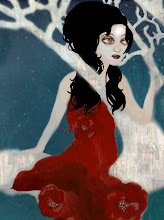
member of:Observers of the Interdependence of Domestic Objects and Their Influence on Everyday Life


This group has been active for a long time and has already made some remarkable assertions which render life simpler from the practical point of view. For example, I move a pot of green color five centimeters to the right, I push in the thumbtack beside the comb and if Mr. A (another adherent like me) at this moment puts his volume about bee-keeping beside a pattern for cutting out vests, I am sure to meet on the sidewalk of the avenida Madero a woman who intrigues me and whose origin and address I never could have known...
--Remedios Varo


(Slideshow is of Artwork by Remedios Varo)
By believing passionately in something that still does not exist, we create it. The nonexistent is whatever we have not sufficiently desired.
--Franz Kafka

Saturday, November 28, 2009

The Line Becomes Flesh


Aubrey Beardsley’s peacock dress illustration for Oscar Wilde’s play, Salomé


Alla Nazimova as Salomé

I

Aubrey Beardsley’s 1894 illustrations of Oscar Wilde’s Salomé are perhaps as famous as the play itself. Recently, however, I stumbled upon a complete surprise in John Coulthart’s blog: in 1923, those drawings were brought to life in a silent film production of Salomé starring Russian actress Alla Nazimova (nee Mariam Edez Adelaida Leventon). Reputedly the hostess of parties ablaze with debauchery--at her very own “Garden of Allah”-- Nazimova was unmoved by the studios’ fears of scandal and therefor took on much of the extremely high expense ($350,000) of the film’s production herself. Much of the expense seems to have come from the costuming, with all the textiles being shipped from Paris.


Nazimova, who inspired Tennessee Williams to become a playwright with her 1936 performace of Ibsen’s Ghosts, had little trouble playing Herod’s sultry teenage daughter convincingly, though she was herself 42. However, the film flopped miserably, as the morals of the day found it just as unacceptable as Wilde’s and Aubrey Beardsley’s contemporaries had found the play and its illustrations.


“The Dancer’s Reward” (Aubrey Beardsley)


Alla Nazimova

Black Cape (Aubrey Beardsley)

Above, you can see the inspirations for the collar, the flower-designs, the shape of the cape, and the odd head-piece.


Though I do not have Nazimova’s version of Salome’s famous Dance of the Seven Veils to share with you here, I do have something that is infinitely (in my opinion) better: Rachel Brice, performing a more modern, stylized version of what Aubrey Beardsley called “The Stomach Dance.” Among the long list of things Brice could convince someone to do just by dancing for them, I can add: her performance convinced me to give up several hours of the day towards trying to learn this style of dance.


And here is Zoe Jakes (not me, unfortunately), to show you that there are really no limits to what your body can do. I’m serious. Just watch.


Enjoy!

Wednesday, November 25, 2009

Erzulie Wishes you a Happy Thanksgiving

Erzulie III


some notes:
"Voudoun has given woman, in the figure of Erzulie, exclusive title to that which distinguishes humans from all other forms: their capacity to conceive beyond reality, to desire beyond adequacy, to create beyond need. In Erzulie, Voudoun salutes woman as the divinity of the dream, the Goddess of Love, the muse of beauty." 138The Divine Horsemen

One of the most striking aspects of the traditions surrounding the devotions to Erzulie is that they always end with her weeping. Erzulie is lovely, beautiful, and she has the adoration of all men, yet she does not strike hateful jealousy in the women, because of her child-like innocence. She induces wonder and care, she is like a child. And, though she begins all celebrations in her honor filled with giddiness and pleasure at the excess of beautiful and expensive things that are always lavished on her parties, she slowly grows sad, accusing the people of not honoring her enough, not giving her enough, not loving her enough. In Maya Deren's book "The Divine Horsemen," she suggests that this is just another aspect of her child-like behavior (along with an "impatience with economies, with calculation, even with careful evaluation" 139), that you cannot give a child enough attention to satiate its need, and that those present at the devotions understand this and soothe her. I feel, however, that perhaps Erzulie is right. We do not devote enough of our attentions to child-like wonder, to endless and all-enveloping love--if we did, the world would be a much different place.
In Candomblé Ketu, Ewá represents the water element, and is the goddess of enchantment, beauty, and harmony. Like Erzulie, in the related Voodoo pantheon, she is universally loved and loving and "represents all that is fragile and sensitive." According to Morwyn, in Magic from Brazil, "Euá was so beautiful that men would fight to the death to possess her. In order to stop the carnage she changed herself into a puddle of water that evaporated to the sky, condensed into a cloud, and fell as rain. Thus she is known as the deity of transformation."

Here, I am fusing the two water divinities, hoping for a major transformation such as the one Erzulie begs for, one in which I no longer need to mess with stupidities like balancing my checkbook, for example... She is still paired with the Green Lion of alchemical transformation, and they rest beside Legba's tree, which opens the doors to the other worlds. If you look closely, you can see the first bird forming from the clouds billowing up from her scarf.
More on Erzulie, Ewa, and Legba here and here.