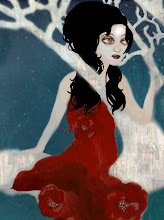
"Desires"
"Moon Sonata"
"Dream in the Olive Garden"
"Venus' Letter"
The Art of Peter MarčekMajor themes in the work of Peter Marček seem to center around two types/ definitions of wealth, music, and Paradise. First, the two types of wealth:
The first is theft of riches...as in the way we take jewels from the earth for adornment, worship them (see "Mammon") and torture slaves to get them, making some men very rich from ownership but making others suffer greatly in the mines.
"Mammon"
mammon |ˈmamən| (also Mammon)
noun
wealth regarded as an evil influence or false object of worship and devotion. It was taken by medieval writers as the name of the devil of covetousness, and revived in this sense by Milton.
(From my fantastic Mac dictionary)
Or here, where the story might be on coveting omniscience:
"Guilt and Judgement"
"Last Day in Paradise"
The second definition of wealth has to do with the giving of riches, for example, the riches that pour from the earth and flood it with a great greenness (for example in "The Horn of Plenty," below): the wealth of nature. This theme is also expressed in Noah's Ark (below), with the salvaged and already regenerating pieces of earth, the animals and insects, and music--music especially, because that seems to be one thing that comes from man that can be called a natural richness (as well as great visual art such as this, of course, and the stories we tell, and...). In the Ark, it seems the Three Fates are ready to re-weave the earth all over again with their music.
"Horn of Riches"
"Noah's Ark"
Music comes up again and again, for example in the "Earth's Song," surely that concerto saved from the floods, where a root plays the wind through a small detached piece of itself, and the woman has become her instrument:
IMAGE "Earth's Song"
On the 11/3/07 (free) podcast of the Bob Edwards Show, there is an interview with Oliver Sacks in which we get an idea of just how powerful a tool music would be in healing humanity (which would give the rest of the planet some hope). In this interview, they discuss Music Therapy, a subject Sacks writes about in his book
Awakenings. Here is some of what he said:
"I first encountered this [music as a form of therapy] about 40 years ago with the deeply Parkinsonian people whom I later described in Awakenings; these were people who were often unable to initiate any movement or any speech by themselves--who were stuck, who were frozen, who had no flow. But when music was played, then they could suddenly be liberated, and they could speak and dance and move. Music seemed to give them the flow and the sort of temporal organization which they couldn't generate for themselves. There's particular parts of the brain called the Basal Ganglia which are necessary to have sequences and structure and flow--that's damaged in Parkinson's, but music could almost, as it were, be a prosthesis for them. So, music therapy is very useful for people with Parkinson's, and also sometimes people with Parkinson's can carry an iPod around, to have a source of music, which allows them to move more easily. But music can make a tremendous difference to people with Alzheimer's Disease, or with Dementia...
...Typically, even when the ability to respond to language, even when language has been lost, when so much has been lost, the ability to respond to music, and recognize it seems almost indestructible, it seems to last till very, very late...."(The interview with Oliver Sacks is the first one on that episode. The quoted sections take place from around 20:30.)
In the same interview, they discuss synesthesia:
synesthesia |ˌsinəsˈθē zh ə| ( Brit. synaesthesia)
noun Physiology & Psychology
1. the production of a sense impression relating to one sense or part of the body by stimulation of another sense or part of the body.
2. the poetic description of a sense impression in terms of another sense, as in “a loud perfume” or “an icy voice.”
(also from my Mac).
In this particular conversation, they were talking about people who "see" different sounds or chords as distinct colors. The musician Jimmi Hendrix is a famous example of someone with this ability.
Marcek's images are so musically-themed and vividly colored, I could imagine some of these being the shaping of some great concerto he's listening to as he paints. Here is Concerto 1, which I imagine to be in D#.
"Concerto 1"
What struck me first, and most, about his paintings was the contrast between the smoothness of the skin and delicacy of the women's and birds' forms and faces and the oddly-shaped, collage-seeming textures of their hair, the rocks and plants of their environments, and the castle pieces. There is often an interesting abruptness between the foreground and the background. Simultaneous with that, I noticed that he's partial to vivid blues and ambers, which makes him a dear friend of mine. And, the instruments he paints are fantastic!
"Musica Natura"
Peter says:"The central aim of my creation is a woman, as a mysterious object of admiration, but the eternal source of inspiration."
"The Three Graces"
"Allure of the Medusa"
Here she is, in her
pre-hideous days. Playing a classical bass in a way that shows she knows what's to come, music-wise...
Then he has one called "Samhain." As I am now in 100+ degree weather, with excessive humidity,let us daydream a bit: This three day festival (Samhain) marked the end of summer, and the harvest time. For the Celts, it also marked the beginning of the new year--they divided the year into the light half and the dark half, and they began their year with the dark half, as they began their day at night. "For it was understood that in dark silence comes whisperings of new beginnings, the stirring of the seed below the ground." (chalicecentre.net) All the fires in the area would be extinguished, and a huge bonfire would be set at the fortress marking the grave of Tlachtga. Everyone would relight their hearth from that fire, in order to connect and unite the community symbolically. On that night, the line between the living and the dead and the humans and the gods would fade, allowing for a meal to be shared among them and wisdom to be proffered, and as the night continued, many tales of the ancients were told. It was also a good night for divination.
In Marcek's painting of Samhain, the golds and ambers of harvest are prevalent; a pod bursts with seeds, wheat fills the background. My guess is that the woman riding the back of the horse is Tlachtga herself, a powerful druidess and a sun goddess--here set before a sun-drenched sky:
"Samhain/ End of Celt's Summer"
As for influences, Peter Marček creates homages to some of them: Hieronymus Bosch, Max Ernst, J. Brahms.
"The World of H. Bosch"
"In the Garden of Max Ernst"
New creatures, new perceptions...In the Garden of Max Ernst, Aphrodite emerges from her shell (a flower?), and transcends to bird form, accompanied by a creature to her left playing cello, and an almost-man to the right playing a very long and twisted trumpet --always, music.... And below, we have again a very ark-like and musical image, stuffed to the brim, and transcending from the head of Mr. Brahms at the bottom out the mouths of birds at the top is...music:
"Homage to J Brahms"
Here's Rhapsody No.2 in G Minor, composed by Brahms and performed by Glenn Gould:
Brahms - Rhapsody, No. 2 in G minor - Glenn Gould(For some reason, imeem only allows 30 seconds of it here, but if you follow the link, you can hear the whole thing, which is gorgeous.)
Peter Marček's paintings are art as a way of re-creation and repair:
"On the Way to Paradise"
"The Image of Paradise"
A glorious, large slide show with almost sixty of his paintings in very good color is provided by
art odyssey at
this link (it was too wide to post here, but GO SEE IT!).
The artist's website is
here


 Posts
Posts