member of:Observers of the Interdependence of Domestic Objects and Their Influence on Everyday Life
This group has been active for a long time and has already made some remarkable assertions which render life simpler from the practical point of view. For example, I move a pot of green color five centimeters to the right, I push in the thumbtack beside the comb and if Mr. A (another adherent like me) at this moment puts his volume about bee-keeping beside a pattern for cutting out vests, I am sure to meet on the sidewalk of the avenida Madero a woman who intrigues me and whose origin and address I never could have known... --Remedios Varo
(Slideshow is of Artwork by Remedios Varo)
By believing passionately in something that still does not exist, we create it. The nonexistent is whatever we have not sufficiently desired. --Franz Kafka
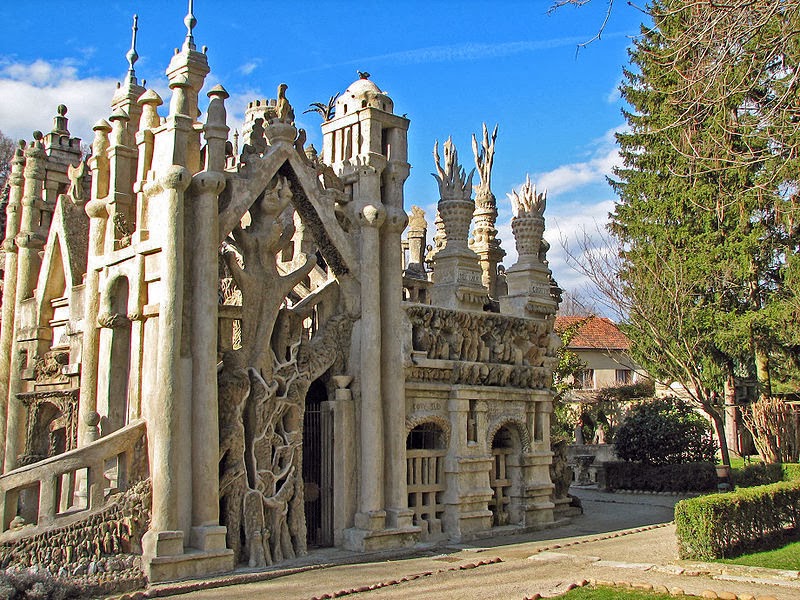
In 1879, a postman in Southern France, Ferdinand Cheval, picked up a stone somewhere along his route and made a decision to build a castle. He had no training at all.
"I was walking very fast when my foot caught on something that sent me stumbling a few meters away, I wanted to know the cause. In a dream I had built a palace, a castle or caves, I cannot express it well... I told no one about it for fear of being ridiculed and I felt ridiculous myself. Then fifteen years later, when I had almost forgotten my dream, when I wasn't thinking of it at all, my foot reminded me of it. My foot tripped on a stone that almost made me fall. I wanted to know what it was... It was a stone of such a strange shape that I put it in my pocket to admire it at my ease. The next day, I went back to the same place. I found more stones, even more beautiful, I gathered them together on the spot and was overcome with delight... It's a sandstone shaped by water and hardened by the power of time. It becomes as hard as pebbles. It represents a sculpture so strange that it is impossible for man to imitate, it represents any kind of animal, any kind of caricature."
"I said to myself: since Nature is willing to do the sculpture, I will do the masonry and the architecture." ( Becker, Howard S. Art Worlds)
The non-offending first stone
He carried stones in his pockets, then began to use a wheelbarrow on his route, picking up whatever caught his eye.
The castle is 85 feet long and stretches from 26-32 feet high.
"You start wondering," the facteur wrote, "if you have not been carried away into a fantastic dream with boundaries beyond the scope of imagination."" (New York Times, Mary Blume, May 3, 2007)
He ignored ridicule; he ignored the fact that he had no training. He dreamt of building a palace, and so he did. Stone by stone. It took him 33 years.
In yesterday's post, I talked about how objects could be infused with such meaning from our lives and from their own creation and history that they might directly and powerfully affect our own actions and abilities. The artwork of Remedios Varo almost always has an undercurrent of such beliefs in its assemblage, beliefs she staunchly declared herself to hold. I recently came across some of her writings, in Cartas, suenos, y otros textos de Remedios Varo, compiled and edited by Isabel Castells, and I discovered that she carried out experiments in the spirit of these beliefs not only in her paintings, but in all areas of her life. Amongst her writings, there were recipes, using pieces of clothing, masks, rocks, glass, spices, and a few food items, along with very specific mixing and preparing instructions in order to replace bad dreams with happy or erotic ones:
Pluck the chickens, carefully preserving the feathers. Put two liters of distilled water or rainwater to boil, without salt but with peeled and minced garlic. Let it boil at a low heat. While the birds are cooking, align the Oriental bed from northeast to southeast and let it rest with the window open. Close the window after half an hour and place the red brick below the left leg underneath the headboard (northeast). Let it rest. While the bed is resting, grate the strong root directly over the pot, attentively keeping your hands consistently heated from the steam. Stir and let it boil. Four kilos of honey should then be spread over the sheets of the bed. Take the chicken feathers and scatter them over the honeyed sheets. Lie on the bed carefully....(my translation)
So part of the recipe is in the correct placement of objects--a brick, a bed, a window...Here’s hoping the same could be done with found feathers and while boiling cabbage, for the sake of vegetarians. And there’s much more in the book. There are her dreams, examples of her automatic writing, ideas for paintings, and a tongue-in-cheek record of a very important archaeological discovery, in very stuffy academic tones complete with bits of invented Latin, of prehistoric human bones which showed that we once were wheeled...
Homo Rodans
...complete with photos of the found and assembled bones.
This is an appeal: please make this book available again! It is out of print, but so, so fascinating...
“When I was about 5 years old, I wanted to be King Kong. I wanted to climb the Empire State Building, clutching a beautiful little blond woman, while bi-planes circled around me trying to shoot my hairy ass down. Fortunately, I never acted any of that out. Most of my early childhood in New York, was spent making drawings and watching “atomic age” sci-fi and horror movies.
“Most Saturday afternoons included trips to the local comic shops and noon matinees at the RKO Keith’s on Northern Blvd, marveling at the 1950’s memorabilia; the rocket ships, the superheroes, the giant monsters, and those wonderful movie posters! I would try and draw as much as I could remember from those excursions.After high school, my ‘formal art training’ was at Pratt Institute in Brooklyn, NY." Source
In an interview with Juxtapose magazine, he was asked how he would prefer to die, and he said... "Being shot down in a hail of gunfire from bi-planes circling around me as I am clutching a beautiful blond woman and straddling the tallest Art Deco structure in New York City. I would probably be screaming, "Don't judge me, . . . I was a man once."
At my funeral, I would want someone to say, "It was beauty that killed the beast"
"The Smoking Man"
The above image was from a show in November of last year, which was a collection of images inspired by the experiences of young Travis visiting his grandmother in her apartment complex on Mulberry Street in Italy. The building super was an "odd guy," difficult to understand, who worked on his sculptures, drilling and sanding at all hours of the night, sending odd noises wafting up from the basement...He remembers that the whole building was full of strange noises, and he spent many hours trying to imagine what the people behind those noises looked like. This show was called "Strange Neighbors."
"The Taxidermist" (From "Strange Neighbors")
(Thumbnail sketches)
In an interview with Arrested Motion, Travis Louie described a bit of his process: "I usually write my stories first and I keep a journal with me at all times. It’s become kind of a ritual for me to write a little every day. I go through my journals and imagine what pictures can be made from the writings and what cohesive elements would make for a series of paintings. I try to look at the overview of where my work is going . . . not to be too calculating, but it helps me pick where I want to go with this. The next step in my process is to make many little drawings. After refining the best ones . . . a final drawing or drawings are put together for the paintings. I then prep my boards and transfer the images . . . I still make changes . . . but they are usually not huge ones at this stage. Painting is more like a refining process for me. All the creativity takes place well before the actual painting is even started."
He also claims to get a lot of inspiration and direction from his dreams.
You can watch him in speedy motion creating one of his portraits here.
"Abagail" Last night (Aug 21) was the opening night of his newest show, at the Roq la Rue gallery in Seattle, entitled "Portrait of the Artist as a Young Monster." On his webpage, he gives a little on his own background and his artwork:
"The visual style of his work is mostly influenced by the lighting and atmosphere of German Expressionist and Film Noir motion pictures from the Silent Era to the late 1950’s. Films from directors like F W Murnau, Fritz Lang, Orson Welles, Robert Siodmak, Robert Aldrich, Jacque Tourneur, and cinematographer, Greg Toland, had a great effect on the way he wanted his paintings to look. To achieve the dramatic 'mood' in his paintings, they are produced primarily in black and white or limited color. He uses acrylic paints over tight graphite drawings on smooth grounds, like 'plate' finish illustration board or finely sanded, primed wood panels."
And he's expounded a bit on his themes: "Mistaken identity… being judged solely on one's appearance… racism. I remember being on a bus with my mom in 1973, and a woman started giving my mom a hard time because of our Southeast Asian appearance. She assumed we were Vietnamese, and insulted us about the conflict in Vietnam and how we didn't belong in her country. My mom always tried to hide such things from us. She felt it was not right to expose us to how ugly ignorance is. The bus driver stepped in and told the lady to pipe down. It played like an awkward moment in a Norman Lear sitcom, but the experience stayed with me.
The characters in my paintings are – or can easily be – misunderstood. They are, for the most part, kind and affable – just trying to get by, like anyone else. I try to keep it light and maybe humorous.
Part of what fascinates me about films like Invasion of the Body Snatchers and Invaders from Mars is the paranoia. I can identify with the character who knows something's going on, but no one believes him." --Source.
Ouija Board Travis Louie created for a "Talking Board Show" at Copro Nason Gallery in Santa Monica.
Travis Louie also created the artwork for an album by one of the most incredible musical artists I know of, Les Claypool, whose bass playing, lyrics, and style are also out of this world:
"Of Fungi and Foe"
Here is Les Claypool, performing "Booneville Stomp", from that album, live on Jimmy Kimmel, with images by Travis Louie on large screens in the background. At around 3:18, it starts to get crazy....
Travis Louie recently released a book of his images and the stories behind them, set up like an old family photo album, entitled "Curiosities." Buy it here if you're not close enough to get a signed version...although I've heard if you contact him, he'll sign one and send it to you.
"Curiosities"
A few examples of his astonishing gift for creative character sketches follow, along with a link to his page.
Herbert "Herbert was a very peculiar simian. He walked upright with a cane. and had an unusual gait that consisted of a slow step followed by a slightly faster one, and then a short hop. His prehensile tail was longer than usual and he used it to pick people’s pockets, . . .not to rob them, but to find out as much information as he could about them, . . . fore he loved people. They fascinated him. Most of his early life was spent working for an organ grinder in a town square in Sheffield. It was his favorite vocation because he was in contact with so many different people. He danced to the sounds of the organ grinder for 5 years and then tragically, his employer was run over by a team of Clydesdale horses. As a result, he developed a phobia of horses and a weakness for single malt scotch. In 1915, he enlisted in the military and left Sheffield to fight in the trenches for 2 years. He returned home after suffering the war wound that accounted for his unusual gait and his need for a cane. No longer able to dance, he was forced to get a job at a distillery. On his first day of work, he came across a team of draft horses and nearly wet himself. To help him overcome his equine anxieties, his fellow workers came up with an elaborate plan. They dressed up as horses and pranced around him for days. When he was hauled away to the asylum, they all apologized and wished him well. He recovered and spent the rest of his days working for shipbuilders in Glasgow and avoiding horses. "
"Herbert"
Sam the Krampus "It's that season again, Krampus' will be descending upon the wicked and selfish, . . .
Sam likes to sneak up on his victims and cover their eyes. He is only 3 feet tall, so he carries a folding stepladder with him. Once he has his hands over the person's eyes he whispers in a very convincing woman's voice, when they turn around, they usually are frightened into unconsciousness. At which time, he cross-dresses his victims, . . . affixing crooked wigs to their heads and miss-matched high heels to their feet (usually 2 left feet), and places them in uncomfortable locations where they might be seen by the most people, like train stations or bus terminals."
"Sam the Krampus"
In an exceptionally well-done interview on Erratic Phenomena, he described his relationship with his grandfather, who encouraged his artwork, and influenced the way he would create and work with other creators.
"My grandfather was a machinist who worked for the Bulova Watch Co. in Astoria. He was a decent draftsman himself and used to draw dinosaurs and elephants for me. He encouraged me to draw what I saw on the big screen – and the little one. He said, "Someone had to design everything you are looking at." He introduced me to those great stop-motion creature features, from King Kong to Jason and the Argonauts. He bought me art supplies and built my first drawing table. I remember when we saw the Ralph Bakshi-animated Lord of the Rings, he asked me to try and remember what I saw and draw it. I drew a really clunky version of Gollum."
One thing that he's gaining a name for other than his art is his support of other up-and-coming artists. Recently (July 11th), he curated a show called "Monster?" at the Copro Gallery, which included work by over 50 artists, including individual works by production artists from film, book and magazine illustrators, as well as "gallery" artists. He generally picked artists whom he felt were under-appreciated, taken for granted because of the way their artwork is generally seen as simply an aspect of a larger work--recalling, perhaps, the words of his grandfather...
Following what appears to be this week's theme of Max Ernst and collage...
"Lost at Sea"
"Bird Woman"
In a 2006 interview with Robert Ayers for the Nancy Hoffman Gallery, which represents her, Colette Calascione was asked: So how do you actually make a painting like Persephone? Her answer is rather surprising, and reminds me that there are a million ways to create, and it's always up to us to explore and discover a way that opens the path for us:
"The first stage is the drawing, getting the drawing together. That’s always my favorite part, that’s the best. I’m actually not that good at drawing—I trace everything, with no shame. So I generally start with everything on tracing paper. Then I do lots of Xeroxing and enlarging. And then things happen, changes happen, and I get to play around with things. Everything comes together like a collage. Persephone was from a photograph—I love those old erotic photographs—and I had the mask, so it just worked out that way.
Then I draw everything on a white panel with a watercolor pencil. I’ll do that until I get the drawing how I like it. Then I’ll do the various layers. It’s mostly for the flesh that I’ll do all of this, because I have so much flesh in my painting! Over the drawing, I do a coat of Caput Mortem—which is an old-time technique, an earth red—and over that I’ll put three layers of white and a layer of green which neutralizes the red. All that creates an optical gray, a grisaille. Then the color starts happening and that’s the tortuous stuff. That’s the hard part...Because I’m so particular. It has to be perfect. The color has to set a mood, and be just right. I’ll redo a color 10 times sometimes until I get it right."
"Persephone"
--In a different version of Adam and Eve, a much older one, in fact, it is the man, ___, who tricks (willfully) the woman, Persephone, into partaking of forbidden foods, in this case, a pomegranate, though it's interesting to note here that there's a lot of scholarship suggesting that the pomegranate was also the actual forbidden fruit in the Garden of Eden. For the six little seed she absent-mindedly--unaware of the consequences-- nibbles on during the first moments of her captivity, Persephone must from here unto forever spend 6 months out of every year in the Underworld with her captor. And her mother, mourning this, sends the world into winter.
Here, Persephone's mask, a bird swooping downwards, is all she wears, and she seems completely casual, indeed almost bored in her nakedness, as if what had once been terrifying--her abduction to and rape in the underworld--is now just another bit of routine, you know, fall and winter follow spring and summer and then it's back to that constant orgy for 6 months. It's not a bad life, just repetitive. There's no pomegranate here, no symbol of lost innocence, no recollection of lost innocence.
DREAM OF THE HUNGRY GHOST
"That one [Dream of a Hungry Ghost] is my favorite painting. It's based on my favorite Max Ernst collage. I just the loved the image. I had it hanging on my wall for years. That's me in the painting looking like Mary Poppins. Recently I've been painting me a lot. The sculpture on the table is a Picasso drawing. Then look at the wallpaper. The roses are insane. There are five hundred roses in there, and I painted each one in detail, and they are so thick that there are bumps on the surface of the paint. You can feel them. I worked on it for two years. I think it probably looked finished after a year, but I had it here on my studio wall, and though I'd be working on something else, there’d always be some little thing I could do to make it look more illuminated. I really like that, to keep a painting around and I’ll think, "Maybe I could just add a little highlight here," and then it gets this really nice polished look."
(Max Ernst, from "Une Semaine de Bonte")
In 1934, Max Ernst put together a book of collages called Une Semaine de Bonta, ou, Les Sept Elements Cardinaux (A Week of Kindness, or, the Seven Deadly Elements), which I have already written about here, and the entirety of which is available here. Each day of the week envisions one of the seven deadly elements-- -- in several collaged images. "On Tuesday, large or small dragons (sometimes bats or serpents) are almost universally present… Stern, proper-looking women sprout giant sets of wings, serpents appear in the drawing-room and bed-chamber…" Tuesday is La Cour du Dragon, The Dragon's Heart, whose element is fire. Here you have the man with his dragon's wings, passionately embraced, clutched into a kiss, in a Victorian drawing room. Calascione's version adds color, and she paints it as a whole piece, but it still keeps an oddly collaged feel, perhaps because of the incongruence of the images. She also adds angels wings into the petticoats of the woman's dress, strengthening the incongruence and deepening the story: is this an angel, pulling a demon into an embrace? Because she is very clearly in the lead. Calascione also adds the element of fire. The colored squares of the floor hollow out, adding another dimension to the room, and flames leap up from the depths in a circle around them. But they do not touch the couple. From above a key is offered, by a hand from yet another dimension, that enters through a wall. Here is a moment of union, a moment of opportunity. Instead of seeing it as the woman falling into the clutches of a demon (which is still a possibility, once the moment ends, as the flames and the easy access from below remind us), we can see here a demon gaining the key to heaven. It is not clear whether he will accept, but at the moment, anything is possible. That's just my opinion. But in the interview with Robert Ayers, Calascione expressed her hope that viewers would come up with their own interpretations of the images, as she was offering none.
Coincidental Gathering
Here's a mermaid against the background of Hokusai's giant wave, from the Mt. Fuji wood-block series of the Edo Period. I like the effect of lush painting against wood-block style. Note that she's turned some of the ocean spray into bubbles, thus mixing the foreground with the background.
Hokusai's Great Wave.
I first discovered her art here, on ArtOdyssey's blog.
"When I enter a cafe, the first thing I perceive are implements. Not things, not raw matter, but utensils: tables, seats, mirrors, glasses and saucers... Taken as a whole, they belong to an obvious order. The meaning of this ordering is an end — an end that is myself, or rather, the man in me, the consumer that I am. Such is the surface appearance of the human world... Now let us describe the cafe topsyturvy.
"...Here, for example, is a door. It is there before us, with its hinges, latch and lock. It is carefully bolted, as if protecting some treasure. I manage, after several attempts, to procure a key; I open it, only to find that behind it is a wall. I sit down and order a cup of coffee. The waiter makes me repeat the order three times and repeats it himself to avoid any possibility of error. He dashes off and repeats my order to a second waiter, who notes it down in a little book and transmits it to a third waiter. Finally, a fourth waiter comes back and, putting an inkwell on my table, says, 'There you are.' 'But,' I say, 'I ordered a cup of coffee.' 'That's right,' he says, as he walks off.
"If the reader, while reading a story of this kind, thinks that the waiters are playing a joke or that they are involved in some collective psychosis, then we have lost the game. But if we have been able to give him the impression that we are talking about a world in which these absurd manifestations appear as normal behaviour, then he will find himself plunged all at once into the heart of the fantastic." — Jean-Paul Sartre
Brian Dettmer's sculpture deals with what he perceives (he hasn't been to my house) as the dying out of the use of books as a result of the new media form we're using here--the net. As the books are no longer used as "books," that is as sources for information, he re-constructs them as other things: skulls, hollows, collages... Looking at his work, you wander into a world where books can't be opened, where they don't fit correctly on a shelf, and where you might really know the writer's intention by looking at the cover.
Dettmer explains: “Old books, records, tapes, maps, and other media frequently fall into a realm that too much of today’s art occupies. Their intended role has decreased or deceased and they often exist simply as symbols of the ideas they represent rather than true conveyers of content. ... When an object's intended function is fleeting, the necessity for a new approach to its form and content arises.” (Valdez 2006).
And so he leaves us with an international dictionary that contains no words:
He has also created an entire series from one book called Key Monuments of the History of Art. He tells us, "The first one is carved from the front, the second, and open front, the third is carved from the open face back towards the beginning and into the end and the fourth and fifth are in from the back, so the chronological path is reversed. They all approach space/time from a different direction. All five will be in a solo show with Toomey Tourell in San Francisco which will open Sept. 3 this year (2009)."
Note the iconic profile of Queen Nefertiti, whose crown is filled with other monuments here. She was key in altering the view of "the gods" of her people to "God," that is, Aten. She also enjoyed an exceptional amount of power for her time, possibly attaining a status equal to that of her husband, the pharaoh--sort of a move in the opposite direction... (This is suggested by the size of her image in artworks of her time, in comparison to his).
Antonia Pocock says: "The multifaceted surfaces of Dettmer's books not only resemble natural landscapes, but also mimic the haphazard, multidirectional structure of the internet. Certain book-sculptures fragmented by sharp square cuts reveal a pixelated picture, further contaminating the static vector of the book with the dynamic, digital mosaic of the computer screen."
Dettmer describes his process: "I begin with an existing book and seal its edges, creating an enclosed vessel full of unearthed potential. I cut into the cover of the book and dissect through it from the front. I work with knives, tweezers and other surgical tools to carve one page at a time, exposing each page while cutting around ideas and images of interest." He clear-coats the freshly-cut pages to as he works to hold them in place, adding a final overall clear coat at the end. “A book needs to feel right, it needs to have the right size and paper type. There needs to be enough diversity and variety. There needs to be a subject of interest with illustrations or photographs or text. I’ll flip through the pages before I seal them up and sometimes I’ll see an image and think, ‘I hope I come across that.’ But once I seal up the book, there’s a degree of randomness, a lack of control because I don’t move or add anything. I never plan what I’m going to come across. That’s one of the things that keeps it interesting to me. That in itself is like reading in a way because I don’t know what’s on the next page when I’m carving through. I never have a picture of what it’s going to look like when I’m done.”
The Art of Janda Zdenek, the Ars Memoria of Giordano Bruno, and Dream Theory
"Beauty and the Beast"
"Gothics in Bohemia"
Janda Zdenek is a painter, born in Louny Czechoslovakia in 1953.
"Adoration of the Three Magi"
"At the Beginning There Was Stone... Words from the artist:
I painted two stones as a study into a sudden flash of thought I received . I painted them, one hanging above the other. Oh dear, my inspiration. These stones were different from the heavy lying ones. There will forever be tension between them. Stones levitate. It was my first stimulus and it needed to be considered. From stones still life emanates, from stones human drama can be created. By arranging stones and other various components into mutual combinations, chords of feeling can be created. These cords of feeling radiate the human experience."
I create new shapes with my fantasy and onto empty stages I place the players of dramatic experience; puppets; stony mountains; sand; wood; metal...myself the scenarist, costume designer, lighting technician, director. My own Commedia dell Mundo."
"Giordano Bruno"
It's interesting that Janda Zdenek describes his work as being a placing together of disparate objects to give them new life and meaning...Girodano Bruno (painted above) had a similar process through which he developed the Ars Memoria, or Memory Arts. Above, he is painted with many objects sailing around his head; in his right hand, he holds a pointer which he directs towards a disembodied head. The whole universe is there, emanating from his brain. To have the whole universe at one's fingertips, like that, was the goal of the memory arts. The process of the art was (loosely) to create symbols to represent ideas and facts and hypotheses and arguments, symbols that were meaningful to you, the creator, but were "funny" in some way--odd in their juxtaposition with the idea to be remembered, because it was understood that things that were funny (or violent or sexual) were easier to remember. Verbal puns (for example) on the words or ideas to be remembered would be visually expressed and then the visual symbol would be "placed" in a particular corner of a particular room of a particular floor of a house (or a place in a garden), which was your memory castle, or your memory garden. You, the Mnemonist would then be able to stroll through the house or the garden (or the castle or the library) in your mind, and with each item you passed, recall a different aspect of the speech, or the list of medical facts, or the arguments of a proof, that you were trying to memorize. Your first step was to create the house or garden. Your second step was to decide upon the symbols you would use for each letter of the alphabet and for the numbers 0-9. Then you were ready to begin.
John Michael Greer gives this example: "For instance, if-to choose an example wholly at random-one needed to memorize the fact that streptococcus bacteria cause scarlet fever, rheumatic fever, and streptococcal sore throat, the first task would be the invention of an image for the word "streptococcus." One approach might be to turn this word into "strapped to carcass," and visualize the figure who represents the letter S with a carcass strapped to his or her back by large, highly visible straps. For scarlet fever-perhaps "Scarlett fever" -a videotape labeled "Gone With The Wind" with a large thermometer sticking out of it and an ice pack on top would serve, while rheumatic fever-perhaps "room attic fever" -- could be symbolized by a small model of a house, similarly burdened, with the thermometer sticking out of the window of an attic room ; both of these would be held by the original figure, whose throat might be red and inflamed to indicate the sore throat. Again, this takes much longer to explain, or even to describe, than it does to carry out in practice."
There was a secondary purpose to this process, and that was of a more alchemical nature. The Hermetic magicians of the Renaissance (and Giordano Bruno himself) felt that if you could organize an image of the universe from your memory (holding always the Platonic view that all "learning" was really just memories from before you were born into human form), you would attain the key to universal knowledge. Your mind works in images and puns (think here of the odd scenes of your dreams, which reorganize the occurrences of your day into short story form to help you understand them), and your mind knows more than you are aware of (more than you have yet “remembered”). If you access that image-producing, pun-producing part of your brain, regularly storing all the knowledge you come across that way, then you will (according to this school of thought) come to a point where you can begin to have an effect on the outer, physical world by moving around those symbolic images in your mind. This may seem like a ridiculous claim, but it reminds me of the current dream theories, which posit that since your subconscious mind works in images and puns (!), it is much easier to change a deeply-held fear or other weakness by using the visual representations of that fear provided by your dream than it is to try to logically reason away that fear. The most common example: if you are dreaming of a dark monster chasing you down the stairs every night, then the task set out for you is to stop running, turn around, and ask the monster what it wants, exactly. According to dream theory, the monster, like every other being that shows up in your dreams (including your cheating husband and your mother-in-law) is only an aspect of yourself. It is something you are creating that is holding you down by terrorizing you. Once you turn around to face it, once you talk to it, once you touch it, refuse to be afraid of it, it will stop chasing you, and then big changes are set to occur in your waking life. Opportunities will pop up unexpectedly, because you will be ready to move forward. (It is important, here, to feel the things that are happening in this dream, so that your body is fooled into believing it is an actual experience.) This practice, by the way, is also called alchemy.
So, returning to the memory castles, the idea becomes that you can address a problem symbolically. You create a visual representation of all the knowledge you have on the problem, all the problematical aspects, and then think about what you hope to gain by solving it. Move things around in an effort to get to that resolution, and... voila, the world changes. It's not a joke to say that most of the bigger problems of the world are often solved by looking at the issue sideways or upside down; this is the same kind of idea.
"Psychoanalysis on the Bridge"
Note the bird, the Jungian symbol of transcendence, waiting to be released from the cage of the mind. The horse drinks from the glass-encased brain of the man behind her--a man composed only of legs and head, drive and will; the horse seems to be sucking everything out of the man's mind. In dreams, a favorite source of materials for analysts, animals symbolize your instincts. Horses represent some sort of passion. Here it seems as though that passion is perhaps sucking the juice out of its owner, making him behave like a dummy? A bridge would be symbolic of a crossing, a transition from one land to another; maybe bridging a gap (speaking of puns), or an age transition-- it is at this transition that the psychoanalysis occurs. Note that the uber-passionate male is not looking where he's going in that transition, and he's barely on the bridge. It will not take much to cause him to drown-- which, by the way, is another symbolic act, as water mostly represents emotions, and thus the over-passionate male, blinded by his passion, is overwhelmed by his passion, "drowns" in it.
"Surrealist Sailing"
The Surrealist movement, of course, was based on the idea of juxtaposing seemingly disparate objects, especially as would be formulated in a dream. Salvador Dali, here painted right behind the figurehead, referred to Sigmund Freud as his "father" for most of his professional life, and painted many canvases that seemed driven by the same bizarre logic as a dream. The Tree of Knowledge in the biblical Garden of Eden has often been represented as a pear tree, so it could be that the pear here is the fruit that the "automatic," (and thus subconscious) bizarre pairings that occur in a surrealist painting strive to capture--the ultimate knowledge, that same ultimate knowledge the practitioners of the Hermetic Arts strove for. For the meaning of the egg on the head of the last member of the party, I looked to http://thealchemicalegg.com, where it states: "According to Rulandus' 17th century Alchemical Lexicon, the "Ovum Philosophicum," which can be translated as the Philosophical or Hermetic Egg, is the principal vessel used in alchemical operations...The alchemists would seal the subject of their work, the substance that would be transformed through the alchemical operations, in the egg. During the alchemical process, the subject, Hermetically sealed in the Egg, would go through a symbolic death and rebirth. When the Egg was cracked, a new mystical substance emerged which was an elixir that prolonged life and acted as a catalyst capable of improving any substance that it came in contact with. This substance, called the Philosopher's Stone, could change lead into gold and change an ordinary person into an enlightened master."
Back to Janda Zdenek: "The frame provides the psychological distance by surrounding the picture. Consequently, the frame protects the soft painting in the middle with its massiveness physically. From the very beginning, my intention was to create a unique frame for every picture, and after several failed attempts from specialists, I came up with the conclusion that I must create the whole frame by myself. Only the artist by himself can, if he is capable, complete the unity of his work. Into the frame I enclosed not only various shapes and kinds of wood, stone and other natural materials connected to the pictures, but I also enclosed my careful artwork and my own personal fantasy."
"Legend of the Warrior"
"Angel in the Rocks"
Zdenek describes the above painting on his website. Parts of that description are copied here: "The Angel in the Rocks is about faith, not just faith in the sense of religion, but in the belief of the idea of faith in general. The test of faith comes when you can't see the horizon, yet you believe if you follow the light, your conviction in faith will protect you.
The composition of The Angel in the Rocks is divided into three meaningful settings. The left part of the composition (allowing for the sense of movement of figures in the foreground) a messenger of the truth is walking -the Angel. She is leading a group of men and women, showing them the way through a difficult part of life - the rocks..." “From the head of the Angel the light of truth is waving like hair over those in the middle part of the composition. These are the faithful, the believers in the idea. The first figure is walking with steadfast confidence and has no doubt in his belief.... “The last part of the composition belongs to the undecided ones. The fourth figure has not yet recognized his direction. His eyes are covered by a velvet ribbon, which prevents him from properly seeing the illuminated path. His mouth, closed by a medieval wooden pear prevents him from speaking. The figure is blind and mute and must through the power of his mind break his psychosis and find the right direction. If he doesn't, he will fall into the depths . The fifth and last figure, with his hand cupped around his ear, is listening. Atop his rounded head a fragile bottle is balancing. Though the bottle is still closed and not able to accept the light of truth, the figure is beginning to feel the beneficial influence of faith.”
For more from John Michael Greer on the Ars Memoria, see: http://www.synaptic.ch/infoliths/textes/arsmem.htm
“This book first arose out of a passage in [Jorge Luis] Borges, out of the laughter that shattered, as I read the passage, all the familiar landmarks of my thought—our thought that bears the stamp of our age and our geography—breaking up all the ordered surfaces and all the planes with which we are accustomed to tame the wild profusion of existing things, and continuing long afterwards to disturb and threaten with collapse our age-old distinction between the Same and the Other. This passage quotes a ‘certain Chinese encyclopaedia’ in which it is written that ‘animals are divided into: (a) belonging to the Emperor, (b) embalmed, (c) tame, (d) suckling pigs, (e) sirens, (f) fabulous, (g) stray dogs, (h) included in the present classification, (i) frenzied, (j) innumerable, (k) drawn with a very fine camelhair brush, (l) et cetera, (m) having just broken the water pitcher, (n) that from a long way off look like flies’. In the wonderment of this taxonomy, the thing we apprehend in one great leap, the thing that, by means of the fable, is demonstrated as the exotic charm of another system of thought, is the limitation of our own, the stark impossibility of thinking that.”
Michel Foucault, The Order of Things (New York: Pantheon, 1970) xv.
"Everything leads me to think that, in the near future, reality will be considered exclusively as a mere state of depression and inactivity of the mind" --Salvador Dali



 Posts
Posts