|
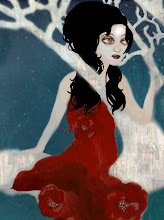
| Santa Caterina maquette in the style taught by Clive Hicks-Jenkins |
How Music and Art will Save Your Life
I sing the body electric,
The armies of those I love engirth me and I engirth them,
They will not let me off till I go with them, respond to them,
And discorrupt them, and charge them full with the charge of the soul.
--Walt Whitman |
| Santa Caterina Maquette by zoe blue |
In his address to the parents of incoming music students to the Boston Conservatory, Karl Paulnack, in an explanation of how musicians are like emergency-workers, reached back millenia in history to begin his argument:
“The first people to understand how music really works were the ancient Greeks. And this is going to fascinate you; the Greeks said that music and astronomy were two sides of the same coin. Astronomy was seen as the study of relationships between observable, permanent, external objects, and music was seen as the study of relationships between invisible, internal, hidden objects. Music has a way of finding the big, invisible moving pieces inside our hearts and souls and helping us figure out the position of things inside us.”
This is not only a meditation on the impact music can have on mood and emotion, for it is also true that music can grab hold of diseases our science still has little idea how to locate in the body, and hold them down or shut them down, releasing our invisible pieces so we can function again.
“While the power of music has been known for millennia,” Oliver Sacks states in his Musicophilia, “the idea of formal music therapy arose only in the late 1940s, especially in response to the large numbers of soldiers returning from the battlefields of the Second World War with head wounds and traumatic brain injuries or ‘battle fatigue’ (or ‘shell shock,’ as it was called in the First World War, a condition we would now categorize as ‘post-traumatic stress disorder’).With many of these soldiers, it was found that their pain and misery and even, seemingly, some of their physiological responses (pulse rates, blood pressure, and so on) could be improved by music.”
Listening to music can bring the blood pressure back into balance whether it was too high or too low, and it can decrease physical pain, both acute and chronic. Just after WWI, as those traumatized vets were entering the wards, a bizarre ‘sleeping sickness’, encephalitis lethargica, also “swept the globe,” its cause unclear. Those patients were either frozen--catatonic-- or racked by stuttering, explosive, non-functional movements; they would remain that way for decades. When Sacks started working with them in 1966, there was still no medication available to help them, but there was music: what he saw was that the patients
“could not easily initiate anything, and yet often they were able to respond. Many could catch and return a ball if it was thrown, and almost all of them tended to respond in some way to music. Some of them could not initiate a single step but could be drawn into dancing and could dance fluidly. Some could scarcely utter a syllable; their voices, when they could speak, lacked tone, lacked force, were almost spectral. But these patients were able to sing on occasion, loudly and clearly, with full vocal force and a normal range of expressiveness and tone.”
Two different things are revealing themselves in this range of patient: one is that music can return a patient’s mysteriously stolen spark, bringing him or her ‘back to life’; the second is that music can re-calibrate the pulse rates, blood pressure, and other physiological and psychological damages caused by war. What does that mean about those damages? Think about the cacophony of war, the discordance of the exercise itself, yes, but also the jarring, shocking, thundering sounds of it: a piece of music, the symphony of society, is destroying itself. Someone who has been in the midst of that loses his way, his heart stutters, the blood thus doesn’t flow smoothly and the oxygen balances are inadequate at times or overwhelming at others (like what happens when you stand up too fast, multiplied)--these are symptoms that bring to mind hyperventilation--

--and hyperventilation brings me to the studies of Vic Tandy, a professor at Coventry University. Tandy was an engineering designer who, at the time of the events described below, was working in a lab that manufactured medical equipment. His experiences there led to the publication of a paper in the Journal of the Society for Psychical Research called The Ghost in the Machine. People working in that lab were beginning to complain of hauntings; odd things were happening, and the stress and anxiety of working there skyrocketed. Tandy himself chalked events up to odd noises made by various pieces of equipment combined with the power of suggestion and ignored the drama to focus on his work. But one night, he stayed late, alone, working on a project:
“As he sat at the desk writing he began to feel increasingly uncomfortable. He was sweating but cold and the feeling of depression was noticeable. The cats were moving around and the groans and creaks from what was now a deserted factory were ‘spooky’, but there was also something else. It was as though something was in the room with V.T. There was no way into the lab without walking past the desk where V.T. was working. He looked around and even checked the gas bottles to be sure there was not a leak in the room. There were oxygen and carbon dioxide bottles and occasionally the staff would work with anaesthetic agents, all of which could cause all sorts of problems if handled inappropriately. All of these checked out fine so V.T. went to get a cup of coffee and returned to the desk. As he was writing he became aware that he was being watched, and a figure slowly emerged to his left. It was indistinct and on the periphery of his vision but it moved as V.T. would expect a person to. The apparition was grey and made no sound...”
Vic Tandy decided to go home for the night, reasoning that his exhaustion was affecting his brain. When he returned the next day, it was early and with his fencing foil, which needed a small adjustment before a competition; he was planning to use the lab’s bench vice to hold it down as he worked. He set everything up and left the room to get some oil:
“As he returned, the free end of the blade was frantically vibrating up and down. Combining this with his experience from the previous night he once again felt an immediate twinge of fright. However, vibrating pieces of metal were more familiar to him than apparitions so he decided to experiment. If the foil blade was being vibrated it was receiving energy which must have been varying in intensity at a rate equal to the resonant frequency of the blade. Energy of the type just described is usually referred to as sound. There was a lot of background noise but there could also be low frequency sound or infrasound which V.T. could not hear.”
Human hearing, like human sight, is limited to a small range of frequencies. At the bottom of the piano keyboard, around where the tuba gets its tones, our ability to pick up sound drops off, and the frequencies enter a range referred to as infrasound--which we can’t hear, but we can still be immensely affected by. Infrasound is responsible for much of the damage caused by the explosion of a bomb, for example, as a sonic wave carries the destruction over a far greater area than the actual blast site (remember our soldiers, above). Scientists are now using infrasound detectors to try to get some warning before earthquakes, and it is believed that the explosion of a volcano is also a deep infrasonic event. It’s infrasound that shatters windows miles away from an explosive event. Vic Tandy, in an interview with Chris Arnot for the Guardian, explains that “evidence from NASA and other sources suggests that it [infrasound] can cause you to hyperventilate and your eyeballs to vibrate;” the resultant vision-smearing and oxygen-depletion then combine to create anxiety and apparitions, all of which can veer into a self-feeding loop that leads to the sensation that some entity is trying to kill you--and in that, the effects of shell-shock and the experience of terrifying ghost-hauntings can become oddly similar. Vic Tandy’s lab had just had an exhaust fan installed which had a frequency of 18.9 Hz (our hearing bottoms out around 20 Hz), and the shape of the room had created a standing wave at that frequency, meaning, basically, that it was bouncing off the wall of one end and returning to the other side in an endless cycle. The center of the standing wave was his desk: the apparitions, the vibrating metal, and the sense of unease and terror were all a creation of the low, inaudible hum of an exhaust fan. Haunting solved.

Imagine the explosions of war, combined with the front-row view of some of the bleakest of human capabilities, and suddenly ‘shell-shock’ becomes understandable as physiological damage in an endless feedback loop. How fascinating, then, that music can be precisely what is needed to heal it--although it’s likely that, for a long-term cure, a different demonstration of human society’s capabilities might also be necessary.
And, in fact, every patient--whether traumatized, parkinsonian, aphasic, or otherwise ‘locked-in’, needs a particular music to return him (or her) back to his own natural rhythm and flow. It’s not a cure in a pill; it’s specific to the patient, and to his desired interaction with his environment.
In several of the cases Sacks studies, the power of symbolism is noted as is the fact that practice in the mind is at least to some extent equal to practice in the body. For some, imagining a piece of music playing is enough to get them going and keep a flowing movement in their mind, speech and body, for as long as they can keep the piece going in their imagination, so the mere mention by a nurse or visitor of a particular Chopin Nocturne could be enough to kick-start (galvanize) the patient. But imagination is even more powerful in that within it, you can call upon many only hoped-for abilities and put them into play, and this is where Santa Caterina as an iconic character, there to remind you to move when you feel frozen, comes in:
“Ivan Vaughan, a Cambridge psychologist who developed Parkinson’s disease, wrote a memoir about living with the disease, and Jonathan Miller directed a 1984 BBC documentary (Ivan, broadcast as part of the Horizon series) based on this. In both the book and the film, Ivan describes a variety of ingenious, indirect stratagems for getting himself going, which he could not do by sheer will. Thus, for example, he would allow his eyes to wander when he woke up, until he caught sight of a tree painted on the wall by his bed. This would act as a stimulus, in effect saying, “Climb me,” and by imagining himself climbing, Ivan could climb out of bed—a simple act which he was unable to do directly.”(Musicophilia).

Music and electricity, incorruptibility and renewal, are all contained within the vision of her music, her dance to set you free.


 Posts
Posts