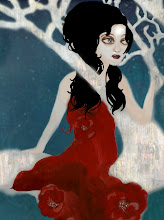
member of:Observers of the Interdependence of Domestic Objects and Their Influence on Everyday Life


This group has been active for a long time and has already made some remarkable assertions which render life simpler from the practical point of view. For example, I move a pot of green color five centimeters to the right, I push in the thumbtack beside the comb and if Mr. A (another adherent like me) at this moment puts his volume about bee-keeping beside a pattern for cutting out vests, I am sure to meet on the sidewalk of the avenida Madero a woman who intrigues me and whose origin and address I never could have known...
--Remedios Varo


(Slideshow is of Artwork by Remedios Varo)
By believing passionately in something that still does not exist, we create it. The nonexistent is whatever we have not sufficiently desired.
--Franz Kafka

Tuesday, August 4, 2009

Dreams of Hungry Ghosts

Following what appears to be this week's theme of Max Ernst and collage...


"Lost at Sea"


"Bird Woman"


In a 2006 interview with Robert Ayers for the Nancy Hoffman Gallery, which represents her, Colette Calascione was asked:
So how do you actually make a painting like Persephone? Her answer is rather surprising, and reminds me that there are a million ways to create, and it's always up to us to explore and discover a way that opens the path for us:

"The first stage is the drawing, getting the drawing together. That’s always my favorite part, that’s the best. I’m actually not that good at drawing—I trace everything, with no shame. So I generally start with everything on tracing paper. Then I do lots of Xeroxing and enlarging. And then things happen, changes happen, and I get to play around with things. Everything comes together like a collage. Persephone was from a photograph—I love those old erotic photographs—and I had the mask, so it just worked out that way.

Then I draw everything on a white panel with a watercolor pencil. I’ll do that until I get the drawing how I like it. Then I’ll do the various layers. It’s mostly for the flesh that I’ll do all of this, because I have so much flesh in my painting! Over the drawing, I do a coat of Caput Mortem—which is an old-time technique, an earth red—and over that I’ll put three layers of white and a layer of green which neutralizes the red. All that creates an optical gray, a grisaille. Then the color starts happening and that’s the tortuous stuff. That’s the hard part...Because I’m so particular. It has to be perfect. The color has to set a mood, and be just right. I’ll redo a color 10 times sometimes until I get it right."


"Persephone"


--In a different version of Adam and Eve, a much older one, in fact, it is the man, ___, who tricks (willfully) the woman, Persephone, into partaking of forbidden foods, in this case, a pomegranate, though it's interesting to note here that there's a lot of scholarship suggesting that the pomegranate was also the actual forbidden fruit in the Garden of Eden. For the six little seed she absent-mindedly--unaware of the consequences-- nibbles on during the first moments of her captivity, Persephone must from here unto forever spend 6 months out of every year in the Underworld with her captor. And her mother, mourning this, sends the world into winter.

Here, Persephone's mask, a bird swooping downwards, is all she wears, and she seems completely casual, indeed almost bored in her nakedness, as if what had once been terrifying--her abduction to and rape in the underworld--is now just another bit of routine, you know, fall and winter follow spring and summer and then it's back to that constant orgy for 6 months. It's not a bad life, just repetitive. There's no pomegranate here, no symbol of lost innocence, no recollection of lost innocence.


DREAM OF THE HUNGRY GHOST

"That one [Dream of a Hungry Ghost] is my favorite painting. It's based on my favorite Max Ernst collage. I just the loved the image. I had it hanging on my wall for years. That's me in the painting looking like Mary Poppins. Recently I've been painting me a lot. The sculpture on the table is a Picasso drawing. Then look at the wallpaper. The roses are insane. There are five hundred roses in there, and I painted each one in detail, and they are so thick that there are bumps on the surface of the paint. You can feel them. I worked on it for two years. I think it probably looked finished after a year, but I had it here on my studio wall, and though I'd be working on something else, there’d always be some little thing I could do to make it look more illuminated. I really like that, to keep a painting around and I’ll think, "Maybe I could just add a little highlight here," and then it gets this really nice polished look."


(Max Ernst, from "Une Semaine de Bonte")

In 1934, Max Ernst put together a book of collages called Une Semaine de Bonta, ou, Les Sept Elements Cardinaux (A Week of Kindness, or, the Seven Deadly Elements), which I have already written about here, and the entirety of which is available here. Each day of the week envisions one of the seven deadly elements-- -- in several collaged images. "On Tuesday, large or small dragons (sometimes bats or serpents) are almost universally present… Stern, proper-looking women sprout giant sets of wings, serpents appear in the drawing-room and bed-chamber…" Tuesday is La Cour du Dragon, The Dragon's Heart, whose element is fire. Here you have the man with his dragon's wings, passionately embraced, clutched into a kiss, in a Victorian drawing room. Calascione's version adds color, and she paints it as a whole piece, but it still keeps an oddly collaged feel, perhaps because of the incongruence of the images. She also adds angels wings into the petticoats of the woman's dress, strengthening the incongruence and deepening the story: is this an angel, pulling a demon into an embrace? Because she is very clearly in the lead. Calascione also adds the element of fire. The colored squares of the floor hollow out, adding another dimension to the room, and flames leap up from the depths in a circle around them. But they do not touch the couple. From above a key is offered, by a hand from yet another dimension, that enters through a wall. Here is a moment of union, a moment of opportunity. Instead of seeing it as the woman falling into the clutches of a demon (which is still a possibility, once the moment ends, as the flames and the easy access from below remind us), we can see here a demon gaining the key to heaven. It is not clear whether he will accept, but at the moment, anything is possible. That's just my opinion. But in the interview with Robert Ayers, Calascione expressed her hope that viewers would come up with their own interpretations of the images, as she was offering none.


Coincidental Gathering


Here's a mermaid against the background of Hokusai's giant wave, from the Mt. Fuji wood-block series of the Edo Period. I like the effect of lush painting against wood-block style. Note that she's turned some of the ocean spray into bubbles, thus mixing the foreground with the background.


Hokusai's Great Wave.


I first discovered her art here, on ArtOdyssey's blog.


Rapunzil

Monday, August 3, 2009

A Gift

A kind soul on Flickr, Claudio, made a video of my paintings. I am floored and honored, and I post it for your enjoyment here:


The link is here.
Have a beautiful day!

Saturday, August 1, 2009

Mitobiografia

Andrea Barberini is an artist residing in Italy, on the coast of the Adriatic Sea. After discovering the collage book of Max Ernst, Une Semaine du Bonte, he set out to create a book of his own using a similar collage style. He created the background and characters for his tale from images he found in the Encyclopedia of Diderot and D'Alambert from the XVIII century--the first encyclopedia in history. From there, he cut and pasted illustrations "according to my mood and fancy," using anatomy books, history books, and anything else he could find. After several years, he decided that the book should have a text, and he created this fictional "autobiography" with its very surreal flavor. I discovered the book when he made a video of it on YouTube, under the screen name "shivabel." On his page, he has also made available generous selections from several artistic texts, such as the Ernst collage book and also the Codex Seraphinianus (Luigi Serafini), and the Parallel Botany (leo Lionni), setting them to music with great sensitivity. His YouTube Page is thus a great resource.

His Mitobiografia, followed by a translation of the text and some of its images, is here:


"The Mitobiografia is totally imaginary, so please consider every reference to facts or persons, first and foremost my person, as merely casual or arbitrary.

1- In the beginning was the fortuitous meeting, in front of a respectably bourgeois house, between a slime of liquid fire and a naked snail. Never far away was the archetypal sacrifice of the young supplicant.

[The liquid fire and naked snail are sexual symbols, their meeting leading to a birth. This is the recurring cycle of life: birth and sacrifice...]


"In Front of a Respectably Bourgeois House..."

2- The scream of the sacrificed froze the world for the eternity of a moment.

3- Little by little, I felt myself swelling and expanding past what seemed possible, while confused yet tangible presences insufflated me with the breath of life.

4- The shapeless being that I had become was then cheerfully tortured by pitilessly well-intentioned persons; they carefully and attentively used obscure and secret devices about which only they were knowledgeable.


"Pitilessly Well-Intentioned Persons..."

5-My seraphic mother was blissfully unaware of the tragedy of my childhood.


"My Seraphic Mother..."

6- Every morning, at daybreak, my severed head watched its executioner break my body to pieces in a constant, repeated nightmare.

7- The environment in which I grew up came out very soon as a place of perdition, an ambiguous den for degenerates where, behind a mask of respectability, the most vile and vicious persons arranged to meet.

8-One day, i took advantage of the inattention of a guardian and i ran away into the wild, far away from these horrible places.

9-I was welcomed among wild and thoughtful persons. They offered to me a nourishing meal and a contagious joy. For the first time in my life I felt I was happy.

10-But I was discovered and, sadly, I was forced to return to my house. There, I took advantage of the frequent quarrels of my parents to devote myself to obscure trades which allowed me to explore my true nature.

11-Irresponsible and presumptuous friends continually harassed me during the hours i dedicated to study, urging me to think more in line with what would help me attain a respectable job.

12-Anxious and naive, i warmed myself at the flame of Truth burning my fingers and, feigning indifference, i tried to hear the pressing questions of the Cosmic Mother. But, not a word from the silent oracle, nothing but incomprehensible noises.


"At the Flame of Truth"

13-Behind a mask of shadows, I wildly watched the obscene miracle of the temptation.


14-My anguish prevented me from showing to all people the innocence of my crime. Shy and childish, i hid myself in the most secluded places from the faintest hint of another's presence.

15-In these unhealthy paradises, the heavenly wine of ecstasy was ceaselessly distilled, and I drank of it to inebriation, a blissful victim.

16-But as soon as I closed my eyes I could clearly hear the words full of poison pronounced by a female voice. A sad and cruel lament. My head burned.


"My Head Burned"

17-Recovered from the fever, I opened my eyes and I was dazzled by Beauty. Mad with joy, I stripped myself of all decency, and crazy for passion, I was able to take Her away from Her prostrated parents.

18-She was my prisoner, and I showed Her pale and silent face to the few privileged only, stingily.

19-Restless, every day I questioned the mute simulacrum, the black mirror of my desire. And She questioned me.

20-I was satisfied even if I only observed her, happy and playful, in my study.

21- With time, i can only ascribe to a divine gesture the awakening of a new sensuality, more sweet, more delicate, which filled my heart with secret joys. I returned to life.

22-At last, we decided to set off to a long journey. But first we consulted the strange animal of a gipsy child. After hearing the response, we abandoned the last pretense, and we run, full of fear and desire, to the open sea.

23-The phantom of paternity was already waiting in my future's dreams..."


THE END


Recently, his sister visited some caves in Italy and took many magical photos, showing a natural landscape that could easily have influenced Max Ernst's famous "frottage" style, most clearly seen in "Europe After the Rain," and "The Eye of Silence." The video of those photos, set to music by Diamanda Galas, is here:


Max Ernst, "The Eye of Silence":